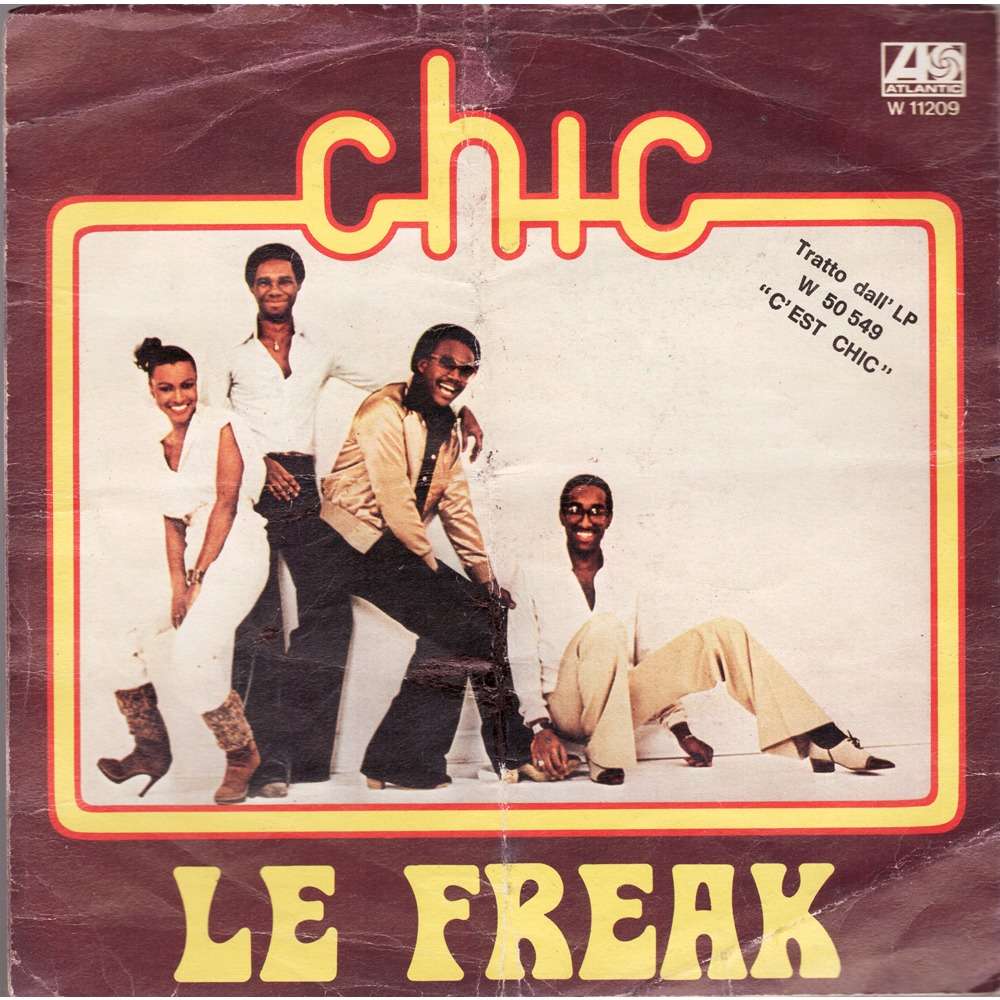
Ah Freak out! Dance music is usually not my thing but Nile Rodgers guitar groove on this song is fantastic. It’s also a great memory of 5th grade for me.
Rodgers and Edwards wrote this after they were denied admission to a nightclub, even though their song “Dance, Dance, Dance (Yowsah, Yowsah, Yowsah)” often played inside.
It was New Year’s Eve, 1977, and they were invited to Studio 54, a very popular club in New York City where many celebrities and trendsetters were known to hang out. A singer named Grace Jones wanted Nile Rodgers (guitarist) and Bernard Edwards (Bass Player) to do some production work for her and asked them to come down to the club as her guest.
When they got there, they were not on the list, and couldn’t convince the doorman that they were the group Chic. All dressed up and nowhere to go on New Year’s Eve, they left and started writing this song as a reply to the doorman. They called it “F–k Off,” but when they decided to record it, Edwards wasn’t comfortable with the cursing, so they tried it as “Freak Off.” That title sounded lame, but when they made the opening lines “aaaahh Freak Out!” instead of “aaaahh F–k Off!”, they came up with a better title: “La Freak.”
The song peaked at #1 in the Billboard 100 in 1978. This was #1 in the US for six weeks. After a while, they stopped distributing it as a single to encourage people to buy the album.
From Songfacts
Chic was a group led by bass player Bernard Edwards and guitarist Nile Rodgers. Both were very successful writers and producers, combining to work on hits for Sister Sledge and Diana Ross. Edwards went on to produce for The Power Station, Joe Cocker, and Robert Palmer, while Rodgers has worked with Mick Jagger, David Bowie, and Madonna. Edwards died of pneumonia in 1996.
They ended up not working for Grace Jones, although Rodgers produced her comeback album in 1986.
Studio 54 is mentioned in the last verse: “Come on down to 54.” A year after Rodgers and Edwards couldn’t get into the club, this was included on an album of dance songs called A Night At Studio 54. They had no trouble getting in at this point.
“C’est Chic” (which was not just the name of the album but also part of the lyrics to the song) is French for “It is Chic.”
This is the best selling single of all time for Atlantic Records with 13 million sales, including 2 million in the USA.
This was the first single to be displaced from the US # 1 twice, each time regaining the top position. It first hit the top spot in December 1978, then dropped to #2 for a week to make way for “You Don’t Bring Me Flowers.” After reassuming the #1 position for a second week, it then dropped to #2 again for two more weeks, this time to make way for the Bee Gees’ hit “Too Much Heaven.” In January 1979, “Le Freak” then moved back into the #1 spot for a third time, holding down the top spot for four more weeks.
This song returned, remixed, to the UK Top 20 in 1987 as “Jack le Freak.”
Nile Rodgers told Billboard that the song “was our homage to a Chubby Checker song called the ‘Peppermint Twist.'”
Nile Rogers told the Big Issue that he knew “Le Freak” was going to be a monster record even though the record company hated the song. He recalled:
“By the time the song ended, after about seven and a half minutes, we’d cleared the conference room. We were just sitting there by ourselves – myself, Bernard Edwards and our attorney. Everybody else was outside trying to figure out how to tell us how much the song sucked, and wondering did we have anything else on the album that was better.”
Le Freak
Ah Freak out! Le Freak, see’est Chic Freak out! Ah Freak out! Le Freak, see’est Chic Freak out! Ah Freak out! Le Freak, see’est Chic Freak out! Ah Freak out! Le Freak, see’est Chic Freak out!
Have you heard about the new dance craze? Listen to us, I’m sure you’ll be amazed Big fun to be had by everyone It’s up to you, It surely can be done Young and old are doing it, I’m told Just one try, and you too will be sold It’s called Le Freak! They’re doing it night and day Allow us, we’ll show you the way
[Chorus]
All that pressure got you down Has your head spinning all around Feel the rhythm, check the ride Come on along and have a real good time Like the days of stopping at the Savoy Now we freak, oh what a joy Just come on down, two fifty four Find a spot out on the floor
[Chorus]
Now Freak! I said Freak! Now Freak!
All that pressure got you down Has your head spinning all around Feel the rhythm, check the ride Come on along and have a real good time Like the days of stopping at the Savoy Now we freak, oh what a joy Just come on down, two fifty four Find a spot out on the floor
This is one of my favorite songs from Led Zeppelin. I think it’s one of their best if not their best. It was on the Physical Graffiti Album released in 1975. The song did not chart but is hugely popular on the radio.
The song is hypnotic to listen to. The drums are the key to this song… Jimmy Page has said this about John Bonham on Kashmir… It was what he didn’t do that made it work.
Jimmy also said this was the best Led Zeppelin guitar riff.
Kashmir, also known as Cashmere, is a lush mountain region North of Pakistan. India and Pakistan have disputed control of the area for years. The fabric Cashmere is made from the hair of goats from the region. The area is also famous for growing poppies, from which heroin is made.
The songwriters were John Bonham, Jimmy Page, and Robert Plant.
Robert Plant – Plant explained: “‘Kashmir’ came from a trip Jimmy and me made down the Moroccan Atlantic coast, from Agadir down to Sidi Ifni. We were just the same as the other hippies really.”
From Songfacts
All band members agreed this was one of their best musical achievements. Robert Plant said it was “One of my favorites… it was so positive, lyrically.”
Plant wrote the lyrics in 1973 while driving through the Sahara Desert on the way to the National Festival of folklore in Morocco. Kashmir is in Southern Asia; he was nowhere near it. In Mojo magazine, September 2010,
The original title was “Driving To Kashmir.”
This runs 8:31. Radio stations had no problem playing it, especially after “Stairway To Heaven,” which was almost as long, did so well.
The signature guitar riff began as a tuning cycle Jimmy Page had been using for years.
This is one of the few Zeppelin songs to use outside musicians. Session players were brought in for the string and horn sections. Jimmy Page said (Rolling Stone, 2012): “I knew that this wasn’t just something guitar-based. All of the guitar parts would be on there. But the orchestra needed to sit there, reflecting those other parts, doing what the guitars were but with the colors of a symphony.”
Speaking with Dan Rather in 2018, Robert Plant said: “It was a great achievement to take such a monstrously dramatic musical piece and find a lyric that was ambiguous enough, and a delivery that was not over-pumped. It was almost the antithesis of the music, this lyric and this vocal delivery that was just about enough to get in there.”
Led Zeppelin played this in every live show from it’s debut in 1975 to their last concert in 1980.
Page and Plant recorded this with an orchestra and Moroccan musicians for their 1994 Unledded album.
Puff Daddy (he wasn’t Diddy yet) sampled this in 1998 for a song called “Come With Me.” He performed it on Saturday Night Live with Page on guitar.
The remaining members of Led Zeppelin performed this at the Atlantic Records 40th-anniversary party in 1988 with Jason Bonham on drums. It was a mess – the keyboards got lost in the feed and Plant was bumped by a fan and forgot some of the words. They had more success when they performed the song on December 10, 2007, at a benefit show to raise money for the Ahmet Ertegun education fund.
In the movie Fast Times At Ridgemont High, Mike Damone tells Mark Ratner, “When it comes down to making out, whenever possible, put on side one of Led Zeppelin 4. In the next scene, he is on the date with this song playing in the car. Cameron Crowe, who wrote the screenplay, couldn’t get the rights to any of the songs on Led Zeppelin 4, so he used “Kashmir” instead. Crowe used Zeppelin’s “That’s The Way” on his 2001 movie Almost Famous.
Plant said in an audio documentary that he loved this song not only because of its intensity but also because it was so intense without being considered “heavy metal,” a label none of the band liked.
Jimmy Page: “The intensity of ‘Kashmir’ was such that when we had it completed, we knew there was something really hypnotic to it, we couldn’t even describe such a quality. At the beginning, there was only Bonzo [drummer John Bonham] and me in Headley Grange. He played the rhythm on drums, and I found the riff as well as the overdubs which were thereafter duplicated by an orchestra, to bring more life to the track. It sounded so frightening at first…”
Zeppelin’s manager Peter Grant said: “I remember Bonzo having me listen to the demo of ‘Kashmir’ with only him and Jimmy. It was fantastic. What’s funny is that after a first recording of the song, we found it sounded a bit like a dirge. We were in Paris, we had Atlantic listen to it, and we all thought it really sounded like a dirge. So Richard (Cole) was sent to Southall in London to find a Pakistanese orchestra. Jonesy put it all together and the final result was exactly what was needed. He was an exceptional arranger.”
“Kashmir” makes the “songs performed at the Super Bowl” list because a few seconds of it played during Shakira’s set when she performed at halftime in the matchup between the Kansas City Chiefs and San Francisco 49ers in 2020.
Kashmir
Oh, let the sun beat down upon my face And stars to fill my dream I’m a traveler of both time and space To be where I have been To sit with elders of the gentle race This world has seldom seen They talk of days for which they sit and wait All will be revealed
Talk in song from tongues of lilting grace Sounds caress my ear And not a word I heard could I relate The story was quite clear
Oh, oh Oh, oh
Oh, oh baby, I been flying No yeah, mama, there ain’t no denying Oh, oh yeah I’ve been flying Mama, mama, ain’t no denying, no denying
All I see turns to brown As the sun burns the ground And my eyes fill with sand As I scan this wasted land Trying to find, trying to find, where I’ve been
Oh, pilot of the storm who leaves no trace Like thoughts inside a dream Heed the path that led me to that place Yellow desert stream Like Shangri-la beneath the summer moon I will return again Sure as the dust that floats high in June When moving through Kashmir
Oh, father of the four winds fill my sails Across the sea of years With no provision but an open face Along the straits of fear
Oh, oh Oh, oh
Oh, when I’m on, when I’m on my way, yeah When I see, when I see the way, you stay yeah
Oh, yeah-yeah, oh, yeah-yeah, when I’m down Oh, yeah-yeah, oh, yeah-yeah, but I’m down, so down Oh, my baby, oh, my baby, let me take you there Come on, come on, oh, let me take you there, let me take you there
This is one of the songs that got me into ELO. I always thought Jeff Lynne was singing “Bruuucee” in this song but he wasn’t. Jeff Lynne repeatedly sings the word “gruss” after the song’s title line? Apparently, it was a made-up place-keeper word to fill a gap in the vocals when he was improvising the lyrics.
When the German engineer Reinhold Mack heard the ELO frontman’s demo he asked Lynne how he knew “Gruss” means “greetings” in his country’s language. Upon learning the German meaning, Lynne decided to leave it in. Many fans misinterpreted “gruss” as “Bruce.” In fact, so many people misheard the lyric that Lynne actually began to sing the word as “Bruce” for fun at live shows.
The song peaked at #4 in the Billboard 100, #3 in the UK, #1 in Canada, and #6 in New Zealand in 1979. The song was on the Discovery album which peaked at #5 in the Billboard Album Chart in 1979.
From Songfacts
This was the first ELO song that did not use strings. After recording it, they fired their string section, leaving four members in the band.
This is the highest-charting ELO hit in both the UK and US, although ELO’s “Xanadu” collaboration with Olivia Newton-John did hit #1 UK.
ELO leader Jeff Lynne wrote this song late in the sessions for the Discovery album. He came up with the track by looping the drums from a song he recorded earlier in the session, then coming up with more music on the piano. The words came last, as Lynne put together some lyrics about a girl who thinks she’s too good for the guy she’s with.
As a little joke, Lynne put a count-in at the beginning of the song, even though there was nobody he was counting in.
This turned out to be a good theme song for astronauts enjoying their time in space. The song was played to astronauts on the Space Shuttle Columbia as their wake up call on July 6, 1996 – they were in flight longer than expected because of bad weather on the ground. ELO’s record company also tried to tie in the song with the Skylab space station, which crashed to Earth on July 11, 1979 after six years in space. They placed ads in trade magazines promoting the new single “Don’t Bring Me Down” by dedicating it to Skylab.
This appears in the 2006 Doctor Who episode “Love & Monsters,” and in the 2012 Family Guy episode “Jesus, Mary, and Joseph!” It has also been used in these films:
I Can Only Imagine (2018) Super 8 (2011) College Road Trip (2008) The In-Laws (2003) Donnie Brasco (1997)
In 2020, this was used in a Peloton commercial where a dad tries to stay motivated using the fitness bike. It was also used in the trailer for the 2017 film The Emoji Movie.
Don’t Bring Me Down
You got me runnin’ goin’ out of my mind You got me thinkin’ that I’m wastin’ my time (Don’t bring me down, no no no no no) I’ll tell you once more before I get off the floor (Don’t bring me down)
You wanna stay out with your fancy friends I’m tellin’ you it’s got to be the end (Don’t bring me down, no no no no no) I’ll tell you once more before I get off the floor (Don’t bring me down)
Don’t bring me down, gruss Don’t bring me down, gruss Don’t bring me down, gruss Don’t bring me down
What happened to the girl I used to know? You let your mind out somewhere down the road (Don’t bring me down, no no no no no) I’ll tell you once more before I get off the floor (Don’t bring me down)
You’re always talkin’ ’bout your crazy nights One of these days you’re gonna get it right (Don’t bring me down, no no no no no no no) I’ll tell you once more before I get off the floor (Don’t bring me down)
Don’t bring me down, gruss Don’t bring me down, gruss Don’t bring me down, gruss Don’t bring me down
You’re lookin’ good just like a snake in the grass One of these days you’re gonna break your glass (Don’t bring me down, no no no no no no no) I’ll tell you once more before I get off the floor (Don’t bring me down)
You got me shakin’ got me runnin’ away You got me crawlin’ up to you everyday (Don’t bring me down, no no no no no) I’ll tell you once more before I get off the floor (Don’t bring me down)
I’ll tell you once more before I get off the floor (Don’t bring me down)
A guitar-powered anthem if I ever heard one. Great title track of the Clash’s greatest album London Calling.
Authorship of this song was credited to Joe Strummer and Mick Jones, but at some point, the other two members of the band, Paul Simonon and Topper Headon were added.
The title came from the BBC World Service’s radio station identification: “This is London calling…” The BBC used it during World War II to open its broadcasts outside of England. Joe Strummer heard it when he was living in Germany with his parents.
According to guitarist Mick Jones, it was a headline in the London Evening Standard that triggered the lyric. The paper warned that “the North Sea might rise and push up the Thames, flooding the city,” he said in the book Anatomy of a Song. “We flipped. To us, the headline was just another example of how everything was coming undone.”
The song peaked at #11 in the UK in 1979
The Clash wrote this song in 1979 on their first US tour, then recorded it after returning to England.
From Songfacts
This is an apocalyptic song, detailing the many ways the world could end, including the coming of the ice age, starvation, and war. It was the song that best defined The Clash, who were known for lashing out against injustice and rebelling against the establishment, which is pretty much what punk rock was all about.
Joe Strummer explained in 1988 to Melody Maker: “I read about 10 news reports in one day calling down all variety of plagues on us.”
Singer Joe Strummer was a news junkie, and many of the images of doom in the lyrics came from news reports he read. Strummer claimed the initial inspiration came in a conversation he had with his then-fiancee Gaby Salter in a taxi ride home to their flat in World’s End (appropriately). “There was a lot of Cold War nonsense going on, and we knew that London was susceptible to flooding. She told me to write something about that,” noted Strummer in an interview with Uncut magazine.
The line “London is drowning and I live by the river” came from a saying in England that if the Thames river ever flooded, all of London would be underwater. Joe Strummer was living by the river, but in a high-rise apartment, so he would have been OK.
The line about the “a nuclear era, but I have no fear” was inspired by the Three Mile Island nuclear reactor meltdown in March 1979. This incident is also referred to in the lyrics to “Clampdown” from the same album.
The band was intrigued by American music as well as its rock’n’roll mythology, so much so that the album cover was a tribute to Elvis Presley’s first album.
This was recorded at Wessex Studios, located in a former church in the Highbury district of North London. Many hit recordings had already come out of this studio, including singles and albums by the Sex Pistols, The Pretenders and the Tom Robinson Band. Chief engineer and studio manager Bill Price had developed a slew of unique recording techniques suited to the room.
Fellow punk band The Damned were recording overdubs to their album Machine Gun Etiquette in the studio, and as they were old touring buddies of The Clash they roped Strummer and Mick Jones into record backing vocals for the title song to their album – the shouted lines of “second time around!” in that song are actually Strummer and Jones in uncredited cameos.
Interestingly, the band initially wrote most of the London Calling album at the Vanilla rehearsal studios near Vauxhall Bridge in London. Roadie Johnny Green explained: “It had the advantage of not looking like a studio. Out front of a garage. We wrote a sign out front saying ‘we ain’t here.’ We weren’t disturbed.”
With a great vibe going in the studio and having already recorded some demos with The Who’s soundman Bob Pridden, Strummer had the crazy idea to record the entire album there and bypass expensive studio time. CBS refused point blank, so Wessex was chosen because it had a similar intimacy to Vanilla. The original Vanilla demos were made available on the 25th anniversary edition of London Calling.
At the end of the song, a series of beeps spells out “SOS” in morse code. Mick Jones created these sounds on one of his guitar pickups.
The SOS distress signal has often been used metaphorically in songs (like the 1975 Abba song), but in “London Calling” it’s more literal, implying that the disaster has struck and we are calling for help.
London Calling was a double album, but it wasn’t supposed to be. The band were angry that CBS had priced their previous EP, The Cost of Living at £1.49, and so in the interests of their fans they insisted that London Calling be a double LP. CBS refused, so the band tried a different tactic: how about a free single on a one-disc LP? CBS agreed, but didn’t notice that this free single disc would play at 33rpm and contain eight songs – therefore making it up to a double album! It then became nine when “Train in Vain” was tacked on to the end of the album after an NME single release fell through. “Train” arrived so late on that it isn’t on the tracklisting on the album sleeve, and the only evidence of its existence is a stamp on the run-out groove and its presence on the end of side four. So in the end, London Calling was a 19-song double-LP retailing for the price of a single!
Rolling Stone magazine named London Calling the best album of the ’80s. Pedantic readers noted that it was first released in the UK in December 1979. In the US it was released two weeks into January 1980, meaning that from a US perspective, it’s a 1980s album. And if anyone can come up with a better alternative to best album of the ’80s, Rolling Stone would love to hear from you!
According to NME magazine (March 16, 1991), we know that Paul Simonon smashed his bass guitar – as photographed on the cover of the album – at exactly 10:50 pm. This is because he broke his watch in the process and handed the busted bits to photographer Pennie Smith, who snapped the photo.
Smith thought the photo wouldn’t be good for an album cover, citing that it was too blurry and out of focus. “I was wrong!” she admitted in the Westway to the World documentary!
As a tribute to Clash singer/guitarist Joe Strummer, who died in 2002, Bruce Springsteen, Dave Grohl, Elvis Costello and Little Steven Van Zant played this at the close of the 2003 Grammys as a tribute to the band. All four played guitar and took turns on vocals. The Grammys is the type of commercialized event The Clash probably would have avoided, although they did win their first Grammy that night when “Westway To The World” won for Best Long Form Music Video.
In 2003, The Clash were inducted into the Rock and Roll Hall of Fame, and it was rumored that Bruce Springsteen would join them to perform at the ceremony. The classic lineup of Strummer/Jones/Simonon/Headon were in talks to reunite to perform at the ceremony and play on stage for the first time since 1982, but Simonon was always against a reunion. In the end, Strummer’s death in December 2002 put paid to the reunion of the original lineup, and the remaining members declined to play. Said Simonon: “I think it’s better for The Clash to play in front of their public, rather than a seated and booted audience.”
According to Mick Jones, his guitar solo was played back backwards (done by flipping over the tape) and overdubbed onto the track.
This is one of the most popular Clash songs, and has been used in many commercials and soundtracks. It was used in promos counting down the 2012 Summer Olympics in London, as well as the film soundtracks for Intimacy (2001), Billy Elliot (2000), Atomic Blonde (2017) and the James Bond movie Die Another Day (2002).
The lyrics contain an observation about how society often turns to pop music to make them feel better about world events, and how The Clash didn’t want to become false idols for folks looking for escapism. This can be heard in the line, “Don’t look to us – phoney Beatlemania (a reference to The Beatles’ massive fanbase in the ’60s) has bitten the dust!” (Mick Jones said the line was “aimed at the touristy soundalike rock bands in London in the late ’70s.)
There’s also a subtle reference to Joe Strummer’s brush with Hepatitis in 1978 with the mention of “yellowy eyes.”
A check of the archives reveals that this song – hailed by many music journalists as a monumental track – received far from unanimous praise from critics when it was released. David Hepworth in Smash Hits criticized the band for playing too loud in the studio. “Why won’t Joe Strummer let us hear more than one word in every three? Until they face those elementary facts, sides like ‘London Calling’ will always fail to condense all that fury and grandeur into a truly great record,” he wrote.
The sales figures and continuing popularity of the song suggest that not many other people had the same problem!
The video was filmed at Cadogan Pier, next to the Albert Bridge in Battersea Park in London. It was directed by longtime friend of the band Don Letts, and made on a wet night in December 1979 which sees the band performing on a barge. Letts didn’t have a happy time doing the video. He explained:
“Now me, I am a land-lover, I can’t swim. Don Letts does not know that the Thames has a tide. So we put the cameras in a boat, low tide, the cameras are 15 feet too low. I didn’t realize that rivers flow, so I thought the camera would be bouncing up and down nicely in front of the pier. But no, the camera keeps drifting away from the bank. Then it starts to rain. I am a bit out of my depth here, but I’m going with it and The Clash are doing their thing. The group doing their thing was all it needed to be a great video. That is a good example of us turning adversity to our advantage.”
Joe Strummer does some ominous echoed cackling about two minutes into this song. He was essentially imitating a seagull, as heard on the Otis Redding song “(Sittin’ On) The Dock of the Bay.”
Many cover versions of this song have been recorded, including variants by One King Down, Stroh, and the NC Thirteens. Bob Dylan covered the song during his 2005 London residency, and Bruce Springsteen has followed up from his performance of the song at the 2003 Grammys by performing it at some of his concerts, including on his 2009 London Calling: Live in Hyde Park DVD, which is named after the song.
In late 1991, the Irish folk-punk band The Pogues sacked lead singer Shane MacGowan just at the height of their fame. Joe Strummer, by now well split up from The Clash, agreed to take over on vocals for a couple of years until he departed in 1993 on good terms – he didn’t want to be the permanent replacement for MacGowan and wanted to do his own thing. During his time with the Pogues, the band would often play a searing version of “London Calling” at live shows. Like many strong Clash songs, Strummer took it with him to play with his solo band the Mescaleros in the late 1990s.
This was featured in the October 13, 2013 Funny Or Die episode, where a costumed Fred Armisen interviewed the real Mick Jones and Paul Simonon.
This was featured in the 1998 Friends episode “The One with Ross’s Wedding: Part 1,” when the gang arrives in London for Ross and Emily’s nuptials.
London Calling
London calling to the faraway towns Now war is declared and battle come down London calling to the underworld Come out of the cupboard, you boys and girls London calling, now don’t look to us Phony Beatlemania has bitten the dust London calling, see we ain’t got no swing Except for the ring of that truncheon thing
The ice age is coming, the sun is zooming in Meltdown expected, the wheat is growin’ thin Engines stop running, but I have no fear ‘Cause London is drowning, and I, I live by the river
London calling to the imitation zone Forget it, brother, you can go it alone London calling to the zombies of death Quit holding out and draw another breath London calling and I don’t want to shout But when we were talking I saw you nodding out London calling, see we ain’t got no high Except for that one with the yellowy eye
The ice age is coming, the sun is zooming in Engines stop running, the wheat is growin’ thin A nuclear era, but I have no fear ‘Cause London is drowning, and I, I live by the river
The ice age is coming, the sun is zooming in Engines stop running, the wheat is growin’ thin A nuclear era, but I have no fear ‘Cause London is drowning, and I, I live by the river
Now get this
London calling, yes, I was there, too And you know what they said? Well, some of it was true! London calling at the top of the dial And after all this, won’t you give me a smile?
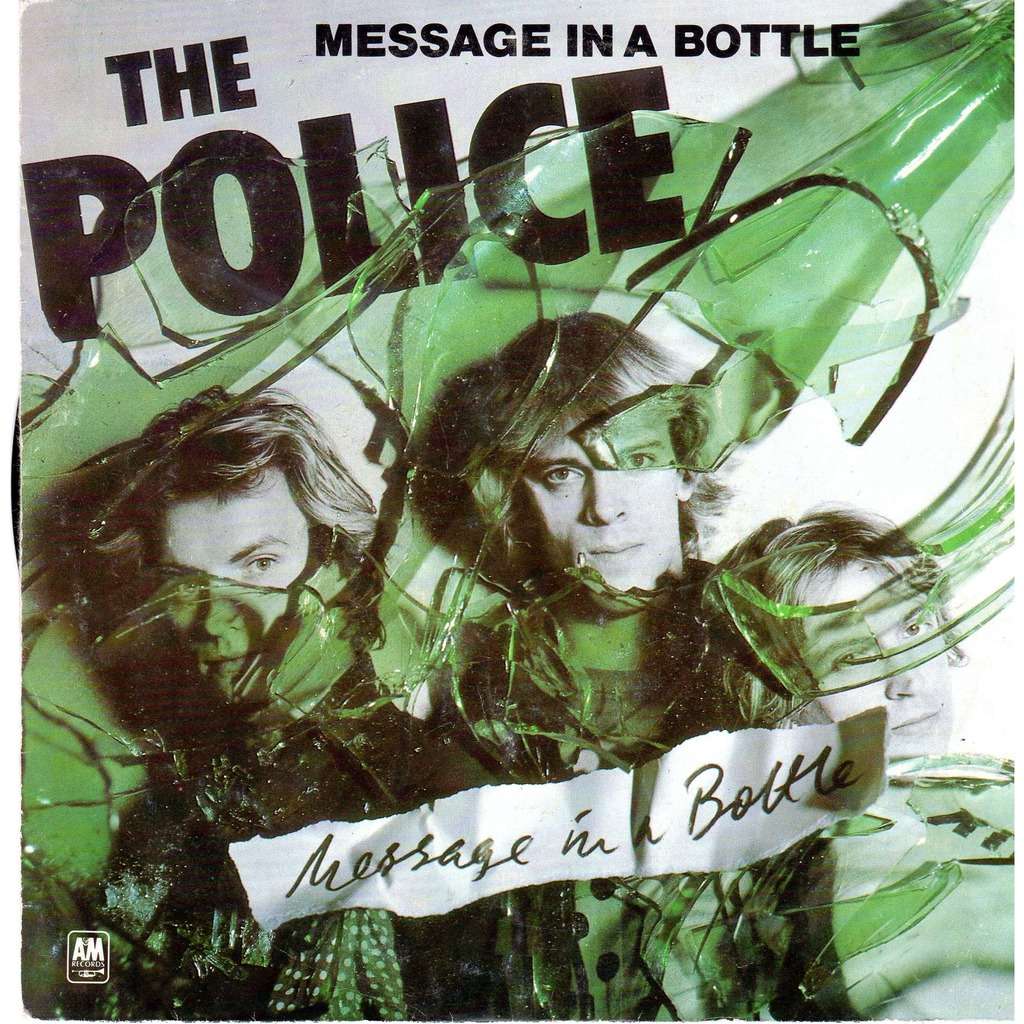
It’s one of those songs that I would have bet charted higher in the US than it did. In America, “Message In A Bottle” was just a minor hit, peaking at #74 in the Billboard 100 in 1979. It wasn’t until their third album, Zenyatta Mondatta, released in 1980, that the group got much attention in the US.
The song peaked at #1 in the UK, #2 in Canada, and #11 in New Zealand.
Sting:“I used to sing Gregorian chants and plainsong as an altar boy. A lot of my melodies might reflect that love and my early exposure to that stark, melodic narrative. ‘Message In A Bottle’ reflects that, too.”
“I think the lyrics are subtle and well crafted enough to hit people on a different level from something you just sing along to. It’s quite a cleverly put together metaphor. It develops and has an artistic shape to it.”
From Songfacts
This song is about a guy stranded on a remote island. One day he finds a bottle, puts a message in it and throws it out to sea in hopes that someone will find it and come save him. He’s thrilled to wake up one morning and find a whole bunch (a hundred billion, by his count) of bottles on the shore, proving there are many other castaways just like him. The lyrics can be seen as a metaphor for being lonely and realizing there are lots of people just like you. >>
Guitarist Andy Summers said it was the best track he ever played on.
Until they were inducted into the Rock and Roll Hall of Fame, this was the last song The Police played together; after breaking up in 1986, they performed it at Sting’s wedding to Trudie Styler in 1992. Sting, Stewart Copeland, and Andy Summers were all a little drunk and didn’t play it very well, but the guests loved it. In 2003, The Police got together again for the induction ceremonies, where they played this along with “Roxanne” and “Every Breath You Take.”
This was the first single from the second Police album, Reggatta De Blanc (which means “White Reggae” in Police-speak). In the UK, their first album, Outlandos d’Amour, was released a year earlier but was still being discovered. “Roxanne” and “Can’t Stand Losing You” had charted, but the band was still bubbling under. “Message In A Bottle” was when they exploded in Britain; the song went to #1 on September 29, 1979 and stayed for three weeks. Their next single, “Walking On The Moon,” also went to the top. At this point, “So Lonely,” a track from their first album that flopped when it was issued as a single, was re-released, reaching #6 in March 1980.
Sting wrote in Lyrics By Sting: “I was pleased that I’d managed a narrative song with a beginning, a middle, and some kind of philosophical resolution in the final verse. If I’d been a more sophisticated songwriter, I would have probably illuminated this change of mood by modulating the third verse into a different key. But it worked anyway.”
This song is “Hey Jude”-like in its outro, with the phrase “sending out an SOS” repeated over and over for over a minute as it slowly fades. We counted 25 repetitions of the phrase.
Drummer Stewart Copeland overdubbed some cymbals and snare on top of this section, which he later came to regret. “I just overdid it,” he told Songfacts. “Where was Andy [Summers] when we needed him? Because usually it was Andy who was the limiter of our indulgence. He must have stepped out of the studio.”
The first person to hear the guitar riff for this song was not a person at all, but Sting’s dog. “I used to play it over and over again to my dog in our basement flat in Bayswater,” Sting wrote in Lyrics By Sting, “and he would stare at me with that look of hopeless resignation dogs can have when they’re waiting for their walk in the park. Was it that hopeless look that provoked the idea of the island castaway and his bottle? I don’t know, but the song sounded like a hit the first time we played it. The dog finally got his walk, and this song was our first number-one in the UK.”
This was the first-ever UK #1 for the A&M label, which Herb Alpert and Jerry Moss founded in 1962.
This might be the most famous song where a singer sends out an SOS distress signal, but it’s certainly not the only one. The Clash did it in “London Calling,” and many groups have done it metaphorically to signify love gone wrong.
Sting performed this at an Amnesty International benefit in 1981 that was used in a film released the following year called The Secret Policeman’s Other Ball.
This was one of the most popular live songs for the band, played at just about every concert after it was released, often as the set opener. Sting continued to perform it as a solo artist, including at his set at Live Aid in 1985.
After MTV launched in 1981, The Police made some high-concept, big-budget videos that were huge on the network. Prior to that, their videos were more restrained. The “Message in a Bottle” video combines concert footage with shots of the band performing it in some kind of backstage area. It was directed by Derek Burbidge.
Sting performed this with No Doubt at halftime of the 2003 Super Bowl between the Bucs and Raiders. No Doubt lead singer Gwen Stefani came out and sang with him about midway through. Stefani inducted Police into the Rock and Roll Hall of Fame later that year.
It may surprise you to learn that the song was influenced by the church music that Sting used to sing as a child. He explained in Isle of Noises by Daniel Rachel: isode “Fallen Angel”; in Doctors, in the 2011 episode “Message in a Bottle”; and in The Office (US), in the 2007 episode “Phyllis’ Wedding.”
The Police boxed set is called Message In A Box as a reference to this song.
The industrial metal band Machinehead covered this on their 1999 album The Burning Red >>
There is a 1999 film by the same name starring Kevin Costner, Robin Wright Penn, and Paul Newman that is not directly connected to this song. >>
In 2003, this song got the post-punk treatment when American Hi-Fi covered it for the film Rugrats Go Wild.
Message In A Bottle
Just a cast away an island lost at sea-o Another lonely day, no one here but me-o More loneliness than any man could bear Rescue me before I fall into despair-o
I’ll send an S.O.S. to the world I’ll send an S.O.S. to the world I hope that someone gets my I hope that someone gets my I hope that someone gets my message in a bottle yeah Message in a bottle yeah
A year has passed since I wrote my note But I should have known this right from the start Only hope can keep me together Love can mend your life but love can break your heart
I’ll send an S.O.S. to the world I’ll send an S.O.S. to the world I hope that someone gets my I hope that someone gets my I hope that someone gets my message in a bottle yeah Message in a bottle yeah Oh message in a bottle yeah Message in a bottle yeah
Walked out this morning I don’t believe what I saw A hundred billion bottles washed up on the shore Seems I’m not alone in being alone A hundred billion castaways looking for a home
I’ll send an S.O.S. to the world I’ll send an S.O.S. to the world I hope that someone gets my I hope that someone gets my I hope that someone gets my message in a bottle yeah Message in a bottle yeah Message in a bottle whoa Message in a bottle yeah
Sending out an S.O.S. Sending out an S.O.S. I’m sending out an S.O.S. I’m sending out an S.O.S. Sending out an S.O.S. Sending out an S.O.S. Sending out an S.O.S. Sending out an S.O.S. Sending out an S.O.S. Sending out an S.O.S. Sending out an S.O.S. Sending out an S.O.S. Sending out an S.O.S. Sending out an S.O.S. Sending out an S.O.S. Sending out an S.O.S. Sending out an S.O.S. Sending out an S.O.S. Sending out an S.O.S. Sending out an S.O.S. Sending out an S.O.S. Sending out an S.O.S. Sending out an S.O.S. Sending out an S.O.S. Sending out an S.O.S.
I’ve heard this one a lot but I still love that simple bass line that drives the song. They did manage to get 8 songs in the Billboard 100 but with only two top twenty hits. Radar Love is a great driving song.
This song peaked at #13 in the Billboard 100 and #7 in the UK in 1973.
Golden Earring was founded 1961 and into the ’00s was still playing with the same lineup since 1970, doing 100+ shows a year in The Netherlands, Belgium, and Germany. The group is from The Netherlands, where this was a #1 hit. They had only one other hit. It didn’t come until 1982, with “Twilight Zone.”
To celebrate the fiftieth anniversary of the band, Golden Earring recorded a new track in October 2019, titled “Say When”
The time signatures to this song are quite different than your normal songs. I found this about it…so Jeremy if you are reading…you might be interested.
The song is all in 4/4 time, and the original tempo is around 100 BPM. It’s a very clever arrangement: the intro is on the beat of each bar at the start. The shuffle on the snare is semi triplets which give the illusion of the song speeding up. You have to quantize drum machines to a 6th beat. Consequently, the chorus is doubled up to give the impression that the tempo has speeded up to 200 BPM. You have to transpose the 4/4 bar so it can be played with in 1 beat of the bar. It does take a bit of lateral thinking to get your head around the math, but the song is all 4/4 at 100 BPM.
From Songfacts
Before you could send a text message or call someone in their car, there was no way to communicate to a driver – unless you had a certain telepathic love that could convey from a distance your desire to be with that person, something you might call – Radar Love. In this song, the guy has been driving all night, but keeps pushing the pedal because he just knows that his baby wants him home.
Like many of Golden Earring’s songs, this began with the title and grew from there. Originally intended only as an album track, it turned out to be the only cut on their US debut album Moontan that they could whittle down to a single for radio. It became their showstopper at concerts, and provided a striking moment for their drummer Cesar Zuiderwijk, who would take a few steps back and leap at the drum kit near the end of the song.
This song is featured in the movie Detroit Rock City, about four teenage boys and their struggle to finally see the band KISS play live.
The website http://www.radar-love.net details lots of info on the use and abuse of this song. It has been covered over 250 times: Notable versions include Bryan Adams, U2, Crowded House, Def Leppard, R.E.M. and Carlos Santana. It has also been used in TV shows The Simpsons, The X-Files, Beverly Hills, 90210 and My Name Is Earl. Movie usages include The Break-Up, Pushing Tin and Wayne’s World 2.
White Lion had a minor hit with their cover of this in 1989.
UK radio station Planet Rock carried out a survey of their listeners in 2011 regarding their favourite tracks for in-car listening. This song came out top with Deep Purple’s “Highway Star” the runner-up and AC/DC’s “Highway To Hell” in third place.
The line, “The radio’s playing some forgotten song, Brenda Lee’s coming on strong” is a reference to the 1966 Brenda Lee song “Coming On Strong,” which made #11 US.
Radar Love
I’ve been drivin’ all night, my hands are wet on the wheel There’s a voice in my head that drives my heel My baby call said I need you here It’s half past four and I’m shifting gears
When she gets lonely and the longing gets too much She sends a cable coming in from above Don’t need a phone at all We got a thing that’s called radar love We got a wave in the air Radar love
The radio’s playin’ some forgotten song Revelry’s coming on strong The road has got me hypnotized As I spin into a new sunrise
When I get lonely and I’m sure I’ve had enough She sends comfort coming in from above Don’t need no letters at all We got a thing that’s called radar love We got a line in the sky
No more speed I’m almost there Gotta keep cool, now, gotta take care Last car to pass, here I go The line of cars drove down real slow The radio plays that forgotten song Brenda Lee’s coming on strong The news man sang his same song One more radar lover gone
When I’m feeling lonely and I’m sure I’ve had enough She sends the comfort coming in from above Don’t need no radio at all We got a thing that’s called radar love We got a light in the sky We got a thing and its called radar love We got a thing that’s called Radar love
These are my favorite guitar solos. Some of these solos are intricate but some are pretty simple. I picked ones out that I have always liked. Some of them are not considered great but I always thought they were memorable. They caught my ear for one reason or another.
1. Cream – Crossroads – A live solo by Eric Clapton. He pulls notes out of the air and turns this cover of the Robert Johnson song into a great rock track.
2. Beatles – While My Guitar Gently Weeps – One of the few times someone else played on a Beatles track. This was Eric Clapton playing this solo. Eric played his guitar through a Leslie cabinet to make it more “Beatlely”
3. Jimi Hendrix – All Along The Watchtower – Jimi made this Bob Dylan song into his own.
4. Dire Straits – Sultans of Swing – I can hum this one all the way through. I know it better than the lyrics.
5. Elvis Presley – That’s Alright Mama – Scotty Moore nails this solo. It’s very simple but it’s perfect.
6. The Rolling Stones – Sympathy For The Devil – Keith’s solo compliments the song perfectly.
7. Led Zeppelin – Heartbreaker – My favorite solo by Jimmy Page
8. Tom Petty – Breakdown – Mike Campbell’s solo is just as part of the song as the lyrics are…
9. Queen – We Will Rock You – Not a difficult solo but catchy. This solo was one of the first ones that I ever noticed. Brian May plays solos you can hum.
10. Badfinger – Baby Blue – A very simple solo but it fits this great power-pop song.
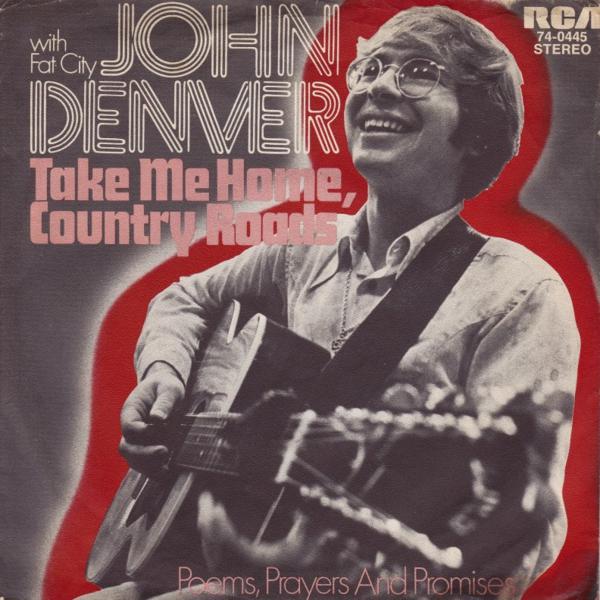
This John Denver song I really like. Denver was a huge star in the early to mid-seventies. I’m not a huge fan by any means but he did have a few songs I liked. He was a songwriter, musician, activist, actor, and he sold millions of records (over 33 million). He was never known to be cool or hip.
Denver was an easy target for critics and peers. Robert Christgau dubbed him “the blandest pop singer in history,” and comparing him to James Taylor… “If James is a wimp, John is a simp, and that’s even worse.”
I don’t think all the criticism was fair. Some of his music was really good to great like Rocky Mountain High…
Denver wrote this song with his friends Bill and Taffy Danoff. Denver was in Washington, DC to perform with the Danoffs, and after the show, they went back to the couple’s home where they played him what they had of this song. Denver almost didn’t make it because he was in a car wreck and injured his thumb.
The Danoffs have stated they were hoping to get Johnny Cash to record this song when they wrote it. They almost didn’t play it for Denver because they didn’t think it fit his style.
Denver helped them complete the song, and the next night they sang it together on stage. Denver knew he had a hit song on his hands, and brought the Danoffs to New York where they recorded the song together – you can hear Bill and Taffy on background vocals.
The song peaked at #2 in the Billboard 100 and #3 in Canada in 1971.
From Songfacts
The country roads in this song are in West Virginia, but Denver had never even been to West Virginia. Bill and Taffy Danoff started writing the song while driving to Maryland – they’d never been to West Virginia either! Danoff got his inspiration from postcards sent to him by a friend who DID live there, and from listening to the powerful AM station WWVA out of Wheeling, West Virginia, which he picked up in Massachusetts when he was growing up.
Bill Danoff told NPR in 2011: “I just thought the idea that I was hearing something so exotic to me from someplace as far away. West Virginia might as well have been in Europe, for all I knew.”
The Danoffs were in a band called Fat City at the time they wrote this. They later formed the Starland Vocal Band, who had a big hit with “Afternoon Delight” in 1977. There was some speculation that Denver somehow screwed the Danoffs when he became famous and they remained in obscurity, but the couple always defended Denver in interviews, pointing out that he brought Fat City on tour and helped them get a record deal with his RCA/Windsong Records. Denver also recorded several other songs Bill Danoff wrote.
The Shenandoah River is in West Virginia, running right through Harper’s Ferry into the Potomac. The Blue Ridge Mountain Ranges run in a strip from northeast West Virginia to its southwest across the eastern part of the state. Clopper Road originates in Gaithersburg, Maryland. It was a single lane road, but is now a busy four-lane road that heads to Germantown, Maryland. No country road anymore… not even close! It is attainable by exiting off of I-270 at Exit 10.
This was released as a single in the spring of 1971. It broke nationally in mid-April, but moved up the charts very slowly, as Denver was a little-known singer. To this point, Denver’s biggest success was writing “Leaving On A Jet Plane,” which he performed as a member of The Chad Mitchell Trio but was a hit for Peter, Paul and Mary in 1969. Denver pushed RCA records to keep promoting “Take Me Home Country Roads,” and their persistence paid off when it became a huge hit that summer. It was Denver’s first hit, and the first of 13 US Top 40 hits he scored in the ’70s.
Denver charted earlier in 1971 with “Friends With You” at #47, but “Country Roads” established him as a crossover artist with appeal to Pop, Country and Easy Listening audiences. >>
Clopper Road is still there. It is a four lane road from Qince Orchard Boulevard to just past Rt. 118 where it returns to a two lane road. The end of Clopper Road is in a town called Boyds. From Rt. 118 to the end, the road is much like it was in 1969 through the mid-1980s.
In 1969, it really did seem idyllic in a way. Other than the farms and a few houses, there was nothing between Gaithersburg and Boyds other than the few stores and a few businesses in Germantown, and a gas station/country store at the corner of Clopper Road and Rt. 118.
Today, the road is built up from Quince Orchard Road to Seneca Creek, but the last mile or two is like it was back then. The concrete batch plant has been gone for a number of years, the old B&O railroad flag stop is now a MARC commuter rail stop for Boyds, but the rest of Clopper Road has been sold to housing developments. The trip from Rt. 118 to Boyds and to Dickerson beyond is still one of the nicest and peaceful drives in the Metropolitan area. >>
After hearing the first verse, most people feel compelled to sing the chorus, especially in a group environment or if alcohol is involved. The St. Louis Blues hockey team learned this on February 9, 2019 when they played the song during a break in the third period of a game against the Nashville Predators. When play resumed, they faded the song just as it was getting to the chorus, but the crowd sang it anyway and a tradition was born. It helped that the team was winning: they ended up going all the way to the Stanley Cup Finals for the first time in 49 years. Laura Branigan’s “Gloria” also soundtracked the team that season.
Take Me Home Country Roads
Almost heaven, West Virginia Blue Ridge Mountains Shenandoah River, Life is old there Older than the trees Younger than the mountains Blowin’ like the breeze
Country roads, take me home To the place I belong West Virginia, mountain momma Take me home, country roads
All my memories gathered ’round her Miner’s lady, stranger to blue water Dark and dusty, painted on the sky Misty taste of moonshine Teardrops in my eye
Country roads, take me home To the place I belong West Virginia, mountain momma Take me home, country roads
I hear her voice In the mornin’ hour she calls me The radio reminds me of my home far away And drivin’ down the road I get a feelin’ That I should have been home yesterday, yesterday
Country roads, take me home To the place I belong West Virginia, mountain momma Take me home, country roads
Country roads, take me home To the place I belong West Virginia, mountain momma Take me home, country roads
Take me home, now country roads Take me home, now country roads
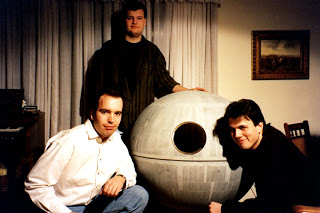
It’s unbelievable how close this famous movie prop came to being lost.
The model used in the film along with some other props were thought to be garbage after the movie finished filming.
Many of the props were kept in a facility called Dollar Moving and Storage. The storage unit was rented by the studio and upon completion of postproduction, the studio decided they no longer wanted to pay rent and ordered everything in storage to be discarded. An employee named Doug W. rescued many of the props from the garbage including the Death Star. In a world before ebay…who knows what was lost.
Doug displayed the Death Star in his home in California for about a decade. Around 1988, Doug moved to Missouri and stored the Death Star at his mother’s antique shop (Sutter’s Mill Antiques, later renamed The Mexican Hillbilly) in Missouri.
Todd Franklin, a Star Wars collector living in the area, drove by the antique shop and was immediately convinced it had to be the original Death Star model. Todd wondered how and why the original Death Star was in Missouri. He made some calls and was convinced it was the one. He was going to buy it but before he got back it was sold to another person named Mark who was the owner of a country and western music show called Star World. Mark displayed the Death Star in the lobby.
In 1994 Todd, his brother Pat, and friend Tim Williams traveled to Star World who was going out of business. The Death Star was being used as a trash can in the corner! Todd made an offer and bought it on the spot. All three owned it and contacted Lucasfilm but they did not want to buy it back.
In 1999 Gus Lopez contacted Todd, Pat, and Tim and negotiated a price. Now, Gus owns the famous Death Star.
Since then, Lopez has had the original Death Star on display in a custom-made case in his home, and he even loaned it to the Museum of Pop Culture in Seattle (though Lopez refers to it by its former name: the EMP (Experience Music Project) Museum) for a five-year stint.
Gus Lopez: “The EMP gave it top billing in the museum with a prominent spot at the center of one of the main rooms. I got a kick out of reading about the Death Star in local tourist literature and walking by the Death Star on display at the museum to hear conversations from people telling their stories about what Star Wars meant to them. And now the Death Star is back home, where I see it every day. And when I look at it, I am still amazed it survived its long journey and is sitting right in front of me.”
This song was on Blood On The Tracks, a brilliant album by Bob released in 1975. This wasn’t a hit but it was a great song. The album though was a hit…peaking at #1.
As with other Dylan songs, the words keep me in this one. I also like the way he sings it…he sings it like he has lived it. People tell me it’s a sin, To know and feel too much within, I still believe she was my twin, but I lost the ring, She was born in spring, but I was born too late, Blame it on a simple twist of fate.
This album was made when he was having trouble with his wife Sara. Dylan denies the album is about the two of them.
In Rolling Stone 500 Greatest Albums of all time in the early 2000s, Blood on the Tracks came in at Number 16.
Jacob Dylan about Blood on the Tracks: ‘When I’m listening to ‘Subterranean Homesick Blues,’ I’m grooving along just like you. But when I’m listening to Blood on the Tracks, that’s about my parents.’
From Songfacts
This song is from Blood on the Tracks, the 15th studio album by Bob Dylan, which made the album charts at #1 in the US and #4 in the UK. Blood on the Tracks is also legendary amongst Bob Dylan fans and critics, regarded as one of the high points of his career and standard against which future Bob Dylan albums were compared.
Dylan’s son Jakob Dylan has stated that the songs from Blood on the Tracks are “his parents talking.” Although Dylan denies that the album content is autobiographical, most of the lyrics have a confessional nature.
Covers of “Simple Twist of Fate” include Joan Baez (1975), The Jerry Garcia Band (1991), Concrete Blonde (1994), Sean Costello (2005), The Format (2005), Bryan Ferry (2007), Jeff Tweedy (2007), and Stephen Fretwell (2007). The Jeff Tweedy cover was also used on the soundtrack for the film I’m Not There .
A Simple Twist Of Fate
They sat together in the park As the evening sky grew dark She looked at him and he felt a spark Tingle to his bones ‘Twas then he felt alone And wished that he’d gone straight And watched out for a simple twist of fate
They walked along by the old canal A little confused, I remember well And stopped into a strange hotel With a neon burnin’ bright He felt the heat of the night Hit him like a freight train Moving with a simple twist of fate
A saxophone someplace far-off played As she was walkin’ on by the arcade As the light bust through a beat-up shade Where he was waking up She dropped a coin into the cup Of a blind man at the gate And forgot about a simple twist of fate
He woke up, the room was bare He didn’t see her anywhere He told himself he didn’t care Pushed the window open wide Felt an emptiness inside To which he just could not relate Brought on by a simple twist of fate
He hears the ticking of the clocks And walks along with a parrot that talks Hunts her down by the waterfront docks Where the sailors all come in Maybe she’ll pick him out again How long must he wait? One more time, for a simple twist of fate
People tell me it’s a sin To know and feel too much within I still believe she was my twin But I lost the ring She was born in spring But I was born too late Blame it on a simple twist of fate
The title alone is worth a listen or two. Loretta had some great song titles.
The song peaked at #1 in the Billboard Country Charts in 1967. The song also earned Lynn her very first Grammy nomination for Best Country & Western Performance.
The song was written by Loretta Lynn and Peggy Sue Wright. Peggy Sue Wright is Loretta’s younger sister.
Loretta Lynn: “I looked at what she had on paper, and I kind of knew what she was trying to say. It’s like when there’s twins, the old saying is, ‘What one can’t think of, the other one can.’ I’ve always had this feeling with Peggy that I am kind of inside her head. Maybe it’s because she means so much to me. We can look at each other and know what the other is thinking. Sometimes it’s not good to be like that, but when the song was finished, we both thought it was great.”
From Songfacts
In her first #1 country hit, Loretta Lynn is fed up with her alcoholic husband who gets drunk with his buddies and comes home expecting to get frisky with his neglected wife. Lynn could certainly relate to the scenario, as almost all of the turmoil in her nearly 50-year marriage was caused by her husband’s alcoholism, but a different marriage inspired the song. Her sister Peggy Sue was struggling with the same issues in her first marriage and brought the song idea to Lynn, who fleshed it out. Peggy Sue was following Lynn’s path as an aspiring singer who was trying to carve out a career while raising children and making her marriage work.
Peggy Sue, who went on to marry singer/songwriter Sonny Wright, released her debut album, Dynamite!, in 1969.
In 1967 Lynn’s brother Jay Lee Webb released the answer song “I Come Home A-Drinkin’ (To a Worn Out Wife Like You),” which peaked at #21 on the country chart.
Lynn became the first female country singer to have a gold-certified album when Don’t Come Home A-Drinkin’ (With Lovin’ On Your Mind) earned the honor in 1970, with over 500,000 copies sold.
Tammy Wynette covered this on her debut album, Your Good Girl’s Gonna Go Bad, in 1967.
Gretchen Wilson sang this on the 2010 album Coal Miner’s Daughter: A Tribute to Loretta Lynn.
This was used on the 2007 Friday Night Lights episode “I Think We Should Have Sex.”
Don’t Come Home A-Drinkin’ (With Lovin’ on Your Mind)
Well you thought I’d be waitin’ up when you came home last night You’d been out with all the boys and you ended up half tight But liquor and love they just don’t mix leave the bottle or me behind And don’t come home a drinkin’ with lovin’ on your mind
No don’t come home a drinkin’ with lovin’ on your mind Just stay out there on the town and see what you can find ‘Cause if you want that kind of love well you don’t need none of mine So don’t come home a drinkin’ with lovin’ on your mind
You never take me anywhere because you’re always gone And many a night I’ve laid awake and cried here all alone Then you come in a kissin’ on me it happens every time No don’t come home a drinkin’ with lovin’ on your mind
No don’t come home a drinkin’ with lovin’ on your mind Just stay out there on the town and see what you can find ‘Cause if you want that kind of love well you don’t need none of mine So don’t come home a drinkin’ with lovin’ on your mind No, don’t come home a drinkin’ with lovin’ on your mind
This song was probably the first song that made me aware of The Velvet Underground. This song was on the album Loaded. Lou Reed wrote this song and the album was an attempt to write more of a commercial album.
This was Reed’s attempt at writing a hit for the Velvet Underground, who were highly influential, but commercially doomed. Loaded was the band’s last album, and the title was a reference to the record company mandate that the album be “Loaded with hits.”
The album was released on November 15, 1970. Loaded was ranked 110 on Rolling Stone‘s list of the 500 greatest albums of all time.
From Songfacts
The Velvet Underground leader Lou Reed wrote this song as a surreal look at the life of a rock star. Reed included the song in his live sets; it appeared on his album Live at Max’s Kansas City in 1972 and on another live album, Rock n Roll Animal, in 1974. The version on Rock n Roll Animal, which was recorded at a New York show on December 21, 1973, features the twin-guitar work of Steven Hunter and Dick Wagner, who Reed employed to rock out his songs on tour.
Released as a single, this live version of the song heralded a new sound for Reed, one he quickly abandoned when he fired Hunter and Wagner at the end of the tour and disavowed the album. Reed released his intentionally awful Metal Machine Music album the following year, while his bygone guitarists joined Alice Cooper on tour, with Wagner becoming Cooper’s songwriting partner. In our interview with Dick Wagner, he explained: “He claims that he didn’t like the Rock n’ Roll Animal album, but at the time he sure loved it. A lot of the songs were from the Velvet Underground days, and I wanted to take them out of that placid performance of the songs and make it more for the concert stage and the stadiums, so I did some majestic arranging with some of the songs – that’s what I do. Within the context of the band and how to deliver the songs, it really worked. I guess Lou doesn’t really like it that much, but that’s kind of a lie.”
There was a great deal of acrimony during recording of the album, and Reed left before it was finished. In his absence, “Sweet Jane” was edited down, with a wistful coda removed from the song. This angered Reed, who told Rolling Stone magazine that if he knew they were going to press on with the album, “I would have stayed with them and showed them what to do.” The full version of the song can be heard on the album Live at Max’s Kansas City, recorded in 1969.
This song appears on the album 1969: The Velvet Underground Live, which was released in 1974. This is the double album with the famous gatefold revealing a leggy model in sparkling go-go boots and hot pants showing some can, on a vibrant green background; very sought-after by today’s VU collectors. There, “Sweet Jane” has a significantly different chord progression and lyrics; it was still a work-in-progress. Captured on the bootleg recording of Lou Reed’s last night performing live with The Velvet Underground, which happened through the tail end of the Loaded sessions, is one Jim Carroll. As told in The Velvet Underground: An Illustrated History of a Walk on the Wild Side, Carroll can be heard ordering a Pernod and discussing the drug Tuinal. Carroll would later write The Basketball Diaries.
Reed did a parody version on his 1979 album Live – Take No Prisoners.
The original lyrics were, “Jane in her corset, Jack is in his vest, and me I’m in a rock n’ roll band.” Lou changed them to “Jack is in a corset, Jane is in a vest” to portray the wackiness of rock stars.
Mott the Hoople covered this on their All the Young Dudes album, which was also produced by David Bowie – Reed fully endorsed this cover and even did a reference vocal to help them out. Another version Reed liked was the one recorded by Brownsville Station on their 1973 album Yeah!.
Other notable covers of this song include versions by Cowboy Junkies, 2 Nice Girls, Phish, The Kooks, Gang of Four, and the Red Hot Chili Peppers. Reed himself appeared with Metallica (Metallica!) on October 25, 2009 at Madison Square Garden in New York City to perform “Sweet Jane” at the concert to celebrate the 25th Anniversary of the Rock and Roll Hall of Fame.
Q Magazine rated “Sweet Jane” at #18 on its list of 100 Greatest Guitar Tracks, and Guitar World rated it at #81 on its list of the 100 Greatest Guitar Solos, while Rolling Stone ranked it #335 on their list of the 500 Greatest Songs of All Time.
Sweet Jane
Standin’ on a corner Suitcase in my hand Jack’s in his car, says to Jane, who’s in her vest, And me, I’m in a rock n’ roll band. Ridin’ in a Stutz Bearcat, Jim You know,those were different times All the poets studied rows of verse, And those the ladies rolled their eyes
Sweet Jane, sweet Jane, sweet Jane
Now, Jack, he is a banker And Jane, she is a clerk And the both of them are saving up their moneys And when they come home from work Sittin’ by the fire The radio does play The classical music there, Jim The march of the wooden soldiers All you protest kids You can hear Jack say, get ready, ah
Sweet Jane, come on baby,sweet Jane, oh-oh-a,sweet Jane
Some people, they like to go out dancing And other peoples, they have to work. Just watch me now And there’s even some evil mothers Well they’re gonna tell you that everything is just dirt Y’know that, women, never really faint And that villains always blink their eyes, woo And that, y’know, children are the only ones who blush And that, life is, just to die And, everyone who ever had a heart, oh That wouldn’t turn around and break it And anyone who ever played a part, whoa And wouldn’t turn around and hate it
Sweet Jane! Whoa-oh-oh! Sweet Jane! Sweet Jane Sweet Jane
Heavenly wine and roses Seem to whisper to her when he smiles Heavenly wine and roses Seem to whisper to her, hey when she smiles
Lala, lala,lala, lala, lala, lala, lala,lala
Sweet Jane Sweet Jane Sweet Jane Sweet Jane Sweet Jane
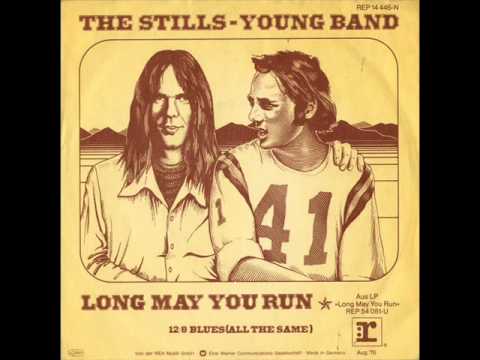
Always a favorite Neil Young song of mine. This was the title song on the joint album by Neil Young and Stephen Stills. Stills and Young wrote separately for the album, which Stephen contributing four songs, and Young adding five, including the title track.
It was going to be a Crosby, Stills, Nash, and Young album but Crosby and Nash to leave for a while for commitments. Stills and Young scrubbed the tapes clean of any contributions made by their bandmates and resolved to keep the album a Stills-Young release. It would end up being credited to the Stills-Young Band.
Stills and Young toured on the album but after a few dates…Neil Young abruptly left the tour and sent a telegram to Stills…“Dear Stephen, funny how some things that start spontaneously end that way. Eat a peach. Neil.”
The song did chart in the UK at #71 in 1976.
From Songfacts
Neil’s beloved Pontiac hearse, “Mort” (a.k.a. “Mortimer Hearseburg”), was the inspiration for this song. Neil drove “Mort” from Toronto to Los Angeles, where he met Stephen Stills and formed Buffalo Springfield.
Neil was in Canada driving to Sudbury when ‘Mort’ broke down in Blind River, June 1965. (Which is contradictory to the lyrics; “well it was back in Blind River, in 1962, when I last saw you alive”).
In 1976, Stephen Stills and Neil Young formed The Stills-Young Band and released an album called Long May You Run, which turned out to be somewhat ironic when the collaboration quickly stalled.
Stills is a longtime collaborator of Neil’s, having worked with him first in Buffalo Springfield and then in Crosby, Stills, Nash & Young. However, they had a falling out only nine days into the Long May You Run tour. Young decided to abandon the project, leaving Stills with a mere telegram to explain his departure. It read: “Dear Stephen, funny how some things that start spontaneously end that way. Eat a peach. Neil.”
In addition to Young’s compilation album Decade this also appears on his 1993 album Unplugged.
The last ever Tonight Show with Conan O’Brien on Friday January 22, 2010 finished in style when O’Brien’s final musical guest, Neil Young, performed this song in what appeared to be a poke at NBC. O’Brien had been asked to move his slot to 12:05 a.m., and the TV host refused to move his show to such a late hour, and instead negotiated a $45 million exit deal.
Neil Young performed this song at the Closing Ceremonies of the 2010 Vancouver Winter Olympic Games to a rousing ovation of Canadian audience members.
Long May You Run
We’ve been through some things together With trunks of memories still to come We found things to do in stormy weather Long may you run.
Long may you run. Long may you run. Although these changes have come With your chrome heart shining in the sun Long may you run.
Well, it was back in Blind River in 1962 When I last saw you alive But we missed that shift on the long decline Long may you run.
Long may you run. Long may you run. Although these changes have come With your chrome heart shining in the sun Long may you run.
Maybe The Beach Boys have got you now With those waves singing “Caroline” Rollin’ down that empty ocean road Gettin’ to the surf on time.
Long may you run. Long may you run. Although these changes have come With your chrome heart shining in the sun Long may you run.
I’ve been listening to arena rock in the last few days…in short doses it’s alright.
I saw this band in 1982 and they were loud. What I remember most is in the middle of this song..singer Dan McCafferty came out and played bagpipes. That was the first time I ever heard bagpipes live…and like the rest of the band…they were very loud. The studio version doesn’t have them in it but they did sound great live.
It was on the album Hair of the Dog and it peaked at #17 in the Billboard album charts in 1975.
This song is what I call an angry song. When I would cruise in my teens and I wanted to feel a rush of emotion…I would turn this song up and drive along. It has a fun guitar riff in this song…a variation of the Day Tripper riff. The chorus is hard to miss also.
From Songfacts
This song is about a charming and manipulative woman who can get guys to acquiesce to her every need. The singer is letting her know that she has met her match in him, and she won’t be able to push him around.
“Hair Of The Dog” does not appear in the lyrics. The logical title would be “Son Of A Bitch,” but it would be tough to get airplay with a song of that name. “Hair Of The Dog” comes from the phrase “Hair of the dog that bit you,” which some people consider a hangover cure, meaning that if you wake up in pain after drinking lots of beer the night before, a beer will help cure you.
In the US, this was used in a TV commercial for Dodge.
Girls Aloud sampled this on their UK hit “Sexy! No No No.”
Artist to cover this song include Guns N’ Roses, Warrant and The Michael Schenker Group.
A bagpipe version…around the time that I saw them.
Hair of the Dog
Heartbreaker, soul shaker I’ve been told about you Steamroller, midnight shoulder What they been saying’ must be true
Red hot mama, down light charmer Time’s come to pay your dues
Now you’re messin’ with a (A son of a bitch) now you’re messin’ with a son of a bitch Now you’re messin’ with a (A son of a bitch) now you’re messin’ with a son of a bitch
Talking jiving poison ivy You ain’t gonna cling to me Man taker bone faker I ain’t so blind I can’t see
Red-hot mama, down light charmer Time’s come to pay your dues
Now you’re messin’ with a (A son of a bitch) now you’re messin’ with a son of a bitch Now you’re messin’ with a (A son of a bitch) now you’re messin’ with a son of a bitch
Now you’re messin’ with a (A son of a bitch) now you’re messin’ with a son of a bitch Now you’re messin’ with a (A son of a bitch) now you’re messin’ with a son of a bitch
Now you’re messin’ with a (A son of a bitch) now you’re messin’ with a son of a bitch Now you’re messin’ with a (A son of a bitch) now you’re messin’ with a son of a bitch
Now you’re messin’ with a (A son of a bitch) now you’re messin’ with a son of a bitch Now you’re messin’ with a (A son of a bitch) now you’re messin’ with a son of a bitch
Now you’re messin’ with a (A son of a bitch) now you’re messin’ with a son of a bitch Now you’re messin’ with a (A son of a bitch) now you’re messin’ with a son of a bitch
Now you’re messin’ with a (A son of a bitch) now you’re messin’ with a son of a bitch Now you’re messin’ with a (A son of a bitch) now you’re messin’ with a son of a bitch
Now you’re messin’ with a (A son of a bitch) now you’re messin’ with a son of a bitch
This has turned into one of my favorite songs since I heard 10 years ago or so.
I originally blogged this when I had around 3 followers two years ago…so I apologize to you three for the repeat!
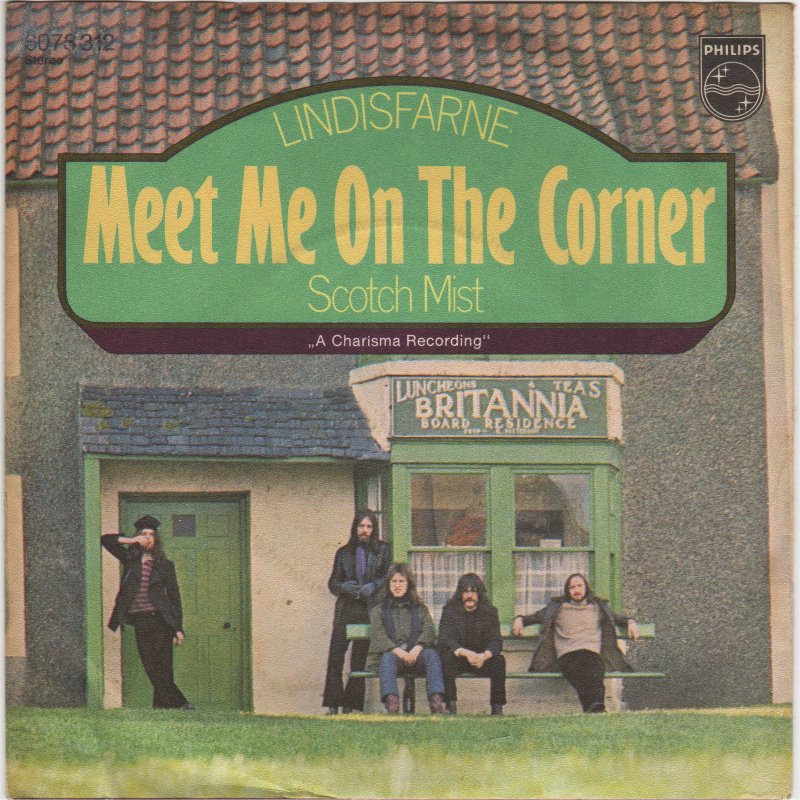
It’s a feel-good, quirky song with bright harmonies. It was released in 1971 and went to number 5 in the UK…kinda like the Bee Gees go folk.
The song was written by Lindisfarne member Rod Clements and sung by Ray Jackson. The mandolin solo in Maggie May by Rod Stewart was played by Ray Jackson. On the “Every Picture Tells A Story”album liner notes, it is stated that “The mandolin is played by the mandolin player in Lindisfarne. The name slips my mind.”
Meet Me On The Corner
Hey mister dream seller Where have you been. Tell me have you dreams I can see? I came along, just to bring you this song, Can you spare one dream for me?
You wont have met me, And you’ll soon forget. So don’t mind me tugging at your sleeve. I’m asking you, If I can fix a rendezvous, For your dreams are all I believe.
[Chorus] Meet me on the corner, When the lights are coming on, And I’ll be there. I promise I’ll be there. Down the empty streets, We’ll disappear into the dawn, If you have dreams enough to share.
Lay down your bundles, Of rags and reminders, And spread your wears on the ground. Well I’ve got time, If you’re dealing mine, I’m just hanging around.
[Chorus]
Hey mister dream seller, Where have you been. Tell me have you dreams I can see? I came along, just to bring you this song, Can you spare one dream for me?










 PowerPop... An Eclectic Collection of Pop Culture