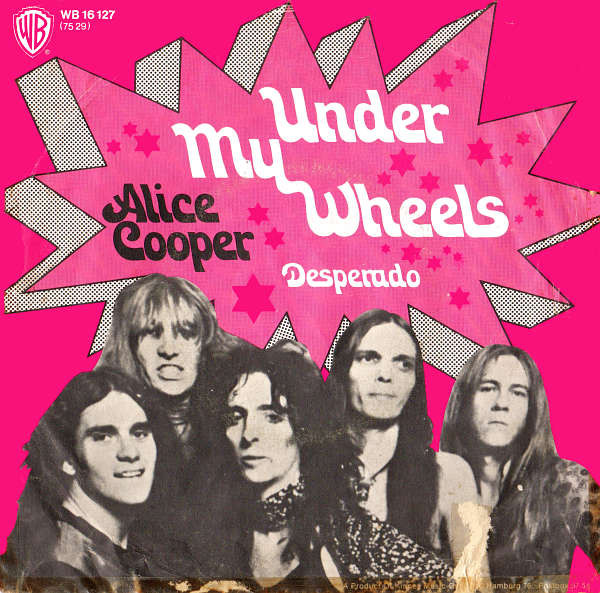
Alice Cooper – Under My Wheels

This song was off the Killer album. It peaked at #59 on the Billboard 100. The album peaked at #21 on the Billboard Album Charts, #11 in Canada, and #27 in the UK in 1971.
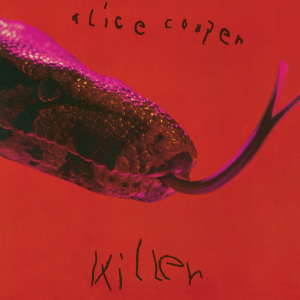
Alice Cooper - Killer

One of my favorites of Alice Cooper. The song wasn’t a giant success but it has remained in Alice’s set since it was released in 1971.  The song’s impact can be seen in its inclusion in movies, TV shows, and video games. It has been covered by several other musicians, including Poison and Motörhead.

The guitar solo in this song is played by Rick Derringer. The songwriters were the group’s guitarist Michael Bruce and bass player Dennis Dunaway along with producer Bob Ezrin.   The song is about a guy who accidentally runs over his girlfriend in the new car he just bought.

Alice Cooper has blended styles throughout his career. He has had Heavy Metal, rock, hard rock, and plain-out pop.

Alice Cooper’s real name is Vincent Furnier. Alice Cooper was the name of the band, but the name became so associated with the lead singer that he took it.

The band did a good job spreading the rumor that “Alice Cooper” was the name of a girl who was accused of being a witch in the 1600s, saying she contacted them through an Ouija board. Furnier later explained that he made it up when he was thinking of a sweet, innocent-sounding name that would contrast against their shocking stage show.

Cooper is a big family man which contradicts his reputation. Cooper is a born-again Christian and believes in the devil enough to have genuine supernatural fear. He’s never taken a Satanist stance and warns other bands against it. When he was a kid, his family was poor and there were very few presents. Now, Cooper goes crazy on Christmas, buying lots of gifts for his family.

Dennis Dunaway: This was another song that I wrote. I remember singing the song to Glen Buxton about this guy who’s just bought a brand new car and he’s going over to pick up his girlfriend and take her to the movies. Glen was like, ‘We don’t do girl songs!’ And I was like, ‘No, the guy runs over the girl.’ So he said, ‘Oh, OK.’ Ha ha! Anyway, Under My Wheels is about a guy who accidentally runs over his girlfriend, who he’s trying to impress with his new car. It was a fairly decent hit in America, and we also plugged it in Britain. We did a Killer tour over there when the single had just been released.

“Under My Wheels”

The telephone is ringing you got me on the run I’m driving in my car now anticipating fun
I’m driving right up to you babe I guess that you couldn’t see yeah yeah
But you were under my wheels why don’t you let me be
’cause when you call me on the telephone saying take me to the show
And then I say honey I just can’t go old lady’s sick and I can’t leave her home
The telephone is ringing you got me on the run I’m driving in my car now
I got you under my wheels I got you under my wheels I got you under my wheels
Got you under my wheels yeah yeah I got you under my wheels
Aah the telephone is ringing you got me on the run I’m driving in my car now anticipating fun
I’m driving right up to you babe I guess that you couldn’t see yeah yeah
But you were under my wheels why don’t you let me be
Yeah yeah got you under my wheels yeah yeah I got you under my wheels
I got you under my wheels got you got you got you got you
Under my wheels got you under my wheels wheels wheels wheels

Gram Parsons and Emmylou Harris – Love Hurts

This song has been covered many times. The one that is probably the most popular is by the hard rock band Nazareth. This version was the one that Nazareth heard to base their version on. It was written and composed by the American songwriter Boudleaux Bryant, who was a very prolific and successful songwriter for other artists throughout the 1950s and beyond.

Gram and Harris’s version is my favorite version of the song now. It was on Parson’s Grievous Angel album released in 1974. Parsons and Harris had a great musical partnership. You can hear it in this song on how their voices weaved together.

Gram Parsons and Emmylou Harris

On the album… James Burton played electric lead guitar, Herb Pederson on rhythm, and Al Perkins on pedal steel. Bernie Leadon played dobro, and Byron Berline added some fiddle and mandolin. Linda Ronstadt always contributed vocals to a Harris-Parsons song that I will cover next.

Harris was talking about the making of the Grievous Angel Album: “Gram was in really good shape for that album, and we were really tight from working on the road together. The band knew what they were doing and we had the charts together by the time we got into the studio. We went in and, man, it was really fast – we did the tracks in five days and then a second five days for the vocals which were nearly all first or second takes. For all extent and purposes ist should be regarded as a ‘live’ album.”

“We didn’t really write songs together. He always carried those songs around in his head. He just needed a little prodding to get them out. That’s all I did. I helped him with a line here and there. I’d suggest something but those were his songs. I didn’t dispute the credit on ‘In My Hour Of Darkness’, which he gave to me. I think that was probably because at the same time, there was this big thing about that stupid album cover.”

What Harris was referring to about the cover was that it made Gram’s wife upset. It was originally a cover of Parson and Harris that Gram picked out. Parson’s manager was Phil Kaufman and he said that Gretchen Parsons, Gram’s wife, found out about the picture and fought with Parsons. So, she had the picture removed when it was released because Gram had passed away in September of 1973 and this album was released in 1974.

The Everly Brothers were the first to cover it, but they never released the song as a single. They planned to release this as a single, but industry politics got in the way. Their version is very good as well but Harris and Parson’s voices just sounded so good together for this particular song.

Emmylou Harris: “I really liked working with Gram, it was a completely new experience for me. I was a little weary at first because of Los Angeles and Hollywood and all, and I was very much East Coast orientated. I was very much on my guard but Gram was a very real person and, whenever I went out there, I always felt that I was in some kind of protective bubble. It was never Los Angeles itself, but always working with Gram and the music, and I kept myself in a very small circle.”

“It was the first time to have ever lost a close friend. I’m sure that all people have lost someone who is very dear to them, but Gram was young and so full of life. There are people who say ‘well, it was bound to happen’… but not to me because Gram was the most alive person I ever knew and breathed a whole lot into me and into my life. So he still remains very much alive in my heart.”

“Eventually Gram will find his place in history. He had a real creative vision of his own as a writer. Perhaps there is a shadow of that inspiration on my records but it’s not the gut level thing.”

Here is a live version from Gram and Emmylou from 1973. 

Love Hurts

Love hurts, love scarsLove wounds and marsAny heart not toughNor strong enoughTo take a lot of painTake a lot of painLove is like a cloudHolds a lot of rain

Love hurtsMmm-mm, love hurts

I’m young, I knowBut even soI know a thing or twoI’ve learned from you

I’ve really learned a lotReally learned a lotLove is like a stoveBurns you when it’s hotLove hurtsMmm-mm, love hurts

Some fools think of happinessBlissfulness, togethernessSome fools fool themselves, I guessBut they’re not fooling me

I know it isn’t trueKnow it isn’t trueLove is just a lieMade to make you blue

Love hurtsMmm-mm, love hurts

Love hurtsMmm-mm, love hurtsOh-oh, love hurts

The Inmates

CB and I were emailing each other and he sent me a few links to this band. They were a great British pub band that formed in 1977. They got together after the split of another band named The Flying Tigers. As CB and I have done these…I usually give you a “sample platter” of them and later on I’ll concentrate on one song at a time in a later post. This should introduce you to them.

The first thing I noticed was how good their songs sound. Many pub bands I’ve heard have a muddy sound to them but this band sounded clear and great. I do remember one of their songs…it was a cover of the Standells Dirty Water. Their producer until 1989 was a guy named Vic Maile who helped shape their overall sound. He was a winner…he worked with artists such as Fleetwood Mac, Jimi Hendrix, Led Zeppelin, Eric Clapton, The Pirates,  Hawkwind, Motörhead, The Godfathers, The Kinks, Small Faces, Dr. Feelgood, Girlschool, and the Deep Fix. Most of those bands I’ve covered.

They released nine studio albums and three live ones between 1979 and 2008. They were considered a Pub band but you also hear a lot of that great 1960s garage sound in lead singer Bill Hurly’s voice. They remind me of pre-Godfathers…they take no prisoners and come right at you. Their songs are rough and raw but their melodic and catchy at the same time. Their choice of covers is quite interesting. They pick many songs you wouldn’t think.

They also made a tribute live album to the Beatles called The Inmates Meet The Beatles: Live In Paris. They did it in their style and made the songs their own which is a great way of doing it. They even managed to take one of the very few Beatles songs I don’t like and turned it on its head. I like their version of it…Little Child.

Enough of me babbling on…let’s listen to the Inmates. I’ll start off with one that you should know. I do remember this song and this version. Their first album First Offence peaked at #40 on the Billboard Album Charts. The song Dirty Water peaked at #51. I’ve included songs from their first three albums.

The next song is a cover of a song called The Walk by Jimmy McCracklin and His Band originally released in 1958.

This song is Sweet Rain off of their  2nd album Shot in the Dark released in 1980. I can hear a lot of Them in this one. The guitar in this has an older sixties feel. This was the B-Side to the song below.

This song is the A-Side to Sweet Rain called Stop, It Baby off of their  2nd album Shot in the Dark released in 1980. It jumps and moves…very catchy.

This one called She’s Gone Rockin’ was off of their third album Heatwave in Alaska It was released in 1982.


Tom Waits – I Hope That I Don’t Fall In Love With You

I was commenting on Aphoristical’s blog and he listed the 10 best Tom Waits songs. I’ve heard Waits through the years and I’ve liked what I’ve heard but never listened to his debut album. I knew more of his later music than his beginning. After reading Graham’s site it got me listening to Wait’s debut album and it shocked me with his voice…but forget that…it’s a damn good album called Closing Time. The comment I left on his site was “Unlike most artists…I know more of him in the later parts of his career. I never heard your number 1 song…that floored me! Great song and that voice…I like that voice.”

A few weeks ago I listened to the album and the songs really stuck with me. The three top songs to me are this one, Grapefruit Moon, and Ol’55. The album is one that music fans should listen to. I had forgotten which song that Graham had number one so after I picked the one I wanted to post about…I went to link Graham’s site and yes…he picked this one…I see why. You know…this is why we do these blogs… to learn.

I rarely do this but I like how Waits takes the opposite approach in this song. Instead of hoping he can go to the next step with this woman…he is aware of the potential risks and heartbreak that come with falling in love. He is trying to place a wall between any thought of it. The vulnerability of a closely guarded world-weary man. Waits is a great songwriter and many times takes a different approach which I can appreciate.

Closing time was released in 1973 and it charted at #44 on the German charts and #29 in Ireland. On secondhandsongs.com it lists 36 versions of the song.

I Hope That I Don’t Fall In Love With You

One, two, three, four

Well, I hope that I don’t fall in love with you

‘Cause falling in love just makes me blueWell, the music plays and you display your heart for me to seeI had a beer and now I hear you calling out for meAnd I hope that I don’t fall in love with you

Well, the room is crowded, people everywhere

And I wonder, should I offer you a chair?Well, if you sit down with this old clown, take that frown and break itBefore the evening’s gone away, I think that we could make itAnd I hope that I don’t fall in love with you

Well, the night does funny things inside a man

These old tomcat feelings you don’t understand

Well, I turn around to look at you, you light a cigaretteI wish I had the guts to bum one, but we’ve never metAnd I hope that I don’t fall in love with you

I can see that you are lonesome just like me

And it being late, you’d like some companyWell, I turn around to look at you, and you look back at meThe guy you’re with, he’s up and split, the chair next to you’s free

And I hope that you don’t fall in love with me

Now it’s closing time, the music’s fading out

Last call for drinks, I’ll have another stout

Well, I turn around to look at you, you’re nowhere to be foundI search the place for your lost face, guess I’ll have another roundAnd I think that I just fell in love with you

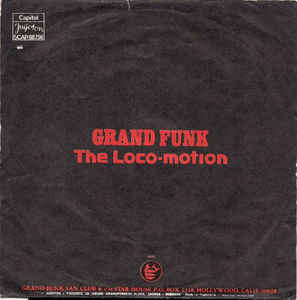
Grand Funk – The Loco-Motion

This is one band the critics roasted during the seventies but they were extremely popular. Led Zeppelin was also the critic’s target but their music has aged very well. Grand Funk did come out with some catchy hits …and this remake is one of them.

I remember this song as a kid and I was captivated by it…I’ve always liked the overall sound of this recording that Todd Rundgren captured. He produced this album named Shinin’ On in 1974 and We’re an American Band the year before. He made a big difference with their sound. He started to work with them to shorten songs. When I was around 7 or 8…I heard this solo and it grabbed my attention.

Little Eva first took this song to #1 in 1962. The Grand Funk version peaked at #1 on the Billboard 100 and #1 in Canada in 1974. The Locomotion was written by Carole King and Gerry Goffin. Another cover that Grand Funk did well with was Some Kind Of Wonderful.

The album Shinin’ On peaked at #5 on the Billboard Album Charts and #4 in Canada in 1974.

Don Brewer: “The idea of Locomotion came when we were working on the Shinin’ On album in the studio with Todd (Rundgren). We had basically finished the album – ‘Shinin’ On’ was going to be the first single, and we were thinking about what we were going to do for another song. Mark (Farner) came in one day and off the top of his head was singing, ‘Everybody’s doing a brand new dance now,’ just for fun, and we all went, ‘Yeah, Grand Funk doing the Locomotion.’ It was a tongue-in-cheek kind of thing, and we said, ‘Let’s try it, let’s do it,’ so we sent off to New York, got the lyrics, and Todd had the idea of doing the song kind of like The Beach Boys’ ‘Barbara Ann’ where it sounded like a big party was going on, except Todd could really crank up everything with the hand claps and all of that stuff. It just had this huge sound to it – it sounded like a big party.”

Gerry Goffin: “It’s like a nice gift. It is kind of weird hearing it done in a different way, but you can still hear how it appeals to the kids.”

The Locomotion

Everybody’s doing a brand-new dance, now
(Come on baby, do the loco-motion)
I know you’ll get to like it if you give it a chance now
(Come on baby, do the loco-motion)
My little baby sister can do it with me
It’s easier than learning your A-B-C
So come on, come on, do the Loco-motion with me
You gotta swing your hips, now

Come on
Jump up
Jump back
Well, now, I think you’ve got the knack
Wow, wow

Now that you can do it, let’s make a chain, now
(Come on baby, do the loco-motion)
A chug-a chug-a motion like a railroad train, now
(Come on baby, do the loco-motion)
Do it nice and easy, now, don’t lose control
A little bit of rhythm and a lot of soul

Come on, come on
And do the Loco-motion with me

Move around the floor in a Loco-motion
(Come on baby, do the loco-motion)
Do it holding hands if you get the notion
(Come on baby, do the loco-motion)

There’s never been a dance that’s so easy to do
It even makes you happy when you’re feeling blue
So come on, come on, do the Loco-motion with me

(Come on baby, do the loco-motion)
So come on, come on and do the Loco-motion with me
(Come on baby, do the loco-motion)
So come on, come on and do the Loco-motion with me
(Come on baby, do the loco-motion)

Max Picks …songs from 1983

After this year, my fandom with The Replacements and REM began to accelerate because of the top 40. There is still some great top 40 coming but alternative music started to make more of an impression on me.

1983

U2 – Sunday Bloody Sunday – Of all the U2 songs this one is probably on the top of my list right beside Angel of Harlem. The drum pattern sounds like they are marching off to battle. It’s raw and you can hear the conviction in what Bono is singing. The Edge’s guitar is crunchy and perfect. The drum beat was composed by Larry Mullen Jr. It was recorded in a staircase of their Dublin recording studio because producer Steve Lillywhite was trying to get a full sound with natural reverb.

“Bloody Sunday” was a term given to an incident, which took place on 30th January 1972 in Derry, Northern Ireland where British Soldiers shot 28 unarmed civilians who were peacefully protesting against Operation Demetrius. Thirteen were killed outright, while another man lost his life four months later due to injuries. It was reported that many of the victims who were fleeing the scene were shot at point-blank range.

The first person to have addressed these events musically was John Lennon who composed “Sunday Bloody Sunday” and released it on his third Solo album “Sometime In New York City”. His version of the song directly expresses his anger towards the massacre

David Bowie – Modern Love – This was my favorite song off of the Let’s Dance album released in 1983.

Stevie Ray Vaughan played guitar on this song. Bowie asked him to play on the Let’s Dance album after seeing him perform at a music festival.

David Bowie and Nile Rodgers wrote this song.  Modern Love peaked at #14 in the Billboard 100, #2 in Canada, #2 in the UK, and #6 in New Zealand in 1983. The album was also produced by Bowie and Rodgers.

Nile Rodgers said that Bowie came into his apartment one day and showed him a photograph of Little Richard in a red suit getting into a bright red Cadillac, saying “Nile, darling, that’s what I want my album to sound like.”

How cool is that?

John Mellencamp – Pink Houses -I remember this song well but I also remember the MTV giveaway contest “Paint The Mutha Pink”. Oh yes, you could win a free house in Indiana where Mellencamp was from…a pink one of course! MTV got a good deal on the first house…20,000 dollars…there was a reason for that. It was across the street from a toxic dump. MTV then had to get another house and they finally did and gave it away. Susan Miles won the house along with a pink jeep and a garage full of Hawaiian Punch…not sure how that factored in.

According to a 1991 article in the Herald times online, it turned out that Susan Miles had only kept the house long enough to reap some tax advantages from owning a property. She never actually lived in the house. She went back to Bellevue, Washington after the contest was over.

Inspiration for this song came when Mellencamp was driving on Interstate 65 in Indianapolis. As described in the first verse, he saw a black man sitting in a lawn chair just watching the road. The image stuck with Mellencamp, who wasn’t sure if the man should be pitied because he was desolate, or admired. After all, he was happy.

MTV Contest

Big Country – Big Country – I love the drums in this song…they are so BIG…no pun intended. In America, this was their only song that hit big. Stuart Adamson was inspired to write “In A Big Country” after hearing what producer Steve Lillywhite was able to achieve on Big Country’s “Fields of Fire” single.

I thought this had bagpipes in it but it doesn’t. The guitarist, Stuart Adamson, used a technique called the “e-bow” to achieve the sound that resembles bagpipes. This technique involves using a handheld electronic device to vibrate the guitar strings, creating a sustained, bagpipe-like sound. For almost all of their music, Big Country was an all-guitar band.

Van Halen – Jump – This song was unusual for Van Halen because of the Oberheim OB-Xa synthesizer. Roth didn’t want to use it because he was afraid people would look at it as selling out to get a record in the charts. ZZ Top was doing the same thing at the time.

Eddie wanted to use it and had written the riff in 1981. Songfacts said: 1984 was David Lee Roth’s last album with Van Halen before he left the band in 1985; the video for “Jump” inflamed the tensions that led to his departure. The video was produced by Robert Lombard, who wanted to show the personal side of the band on stage. Roth, however, wanted the performance intercut with footage of him in various hedonistic pursuits, so they shot him doing things like riding a motorcycle and getting arrested while wearing nothing but a towel. Lombard edited the video and used none of the extra Roth footage, taking it to Eddie and Alex for approval. Two days later, the band’s manager fired him for bypassing Roth; Lombard says he never received the award the video won from MTV.

John Lennon – How?

This song was on the Imagine album and I heard it in more than one documentary about him. This song is about John being vulnerable which is not as typical of him.

This song was written after the Beatles broke up plus after the primal scream therapy of Dr Arthur Janov. What is Primal Scream Therapy? I found this definition: psychotherapy in which the patient recalls and reenacts a particularly disturbing past experience usually occurring early in life and expresses normally repressed anger or frustration, especially through spontaneous and unrestrained screams, hysteria, or violence.

When the Beatles broke up, John and Paul dove headfirst into their individual careers. Paul jumped straight into pop and Lennon dived into writing what he thought was the truth and setting it to a backbeat. They were not going to veer from their respective targets. You could tell they didn’t have each other to hold the other back anymore. That is what the Beatles had as a whole that the two head Beatles didn’t anymore. George just went on… already accustomed to writing alone but John and Paul had no brakes or guard rails.

For John, it paid off in two brilliant albums off the bat that probably would not have been the same with The Beatles. With Paul, it paid off with Ram but with just an OK debut album. After these first two albums, John seemed to lose some of his edge and Paul took a while but finally gained more confidence until he made his masterpiece Band On The Run released late in 1973.

Imagine peaked at #1 on the Billboard Album Charts and in the UK. It also peaked at #2 in Canada in 1971.

I’ve always read and seen interviews where Ozzy Osbourne is a huge fan of the Beatles and John Lennon. Ozzy Osbourne released a cover of this song in support of Amnesty International during the same week John Lennon would have turned 70. Ozzy sticks very close to John’s version of the song.

John Lennon on recording the Imagine album: We recorded it at home in our studio, Phil Spector produces with Yoko and I, so as we don’t go overboard and he doesn’t go overboard – we get a balance between the three of us. It was better than the first time, because now we know each other and we’ve done quite a lot of work together and we understand each other, so we know how to work better. That’s why it’s been quicker. We did the last one in ten days and we did this one in nine.

How?

How can I go forward when I don’t know which way I’m facing?
How can I go forward when I don’t know which way to turn?
How can I go forward into something I’m not sure of?
Oh no, oh no

How can I have feeling when I don’t know if it’s a feeling?
How can I feel something if I just don’t know how to feel?
How can I have feelings when my feelings have always been denied?
Oh no, oh no

You know life can be long
And you got to be so strong
And the world is so tough
Sometimes I feel I’ve had enough

How can I give love when I don’t know what it is I’m giving?
How can I give love when I just don’t know how to give?
How can I give love when love is something I ain’t never had?
Oh no, oh no

You know life can be long
You’ve got to be so strong
And the world she is tough
Sometimes I feel I’ve had enough

How can we go forward when we don’t know which way we’re facing?
How can we go forward when we don’t know which way to turn?
How can we go forward into something we’re not sure of?
Oh no, oh no

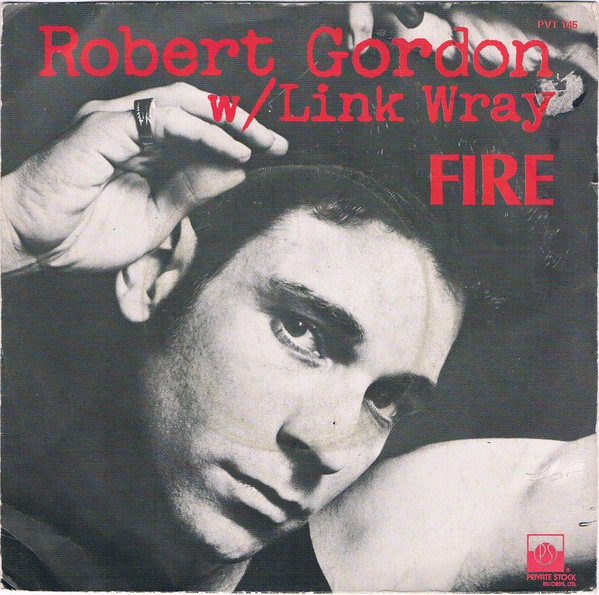
Robert Gordon – Fire

A few weeks back Randy from Mostlymusiccovers was listing songs with Rock and Roll in the title and mentioned Robert Gordon. I knew I knew the name and I remember CB mentioning him a while back and I’ve been in a rockabilly mood recently and have been listening to him.

Bruce Springsteen wanted Elvis to do this song but Elvis died in 1977 soon after Bruce wrote it. Springsteen offered it to Robert Gordon after seeing him perform live. This 1977 recording features Link Wray on guitar and Springsteen on piano. “Fire” would become a hit later that year when it was recorded by the Pointer Sisters. After listening to it…I do understand why he offered it to Gordon. He did a fantastic job with it and yes…you can hear Elvis in his version.

The man sounds like he should have been born earlier and active through the fifties.  He helped kickstart the worldwide rockabilly revival in 1977 with the release of his debut album, Robert Gordon With Link Wray, made in tandem with the guitar legend behind the 1958 instrumental hit Rumble.

Everyone thought he would be huge. His producer was Richard Gottehrer and he helped launch the careers of Madonna, Blondie, The Ramones, and The Talking Heads. Gordon did pave the way for future rockabilly acts like The Stray Cats that came in the 80s. He also shined a much-needed light on the legendary guitarist Link Wray. He saw Wray playing the oldies circuit and convinced Wray to play guitar with him.

Much like The Yardbirds and John Mayall…Gordon had a knack for picking great guitar players to play with him. Chris Spedding (a versatile session guitarist), Danny Gatton (toured with Roger Miller and others), Eddie Angel, Quentin Jones, and, most recently, Danny B. Harvey. Gordon’s 2020 album Rockabilly For Life had players such as Albert Lee, Steve Wariner, and the great Steve Cropper.

From 1977 to 2022 he made 12 studio albums and 4 live albums. Gordon died in 2022 of acute myeloid leukemia.

Robert Gordon: “I’ve always done my thing. I choose the songs, and I let the guitarists do their thing. I don’t step on their territory, but I like to hear what I like to hear, and it works out good. When you’re working with people like Chris Spedding and Danny Gatton, you don’t have to tell them too much. These guys have been there and done that, and they’re the best. I always let them do their thing before I open my mouth.” 

Fire

I’m drivin’ in my car, you turn on the radio
I’m pullin’ you close, but you just say no
You say you don’t like it, but girl I know you’re a liar
‘Cause when we kiss, ooh, fire

Late at night, I’m chasin you home
I say I wanna stay, you say you wanna be alone
You say you don’t need me, but you can’t hide your desire
‘Cause when we kiss, ooh, fire

You’ve had a hold on me right from the start
It felt so good, I couldn’t tear it apart
Got my nerves all jumpin’, actin’ like a fool
‘Cause your kisses they burn, but your heart stays cool

Romeo and Juliet, Samson and Delilah
Baby, you can bet the love they couldn’t deny
Well, now your words say split, but your words they lie
‘Cause when we kiss, ooh, fire

Oh-oh, fire
Mm-mm, fire
Oh-oh, fire
Oh-oh, fire

Leon Redbone – I Ain’t Got Nobody

In the seventies, I would sometimes sneak a peek at SNL when I was a kid. I wasn’t old enough to get the jokes but I liked the music. This was back when Lorne Michaels would actually take a chance and let someone play that wasn’t on the charts or “hot.” He was so different then. The way he looked, sounded and presented himself. You would expect Mark Twain to pop out at any moment.

This guy I could never forget. In the middle of disco and punk, he was a throwback from the 1920s or so. Leon Redbone’s musical style was shaped by his deep love for early jazz, blues, and country music. He spent countless hours studying the recordings of legendary artists from the 1920s and 1930s, seeking to recreate the sound and feel of that era. This dedication, coupled with his exceptional talent and passion for music, allowed him to develop a truly unique style that set him apart from his contemporaries.

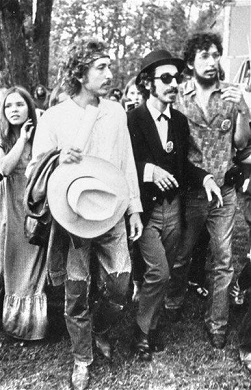
Redbone and Bob Dylan

Bob Dylan himself said that if he owned a record company, he would sign Leon Redbone. Soon thereafter, Leon Redbone did sign with a major label, Warner Brothers.

Redbone was one of the best vocalists of his time. He basically gave  1970’s audiences vintage music at a time when nobody was asking for it. He mixed blues of various dialects and included them in his musical performances along with early country, ragtime, tin pan alley favorites, and songs from America. He played music that was so far out of the mainstream he was labeled an eccentric. The truth of the matter was that it was beautiful music played brilliantly.

This song was off on his 1994 album Whistling in the Wind. If you want something different find some Leon Redbone, sip on a Mint Julep, and enjoy life. I wish I would have caught him live in concert. He passed away on May 30, 2019, at the age of 69.

I Ain’t Got Nobody

I ain’t got nobody and nobody cares for me
I got the blues, the weary blues

There’s a saying going ’round and I begin to think it’s true
It’s awful hard to love someone, when they don’t care ’bout you
Once I had a lovin’ man, as good as many in this town
But now I’m sad and lonely, for he’s gone and turned me down, now

I ain’t got nobody and nobody cares for me
I got the blues, the weary blues

And I’m sad and lonely, won’t somebody come and take a chance with me?
I’ll sing sweet love songs honey, all the time
If you’ll come and be my sweet baby mine
‘Cause I ain’t got nobody, and nobody cares for me

Won’t somebody go and find my man and bring him back to me
It’s awful hard to be alone and without sympathy
Once I was a loving gal, as good as any in this town
But since my daddy left me, I’m a gal with her heart bowed down

Jerry Reed – Amos Moses

Well I wonder where the Louisiana sheriff went to?

I can still see the 8-track of Jerry Reed’s greatest hits in my stepdad’s truck. Jerry was a great guitar player but that gets lost sometimes because of his later acting career. He played guitar on his own recordings, as well as on sessions for Elvis, Bobby Bare, Porter Wagoner, Joan Baez, Ringo Starr, Willie Nelson, and others.

Whenever I read or think about the best guitarists…I think Jimi Hendrix (my favorite), Eric Clapton, Duane Allman, Jimmy Page, SRV, and others. Some guitarists seem to be left out in the country field. Jerry Reed, Roy Clark, and perhaps the greatest of them all…Glen Campbell. Jerry Reed’s style is what I always called “chicken picking” and he was one of the greats.

Frankly, I was surprised when I checked Billboard and saw how successful he was in the charts. He had 51 songs in the Country 100 charts…including three number 1’s and six top ten hits. In the Billboard 100, he had ten songs in the top 100 including two top 10 hits. Amos Moses was one of them… peaking at #8 in the Billboard 100 and #16 in the Country Charts in 1971…The other song was When You’re Hot, You’re Hot at #9.

The song’s popularity further established Reed as a prominent figure in the country music scene. His last number-one in the country charts was “She Got the Gold Mine (I Got the Shaft)” in 1982… Why did I mention it? How could I not with a title like that?

The song appears in the video game Grand Theft Auto: San Andreas. Chet Atkins produced this recording.

This is from Guitar Player magazine.

WHEN PEOPLE TALK ABOUT UNDERRATED guitarists, the name Jerry Reed often doesn’t even come up. That’s how underrated Jerry Reed is. More often viewed as an actor, singer, or variety show regular, Reed possessed mindboggling guitar technique that incorporated intricate fingerpicking, gorgeous cascading harp-style runs, and an infectious, funky sense of rhythm and humor. He got his start as a songwriter, penning “Crazy Legs” (which would be covered by Gene Vincent and later inspire an album of the same name by Jeff Beck) and “Guitar Man,” which caught the ear of Elvis Presley. By the mid-’60s, Mr. Guitar himself, Chet Atkins, had taken note of Reed’s amazing fingerstyle prowess and began producing and collaborating with Reed, most notably on the albums Me & Jerry and Me & Chet.

Amos Moses

Yeah here comes Amos
Now Amos Moses was a Cajun
He lived by himself in the swamp
He hunted alligator for a living
He’d just knock them in the head with a stump
The Louisiana law gonna get you Amos
It ain’t legal hunting alligator down in the swamp boy

Now everyone blamed his old man
For making him mean as a snake
When Amos Moses was a boy
His daddy would use him for alligator bait
Tie a rope around his neck and throw him in the swamp
Alligator bait in the Louisiana bayou
About forty-five minutes southeast of Tippitoe, Louisiana
Lived a man called Doc Mills South and his pretty wife Hannah
Well, they raised up a son that could eat up his weight in groceries
Named him after a man of the cloth
Called him Amos Moses, yeah

Now the folks around south Louisiana
Said Amos was a hell of a man
He could trap the biggest, the meanest alligator
And he’d just use one hand
That’s all he got left cause an alligator bit it
Left arm gone clear up to the elbow

Well the sheriff caught wind that Amos was in the swamp trapping alligator skin
So he snuck in the swamp gonna get the boy
But he never come out again
Well I wonder where the Louisiana sheriff went to
Well you can sure get lost in the Louisiana bayou
About forty-five minutes southeast of Tippitoe, Louisiana
Lived a cat called Doc Mills South and his pretty wife Hannah
Well, they raised up a son that could eat up his weight in groceries
Named him after a man of the cloth
Called him Amos Moses

Sit down on ’em Amos!
Make it count son
About forty-five minutes southeast of Tippitoe, Louisiana
Lived a man called Doc Mills South and his pretty wife Hannah

Lynyrd Skynyrd – Call Me The Breeze

I’ve been in a J.J. Cale mood for a while so here is another one of his songs made popular by someone else and he was happy about it.

Like Eric Clapton… Lynyrd Skynyrd helped Cale finance his lifestyle, allowing him to release albums in a leisurely fashion. Cale didn’t like fame and tried to avoid it. On his first seven albums, he didn’t include a picture of himself.

Of Skynyrd’s rendition of “Call Me the Breeze,” Cale said that it afforded him the money to have more freedom in how and when he made his music and was always honored when other artists covered his songs. This was a popular song by the band but never was released as a single. It has become a staple of classic rock radio though since the format started. It appeared on Second Helping released in 1974.

Instead of following Cale’s more stripped-back lead on the track, Skynyrd amped the song up with a more rock style. With Van Zant’s vocals and King, Collins, and Rossington’s guitars it became a concert favorite. Throughout the years, “Call Me the Breeze” has been covered by Johnny Cash with his son John Carter Cash, Shooter Jennings, Bobby Bare, Peter Frampton, John Mayer, and more.

When Cale died in 2013 from a heart attack, Clapton paid tribute to his friend by including a rendition of “Call Me the Breeze” and other tracks for a Cale tribute album in 2014, The Breeze: An Appreciation of JJ Cale, which also features Willie Nelson, Tom Petty, Mark Knopfler, and John Mayer.

Lynyrd Skynyrd thought a lot of J.J. Cale. They didn’t record covers very often but they covered Cale twice with this one and a song called Same Old Blues off of the 1976 album Gimme Back My Bullets.

Call Me The Breeze

Call me the breeze
I keep blowin’ down the road
Well now they call me the breeze
I keep blowin’ down the road
I ain’t got me nobody
I don’t carry me no load

Ain’t no change in the weather
Ain’t no changes in me
Well there ain’t no change in the weather
Ain’t no changes in me
And I ain’t hidin’ from nobody
Nobody’s hidin’ from me
Oh, that’s the way it’s supposed to be

Well I got that green light baby
I got to keep movin’ on
Well I got that green light baby
I got to keep movin’ on
Well I might go out to California
Might go down to Georgia
I don’t know

Well I dig you Georgia peaches
Makes me feel right at home
Well now I dig you Georgia peaches
Makes me feel right at home
But I don’t love me no one woman
So I can’t stay in Georgia long

Well now they call me the breeze
I keep blowin’ down the road
Well now they call me the breeze
I keep blowin’ down the road
I ain’t got me nobody
I don’t carry me no load
Oooh Mr Breeze

Max Picks …songs from 1982

1982

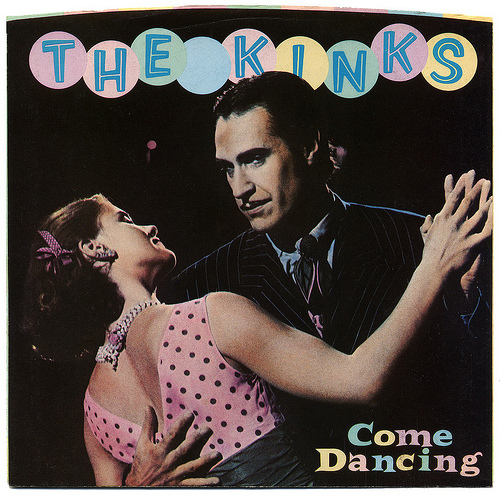
Kinks – Come Dancing – I saw the Kinks on this tour. It remains one of the best concerts I’ve ever been to…if not the best. They were in their early forties at this point and all over the stage. This song got heavy play on MTV at a time when I watched it. The Kinks are one of the four walls that make up modern rock including The Beatles, Who, and Stones.

Dexys Midnight Runners – Come On Eileen – It was very different than what was on the radio at the time. It was a refreshing song to hear in the early eighties.

I really thought this band would score another hit but they ended up a one-hit wonder in America…one thing that didn’t help was when they were opening up for David Bowie in France, Kevin Rowland called Bowie a bad copy of Bryan Ferry and later he told the British press: “We only agreed to the show because France is an important market for us – not because I have any respect for Bowie”… Not a smart thing to do.

Billy Joel – Allentown – A great single by Billy Joel with a song off of the Nylon Curtain album.

Allentown is a town in Northeast Pennsylvania about 45 minutes away from the Pocono mountains. An industrial town, many of the once-thriving factories and mills had fallen on hard times when Joel wrote the song, and unemployment in the area was at an all-time high of 12%.

Also mentioned in the song is nearby Bethlehem, Pennsylvania, whose main employer, Bethlehem Steel, had been closing operations. Joel sings about the unemployed workers in the line, “Out in Bethlehem they’re killing time, filling out forms, standing in line.”

Judas Priest – Living After Midnight -I liked this one the first time I heard it. I never really cared what a band was…as long as they sounded good…and this does.

John Lennon has a distant connection to this song. Judas Priest was renting Tittenhurst Park (John Lennon’s former home) in 1980 to record their album British Steel. As they were watching television…guitarist Glenn Tipton said they saw John Lennon’s Imagine video and were in the very same room where it was filmed… he said they could imagine the piano and the white walls…and how surreal it was…

Rob Halford actually got the inspiration for the lyrics for Living After Midnight as his bandmates kept him awake by blasting out riffs and drum beats in the studio below.

He came downstairs to complain and said, Hey, guys, come on. It’s gone midnight…and they wrote the song.

Madness – Our HouseAt the start of MTV the small town I lived in had yet to get cable…but it wouldn’t take too long. At that time I had to travel to relatives in Nashville before I got a chance to see it. I would spend the weekend and we would watch MTV for hours at a time. Binge-watching before binge-watching was a saying. We would wake up bleary-eyed the next day and turn on more MTV.

I did find some music I never heard before. This band and song caught my attention. The song was on the The Rise & Fall album. They were different…they have been described as a British ska and pop band.

This was Madness only top-10 hit in the US. Much of the song’s success in America was helped out by the clever music video that was in heavy rotation in the early days of MTV.

Animal House

I never go too long without watching this movie because I love it. It started a new style of comedy movies although the copies never measured up to the guys at the Delta Tau Chi fraternity.

This was an ensemble movie but make no mistake…it was built around the force of nature that was John Belushi. Lorne Michaels has said that Belushi lived 3 different lives a day with 3 eight hour shifts. A set of different friends for each shift. Belushi hung out with rock stars, authors, and actors constantly.  Keith Richards, Ronnie Wood, Bill Kreutzmann, Robin Williams, Robert de Niro, Akyroyd, and also with Hunter S. Thompson. The rock equivalent would probably be Keith Moon.

The movie changed college life forever. My dad took me to a Tennessee Vol game in the early eighties, around 2-3 years after this movie. I walked around campus and out of two different dorms I heard Louie Louie blasting and yes a party going on at 10am.

Movies…some that were inspired by this movie were the American Pie films, Old School, and The Hangover. The movie also opened the door to music comedies. The playing of classic rock and R&B songs in the movie. Like the Blues Brothers that came the following year…they shined the light on some early classic songs. It also spawned some terrible knockoff movies but it’s not its fault.

I love watching the adventures of Bluto, D-Day, Pinto, Otter, Flounder, Hoover, Stork, and the list goes on. Some great scenes in this movie are The Cafeteria scene with Bluto (See if you can guess, what I am now), the initiation, the bar scene, and so on…the ending is great.

This is on many lists of movies that have been deemed “Politically Incorrect”…that makes me want to watch it even more.

Jackson Browne – Running On Empty

The album Running On Empty album was always very interesting to me. He basically made a new album in front of audiences and in hotels. The songs were not his old songs…they were songs he would have ordinarily gone into a studio with. This song was recorded at the Merriweather Post Pavilion in Columbia, Maryland on August 27, 1977. It was the first live rock album with all new songs.

The album and song were about life on the road in all its glory and squalor. To emphasize this notion even further, Browne literally recorded the album on the road, in hotel rooms, on buses, and, in the case of “Running On Empty,” on stage.

The dates and ages given in the song (“In ‘65 I was seventeen” and “In ‘69 I was 21”) synch up with Jackson’s own timeline. He imagines a life spent running for so long that it becomes difficult to know where it all started or where it will end. He is not looking back in the song…he sings it in the present tense. He wrote about himself and where he was at in 1978.

In 1976 Browne had a terrible year. His wife, model Phyllis Major, had committed suicide, leaving Browne to raise their toddler son alone. The grief of her death permeated his fourth album, The Pretender. You can hear it in the single off of that album, “Here Come Those Tears Again,” co-written by Major’s mother, Nancy Farnsworth.

The song’s title track and opening cut blasted strong right out of the gate, landing on radio playlists across the country as the single soared up the charts. The single peaked at #11 on the Billboard 100 and #4 in Canada.

The album peaked at #3 on the Billboard Album Chart in 1978. and #8 in Canada (the best I can find) in 1978.

Jackson Browne: “I’ve always been real close with my crew, as a matter of fact, the guy who’s my manager now. Lines like, “The first to come and the last to leave,” come from him. His name’s Buddha. He’s a guy that you’d wind up spending an incredible amount of time with… people that you’d get to know because the closeness. These guys work really hard, and at least in those days they really did make practically the minimum wage.”

Running On Empty

Looking out at the road rushing under my wheels
Looking back at the years gone by like so many summer fields
In sixty five I was seventeen and running up 101
I don’t know where I’m running now, I’m just running on

Running on, running on empty
Running on, running blind
Running on, running into the sun
But I’m running behind

Gotta do what you can just to keep your love alive
Trying not to confuse it with what you do to survive
In sixty-nine I was twenty-one and I called the road my own
I don’t know when that road turned, into the road I’m on

Running on, running on empty
Running on, running blind
Running on, running into the sun
But I’m running behind

Everyone I know, everywhere I go
People need some reason to believe
I don’t know about anyone but me
If it takes all night, that’ll be all right
If I can get you to smile before I leave

Looking out at the road rushing under my wheels
I don’t know how to tell you all just how crazy this life feels
Look around for the friends that I used to turn to to pull me through
Looking into their eyes I see them running too

Running on, running on empty
Running on, running blind
Running on, running into the sun
But I’m running behind

Honey you really tempt me
You know the way you look so kind
I’d love to stick around but I’m running behind
You know I don’t even know what I’m hoping to find
Running into the sun but I’m running behind

Ry Cooder – How Can A Poor Man Stand Such Times and Live?

Last week I was talking to CB about the song Prodigal Son by the Reverend Robert Wilkins and The Stones. It turns out that Ry Cooder has a song with the exact name but a different song entirely. That got me listening to Cooder this week and this title alone drew me in.

This song was written by Blind Alfred Reed and was first recorded in 1929, a protest song about the Great Depression, prohibition, and poverty. Blind Alfred Reed was, in fact, born blind as was another sibling. He played the fiddle on street corners throughout West Virginia and Virginia. This song is considered an early example of a protest song.

This song holds some relevance today. It was on Ry Cooder’s self-titled debut album released in 1970. He is joined, amongst other long-time friends like producer Van Dyke Parks, percussionist Milt Holland, country rock bassist Chris Ethridge, and Little Feat’s drummer Richie Hayward and bassist Roy Estrada.

Cooder is an excellent musician and one of the great slide players of our time. Cooder also contributed to the Rolling Stones albums Let It Bleed and Sticky Fingers and was looked at briefly as a replacement for Brian Jones. Some say he wrote the riff to “Honky Tonk Woman.”

Bruce Springsteen covered it on his nightly Seeger Sessions Tour in 2006 and as a bonus track on the American Land edition of his We Shall Overcome: The Seeger Sessions album.

How Can a Poor Man Stand Such Times and Live?

Well, the doctor comes around with his face all brightAnd he says, “In a little while you’ll be all right!”All he gives is a humbug pill,Dose of dope and a great big billTell me, how can a poor man stand such times and live?

Well, there once was a time when everything was cheapBut now prices nearly put a man to sleepWhen we get our grocery bill,We just feel like making our willTell me, how can a poor man stand such times and live?

Prohibition’s good if it’s conducted rightThere’s no sense in shooting a man ’til he shows flightOfficers kill without a cause,Then they complain about the funny lawsTell me, how can a poor man stand such times and live?