Johnny Otis – Willie and the Hand Jive

I believe I first heard this by Eric Clapton in the late seventies when I was a kid. I always liked the song but this version is great as well. It’s the cool rhythm that draws me in. One of the best and most copied rhythms in rock.

In some circles, Otis was known as “the godfather of rhythm and blues.” He was a multi-talented musician, known primarily as a drummer, vibraphonist, pianist, singer, and composer. He led his own band, the Johnny Otis Orchestra, which played a significant role in the development of West Coast rhythm and blues.

He earned that title. He helped in discovering and promoting such musicians as Etta James, Big Mama Thornton, and Jackie Wilson. Otis was a white musician who immersed himself in black music and culture. He was accepted in that community and became an advocate for racial integration and civil rights. Otis was also a popular radio DJ, hosting shows that showcased rhythm and blues music and spreading the word of that genre.

Johnny wrote this song and released it in 1958. It peaked at #1 on the Billboard R&B Charts and #9 on the Billboard 100. It’s one of the most catchy rhythms in rock and roll next to the Bo Diddley rhythm or Who Do You Love…it very well could be called a variation of Bo Diddley.

When he played this live his audience would mimic a dance and clap they had to the song. Some had said that the song was about masturbation…something that Johnny Otis denied until he passed away in 2012 at the age of 90. I think some people spend their lives trying to find something controversial in everything. I guess I’m guilty of it at times.

According to secondhandsongs.com there are 69 versions of this song. Artists that covered the song include Cliff Richard, The Crickets, Sonny Burgess, The Gentrys, The Tremeloes, New Riders of the Purple Sage, Fleetwood Mac, Eric Clapton, George Thorogood, and I’ve heard The Grateful Dead do it live on a few clips I’ve seen.

Willie and the Hand Jive

I know a cat named Way-Out WillieHe got a cool little chick named Rockin’ BillieDo you walk and stroll with Susie QAnd do that crazy hand jive too?

Papa told Willie “you’ll ruin my homeYou and that hand jive has got to go”Willie said “papa, don’t put me downBeen doin’ that hand jive all over town”

Hand jive, hand jiveHand jive, doin’ that crazy hand jive

Mama, mama, look at uncle Joe, look at himHe’s doin’ that hand jive with sister FloEven gave baby sister a dime, hey, heySaid “do that hand jive one more time”

Well, a doctor and a lawyer and a indian chiefThey all dig that crazy beatWay-Out Willie gave them all a treat, yeahWhen he did the hand jive with his feet

Hand jive, hand jiveHand jive, doin’ that crazy hand jive, hey, heyCome on, sugar, yeah!

Well, Willie and Billie got married last fallThey had a little Willie Junior and that ain’t allYou know that baby got greatness and it’s plain to see, hey, heyDoin’ that hand jive on T.V., come on

Hand jive, hand jive(Why don’t you) hand jive, doin’ that crazy hand jive

Hey, hey, wellYeah, yeah

Lightnin’ Hopkins – Shotgun Blues

You know I’m gonna shoot my woman
Cause she’s foolin’ around with too many men

Before I start this I want to thank Randy from Mostly Music Covers. While writing this up the song title I had was “Bring Me My Shotgun” but I couldn’t find the album it was on. I’m a babe in the woods with blues…so I asked Randy and Shotgun Blues was recorded in 1948. As far as I can tell he did re-record many of his songs and this one around 1960. I’ll include the earlier version of Shotgun Blues and the 1960 version named Bring Me My Shotgun..at least for this post. He would change up the lyrics in some versions. What made it confusing was that he changed the way he did the vocals a little as well… again thank you, Randy.

I’m sitting with headphones on listening to Lightnin’ Hopkins and it’s like he is in the room with me. I’ve never posted anything about him before but I wanted to clear that up today.

He was born in Texas and He grew up in a musical family and learned the blues from his older cousin, country blues legend Blind Lemon Jefferson. Jefferson and Hopkins started to play together at church gatherings. Hopkins started performing in the 1920s and 1930s in the local Texas blues scene. By the mid-30s Hopkins was sent to a prison farm but the reason is unknown. He described working on a road gang and being shackled to his bunk at night.

In the mid-1940s he was teamed with a Houston piano player named Wilson “Thunder” Smith. They were known as Thunder an’ Lightnin’ and they had a local hit named Katie May with Aladdin Records. Hopkins would record with many different labels throughout the rest of his life. The Folk-Blues revival was stirring in 1959, and Folkways producer Sam Charters persuaded Lightning (with the help of a bottle of gin!) to record 10 tracks in the shabby room where he had been living in Houston. I have one of them below called “Hopkins Sky Hop.” Bring Me My Shotgun was released in 1960.

He started to get popular, especially with the British white soon-to-be musicians. He worked the College and club circuit, toured Europe with the Folk/Blues Festival, and starred at the Newport Folk Festival in 1965. He found an appreciative new audience of rock fans who heard this great guitarist who lived the blues.

He later headlined over the Jefferson Airplane and he played with the Grateful Dead a few times. He recorded dozens of albums through the 60s and 70s. He finally left us in 1982.

Bring Me My Shotgun

Woah, go bring me my shotgun
Oh I’m gonna start shootin’ again
Go bring me my shotgun
You know I just got to start shootin’ again
You know I’m gonna shoot my woman
Cause she’s foolin’ around with too many men

Yes bring me my shotgun
Yes man and a pocket full of shells
Yes go bring me my shotgun
Yes man and a pocket full of shells
Yeah you know I’m gonna kill that woman
I’m gonna throw her in that old deep dug well
Hide her from everybody they won’t know where she at

That woman said Lightnin’ you can’t shoot me
She said now you is dead of tryin’
I don’t take a day off for nobody
She said Lightnin’ you can’t shoot me
She said yes and you dare to try
I said the only reason I don’t shoot you little woman
My double barrel shotgun, it just won’t fire

Jimmy Simpson – North To The Last Frontier

This post is more personal for me. Jimmy Simpson was my uncle…my mom’s brother. The man got around and had an interesting life. He was an extra in some movies (the one I know is The Alamo) because of his friendship with John Wayne and James Arness. He was built like them and reminded me of both.

He was born in 1928 and moved out of Tennessee in the early 50s and went to Florida and ended up in Texas working in oil fields while playing at night at clubs. He would go to gigs in Tennessee, Arkansas, Florida, Louisana, Texas, and everything in between. He wasn’t an amateur…he played with some big players like Jim Reeves’ Blue Boys.

He recorded some singles while living in Nashville and Texas. Jimmy and his wife got to know Jimmie Rodger’s widow which this below sounds like it’s heavily influenced by.

He then moved to Alaska in the late 50s to mine for gold which he was successful at. He bought into a snowmobile factory there and played country music in bars in Alaska and Canada. He also released a few albums and charted on local charts in Alaska and Canada.

Simpson Earnest Tubb
Nashville, mid-1950s. From left: Billy Byrd, Ernest Tubb, Jimmy Simpson. Courtesy Jimmy Simpson.

My dad’s side of the family made guitars and they gave Jimmy an acoustic. Gower guitars are compared to Martins and still get really high prices at shops and on eBay. He had that guitar stolen while playing in Alaska…he finally chased the guy down and got the guitar back. The man tore out one of the serial numbers inside the guitar but didn’t get by with it…and knowing my uncle Jimmy the dude was probably missing some teeth afterward. My uncle was a man’s man. He told me about it…“Max…you don’t mess with a man’s guitar…you just don’t.”

Around six months before my uncle passed away in 2014, he came by and gave me that guitar and another one his daughter once owned that our family made. I asked him why because he treasured those guitars (his daughter passed away a few years earlier) and he said, “I want you to have them before I pass away to make sure you get them.” He was 86 at the time. I will treasure them and I play them a lot. I would include a picture but they are getting serviced right now.

He also had an autobiography published in the mid-90s called A Vanishing Breed: The Gold Miner that I read and he lived 3 lifetimes in one. I remember as a kid him showing me this bag of gold…pieces as big as a quarter and very thick. You know it’s a shame…so many questions I would love to ask the man now.

Here is one recording from 1956… I’ll copy what it says from the wired-for-sound.blogspot.com. It’s called “Blue As I Can Be“…it has a little of the Johnny Cash sound in it.

Jimmy Simpson, Tennessee honky tonk singer, Texas oilfield wildcatter, and Canadian gold digger made this one superb session in a West Monroe, Louisiana radio station studio in 1956 with Bobby Garrett (steel) and Leo Jackson (lead guitar), both on hiatus from Jim Reeves’ Blue Boys. Records and gigs weren’t paying Jimmy’s rent, so he picked up jobs working in Texas oil fields for much of the 1950s, before moving to Alaska in 1957.

“I lived at Greggton, Texas (in 1956-57),” Jimmy said in an interview. “We were on our way back from Nashville to San Angelo, and we stopped at Greggton…little town just out of Longview. We had everything we owned in the car. I had my work shoes and my hardhat, ‘cause I could always go to work on an oil rig if everything else failed. In a little restaurant there in Greggton, there was a driller in there that was short-handed, and I overheard ‘em talking. I walked over there and said, “You looking for a derrick man?” He said, “Yeah. You got your work shoes and hardhat with you?” I said, “I got it all underneath the trunk of my car.”

At the time of this session, Jimmy was appearing at the famed Reo Palm Isle club in Longview. “That’s Bobby and Leo (on the session). I forget who that bass player was. He was from Monroe. I’m on rhythm guitar. I didn’t carry a fiddle at that time, but when I was in San Angelo at the Peacock Club, I had two steels and a fiddle. Everybody else would talk about two fiddles. I didn’t make any money up there myself. I was working on an oil rig. But I thought it would be different… Jiffy (Fowler) was a jukebox operator. I just kind of stumbled into him. It was a disc jockey there in Monroe, Ed Hamilton, who set us up in there and turned us loose…You know why that ‘Blue As I Can Be’ come by? Johnny Horton’s ‘I’m a Honky-Tonk Man.'” Two other songs recorded at this session were released on Big State 595 in the Starday custom series.

Ronnie Dawson

Again…a big thank you again to Phil Strawn who gave me the necessary information so the story could be told and much of it from a personal view.

One of the performers in The Big D Jamboree was Ronnie Dawson. He was from Dallas Texas and was nicknamed “The Blonde Bomber.” His father Pinkie showed him how to play the mandolin, drums, and bass guitar. Dawson attended Southwestern Bible Institute in Waxahachie but was expelled. After that, he appeared regularly on the Big D Jamboree Radio Show in Dallas in 1958 as Ronnie Dee and the D Men.  Dawson was known to be highly energetic on stage. Many thought he got it from Elvis but he said no, he learned it from the dynamic Pentecostal revivals he attended.

The Jack Rhodes song “Action Packed” was Dawson’s first release in 1958 on the Backbeat label. After that came the 1959 Rockin’ Bones and this time it was on the Rockin’ Records label. It was issued under Ronnie’s own name with “The Blond Bomber” added. Though Ronnie toured nationally with Gene Vincent and appeared on TV, his records gained no more than regional airplay.

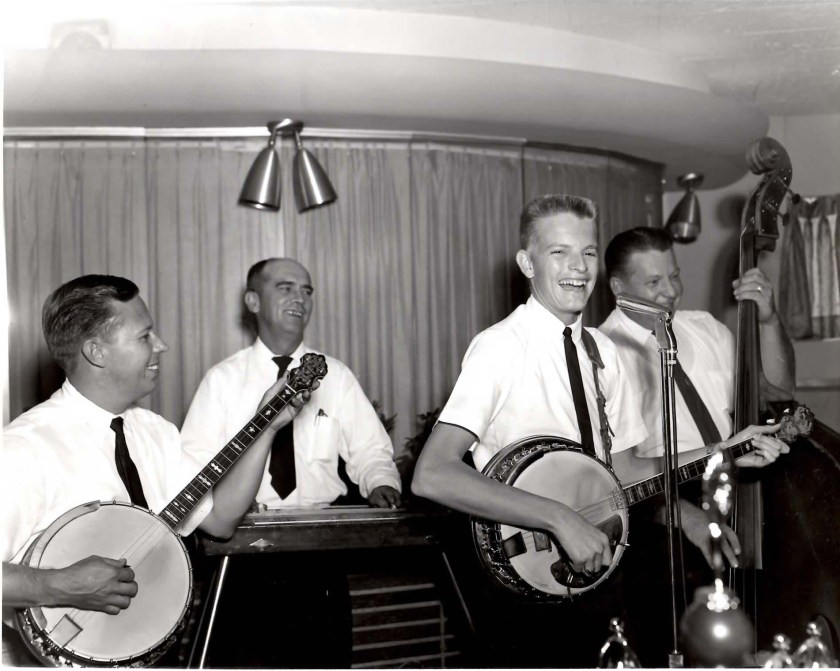
The next 3 paragraphs are from Phil. Back in the early ’60s, there was a club on Mockingbird Lane in Dallas called The Levee. It was a sing-along Dixieland place that was popular at the time. The band was banjos, a doghouse bass and a clarinet and sax. Burgers and pitchers of beer made up the menu. Southern Methodist University was two blocks away, across Highway 75, so most of the clientele were students and couples in their twenties. The famous Egyptian Lounge was next door. It served the best Italian food in Dallas and was a known hangout for the Dallas Mafia and other wise guys.

EPSON MFP image
At a Levee Singers gig at the Adolphus Hotel in Dallas, around 1961 or 62. Phil’s dad is also playing a tenor banjo, as is Ronnie.

Smokey Montgomery, the banjo player for the Light Crust Doughboys, started the Levee with Ed Burnett, who was also his partner in Summit Sounds, a well-known recording studio on Greenville Ave. Ronnie was playing with the Doughboys, so Smokey asked him to play with the banjo band in order to add some youth to the mix. He was a huge hit, and the business tripled. The coeds loved him; their boyfriends hated him. The Levee bounced along all through the 60s until the fad went flat. In the mid-70s, Ronnie was into the progressive country music scene and started a band called The Steel Rail. I don’t remember the drummer, lead, or bass players’ names, but the legendary Tommy Morrell played the pedal steel while Ronnie sang and tore up his Strat.

The old Levee club was empty, so Ronnie leased the space and opened a club called “Aunt Emma’s,” a nod to his favorite aunt. On opening night, Ronnie asked my dad to come down and add some fiddle to the band, which he did. I took my guitar, just in case he needed another player. The place was full up, with a line down past the Egyptian. Around 11 pm, Johnny Paycheck strolled in the door. He had finished a gig in Dallas and heard about Ronnie’s new club, so he stopped by to sit in. Of course, he did all of his hits and played for at least an hour. After that, word got around that Aunt Emma’s was the place to go for the new outlaw country; it out-drew Willie Nelson’s Whiskey River which was a few blocks away on Greenville Ave. 

He made several singles in the early sixties with Dick Clark’s Swan Records. He also did some session work. He played on Paul & Paula’s “Hey Paula. After Elvis died rockabilly started to make a comeback.

Dawson’s career experienced periods of obscurity. However, he continued to perform and record music throughout his life, earning a cult following among rockabilly enthusiasts. In the 1980s and 1990s, he experienced a resurgence of interest in his music, performing at festivals and recording new albums.

In the 1980s Ronnie was just beginning. A fifties revival was happening in the UK and he became popular there. This led Dawson to tour Britain for the first time in 1986. He was blown away by the audience’s reception. Dawson sounded purer than most of his peers from the 1950s and he put on a more energetic show.

He recorded new material for No Hit Records, the label of British rockabilly fan Barry Koumis, which was leased in the USA to Crystal Clear Records. No Hit Records also reissued his recordings from the 1950s and early 1960s on a 16-track LP called “Rockin’ Bones” and an extended 2-CD version of which was released by Crystal Clear in 1996.

Ronnie was still performing until the early 2000s when health problems started.  He passed away in Dallas on September 30, 2003, at the age of 64.

Phil Strawn: He was a great guy and close friend. After his death from lung cancer, which shocked us all because he never smoked cigarettes but did partake of other smokable plants, his wife, Chris, held a wake at the Sons of Herman Hall in Deep Ellum. You couldn’t stir the musicians and rock stars with a stick; the ballroom on the second floor was packed. I remember Billy Joe Shaver, Ray Wylie Hubbard, Michael Martin Murphy, Robert Earl Keen, and Robert Duvall being there. George Gimarc, a noted Texas music historian, has a treasure trove of photos and reel-to-reel recording tapes of Ronnie dating back to the Big D Jamboree and American Bandstand. He refuses to share or part with any of his collections. I told him, that’s okay, leave a few to me when you bite the dust. There is no need for me to approve of your article; you write great music history, and Ima sure this one will also be stellar.

Ronnie Dawson:  “At that point in my life, I was so ready to get out of Dallas. I was really ready to go, and I just blew up when I got over there. … I couldn’t believe it. All these people started embracing me. I was in heaven. I didn’t want to go home.”

He was inducted into the Rockabilly Hall of Fame, in 1998.

Joyce Green

I want to thank Dave for posting this for Turntable Talk a few weeks ago.

When I heard Joyce Green for the first time in 2021, I was blown away. I was thinking…how in the hell was this woman not huge in the 50s and early 60s? She made possibly my favorite ever rockabilly song.

I hesitated writing about Green because what you will hear on this post is her total discography and it wasn’t a hit. I sure wish she had been given a chance. Finding Black Cadillac was like finding a treasure to me.

She was born in 1940 and started to sing with her brothers in church in the 1950s. They eventually formed a trio and began singing at parties and picnics. The big change for Joyce was when Elvis came along. She knew exactly what she wanted to do after that.

She started on radio in 1957 on a station in Arkansas with a musician named Jimmy Douglas. Douglas eventually talked Green’s parents into allowing the 17-year-old to play in bars with one of her brothers with her. She was the only female rocker in Arkansas at the time. After that she started to tour more of the state and get recognized. She met up with Arlen Vaden who had produced records for different artists.

In 1959, Joyce and her sister Doris wrote the song Black Cadillac. She played the song for Arlen Vaden who arranged a recording session for her at KLCN in Blytheville, Arkansas. Joyce sang and played rhythm guitar on the record which included the song Tomorrow on the A-side and Black Cadillac on the B-side. I can’t believe this was a B side.

This was her only release ever…the single Tomorrow/Black Cadillac in 1959.

The song Tomorrow is a cookie cutter 1950s song, but Black Cadillac blows the roof off the joint. Joyce was only 19 and she didn’t play around in this song. She not only sings this song…she owns it, and you don’t want on Joyce’s bad side. Her voice is electric. It’s a downright shame she didn’t do much more. The quality is great.

Wanda Jackson was hitting at this time with hits. Green should have been along with her because she had talent, and that voice is as strong as you can get.

When I heard this, I thought I died and went to rockabilly heaven. A man named Tommy Holder is playing guitar and does he ever. This wasn’t a hit but it’s a treasure to find. Joyce embarked on a promotional tour with Carl Perkins to support the record. The record was never a hit and Joyce did not record again until the 1970s. These later recordings were lost in a fire… so this is it. As far as I can see…Joyce is still alive in Arkansas.

Joyce Green: “I visited the radio stations and did some stage shows with Carl Perkins and other artists. We’d also do country fairs. I believe I could have been a successful recording artist if I could have gotten the breaks I needed.”

Black Cadillac

I caught you cheatin’ and runnin’ roundAnd now I’m gonna put you in a hole in the groundI’m gonna ride to your funeralDaddy, in a black CadillacOh yeah, you think you areOh baby, but you can’t come back

Now, I’m gonna bump you offGonna tell you the reason whyYou’re worth more to me dead, daddyThan you is aliveI’m gonna ride to your funeralDaddy, in a black CadillacOh yeah, you think you areOh baby, but you can’t come back

I’m gonna buy me a pistolA great big forty-fiveI’m gonna bring you back baby, dead not aliveI’m gonna ride to your funeralDaddy, in a black CadillacOh yeah, you think you areOh baby, but you can’t come back

I’ll hire a black CadillacTo drive you to your graveI’m gonna be there babyThrow that mud in your faceI’m gonna ride to your funeralDaddy, in a black CadillacOh yeah, you think you areOh baby, but you can’t come back

I’ll wear a black mink coatA diamond ring on my handI’m gonna put you under groundI’ll find myself another manI’m gonna ride to your funeralDaddy, in a black CadillacOh yeah, you think you areOh baby, but you can’t come back

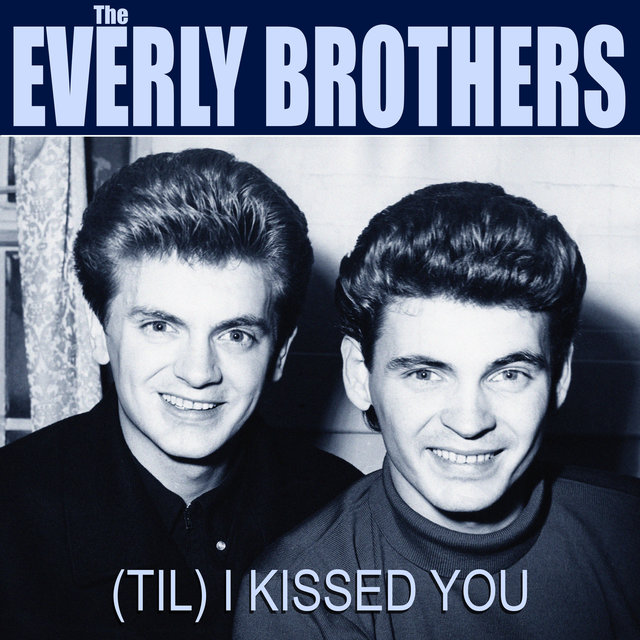
Everly Brothers – (Till) I Kissed You

I bought a compilation album in 1985 with songs like Bend Me, Shape Me, Crimson and Clover, and All I Have To Do Is Dream. Since then, I’ve been a huge Everly Brothers fan.

They did not rock like Chuck Berry, early Elvis, Little Richard, or Buddy Holly. They were different…their two voices made one complete whole voice. Their inspiration goes down the line to The Hollies, Beatles, Stones, and many of the British Invasion Bands. Keith Richards called Don Everly was one of the finest rhythm guitar players he ever heard.

(Till)I Kissed You is a catchy tune with catchy guitar riffs and the signature harmonies that the Everly Brothers were known for. Don Everly wrote this song while touring Australia. He said he wrote it about every girl he met on the tour…but especially about a girl named Lillian.

This recording features two great musicians. Chet Atkins is on guitar with Jerry Allison on drums. They were one of the pioneering acts in country rock. The Everly Brothers are members of the Rock and Roll and Country Music Halls of Fame. Though the brothers had a strained personal relationship, they didn’t speak for ten years at one point, but they managed to chart 35 top 100 singles.

The song peaked at #4 on the Billboard 100, #8 on the Billboard Country Charts, #3 in Canada, #2 in the UK, and #22 on the Billboard R&B Charts in 1959.

Don Everly:  “I wrote it about a girl I met on that trip, her name was Lillian, and she was very, very inspirational. I was married, but… you know.”

(Till) I Kissed You

Never felt like this until I kissed you
How did I exist until I kissed you
Never had you on my mind
Now you’re there all the time
Never knew what I missed until I kissed you, uh-huh
I kissed you, oh yeah

Things have really changed since I kissed you, uh-huh
My life’s not the same now that I kissed you, oh yeah
Mm, you got a way about you
Now I can’t live without you
Never knew what I missed until I kissed you, uh-huh
I kissed you, oh yeah

You don’t realize what you do to me
And I didn’t realize what a kiss could be
Mm, you got a way about you
Now I can’t live without you
Never knew what I missed until I kissed you, uh-huh
I kissed you, oh yeah

You don’t realize what you do to me
And I didn’t realize what a kiss could be
Mm, you got a way about you
Now I can’t live without you
Never knew what I missed until I kissed you, uh-huh
I kissed you, oh yeah

I kissed you, uh-huh
I kissed you, oh yeah
I kissed you, uh-huh

Clash – Brand New Cadillac

This was a great cover by The Clash. It was on the London Calling album released in 1979. They started off as a punk band but The Clash, unlike some other Punk bands, could really play and sing well…, especially Mick Jones. He was probably the best pure musician in the band.

The song was originally by Vince Taylor and released in 1959. It was the B side to a song called Pledging My Love. Taylor wrote the song but Tony Sheridan is credited with the cool guitar riff running through the song. The song’s riff reminds me of the original Batman riff…or really the other way around.

The Clash’s version of the song is the best-known. They did it in one take. It was the B side to the single London Calling. The single peaked at #46 in the UK in 1988 re-release. It also peaked at #64 with another UK re-release in 1991.

Rolling Stone magazine named London Calling the best album of the ’80s. It should be noted that it was first released in the UK in December 1979. In the US, it was released two weeks into January 1980, meaning that from a US perspective, it’s a 1980s album.

I like Vince’s version just as well… a good rock song through and through.

Brand New Cadillac

DriveDrive

My baby drove up in a brand new CadillacYes, she didMy baby drove up in a brand new CadillacShe said, “Hey, come here, daddy”I ain’t never comin’ back

Baby, baby, won’t you hear my plea?Yeah, come on, sugar, just come on back to meShe said, “Balls to you, big daddy”

Baby, baby, won’t you hear my plea?Oh, oh, come on, just hear my pleaShe said, “Balls to you, daddy”She ain’t comin’ back to me

Oh GodBaby, baby, drove up in a CadillacI said, “Jesus Christ, where’d you get that Cadillac?”She said, “Balls to you, daddy”She ain’t never comin’ backShe ain’t, she ain’t comin’ backShe ain’t never comin’ backShe ain’t never comin’ backShe ain’t never comin’ back

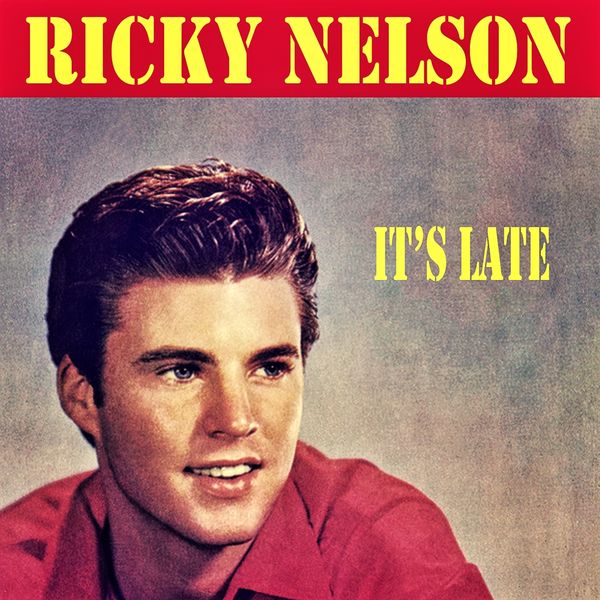
Ricky Nelson – It’s Late

Ricky Nelson was a rockabilly guy and a very good one. He gets lost in the shuffle because he was a huge teenage actor at the time on his family’s show…The Adventures of Ozzie and Harriet. Actors that switch to music are sometimes looked over but Nelson was very successful. All in all, he released 94 singles and 24 studio albums in his career. When talking about the fifties though….Chuck Berry, Fats Domino, Jerry Lee Lewis, Buddy Holly, and Elvis get brought up a lot but Nelson not as much.

It’s Late was written by Dorsey Burnette and his cousin Johnny Burnette and Dorsey released it in 1958. The following year Nelson recorded and released the song. It peaked at #9 on the Billboard 100 and  #3 in the UK in 1959.

I went through a Ricky Nelson phase when I graduated high school in 1985. I purchased a greatest hits package and was learning more songs from him. I wanted to go see him perform that year and I kept waiting for him to appear somewhere because I heard he was touring. This was before the internet and you had to look at the newspapers for any announcements and listen to the radio. Musicians would play at places and you would never know sometimes.

I never got a chance to see him because on December 31, 1985, his chartered jet crashed killing him and six other passengers.

I have to admit…I like the Dorsey Burnette version of this also.

It’s Late

It’s late, it’s lateWe gotta get on homeIt’s late, it’s lateWe’ve been gone too long

Too bad, too badWe shoulda checked our timeCan’t phone, can’t phoneWe done spent every dime

It’s late, it’s lateWe’re ’bout to run outta gasIt’s late, it’s lateWe gotta get home fast

Can’t speed, can’t speedWe’re in a slow-down zoneBaby, look at that clockWhy can’t it be wrong

If we coulda left home at a quarter to nineWoulda had fun and plenty of timeWe got started just a little bit lateHope this won’t be our last date

Look up, look upIs that the moon we see?Can’t be, can’t beLooks like the sun to me

It’s late, it’s lateI hate to face your dadToo bad, too badI know he’s gonna be mad

It’s late, it’s lateWe gotta get on homeIt’s late, it’s lateWe’ve been gone too long

It’s late, it’s lateWe’re ’bout to run outta gasIt’s late, it’s lateWe gotta get home fast

Can’t speed, can’t speedWe’re in a slow-down zoneBaby, look at that clockWhy can’t it be wrong

If we coulda left home at a quarter to nineWoulda had fun and plenty of timeWe got started just a little bit lateHope this won’t be our last date

Look up, look upIs that the moon we see?Can’t be, can’t beLooks like the sun to me

It’s late, it’s lateI hate to face your dadToo bad, too badI know he’s gonna be mad

It’s late, it’s lateWe gotta get on homeIt’s late, it’s lateWe’ve been gone too long

It’s late

Jerry Lee Lewis – Breathless

After this song his career started a decline but you could not keep this man down. He would reemerge and have a country hit filled 60s and 70s. The song swings and jumps like Jerry Lee did.

This one was released in 1958 and it peaked at #7 on the Billboard 100, #4 on the Billboard Country Charts, #3 on the R&B Charts, and #8 in the UK. It was released shortly before High School Confidential. Elvis may have had a dangerous reputation but he wasn’t…Jerry Lee was the real deal. If there was ever a wildman of rock…this man would win first prize.

We know most of the stories but forget those. It’s the music that he is remembered for. He helped shape rock and roll and it is still felt to this day. His songs even feel dangerous…he had swing in his music that carried it. He kept the same in his country songs as well.

His piano playing was different than most. He kept a boogie pattern in everything he did. He was influenced by diverse artists such as Al Jolson, Jimmie Rodgers, Hank Williams, Pentecostal preachers, and rhythm and blues music. You combine all of that and you have Jerry Lee Lewis.

On a side note…if you want to hear one of the best live albums ever…give Jerry Lee Lewis, ‘Live at the Star Club, Hamburg’ (1964) a try. It’s the same club that The Beatles played a little earlier.

Jerry Lee Lewis: “I was reading a lot of magazines about Sam Phillips and Sun Records … so I told my dad, this is the man we need to go see. And we did. We drove down from Ferriday into Memphis and pulled up in front of Sun Records. I came in and auditioned for Jack Clement, who said I could never make it playing the piano. He said rock ’n’ roll was out, cause Elvis had it all tied up. He said I could forget that. Well, I said, ‘I don’t think so.’ I said, ‘I’m a hit.’ He said, ‘They all say that, son.’ I said, ‘I’m not all. I’m different.’”

Here is another version by X.

Breathless

Now, if you love meLet’s please don’t teaseIf I can hold you thenLet me squeeze

My heart goes ’round and ’roundMy love comes a-tumblin’ downYou leave meAhhhhh, breathless-ah

Well, I shake all over andYou know whyI’m sure it’s love, honeyThat’s no lie‘Cause when you call my nameYou know I burn like wood in flameYou leave meAhhhhh, breathless

Ooh, baby! Mm-mm, crazy!You’re much too muchHoney, I can’t love you enoughNow, it’s all right to hold me tightBut when you love meLove me right

Oh, come on, babyNow, don’t be shyThis love was meant for you and IWind, rain, sleet or snowI’m gonna be wherever you goYou have left meAhhhh, breathless-ah

Oh, keep it goin’

Well, ooh, baby! Mmm-mmm, crazy!You’re much too muchI can’t love you enoughWell, it’s all right to hold me tightBut when you love meLove me right

Well, come on, babyNow, don’t be shyLove was meant for you and IWind, rain, sleet or snowI’m a goin’ to b-be wherever you goYou leave meAhhhh, breathless

Bill Haley and His Saddlemen – Rock This Joint

We’re gonna tear down the mailbox, rip up the floor
Smash out the windows and knock down the door

Bill Haley heard this song played on an R&B station and wanted to try it. It was different from the country he played. He started this off in a nightclub and people went crazy. He described it as “Cowboy Jive” and everyone rose to their feet…he knew he was on to something here. The song is credited to Doc Bagby, Don Keene, and Harry Crafton.

Bill Haley and the Saddlemen

Bill had a radio show also during this point. The man that followed him on  air was a disc jockey named Jim Reeves (not the singer Jim Reeves) and he played R&B. Haley had heard Jimmy Preston’s version of Rock This Joint on Reeves’s show. Haley had been wanting to incorporate countryfied rocking boogies in the repertoire of his band, The Saddlemen, this song seemed to him to be the perfect way to take that concept further.

The one thing I noticed about Haley’s version is guitar player Danny Cedrone’s solo… it was recycled for Rock Around The Clock…note for note. Later on…Bill Haley and his Comets would re-record this song as well.

It was released by Essex Records in 1952 but didn’t get into the national charts. Preston’s version was released in 1949 and is known as one of the first rock and roll records. In 1957 this version was rereleased in the UK and peaked at #20. That same year the Comets would rerecord it and release it but it didn’t chart.

It’s a cool early rock and roll song. There have been 16 different versions of it. Billy Swan and Reverend Horton Heat another to play it.

Rock This Joint

We’re gonna tear down the mailbox, rip up the floor
Smash out the windows and knock down the door

We’re gonna rock, rock this joint
We’re gonna rock this joint tonight
Well, six times six is thirty six
I ain’t gonna hit for six more licks

We’re gonna rock
Rock this joint
We’re gonna rock
Rock this joint
We’re gonna rock
Rock this joint
We’re gonna rock this joint tonight

Do the sugar foor rag, side by side
Flying low and flying wide

We’re gonna rock
Rock this joint
We’re gonna rock
Rock this joint
We’re gonna rock
Rock this joint
We’re gonna rock this joint tonight

Do an ol’ Paul Jones and a Virginia Reel
Just let your feet know how you feel

We’re gonna rock
Rock this joint
We’re gonna rock
Rock this joint
We’re gonna rock
Rock this joint
We’re gonna rock this joint tonight

Well six times six is thirty six
I ain’t gonna hit but six more licks

We’re gonna rock
Rock this joint
We’re gonna rock
Rock this joint
We’re gonna rock
Rock this joint
We’re gonna rock this joint tonight

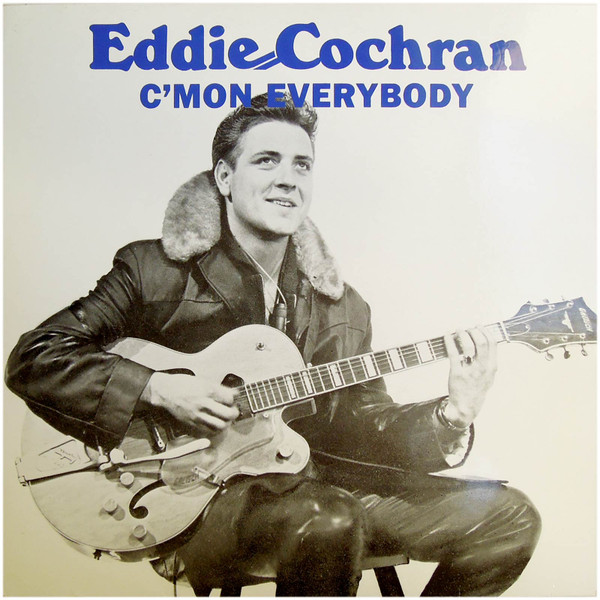
Eddie Cochran – C’mon Everybody

Don’t be a square man… listen to Eddie Cochran and play backseat bingo. Well, I thought I would try some of the fifties phrases.

Eddie Cochran was one of the first rock star guitar players…he was ahead of his time.  He didn’t use his guitar as a prop like some did (cough cough Elvis)…he played it and played it well. He also worked as a session musician. He helped bring rock guitar along in more ways than just his playing. He was one of the first to modify his pickups and he did away with the wound G string on the guitar. He replaced it with an unwound string which made it easier to bend. Many future musicians were paying attention, sitting on the front row of his British tour.

His influence can be heard throughout rock and roll…It was because Paul McCartney knew the chords and words to “Twenty Flight Rock” that impressed John Lennon enough to ask Paul to become a member of the Quarrymen.

Eddie was popular, especially in the UK where they never forgot the 50s stars that started it all. C’mon Everybody peaked at #6 in the UK and #35 on the Billboard 100 in 1958.

During a British tour in 1960, Eddie Cochran, Gene Vincent, Sharon Sheeley (Eddie’s fiancé), and tour manager Pat Thompkins were in a taxi. They were leaving a show in Bristol, England to go to the London Airport…the taxi hit a lamp post and Eddie was thrown from the car and suffered a head injury and died in a hospital. He was only 21 years old. Gene Vincent received injuries to his already bad leg and walked with a limp after the crash. Eddie was the only one to die.

Sharon Sheeley was a songwriter. She wrote Ricky Nelson’s first hit “Poor Little Fool” and a couple of songs (Love Again and Cherished Memories) for Cochran.

I love the set of this video!

C’mon Everybody

Oh, well, c’mon everybody and let’s get together tonightI got some money in my jeans, and I’m really gonna spend it rightWell, I’ve been a doin’ my homework all the week longAnd now, the house is empty and the folks are goneOoh, c’mon everybody

Oh well, my baby’s number one, but I’m gonna dance with three or fourAnd then the house’ll be shakin’ from the bare feet a-slappin’ the floorWell, when you hear that music, you can’t sit stillIf your brother won’t rock, then your sister willOoh, c’mon everybody

Oh well, we’ll really have a party, but we gotta put a guard outsideIf the folks come home, I’m afraid they’re gonna have my hideThere’ll be no more movies for a week or twoNo more runnin’ ’round with the usual crewWho cares, c’mon everybody

Buddy Holly – Bo Diddley

I never knew that Buddy Holly covered this song…somehow I missed or forgot that he covered it.

This was recorded back in 1956 as one of his first recordings. It wasn’t released until 4 years after he died. The original version is just Buddy on guitar and vocals and Jerry Allison on drums. Producer Norman Petty then overdubbed the other instruments with help from a band called The Fireballs.

I consider him the beginning of power pop. His Fender playing a clean jangling melody. Songs like Maybe Baby, Peggy Sue, and Words of Love influenced future artists like The Beatles, Hollies, Bob Dylan, and the list is endless. He wrote his own songs and is still influencing artists today with a recording career that only lasted less than three years.

Buddy Holly’s music is still relevant almost sixty years after he passed away in 1959. He didn’t have a big voice like Elvis, Little Richard, or some of his peers but he wrote and crafted beautiful melodies for his voice to weave through.

This song peaked at #4 on the UK Charts and #116 on the Billboard 100 in 1963. The song was on an album called Reminiscing. The album peaked at #2 on the UK Album Charts and #40 on the Billboard Album Charts.

Not only was he a great songwriter but also a great producer and he would have only got better. Unlike many of his fifties counterparts, I believe that Buddy Holly would have fit in the music scene post-Beatles. I always thought his best songs were in front of him. Most of his music transcends the fifties and would have fit nicely in the sixties.

Here are two versions…the bottom WITH the overdubs and the other the original raw recording. 

Bo Diddley

Bo Diddley buy baby a diamond ringIf that diamond ring don’t shineHe gonna take it to a private eyeIf that private eye can’t see

He better not take that ring from meWon’t you come to my house back at homeTake a-my baby on away from homeLove a-that photo, where ya beenUp to your house and gone againBo Diddley caught a fat cat

To make a-pretty baby a Sunday hatBo Diddley caught him a nanny goatTo make a pretty baby a Sunday coatBo Diddley, Bo Diddley have you heardMy pretty baby says she wants a bird

….

Ray Charles – What I’d Say

Do you want to see a club come alive? Start playing What I’d Say by Ray Charles. An absolutely fantastic song by the man. You can stretch this song out to 20 minutes and it doesn’t lose steam. From the opening riff, it never slows down.

It was written by Charles and the call-and-response style was inspired by church music Charles grew up with. When the preacher said something, the congregation shouted it back. “What’d I Say” stands as the epitome of call-and-response in music.

The intro will hook you right off the bat. The Beatles would cover this in Hamburg and The Cavern and make it last 15 or more minutes. Many artists covered this song. The song peaked at #6 on the Billboard 100 and #1 on the R&B Charts in 1959.

He played this song in a club in Brownsville, Pennsylvania in 1958. When he was finishing the song he realised he had 12 more minutes to fill in the set. He told him to follow him and they did. He later said: “I had sung everything I could think of. So I said to the guys, ‘Look, I’m going to start this thing off, I don’t know where I’m going, so y’all just follow me.’ And I said to the girls, ‘Whatever I say, just repeat after me.'” After that night he knew he had something great. He recorded it really fast and got it out.

He called Jerry Wexler at Atlantic Records about his hot new tune and on February 18, 1959, he cut “What’d I Say” in a handful of live takes. The engineer on this song was the great future producer Tom Dowd. The take was very long but Dowd edited down to six and a half minutes. This was his first top ten hit in the Billboard 100 although he had many R&B hits.

Ray Charles continued to include “What’d I Say” in his shows…usually as his encore. In 2002, the Library of Congress added the single to the U.S. National Recording Registry.

What I’d Say

Hey mama, don’t you treat me wrong
Come and love your daddy all night long
All right now, hey hey, all right
See the girl with the diamond ring
She knows how to shake that thing
All right now now now, hey hey, hey hey
Tell your mama, tell your pa
I’m gonna send you back to Arkansas
Oh yes, ma’m, you don’t do right, don’t do right
Aw, play it boy
When you see me in misery
Come on baby, see about me
Now yeah, all right, all right, aw play it, boy
When you see me in misery
Come on baby, see about me
Now yeah, hey hey, all right
See the girl with the red dress on
She can do the Birdland all night long

Yeah yeah, what’d I say, all right
Well, tell me what’d I say, yeah
Tell me what’d I say right now
Tell me what’d I say
Tell me what’d I say right now
Tell me what’d I say
Tell me what’d I say yeah

And I wanna know
Baby I wanna know right now
And-a I wanna know
And I wanna know right now yeah
And-a I wanna know
Said I wanna know yeah

Hey, don’t quit now! (c’mon honey)
Naw, I got, I uh-uh-uh, I’m changing (stop! stop! we’ll do it again)
Wait a minute, wait a minute, oh hold it! Hold it! Hold it!
Hey (hey) ho (ho) hey (hey) ho (ho) hey (hey) ho (ho) hey
Oh one more time (just one more time)
Say it one more time right now (just one more time)
Say it one more time now (just one more time)
Say it one more time yeah (just one more time)
Say it one more time (just one more time)
Say it one more time yeah (just one more time)

Hey (hey) ho (ho) hey (hey) ho (ho) hey (hey) ho (ho) hey
Ah! Make me feel so good (make me feel so good)
Make me feel so good now yeah (make me feel so good)
Whoa! Baby (make me feel so good)
Make me feel so good yeah (make me feel so good)
Make me feel so good (make me feel so good)
Make me feel so good yeah (make me feel so good)
Huh (huh) ho (ho) huh (huh) ho (ho) huh (huh) ho (ho) huh
Aw, it’s all right (baby it’s all right)
Said that it’s all right right now (baby it’s all right)
Said that it’s all right (baby it’s all right)
Said that it’s all right yeah (baby it’s all right)
Said that it’s all right (baby it’s all right)

Whoa! Shake that thing now (baby shake that thing)
Baby shake that thing now now (baby shake that thing)
Baby shake that thing (baby shake that thing)
Baby shake that thing right now (baby shake that thing)
Baby shake that thing (baby shake that thing)
Whoa! I feel all right now yeah (make me feel all right)
Said I feel all right now (make me feel all right)
Whoa! (make me feel all right)
Tell you I feel all right (make me feel all right)
Said I feel all right (make me feel all right)
Baby I feel all right (make me feel all right)

Bill Haley – Rock Around The Clock

Put your glad rags on and join me, hon
We’ll have some fun when the clock strikes one

Bill Haley looked more like your dad than a rock star but his music helped kick rock and roll off.  His music was different than Elvis, Chuck,  Jerry Lee, Fats, and Buddy Holly. It had a country western swing and jive to it that the others didn’t have. I wanted to cover Mr. Haley today since we had a song yesterday about him. Rock Around The Clock is another B side that was remembered more than the flip side.

Haley started out as a country and western swing singer. He played with a lot of artists such as Hank Williams. Listening to the older pre-rock recordings…he was quite good. He then ran across early versions of rock and roll and combined it with western swing and it worked. He also incorporated some jazz elements in his act.

He toured from the mid-40s to the early 50s playing clubs all over America. He eventually released a song he wrote called Crazy, Man Crazy and it peaked at #12 on the Billboard Hot 100 in 1953. He later switched to Decca and the producer wanted him to release a song called Thirteen Women. The song was about the atom bomb going off and he had 13 women around him. It was the B-Side that will be remembered. As usual…the producer didn’t see a hit on the B-Side…and that would be Rock Around The Clock. What helped the song was that it was included in the film The Blackboard Jungle. That also hurt Haley in the long run because it was connected to teenage delinquency.

The song was written by Max C. Freedman and James E. Myers. It peaked at #1 in the Billboard 100 and #1 in the UK in 1955-56. It recharted in Canada in 1966 and 1968 at #41 both years. It recharted again in 1974 and peaked at #39 on the Billboard 100, #26 in Canada, and #12 in the UK because of Happy Days.

Haley was blinded in his left eye as a child due to a failed operation. Haley later adopted his distinctive spit-curl hairstyle to distract attention from his blind eye. The hairstyle caught on as a 50s-style haircut. His popularity started to decline in America with the emergence of Elvis but he was huge in Europe when he toured there in 1957. They had many more top twenty hits in the UK than in America.

He enjoyed a career resurgence in the late 1960s with the rock and roll revival movement. “Rock Around the Clock” recharted again in 1974 at #34 on the Billboard 100 thanks to Happy Days. That is where I discovered the song and Haley.

He battled alcohol throughout the 60s and 70s. He passed away on February 9, 1981. Haley was posthumously inducted into the Rock and Roll Hall of Fame in 1987.

The A Side…13 Women

Rock Around The Clock

One, two, three o’clock, four o’clock, rock
Five, six, seven o’clock, eight o’clock, rock
Nine, ten, eleven o’clock, twelve o’clock, rock
We’re gonna rock around the clock tonight
Put your glad rags on and join me, hon
We’ll have some fun when the clock strikes one
We’re gonna rock around the clock tonight
We’re gonna rock, rock, rock, ’til broad daylight
We’re gonna rock, gonna rock, around the clock tonight
When the clock strikes two, three and four
If the band slows down we’ll yell for more
We’re gonna rock around the clock tonight
We’re gonna rock, rock, rock, ’til broad daylight
We’re gonna rock, gonna rock, around the clock tonight
When the chimes ring five, six and seven
We’ll be right in seventh heaven
We’re gonna rock around the clock tonight
We’re gonna rock, rock, rock, ’til broad daylight
We’re gonna rock, gonna rock, around the clock tonight
When it’s eight, nine, ten, eleven too
I’ll be goin’ strong and so will you
We’re gonna rock around the clock tonight
We’re gonna rock, rock, rock, ’til broad daylight
We’re gonna rock, gonna rock, around the clock tonight
When the clock strikes twelve, we’ll cool off then
Start a rockin’ round the clock again
We’re gonna rock around the clock tonight
We’re gonna rock, rock, rock, ’til broad daylight
We’re gonna rock, gonna rock, around the clock tonight

Ritchie Valens – Come On, Let’s Go

Ritchie Valens is known now because of the plane crash, the 1987 movie La Bamba, and the music he made. His rise was short and he was only 17 years old when he died. I remember the movie in the 80s, I went in not knowing much about him except the song La Bamba. I came out with a new appreciation for Ritchie Valens and he carries more influence than his small catalog. Now before you think that I took the movie as gospel…I didn’t but it did get him noticed.

Valens recorded more songs than I ever knew. He recorded 29 songs and he wrote 21 of them. Come On, Let’s Go still sounds fresh and the quality is great. The song peaked at #42 on the Billboard 100 in 1958. It has been covered by Tommy Steel which peaked at #10 in the UK in 1958, The McCoys #22 on the Billboard 100, and Los Lobos for 1987 the movie which peaked at #21 on the Billboard 100 in 1987. After he died, a live album was released as well.

Bob Keane produced most of Ritchie Valens’ recordings. In the summer of 1958, the two hit the road to promote the young new rock singer’s first release which was this song. While in the car, Valens played him another song that he would like to try that he didn’t write. It was a Mexican folk song that Keane didn’t think that audiences would like because of the Spanish lyrics. On top of that…Valens didn’t know much Spanish at all.  But…that’s a song for another post.

Valen’s contributions are huge. He is considered a pioneer of Chicano and Latin rock, inspiring many musicians of Mexican heritage. Artists like Santana and Los Lobos are among the artists he influenced. Who knows how far Valens could have gone had the airplane crash hadn’t happened. Not only was he a great performer but he could write as well.

The B side…Framed

Come On, Let’s Go

Well, come on, let’s go, let’s go, little darlin’
Tell me that you’ll never leave me
Come on, come on, let’s go again
Go again and again

Well, now, swing me, swing me, swing me, little darlin’
Come on, let’s go, little darlin’
Let’s go, let’s go again once more

Well, I love you, babe
And I’ll never let you go
Come on, baby, so, oh, pretty baby, I love you so

Well, let’s go, let’s go, let’s go, little sweetheart
Forever we can always be together
Come on, come on, let’s go again

Oh, well, I love you, babe
And I’ll never let you go
Come on, baby, so, oh, pretty baby, I love you so

Well, come on, let’s go, let’s go, little darlin’
Tell me that you’ll never leave me
Come on, come on, let’s go again
Again, again, and again