Power Pop fan, Baseball, Beatles, Alternative music, old movies, and tv show fan. Also anything to do with pop culture in the 60s and 70s... I'm also a songwriter, bass and guitar player. Not the slightest bit interested in politics at all.
I first heard this song on an oldies station in the 80s. This song peaked at #11 in the Billboard 100 and #1 in the UK in 1968. The Foundations were a British Soul band that was active between 1967 to 1970.
When this was first released there appeared to be little enthusiasm for the single until BBC’s newly founded Radio 1 began to play it. The song got onto the station’s playlist mainly because they wanted to avoid any records being played by the pirate radio broadcasters, so they looked back at recent releases that the pirates had missed.
From Songfacts
The song’s co-writer Tony Macaulay recalls in 1000 UK #1 Hits by Jon Kutner and Spencer Leigh: “I woke up that morning with a stinking headache and when I got to the studio and heard The Foundations, I thought they were pretty terrible. I decided my hangover was to blame, and so I gave them the benefit of the doubt. The only song I could think of was something John McLeod and I had had for some time, ‘Baby Now That I’ve Found You.’ I didn’t have a lot of faith in the song but they recorded it with a lot of energy and I learned a lot from making that record.” It went on to become an international hit.
Clem Curtis, the lead vocalist of The Foundations recalls in the same book “Tony Macaulay gave us 2 songs. One was ‘Let The Heartaches Begin’ and the other was ‘Baby Now That I’ve Found You’ and we chose ‘Baby Now That I’ve Found You.’ Long John Baldry recorded the other one and that knocked us off the top.”
This was used in the 2001 film Shallow Hal.
This was the first song by a multiracial band to top the UK singles chart.
A cover version by Alison Krauss was featured in the 1997 Australian comedy, The Castle.
Baby Now That I’ve Found You
[Chorus] Baby, now that I’ve found you I can’t let you go I’ll build my world around you
I need you so Baby, even though you don’t need me You don’t need me.
[Chorus]
Baby, baby, since first we met (doot-doot) I knew in this heart of mine (I want to tell you, doot-doot) The love we had could not be bad (doot-doot) Play it right and bide my time
Spent a lifetime looking for somebody To give me love like you Now you’ve told me that you want to leave me Darling, I just can’t let you.
[Chorus: x2]
Spent a lifetime looking for somebody To give me love like you Now you’ve told me that you want to leave me Darling, I just can’t let you.
Great song by the Young Rascals and also covered by a number of artists. The song peaked at #1 in the Billboard 100 in 1966. This song was written by Rudy Clark and Arthur Resnick. It was originally recorded in 1965 by The Olympics, a novelty/doo-wop group who had hits with “Peanut Butter,” “Western Movies” and “Hully Gully.”
Felix Cavaliere of The Young Rascals was listening to a New York Soul station when he heard The Olympics version. The Rascals liked it and played a sped-up version at their live performances. They recorded the song for Atlantic Records, and although the group did not like the outcome, famed producer Tom Dowd loved the rawness of it and that version was released, becoming a huge hit.
The Young Rascals added the famous half spoken/half sung “One! Two! Three!” count-in, which was by Cavaliere.
According to Rolling Stone magazine, The Young Rascals were surprised by the success of this track. Felix Cavaliere admitted, “We weren’t too pleased with our performance. It was a shock to us when it went to the top of the charts.”
This was The Young Rascals first hit. They went on to achieve seven US Top 30 hits before becoming The Rascals in 1968. They disbanded in 1972 after recording five more American Top 30 songs.
I was feelin’ so bad, I asked my family doctor just what I had, I said, “Doctor, (Doctor ) Mr. M.D., (Doctor ) Now can you tell me, tell me, tell me, What’s ailin’ me?” (Doctor )
He said, “Yeah, yeah, yeah, yeah, yeah, (Yeah, yeah, yeah, yeah, yeah) Yes, indeed, all you really need (Is good lovin’) Gimme that good, good lovin (Good lovin’) All I need is lovin’ (Good lovin’) Good lovin’, baby.
Baby please, squeeze me tight (Squeeze me tight) Now don’t you want your baby to feel alright? (Feel alright) I said Baby (Baby) now it’s for sure (it’s for sure) I got the fever, Baby, Baby, but you’ve got the cure (You’ve got the cure)
I said, “Yeah, yeah, yeah, yeah, yeah, (Yeah, yeah, yeah, yeah, yeah) Yes, indeed, all I really need (Is good lovin’) Gimme that good, good lovin (Good lovin’) All I need is lovin’ (Good lovin’) Good lovin’, baby.
I remember seeing this movie with some buddies in the 1980s and we all loved it. A great mockumentary of the fictional rock group Spinal Tap and their dying drummers. There are many quotable lines in this movie and they have stayed with me since I saw it the first time. I’ve met some people who didn’t get this movie at all and some who loved it.
The movie starred Michael McKeon as singer/guitarist David Saint Hubbins, Christopher Guest as guitarist Nigel Tufnel (reminded me of Jeff Beck), Harry Shearer as bassist Derek Smalls, Tony Hendra as manager Ian Faith, David Kaff as keyboard player Vic Savage and R.J. Parnell as drummer Mick Shrimpton…also Rob Reiner as the Marty DiBergi the filmmaker.
Harry Shearer, Michael McKean, and Christopher Guest actually wrote, played, and sang the music.
The movie was released in 1984 and started slow but built a cult following. At first, some people thought it was about a real band and they would ask Reiner why he would do a documentary on a band no one had heard of.
Christopher Guest said he was inspired at an LA hotel in 1974 when a British band came in and the manager of the band asked the bass player if he left his bass at the airport. The bass player replied I don’t know if I left it…did I leave it? Do you get my bass at the airport? Guest said this went on for 20 minutes back and forth and it stuck with him.
They did have a basic story but the movie was ad-libbed with no script. They had over 100 hours of film and had to edit it down. They have regrouped many times and played live concerts as Spinal Tap.
This Is Spinal Tap was selected for preservation by the National Film Registry because it is a film that is considered “culturally, historically, or aesthetically significant” by the Library of Congress.
My favorite bits? Stonehenge, Nigel’s “Mach” piece, these go to 11, Nigel’s bread, you can’t dust vomit… there are too many to name them all. check the videos out at the bottom.
Some of it hits home according to some rock stars.
Quotes about the movie
The Edge – “It’s so hard to keep things fresh, and not to become a parody of yourself,”. “And if you’ve ever seen that movie Spinal Tap, you will know how easy it is to parody what we all do. The first time I ever saw it, I didn’t laugh. I wept. I wept because I recognized so much and so many of those scenes.”
Ozzy Osbourne reportedly thought it was a real documentary. ” “They seemed quite tame compared to what we got up to”
Joe Perry from Aerosmith – “It was great, every bit as brilliant as it was supposed to be, so good. Even then, we had been through it all six times. I told Steven the next day, ‘You’ve got to see this movie! It’s so good. It’s hilarious.’”
Steven Tyler from Aerosmith – “That movie bummed me out, because I thought, ‘How dare they? That’s all real, and they’re mocking it’
Pete Townsend – “Keith Moon “was ‘Spinal Tap incarnate.”
This man was brilliant and so was the song but this is one song that Hank did not write. Leon Payne wrote and released this song in 1948. Blind since he was a child, Payne wrote hundreds of songs, some of which were recorded by Hank Williams, John Prine, Elvis Presley, George Jones, and Johnny Cash, and many more.
Payne had been hitchhiking around and working jobs. One day he needed to get home to his sick mother in Alba Texas. No one would pick him so he wrote this song on the side of the road.
Hank Williams released this song in 1949 and it peaked at #12 in the Country Charts. This song is one of my favorite country songs.
This song gave us two of the most famous metaphors in music: the Lost Highway and the Rolling Stone (from the line, “I’m a rolling stone, I’m alone and lost”).Both images represent a wandering spirit that keeps moving but often ends up in dark places. Many musicians who left town to pursue their dreams could relate to these concepts and used them in songs. The Lost Highway shows up in:“All I Left Behind” and “Guitar Town” by Emmylou Harris“Heart Is A Drum” by Beck (“You’re falling down across your lost highway”)“Happiness” by Lee Ann Womack (“Down by the lost highway cafe I met a man there with a map in his hands”)“Jesus Of Suburbia” by Green Day (“At the end of another lost highway. Signs misleading to nowhere.”)Those New Jersey ramblers Bon Jovi made their song “Lost Highway” the title track of their 2007 album; in 2009, Willie Nelson also released an album of that name. In 1997, director David Lynch released a suitably disconcerting movie called Lost Highway.
The saying “a rolling stone gathers no moss” dates to biblical times, but this song popularized it in the musical landscape. It was Williams’ version that gave Bob Dylan the title for “Like a Rolling Stone,” which has been the subject of many essays, including one written by Ralph Gleason, who used the phrase when he founded the magazine Rolling Stone.In 1950, Muddy Waters released the song “Rollin’ Stone,” which is where The Rolling Stones got their name from.
This became one of Hank Williams’ most famous songs, but he didn’t write it. It was written by a blind singer named Leon Payne, who released the original version in 1948. According to an interview with Payne’s widow published in the book , he wrote the song when he was hitchhiking from Texas to California when he got stuck for a stretch and was taken in by the Salvation Army.His version is surprisingly upbeat, featuring a string band and various quips by Payne throughout the song.Payne’s version didn’t reach the charts, but when Williams recorded it in 1949, that rendition made #12 on the Country chart. The song grew in popularity as Williams legend grew, as it was so associated with his itinerant lifestyle of wine, women and song.Payne, who died in 1969, also wrote the popular songs “I Love You Because” and “Psycho.”
Lost Highway was used as the title for an off-Broadway play about Williams that ran in 2003.
Artists to cover this song include Leon Russell, Tom Petty, Jerry Lee Lewis, The Osborne Brothers, Bill Frisell and Johnny Horton.
Lost Highway
I’m a rollin’ stone all alone and lost For a life of sin I have paid the cost When I pass by all the people say Just another guy on the lost highway
Just a deck of cards and a jug of wine And a woman’s lies makes a life like mine O the day we met, I went astray I started rolling down that lost highway
I was just a lad, nearly twenty two Neither good nor bad, just a kid like you And now I’m lost, too late to pray Lord I take a cost, o the lost highway
Now boy’s don’t start to ramblin’ round On this road of sin are you sorrow bound Take my advice or you’ll curse the day You started rollin’ down that lost highway
I just watched this movie for the 3rd time this past week. It was directed by Frank Capra and starred Ronald Colman and Jane Wyatt and featured Sam Jaffe, H.B. Warner (Mr. Gower in It’s A Wonderful Life), and the great character actor Thomas Mitchell.
It’s about a group of people on a plane and crashing in the Himalayas and being taken to a wonderful place called Shangri-La. Shangri-La is a place that is beautiful and everyone lives and works in harmony. It is directed by Frank Capra. Ronald Colman is great as a British diplomat named Robert Conway. Jane Wyatt is gorgeous and she plays Sondra a resident of Shangri-La that falls for Conway and him for her.
One of the things they get right is the human element. Who would not want to live in a perfect place, live long, be healthy, and be in peace? Well, there is always one in every crowd and you have a couple here.
The movie has a few minutes with stills and audio because the footage is missing. It’s not a lot of the movie and it doesn’t get in the way. I will recommend this movie to anyone.
It’s Too Late to Turn Back Now peaked at #2 in the Billboard 100 and #1 in Canda in 1972
This was the follow-up song to “Treat Her Like a Lady” that peaked at #3 in the Billboard 100 and #10 in Canada in 1971.
From Wiki…The band was a family soul singing group from Dania Beach, Florida that formed in 1970. While the group failed to find any further success on the scale of their first two singles, two releases, “Don’t Ever Be Lonely” and “I’m Never Gonna Be Alone Anymore” reached the Billboard Top 40. Their final charting single was “Since I Found My Baby” in 1974, from their third and last album. Their records were all produced by Bob Archibald at the Music Factory in Miami.
Too Late To Turn Back Now
My mama told me She said, “Son, please beware There’s this thing called love And it’s everywhere”
She told me, “It can break your heart And put you in misery” Since I met this little woman I feel it’s happened to me And I’m tellin’ you
It’s too late to turn back now I believe, I believe, I believe, I’m fallin’ in love It’s too late to turn back now I believe, I believe, I believe, I’m fallin’ in love
I found myself wantin’ her At least ten times a day You know, it’s so unusual for me To carry on this way
I’m tellin’ you, I can’t sleep at night Wantin’ to hold her tight I’ve tried so hard to convince myself That this feelin’ just can’t be right And I’m tellin’ you
It’s too late to turn back now I believe, I believe, I believe, I’m fallin’ in love It’s too late to turn back now I believe, I believe I believe, I’m fallin’ in love
It’s too late to turn back now oh, baby I believe, I believe, I believe, I’m fallin’ in love It’s too late, baby to turn back now I tell ya I believe, I believe, I believe, I’m fallin’ in love
I wouldn’t mind it If I knew she really loved me too But I hate to think that I’m in love alone And nothing that I can do
It’s too late to turn back now I believe, I believe, I believe, I’m fallin’ in love It’s too late, baby to turn back now I tell ya I believe, I believe, I believe, I’m fallin’ in love It’s too late to turn back now I believe, I believe, I believe, I’m fallin’ in love
Ooh, baby, I tell ya I believe, I believe, I believe, I’m fallin’ in love It’s too late to turn back now I believe, I believe, I believe, I’m fallin’ in love It’s too late to turn back now I believe, I believe, I believe, I’m fallin’ in love
I always thought of this as a perfect pop song. The lyrics won’t challenge Dylan but they fit the melody perfectly. Todd only had 8 songs in the top 100 and one top ten hit which surprises me because I thought it would have been more. He was an excellent producer. He produced Badfinger, The New York Dolls, Grand Funk, and many more. This song peaked at #16 in the Billboard 100 in 1972.
Rundgren talked about this song: “I wrote this song in 15 minutes from start to finish. It was one of the reasons that caused me to change my style of writing. It doesn’t matter how clever a song is – if it’s written in 15 minutes, it is such a string of clichés that it just doesn’t have a lasting impact for me. And for me, the greatest disappointment in the world is not being able to listen to my own music and enjoy it.”
From Songfacts
This song is about a mixed-up young man, perhaps a teenage boy, who stumbles into his first affair and doesn’t know if he loves the girl. It was a solid hit for Todd Rundgren, but far from his favorite. He explained: “‘I Saw The Light’ is just a string of clichés. It’s absolutely nothing that I ever thought, or thought about before I sat down to write the song.”
This was the first song on the album. According to the liner notes of Something/Anything?, Rundgren thought it would be a hit, so he placed it first just like Motown used to do with their records.
The 45 RPM single was pressed on blue vinyl.
Rundgren learned piano on his own, which gave him a nontraditional approach to the instrument. When he wrote this song, he was doing what came naturally, moving his hands up and down the keyboard. As he did it, he came up with very simple lyrics, letting one line flow into another without thinking about it at all:
It was late last night
I was feeling something wasn’t right
Rundgren knew the song had hit potential, which he later learned can often come by keeping things simple. “Sometimes when these things just come spilling out, I’ve found, sometimes they have a more broad appeal to the average listener than if you’re trying to do something impressive,” he told Red Bull Music Academy during a 2013 talk. “I thought, ‘This is a real simple, straight-ahead, easy-to-understand song. I’ll pretend it’s a single and I’ll put it first on the record.”
This was used in the TV shows Six Feet Under, Beavis and Butthead and That ’70s Show. The song was also used in the movies Kingpin and My Girl.
Rundgren wrote this song, produced it, sang it and played all the instruments on it.
Todd states that after the release of Something/Anything he evolved as an artist and reached beyond writing about love and relationships. He states that he’d been using a brief relationship from high school as song fodder, throwing around the word “love” cheaply, and he began to feel strange about it. It inspired him to dig deeper for new material.
Rundgren re-recorded this with The New Cars after joining the band. It appears on their 2006 album It’s Alive!
There is barely any chorus on this song – it’s almost entirely verses and bridge. The chorus is just either “In your eyes” or “In my head” repeated twice.
The following year, another song using lots of “ite” rhymes hit the charts: “Dancing In The Moonlight” by King Harvest. In that one, the end of ever line ends in a rhyme for “light.”
I Saw The Light
It was late last night I was feeling something wasn’t right There was not another soul in sight Only you, only you So we walked along, though I knew there was something wrong And the feeling hot me oh so strong about you Then you gazed up at me and the answer was plain to see ‘Cause I saw the light in your eyes
Though we had our fling I just never would suspect a thing ‘Til that little bell began to ring in my head In my head But I tried to run, though I knew it wouldn’t help me none ‘Cause I couldn’t ever love no one, or so I said But my feelings for you were just something I never knew ‘Til I saw the light in your eyes
But I love you best It’s not something that I say in jest ‘Cause you’re different, girl, from all the rest In my eyes And I ran out before but I won’t do it anymore Can’t you see the light in my eyes
Supertramp was one of those bands I’ve never known much about. They did have songs I liked and this is one of them. This song peaked at #35 in the Billboard 100 in 1975. “Bloody Well Right” was their first charting hit in America but it failed to chart in the UK.
Supertramp had 10 songs total in the Billboard 100 and 2 top ten hits. It was included on the 1974 album Crime of the Century, “Bloody Well Right” became one of Supertramp’s signature songs.
“Bloody Well Right” was Supertramp’s first charting hit in the US, while it failed to chart in the UK. One theory on why the song didn’t chart in their UK homeland has it that Brits were still offended by the adjective “bloody” in 1975. These days it is considered a mild expletive at best all around the world.
Written by Supertramp leaders Rick Davies and Roger Hodgson, Davies sings lead on this one. The song deals with youthful confusion, class warfare, and forced conformity in the British school system (kind of like Pink Floyd’s “Another Brick In The Wall (part II)”). This anti-establishment take was a theme of the album.
The song has a unique structure, with a 51-second piano solo at the start that meanders around, playing the “Locomotive Breath” trick of starting out vaguely recognizable and giving people plenty of time to guess who and which song this is before the more familiar parts kick in. Then a grinding power guitar riff thunders by, making you think this is going to be heavy metal. Nope, guess again – the light piano and suddenly chipper lyrics on the chorus take us back to pop rock.
“Bloody Well Right” is actually an answer song to the previous song on the album, “School.” Crime of the Century is a concept album that tells the story of Rudy. In “School,” Rudy has lamented that the education system in England is teaching conformity above education (boy, Rudy, you should see America). In “Bloody Well Right” he joins a gang believing them to be the organized resistance that he longs for; instead, they’re basically apathetic punks who mock him for his higher aspirations. It’s not that Rudy’s wrong, it’s that Rudy is galvanized by something that is common knowledge to everyone else. Hello, Occupy Wall Street? We have your theme song!
Bloody Well Right
So you think your schooling’s phony I guess it’s hard not to agree You say it all depends on money And who is in your family tree
Right, you’re bloody well right You know you got a right to say Right, you’re bloody well right You know you got a right to say
Ha-ha you’re bloody well right You know you’re right to say Yeah-yeah you’re bloody well right You know you’re right to say Me, I don’t care anyway!
Write your problems down in detail Take them to a higher place You’ve had your cry, no, I should say wail In the meantime hush your face Right, quite right, you’re bloody well right
Right, you’re bloody well right You know you got a right to say Right, you’re bloody well right You know you got a right to say
This is a hidden gem that was never released as a single in America. I first heard this on the Rock and Roll Music compilation album. Paul wrote this song (John and Paul both confirmed this) and his voice and melody are strong. He wrote it in the family home of his current girlfriend Jane Asher where Paul was living.
The song was originally on the “Help!” soundtrack and the album showed the growth the band was making. It’s not among the masterpieces of the Beatles but a very good pop/rock song. John Lennon is playing the electric keyboard (Hohner Pianet) on this song. The Beatles performed this on the Salisbury Plain in their second film, Help!. The album was released in 1965.
Lennon said that Paul and George played the same solo together but in different octaves.
The Night Before
We said our goodbyes, ah, the night before. Love was in your eyes, ah, the night before. Now today I find you have changed your mind. Treat me like you did the night before.
Were you telling lies, ah, the night before? Was I so unwise, ah, the night before? When I held you near you were so sincere. Treat me like you did the night before.
Last night is a night I will remember you by. When I think of things we did it makes me want to cry.
We said our goodbye, ah, the night before. Love was in your eyes, ah, the night before. Now today I find you have changed your mind. Treat me like you did the night before.
When I held you near you were so sincere. Treat me like you did the night before.
Last night is a night I will remember you by. When I think of things we did it makes me want to cry.
Were you telling lies, ah, the night before? Was I so unwise, ah, the night before? When I held you near you were so sincere. Treat me like you did the night before, Like the night before.
I discovered Neysa McMein through Harpo Marx’s autobiography “Harpo Speaks” and I looked up her artwork. I’ve seen her art plenty of times by reading and collecting 20’s and 30’s magazines but never knew the artist. She was also a member of the famed Algonquin Round Table.
She was born Marjorie Frances McMein in 1888 but after seeing a numerologist she changed her name to Neysa. Neysa had musical, acting, and artistic talent. She had a brief stint as an actress in 1913 but then started to work as an illustrator and portrait painter who studied at The School of The Art Institute of Chicago and Art Students League of New York.
She sold millions of magazines with her covers for McCall’s, Saturday Evening Post, Collier’s, McClure’s, Woman’s Home Companion, Photoplay, Liberty, Associated Sunday Magazine, Ladies World. Ad work: memorably for Palmolive; also Cadillac, Lucky Strike, Adam’s Gum, Coke, Hummingbird Hosiery, Gainsborough Hair Nets, Colgate.
She painted portraits of two sitting presidents, Warren G. Harding, and Herbert Hoover.
She also created the first Betty Crocker and updated her through the years.
During World War I, she traveled across France entertaining military troops with Dorothy Parker and made posters to support the war effort.She was made an honorary non-commissioned officer in the United States Marine Corps for her contributions to the war effort.
Neysa marching in 1917 in a Suffrage Parade.
Harpo Marx said this about Neysa: The biggest love affair in New York City was between me—along with two dozen other guys—and Neysa McMein. Like me, Neysa was an unliterary, semi-illiterate gate-crasher at the Algonquin. But unlike me, she was beautiful and bursting with talk and talent. A lot of us agreed she was the sexiest gal in town. Everybody agreed she was the best portrait and cover artist of the times.
She taught Harpo Marx how to paint and according to Harpo she only had one failing as a teacher: Neysa had one failing as an art instructor. It was, as far as I knew, her only failing, period. That was her passion for fires. If a siren or bell should sound during one of our late-night seminars, that was the end of the seminar. Neysa was such a fire buff that she once dashed to Penn Station and jumped on a train when she heard there was a four-alarm fire burning in Philadelphia.
The Harpo quotes are from his autobiography “Harpo Speaks.”
Neysa died in 1949 and was inducted into the Society of Illustrators’ Hall of Fame in 1984.
I had a hard time deciding which version to use…Chuck Berry’s who wrote the song or the Elvis version. This is the version I know the best. The many reasons I really like this version is the clavinet and Ron Tutt’s drumming…and of course, that guy named Elvis does a good job. He also did a really good job on the charts. Altogether he had 109 songs in the Billboard 100, 25 top ten hits and 7 number 1 hits.
I heard this song a lot growing up along with his other hits.
Promised Land peaked at #14 in the Billboard 100 and #9 in the UK Charts. Chuck Berry wrote this when he was serving time in jail for violating the Mann Act. He had to borrow an atlas of the US from the prison library to plot his hero’s journey from Virginia to California.
Promised Land
I left my home in Norfolk Virginia California on my mind I Straddled that Greyhound, and rolled in into Raleigh and all across Carolina
Stopped in Charlotte and bypassed Rock Hill And we never was a minute late We was ninety miles out of Atlanta by sundown Rollin’ out of Georgia state
We had motor trouble it turned into a struggle, Half way ‘cross Alabam And that ‘hound broke down and left us all stranded In downtown Birmingham
Right away, I bought me a through train ticket Ridin’ cross Mississippi clean And I was on that midnight flier out of Birmingham Smoking into New Orleans
Somebody help me get out of Louisiana Just help me get to Houston town There are people there who care a little ’bout me And they won’t let the poor boy down
Sure as you’re born, they bought me a silk suit Put luggage in my hands, And I woke up high over Albuquerque On a jet to the promised land
Workin’ on a T-bone steak a la carte Flying over to the Golden State Oh when The pilot told me in thirteen minutes We’d be headin’ in the terminal gate
Swing low chariot, come down easy Taxi to the terminal zone Cut your engines, cool your wings And let me make it to the telephone
Los Angeles give me Norfolk Virginia Tidewater four ten O nine Tell the folks back home this is the promised land callin’ And the poor boy’s on the line
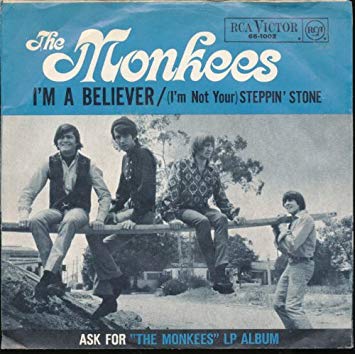
My favorite Monkee wrote this song. Micheal Nesmith wrote this song before he was picked to be a Monkee. At the time, he was developing his skills as a folk singer…a long way from what the Monkees turned into. In 1965, he met John Herald, guitarist for a bluegrass/folk group called The Greenbriar Boys. They played songs for each other, and Herald loved “Different Drum.” He brought it to his group, slowed down the tempo, and released it on the group’s 1966 album Better Late Than Never! Linda Ronstadt heard this version and recorded it with her group The Stone Poneys (named after the Charlie Patton song “Stone Pony Blues), this version is the best-known version of Different Drum.
This version peaked at #13 in the Billboard 100 in 1968. This would be their only top twenty hit. They stayed together a little while after this and even toured with the Doors with Jim Morrison who Rondstadt didn’t like too well. The Stone Poneys broke up and Rondstadt went solo.
Like “Me And Bobby McGee,” this is a song written and originally recorded by a guy that switched genders when a female recorded it. With a male narrator, the girl is tying him down, and he has to leave her to strike out on his own. With Ronstadt singing it, the girl become the one who is reigned in, and leaves her man so she can do her own thing. Notice that she ends up describing the guy as “pretty,” which makes a lot more sense when it was Nesmith singing about a girl.
In this song, Ronstadt is ready to bail on a relationship, claiming they are very different people and she doesn’t want to be tied down to one person anyway. It’s a variation of both the “I want to see other people” and the “It’s not you, it’s me” breakups. Mike Nesmith wrote it in character – he was newly married and his wife was pregnant.
The Monkees were given very little control of their musical output, which didn’t sit well with Mike Nesmith, who found out after he joined the ensemble that session musicians would be playing on their albums and hired guns would write their songs. Nesmith was a talented performer and songwriter, and he proved it with this tune, which he pitched for The Monkees. He explained in 1971: “Most of the songs I did write, they didn’t want, so on the last few albums I didn’t contribute much in the way of material. I took them ‘Different Drum’ and they said all it needed was a hook. They asked me to change it and told me it was a stiff.”
The Stone Poneys were a folk trio of Ronstadt, Kenny Edwards and Bobby Kimmel. They released their first album earlier in 1967, and it went nowhere. This song was included on their second album, Evergreen Volume 2, later that year and appeared to be headed toward a similar fate. In dire financial straits, the band was driving to a meeting with their record company when their car broke down on La Brea Avenue in Los Angeles. At the gas station where they ended up, they heard this song playing on the radio – it had been added to the playlist at KRLA-AM, a huge station in LA. Suddenly, they had a hit on their hands.
Their fortunes improved, but the song only took them so far. After one more charting single (“Up To My Neck In High Muddy Water” – #93) the band broke up. Ronstadt went solo and charted a few minor hits from 1970-1974, but landed a #1 in 1975 with “You’re No Good,” launching her to stardom.
Bobby Kimmel did most of the songwriting in The Stone Poneys, who generally shared vocals like Peter, Paul and Mary. These songs rarely suited Linda Ronstadt’s voice, but when she heard “Different Drum” by The Greenbriar Boys, she thought it was a perfect fit and a great opportunity to take a lead vocal.
Mike Nesmith played a short, intentionally awful version of this song on the “Too Many Girls” episode of The Monkees TV series. The episode aired December 19, 1966, which was shortly before Ronstadt released the song.
Fittingly, this song was far different than previous Stone Poneys material, and the male members of the group, Kenny Edwards and Bobby Kimmel, didn’t even play on it. Ronstadt envisioned the song as an acoustic piece, but their producer, Nick Venet, had different ideas. When the group showed up for the three-song session at Capitol Records’ Studio B in Los Angeles, there were a number of studio musicians there. Edwards and Kimmel played on two of the songs, but when it came time to record “Different Drum,” they watched from the control room as the seasoned studio pros worked up the song under Venet’s direction. Among the musicians:
Don Randi – harpsichord Al Viola – guitar Jimmy Bond – bass Jim Gordon – drums
There was also a string section conducted by Sid Sharp. Gordon and Randi also played on many of the Monkees recordings in place of the actual group.
Ronstadt did one run-through of the song before recording her vocal, start to finish, in the next take. As she developed her vocal talents, she came to hate the way she sounded on the song. “Today I will break my finger trying to get that record off when it’s on,” she said in the 2016 book Anatomy of a Song. “Everyone hears something in that song – a breakup, the antiwar movement, women’s lib. I hear a fear and a lack of confidence on my part. It all happened so fast that day.”
The Monkees were in their second (and final) season when this song reached its chart peak in January 1968. Mike Nesmith heard it for the first time on a Philadelphia radio station when the group was riding together in a limousine.
Nesmith recorded this himself in 1972 on a solo album called And The Hits Just Keep On Comin’. Nesmith had a substantial solo output after The Monkees TV series was canceled.
A Different Drum
You and I travel to the beat of a different drum Oh, can’t you tell by the way I run Every time you make eyes at me. Wo oh You cry and you moan and say it will work out But honey child I’ve got my doubts You can’t see the forest for the trees
Oh, don’t get me wrong. It’s not that I’m knockin’ It’s just that I’m not in the market For a boy who wants to love only me Yes, and I ain’t sayin’ you ain’t pretty All I’m sayin’s I’m not ready for any person, Place or thing to try and pull the reins in on me So goodbye, I’ll be leavin’ I see no sense in the cryin’ and grievin’ We’ll both live a lot longer if you live without me
This song peaked at #1 in the Billboard 100 and #1 in Canada in 1967. This was an American band from Chicago that formed in 1966. They scored 3 top ten hits (#5 Mercy, Mercy, Mercy, #6 Don’t you Care and this song).
The Buckingham was a band from Chicago that formed in 1966. They were very successful in 1967 and 68 and broke up in 1970. They reformed in 1980 and are still together today.
“Kind of a Drag” was written by Jim Holvay, who was a friend of the band’s from Chicago. It is The Buckingham’s only #1 hit, although they peeked into the Top 10 twice more and charted a couple more times after that. Holvay went on to write “Don’t You Care,” “Susan” and “Hey Baby They’re Playing Our Song” for The Buckinghams.
Is that a song from the late-’60s/ early-’70s with a horn section? Then odds are good it’s produced by James William Guercio. Guercio produced both early Chicago and The Buckinghams, and the latter influenced the formation of Blood Sweat & Tears. Try playing “Kind of a Drag” back-to-back with “Saturday In The Park” (Chicago) and “You’ve Made Me So Very Happy” (BS&T).
Meet The Buckinghams: Dennis Tufano (vocals), Carl Giammarese (guitar), Martin Grebb (keyboard), Nick Fortuna (bass), Jon Poulos (drums). The band had dissolved by 1970, but a reunion has since taken place starting in 1980, with the only two original members now being Carl and Nick. Jon Poulos died from a drug overdose in 1980.
The Buckinghams had five charting hits, and they all occurred in 1967, prompting Billboard magazine to declare them “the most-listened-to band of the year.” So why did they fall off the map? In our interview with Tommy James, he explained that 1968 marked the emergence of album-oriented bands, with singles acts dying off. Said James: “When we left in August (1968, for the Democratic National Convention), all the big acts were singles acts. It was the Association, it was Gary Puckett, it was the Buckinghams, the Rascals, us. But the point was that it was almost all singles. In 90 days, when we got back, it was all albums. It was Led Zeppelin, Crosby, Stills and Nash, Blood, Sweat and Tears, Joe Cocker, Neil Young. And there was this mass extinction of all of these other acts. It was just incredible. Most people don’t realize that that was sort of the dividing line where so many of these acts never had hit records again.”
The modern-day version of The Buckinghams have risen to such heights as playing at President Barack Obama’s 2009 inauguration ball, and being inducted into the 2009 class of the Hit Parade Hall of Fame.
Kind of a Drag
Kind of a drag When your baby don’t love you Kind of a drag When you know she’s been untrue
Oh oh, listen to what I’ve gotta to say Girl, I still love you I’ll always love you Anyway, anyway, anyway
Kind of a drag When your baby says goodbye Kind of a drag When you feel like you want to cry
Oh oh girl, even though you make me feel blue I still love you I’ll always love you Anyway, anyway, anyway
Oh, listen to what I’ve gotta say Girl, I still love you I’ll always love you Anyway, anyway, anyway
Billy Preston played with and toured with a lot of artists. Mahalia Jackson, Ray Charles, Little Richard, The Beatles, Rolling Stones, and more. He had 17 songs in the Billboard 100, six top ten hits, and three number 1’s… One of the #1’s was with the Beatles with Get Back.
This song peaked at #1 in the Billboard 100 in 1974. Preston performed this song on the very first episode of Saturday Night Live. He and Janis Ian were the musical guests on the October 11, 1975 debut.
Preston started writing this one night in the dressing room of an Atlanta nightclub where he was performing. He wanted to write a song based on the saying, “Nothing from nothing leaves nothing.”
“The saloon piano gave it character,” Preston explained, “and I had a feeling it would be a hit because it was a sing-a-long kind of thing.”
Bruce Fisher, who was Preston’s songwriting partner (he co-wrote his previous American chart-topper, “Will It Go Round In Circles”), added a second verse.
The B-side of the single was another song Preston wrote with Fisher: “You Are So Beautiful,” which was later a hit for Joe Cocker.
Preston started off at the age of 10 playing keyboards for gospel legend Mahalia Jackson. Later he joined Ray Charles’ touring band before recording with The Beatles on several of their tracks including “Get Back” and “Let It Be” (The Beatles considered him to be the fifth Beatle). He also played on a number of Sly & The Family Stone recordings. Preston went on to have a successful solo career with five Top 10 US hits. In 1997 he was sent to prison on drug charges. He died in 2006 at age 59.
In the US, this was used in a TV commercial for Fidelity Investments. >>
This was used in several movies, including the 1995 thriller To Die For, starring Nicole Kidman, the 2003 comedy Elf, starring Will Ferrell, the 2008 comedy Be Kind Rewind, starring Jack Black and Mos Def, and the 2011 comedy Bad Teacher, starring Cameron Diaz and Justin Timberlake.
Nothing from Nothing
Nothin’ from nothin’ leaves nothin’ You gotta have somethin’ if you want to be with me Nothin’ from nothin’ leaves nothin’ You gotta have somethin’ if you want to be with me
I’m not tryin’ to be your hero ‘Cause that zero is too cold for me, Brrr I’m not tryin’ to be your highness ‘Cause that minus is too low to see, yeah
Nothin’ from nothin’ leaves nothin’ And I’m not stuffin’, believe you me Don’t you remember I told ya I’m a soldier in the war on poverty, yeah Yes, I am
Nothin’ from nothin’ leaves nothin’ You gotta have somethin’ if you want to be with me Nothin’ from nothin’ leaves nothin’ You gotta have somethin’ if you want to be with me
You gotta have somethin’ if you want to be with me You gotta bring me somethin’ girl, if you want to be with me
I like the overall sound of this recording. The mix and depth are perfect. Sara’s voice is powerful and the structure of the song is great. This is a song that you turn up to 11 on your stereo, iPod, or phone with good headphones. The engineer of this song did his or her job very well.
She talked about the song and said: “basically about the fact that we all… have insecurities to hide, and we often do that by putting on a façade.” She also goes on to say that “unfortunately, if we just be who we are, that’s usually the more attractive and beautiful thing.”
Building a Mystery peaked at #13 in the Billboard 100 and #1 in Canada in 1997.