Power Pop fan, Baseball, Beatles, Alternative music, old movies, and tv show fan. Also anything to do with pop culture in the 60s and 70s... I'm also a songwriter, bass and guitar player. Not the slightest bit interested in politics at all.
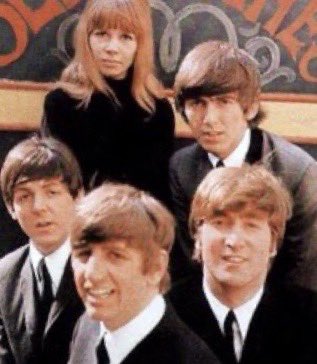
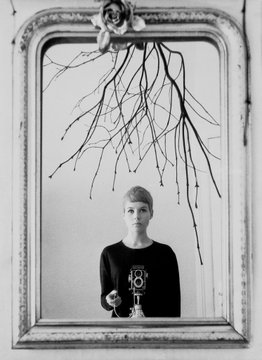
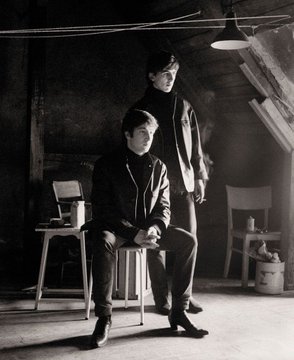
I read about Astrid when I was in 8th grade in the Hunter Davies book…how she took the best pictures of the Beatles before they were THE BEATLES. She became a fan and then influenced them in many ways. She brought her art friends with her to see them in Germany. From there… their hair, clothes, and style changed. It can honestly be said that without her and her friends the Beatles as we know them might not have existed.
Astrid passed away at the age of 81.
Historian Mark Lewisohn Tweeted about Astrid: “intelligent, inspirational, innovative, daring, artistic, awake, aware, beautiful, smart, loving and uplifting.”
#RingoStarr
@ringostarrmusic
·
God bless Astrid a beautiful human being And she took great photos peace and love
George Harrison
@GeorgeHarrison
Astrid is and was the sweetest woman, so thoughtful and kind and talented, with an eye to capture a soul. Our family loved her and none more than George. I am truly saddened but honoured to have known her. Olivia
Love the guitar tone in this song but you cannot get it out of your head after one listen.
This is a traditional song that folk singer Leadbelly popularized before his death in 1949. He recorded a lot of songs that otherwise might have been lost, including “Goodnight Irene” and “Midnight Special.” Leadbelly’s version is a cappella and commonly sung by laborers to pass the time while working.
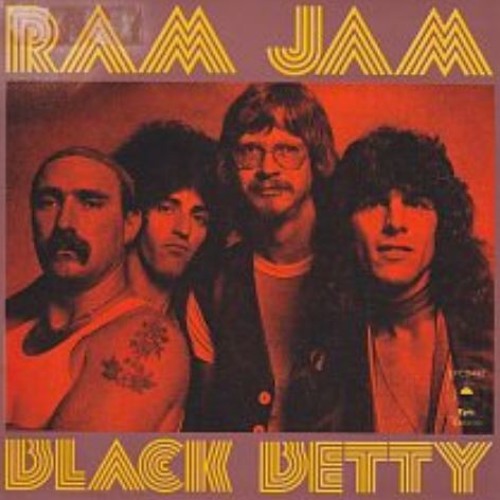
Ram Jam took some heat because some civil rights groups felt the lyrics were disrespectful.
This was Ram Jam’s only hit. The song peaked at #18 in the Billboard 100, #46 in Canada, #7 in the UK, and #8 in New Zealand in 1977.
A remix of “Black Betty” by Ben Liebrand reached number 13 in the UK Singles Chart in 1990. Cover versions of the song also appear on the 2002 album Mr. Jones by Tom Jones and on the 2004 album Tonight Alright by Australian rock band Spiderbait.
From Songfacts
Ram Jam was a short-lived band from New York City, and this was their only hit. While the lyrics can be deconstructed, Ram Jam’s version is driven by the powerful beat and aggressive tempo, making it one of those songs that gets your heart beating faster. The song is commonly played at sporting events to pump up the crowd.
This was produced by Jerry Kasenetz and Jeff Katz, who were architects of the Bubblegum Sound, producing groups like The Ohio Express and the 1910 Fruitgum Company.
The Australian band Spiderbait recorded this in 2004. It was their first single to reach #1 on the Australian charts.
A remixed version of this song is used in the 2002 movie Kung Pow: Enter The Fist when the main character fights the villain.
Black Betty
Whoa, Black Betty (Bam-ba-Lam) Whoa, Black Betty (Bam-ba-Lam)
Black Betty had a child (Bam-ba-Lam) The damn thing gone wild (Bam-ba-Lam) She said, “I’m worryin’ outta mind” (Bam-ba-Lam) The damn thing gone blind (Bam-ba-Lam) I said “Oh, Black Betty” (Bam-ba-Lam) Whoa, Black Betty (Bam-ba-Lam)
Oh, Black Betty (Bam-ba-Lam) Whoa, Black Betty (Bam-ba-Lam)
She really gets me high (Bam-ba-Lam) You know that’s no lie (Bam-ba-Lam) She’s so rock steady (Bam-ba-Lam) And she’s always ready (Bam-ba-Lam) Whoa, Black Betty (Bam-ba-Lam) Whoa, Black Betty (Bam-ba-Lam)
Whoa, Black Betty (Bam-ba-Lam) Whoa, Black Betty (Bam-ba-Lam)
She’s from Birmingham (Bam-ba-Lam) Way down in Alabam’ (Bam-ba-Lam) Well, she’s shakin’ that thing (Bam-ba-Lam) Boy, she makes me sing (Bam-ba-Lam) Whoa, Black Betty (Bam-ba-Lam) Whoa, Black Betty Bam-ba-lam
A snare drum shot starts this song that helped shape the sixties. In 2004 Rolling Stone named Bob Dylan’s “Like A Rolling Stone” the greatest song of all time. When Bob sings “How Does it Feel?” you can feel the venom.
“Like a Rolling Stone” runs 6:13. It was a big breakthrough when the song got radio play and became a hit, as many stations refused to play songs much longer than 3 minutes. It was also rare for a song with so many lyrics to do well commercially.
The title was taken from the proverb “a rolling stone gathers no moss.” Dylan got the idea from the 1949 Hank Williams song “Lost Highway,” which contains the line, “I’m a rolling stone, all alone and lost.”
The song peaked at #2 in the Billboard 100, #3 in Canada, and #4 in the UK in 1965. The song was on the album Highway 61 Revisited that was released a few weeks after this single.
I like the studio version the best but I also like the “Judas” live version in 1966. Bob with The Hawks (later The Band) backing him fought boos and shouts through the tour. The world it seemed was upset at Dylan for going “electric” and having a band back him up. These are my favorite live Dylan performances…both versions are at the bottom of the post.
From Rolling Stone Magazine:
The music here is much more in that celestial mode, like it’s ether-borne, rather than anything originating from mind, guitar, bass, drum, organ, voice. The final showdown begins when someone in the audience, from out of the tension of the attendant silence, shouts, “Judas!” In the annals of heckling, that’s a pretty good one. Dylan responds with “I don’t believe you” – a nice little reference, too, to the earlier song. There is venom in his voice. “You’re a liar.” Another pause, before Dylan turns to his band and orders them to “Play fucking loud!” And goodness do they, right on command. Dylan puts his entire body into the “How does it feel?” line, like he is jumping straight down someone’s soul and punching the crap out of it. Then it is all over. Dylan says, “Thank you,” and “God Save the Queen” plays on the PA. Time to be rolling on.
From Songfacts
This was the only song on the album produced by Tom Wilson, who produced Dylan’s second album, The Freewheelin’ Bob Dylan. Wilson had been a jazz producer and was brought in to replace John Hammond. Wilson invited keyboard player Al Kooper to the session, and Al produced the famous organ riff that drove the song. This was the last song Wilson worked on with Dylan, as Bob Johnston took over production duties.
Thanks to The Rolling Stones, many associate the phrase with a life of glamor, always on the move, but Williams’ song is about a hobo paying the price for his life of sin. Dylan also used the phrase to indicate loneliness and despair: his rolling stone is “without a home, like a complete unknown.”
Dylan based the lyrics on a short story he had written about a debutante who becomes a loner when she falls out of high society. The lyrics that made it into the song are only a small part of what was in the story.
Dylan’s manager, Albert Grossman, who revolutionized the music manager profession and was known as a shrewd defender of his artists, was the one who told Columbia Records that they couldn’t shorten “Like a Rolling Stone” in order to make it more radio friendly.
Dylan recorded another version in 1970 for his Self Portrait album. This time, he used experienced session players in Nashville, Tennessee. Ron Cornelius played guitar on the album and told us about the session: “You’re not reading manuscripts. In Nashville the players are booked because of what they can create right now, not what’s written on a piece of paper. Everybody’s creating their part as the tape is rolling. Out of everybody I’ve worked with, I don’t know of anyone who’s been any nicer than Bob Dylan. He treated me wonderfully, but at the same time you knew being around him day after day that this man wakes up in a different world every morning. On a creative level that’s a really good thing and to try to second guess him or to ask him what he actually meant by these lyrics, you’re shooting in the dark because he’s not going to tell you anyway. And he might be telling you the truth when he says “I don’t know, what does it mean to you.'”
It is rumored that this was written about one-time debutante Edie Sedgwick, who was part of artist Andy Warhol’s crowd. She was the subject of an emotional tug-of-war between the Dylan camp and the Warhol camp.
According to this theory, the song includes some fanged, accusatory lines about Warhol and the way he mistreated the girl:
Ain’t it hard when you discover that
He really wasn’t where it’s at
After he took from you everything he could steal
“Poor Little Rich Girl” Sedgwick is viewed by many as the tragic victim of a long succession of abusive figures. After escaping home and heading to New York, she ran into Warhol, who soon began to use her as his starlet. When her 15 minutes had come to an end, Warhol moved on.
Sedgwick and Dylan had a brief affair shortly before the musician married Sarah Lownds, and many say that this Dylan song was written about her. It should be noted that there is absolutely nothing beyond circumstantial evidence to support this idea, but the myth is so widely known that it’s taken on a life of its own and is therefore recognizable on its own terms.
This made Bob Dylan an unlikely inspiration for Jimi Hendrix, who before hearing this considered himself only a guitarist and not a singer. After hearing this, he saw that it didn’t take a conventional voice to sing rock and roll.
Hendrix often played “Like A Rolling Stone,” including a performance at the 1967 Monterey Pop Festival. Hendrix and Dylan met only once, but Jimi had a knack for bringing out the emotions in Dylan’s songs: he also did a very successful cover of “All Along The Watchtower.”
The Rolling Stones didn’t take their name from this song, but rather the 1950 Muddy Waters track “Rollin’ Stone.” The magazine Rolling Stone was named after this song, with a degree of separation: Ralph Gleason wrote a piece for The American Scholar about the influence of music on young people called “Like a Rolling Stone,” which he titled after the song. When he founded the magazine with Jann Wenner in 1967, they decided to name it after his story. Wenner muddied the waters a bit when he wrote in the debut issue: “Muddy Waters used the name for a song he wrote. The Rolling Stones took their name from Muddy’s song. ‘Like a Rolling Stone’ was the title of Bob Dylan’s first rock and roll record.”
In the November 2004 issue, Rolling Stone Magazine named this #1 on their list of the greatest songs of all time. >>
Greil Marcus wrote a book of almost 300 pages about this song. The book was released in 2005 and is titled Like a Rolling Stone: Bob Dylan at the Crossroads.
Al Kooper, who was primarily a guitarist and went on to be a very successful music producer, played this organ on this song. If you listen very closely at the beginning of this song, you will notice that the organ is an 1/8th note behind everyone else. Kooper wasn’t an expert on the organ, but Dylan loved what he played and made sure it was turned up in the mix.
When we asked Kooper what stands out as his finest musical accomplishment, he told us: “By the amount of emails I receive and the press that I get it is undoubtedly the organ part on ‘Like A Rolling Stone.’ I kinda like the way Martin Scorcese edited my telling of that story in the documentary No Direction Home. For me, no one moment or event sticks out. I think reading my resumé every ten years or so, is my finest moment – certainly my most incredulous. I cannot believe I did all the stuff I did in one lifetime. One is forced to believe in luck and God.” (Check out our interview with Al Kooper.)
A line from this song provided the title of the 2005 Martin Scorsese documentary about Bob Dylan called No Direction Home.
Jimi Hendrix’s performance of this song at Monterey is a classic. Hendrix had made a name for himself in Europe, but didn’t manage to make a dent in the US market until the fabled Summer of Love. It happened at the Monterey Pop Festival in June 1967. All of a sudden, an artist who had struggled unsuccessfully for recognition in his own country became one of its future music legends.
Rolling Stone asked a panel of musicians, writers and academics to vote for Dylan’s greatest song in a poll to mark Dylan’s 70th birthday on May 24, 2011. This song came out on top, beating “A Hard Rain’s A-Gonna Fall” and “Tangled Up In Blue” into second and third places respectively.
Dylan’s original draft of the song’s lyrics were written on four sheets of headed note paper from the Roger Smith Hotel in Washington, DC. The quartet of handwritten pages fetched over $2 million at Sothebys New York in June 2014, setting a new price record for a popular music manuscript. The previous record was John Lennon’s handwritten lyrics for the 1967 Beatles track “A Day In The Life,” which cost $1.2 million.
The Rolling Stones recorded this for their 1995 album Stripped. Stones guitarist Keith Richards explained: “We got over the built-in reticence. If he [Bob Dylan] had written ‘Like a Beatles,’ we probably would have done it straight away. We’ve been playing that song ever since Bob brought it out; it was like a dressing room favorite, a tuning room favorite. We know it really well. It was just a matter of screwing up the courage, really, to get over the feeling like we were riding on its back. We also realized that, hey, we took our name from a Muddy Waters album, a Muddy Waters song. Suddenly it didn’t feel awkward to play it.”
An early manuscript of this song in the Dylan archives at the Center for American Research in Tulsa reveals some lyrics that were later changed or removed. Instead of “You used to laugh about,” it was “You used to make fun about.” Some lines that were excised:
You’ve studied all these great theories on life
And now you find out they don’t mean a thing
You’ve been blessed by counts these old friends claimed to love
Now they’re all ashamed of you
John Mellencamp performed this with Al Kooper at a Bob Dylan tribute concert held in Madison Square Garden on October 16, 1992.
Like A Rolling Stone
Once upon a time you dressed so fine Threw the bums a dime in your prime, didn’t you People call say beware doll, you’re bound to fall You thought they were all kidding you You used to laugh about Everybody that was hanging out Now you don’t talk so loud Now you don’t seem so proud About having to be scrounging for your next meal
How does it feel How does it feel To be on your own With no direction home Like a complete unknown Like a rolling stone
You’ve gone to the finest schools, alright Miss Lonely But you know you only used to get juiced in it Nobody’s ever taught you how to live out on the street And now you’re gonna have to get used to it You say you never compromise With the mystery tramp, but now you realize He’s not selling any alibis As you stare into the vacuum of his eyes And say do you want to make a deal
How does it feel How does it feel To be on your own With no direction home Like a complete unknown Like a rolling stone
You never turned around to see the frowns On the jugglers and the clowns When they all come down and did tricks for you You never understood that it ain’t no good You shouldn’t let other people get your kicks for you You used to ride on a chrome horse with your diplomat Who carried on his shoulder a Siamese cat Ain’t it hard when you discovered that He really wasn’t where it’s at After he took from you everything he could steal
How does it feel How does it feel To be on your own With no direction home Like a complete unknown Like a rolling stone
Princess on a steeple and all the pretty people They’re all drinking, thinking that they’ve got it made Exchanging all precious gifts But you better take your diamond ring, you better pawn it babe You used to be so amused At Napoleon in rags and the language that he used Go to him, he calls you, you can’t refuse When you ain’t got nothing, you got nothing to lose You’re invisible now, you’ve got no secrets to conceal
How does it feel How does it feel To be on your own With no direction home Like a complete unknown Like a rolling stone
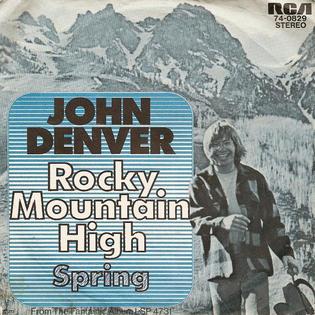
If you asked who the hippest person was in the seventies…John Denver probably would not make the shortlist. He did, however, release some interesting songs and this is one is great. This song peaked at #9 in the Billboard 100 and #8 in Canada in 1973.
Denver started writing this song during the Perseid Meteor Shower which happens every August. He was camping with friends at the tree line at Williams Lake near Windstar (his foundation in Colorado) and all of a sudden there were many shooting stars and he noticed “The shadow from the starlight”… thus the line from the song. He says that while the inspiration struck quickly, it took him about nine months to complete the song. The song was written by John Denver and Mike Taylor.
The song peaked at #9 in the Billboard 100 and #8 in Canada in 1974.
In 2007 “Rocky Mountain High” was named one of the two state songs of Colorado. The other song is “Where the Columbines Grow.”
From Songfacts
In Denver’s autobiography, he wrote: “I remember, almost to the moment, when that song started to take shape in my head. We were working on the next album and it was to be called Mother Nature’s Son, after the the Beatles song, which I’d included. It was set for release in September. In mid August, Annie and I and some friends went up to Williams Lake to watch the first Perseid meteor showers. Imagine a moonless night in the Rockies in the dead of summer and you have it. I had insisted to everybody that it was going to be a glorious display. Spectacular, in fact.
The air was kind of hazy when we started out, but by 10 p.m. it had grown clear. I had my guitar with me and a fishing rod. At some point, I went off in a raft to the middle of the lake, singing my heart out. It wasn’t so much that I was singing to entertain anyone back on shore, but rather I was singing for the mountains and for the sky. Either my voice gave out or I got cold, but at any rate, I came in and found that everybody had kind of drifted off to their individual campsites to catnap. We were right below the tree line, just about ten thousand feet, and we hadn’t seen too much activity in the sky yet. There was a stand of trees over by the lake, and about a dozen aspens scattered around. Around midnight, I had to get up to pee and stepped out into this open spot. It was dark over by those trees, darker than in the clearing. I looked over there and could see the shadow from the starlight. There was so much light from the stars in the sky that there was a noticeable difference between the clearing and everywhere else. The shadow of the starlight blew me away. Maybe it was the state I was in. I went back and lay down next to Annie in front of our tent, thinking everybody had gone to sleep, and thinking about how in nature all things, large and small, were interwoven, when swoosh, a meteor went smoking by. And from all over the campground came the awed responses “Do you see that?” It got bigger and bigger until the tail stretched out all the way across the sky and burned itself out. Everybody was awake, and it was raining fire in the sky.
I worked on the song – and the song worked on me – for a good couple of weeks. I was working one day with Mike Taylor, an acoustic guitarist who had performed with me at the Cellar Door and had moved out to Aspen. Mike sat down and showed me this guitar lick and suddenly the whole thing came together. It was just what the piece needed. When I realized what I had – another anthem, maybe; a true expression of one’s self, maybe – we changed the sequencing of the album we’d just completed, and then we changed the album title.”
Some of the references in the lyrics:
“He was born in the summer of his 27th year” – John was 27 that summer.
“Coming home to a place he’d never been before” – He and Annie had just made Aspen home.
“And he lost a friend but kept his memory” – A good friend from Minnesota had come to visit and was killed riding John’s motorcycle.
“Why they try to tear the mountains down to bring in a couple more” – This referred to the debate at that time about bringing the Olympics to Colorado.
On his BBC radio program The John Denver Show, he set the stage for this song by introducing it with this story: “You and I have just broken out of a huge stand of Douglas fir. The trees tower hundreds of feet above us. We’ve come out of the solemn, cathedral-like darkness of the trees, into the bright, early morning sunshine of a grassy slope. The grass is wet and soft with morning dew beneath our feet. The air is crisp, so crisp it sends little needles of joyful pain through the membranes of your nose. The air is so clear, it seems to purify your lungs. On both sides, above and beyond, stretch the awesome Rockies, their great, snow-capped peaks jutting out of the early morning mist. This is living. This is what man was created for: to live and work and continue what these mountains represent. This is true freedom. Being part of nature and drawing from it, and returning back to it.”
Denver invoked this song when he testified at a Senate hearing in 1985 where he opposed the labeling of albums proposed by the Parents Music Resource Center (PMRC). “As an artist, I am opposed to any kind of a rating system, voluntarily or otherwise,” he said. “My song “Rocky Mountain High” was banned from many radio stations as a drug-related song. This was obviously done by people who had never seen or been to the Rocky Mountains and also had never experienced the elation, celebration of life, or the joy in living that one feels when he observes something as wondrous as the Perseides meteor shower on a moonless, cloudless night, when there are so many stars that you have a shadow from the starlight, and you are out camping with your friends, your best friends, and introducing them to one of nature’s most spectacular light shows for the very first time. Obviously, a clear case of misinterpretation. Mr. Chairman, what assurance have I that any national panel to review my music would make any better judgment?”
Rocky Mountain High
He was born in the summer of his 27th year Coming home to a place he’d never been before He left yesterday behind him, you might say he was born again You might say he found a key for every door
When he first came to the mountains his life was far away On the road and hanging by a song But the string’s already broken and he doesn’t really care It keeps changing fast and it don’t last for long
But the Colorado rocky mountain high I’ve seen it rainin’ fire in the sky The shadow from the starlight is softer than a lullabye Rocky mountain high (Colorado)
He climbed cathedral mountains, he saw silver clouds below He saw everything as far as you can see And they say that he got crazy once and he tried to touch the sun And he lost a friend but kept his memory
Now he walks in quiet solitude the forest and the streams Seeking grace in every step he takes His sight has turned inside himself to try and understand The serenity of a clear blue mountain lake
And the Colorado rocky mountain high I’ve seen it raining fire in the sky You can talk to God and listen to the casual reply Rocky mountain high
Now his life is full of wonder but his heart still knows some fear Of a simple thing he cannot comprehend Why they try to tear the mountains down to bring in a couple more More people, more scars upon the land
And the Colorado rocky mountain high I’ve seen it rainin’ fire in the sky I know he’d be a poorer man if he never saw an eagle fly Rocky mountain high
It’s Colorado rocky mountain high I’ve seen it rainin’ fire in the sky Friends around the campfire and everybody’s high Rocky mountain high Rocky mountain high Rocky mountain high Rocky mountain high Rocky mountain high Rocky mountain high
The two songs today will involve the Rocky Mountains…by song title anyway. This song just flat out rocks. Joe Walsh includes a talk box on the guitar in the solo.
Joe Walsh left the James Gang just as they were building momentum, having scored hits with “Walk Away” and “Funk #49.” Splintering the band as they were on the verge of stardom didn’t go over well with Walsh’s bandmates or their record company, but Joe felt creatively limited in the 3-piece band and wanted out. Colorado put him near James Gang producer Bill Szymczyk, who continued to work with Walsh and produced this album.
When Joe Walsh moved to Colorado, he formed a band called Barnstorm, whose first, self-titled album came out in 1972. Their next album was The Smoker You Drink, The Player You Get, contained this track. The song was co-written by the group: Rocke Grace (keyboards), Kenny Passarelli (bass), Joe Vitale (drums), and Walsh. The music was written before Walsh added the lyrics.
Joe Walsh: “I’m living in Colorado and I’m mowing the lawn. I look up and there’s the Front Range of the Rocky Mountains and there’s snow on them in the summer. And it knocked me back because it was just beautiful. And I thought, ‘Well I have committed. I’m already in Colorado and it’s too late to regret the James Gang. The Rocky Mountain way is better than the way I had, because the music was better.’ I got the words. Bam!”
The song peaked at #23 in the Billboard 100 and #31 Canada in 1973.
This was one of the first songs to feature a talkbox, which allows a guitarist to make distorted vocalizations with his mouth. Peter Frampton is probably the most famous talkbox practitioner, and his use of the device is prominent on his famous 1976 album Frampton Comes Alive.
From Songfacts
After leaving his group the James Gang at the end of 1971, Joe Walsh moved from Cleveland to Boulder, Colorado, where he wrote this song, which celebrates the scenery and lifestyle of Colorado. In some ways, the song is a rocked-up version of John Denver’s “Rocky Mountain High,” which was released the previous year. Both songs use the famous Rocky Mountains as a focal point for the virtues of Colorado.
“Rocky Mountain Way” reflects Walsh’s range of emotions after making the big move. He explained in the book The Guitar Greats: “I got kind of fed up with feeling sorry for myself, and I wanted to justify and feel good about leaving the James Gang, relocating, going for it on a survival basis. I wanted to say ‘Hey, whatever this is, I’m positive and I’m proud’, and the words just kind of came out of feeling that way, rather than writing a song out of remorse. It was special then, and the words were special to me, because the words were like, ‘I’m goin’ for it, the heck with feeling sorry for this and that’, and it did turn out to be a special song for a lot of people. I think the attitude and the statement of that have a lot to do with it – it’s a positive song, and it’s basic rock’n’roll, which is what I really do.”
As for Barnstorm, they played up to their name and did over 300 gigs in 1973. The band broke up after the two albums, which have since been more commonly credited as Joe Walsh solo works.
Walsh is a big baseball fan, and this song has become associated with the game because of the lyrics “Casey’s at bat,” which is a reference to a famous baseball poem. When the Colorado Rockies baseball team formed in 1993, “Rocky Mountain Way” became a popular song at their stadium, Coors Field, where the song is played after a Rockies win.
Joe Walsh described writing the lyrics to this song during an interview with Howard Stern. Walsh explained he had the track recorded but had no ideas for lyrics. He had been living in Colorado after leaving the James Gang over creative differences with the direction of the music. He was mowing his lawn and looking at the Rocky Mountains and the lyrics came to him. He ran inside to write the lyrics but forgot to shut off the lawn mower. The mower ran into his neighbor’s yard and ruined the neighbor’s garden.
“It was a very expensive song to write,” Walsh said, implying he had to pay to repair the damage to the neighbor’s yard. He said the lyrics describe his anxiety about leaving the James Gang and his excitement about a solo career.
Rocky Mountain Way
Spent the last year Rocky Mountain Way Couldn’t get much higher Out to pasture Think it’s safe to say Time to open fire
And we don’t need the ladies Crying ’cause the story’s sad ’cause the Rocky Mountain Way Is better than the way we had
Well he’s tellin’ us this And he’s tellin’ us that Changes it every day Say’s it doesn’t matter Bases are loaded and Casey’s at bat Playin’ it play by play Time to change the batter
And we don’t need the ladies Crying ’cause the storie’s sad, uh huh Rocky Moutain Way Is better than the way we had Hey, hey, hey, hey
This was a great double-sided single… the B-side was Undun.
A hit in their native Canada, this song was written by Randy Bachman and Burton Cummings during their brief collaboration together in The Guess Who.
Their name came about when their label Quality Records released their first hit single (“Shakin’ All Over”) credited only to “Guess Who?” in an attempt to build a mystique around the band. They wanted the public to believe that this was a possible British band. The real name of the band was “Chad Allan & The Expressions,” but radio station DJs continued to refer to them as “The Guess Who.” when playing subsequent singles.
Laughing peaked at #1 in Canada and #10 in the Billboard 100 in 1969. The song was on the album Canned Wheat which peaked at #91 in the Billboard Album Charts.
While the team-up of Bachman and Cummings was short-lived, as Bachman split a year later citing conflicts with his Mormon beliefs, they have since reunited as either The Bachman-Cummings Band or, under the name of their backing band, The Carpet Frogs.
This song took about 10 minutes to write. Speaking with The Edmonton Journal in 1969, Bachman said: “We find that if we have to sit down and ponder, it doesn’t happen.”
Rolling Stone’s review of the album Canned Wheat sniffed that it “would be even more pleasurable if they didn’t sound a mite too much like the Airplane (instrumentally) and the Springfield (vocally and often instrumentally).”
Undun
Laughing
Laughing
I should laugh, but I cry Because your love has passed me by You took me by surprise You didn’t realize, that I was waiting
Time goes slowly but carries on And now the best years have come and gone You took me by surprise I didn’t realize that you were laughing
Laughing… the things you’re doin’ to me Laughing… that ain’t the way it should be You took away everything I had You put the hurt on me
I go alone now, calling your name After losing at the game You took me by surprise I didn’t realize, that you were laughing
Time goes slowly, but carries on And now the best years, the best years have come and gone You took me by surprise I didn’t realize, that you were laughing
Laughing… the things you’re doin’ to me Laughing… that ain’t the way it should be You took away everything I had You put the hurt on me
Laughing… the things you’re doin’ to me Laughing… that ain’t the way it should be You took away everything I had You put the hurt on me
Oo! Laughing…ha-ha-ha-ha-ha-ha Laughing…ha-ha-ha-ha-ha-ha-ha Laughing, well you’re laughin’ at me Laughing, well you’re laughin’ at me Laughing, oh, what you’re doin’ to me, girl Laughing, I’m a-lookin’, you’re laughin’ Laughing, I’m a-lookin’, you’re laughin’ Laughing, you’re a-lookin’, I’m a-laughin’ Laughing, laughin’ at me Laughing, ah, but you’re a-laughin’, baby Laughing
Pete Townshend took a chance with this song and the album. Back in1971 when you used any new synthesizer or electronic sounds you ran the risk of sounding dated very quickly as new devices were coming out regularly.
Townshend played a Lowrey TBO-1 organ at his home studio. He tried to run it through an ARP synthesizer/sequencer, but couldn’t get the sound he was looking for. Instead, he used the “marimba repeat” setting on his Lowrey to create an arpeggiated, complex repeating pattern. The album sounds fresh today.
The song was on Who’s Next…arguably the most successful album of the Who’s career. There is not a weak song on the album. The difference in the sound of the album compared to Tommy is phenomenal. This album has a sonic quality that not many albums have.
The album was released on August 14, 1971.
From Songfacts
The first part of the title comes from Meher Baba, who was Pete Townshend’s spiritual guru. The second part comes from Terry Riley, an experimental, minimalist composer Townshend admired – many of the keyboard riffs and sound effects on Who’s Next were a result of Riley’s influence. According to the Who’s Next liner notes, Townshend wrote it as his vision of what would happen if the spirit of Meher Baba was fed into a computer and transformed into music. The result would be Baba in the style of Terry Riley, or “Baba O’Riley.”
The title is not mentioned in the lyrics, so the song is often referred to as “Teenage Wasteland.” The “Teenage Wasteland” section was a completely different song Townshend combined with his “Baba O’Riley” idea to form the song.
Pete Townshend spent a few weeks in his home studio putting together the part that sounds like a synthesizer on a Lowry organ. His goal: to create “a replication of the electronic music of the future.”
When he took the tape of his recording to engineer Glyn Johns, he expected Johns to alter it, but Johns left it as is, insisting it was perfect.
This is the first song on Who’s Next, the most successful album of The Who’s career. Although this is one of the most popular Who songs, it was never released as a single in America or the UK. It was, however, the perfect song for the up-and-coming Album Oriented Rock (AOR) format that was picking up steam on FM radio. Always played in moderation, “Baba” became a Classic Rock staple and remains on many playlists.
When The Who perform this live, the processed organ is played from a recording, since it would be nearly impossible to replicate on an instrument. The guitar doesn’t come in until 1:40, giving Pete Townshend some time to reflect on his work. “There is this moment of standing there just listening to this music and looking out to the audience and just thinking, ‘I f–king did that. I wrote that,” he told Rolling Stone. “I just hope that on my deathbed I don’t embarrass myself by asking someone, ‘Can you pass me my guitar? And will you run the backing tape of ‘Baba O’Riley’? I just want to do it one more time.”
This marked one of the first times a keyboard/synthesizer was used to form the rhythm of a rock song, rather than employing it as a lead instrument.
Regarding the phrase “Teenage Wasteland”:
Lifehouse is set in a time where most of England is a polluted wasteland. Townshend described it as: “A self-sufficient drop-out family group farming in a remote part of Scotland decide to return South to investigate rumors of a subversive concert event that promises to shake and wake up apathetic, fearful British society. Ray is married to Sally, they hope to link up with their daughter Mary who has run away from home to attend the concert. They travel through the scarred wasteland of middle England in a motor caravan, running an air conditioner they hope will protect them from pollution.”
As for the “teenage” bit, Townshend said: “There are regular people, but they’re the scum off the surface; there’s a few farmers there, that’s where the thing from ‘Baba O’Riley’ comes in. It’s mainly young people who are either farmer’s kids whose parents can’t afford to buy them experience suits; then there’s just scum, like these two geezers who ride around in a battered-up old Cadillac limousine and they play old Who records on the tape deck… I call them Track fans.” So basically, teenagers traveling across the wasteland to attend this concert.
The famous violin part was performed by Dave Arbus of the group East of Eden, who created what many consider the first Celtic Rock song with Jig a Jig.
According to Rolling Stone magazine’s 500 Greatest Songs Of All Time, this violin jig at the end was drummer Keith Moon’s idea. In concert, Roger Daltrey would play the jig on harmonica.
This began as part of Townshend’s “Lifehouse” project, which is a film script he wrote. The playscript was published in 1999 by Pocket Books, Great Britain. In the screenplay of “Lifehouse,” Townshend wrote about the composer (Bobby) setting up the concert: “An experiment Bobby conducts in which each participant [in the concert] is both blueprint and inspiration for a unique piece of music or song which will feature largely in the first event to be hacked onto the grid.”
Townshend subsequently decided to actually pursue this, which he did through lifehouse-method.com.
Townshend was never able to convince anyone to do the Lifehouse film, and he more or less gave up on that – but he never gave up on having it produced. He revised the script to be more relevant to the world of the Internet (which had caught up with his 1971 concept of a global grid), and to incorporate thoughts and insights he’d had in the ensuing 25+ years, and it was performed on BBC3 on December 5, 1999.
The final version of the song runs 5:01, but Townshend’s instrumental synthesizer demo of the song was a healthy 9:48. This demo was released in 1972 on a Meher Baba tribute album called I Am.
In an interview with Billboard magazine carried out in February 2010, Townshend discussed how he feels now that 40 years on this and other Who songs take on a deeper meaning. He explained that when he wrote the band’s classic tunes, “The music there was about living in the present and losing yourself in the moment. Now that has changed. Boomers kind of hang on to that as a memory.When I go back and listen to those songs, the Who songs in particular of the late ’60s and early 70s, there was an aspiration in my writing to attune to the fact that what I could feel in he audience was – I won’t say religious – but there was certainly a spiritual component to what people wanted their music to contain. There’s definitely a higher call for the music now which is almost religious. U2, for example, are hugely successful with songs about inner longing for freedom, ideas.
A song like ‘Baba O’Riley,’ with ‘we’re all wasted,’ it just meant ‘we’re all wasted’ – it didn’t have the significance that it now has. What we fear is that in actual fact we have wasted an opportunity. I think I speak for my audience when I say that, I hope I do.”
This is the theme song for the TV show CSI: NY, which launched in 2004, the third in the CSI franchise. Every CSI uses a theme song by The Who: for the original CSI: Crime Scene Investigation it’s “Who Are You,” CSI: Miami uses “Won’t Get Fooled Again,” and for CSI: Cyber it’s “I Can See For Miles.”
This was used in commercials for the 2000 Nissan Pathfinder, and also appeared in ads for Cisco. The Who lost a lot of money on bad business deals in their early years and decided to cash in when they were offered big bucks for commercials.
This quickly became a concert favorite for The Who. Live versions of this song can be found on the albums The Kids Are Alright (1978), Concerts for the People of Kampuchea (1979), Who’s Last (1982), The Blues To The Bush (1999) and The Who & Special Guests Live at the Royal Albert Hall video (2000).
Black Francis of the Pixies finds this song rather intriguing. He broke it down in an interview with Songfacts. “It’s not just straight up verse/chorus/verse/chorus,” Francis said. “I was always impressed by that song, the way that it changes, the way the end of the song sort of becomes the chorus by eliminating one of the chords. It removes the minor chord, and it’s an outro, I guess, but it feels like, Oh, here we are in the chorus again, even though it’s not again – it’s totally different than anything that came before it. So I really like that song. Songs like that I tend to deconstruct a little bit and try to understand what it is that I’m hearing.”
In 2007, the song was covered by The Blue Man Group for the TV show America’s Got Talent. Since then, it has become a staple at Blue Man Group shows.
While Townsend’s keyboard playing is legendary and brilliant, it’s not quite what it seems. When the song was recorded, the band’s newly purchased Lowry organ came with a very special feature: a pedal that, when pressed, would repeat each note played three times in succession. (Source: interstitial on 97.1FM The Mountain, Denver, Colorado – thanks, S.D. – Denver, CO)
Spike Lee used this in his 1999 movie Summer of Sam, and a fully orchestrated version was used at the beginning of the 2002 movie Slackers. Other movies to use the song include:
Far Out (2015) Slash 3 (2015) Premium Rush (2012) The Girl Next Door (2004) Fever Pitch (1997) Prefontaine (1997) Love in Maid (1975)
It has been used in these TV series:
Stranger Things (“Chapter One: Suzie, Do You Copy?” – 2019) Family Guy (“Quagmire’s Mom” – 2015) The Good Guys (“Vacation” – 2010) My Name Is Earl (“The Trial” – 2007) One Tree Hill (“Pictures of You” – 2007) House (“Control” – 2005) King of the Hill (“Tankin’ It to the Streets” – 2002) Miami Vice (“Out Where the Buses Don’t Run” – 1985)
This song was used for Part 3 of the VH1 special The Drug Years about drug use in the 1970s. It showed how drugs went from a religious experience in the ’60s to just getting “Wasted” in the ’70s.
This was used at the end of the trailer for the film The Girl Next Door. The movie encompasses some of the dramas of teenage life.
Baba O’Riley
Out here in the fields I fight for my meals I get my back into my living I don’t need to fight To prove I’m right I don’t need to be forgiven
Don’t cry Don’t raise your eye It’s only teenage wasteland
Sally take my hand We’ll travel south cross land Put out the fire And don’t look past my shoulder The exodus is here The happy ones are near Let’s get together, before we get much older
Teenage wasteland It’s only teenage wasteland Teenage wasteland Oh yeah, teenage wasteland They’re all wasted!
This band had quite a few hits in the seventies. Each of their singles sounded a little different than the previous one. They had songs that included Little Willy, Fox On The Run, Ballroom Blitz, and this one Love Is Like Oxygen. This song marks a change in their sound. You can hear a little Queen and 10cc in their sound.
Sweet guitarist Andy Scott wrote this song and was nominated for an Ivor Novello Award for the composition. It lost to “Baker Street” by Gerry Rafferty.
Life Is Like Oxygen peaked at #8 in the Billboard 100, #8 in Canada, #9 in the UK, and #6 in New Zealand in 1978. This song was the last hit for Sweet as punk coming in.
From Songfacts
Many songs make liberal use of metaphor in the lyrics, but rarely is a song title a direct metaphor, which is the case here. Sweet eschews subtlety as they make the case that love, much like oxygen, must be constantly regulated.
One of Sweet’s more serene song titles, this was Sweet’s last US, UK and German Top 10 hit, as the group left the glam rock scene for the more plush atmosphere of pop-driven music.
Level Headed was Sweet’s first album for their new label Polydor, in which like ELO they found themselves experimenting with mixing rock and classical sounds.
In 2002, Andy Scott told the Slovakian Box Network: “We had finished with our first record company and had begun on a project for another. At that time the era of the Sex Pistols had started, and how people thought of music reached new dimensions. No one knew what was coming next. We were already a part rock, part metal band. Therefore in the area which was most touched by the changes. That is when I wrote the song ‘Love is Like Oxygen,’ and then the idea came along to compose it in a style which at that time was totally new, yet one that suited us. I think it worked out well. Of course the people didn’t accept it so easily. I consider Level Headed to be a good album, it sold around the world.”
The 1975 Hall & Oates’ song “Grounds for Separation” contains similar lyrics: “But isn’t it a bit like oxygen, ’cause too much will make you high, but not enough will make you die.”
Love Is Like Oxygen
Love is Like Oxygen, You get too much, you get too high, Not enough and you’re gonna die. Love gets you high.
Love is Like Oxygen, You get too much, you get too high, Not enough and you’re gonna die. Love gets you high.
Time on my side. I got it all. I heard that pride Always comes before a fall.
There’s a rumor goin’ around the town. That you don’t want me around. I can’t shake off my city blues. Everywhere I turn, I lose.
Love is Like Oxygen, You get too much, you get too high, Not enough and you’re gonna die. Love gets you high.
Love is Like Oxygen, You get too much, you get too high, Not enough and you’re gonna die. Love gets you high.
Time is no healer. If you’re not there. Holy fever. Set words in the air.
Some things are better left unsaid. I’m gonna spend my days in bed. I walk the streets at night, To be hidden by the city light. City light.
Love is Like Oxygen, You get too much, you get too high, Not enough and you’re gonna die. Love gets you high.
Love is Like Oxygen, You get too much, you get too high, Not enough and you’re gonna die. Love gets you high.
A masterpiece. I was 12 when this was released and it sounded timeless even then. It was a great song in 1979 and will be great in 2079. Not only are the words inventive but this was most people’s introduction to Mark Knopfler. I wasn’t a guitar player when I was 12 but I knew he was something special.
I’ve heard this one at what seems like a thousand times but I’ll always turn it up when it comes on the radio.
Sultans of Swing peaked at #4 in the Billboard 100, #4 in Canada, #8 in the UK, and #12 in New Zealand in 1979.
Mark Knopfler was inspired by watching a lousy club band perform. Knopfler was in England on a rainy night. He ducked into a bar where a mediocre band was closing out the night to an audience that was maybe four or five drunks unaware of their surroundings. The hapless jazz combo ended their set with the lead singer announcing, “Goodnight, and thank you. We are the sultans of swing.”
Mark Knopfler:“When the guys said ‘Thank you very much, We are the Sultans of Swing,’ there was something really funny about it to me because Sultans, they absolutely weren’t. You know they were rather tired little blokes in pullovers.”
From Songfacts
This song is about guys who go to a club after work, listen to music and have a good time. They are there for the music, and not for the image presented by the band. The song was a marked change from the waning disco style and the nascent punk movement.
Knopfler got a lot of songwriting ideas from observing everyday people, something that got harder to do when he became famous.
This was Dire Straits’ first single. It was one of five songs on a demo tape they used to get their record deal. The tape got played on London radio and started a bidding war for the band.
Despite the title, the song is not played with a swing rhythm.
A singer-songwriter from Indiana named Bill Wilson, who died in 1993, claimed that he wrote the lyrics to this song. He would often tell the story in concert, which was recorded for a 24-track CD that was released by a production company which recorded various artists between 1989-1995. One of the tracks is Wilson (identified only as “B. Wilson”) performing “Sultans Of Swing.”
There is an asterisk after his name and on the CD it says that this was from a live show performed at The Warehouse in Indianapolis, Indiana. Before Wilson plays the song he says the following: “I do this thing I co-wrote about, I guess, it’s been about 12 years ago I wrote the lyrics and a friend of mine used to work a lot of sessions for my old producer, Bob Johnston, and worked a session with this fellow from England by the name of Mark Knopfler. Has his own group over there called Dire Straits. He had this little melody. It sounded like ‘Walk, Don’t Run.’ And he had this little story concerning a band that nobody wanted to listen to. Only a few people show up to hear. So we got together one night after the session and tossed these lyrics around on a napkin and I guess I wound up writing most of the lyrics to the tune. Made enough money to buy a new Blazer that year I remember, so… didn’t do too bad. It goes like this…”
Then he starts playing an acoustic guitar, strumming Spanish style and singing “Sultans.” The lyrics are pretty close to what Mark Knopfler recorded but are slightly different. In 2009, this was posted to YouTube.
It is unlikely that Wilson’s account is true. Knopfler has never made mention of him, and Wilson is not credited for any contribution to the song. Also, the timeline doesn’t sync: Mark Knopfler didn’t come to America until after the album was released. The session work he did in Memphis was in the late ’80s and early ’90s when he was on a break from Dire Straits.
Sultans of Swing
You get a shiver in the dark It’s a raining in the park but meantime- South of the river you stop and you hold everything A band is blowing Dixie, double four time You feel alright when you hear the music ring
Well now you step inside but you don’t see too many faces Coming in out of the rain they hear the jazz go down Competition in other places Uh but the horns they blowin’ that sound Way on down south Way on down south London town
You check out guitar George, he knows-all the chords Mind, it’s strictly rhythm he doesn’t want to make it cry or sing They said an old guitar is all, he can afford When he gets up under the lights to play his thing
And Harry doesn’t mind, if he doesn’t, make the scene He’s got a daytime job, he’s doing alright He can play the Honky Tonk like anything Savin’ it up, for Friday night With the Sultans We’re the Sultans of Swing
Then a crowd a young boys they’re a foolin’ around in the corner Drunk and dressed in their best brown baggies and their platform soles They don’t give a damn about any trumpet playin’ band It ain’t what they call Rock and Roll And the Sultans Yeah, the Sultans, they play Creole Creole
And then the man he steps right up to the microphone And says at last just as the time bell rings “Goodnight, now it’s time to go home” Then he makes it fast with one more thing
I always liked the rhythm of this song and the stuttering vocal.
Bachman wasn’t planning to release the song with the stuttering vocal. He sang it with the stutter to poke fun at his brother Gary, who had a speech impediment. During microphone checks, he would sing it with the stutter and recorded a version that was intended just for Gary. His record company liked it a lot better than the non-stuttering version, so that’s the one they released. Eventually, Gary stopped stuttering.
The song peaked at #1 in the Billboard 100, #1 in Canada, #1 in New Zealand, and #2 in the UK in 1974.
Randy Bachman: “I was rehearsing and producing BTO’s third album. We needed an FM Top 40 hit, something light with a heavy bit in it. At that time, I was inspired by Traffic’s Dave Mason and his song Only You Know And I Know, which had a dang-a-lang rhythm, and the Doobie Brothers’ Listen To The Music. So I copped those jangling rhythms, changed the chords and then added some power chords of my own. I had a work in progress, in two parts: a great rhythm and a heavy riff.”
“I thought it was embarrassing, but it went to No.1 in the States and 2. other countries. I was dumbfounded. Particularly because as soon it became a hit my brother stopped stammering.”
From Songfacts
This is one of the most famous songs with prominent stutter, as Randy Bachman sings, “B-b-b-baby, you just ain’t seen n-n-nothin’ yet.”
The lyrics, especially “She took me to her doctor and he told me of a cure,” led to rumors that the song was about herpes or some other social disease. According to Bachman, the lyrics are just words he improvised, as he didn’t thing the song was going to be released and was just using it to test levels in the studio.
Randy Bachman produced the Not Fragile album and used this song to test dynamics in the studio, since the guitars would go from quiet to loud.
When the band recorded it, they didn’t think it would be released, so they didn’t bother perfecting it – or even tuning their instruments. Bachman’s vocal was considered a scratch track. This became Bachman’s “work song” for testing.
The band only played it for their label after the boss at Mercury, Charlie Fach, heard the eight songs they completed and didn’t hear a hit. The engineer suggested playing him the “work song,” and Bachman reluctantly agreed.
When Fach heard the song, he loved it, warts and all. In a Songfacts interview with Bachman, he explained: “Charlie said, ‘I want to put this on the album.’ And I said, ‘I need to remix it.’ And he said, ‘Don’t touch it. Put it on the way it is. When you play this with the other songs, it just jumps off the turntable.'”
The title is grammatically incorrect. It is a double-negative, although “You Haven’t Seen Anything Yet” wouldn’t have the same ring to it.
This song came about when the band was playing a jam session in the key of “A.” “Takin’ Care Of Business” also came out of a jam session, but that one was in the key of “C.”
Randy Bachman wrote this song and sang lead. He and his bandmate Fred Turner split vocal duties in the band.
Bachman’s inspiration for the intro/verse melody was Dave Mason’s “Only You Know and I Know.”
Stephen King referenced “You Ain’t Seen Nothing Yet” in the short story “Big Driver” from his 2010 collection, Full Dark, No Stars, when the protagonist hears the tune blasting from a car. King has another connection to the band. Early in his career, his publisher only allowed him to release one book a year, so he bypassed the rule by coming up with a pen name: Richard Bachman, inspired by the Richard Stark novel on his desk and the Bachman-Turner Overdrive album in his record player.
This was used in these TV shows:
My Name Is Earl (“Darnell Outed: Part 1” – 2009) Supernatural (“The Magnificent Seven” – 2007) Cold Case (“Yo, Adrian” – 2005) The Sopranos (“Watching Too Much Television” – 2002) The Simpsons (“Saddlesore Galactica” – 2000)
And in these movies:
The Watch (2012) It’s A Boy Girl Thing (2006) The Ex (2006) Joe Dirt (2001) Pushing Tin (1999)
You Ain’t Seen Nothing Yet
I met a devil woman She took my heart away She said, I’ve had it comin’ to me But I wanted it that way I think that any love is good lovin’ So I took what I could get, mmh Oooh, oooh she looked at me with big brown eyes
And said, You ain’t seen nothin’ yet B-b-b-baby, you just ain’t seen n-n-nothin’ yet Here’s something that you never gonna forget B-b-b-baby, you just ain’t seen n-n-nothin’ yet
Nothin’ yet, you ain’t been around That’s what they told me
And now I’m feelin’ better ‘Cause I found out for sure She took me to her doctor And he told me of a cure He said that any love is good love So I took what I could get Yes, I took what I could get And then she looked at me with them big brown eyes
And said, You ain’t seen nothin’ yet B-b-b-baby, you just ain’t seen n-n-nothin’ yet Here’s something, here’s something your never gonna forget, baby You know, you know, you know you just ain’t seen nothin’ yet
You need educatin’ You got to got to school
Any love is good lovin’ So I took what I could get Yes, I took what I could get And then, and then, and then She looked at me with them big brown eyes
And said, You ain’t seen nothin’ yet Baby, you just ain’t seen n-n-nothin’ yet Here’s something, here’s something Here’s something that your never gonna forget, baby Baby, baby, baby you ain’t seen n-n-nothin’ yet You ain’t been around You ain’t seen nothin’ yet That’s what she told me She said, I needed educatin’, go to school I know I ain’t seen nothin’ yet I know I ain’t seen nothin’ yet Got something for you right now Feels good, alright, how do you do that? But I ain’t seen nothin’ yet I deserve it one of these days Woohoo, but I ain’t seen nothin’ yet Yeahyeahyeahyeahyeahyeah I ain’t seen nothin’ yet I’ll wait, I’ll wait, I’ll wait If you want to show me what I ain’t seen, where I ain’t been Lalalalalala
Bonnie Raitt hit really big 1989 and the early nineties. She is an excellent slide guitar player. I was happy to see her so popular. She had been working since the early seventies and had some minor success in 1977 with a remake of Runaway.
In 1989 she released Nick of Time and had success with “Thing Called Love.” In 1990 she released the album Luck of the Draw which “Something To Talk About” was on.
The song peaked at #5 in the Billboard 100, #3 in Canada, and #33 in New Zealand 1991.
This was written by the Canadian singer Shirley Eckhard, who had recorded in the Jazz and Country genres but has had her most success as a songwriter, with songs recorded by Chet Atkins, Cher, Anne Murray, and Rita Coolidge.
Raitt was looking for songs for her next album after the success of Nick of Time. She said that the tape by Eckhard could have been sitting on her shelf for two years. She loved Shirley’s songs. Raitt waited to call her until she recorded the song. When she did she called Shirley and played the recording on Eckhard’s answering service.
This won a Grammy Award for Best Female Pop Vocal Performance.
From Songfacts
This song is about small-town gossip and the effect it has on the singer and the guy she’s secretly in love with. It turns out that they’re rumored to be having an affair, and since the rumor-spreaders already think that the two people are involved, the song asks, why not have an affair anyway, thus giving them “something to talk about.”
According to Anne Murray’s 2009 book All of Me, Anne wanted to record this song in 1986, but her producers didn’t think it would be a hit. She called her 1986 album “Something to Talk About” even though it did not include this song. Anne said she was happy that Bonnie Raitt made it a big hit five years later. >>
For Raitt, this was by far her biggest chart hit in the United States.
This is a very popular Karaoke song, and is often performed by American Idol contestants. Season 3 winner Fantasia Barrino performed the song on the show, as did Idol notables Kellie Pickler and Sanjaya Malakar.
Something To Talk About
People are talkin’, talkin’ ’bout people I hear them whisper, you won’t believe it They think we’re lovers kept under covers I just ignore it, but they keep saying We laugh just a little too loud We stand just a little too close We stare just a little too long Maybe they’re seeing something we don’t, darlin’
Let’s give them something to talk about Let’s give them something to talk about Let’s give them something to talk about How about love?
I feel so foolish, I never noticed You’d act so nervous Could you be falling for me? It took a rumor to make me wonder Now I’m convinced I’m going under Thinking ’bout you every day Dreaming ’bout you every night Hoping that you feel the same way Now that we know it, let’s really show it, darlin’
Let’s give them something to talk about A little mystery to figure out Let’s give them something to talk about How about love, love, love, love?
Let’s give them something to talk about, baby A little mystery to figure out Let’s give them something to talk about How about love, love, love, love?
(Something to talk about) (Something to talk about) How about love, love, love, love?
Yet another hit off of Born in the USA. It took me a little longer to get into this one. This was intially my least favorite song on the Born in the USA album. It grew on me because of the guitar.
Springsteen wrote this for Donna Summer, but decided to keep it for himself after recording the demo. A fan of the disco diva, Springsteen gave her a song called “Protection.”
Cover Me would have fit Donna Summer perfectly. The song peaked at #7 in the Billboard 100, #16 in the UK, #12 in Canada, and #7 in New Zealand in 1984.
Arthur Brown did a remix of Cover Me and Bruce liked it so much that he started to adapt parts of it live. This version peaked at #11 in the Billboard Dance/Club Charts in 1984.
The Arthur Baker Remix
Cover Me
The times are tough now, just getting tougher This whole world is rough, it’s just getting rougher Cover me, come on baby, cover me Well I’m looking for a lover who will come on in and cover me
Now promise me baby you won’t let them find us Hold me in your arms, let’s let our love blind us Cover me, shut the door and cover me I’m looking for a lover who will come on in and cover me
Outside’s the rain, the driving snow I can hear the wild wind blowing Turn out the light, bolt the door I ain’t going out there no more
This whole world is out there just trying to score I’ve seen enough I don’t wanna see any more, Cover me, come on in and cover me I’m looking for a lover who will come on in and cover me
Outside’s the rain, the driving snow I can hear the wild wind blowing Turn out the light, bolt the door I ain’t going out there no more
This whole world is out there just trying to score I’ve seen enough I ain’t gonna see any more, Cover me, wrap you arms around and cover me Well I’m looking for a lover who will come on in and cover me Ah looking for a lover who will come on in and cover me Yeah I’m looking for a lover who will come on in and cover me
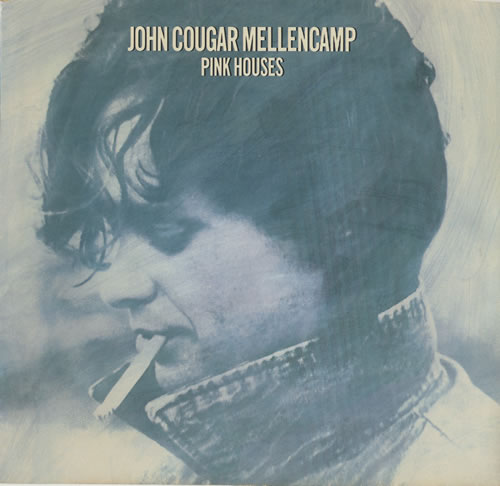
I remember this song well but I also remember the MTV giveaway contest. Oh yes, you could win a free house in Indiana where Mellencamp was from…a pink one of course! MTV got a good deal on the first house…20,000 dollars…there was a reason for that. It was across the street from a toxic dump. MTV then had to get another house and they finally did and gave it away. Susan Miles won the house along with a pink jeep and a garage full of Hawian Punch…not sure how that factored in.
Inspiration for this song came when Mellencamp was driving on Interstate 65 in Indianapolis. As described in the first verse, he saw a black man sitting in a lawn chair just watching the road. The image stuck with Mellencamp, who wasn’t sure if the man should be pitied because he was desolate, or admired because he was happy.
Pink Houses peaked at #8 in the Billboard 100 and #15 in Canada in 1984. The song was on the Uh-Huh and that album peaked at #9 on the Billboard Album Charts in 1984. This is the album that in my opinion placed John Mellencamp with the so-called “Heartland Rockers” like Bruce Springsteen, Tom Petty, and Bob Seger.
From Songfacts
Mellencamp is from a rural town in Indiana and often writes about the American experience. His songs are sometimes misinterpreted as patriotic anthems, when a deeper listen reveals lyrics that deal with the challenges of living in America as well as the triumphs. Mellencamp has expressed his love for his country, but has also criticized the US government for going to war in Iraq, developing a dependency on foreign oil and not doing more to support the working class.
“It’s really an anti-American song,” Mellencamp told Rolling Stone about “Pink Houses.” “The American dream had pretty much proven itself as not working anymore. It was another way for me to sneak something in.”
MTV ran a contest based on this song where they gave away a pink house in Indiana. They got a great deal on the place – John Sykes at the network remembers paying $20,000 for it – but unfortunately, the house was across from a toxic waste dump. When Rolling Stone ran an article pointing this out, Sykes flew to Indiana and bought another house, which is the one they gave away (after painting it pink). The ordeal provided one of the many strange-but-true memories of the early MTV years (and not the only one involving a contest – when they did a promotion with Van Halen making a viewer a “roadie for a day,” the guy who won almost died from the alcohol, drugs and assorted excess). According to Sykes, the house near the waste dump stayed on the books at MTV until 1992, as they couldn’t get rid of it.
Uh-Huh was the first album where Mellencamp used his real name. His manager named him “Johnny Cougar” when he started out, a name he used on his first two albums. He then became “John Cougar” until his seventh album, Uh-Huh, when he used John Cougar Mellencamp. In 1990, he recorded as John Mellencamp.
Changing his name was out of character, as he was notoriously combative with his record company and refused to participate in conventions like listening parties. But he knew that the only way he could ever call his own shots was by making hits, and the name change seemed like a good call, even though it didn’t suit him. When his plan worked, earning his autonomy, he started the process of changing to his real name.
Mellencamp’s previous hits, notably “Hurts So Good” and “Jack & Diane,” took him a long time to write. “Pink Houses” was different, and marked a creative breakthrough.
“I started writing every day and painting and drawing, and I found myself open to suggestion,” he said in his Plain Spoken DVD. “I wrote a song called ‘Pink Houses’ that came very quickly. I wasn’t thinking about it – I saw something a couple of days before, and I just more-less reported on it, and it came out to be ‘Pink Houses.’ True art is always a surprise. It’s not constructed. If it doesn’t surprise the person that’s writing it, it’s not going to surprise the person that’s listening.”
Mellencamp performed an 8-minute version of this with Kid Rock at the 2001 “Concert For New York,” a benefit for victims of the World Trade Center attacks.
Pink Houses
There’s a black man with a black cat Living in a black neighborhood He’s got an interstate running’ through his front yard You know, he thinks, he’s got it so good And there’s a woman in the kitchen cleaning’ up evening slop And he looks at her and says: “Hey darling, I can remember when you could stop a clock”
Oh but ain’t that America, for you and me Ain’t that America, we’re something to see baby Ain’t that America, home of the free, yeah Little pink houses for you and me, oh for you and me
Well there’s a young man in a T-shirt Listenin’ to a rock ‘n’ roll station He’s got a greasy hair, greasy smile He says: “Lord, this must be my destination” ‘Cause they told me, when I was younger Sayin’ “Boy, you’re gonna be president” But just like everything else, those old crazy dreams Just kinda came and went
Oh but ain’t that America, for you and me Ain’t that America, we’re something to see baby Ain’t that America, home of the free, yeah Little pink houses, for you and me, oh baby for you and me
Well there’s people and more people What do they know, know, know Go to work in some high rise And vacation down at the Gulf of Mexico Ooo yeah
And there’s winners, and there’s losers But they ain’t no big deal ‘Cause the simple man baby pays the thrills, The bills and the pills that kill
Oh but ain’t that America, for you and me Ain’t that America, we’re something to see baby Ain’t that America, home of the free, yeah Little pink houses for you and me, ooo, ooo yeah
Ain’t that America, for you and me Ain’t that America, hey we’re something to see baby Ain’t that America, oh the home of the free, Yeah yeah yeah yeah yeah yeah yeah Little pink houses babe for you and me, ooo yeah ooo yeah
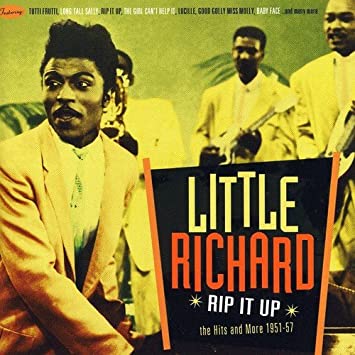
Little Richard passed away yesterday at 87 years old…he was one of the last fifties pioneers left. His influence passed through generations from Bob Dylan, The Beatles, Jimi Hendrix, James Brown, to Lemmy from Motorhead.
I’ve read interviews from so many artists saying how he influenced them. Bob Dylan started on Little Richard in Minnesota as a teenager and I’ve read where Lemmy was a giant fan. Richard touched many generations.
My dad told me about Little Richard before I ever heard him. He said he had the biggest voice he ever heard. He talked about a song called Long Tall Sally. I first heard it…it blew me away. Such a raw emotional power in that voice. He would take us to the edge of the cliff and then at the last minute pull us back.
His voice was one of a kind…and I mean one of a kind. He could sing anything.
Bob Dylan:I just heard the news about Little Richard and I’m so grieved. He was my shining star and guiding light back when I was only a little boy. His was the original spirit that moved me to do everything I would do.
Keith Richards:So sad to hear that my old friend Little Richard has passed. There will never be another!!! He was the true spirit of Rock’n Roll!
Rip It Up
A songwriter named Johnny Marascalco wrote this song, which was released as Little Richard’s third single. Marascalco while he was sitting in a cotton field waiting for a friend to get out of church so they could hunt rabbits. A later weekend, he heard Little Richard’s “Long Tall Sally” and decided that he could write similar songs.
Little Richard’s producer Bumps Blackwell (who has a co-writing credit on this one as well) bought both “Rip It Up” and another Marascalco song, “Ready Teddy,” which was released as the B-side of the single. The two songs were recorded at J&M Studios in New Orleans on May 9, 1956.
The song peaked at #1 in the R&B Charts, #27 in the Billboard Charts, #30 in the UK, and #30 in Canada in 1956.
Rip It Up
‘Cause it’s Saturday night and I just got paid Fool about my money don’t try to save My heart says go, go Have a time ’cause it’s Saturday night And I’m feelin’ fine
I’m gonna rock it up I’m gonna rip it up I’m gonna shake it up I’m gonna ball it up I’m gonna ride it out And ball tonight
I got a date and I won’t be late Pick her up in my ’88’ Shag it on down to the union hall When the music starts jumpin’ I’ll have a ball
I’m gonna rock it up I’m gonna rip it up I’m gonna shake it up I’m gonna ball it up I’m gonna ride it out And ball tonight
Along about 10 I’ll be flying high Rocking on out into the sky I don’t care if I spend my gold ‘Cause tonight I’m gonna be one happy soul
I’m gonna rock it up I’m gonna rip it up I’m gonna shake it up I’m gonna ball it up I’m gonna ride it out And ball tonight, aw
Well it’s Saturday night and I just got paid Fool about my money don’t try to save My heart says go, go Have a time ’cause it’s Saturday night And I’m feelin’ fine
I’m gonna rock it up I’m gonna rip it up I’m gonna shake it up I’m gonna ball it up I’m gonna ride it out And ball tonight
Along about 10 I’ll be flying high Rocking on out into the sky I don’t care if I spend my gold ‘Cause tonight I’m gonna be one happy soul
I’m gonna rock it up I’m gonna rip it up I’m gonna shake it up I’m gonna ball it up I’m gonna ride it out And ball tonight
My wife asked me if I have ever posted this song before. So for her… here it is…September by Earth, Wind, and Fire. It was her…”Jr High Song.” One warning…when you hear it you cannot get it out of your head.
Maurice White, Al McKay, Allee Willis wrote this song. Maurice White said he got the idea for this song in an unlikely place… a hotel room in Washington DC while there was some kind of protest going on below. Said White, “There’s all these cats screaming and throwing things and going crazy and this tune just evolved.”
September peaked at #1 in the Billboard 100, #3 in the UK, #10 in Canada, and #12 in New Zealand in 1979.
Earth, Wind, and Fire had 33 songs in the top 100, 7 top ten hits, and one number 1.
Verdine White (Bass Player): “People now are getting married on September 21st,” he said. “The stock market goes up on September 21st. Every kid I know now that is in their 20s, they always thank me because they were born on September 21st.”
From Songfacts
This song has a tendency to make people happy when they hear it. Allee Willis, who wrote the song with Maurice White and Al McKay from Earth, Wind & Fire, describes it as “Joyful Music.”
It was the first song Willis wrote with the band, and quite a learning experience. She told us: “Their stuff was very much based on Eastern philosophies, an incredibly positive outlook on life; the lyrical content of their songs was not typical of what would have been in soul music at that time. So when I left the studio that first day, Maurice gave me the name of a book, it was called The Greatest Salesman In The World, and he sent me to the Bodhi Tree, which is a very spiritual bookstore here in LA. I got that and a bunch of other books that the saleswoman said was the philosophy. And what went from being a very simple experience turned into, for me, an incredibly complex experience. Because I dove into these books.
And even the way they were written, the language they were written in, I kind of didn’t understand anything. But Maurice told me right from the jump he thought I was a very spiritual person, and I was put here to communicate. And I thought, if Maurice was saying that to me, I need to hang with this.
I was pouring through these books for a couple of months. Lyrics started being 25-30 pages long as I’m trying to figure all this stuff out. Reading all that stuff changed me forever. He lead me to a path I’ve stayed on.
“So ‘September’ was fantastic and thrilling, and they had started the intro of it by the time I had walked into the studio to meet everyone. Just as I opened the door and I heard that little guitar intro, I thought, Oh God, please let this be what they want to work with me on. Because it was so obviously a hit.” (Here’s our full Allee Willis interview. Her website is alleewillis.com.)
While there are many theories as to the “21st night of September” in the opening lyrics, the truth is they just felt right. Willis told us: “Maurice had that very first line, and I said to him, ‘Why the 21st?’ Because I’m someone who likes to tie up all the ends very neatly, so if I’m saying the 21st, I want to know during the song what’s the significance. But he always told me there was no real significance. So whether that’s true or not I can’t say. But as far as I know, it’s just something that sang really well. And I would say the main lesson I learned from Earth, Wind & Fire, especially Maurice White, was never let a lyric get in the way of a groove. Ultimately it’s the feel that is the most important, and someone will feel what you’re saying if those words fit in there right. I do remember us experimenting with other dates, but 21st just sang phonetically fantastic.”
Willis co-wrote most of the songs on Earth, Wind & Fire’s next album I Am, including the hit “Boogie Wonderland.”
Although many people hear the first words in the chorus as “Party On,” it’s really “Bada-Ya.” Allee Willis explained in her Songfacts interview: “I absolutely could not deal with lyrics that were nonsensical, or lines that weren’t complete sentences. And I’m exceedingly happy that I lost that attitude. I went, ‘You cannot leave bada-ya in the chorus, that has to mean something.’ Maurice said, ‘No, that feels great. That’s what people are going to remember. We’re leaving it.’ We did try other stuff, and it always sounded clunky – thank God.”
This was written specifically for Earth, Wind & Fire’s greatest hits album The Best of Earth, Wind & Fire, Vol. 1. Along with their cover of “Got To Get You Into My Life,” it was one of two new songs included on the set, which became their best-selling album and helped the band cross over to a broader audience.
Movies that used this song include Night at the Museum, The Ringer, Soul Food, Dan In Real Life and Babel.
This was featured on the NBC spy comedy Chuck in the 2010 episode “Chuck Versus the Living Dead.” On the show, Buy More manager Big Mike claims he was once a member of the band back when they were called Earth, Wind, Fire & Rain (he was Rain).
Taylor Swift released an airy, banjo-and-acoustic-guitar version of this song on April 13, 2018 that provoked ire on social media. Her recording was part of a Spotify promotion; she explained that she covered it for “sentimental reasons” and because the month of September is when one of her memorable breakups occurred.
Philip Bailey of EW&F came to her defense, tweeting,”Music is free like that… Ain’t Got Nothing But Love for Ya.”
September
Do you remember the 21st night of September? Love was changing the minds of pretenders While chasing the clouds away
Our hearts were ringing In the key that our souls were singing As we danced in the night Remember how the stars stole the night away
Hey hey hey Ba de ya, say do you remember Ba de ya, dancing in September Ba de ya, never was a cloudy day
Ba duda, ba duda, ba duda, badu Ba duda, badu, ba duda, badu Ba duda, badu, ba duda
My thoughts are with you Holding hands with your heart to see you Only blue talk and love Remember how we knew love was here to stay Now December found the love that we shared in September Only blue talk and love Remember the true love we share today
Hey hey hey Ba de ya, say do you remember Ba de ya, dancing in September Ba de ya, never was a cloudy day
There was a Ba de ya, say do you remember Ba de ya, dancing in September Ba de ya, golden dreams were shinny days
The bell was ringing Our souls were singing Do you remember, never a cloudy day
There was a Ba de ya, say do you remember Ba de ya, dancing in September Ba de ya, never was a cloudy day
There was a Ba de ya, say do you remember Ba de ya, dancing in September Ba de ya, golden dreams were shinny days
Ba de ya de ya de ya Ba de ya de ya de ya Ba de ya de ya de ya de ya
Ba de ya de ya de ya Ba de ya de ya de ya Ba de ya de ya de ya de ya









 PowerPop... An Eclectic Collection of Pop Culture