A.T.N.T. – Cobblestone Street

A few weeks ago I posted about Mouse and the Traps, a Texas band formed in the 1960s. I thought my fellow blogger friend Phil from Notes from the Cactus Patch may have known them. He did…. so I thought…I would like to write about Phil’s 1960s band. I first heard of Phil from Hanspostcard… he sent me THIS link to Phil’s post about meeting John Sebastian in Texas in the sixties along with the other Lovin Spoonful. He also briefly met Janis Joplin when she cut the food line at the Texas International Pop Festival” I survived one-hundred-degree temperatures for three days and got to meet Janis Joplin one late night when this nice gal with a Texas twang asked me if she could cut in line as I was waiting to buy a hot dog. It took a minute for me to realize it was her, but I was cool; it was the sixties, man. That night, ole Janis “took a little piece of my heart, now baby.”

I’m getting most of the info from this post. I urge you to read that because he tells a more complete story.  Phil’s Dad, Johnny Strawn played with the Light Crust Doughboys so Phil was surrounded by music when he grew up. He went through a few bands on the way. He formed his first band in 1964 and they were called The Dolphins and in late 65 they became The Orphans. The Orphans lasted until 1967 and the members were Johnny Strawn, vocals and lead guitar –  Jarry Davis, vocals and rhythm guitar-  Danny Goode, lead vocals and bass –  Marshall Sartain, vocals and keyboards- Barry Corbett, vocals.

The music they played was all over the place and everything that kept people on the dance floor.  The music they played was Soul Music, Beatles, Bee Gees, Rascals, Hendrix, Doors, Steppenwolf, Cream, Stones, Vanilla Fudge, and Jefferson Airplane.  They played all over Texas and parts of Oklahoma…and some of the clubs he mentioned were The Studio Club, LuAnn’s, Strawberry Fields, Phantasmagoria, The Cellar, The Box, and more. This was when three of the band were still in high school. 

Phil Strawn:  We used to do a lot of double bills at The Studio Club and LuAnn’s; that was a big thing back then. I remember playing a lot of them with Southwest F.O.B. We were playing at LuAnn’s one weekend when during the Jimi Hendrix song Fire, our drummer put lighter fluid on his cymbals, lit his drum sticks, then hit the cymbals and ignited them. It got a little out of hand and it burned up his drums. That kind of stuff wouldn’t fly nowadays, but back then, we didn’t think of the repercussions. The crowd loved it, sort of like The Who, only with real fire and smoke. Miss Lou Ann was not pleased and banned us from the club for about six months. We eventually worked our way back into her good graces. Ron Chapman the famous DJ on KLIF and KVIL remembered us as the band that nearly burned down LuAnn’s. Some legacy.

They met a guy named Mark Lee who became their manager. After they signed with him their gigs increased. They even opened up for Iron Butterfly at a place called Strawberry Fields. The Orphans committed a cardinal sin by learning an Iron Butterfly song called Possession and nailed it while opening for Iron Butterfly. Lee put them up to it because he knew it would get under Iron Butterfly’s skin…and it did! They ended up swiping Phil’s Vox Wah Wah pedal and a velvet Nehru suit from their drummer. 

In 1968 they had to change their name. The drummer, Jerry Deaton, had a friend who wanted to manage them but they were happy with Mark Lee. The guy went out and had “The Orphans” copyrighted and told the band he would sue them if they continued so they changed their name. Phil said: “We liked ATNT {Alice talks “n” talks} and Jerry’s mother was the inspiration for that name. Later, we found out that he had managed another band called the Orphans for a while, so that was the reason for all the drama. He copyrighted the name so we had to change.”

Check out this 1968 Flower Fair entertainment. ATNT played and look at the other artists as well. Spencer Davis, Jimmy Reed, Mitch Ryder, The Lemon Pipers, and Neil Diamond. The Doors were going to play but they had scheduling conflicts. 

ATNT Scedule

In 1966 they recorded a song that Phil wrote called “Leader of My Mind” which was a Byrds-type song with harmonica but no one can find any copies. In 1968 they recorded two songs called “No One Told Me About Her” with the flipside Cobblestone Street. 

They also did a couple of appearances on Mark Stevens TV Show which they lipsynced to their songs. Phil quit in the late sixties because of a disagreement with the rhythm guitar player. He had to make a choice and his final exams were coming up and Phil decided to study rather than just practice with the band. 

After that, Phil said he didn’t play much until around 1974 when he started to play in the progressive country music scene in Austin and Dallas. I played with various people around town and some in south Texas and did some pick-up and studio work. I joined the Trinity River Band in late ’79 and played with them until ’85. I also played with The Light Crust Doughboys from time to time and did some studio work on the five-string banjo. I was fortunate to play on the Light Crust Doughboys album, ” One Hundred-Fifty Years of Texas Music.” 

The A.T.N.T. Discogs page. 

Phil Strawn: The A side is “Cobblestone Street,” written and sung by myself and our drummer Barry Corbett. The B side is ” No One Told Me About Her,” written and sung by our lead singer and bass player, Danny Goode. The two producers, Marvin Montgomery and Artie Glenn, suggested we add horns to get a Chicago Transit Authority sound. Before the brass was added, Cobblestone Street was loud and raw with loud guitars and organs. After adding the horns, we returned to the studio and tweaked the cuts. I purposely untuned my Gibson 335 a bit to give the guitar break a bit of an out-of-tune carnival sound. Marvin, who went by the name of Smokey, was a member of the Light Crust Doughboys since the 1930s and played with Bob Wills. He produced Paul and Paula and Delbert McClinton. Artie Glenn wrote the famous Elvis hit “Crying In The Chapel” and many others; he was also a Light Crust Doughboy western swing musician. These two men were top-shelf record producers, so we listened when they suggested.

Phil Strawn: It was absolutely the best time of my life. How could you not enjoy being a teenager in the ’60s and playing in a popular rock band? The people we met and played with, the experience that we will all carry with us the rest of our lives. It was just a part of life that helped shape us into what we are now – being part of that change in our country, that decade. It was a time of turmoil, but it was also the last year of the innocence we grew up with. Teenagers these days are so hardened. The music then was happy and said a lot. It would move you, whether you played it or danced to it. The music now has a meaner, harder edge, and reflects the times we live in.

Phil Strawn: I am a project manager in commercial construction, and do a lot of painting and artwork – mostly Texas art. After 35 years, Danny Goode, who I played with in ATNT and the Orphans, called me and asked me to be part of their group, The American Classics. I joined them about two years ago and that’s what we do nowadays. The band consists of Danny Goode, bass and lead vocals; John Payne, lead guitar and keyboards; Jordan Welch, drums; and me on rhythm guitar and vocals. We play about once a month or so around Dallas Fort Worth, mostly private parties. We recently played in Deep Ellum, and will probably be back down there soon. We stick to mostly ’60s music – it’s what we know well. It’s good to still be playing rock music at this age. You really never outgrow it.

I love the horns in this song but I would also love to hear what it sounded like with loud guitars as well. 

Ronnie Dawson

Again…a big thank you again to Phil Strawn who gave me the necessary information so the story could be told and much of it from a personal view.

One of the performers in The Big D Jamboree was Ronnie Dawson. He was from Dallas Texas and was nicknamed “The Blonde Bomber.” His father Pinkie showed him how to play the mandolin, drums, and bass guitar. Dawson attended Southwestern Bible Institute in Waxahachie but was expelled. After that, he appeared regularly on the Big D Jamboree Radio Show in Dallas in 1958 as Ronnie Dee and the D Men.  Dawson was known to be highly energetic on stage. Many thought he got it from Elvis but he said no, he learned it from the dynamic Pentecostal revivals he attended.

The Jack Rhodes song “Action Packed” was Dawson’s first release in 1958 on the Backbeat label. After that came the 1959 Rockin’ Bones and this time it was on the Rockin’ Records label. It was issued under Ronnie’s own name with “The Blond Bomber” added. Though Ronnie toured nationally with Gene Vincent and appeared on TV, his records gained no more than regional airplay.

The next 3 paragraphs are from Phil. Back in the early ’60s, there was a club on Mockingbird Lane in Dallas called The Levee. It was a sing-along Dixieland place that was popular at the time. The band was banjos, a doghouse bass and a clarinet and sax. Burgers and pitchers of beer made up the menu. Southern Methodist University was two blocks away, across Highway 75, so most of the clientele were students and couples in their twenties. The famous Egyptian Lounge was next door. It served the best Italian food in Dallas and was a known hangout for the Dallas Mafia and other wise guys.

EPSON MFP image
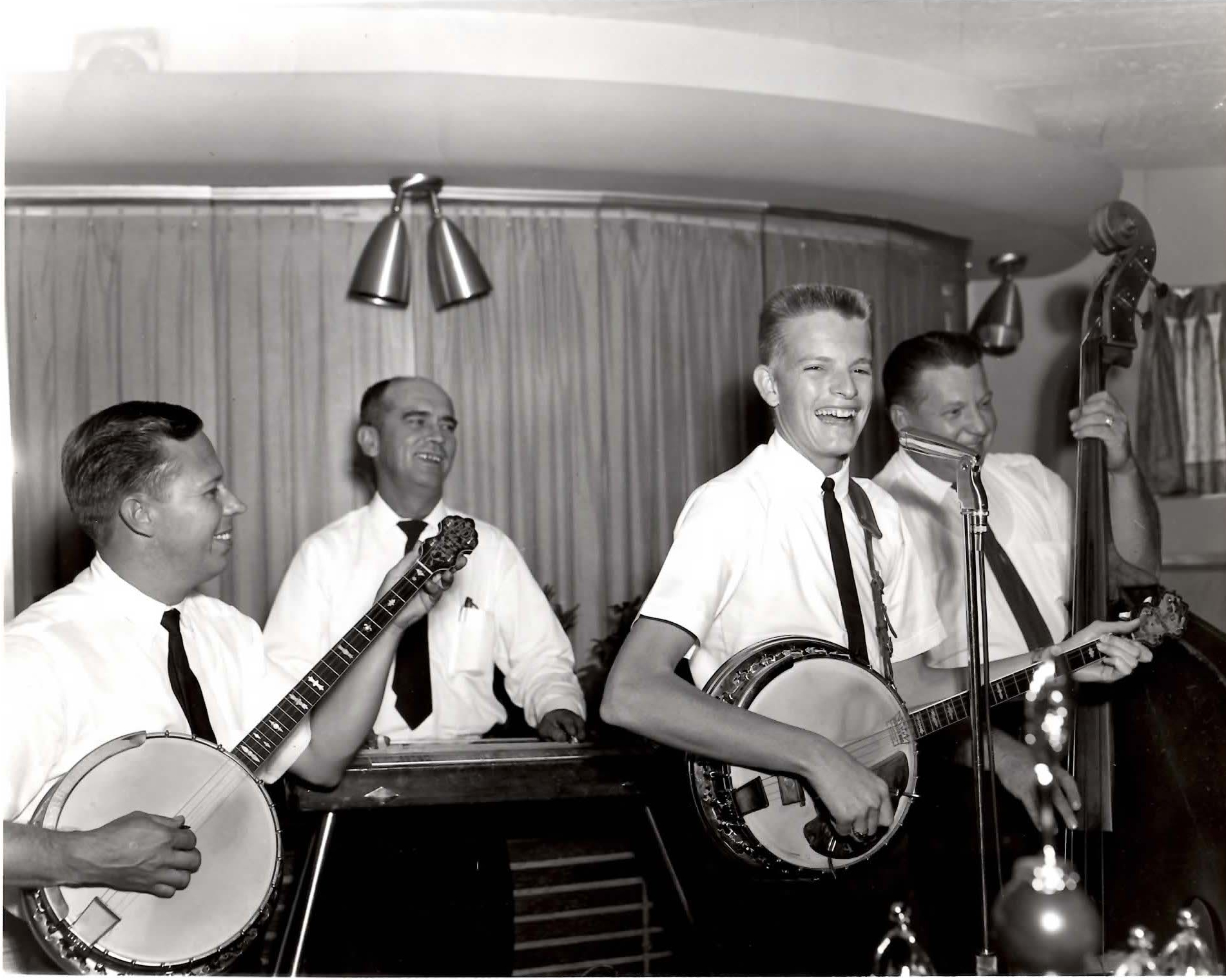
At a Levee Singers gig at the Adolphus Hotel in Dallas, around 1961 or 62. Phil’s dad is also playing a tenor banjo, as is Ronnie.

Smokey Montgomery, the banjo player for the Light Crust Doughboys, started the Levee with Ed Burnett, who was also his partner in Summit Sounds, a well-known recording studio on Greenville Ave. Ronnie was playing with the Doughboys, so Smokey asked him to play with the banjo band in order to add some youth to the mix. He was a huge hit, and the business tripled. The coeds loved him; their boyfriends hated him. The Levee bounced along all through the 60s until the fad went flat. In the mid-70s, Ronnie was into the progressive country music scene and started a band called The Steel Rail. I don’t remember the drummer, lead, or bass players’ names, but the legendary Tommy Morrell played the pedal steel while Ronnie sang and tore up his Strat.

The old Levee club was empty, so Ronnie leased the space and opened a club called “Aunt Emma’s,” a nod to his favorite aunt. On opening night, Ronnie asked my dad to come down and add some fiddle to the band, which he did. I took my guitar, just in case he needed another player. The place was full up, with a line down past the Egyptian. Around 11 pm, Johnny Paycheck strolled in the door. He had finished a gig in Dallas and heard about Ronnie’s new club, so he stopped by to sit in. Of course, he did all of his hits and played for at least an hour. After that, word got around that Aunt Emma’s was the place to go for the new outlaw country; it out-drew Willie Nelson’s Whiskey River which was a few blocks away on Greenville Ave. 

He made several singles in the early sixties with Dick Clark’s Swan Records. He also did some session work. He played on Paul & Paula’s “Hey Paula. After Elvis died rockabilly started to make a comeback.

Dawson’s career experienced periods of obscurity. However, he continued to perform and record music throughout his life, earning a cult following among rockabilly enthusiasts. In the 1980s and 1990s, he experienced a resurgence of interest in his music, performing at festivals and recording new albums.

In the 1980s Ronnie was just beginning. A fifties revival was happening in the UK and he became popular there. This led Dawson to tour Britain for the first time in 1986. He was blown away by the audience’s reception. Dawson sounded purer than most of his peers from the 1950s and he put on a more energetic show.

He recorded new material for No Hit Records, the label of British rockabilly fan Barry Koumis, which was leased in the USA to Crystal Clear Records. No Hit Records also reissued his recordings from the 1950s and early 1960s on a 16-track LP called “Rockin’ Bones” and an extended 2-CD version of which was released by Crystal Clear in 1996.

Ronnie was still performing until the early 2000s when health problems started.  He passed away in Dallas on September 30, 2003, at the age of 64.

Phil Strawn: He was a great guy and close friend. After his death from lung cancer, which shocked us all because he never smoked cigarettes but did partake of other smokable plants, his wife, Chris, held a wake at the Sons of Herman Hall in Deep Ellum. You couldn’t stir the musicians and rock stars with a stick; the ballroom on the second floor was packed. I remember Billy Joe Shaver, Ray Wylie Hubbard, Michael Martin Murphy, Robert Earl Keen, and Robert Duvall being there. George Gimarc, a noted Texas music historian, has a treasure trove of photos and reel-to-reel recording tapes of Ronnie dating back to the Big D Jamboree and American Bandstand. He refuses to share or part with any of his collections. I told him, that’s okay, leave a few to me when you bite the dust. There is no need for me to approve of your article; you write great music history, and Ima sure this one will also be stellar.

Ronnie Dawson:  “At that point in my life, I was so ready to get out of Dallas. I was really ready to go, and I just blew up when I got over there. … I couldn’t believe it. All these people started embracing me. I was in heaven. I didn’t want to go home.”

He was inducted into the Rockabilly Hall of Fame, in 1998.

The Big D Jamboree

Today I’m going to have two related posts. I want to thank Phil Strawn for his information. He basically wrote a lot of this and the next post in his emails to me. To actually talk to someone who was witnessing history is wonderful. For that reason I’m using two posts today to cover a little of Phil’s dad, The Big D Jamboree (A Dallas Music Show), and a rockabilly performer there named Ronnie Dawson on the next post.

Phil from Notes from the  Cactus Patch told me about this event in Dallas. He actually lived, saw, and met some of these artists who were vital to the beginning of Rockabilly and the history of Country music. His dad was Johnny Strawn and played in the Light Crust Doughboys. That is a  country band formed in 1931 and is still going…with different members of course. The band also included the legendary Bob Wills. They played on a radio show and were active until around 1950. They were dormant for a while until the sixties when they were revived.

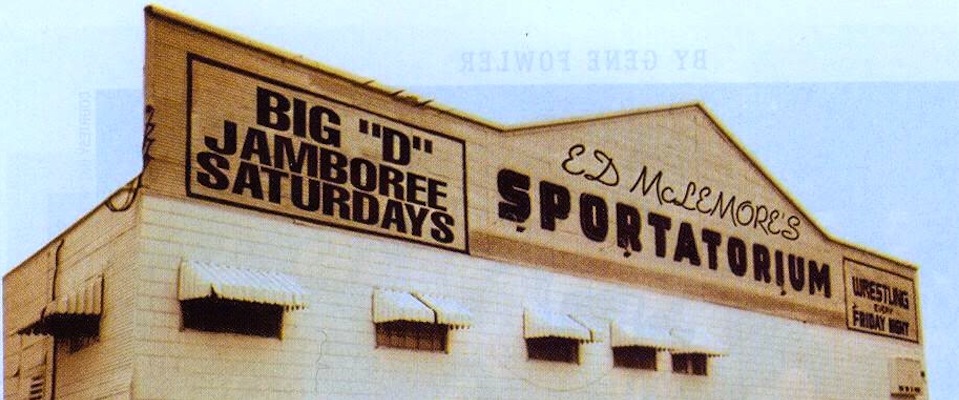
On October 16, 1948, the Big D Jamboree first aired on the Dallas radio station KRLD. The Big D Jamboree was held at the Dallas Sportatorium, a large indoor arena located at 1000 South Industrial Boulevard in Dallas, Texas. The Sportatorium was known for hosting various events, including wrestling matches, concerts, and other entertainment shows. The show was started by Ed McLemore, a Dallas-based promoter.

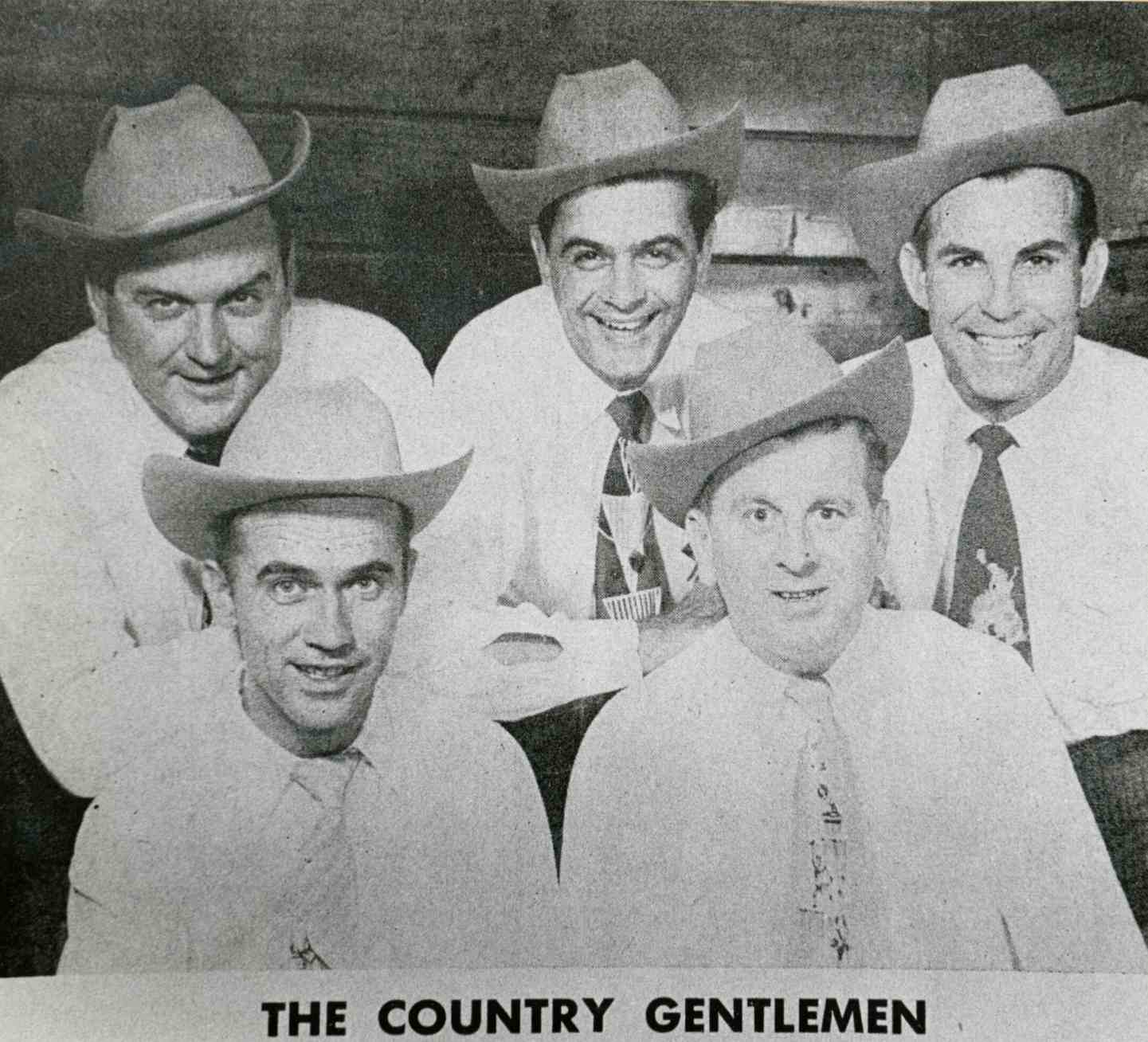
It was a live country and rockabilly music show held during the 1950s and 1960s. It was one of the premier venues for country, rockabilly, and honky-tonk music during that era. The “Big D” in the name refers to Dallas, where the show was based. The Light Crust Doughboys didn’t play there but members of that band including Johnny Strawn would make up the house band called The Country Gentlemen.

Big D jamboree pic 1
. The Country Gentlemen were the official band with Marvin “Smokey” Montgomery and Paul Blunt of the Doughboys. Weekly rotations were Johnny Strawn-fiddle, Carroll Hubbard-fiddle, Ken Cobb-Bass, Artie Glen-Bass, Jim Boyd guitar, Jerry Elliot guitar, Bill Hudson-guitar, Eddie McDuff guitar, Paul Blunt steel guitar, Smokey Montgomery-banjo. Marvin Montgomery was the official leader of the Doughboys, as well as the house band leader of the jamboree. The stage was also the wrestling ring, and the performers either sat at the back, behind, or to one side of the elevated stage.

The Jamboree provided a platform for emerging and established artists to showcase their talent to a live audience and was broadcast on radio stations across Texas. It played a significant role in promoting the careers of many notable musicians, including Johnny Cash, Elvis Presley, and Willie Nelson, Wanda Jackson, Ronnie Dawson, Eddie Cochran, George Jones, Buddy Knox, Roy Orbison, among many others.

Speaking of the great Wanda Jackson. Phil had a story about her. “Wanda Jackson took a liking to me and even cleaned my ears with spit on a handkerchief; now that was something to behold. She also filled me with Coca-Cola and candy bars.” Unfortunately, the show ended in 1966. The Sportatorium was demolished in 2003. It remains a celebrated part of Dallas’s musical heritage and is remembered fondly by those who attended or were influenced by the event. The impact of the Big D Jamboree on the development of American music cannot be overstated

For a prelude to what is coming in the next post on Ronnie Dawson. Phil StrawnThe house band and Smoky Montgomery took a shine to him and, a few years later, asked him to join the Doughboys. At that time, the band was playing a lot in Texas, Oklahoma, MS, Louisiana, and Arkansas, and Smokey wanted to add some rock n roll to the band for the youngsters. Ronnie was a perfect fit and became lifelong friends with all the guys. 

You can see a young Ronnie Dawson third from the left in this picture.

EPSON MFP image
Ronnie Dawson with the Light Crust Doughboys

Continue reading “The Big D Jamboree”