I’ve been visiting Cork’s site for years and it’s one of my favorite blogs to visit. I’ve read posts about Eric Clapton, Sasquatch, Frozen Pizza, Iron Maiden, movies, blues songs, and many more. Take a visit to his site at https://mojohorizon.home.blog/ it’s totally worth it.
Made you look! This isn’t an exploration of the erotic — sorry, if you’re disappointed. It’s a comparison of recordings. The song is called “She’s Got Everything”. It’s a pretty generic title, but it’s definitely in the hidden gem category. I came to know The Romantics’ version of this song when I was a college student. (You might be more familiar with “What I Like About You” which precedes it on their self-titled release.) Both songs are in the world of three-chord-or-so garage rock. I used to hear the songs back-to-back at college parties when enough people were feeling loose enough to dance.
If I had a time machine, I’d go back and yell, “It’s a TWIN SPIN!!” in the middle of them. I can honestly say I actually saw people doing “the monkey” to this song in the late 80’s and early 90’s. The song rocks! It’s got a great feel to it. Loud, fast, raucous. What more could you want?
If I’m not mistaken, I had The Romantics album on vinyl and discovered “She’s Got Everything” was actually written and sung by The Kinks’ Ray Davies from the liner notes. It took me awhile to find it or find it in a collection I wanted. It was apparently the B side to “Days.” The original version of “She’s Got Everything” by The Kinks is worth a listen.
I’m biased towards The Romantics version, but I love The Kinks and the songwriting of Ray Davies. Naturally, Ray’s brother Dave Davies plays an aggressive-sounding lead guitar solo on the track. “Pretty ringlets in her hair” is my favorite line from this song. I don’t think I’ve ever heard the word ringlets used in song outside of this example. (I always pictured a ringlet as a ribbon or something, but it’s a style of “princess curls” a la Shirley Temple.)
I recently listened to The Kinks’ tune again and dialed in the little instrumental bit around the 1:30 mark. When I listened to it, I heard the first few seconds of Deep Purple’s “Woman from Tokyo.” Listen to the DP tune around 8 seconds into it.
Deep Purple’s song didn’t come out until 1973. Did they own a copy of the 1968 Kinks release “She’s Got Everything”? I don’t know, but it’s just what I hear. The two songs are in different keys, but both feature the same chord changes of I to V, which is a distinct feature.
Thanks to Dave for posting this song. It was a response to Dave asking us about songs that mention a city on Turntable Talk. This one and Nashville Cats came to mind…but I went with the Purple.
This song is all about the riff…it is a memorable riff… The song has drive and suspense. The dynamics are great after the middle section when the intro riff is reintroduced. What made Deep Purple different from other hard rock bands at the time was the Hammond C3 organ played by Jon Lord. In this song the Hammond sounds as mean as the guitar.
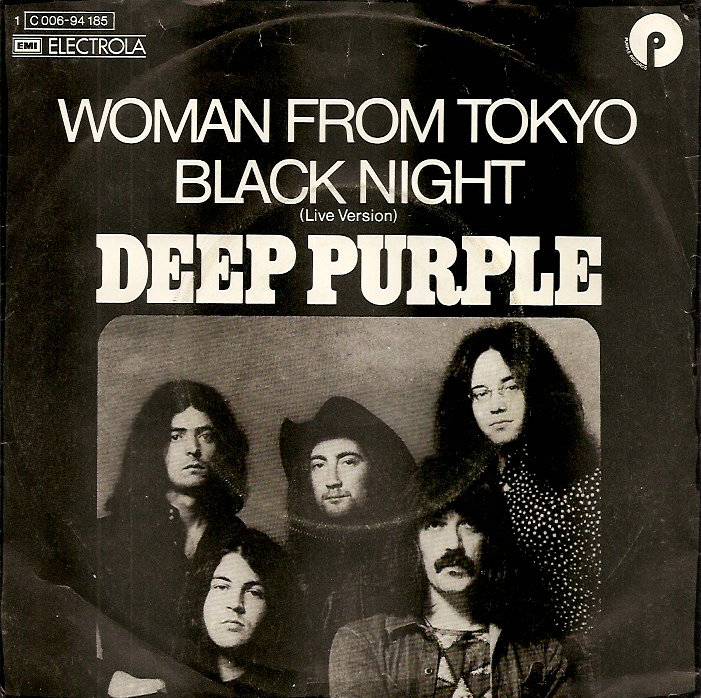
The song was inspired by Deep Purple’s first tour of Japan in 1972. The band was struck by the contrast between the crowded bustling, modern city of Tokyo and the traditional aspects of Japanese culture. Tokyo is personified as a woman.
Woman from Tokyo was on the album Who Do We Think We Are released in 1973. The band members were dealing with exhaustion from constant touring and the pressure to deliver another hit album. The album did quite well peaking at #4 in the UK, #15 on the Billboard Album Charts, and #11 in Canada.
Deep Purple wasn’t a singles band, but this one got a lot of airplay on radio. The song peaked at #60 on the Billboard 100 and #55 in Canada in 1973. That surprises me because I did hear this one a lot growing up.
The band never liked it very much. They didn’t start playing it live until they re-formed in 1984 after their 1976 split. Roger Glover insists that no real live versions of this song existed until the 80s despite being on live compilation albums from their 1970s period.
Because of endless touring and fatigue, Ian Gillan gave a six-month notice stating that he was leaving the band after fulfilling all his commitments in 1973. After lead singer Ian Gillian left Deep Purple in 1973, they had two other lead singers before reforming in 1984…and they were David Coverdale and Joe Lynn Turner. To me though…Ian Gillian is the singer I think of when I think of Deep Purple.
Ritchie Blackmore: “We were in Japan, and it was an incredible experience for us. The song came out of our admiration for the country and the fans there. Tokyo had a lasting impression on us.”
Ritchie Blackmore: “I wanted ‘Woman from Tokyo’ to have a strong, catchy riff that would stay with the listener. The middle section was intended to give it a different feel, almost like taking the listener on a journey.”
Ritchie Blackmore: “The recording sessions for ‘Who Do We Think We Are’ were tough. There was a lot of tension in the band, but ‘Woman from Tokyo’ was one of the moments where things came together well.”
Woman from Tokyo
Fly into the rising sun Faces, smiling everyone Yeah, she is a whole new tradition I feel it in my heart
My woman from Tokyo She makes me see My woman from Tokyo She’s so good to me
Talk about her like a Queen Dancing in a Eastern Dream Yeah, she makes me feel like a river That carries me away
My woman from Tokyo She makes me see My woman from Tokyo She’s so good to me
But I’m at home and I just don’t belong
So far away from the garden we love She is what moves in the soul of a dove Soon I shall see just how black was my night When we’re alone in Her City of light
Rising from the neon gloom Shining like a crazy moon Yeah, she turns me on like a fire I get high
My woman from Tokyo She makes me see My woman from Tokyo She’s so good to me
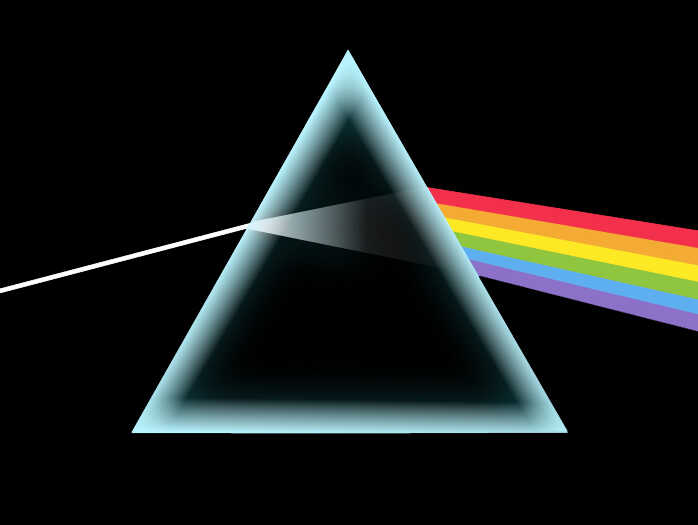
Pink Floyd released one of the biggest albums of all time…Dark Side of the Moon.
Roger Waters put together the cash register tape loop that plays throughout the song. It also contains the sounds of tearing paper and bags of coins being thrown into an industrial food-mixing bowl. The intro was recorded by capturing the sounds of an old cash register on tape and meticulously splicing and cutting the tape in a rhythmic pattern to make the “cash register loop” effect. Waters also wrote the song.
Like many of their songs, this was not released as a single in the UK, where singles were perceived as a sellout…but it was released as a single in America in 1973
Another positive song that was written by George Harrison. “Give Me Love (Give Me Peace on Earth)” replaced Wings’ “My Love” at number 1 on the Hot 100 singles chart…For the week ending 30 June that year, the Harrison and McCartney songs were ranked numbers 1 and 2 respectively.
This song was based on a true story that happened to the band. Smoke On The Water took inspiration from a fire in the Casino at Montreux, Switzerland on December 4, 1971. Deep Purple was going to start recording their Machine Head album there right after a Frank Zappa concert, but someone fired a flare gun at the ceiling during Zappa’s show, which set the place on fire when Deep Purple was watching. It was released in May of 1973.
Music stores would not be the same without this song. It was written by Ritchie Blackmore, Ian Gillan, Roger Glover, Jon Lord, and Ian Paice.
Allman Brothers released this song in August of 1973. It was the band’s biggest hit that almost didn’t get released. The band thought it was too country and almost didn’t release it. This one was written by Dickey Betts.
My sister had a Jim Croce greatest hits album and I played it non-stop. This one is easy for kids to remember. This song has been played to death but I still love it. This one remains one of the most remembered songs from the early seventies. Jim Croce wrote this one.
I had a relative that played this song to death…but I didn’t mind. Machine Head is a great hard rock album.
The intro to this song is worth the price of admission. Jon Lord’s organ has a filthy dirty sound. The half-step riffs in the refrain were inspired by the theme music for the Batman TV program composed by Neal Hefti. Blackmore asked singer Ian Gillan if he could write any lyrics over the riff, and the rest of the song evolved from there.
Machine Head peaked at #1 in the UK, #1 in Canada, and #7 in the Billboard Album Charts in 1972. Ian Gillan, Ritchie Blackmore, Roger Glover, Jon Lord, and Ian Paice – are all credited as writers of this song.
This song actually got into space when the astronaut Kalpana Chawla took a copy of the Machine Head album with her on board the Space Shuttle Columbia, which sadly disintegrated before it could land back on Earth during its 2003 mission. Chawla got to know Deep Purple guitarist Steve Morse, which is why she brought the album with her. Morse wrote a song called “Contact Lost,” which appeared on the 2003 Deep Purple album Bananas in memory of Chawla and the others on board.
The album Machine Head was recorded in a hotel. The plan was to use the Montreux Casino in Switzerland as a studio to help capture their live sound, but the day after they got there, it burned down during a Frank Zappa concert. We all know that story told so well as told in Smoke On The Water.
They ended up recording this at the Grand Hotel and they used the Rolling Stones mobile unit that Zeppelin and a few others used at that time. That was a genius idea…you could have a studio in your house or an old castle somewhere if you wanted.
Ace Frehley covered this song in 2020.
Space Truckin
Well, we had a lot of luck on Venus
We always had a ball on Mars
We’re meeting all the groovy people
We’ve rocked the Milky Way so far
We danced around with Borealis
We’re space trucking ’round the the stars
Come on, come on, come on
Let’s go space truckin’
Come on, come on, come on
Space truckin’
Remember when we did the moonshot?
And pony trekker led the way
We’d move to the Canaveral moonstop
And every ‘naut would dance and sway
We got music in our solar system
We’re space truckin’ ’round the stars
Come on, come on, come on
Let’s go space truckin’
Come on, come on, come on
Space truckin’
The fireball that we rode was moving
But now we’ve got a new machine
Yeah, yeah, yeah, yeah the freaks said
Man those cats can really swing
They’ve got music in their solar system
They’ve rocked around the Milky Way
They dance around the Borealis
They’re space truckin’ everyday
Come on, come on, come on
Let’s go space truckin’
Come on, come on, come on
Space truckin’
Come on, come on, come on
Let’s go space truckin’
Come on, come on, come on
Space truckin’
Yeah, yeah, yeah, space truckin’
Yeah, yeah, yeah, space truckin’
Yeah, yeah, yeah, space truckin’
Yeah, yeah, yeah, yeah, yeah, yeah
Yeah, yeah, yeah, space truckin’
Yeah, yeah, yeah
Imagine a concert in 1975 with The Beatles, Bob Dylan, the Allman Brothers, Linda Ronstadt, The Rolling Stones, The Who, and more. Well, it happened! Sorta. Rod Serling did all of the radio promos. It would be one of his last projects…he would pass away before it aired.
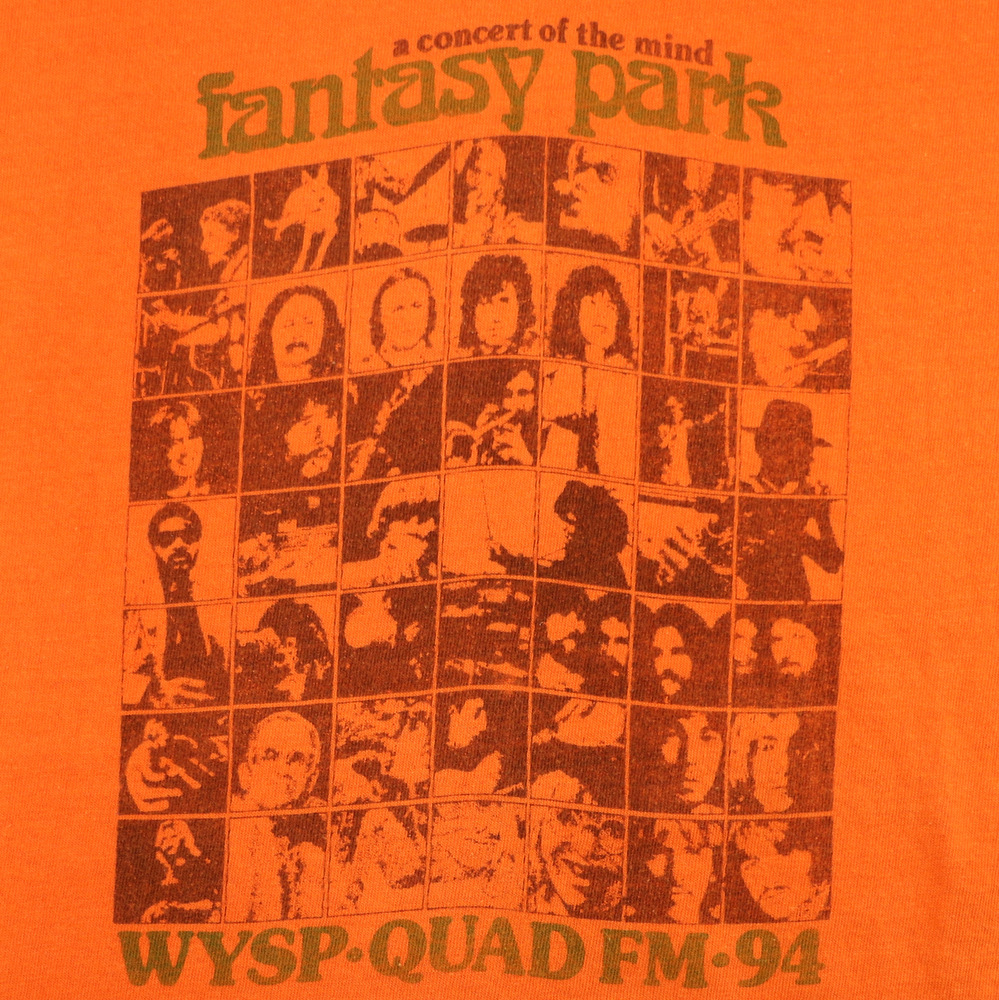
It was a 48-hour-long rock concert (Fantasy Park) that was aired by nearly 200 radio stations over Labor Day weekend in 1975. The program, produced by KNUS in Dallas, featured performances by dozens of rock stars of the day and even reunited The Beatles. It was also completely imaginary, a theatre-of-the-mind for the 70s.
The “concert” consisted of live and studio recordings by the artists with live effects added to make it sound legit.
The show had college students hitchhiking all over America hoping to get to Fantasy Park. In New Orleans when the concert aired, the IRS came knocking on the doors of WNOE trying to attach the gate receipts to make sure the Feds got their cut! Callers were asking where they could get tickets to this amazing show.
The show was so popular in Minnesota that they played it again in its entirety the next year…now that people knew it wasn’t real and weren’t looking for tickets. The greatest concert that never was. Fantasy Park had their own emcee and special reporters covering the weekend event giving you the play-by-play details along with some behind-the-scenes updates.
The concert would always be halted due to rain on a Sunday morning to allow the locals to get in their regular (usually religious) programming. The whole event ended promptly at 6 pm on Sunday.
Now people look for the full 48-hour tapes of the show. They are a hot collector’s item. Rod Serling passed away on June 28, 1975.
Bands at Fantasy Park
Chicago Elton John Led Zeppelin Joe Walsh Cream Shawn Phillips Pink Floyd Carly Simon James Taylor (& Carol King) Poco Alvin Lee Eagles Linda Rondstadt Dave Mason Steve Miller John Denver Beach Boys War Grand Funk Yes Deep Purple Rolling Stones Cat Stevens The Who Rolling Stones Moody Blues Marshall Tucker Band Allman Brothers Band Seals & Crofts America Joni Mitchell Doobie Brothers Loggins and Messina Crosby/Stills/Nash/Young Bob Dylan Beatles
Go to any music store basement right now and some beginner will be playing this riff on guitar. I’ve heard it murdered many times and I contributed to the count also. It’s one of the most popular guitar riffs in rock. I’m not saying best but maybe the most famous….it’s simple for a beginner and sounds great when played right. It was one of the first ones I learned.
This song was based on a true story that happened to the band. Smoke On The Water took inspiration from a fire in the Casino at Montreux, Switzerland on December 4, 1971. The band was going to start recording their Machine Head album there right after a Frank Zappa concert, but someone fired a flare gun at the ceiling during Zappa’s show, which set the place on fire when Deep Purple was watching.
Smoke on the Water peaked at #4 in the Billboard 100 and #2 in Canada in 1973. The song was credited to Deep Purple…Ritchie Blackmore, Ian Gillan, Roger Glover, Jon Lord, and Ian Paice.
Ritchie Blackmore:“Ian Paice (Deep Purple drummer) and I often used to jam, just the two of us. It was a natural riff to play at the time. It was the first thing that came into my head during that jam.”
From Songfacts
Deep Purple was in the audience for the show, and lead singer Ian Gillan recalls two flares being shot by someone sitting behind him which landed in the top corner of the building and quickly set it ablaze. Zappa stopped the show and helped ensure an orderly exit. Deep Purple watched the blaze from a nearby restaurant, and when the fire died down, a layer of smoke had covered Lake Geneva, which the casino overlooked. This image gave bass player Roger Glover the idea for a song title: “Smoke On The Water,” and Gillan wrote the lyric about their saga recording the Machine Head album.
The band was relocated to the Grand Hotel in Montreux, where they recorded the album using the Rolling Stones mobile studio. They needed one more song, so they put together “Smoke On The Water” using Gillan’s lyric and riff the guitarist Ritchie Blackmore came up with. The result was a song telling the story of these strange events just days after they happened – the recording sessions took place from December 6-21.
Frank Zappa, who is mentioned in the lyrics, lost all his equipment in the fire. He then broke his leg a few days later when a fan pulled him into the crowd at a show in England. This prompted Ian Gillan to say “Break a leg, Frank,” into the microphone after recording this for a BBC special in 1972.
Deep Purple bass player Roger Glover had some doubts about the title: he knew it was great but was reluctant to use it because it sounded like a drug song.
Ritchie Blackmore has an affinity for renaissance music, which he writes and performs in his duo Blackmore’s Night. He says that he first took an interest in the form in 1971 when he saw a BBC program called Wives of Henry VIII, and that there is indeed a trace of Renaissance in “Smoke On The Water.” “The riff is done in fourths and fifths – a medieval modal scale,” he explained on MySpace Music. “It makes it appear more dark and foreboding. Not like today’s pop music thirds.”
The band did not think this would be a hit and rarely played it live. It took off when they released it as a US single over a year after the album came out. Talking about the song’s merits as live material, Roger Glover said in Metal Hammer, “I think ‘Smoke On The Water’ is the biggest song that Purple will ever have and there’s always a pressure to play it, and it’s not the greatest live song, it’s a good song but you sorta plod through it. The excitement comes from the audience. And there’s always the apprehension that Ritchie (Blackmore) isn’t gonna want to do it, ’cause he’s probably fed up with doing it.”
When we spoke with Steve Morse, who became Deep Purple’s guitarist in 1994, he talked about performing this song live. “On a tune that I didn’t write like ‘Smoke On The Water,’ I try to tread a line between homage and respect and originality,” he said. “So, say, on the solo, I take it a out a little bit and do it my way for a little bit, and then bring it back to more like the original, and wrap it up with a lick that everybody would recognize. That’s about as much as I can suggest somebody do because there’s ingrained memories of the song in peoples’ minds.”
“Funky Claude,” as in the lyrics “Funky Claude was running in and out pulling kids out the ground,” is Claude Nobs, a man who helped rescue some people in the fire and found another hotel for the band to stay. He is the co-founder of the prestigious Montreux Jazz Festival.
Nobs explained to Gibson.com how this song arose out of the ashes: “Deep Purple were watching the whole fire from their hotel window, and they said, ‘Oh my God, look what happened. Poor Claude and there’s no casino anymore!’ They were supposed to do a live gig [at the casino] and record the new album there. Finally I found a place in a little abandoned hotel next to my house and we made a temporary studio for them. One day they were coming up for dinner at my house and they said, ‘Claude we did a little surprise for you, but it’s not going to be on the album. It’s a tune called “Smoke On The Water.'” So I listened to it. I said, ‘You’re crazy. It’s going to be a huge thing.’ Now there’s no guitar player in the world who doesn’t know [he hums the riff]. They said, ‘Oh if you believe so we’ll put it on the album.’ It’s actually the very precise description of the fire in the casino, of Frank Zappa getting the kids out of the casino, and every detail in the song is true. It’s what really happened. In the middle of the song, it says ‘Funky Claude was getting people out of the building,’ and actually when I meet a lot of rock musicians, they still say, ‘Oh here comes Funky Claude.'”
The B-side of the single was another version of the song, recorded live in Japan.
In 1989, Former members Ritchie Blackmore and Ian Gillan released a new version of this with Robert Plant, Brian May, and Bruce Dickinson. They called the project “Rock Aid Armenia,” with proceeds going to victims of the Armenian earthquake.
IN the 2002 “Weekend at Burnsie’s” episode of The Simpsons, Homer is heard crooning to this song after he uses medicinal marijuana. >>
Pat Boone covered this on In a Metal Mood. On the album, he performed heavy metal songs with string instruments and pianos, but in this case kept the famous guitar riff and even allowed a solo. Otherwise, it’s a very jazzy cover.
In a Songfacts interview with Boone, he said: “Ritchie Blackmore played some guitar on my recording – of his song. He had to do it to a track we sent him in Germany where he was recording in some castle. He played part of the guitar licks on ‘Smoke on the Water,’ but the other part is Dweezil Zappa, on a Hendrix Stratocaster. It was very authentic. I was very serious about treating these songs as good music – with big band jazz arrangements.
The famous guitar riff is performed in the 2003 Jack Black film School Of Rock.
On June 3, 2007 in Kansas City, Kansas, 1,721 guitarists gathered to play this song together and break the record for most guitarists playing at one time. The entire song was played, though only the one lead guitar played the solo. Guitarists from as far as Scotland came out for the event. The event was organized by radio station KYYS.
It’s hard to compete with outsourcing, however, and the record was beaten on October 26, 2007 when 1,730 guitarists gathered in Shillong, India to perform “Knocking On Heaven’s Door.”
This was used in commercials for Dodge trucks. The song plays on a jukebox that a guy is eyeing in an antique store. His wife gets her way and they take home a piece of furniture instead – the point being the large payload capacity of the truck. >>
According to an interview with Ian Gillian on VH1’s Classic Albums: Machine Head, the band did not have much money when recording this album and were renting a recording studio. They stayed past when they were supposed to get out. As they were recording this song, the police were knocking on the door of the studio to kick them out. >>
In a 2008 survey of students from music schools across London, this topped a poll to find the best ever guitar riff. Nirvana’s “Smells Like Teen Spirit” came second and Aerosmith’s “Walk This Way” third.
According to the London Times newspaper, Ritchie Blackmore was embarrassed to present this song to his fellow members of Deep Purple because it was such a Neanderthal tune for a guitarist of his caliber to come up with.
The lyrics, “Swiss time was running out” meant that their visas were going to expire soon. They wrote the songs and recorded them in a matter of weeks.
Many beginners try to play this when they pick up a guitar, and they usually play it wrong. Here’s how: Use the open G and D strings as the starting point and you pluck the strings with a finger each, not a pick. Lots of people play this from the 5th fret of the A and D string, which is wrong.
In Stephen King’s Dreamcatcher (2001), a character recalls losing his virginity to this song at a fraternity party.
Smoke On The Water
We all came out to Montreux On the Lake Geneva shoreline To make records with a mobile We didn’t have much time Frank Zappa and the Mothers Were at the best place around But some stupid with a flare gun Burned the place to the ground
Smoke on the water, a fire in the sky Smoke on the water
They burned down the gambling house It died with an awful sound Funky Claude was running in and out Pulling kids out the ground When it all was over We had to find another place But Swiss time was running out It seemed that we would lose the race
Smoke on the water, a fire in the sky Smoke on the water
We ended up at the Grand Hotel It was empty, cold and bare But with the Rolling truck Stones thing just outside Making our music there With a few red lights and a few old beds We made a place to sweat No matter what we get out of this I know, I know we’ll never forget
Smoke on the water, a fire in the sky Smoke on the water
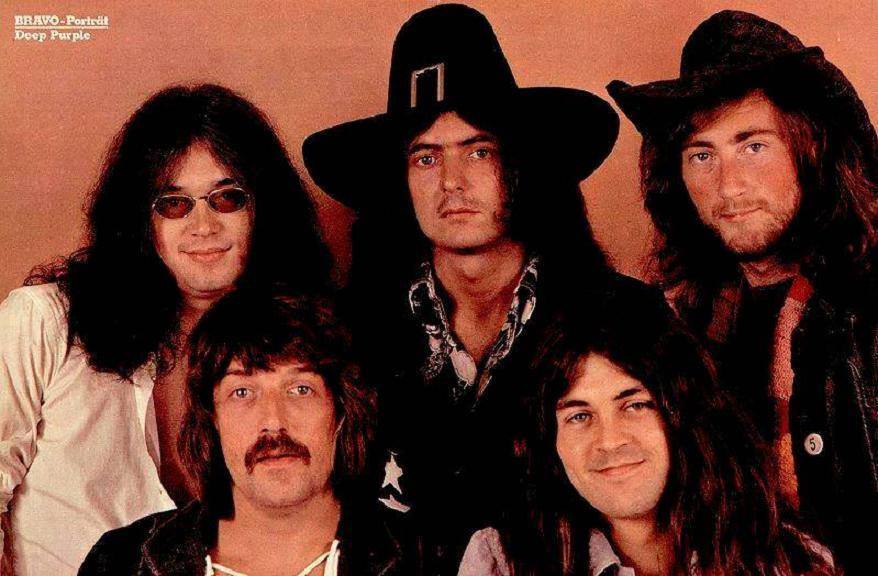
Deep Purple would change before too long to their most famous era of the band in the early seventies. Soon singer Rod Evans and bassist Nick Simper would be gone in 1969 and singer Ian Gillian and bassist Roger Glover would be in…and the most famous version of Deep Purple would last from 1969-1973 with reunions in the 80s and 90s.
This was written by Joe South and first recorded by the country singer Billy Joe Royal in 1967. Joe South was a prominent session musician and songwriter; some of his other compositions include “Games People Play” and “Rose Garden.” South also wrote “Down in the Boondocks” for Royal, which was a #9 US hit in 1965.
For Deep Purple, the song peaked at #4 in the Billboard 100 in 1968.
The Deep Purple version was included on their first album and recorded with the band’s original lineup, which didn’t include lead singer Ian Gillan, who joined in 1969, replacing Rod Evans. The song is a fan favorite, but Gillan kept it off the setlists when he was in the band since he wasn’t the original singer.
The band is still touring today without Ritchie Blackmore who quit and Jon Lord who died in 2012.
From Songfacts
After Royal released his version, “Hush” was quickly recorded by many artists in a variety of styles. The song is about a guy who is so crazy in love that he’ll drop everything if he thinks she might be calling his name. Royal’s recording has a definite country feel, while Deep Purple used a heavy rock sound.
Other artists to record the song include Jimmy Frey, The Rubes, Killdozer, Dan Baird, Gotthard and Thin Lizzy. Kula Shaker had the biggest UK hit with their cover going to #2 in 1997.
Joe South adapted the song from an old African American spiritual, which included the line: “Hush I thought I heard Jesus calling my name.”
It was a cohort of producer Joe Meek, Rod Freeman, who taught Deep Purple this song. Keyboardist Jon Lord recalled to Mojo magazine January 2009: “Initially we thought it’s a bit too disco, or whatever the word was then. But Ritchie (Blackmore) said it would work if we toughened it up a bit.”
This song has been in the following films: Apollo 11 (1996), Isn’t She Great (2000), Beyond the Sea (2004), Children of Men (2006).
The UK Charlatans lifted the organ riff on their 1990 UK hit “The Only One I Know” from this song.
This was not a hit in Deep Purple’s native UK, though a re-recording made to celebrate their 20th anniversary reached a measly #62 in 1988.
In 1997 British band Kula Shaker’s cover of this song peaked at #2 in the UK, bettering Deep Purple’s chart position by 60 places. Kula Shaker’s version featured in the 1997 film I Know What You Did Last Summer.
Jon Lord (from Mojo magazine): “The whacka thing on the organ was something I started doing in (his previous band) The Artwoods. I played it almost like a set of conga drums. The rhythm of Hush is like a samba.” When Steve Morse joined Deep Purple on guitar in 1994, he pushed to bring the song back to their live shows, which they did. “We have a big improv section in there and it’s just a great feel from beginning to end for me,” Morse said in our 2014 interview. “And the lyrics are not even lyrics. It’s just ‘Na nana na na na nananana.’ It’s the most basic tune in the world, but to me Deep Purple got on the map as a hard rock band from doing that version of ‘Hush.’ So I love that. And we stretch that out pretty far live.”
In the US, this was released on Tetragrammaton Records, which was co-owned by Bill Cosby.
Hush
Na na na na na na Na na na na na na I got a certain little girl she’s on my mind No doubt about it she looks so fine She’s the best girl that I ever had Sometimes she’s gonna make me feel so bad
Na na na na na na Na na na na na na Hush, hush I thought I heard her calling my name now Hush, hush She broke my heart but I love her just the same now Hush, hush Thought I heard her calling my name now Hush, hush I need her loving and I’m not to blame now
(Love, love) they got it early in the morning (Love, love) they got it late in the evening (Love, love) well, I want that, need it (Love, love) oh, I gotta gotta have it
She’s got loving like quicksand Only took one touch of her hand To blow my mind and I’m in so deep That I can’t eat and I can’t sleep
Na na na na na na Na na na na na na Listen hush, hush Thought I heard her calling my name now Hush, hush She broke my heart but I love her just the same now Hush, hush Thought I heard her calling my name now Hush, hush I need her loving and I’m not to blame now
(Love, love) they got it early in the morning (Love, love) they got it late in the evening (Love, love) well, I want that, need it (Love, love) oh, I gotta gotta have it
Na na na na na na Na na na na na na Na na na na na na
This song is all about the riff…it is a memorable riff… The song has drive and suspense. Woman from Tokyo peaked at #60 in 1973. This is one of the group’s most popular songs, but they never liked it very much. They didn’t start playing it live until they re-formed in 1984 after their 1976 split.
Because of endless touring and fatigue, Ian Gillan gave a six-month notice and stated that he was leaving the band after fulfilling all of his commitments in 1973. The album Who “Do We Think We Are” was released in January of 1973. The release generated the hit single “Woman from Tokyo.” “Smoke on the Water” was also busy that year becoming Deep Purple’s biggest hit of all-time.
After lead singer Ian Gillian left Deep Purple in 1973 they had two other lead singers before reforming in 1984…and they were David Coverdale and Joe Lynn Turner.
Deep Purple started recording their Who Do We Think We Are in Rome in July 1972. At this point, the band had yet to tour Japan, but they had three shows scheduled there for August: two in Osaka followed by one at the Budokan arena in Tokyo. Drawing on Japanese imagery (“the rising sun,” “an Eastern dream”), they concocted a story of a lovely lady from that country who drives them wild.
Rome was sunny and relaxing, so the band spent a lot of time in the swimming pool in lieu of working. There was also a sound problem in the studio, and the only track they got out of those sessions was “Woman From Tokyo.” The rest of the album was done in Germany.
In 1973, this was issued as a single, achieving a modest chart position of #60 in America. It aged well and got a lot of airplay on AOR and Classic Rock radio stations, keeping it alive. The stretched out “Toe-Key-Oh” became a bit of an earworm and helped embed the song into many an auditory cortex.
On some compilations from the ’70s, this song is listed as “live,” which Roger Glover insists is a lie, since they never did the song live in that decade.
Woman from Tokyo
Fly into the rising sun Faces, smiling everyone Yeah, she is a whole new tradition I feel it in my heart
My woman from Tokyo She makes me see My woman from Tokyo She’s so good to me
Talk about her like a Queen Dancing in a Eastern Dream Yeah, she makes me feel like a river That carries me away
My woman from Tokyo She makes me see My woman from Tokyo She’s so good to me
But I’m at home and I just don’t belong
So far away from the garden we love She is what moves in the soul of a dove Soon I shall see just how black was my night When we’re alone in Her City of light
Rising from the neon gloom Shining like a crazy moon Yeah, she turns me on like a fire I get high
My woman from Tokyo She makes me see My woman from Tokyo She’s so good to me






 PowerPop... An Eclectic Collection of Pop Culture