David Bowie – Starman

This was from my favorite era of Bowie. After Bowie appeared on the Top of the Pops in 1972 performing this song…the song and Ziggy took off.

The song peaked at #65 in the Billboard 100 and #10 in the UK in 1972. The song was on the album The Rise and Fall of Ziggy Stardust and the Spiders from Mars which peaked at #75 in the Billboard Album Charts in 1972 and #21 in 2016.

Woody Woodmansey the drummer in Bowie’s backing band, The Spiders From Mars: “I love ‘Starman’ as it’s the concept of hope that the song communicates. That ‘we’re not alone’ and ‘they’ contact the kids, not the adults, and kind of say ‘get on with it.’ ‘Let the children boogie’: music and rock ‘n’ roll! It lifted the attention away from the depressing affairs in the ’70s, made the future look better. ‘Starman’ was the first Bowie song since ‘Space Oddity’ with mass appeal. After ‘Starman,’ everything changed.”

From Songfacts

This forms part of the Ziggy Stardust story, in which the end of the world lingers just five years away. This song tells of salvation waiting in the sky, as revealed through Starman’s messenger, Ziggy Stardust. The song is told from the perspective of a person listening to Ziggy on the radio. 

In 1972, Bowie performed this song on the British TV show, Top of the Pops. Bowie appeared as the flame-haired Ziggy Stardust dressed in a multicolored jump suit. Bowie strummed a blue guitar while he moved flirtatiously alongside his guitarist, Mick Ronson. It was the first time many had seen Bowie and people were fascinated by his stage presence. This performance would catapult Bowie to stardom and prove wildly influential on the next generation of English rockers.

Among the many who have cited this specific appearance as a transformative moment is Lol Tolhurst of The Cure, who writes in his memoir, “I remember sitting on my couch at home with my mother, watching this spectacle unfold, and at the point where Bowie sang the line, ‘I had to phone someone so I picked on you,’ he pointed directly at the camera, and I knew he was singing that line to me and everyone like me. It was a call to arms that put me on the path that I would soon follow.”

Bowie was influenced by the song “Over The Rainbow,” which is most obvious during the chorus (“There’s a Starman…”). 

This was the last song written for The Rise and Fall of Ziggy Stardust and the Spiders from Mars, supposedly because nobody had heard a potential single on the album. It became Bowie’s first UK hit in three years. His only previous chart entry had been “Space Oddity” in 1969.

“We’d finished recording the Ziggy Stardust album at that time and it went into the record company. They said: ‘We can’t release this. It doesn’t have a single on it!'” Woody Woodmansey recalled to The Quietus. “So, we came out of the studio and in about a month he had written ‘Starman’ and we were back in the studio by January. It was an obvious single! I think Mick and I went out in the car after David played it for us the first time, and we were already singing it, having only heard it only once.”

“At the time, we thought it might be a bit too poppy, a bit too commercial,” he continued. “It might seem strange, but we just hadn’t done anything that commercial before. I always thought Bowie had that ability, that any time he felt like it, he could write a hit single. He just had that about him. I think he chose not to right through his career. If he felt like it, he would write one, and if he didn’t, he wouldn’t. That was just the impression of working with him. It’s not a fluke to be able to write all those amazing tunes.”

This is also the title of John Carpenter’s 1984 sci-fi movie, starring Jeff Bridges as an alien who takes the form of a woman’s (Karen Allen) dead husband and needs her help to get home. The song is not used in the movie.

This was used in a 2016 commercial for the Audi R8 that first aired during the 2016 Super Bowl about two months after David Bowie died. In the spot, a retired astronaut has lost his passion for life, but gets it back after his son presents with the car and he goes for a drive under a moonlit sky. The end panel pays tribute to Bowie, stating, “In memory of the Starman.”

Starman

Didn’t know what time it was and the lights were low
I leaned back on my radio
Some cat was layin’ down some rock ‘n’ roll ‘lotta soul, he said
Then the loud sound did seem to fade
Came back like a slow voice on a wave of phase
That weren’t no D.J. that was hazy cosmic jive

There’s a starman waiting in the sky
He’d like to come and meet us
But he thinks he’d blow our minds
There’s a starman waiting in the sky
He’s told us not to blow it
‘Cause he knows it’s all worthwhile
He told me
Let the children lose it
Let the children use it
Let all the children boogie

I had to phone someone so I picked on you
Hey, that’s far out so you heard him too!
Switch on the TV we may pick him up on channel two
Look out your window I can see his light
If we can sparkle he may land tonight
Don’t tell your poppa or he’ll get us locked up in fright

There’s a starman waiting in the sky
He’d like to come and meet us
But he thinks he’d blow our minds
There’s a starman waiting in the sky
He’s told us not to blow it
‘Cause he knows it’s all worthwhile
He told me
Let the children lose it
Let the children use it
Let all the children boogie

There’s a starman waiting in the sky
He’d like to come and meet us
But he thinks he’d blow our minds
There’s a starman waiting in the sky
He’s told us not to blow it
‘Cause he knows it’s all worthwhile
He told me
Let the children lose it
Let the children use it
Let all the children boogie

La, la, la, la, la, la, la, la
Lynn Anderson – (I Never Promised You A) Rose Garden

I beg your pardon
I never promised you a rose garden

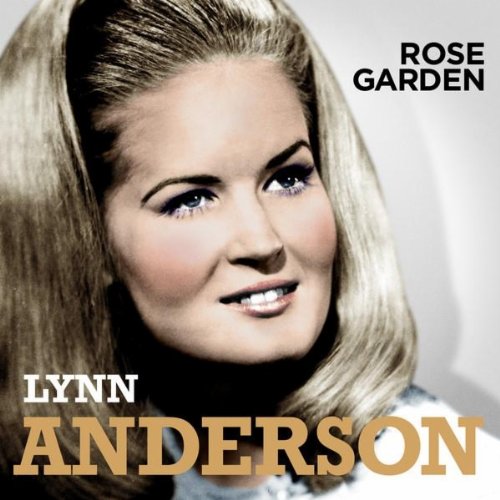
I heard this so many times on country and pop radio around my parents. The song is still played today. It was the rare country cross over hit. It peaked at #1 in the Billboard Country Charts in 1970 and #3 in the Billboard 100 in 1971.

Joe South wrote this for his 1969 debut album, Introspect. It was covered by artists like Freddy Weller, Billy Joe Royal, and Dobie Gray before Lynn Anderson made it an international crossover hit in 1971.

This earned Anderson a Grammy Award for Best Female Country Vocal Performance in 1971.

From Songfacts

“I never promised you a rose garden” is another way of saying “I never said it would be easy.” The singer encourages her lover to enjoy the good times in their relationship because the bad times are inevitable (“Along with the sunshine there’s gotta be a little rain sometime”).

Because of lyrics like “I could promise you things like big diamond rings,” Anderson’s producer (and husband) Glenn Sutton considered this a man’s song and tried to dissuade her from covering it. Only when they had some extra studio time left did he consider it for an album cut, but with some changes. They reworked the track with an uptempo arrangement that included a string section and mandolin. When Columbia Records’ exec Clive Davis heard it, he insisted it be released as a single.

“It was popular because it touched on emotions,” Anderson told the Associated Press of the song in 1987. “It was perfectly timed. It was out just as we came out of the Vietnam years and a lot of people were trying to recover. This song stated that you can make something out of nothing. You take it and go ahead.”

(I Never Promised You A) Rose Garden

I beg your pardon
I never promised you a rose garden
Along with the sunshine
There’s gotta be a little rain some time
When you take you gotta give so live and let live
Or let go oh-whoa-whoa-whoa
I beg your pardon
I never promised you a rose garden

I could promise you things like big diamond rings
But you don’t find roses growin’ on stalks of clover
So you better think it over
Well if sweet-talkin’ you could make it come true
I would give you the world right now on a silver platter
But what would it matter
So smile for a while and let’s be jolly
Love shouldn’t be so melancholy
Come along and share the good times while we can

I beg your pardon
I never promised you a rose garden
Along with the sunshine
There’s gotta be a little rain some time

I beg your pardon
I never promised you a rose garden

I could sing you a tune and promise you the moon
But if that’s what it takes to hold you
I’d just as soon let you go
But there’s one thing I want you to know
You better look before you leap, still waters run deep
And there won’t always be someone there to pull you out
And you know what I’m talkin’ about
So smile for a while and let’s be jolly
Love shouldn’t be so melancholy
Come along and share the good times while we can

I beg your pardon
I never promised you a rose garden
Along with the sunshine
There’s gotta be a little rain some time,
I beg your pardon
I never promised you a rose garden

Beatles – Revolution 9

My son walked into his first college Music Appreciation class in August. The Professor was waiting for everyone and played this piece by The Beatles. He turned around and asked the class…Is this considered music or not?

Bailey wasn’t the only one who knew this strange piece and in the end…the Professor said yes it was music…like art, music can come in different forms.

I went to youtube to see some of the comments…I’m going to list a few.

“This is what it feels like to have anxiety.”
“I use this song to test my sanity”
“Terrifying for sure, but it’s kind of beautiful in an abstract way”
“I listened to She Loves You right before this. I can’t believe it’s the same band”
“Still better than Justin Bieber” 

And last but not least: “Listened to this blind drunk and by the end, I swear I saw John wearing Ringo’s skin as an overcoat”

I remember listening to this at 2 in the morning alone in the dark in around 1981…scared me to death. The memory has stayed with me to this day. I have grown to appreciate this sound collage. They were trying something new…and it is interesting.

John Lennon wrote this with contributions from Yoko and George Harrison. It’s a highly experimental piece, which Lennon once called “The music of the future.” It is the most controversial and bizarre track on the album.

John Lennon: “an unconscious picture of what I actually think will happen when it happens; that was just like a drawing of revolution.” “All the thing was made with loops, I had about thirty loops going, fed them onto one basic track. I was getting classical tapes, going upstairs and chopping them up, making it backward and things like that, to get the sound effects. One thing was an engineer’s testing tape and it would come on with a voice saying ‘This is EMI Test Series #9.’ I just cut up whatever he said and I’d number nine it. Nine turned out to be my birthday and my lucky number and everything. I didn’t realize it; it was just so funny the voice saying ‘Number nine’; it was like a joke, bringing number nine into it all the time, that’s all it was.”

From Songfacts

This was made by layering tape loops over the basic rhythm of “Revolution.” Lennon was trying to create an atmosphere of a revolution in progress. The tape loops came from EMI archives, and the “Number 9” voice heard over and over is an engineer testing equipment.

Paul McCartney and Beatles producer George Martin hated this and tried to keep it off the album.

This is the longest Beatles song – it runs 8:15. It also took longer to complete than any other track on album.

This helped fuel the “Paul is dead” rumors. If played backwards, you were supposed to hear the car crash where Paul died, and a voice saying “Turn me on, dead man.” Also, playing the line, “I’m not in the mood for wearing clothing” in reverse eventually becomes a rather odd but clear reversal, “There were two, there are none now.”

This is referencing the rumor that Paul McCartney died in a car with “Lovely Rita” and that the two were burned away after the wreck.

The rumor took off in October 1969 when a listener called the radio station WKNR in Detroit and told the DJ Russ Gibb about the backward message. When Gibb played it backwards on his show, listeners went wild and spent the next week calling in and offering their own rumors. The story quickly spread, and McCartney helped it along by laying low and letting it play out.

Lennon felt the number 9 was quite significant. He was happy that, after he changed his name to John Ono Lennon, his and Yoko’s names collectively contained 9 O’s. >>

According to the book The Beatles, Lennon And Me, by John Lennon’s childhood friend Pete Shotton, One evening, Lennon was with Shotton in the attic of his Kenwood home, tripping on LSD and smoking a few joints. They messed about with John’s Brunnel recorders, fiddling with feedback, running recordings backwards and creating tape loops. Opening the windows for some fresh air, John and Pete began to shout whatever was on their minds at the trees outside, the recorder running. This night’s lark was to later captured on “Revolution 9.” >>

Marilyn Manson released their own version of this on the B-side of the single for “Get Your Gunn.” It was called “Revelation 9” and ran 12:57. >>

This was parodied on an episode of The Simpsons. When the guys for a group called The B-Sharps, Barney meets a girl during recording. He exclaims at the studio that he’s making the music of all time. The song is Barney’s girl friend (with striking resemblance to Yoko Ono) saying “Number 8” and Barney burping. >>

Charles Manson thought that when they screamed the words “Right!” it was actually “Rise!” meaning the black community rising over the white people. Charles Manson was of course crazy, and thought The Beatles were warning about a race war.

Revolution 9

lyrics?… Oh, yea…Number 9, Number 9…then the madness starts.

New Addition

Things will not be boring around our household for the foreseeable future.

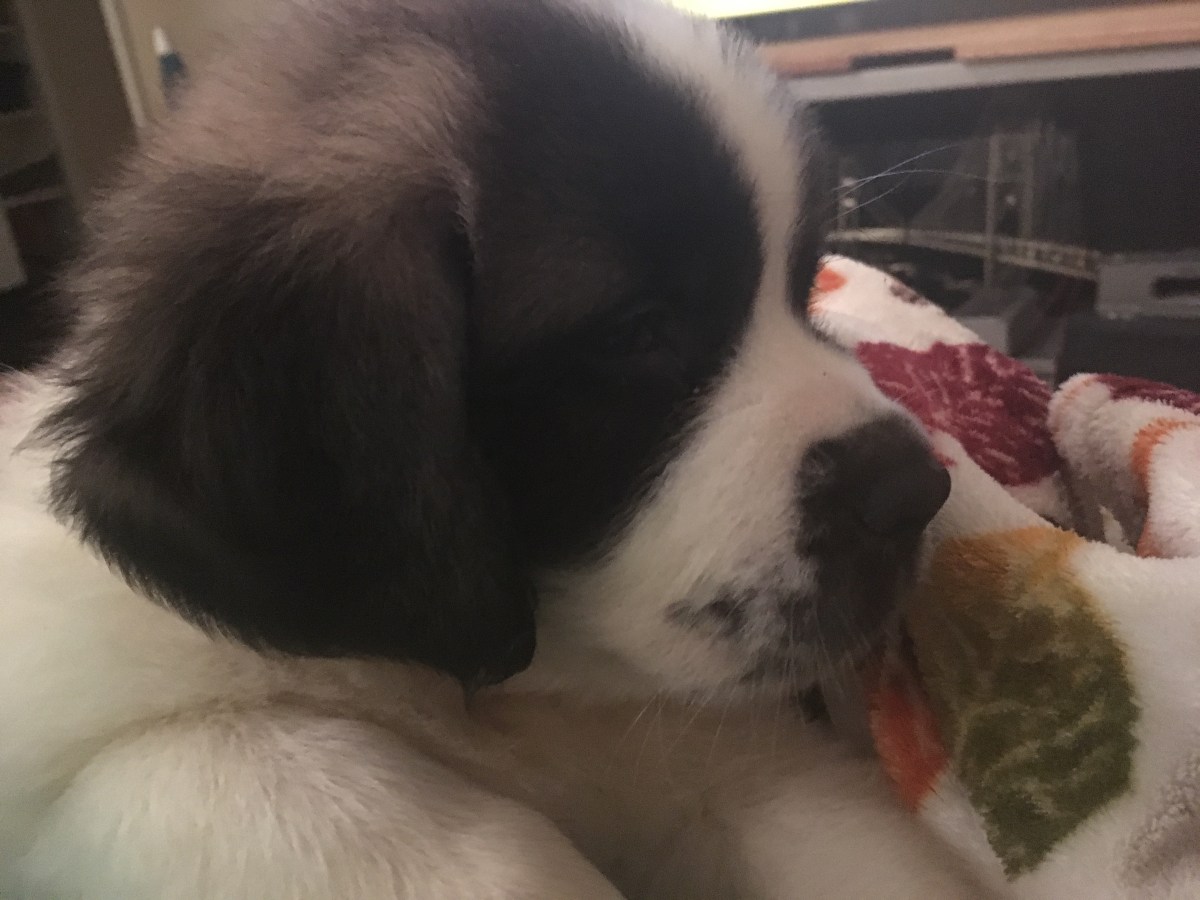
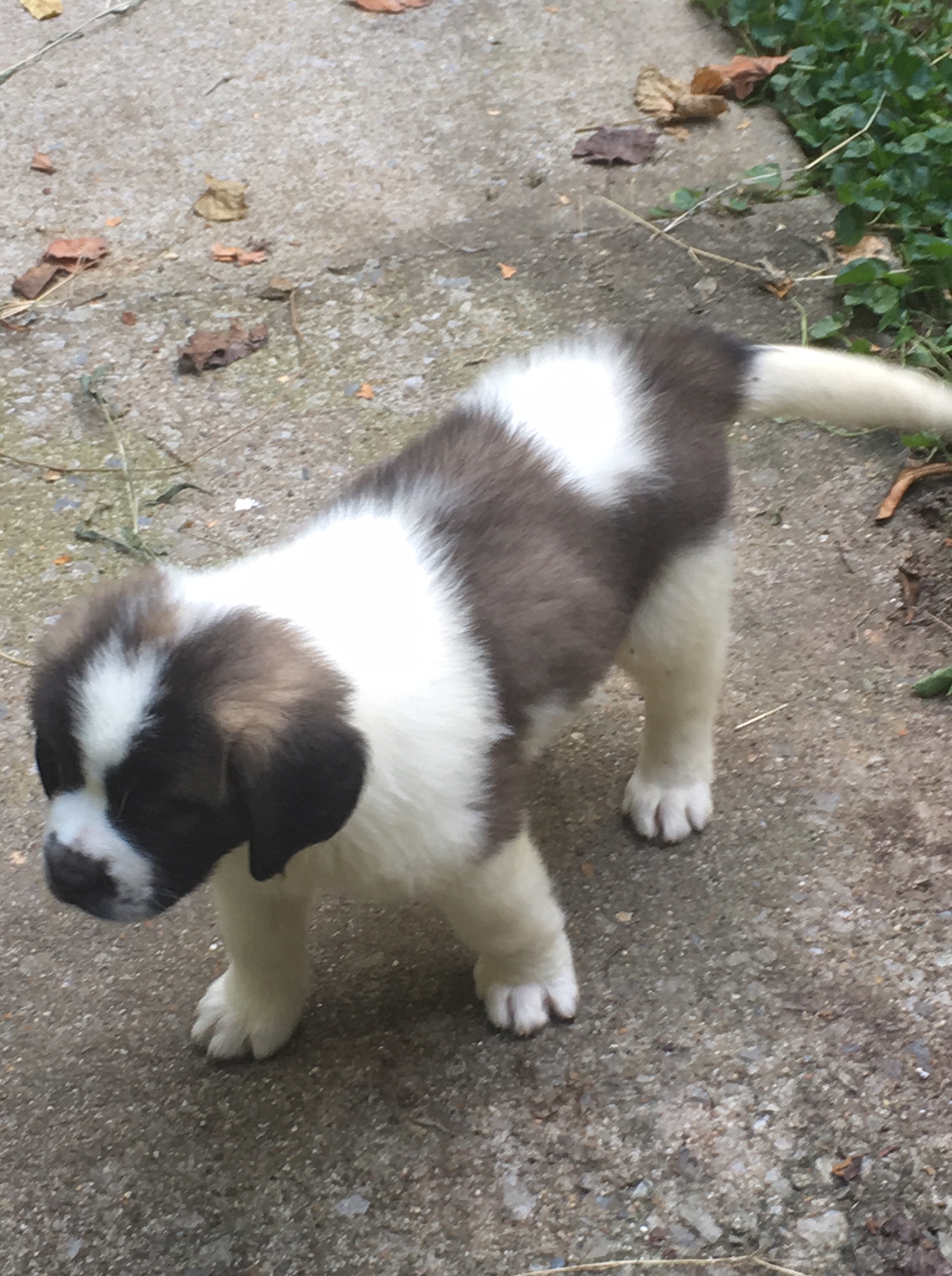
After losing Molly last November we decided we were finally ready for another dog. We got her Thursday night and she has more energy than we do by a mile. It’s going to be cool watching her grow and becoming one of us. Her name is Martha and I’m trying to keep up. Hard to believe that one day she will weigh more than some people do.

It’s fun to pick her up and carry her…knowing that won’t be possible in a few months/weeks. We are trying to find every wire, shoe, piece of anything, book, anything she can possibly put in her mouth and chew to bits out of reach.

I hear “no no no no” echoing through our house…that is how I know exactly where she is at that moment. Here are a few pictures…some are blurry because she doesn’t stop moving.

IMG_2790.JPG

IMG_2776.JPG

IMG_2718.JPG


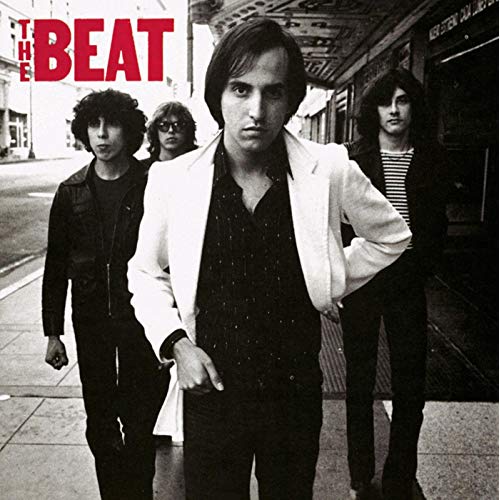
The Beat – Rock N Roll Girl —Powerpop Friday

This song is full of great little guitar hooks. “Rock ‘n’ Roll Girl” is from The Beat’s first album, titled The Beat from 1979.

Paul Collins formed The Beat in 1979, recruiting members of various rock bands including Steven Huff, Larry Whitman, and Michael Ruiz. He studied at the prestigious Julliard Music School and eventually moved to San Francisco where he joined songwriter Jack Lee and bassist Peter Case to form The Nerves in 1974.

The Nerves proved to be one of the pioneers of the burgeoning US punk rock scene, independently releasing their own 4 song EP which included the classic “Hanging on the Telephone,” later to become a hit for Blondie.

Rock N Roll Girl

I went down to check out the local disco show.
I saw the people dancing on the floor.
I wish there was an easier way
To meet the girls of today.
And if I had a chance, this is what I’d say:
I want to be with a rock and roll girl.
I pick up the phone and get a dial tone.
I call up the number, but nobody is home.
But I saw it on my TV.
They said they have someone for me.
I wish she would answer and give me her name.
I want to be with a rock and roll girl.
I see them walking one by one.
I hear them talking, then they are done.
I wish there was an easier way, hey hey!
To meet the girls of today.
I really want to talk, but what can I say?
I want to be with a rock and roll girl.

The Who – Ball and Chain —Powerpop Friday

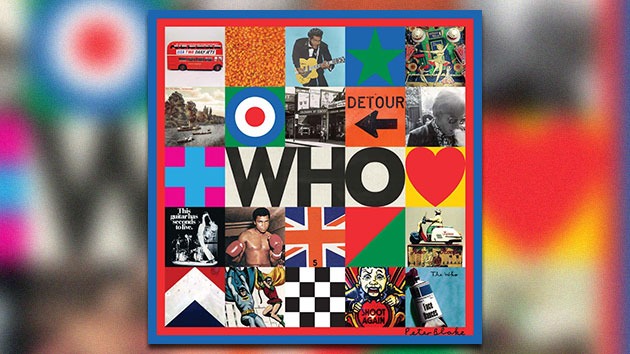
The new release coming from The Who. The new album WHO is coming out later this fall.

From

https://www.npr.org/2019/09/13/760553843/the-who-announces-first-new-album-in-13-years-shares-ball-chain

Fifty-five years after first forming in London, The Who is back with an album of brand-new songs. WHO, due out December 16th, will be the band’s 12th studio record. It includes the first single, “Ball & Chain,” a gritty swamp-rock critique of the Guantanamo Bay detention camp and the powers that have kept it open.

“Down in Guantanamo,” Roger Daltrey sings, “We still got that ball and chain. That pretty piece of Cuba designed to cause men pain.”

The track features a number of classic Who sounds, including an arpeggiated piano line that opens the song in the spirit of “Baba O’Riley,” as well as windmill power chords from Pete Townshend.”Roger and I are both old men now, by any measure,” Townshend says in a statement announcing the record. “So I’ve tried to stay away from romance, but also from nostalgia if I can. … Some of the songs refer to the explosive state of things today.”Townshend and Daltrey are joined on the album by drummer Zak Starkey and bassist Pino Palladino.

Ball and Chain

Down in Guantanamo
We still got the ball and chain
Down in Guantanamo
We still got the ball and chain

That pretty piece off Cuba
Designed to cause men pain
Whoa,  when you light up in Cuba
You won’t feel the same again

Down in Guantanamo
Whew, still waiting for the big cigars
Down in Guantanamo
Whew, still waiting for the big cigars

Been a breach of promise
Still guilty with no charge
There’s smoke in the forest
And the tumor is getting large

Down in Guantanamo
We still got the ball and chain
Down in Guantanamo
We still got the ball and chain

There’s a long road to travel
For justice to make its claim
So let’s bring down the gavel
Let the prisoner say his name
Mmm, still waiting for the big cigars
Still waiting for the
Still waiting for the big cigars
Hey, still waiting for the big cigars


The Who – All This Music Must Fade —Powerpop Friday

I can’t say a lot about this song because it is new. Thank you runsewread for pointing out this new release. They have released two tracks off the new album WHO being released on December 16th. Ball and Chain and All This Music Must Fade are the two new songs being previewed. Ball and Chain will be the Next Post.

Roger’s voice sounds really strong and the song sounds like vintage Who to me.

Townshend and Daltrey are joined on the album by drummer Zak Starkey and bassist Pino Palladino.

https://www.rollingstone.com/music/music-news/the-who-new-song-all-this-music-must-fade-894248/

The Who have shared their contemplative new song “All This Music Must Fade,” the latest single off the rockers’ long-awaited new LP WHO, out December 6th.

The opening track on WHO, the new song takes a tongue-in-cheek attitude about originality in music as well as the band’s own legacy.

Pete Townshend said in a statement that the song is “dedicated to every artist who has ever been accused of ripping off someone else’s song. Seriously? Our musical palette is limited enough in the 21st century without some dork claiming to have invented a common chord scheme.”

“I don’t care / I know you’re gonna hate this song / And that said / We never really got along,” Roger Daltrey sings in the opening verse. “It’s not new, not diverse / It won’t light up your parade / It’s just simple verse / All this music will fade / Just like the edge of a blade.”


All This Music Must Fade

(What’s mine is mine
What’s yours is yours, and what’s mine is mine
What’s yours is yours, and what’s mine is mine)

I don’t care
I know you’re gonna hate this song
And that’s it
We never really got along
It’s not new, not diverse
It won’t light up your parade
It’s just simple verse

All this music will fade
Just like the edge of a blade
All this music will fade
Just like the edge of a blade

I’m long gone
And I ain’t never coming back
[?]
I’ve never really quite gone bland
I’m not blue, I’m not pink
I’m just grey, I’m afraid
And it seems in a blink

All this music will fade
(All this music will fade)
Just like the edge of a blade
(Just like the edge of a blade)
All this music will fade
(All this music will fade)
Just like the edge of a blade
(Just like the edge of a blade)

What’s yours is yours, and what’s mine is mine
What’s mine is yours, and what’s yours is mine
What’s yours is yours, and what’s mine is mine

I don’t mind
Other guys ripping off my song
I’d be a liar
If I said I never done no wrong
Oh, this sound that we share
Has already been played
And it hangs in the air

All this music will fade
(All this music will fade)
Just like the edge of a blade
(Just like the edge of a blade)
All this music will fade
(All this music will fade)
Just like the edge of a blade

I don’t care
I know you’re gonna hate this song
And that’s it
‘Cause we never really got along
It’s not new, not diverse
It won’t light up your parade
It’s just simple verse

All this music will fade
Just like the edge of a blade
All this music will fade
Just like the edge of a blade
All this music will fade

What’s yours is yours, and what’s mine is mine
What’s mine is yours, and what’s yours is mine
What’s yours is yours

(Yours is yours, and what’s mine is mine
And what’s mine is mine, and what’s mine is yours
Who gives a fuck?)

Blondie – Dreaming

Dreamin’, dreamin’ is free
In the late seventies early eighties for a short window, Blondie couldn’t lose. Blondie only had 10 songs in the top 100 but they made the best of it. Out of those 10 songs were four number one hits. This one wasn’t of the number ones but it’s a great song nonetheless. It peaked at #27 in the Billboard 100 in 1979.

Blondie guitarist Chris Stein wrote the music for this song and came up with the line “dreaming is free.” Lead singer Debbie Harry wrote the other lyrics to the songs like she did on their other songs.

When I think of Blondie the image of Debbie Harry comes to mind of course…but as a band, they were really good. Chris Stein was a very good musician but my favorite member…other than Debbie is the drummer Clem Burke who is exceptionally good. He is a huge Keith Moon fan and when Keith died he destroyed his drum kit in Keith’s honor. He also thanked Keith Moon and the Beatles at Blondie’s Rock and Roll Hall of Fame acceptance speech.

From Songfacts

The song starts out with a coherent story – Harry getting propositioned in a restaurant – but it quickly veers off in many directions, simulating a dream where one idea jumps to the next with no real rhyme or reason. It works well with the theme and with the track, including the bridge where Harry repeats the first word of each line:

Feet feet, walking a two mile
Meet meet, meet me at the turnstile

A similar structure can be heard in the 1982 Kim Wilde song “Kids In America.”

Chris Stein said this song was “pretty much a cop” of “Dancing Queen” by ABBA.

Perhaps is was just a convenient word to rhyme with “pleasure,” but when Harry sings “A movie or a measure,” the word “measure” could be interpreted a few different ways. It might mean a plan of action, as in taking some kind of trip, or possibly a measure in the musical sense, meaning the rhythm.

Dreaming

When I met you in the restaurant you could tell I was no debutante
You asked me what’s my pleasure, “A movie or a measure”?
I’ll have a cup of tea and tell you of my dreamin’
Dreamin’ is free
Dreamin’, dreaming is free

I don’t want to live on charity
Pleasure’s real or is it fantasy?
Reel to reel is living verite
People stop and stare at me, we just walk on by
We just keep on dreamin’

Beat feet, walking a two-mile
Meet me, meet me at the turnstile
I never met him, I’ll never forget him
Dream dream, even for a little while
Dream dream, filling up an idle hour
Fade away, radiate

I sit by and watch the river flow
I sit by and watch the traffic go
Imagine something of your very own, something you can have and hold
I’d build a road in gold just to have some dreamin’
Dreamin’ is free
Dreamin’, dreamin’ is free

Dreamin’, dreamin’ is free

New Baseball Blog

I’m starting a baseball-only blog because there are some things that most of the readers here could care less about…like which baseball prospects I like the best, or how I don’t like interleague play as much as some and why I don’t think the National League should adopt the DH role.

I won’t be posting much on that one…only once in a while but anything baseball goes…past, present, and future. I’ll try to keep all the posts to the point like they are here. So if you are a baseball fan come and visit…if not I’ll talk to you here.

If you are interested the link is www.talkingaboutbaseball.com

Sorry for the interruption now we will return you to our eclectic song and pop culture selections.

Thank You All.


Nirvana – The Man Who Sold The World

I rarely post covers but this is a good one. No one will ever top Bowie’s version to me but this one has a charm about it I like. Cobain did a good job on this.

David Bowie liked this cover saying, “I was simply blown away when I found that Kurt Cobain liked my work, and have always wanted to talk to him about his reasons for covering ‘The Man Who Sold the World’.”

What he didn’t like were the kids that come up after his show and say, ‘It’s cool you’re doing a Nirvana song.’ And I think, ‘F**k you, you little tosser!”

Nirvana performed it on the MTV Unplugged episode a few months before Kurt died.

The song peaked at #5 in the US Alternative Top 50, #22 in Canada, and #1 in Poland in 1995.

From Songfacts

This song is about a man who no longer recognizes himself and feels awful about it. For years, Bowie struggled with his identity and expressed himself through his songs, often creating characters to perform them. On the album cover, Bowie is wearing a dress.

Some of the lyrics are based on a poem by Hugh Mearns called The Psychoed:

As I was going up the stair
I met a man who was not there
He wasn’t there again today
I wish that man would go away

Some lyrical analysis: “We passed upon the stair” is a figurative representation of a crossroads in Bowie’s life, where Ziggy Stardust catches a glimpse of his former self, (being David Bowie) which he thought had died a long time ago. Then he (the old David Bowie) says: “Oh no, not me. I never lost control.” This indicates that Bowie never really lost sight of who he was, but he Sold The World (made them believe) that he had become Ziggy, and he thought it was funny (I laughed and shook his hand). He goes on to state, “For years and years I roamed,” which could refer to touring. “Gaze a gazely stare at all the millions here” are the fans at concerts. >>

The album is one of Bowie’s least known, but over the years many fans have come to appreciate it and a lot of bands have covered songs from it.

Critics weren’t always sure what to make of it either, but John Mendelssohn had a good handle on it when he wrote of the album in Rolling Stone magazine, 1971: “Bowie’s music offers an experience that is as intriguing as it is chilling, but only to the listener sufficiently together to withstand the schizophrenia.”

The British singer Lulu (“To Sir With Love”) recorded this in 1974. Bowie produced her version and played saxophone on the track. It went to #4 in the UK. Lulu spoke to Uncut magazine June 2008 about her recording: “I first met Bowie on tour in the early ’70s when he invited me to his concert. And back at the hotel, he said to me, in very heated language, ‘I want to make an MF of a record with you. You’re a great singer.’ I didn’t think it would happen, but he followed up two days later. He was uber cool at the time and I just wanted to be led by him. I didn’t think ‘The Man Who Sold The World’ was the greatest song for my voice, but it was such a strong song in itself. In the studio, Bowie kept telling me to smoke more cigarettes, to give my voice a certain quality. We were like the odd couple. Were we ever an item? I’d rather not answer that one, thanks!
For the video, people thought he came up with the androgynous look, but that was all mine. It was very Berlin cabaret. We did other songs, too, like ‘Watch That Man,’ ‘Can You Hear Me?’ and ‘Dodo.’ ‘The Man Who Sold The World’ saved me from a certain niche in my career. If we’d have carried on, it would have been very interesting.”

Nirvana recorded this for their 1993 MTV Unplugged performance. It was Chad Channing, who was Nirvana’s drummer from 1988-1990, who introduced Kurt Cobain and Krist Novoselic to Bowie’s music. Chad told us: “We were in Boston and stopped by this record store, and I found this copy of The Man Who Sold The World. It was a cool copy – it had the poster in it and everything. And those guys weren’t familiar with the record. And I inquired about, ‘What David Bowie do you like? Do you like David Bowie?’ And they’re like, ‘Well, the only David Bowie we’re familiar with is ‘Let’s Dance.’ I was surprised. I was like, ‘Really? Wow.’ I was like, ‘You’ve got to hear some early David Bowie, for sure.’

So when I got the opportunity, I made a tape of the record at somebody’s house, and then while we were touring around I just went ahead and popped the tape in and let it roll. After a bit, Kurt turned around and said to me, ‘Who is this?’ kind of like knowingly, just something familiar with the voice and stuff. I said, ‘Well, this is David Bowie. This is The Man Who Sold the World record.’ He’s like, ‘Yeah, this is really cool.’ I said, ‘You should check out Hunky Dory and stuff.’ And so eventually, I’m sure he did. But he totally dug it.”

Months after the MTV show, Kurt Cobain was found dead. The acoustic set was released as an album in late 1994.

Bauhaus lead singer Peter Murphy called this “the first true goth record.”

Beck performed this song with Dave Grohl, Krist Novoselic and Pat Smear at the annual Clive Davis Grammy pre-party on February 14, 2016 in tribute to Bowie, who passed away a month earlier. “He’s always been kind of guidepost or gravitational force for me,” Beck said of Bowie.

On March 29, 2016, Michael Stipe performed this song on The Tonight Show Starring Jimmy Fallon, accompanied only by a piano. Two days later, Stipe sang “Ashes To Ashes” with Karen Elston at a Bowie tribute concert held at Carnegie Hall.


The video of The Man Who Sold The World has been giving me troubles…if it is not below…here is the link.

The Man Who Sold The World

We passed upon the stair
We spoke of was and when
Although I wasn’t there
He said I was his friend
Which came as a surprise
I spoke into his eyes
I thought you died alone
A long long time ago

Oh no, not me
We never lost control
You’re face to face
With the man who sold the world

I laughed and shook his hand
And made my way back home
I searched for form and land
For years and years I roamed
I gazed a gazeless stare
We marked a million hills
I must have died alone
A long, long time ago

Who knows?
Not me
I never lost control
You’re face to face
With the man who sold the world

Who knows?
Not me
We never lost control
You’re face to face
With the man who sold the world

U2 – One

This is one of my top U2 songs… it was on the album Achtung Baby released in 1991. the song peaked at #10 on the Billboard 100 in 1992. Johnny Cash covered it on 2000’s American III: Solitary Man,..the video is at the bottom of the post.

The Edge talks about when they came up with it: Suddenly something very powerful happening in the room. Everyone recognized it was a special piece. It was like we’d caught a glimpse of what the song could be. It was a pivotal song in the recording of the album, the first breakthrough in what was an extremely difficult set of sessions.

The band wrote this song in Berlin after being there for months trying to record Achtung Baby. The Berlin Wall had just fallen, so the band was hoping to find inspiration from the struggle and change. Instead, they found themselves at odds with each other and unable to do much productive work.

Most of the song was written in about 30 minutes and it rejuvenated the band creatively. When they left Berlin, they had little to show for it except for this song, but they were able to complete the album back home in Ireland with this song as the centerpiece of the album.

Achtung Baby peaked at #1 on the Billboard Album Charts in 1991. 


This was voted best single in the 1992 Rolling Stone reader’s poll. U2 also won for best album, band, and comeback of the year. In 2003, it was voted the best song ever by Q magazine.


From Songfacts

This song can be interpreted in many ways. Bono, who wrote the lyrics, has always been a bit vague, saying it is “about relationships.” Here are some interpretations:

1) The song could relate to the reunification of Germany, where the band recorded it.

2) It could be about the dissolution of The Edge’s marriage to Aislinn O’Sullivan. The couple was having problems in their relationship and split soon after the sessions. Bono was the best man at their wedding.

3) It could be about the band putting their differences aside and coming together to make the album.

4) Bono may have been writing about his good friend, the Irish painter Guggi, who was having girl trouble.

5) The song could represent a conversation between an AIDS victim and his father.

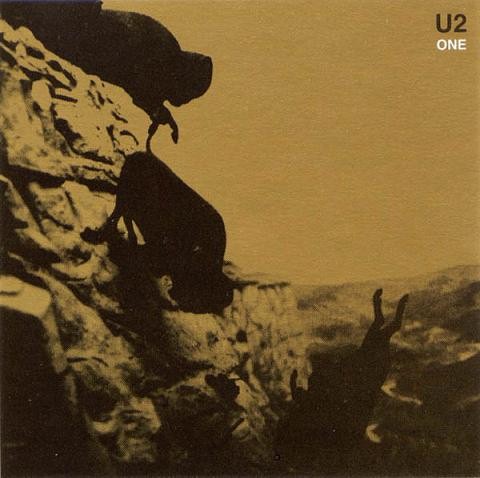
Proceeds from the single were donated to AIDS research, which was stated on the liner notes of the single. Also printed on the notes was this statement: “The image on the cover is a photograph by the American artist David Wojnarowicz, depicting how Indians hunted buffalo by causing them to run off cliffs. Wojnarowicz identifies himself and ourselves with the buffalo, pushed into the unknown by forces we cannot control or even understand. Wojnarowicz is an activist artist and writer whose work has created controversy recently through its uncompromising depiction of the artist’s homosexuality, his infection by the H.I.V. virus and the political crisis surrounding AIDS.”

The Edge came up with the guitar track while working on “Mysterious Ways.” Once he came up with this guitar part, they quickly started writing “One.”

Three different videos were made, each interpreting the song differently. The first, directed by Mark Pellington, shows a buffalo running in a field. The second, which was mostly seen in Europe, featured U2 in drag. The third, shown mostly in the US, is built around Bono reflecting over a cigarette.

Director and photographer Anton Corbijn was at the helm for the video that featured the band in drag. He told The Guardian September 24, 2005: “I had been working with U2 as a photographer for 10 years at this stage and we’d had our ups and downs. I’d done one video for them in 1984 for ‘Pride.’ It was a disaster and no one ever saw it. It took them eight years to give me another chance. I really wanted to put a lot of effort into it to prove myself to them as a director. I even hand-painted the cars that appear in the video myself. I themed the whole thing around the notion of ‘one’ although I don’t think that’s what Bono was actually singing about. That’s why I filmed it in Berlin because the wall had just come down. And I filmed the band performing in a circle like a single unit. I showed Bono’s dad at one end of a seesaw to suggest that on your own you are not always balanced. I liked Bono’s father very much but they had a very complex relationship.

I think it meant a lot for them to appear together. These were all my own ideas but U2 are very much a band who like to meet up and talk about things. There are always a lot of meetings with them! But they cleared all the ideas, including the one about them appearing in drag. Later though, they decided that some of the proceeds from the single would go to Aids charities. They became nervous that the drag element in the video might link Aids to the homosexual community in a negative way. So they dropped the video and got someone else to film something.

It was so painful for me at the time. They replaced it with a video of Bono in a bar surrounded by models, which I particularly didn’t like. But once the song had died in the charts a few months later they got MTV to start running my video instead. That’s why I like working with U2: they have stayed very loyal to me, which is rare in music.”

According to The Guardian, Bono’s father, Robert Hewson, appeared in the song’s video. He later complained to his son that he hadn’t been paid.

In 2005, Bono got involved in the “One” campaign, which tried to convince the US government to give an additional 1% of its budget to help poor regions in Africa. On the Vertigo tour, fans who signed up had their names displayed on video screens when U2 played this.

Adam Clayton and Larry Mullen performed this at the “MTV Rock n Roll Inaugural Ball” for Bill Clinton in 1993 with Michael Stipe and Mike Mills from R.E.M. The impromptu group became known as “Automatic Baby,” a combination of album titles Automatic For The People and Achtung Baby.

The “buffalo” video directed by Mark Pellington was comprised of projections he made for the Zoo TV tour. In a Songfacts interview with Pellington, he explained: “They had made a video for the song already – that Anton Corbijn had done – of them in drag, and they weren’t really crazy about it. So, they released mine, and it was out there for a while. It was a very ‘anti-video’: no band, a slow art piece. And they made a third version of the video with Bono singing in a bar.

It always was interesting to me to have more than one video for a song. I don’t know why bands don’t do that more.”

Pellington later worked on the 2007 film U2 3D.

On the Popmart tour in Mexico City, while the Edge played the intro Bono said, “This one goes out to a mate of ours, a great mate, a great singer, we’re sorry, we’re sorry, for Michael Hutchence.” 

On their 2001-2002 tour, a list of victims of the September 11 attacks was projected on a screen while they performed this.

In 2006, after Bank of America merged with MBNA, BoA held a corporate conference where Ethan Chandler, who managed a New York branch, performed a new version of this song celebrating the merger. Sample lyric: “And we’ve got Bank One on the run. What’s in your wallet? It’s not Capital One.” Thankfully, someone leaked the video and it ended up on YouTube, where you can see it in all its glory. Watch for the standing ovation at the end.

Mary J. Blige sang this with Bono in 2006 for a benefit for victims of hurricane Katrina. Blige then recorded it with Bono and U2 for her album Reminisce.

In a March 2007 poll carried out by The Tony Fenton Show on the Irish radio station Today FM, this was voted the Best Irish Single Ever.

Bono explained the meaning of this song to Rolling Stone in 2005: “It’s a father-and-son story. I tried to write about someone I knew who was coming out and was afraid to tell his father. It’s a religious father and son… I have a lot of gay friends, and I’ve seen them screwed up from unloving family situations, which just are completely anti-Christian. If we know anything about God, it’s that God is love. That’s part of the song. And then it’s also about people struggling to be together, and how difficult it is to stay together in this world, whether you’re in a band or a relationship.” >>

The line “One life, with each other, sisters, brothers” was voted the UK’s favorite song lyric in a 2006 poll by music channel VH1.

Anyone thinking of using this at their wedding might want to reconsider. “‘One’ is not about oneness, it’s about difference,” Bono points out in the book U2 by U2. “It is not the old hippie idea of ‘Let’s all live together.’ It is a much more punk rock concept. It’s anti-romantic: ‘We are one, but we’re not the same. We get to carry each other.’ It’s a reminder that we have no choice. I’m still disappointed when people hear the chorus line as ‘we’ve got to’ rather than ‘we get to carry each other.’ Because it is resigned, really. It’s not: ‘Come on everybody, let’s vault over the wall.’ Like it or not, the only way out of here is if I give you a leg up the wall and you pull me after you. There’s something very unromantic about that. The song is a bit twisted, which is why I could never figure out why people want it at their weddings. I have certainly met a hundred people who’ve had it at their weddings. I tell them, ‘Are you mad? It’s about splitting up!'”

The Edge offers his take: “The lyric was the first in a new, more intimate style. It’s two ideas, essentially. On one level it’s a bitter, twisted, vitriolic conversation between two people who’ve been through some nasty, heavy stuff: ‘We hurt each other, then we do it again.’ But on another level there’s the idea that ‘we get to carry each other.’ ‘Get to’ is the key. ‘Got to’ would be too obvious and platitudinous. ‘Get to’ suggests it is our privilege to carry one another. It puts everything in perspective and introduces the idea of grace. Still, I wouldn’t have played it at any wedding of mine.”

This was featured in the trailer for the 2000 Nicolas Cage movie The Family Man. It was not used in the movie itself.

One

Is it getting better
Or do you feel the same?
Will it make it easier on you now?
You got someone to blame

You say one love, one life (One life)
It’s one need in the night
One love (one love), get to share it
Leaves you darling, if you don’t care for it

Did I disappoint you?
Or leave a bad taste in your mouth?
You act like you never had love
And you want me to go without

Well it’s too late, tonight
To drag the past out into the light
We’re one, but we’re not the same
We get to carry each other
Carry each other

One, one
One, one
One, one
One, one

Have you come here for forgiveness?
Have you come to raise the dead?
Have you come here to play Jesus?
To the lepers in your head
Well, did I ask too much, more than a lot?
You gave me nothing, now it’s all I got
We’re one, but we’re not the same
See we hurt each other, then we do it again
You say love is a temple, love is a higher law
Love is a temple, love is a higher law
You ask me of me to enter, but then you make me crawl
And I can’t keep holding on to what you got, ’cause all you got is hurt

One love
One blood
One life
You got to do what you should
One life
With each other
Sisters and my brothers
One life
But we’re not the same
We get to carry each other, carry each other

One, one
One, one

One
One love, one life

Scooby Doo Where Are You!

On Saturday morning, September 13, 1969, Scooby-Doo, Where Are You! premiered. This is probably one of the most popular cartoons ever that even spawned a few live-action movies and tons of merchandise. The show went through many stages before it was ready for the public.

In 1968 Fred Silverman envisioned the show as a cross between the popular I Love a Mystery radio serials of the 1940s and the popular early 1960s TV show The Many Loves of Dobie Gillis.

Joe Ruby and Ken Spears, and artist/character designer Iwao Takamoto worked on Silverman’s idea. Their original concept of the show had the title Mysteries Five, and featured five teens (Geoff, Mike, Kelly, Linda, and Linda’s brother “W.W.”) and their dog, Too Much, who were all in a band called “The Mysteries Five” (even the dog; he played the bongos). When “The Mysteries Five” weren’t performing at gigs, they were out solving spooky mysteries involving ghosts, zombies, and other supernatural creatures. Ruby and Spears then had to decide what to make their dog. The dog was going to be a sheepdog but that would conflict with the Archies (who had a sheepdog, Hot Dog, in their band) but then settled on a Great Dane.

The executives felt that the presentation artwork was too frightening for young viewers, and, thought the show would be the same, decided to pass on it.

Ruby and Spears reworked the show to make it more comedic and less frightening. They dropped the rock band element and began to focus more attention on Shaggy and Too Much. According to Ruby and Spears, Silverman was inspired by the ad-lib “doo-be-doo-be-doo” he heard at the end of Frank Sinatra’s interpretation of Bert Kaempfert’s song “Strangers in the Night” on the way out to one of their meetings, and decided to rename the dog “Scooby-Doo” and re-rechristened the show Scooby-Doo, Where are You?… The rest as they say…is history!

Matthew Sweet did a version of the theme that I really like


The original theme song


http://scoobyaddicts.com/History.aspx

Buddy Holly – Blue Days Black Nights

This is a Holly song that you don’t hear much and has been a favorite of mine. The sessions didn’t go the way that Buddy would have liked. His songs had more of a country feel than Holly would have liked.

I really like the rockabilly guitar played by Sonny Curtis.  It was recorded at Bradley’s Barn in Nashville Tn in January 26, 1956.

This was Buddy Holly’s first single in April 1956, “Blue Days, Black Nights” was not a Buddy Holly composition; it was written by Ben Hall. The song was the B side to Love Me.

Due to a misspelling on Holly’s recording contract, his name was changed from Holley to Holly. This release is the first to use this spelling, He would go with that spelling the rest of his career.


Blue Days Black Nights

Blue days, black nights
Blue tears keep on fallin’, for you dear
Now you’re gone
Blue days, black nights
My heart keeps on calling for you dear
And you alone

Memories of you make me sorry
I gave you reason to doubt me
But now you’re gone and I am left here all alone
With blue memories, I think of you


Blue days, black nights
I didn’t realize I would miss you
The way I do
And now somehow I know I will pay
For the times I have made you blue

Cat Stevens – Morning Has Broken

Morning Has Broken is a beautiful piece of music.

Stevens got the lyrics from a hymn book he found at a bookstore while looking for song ideas. It was a children’s hymn by Eleanor Farjeon, who also wrote a lot of children’s poetry.

Cat Stevens: “I accidentally fell upon the song when I was going through a slightly dry period and I needed another song or two for Teaser And The Firecat. I came across this hymn book, found this one song, and thought, This is good. I put the chords to it and then it started becoming associated with me.”

The song peaked at #6 on the Billboard 100, #9 in the UK, #3 in New  Zealand and #4 in Canada. It was on the album Teaser and the Firecat which peaked at #2 on the Billboard Album Charts in 1972.

From Songfacts

Children in England would have heard Farjeon’s hymn in primary school. Scottish children sang the old Gaelic hymn, “Child in a manger, Infant of Mary” to this tune. This hymn predated “Morning” and was written in Gaelic by Mary MacDonald before being translated into English. For Scottish children it was a Christmas hymn. >>

Rick Wakeman, who later became a member of Yes, played keyboards on this track. He claims he was never paid for his work.

This was Stevens’ first single that did better in America than in England. “Peace Train” and “Wild World” were not released in the US.

This song is set to a Scottish tune entitled “Bunessan,” a melody that was named for a small island town in Scotland. >>

Neil Diamond recorded this in 1992 for his Christmas album (yes, Diamond is Jewish). His version went to #36 in the UK.

Morning Has Broken

Morning has broken like the first morning
Blackbird has spoken like the first bird
Praise for the singing
Praise for the morning
Praise for them springing fresh from the world

Sweet the rain’s new fall, sunlit from heaven
Like the first dewfall on the first grass
Praise for the sweetness of the wet garden
Sprung in completeness where his feet pass

Mine is the sunlight
Mine is the morning
Born of the one light Eden saw play
Praise with elation, praise ev’ry morning
God’s recreation of the new day

Morning has broken like the first morning
Blackbird has spoken like the first bird
Praise for the singing
Praise for the morning
Praise for them springing fresh from the world

WKRP in Cincinnatti

A few weeks ago I posted about Jan Smithers…who portrayed Bailey Quarters on WKRP. it was one of the shows from the late 70s that I wouldn’t miss.

This show was not like the Mary Tyler Moore Show, Bob Newhart, or All In The Family. Those are great shows…some of the best ever sitcoms…but they were aimed more at adults while this one I always felt was largely aimed at teenagers. The show aired from 1978 to 1982. Rock and Roll on a sitcom was not common.

WKRP in Cincinnati” was produced by MTM – the studio Mary Tyler Moore and Grant Tinker built that produces shows such as The Bob Newhart Show, Mary Tyler Moore Show, Phyllis, The White Shadow, Rhoda, and many others.

The episode I remember the most having an effect on me was about the horrible event in 1979 when eleven people were killed at a Who concert in Cincinnati’s Riverfront Park. The show handled the tragic situation very well.

The plot…to make it short was about a Program Director (Andy Travis) who had a perfect record in turning bad radio stations around joins the staff at WKRP. The station is in the bottom of the ratings and he wants to change the format to Rock which is met with trepidation from the oddball staff.

The show would feature new rock music as well as old. Blondie gave the show one of their gold records in appreciation because the show played “Heart of Glass” and helped to make it number 1.

The extended theme song by Steve Carlisle Wkrp In Cincinnati peaked at #65 on the Billboard 100 in 1979…video at the bottom

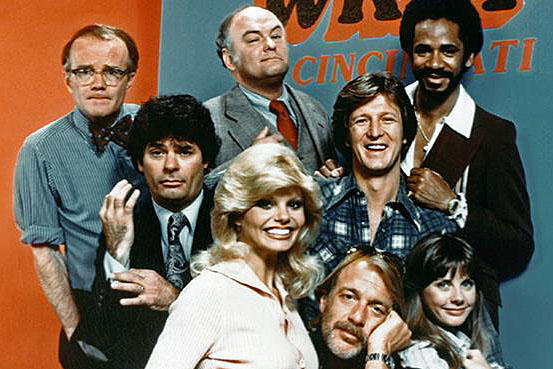
The Cast

Bailey Quarters – Jan Smithers – A shy soft-spoken lady in charge of billing and station traffic soon worked herself up to an on-air personality and other duties. She and Jennifer on the show were a bit like Mary Ann and Ginger on Gilligans Island.

Andy Travis – Gary Sandy –Andy comes to the station as the new Program Director to turn the station around and finds the station’s employees…are like from the Island of Misfit Toys. He finds their strengths and tries to make it work. His character was based on real-life Program Director Mikel Herrington.

Dr. Johnny Fever – Howard Hesseman – Fun Fact…David Cassidy was offered this role but turned it down!

Johnny had been around for a while and was fired off a Los Angeles radio station for saying booger on air. He was probably my favorite character…next to Bailey…on the show when I first watched. Dr. Johnny Fever was based on real DJ “Skinny” Bobby Harper.

Venus Flytrap – Tim Reid – Venus was the night DJ and was one of the smoothest DJ’s ever…Venus wears 70’s type flashy clothes and in the series eventually becomes Assistant Program Director.

Herb Tarlek –  Frank Bonner – Herb was a salesman and dressed very tacky and loud. He hits on Jennifer at every opportunity, despite being married… but gets turned down constantly.

Jennifer Marlowe – Loni Anderson – She was Ginger to Bailey’s Mary Ann. Mr. Carlson’s receptionist…she was the highest-paid employee at the station even though refusing to do most things that receptionists are required to do.

Arthur Carlson –  Gordon Jump – The lovable but ineffective station manager who is the son of the station’s owner. He never wanted to know what was going on…, but when he tries to be hands-on…it leads to disastrous results (see Turkey’s Away episode)

Les Nessman – Richard Sanders – The incompetent News Director…Les was obsessed with the region’s hog farming industry…constantly mispronounced names… ignored obvious news stories for Hog Reports…but he would win the Silver Sow Award and The Buckeye Newshawk Award.


https://tvtropes.org/pmwiki/pmwiki.php/Series/WKRPInCincinnati