Educated fools, From uneducated schools, Pimping people is the rule, Polluted water in the pool, And Nixon talking about don’t worry, worry, worry, worry
I’m saying goodbye to Richard Milhous Nixon with this one. I hope you have enjoyed the songs that referenced the former President. The comments were great so I thank all of you.
(Don’t Worry) If There’s a Hell Below, We’re All Going to Go” was released in November 1970 as the first, and only charting single off of Curtis’ debut album Curtis, it being his first solo charting single. The song peaked at #29 in 1971 in the Billboard 100. It also peaked at #3 in the Billboard Hot Soul Singles chart.
The song was about racial relations and the situation in America’s inner cities. He’d already steered The Impressions toward funkier, more conscious material. As a solo artist, he wanted to make a fresh impression beyond The Impressions. This song certainly did that. Much like John Lennon, he didn’t hold back.
On August 13, 1990, a lighting rig fell on him while he was onstage in New York, crushing three vertebrae and rendering him a quadriplegic for the remainder of his life. He managed to make one last album, two years before his death on December 26, 1999; titled New World Order
(Don’t Worry) If There Is A Hell Below, We Are All Going To Go
Sisters, brothers and the whities
Blacks and the crackers
Police and their backers
They’re all political actors
Hurry
People running from their worries
While the judge and the juries
Dictate the law that’s partly flaw
Cat calling, love balling, fussing and cussing
Top billing now is killing
For peace no-one is willing
Kind of make you get that feeling
Everybody smoke, smoke, smoke, smoke, smoke
Use the pill and the dope, dope, dope, dope, dope
Educated fools
From uneducated schools
Pimping people is the rule
Polluted water in the pool
And Nixon talking about don’t worry, worry, worry, worry
He says don’t worry, worry, worry, worry
He says don’t worry, worry, worry, worry
He says don’t worry, worry, worry, worry
But they don’t know
There can be no show
And if there’s a hell below
We’re all gonna go, go, go, go, go
Everybody’s praying
And everybody’s saying
But when come time to do
Everybody’s laying
Just talking about don’t worry, worry, worry, worry
They say don’t worry, worry, worry, worry
They say don’t worry, worry, worry, worry
They say don’t worry, worry, worry, worry
I hardly slept the night you wept, Our secret’s safe and still well kept, Where even Richard Nixon has got soul., Even Richard Nixon has got Soul.
Campaigner has a more sympathetic take on the former president. This song was inspired by Richard Nixon’s wife Pat when she had a stroke in 1976. Cameron Crowe, then a Rolling Stone magazine writer remembered: Neil Young is on tour. Young and his son, Zeke, are sitting on a hotel bed watching television. A news bulletin interrupts the broadcast. Pat Nixon, the wife of the disgraced former president, had suffered a stroke. The report has an announcer talking over a film clip of a distraught Richard Nixon moving through the hospital’s revolving doors. Young took it all in and after some time passed, headed for his bus in the hotel’s parking lot. There he wrote a song, “Campaigner,” and played it in concert a few hours later.
The song was on the Decade, a triple album set that was released in 1977. It’s also on Songs For Judy, a live album recorded in November 1976 that was released in 2018.
Campaigner
I am a lonely visitor.
I came to late to cause a stir,
Though I campaigned all my life
towards that goal.
I hardly slept the night you wept
Our secret’s safe and still well kept
Where even Richard Nixon has got soul.
Even Richard Nixon has got
Soul.
Traffic cops are all color blind.
People steal from their own kind.
Evening comes to early for a stroll.
Down neon streets the streaker streaks. The speaker speaks,
but the truth still leaks,
Where even Richard Nixon has got soul.
Even Richard Nixon has got it,
Soul.
The podium rocks in the crowded waves.
The speaker talks of the beautiful saves
That went down long before
he played this role
For the hotel queens and the magazines,
Test tube genes and slot machines
Where even Richard Nixon got soul.
Even Richard Nixon has got it,
Soul.
Hospitals have made him cry,
But there’s always a freeway in his eye,
Though his beach just got
too crowded for his stroll.
Roads stretch out like healthy veins,
And wild gift horses strain the reins,
Where even Richard Nixon has got soul.
Even Richard Nixon has got
Soul.
I am a lonely visitor.
I came to late to cause a stir,
Though I campaigned all my life
towards that goal.
I don’t want to be a candidate for, Vietnam or Watergate, ‘Cause all I wanna do is Bicycle (yeah) bicycle (eh) bicycle, I want to ride my bicycle bicycle (c’mon) bicycle
Watergate will do for this one to count. I thought we would have a fun one today…
This song is off the wall and I’ve always liked it. Queen does what they do best…go over the top.
I remember when I first heard this song. I was around 11 and I got a giggle out of it. Somewhere (probably Rolling Stone Magazine…when they were still good) I read about the promo video of this song and as an eleven-year-old boy…I thought it was the coolest promo idea ever.
Queen staged a bicycle race around Wimbledon stadium in England to promote the single. Sixty-five professional models were hired to race nude, with special effects hiding the nudity in the original video… a photo from the race was used on the cover of the single and images from the race were used for the video…ahhh the 1970s.
The song peaked at #24 in the Billboard 100 and #11 in the UK in 1979… The song was on the Jazz album and released in 1978. The song was paired with Fat Bottom Girls on a double “A” sided single. The song is listed in Billboard as Bicycle Race/Fat Bottom Girls.
Freddie wrote this song and although he sang “I don’t like Star Wars” Brian May said he was a big Star Wars fan.
From Songfacts
Freddie Mercury wrote this in France after watching the Tour de France bicycle race ride by his hotel. The band was recording Jazz in the French countryside mainly as a tax break – Roger Taylor claimed in the Days of our Lives documentary that they were being taxed as much as 98% on royalties on previous albums, hence why they defected to France and later Montreux in Switzerland to record future albums.
This was released as a double A-side single with “Fat Bottomed Girls.” They ran back to back on the album, and many radio stations played them together. The “Fat Bottomed Girls” are mentioned in this song’s lyrics.
Wherever Queen played, bicycle shops sold out of bells bought by fans who brought them to the show to ring them during this song.
Queen rented 65 bicycles for the race. In a possibly apocryphal but often-repeated story, when the rental company found out what they were used for, they refused to take the bikes back unless the band paid for new seats.
The album contained a poster of the women in the bicycle race. It was left out of some copies for stores that did not want to carry it, but fans could mail order the poster if they desired. A bikini bottom was digitally added to the cover of the single, and on some US releases a bra was also added.
At a 1978 concert in Madison Square Garden, Queen re-created the video by having women with very little clothing ride bicycles around the stage.
Queen had a lot of success the year before with another double A-side, “We Will Rock You” and “We Are The Champions.”
Be Your Own Pet covered this for the 2005 Queen tribute album Killer Queen.
The song features surprisingly complex instrumentation, and the Jazz album as a whole perhaps represents the apex of Queen’s experimentation. It features an imaginative solo played exclusively on bicycle bells, unusual chord progressions, shifts in time signature (from 4/4 to 6/8) and a whole host of pop culture references in the lyrics, including mentions of religion, the Watergate scandal, drugs, Jaws, Star Wars and Frankenstein.
Bicycle Race
Bicycle bicycle bicycle I want to ride my bicycle bicycle bicycle I want to ride my bicycle I want to ride my bike I want to ride my bicycle I want to ride it where I like
You say black I say white You say bark I say bite You say shark I say hey man Jaws was never my scene And I don’t like Star Wars You say Rolls I say Royce You say God give me a choice You say Lord I say Christ I don’t believe in Peter Pan Frankenstein or Superman All I wanna do is
Bicycle bicycle bicycle I want to ride my bicycle bicycle bicycle I want to ride my bicycle I want to ride my bike I want to ride my bicycle I want to ride my Bicycle races are coming your way So forget all your duties oh yeah Fat bottomed girls They’ll be riding today So look out for those beauties oh yeah On your marks, get set, go! Bicycle race bicycle race bicycle race Bicycle bicycle bicycle I want to ride my bicycle Bicycle bicycle bicycle bicycle I want a bicycle race
Hey You say coke I say caine You say John I say Wayne Hot dog I say cool it man I don’t wanna be the President of America You say smile I say cheese Cartier I say please Income tax I say Jesus I don’t want to be a candidate for Vietnam or Watergate ‘Cause all I wanna do is
Bicycle (yeah) bicycle (eh) bicycle I want to ride my bicycle bicycle (c’mon) bicycle I want to ride my bicycle I want to ride my bike I want to ride my bicycle I want to ride it where I like
Tin soldiers and Nixon’s coming, We’re finally on our own, This summer I hear the drumming, Four dead in Ohio
One of the most famous songs to mention Nixon by name…or at least the one I think of the most. It was inspired by a tragic real event that took place onMay 4, 1970, when the US National Guard shot four unarmed students at Kent State University in Ohio. Neil Young wrote it shortly after seeing a news report on the tragedy. It was released 10 days after the shootings.
This song is extremely powerful…In that time some rock songs were like newspaper articles for the young. The guitar riff is pure Neil Young at his raw best. The song peaked at #14 in the Billboard 100 in 1970. This was released as a single, but the song did not appear on an album until Crosby, Stills, Nash, and Young included it on their live album Four Way Street a year later.
Neil Young considers this the best song he wrote with CSN&Y. He included this on his 1977 Greatest Hits album Decade. After the single’s release, it was banned from some AM radio stations because of the challenge to the Nixon Administration in the lyrics.
The most famous song to mention Nixon or Watergate is probably Sweet Home Alabama… This is a write up from Dave from A Sound Day.
From Songfacts
The Kent State shootings had a profound effect on some of the students who later became prominent musicians. Chrissie Hynde was a student at the time and eventually formed The Pretenders. Mark Mothersbaugh and Jerry Casale were also on campus, and after the shootings, they developed the band Devo based on the concept of “De-Evolution,” meaning the human race was regressing. Said Casale, “It refocused me entirely. I don’t think I would have done Devo without it. It was the deciding factor that made me live and breathe this idea and make it happen. In Chrissie Hynde’s case, I’m sure it was a very powerful single event that was traumatic enough to form her sensibility and account for a lot of her anger.” Mothersbaugh added, “It was the first time I’d heard a song about something I’d been a participant in. It affected us. It was part of our life.”
A tin soldier is a toy soldier, mindlessly controlled by its owner. In this song, Young likens the National Guard troops to tin soldiers controlled by Nixon.
It’s likely he got the metaphor from a 1969 song by The Original Caste called “One Tin Soldier,” which went to #1 in Young’s native Canada (it was an American hit two years later for the band Coven). Other songs with the phrase in the title include “The Little Tin Soldier” by Donovan (1965) and “Tin Soldier” by the Small Faces (1967).
Jerry Casale gave Songfacts this account of the shootings:
“I was a student, I was a member of SDS – an antiwar group called Students for a Democratic Society, trying to restore Democracy at a time when LBJ and Nixon were running roughshod over it. There were several antiwar groups. That protest that day where everybody got shot was a protest against the expansion of the Vietnam War into Cambodia. It was a secret expansion, Nixon had done it the night before and we found out about it the next day – the whole nation did. They did it without an act of Congress, without passing any new law or having any meetings. It was completely unconstitutional.
So we’re out there at noon, about 3,500 students at Kent State were out there. The governor, who certainly was a pro-war kind of guy, Governor Rhodes, he had placed the National Guard inside the heating plant of the school the night before anticipating what would happen when the students found out about Cambodia. Not only did he do that, but he waited until about 9 a.m. on May 4th to declare Martial Law, which suspends all first amendment rights of The Constitution, meaning that any assembly is automatically illegal, you’re automatically committing a crime.
These National Guardsmen poured out of the heating plant, surrounded the protesters, and with a bullhorn announced that Martial Law had been declared and that we were all going to jail. Everybody starts chanting and screaming and they start shooting tear gas and some of the more ballsy protesters, while they’re coughing and choking and puking are trying to throw it back, but most of the kids were anywhere from 50 to 100 yards away from these lines of National Guardsmen with guns.
Nobody believed that the guns were actually loaded with live ammo. They just suddenly formed a row. The first one knelt and the second one stood, and they just shot right into the crowd, shot at all of us, down the hill at all of us. The worst thing about it is that two of the four students killed weren’t part of the demonstration, weren’t part of an antiwar group. They’d just come out of class from the journalism building at that time and come out on their way to their next class and we’re looking at the protest, just seeing what the hell’s going on, and they got killed. The bullets just went everywhere, it was like a scatter-gun approach, like shooting geese. A lot of the bullets went over the heads of the protesters and kept going straight down the hill. One of the kids that’s paralyzed for life was getting into his car to leave campus after his class, and they shot him in the back. He was at least 200 yards away and wanted nothing to do with what was going on. It was shocking. It pretty much knocked any hippie that I had left in me right out of me that day.
I had been a member of the honors college and the only way I went to school was with a scholarship. My family was poor and I got a scholarship to go to school. What I had to do every year to earn my scholarship was work three months in the summer for the university admitting new students to the honors college, the incoming freshman, and helping them arrange their curriculum, taking them through the registration process. The summer before May 4th, I had befriended Jeffery Miller and Allison Krause, two honor students, and they turn out to be two of the four killed on May 4th. So I’d known both of them nine months before this happened, and so when I realized that this girl on her stomach with a huge exit wound in her back with blood running down the sidewalk was Allison, I nearly passed out. I sat down on the grass and kind of swooned around and lied down. I was in shock, I couldn’t move.
The government and the press tried to lie about what happened as well as they could. The fact that anybody knows what happened is amazing because they did such a good job of muddying it up and lying, it was amazing. The final chapter there was that the parents of the students who were shot and killed banded together and went on a class action suit against Governor Rhodes and the state of Ohio and the National Guard, and summarily lost across the board. These kids that were shot were 18 and 19 years old. Two of them were 18 and two of them were 19. They lost because by law, no one was allowed to be having a protest once Martial Law was declared, and they threw it out of the court system. I don’t think anyone wants to know the truth. It ruins the myth of freedom in America to find out how easy it can be gone.” (check out our Devo interview)
This became a protest anthem as Americans became fed up with the war in Vietnam. Providing a firsthand account of the shootings and the effect of this song, Alan Canfora told us: “On May 4, 1970, I was waving a black protest flag as a symbol of my anger and despair 10 days after I attended the funeral of my 19-year-old friend killed in Vietnam. I was about 250 feet away from the kneeling, aiming guardsmen from Troop G – the death squad – minutes before they marched away up a hillside. They fired 67 shots from the hilltop during 13 seconds of deadly gunfire, mostly from powerful M1 rifles. I was shot through my right wrist. I survived because I jumped behind the only tree in the direct line of gunfire. About a week later, I was riding in the Ohio countryside with other Kent State massacre survivors when WMMS radio played the song ‘Ohio’ for the first time. We were deeply moved and inspired by that great anti-war anthem.”
Young was a vocal critic of American foreign policy throughout the Vietnam War and became a voice of dissent during the George W. Bush administration when songs like “Let’s Impeach The President” spoke out against the president and his war in Iraq.
Devo recorded this for the 2002 album When Pigs Fly, Songs You Never Thought You’d Hear. The album was a collection of unlikely covers by various artists. Cevin Soling, who put the album together, met Mark Mothersbaugh’s girlfriend at a film festival, who told Mark about the project and got Devo involved. Says Soling: “I knew about the history, I was nervous about them thinking I was being exploitative of their tie to the tragedy. So I really tried to do that gingerly. That took a little while to get off the ground. They did “Itsy Bitsy Teeny Weeny Yellow Polka Dot Bikini,” which I guess they had started working on at one point. And I guess it was just sort of difficult getting everyone together and recording. But then they called me back and they said they listened to it and they didn’t think it was good. So at some point in time, they finally all got motivated and got together. I guess Mark was very nervous about putting out something that might not up to Devo quality, and I think he’s finally let the seer of his legacy kind of loom over doing new stuff.”
Ohio
Tin soldiers and Nixon’s coming We’re finally on our own This summer I hear the drumming Four dead in Ohio
Gotta get down to it Soldiers are gunning us down Should have been done long ago What if you knew her and Found her dead on the ground How can you run when you know
Ah, la la la la…
Gotta get down to it Soldiers are gunning us down Should have been done long ago What if you knew her and Found her dead on the ground How can you run when you know
Tin soldiers and Nixon’s coming We’re finally on our own This summer I hear the drumming Four dead in Ohio Four dead in Ohio
Do you remember, your President Nixon? Do you remember, the bills you have to pay For even yesterday?
This song and album had to be a shock at the time. Bowie went from Glam Rock to more of a soul sound within a year. Young Americans peaked at #28 in the Billboard 100, #33 in Canada, #18 in the UK, and #7 in New Zealand. The album peaked at #5 in the Billboard Album Chart in 1975.
Young Americans was the first Bowie album that guitarist Carlos Alomar played on. Bowie first saw Alomar playing in the house band at the Apollo Theatre in Harlem, and convinced him to play on this album and join the tour. Alomar became a major contributor, playing on several of Bowie’s albums and coming up with guitar riffs for songs like “Fame” and “Golden Years.”
John Lennon appeared on the album on songs Across The Universe and Fame.
From Songfacts
Bowie never was a young American – he was born and raised in England. Bowie said that this was the result of cramming his “whole American experience” into one song.
This was recorded between tour dates at Philadelphia’s Sigma Sound Studios, which was the capital of black music in the area. The soul influence had a very obvious effect on Bowie’s style. He even completely redesigned the stage for the rest of his Diamond Dogs tour.
Over the course of about eight very creative days, Bowie recorded most of the songs for Young Americans at Sigma Studios. He usually recorded his vocals after midnight because he heard that’s when Frank Sinatra recorded most of his vocals, and because there weren’t so many people around.
Sigma had a staff of very talented producers and musicians (known as MFSB – the same folks who had a #1 hit with “TSOP (The Sound of Philadelphia)”), but Bowie used his own people – Tony Visconti produced this track.
The line near the end, “I heard the news today, oh boy,” is a reference to the Beatles song “A Day In The Life.” John Lennon worked with Bowie on “Fame” and also Bowie’s cover of “Across The Universe.” Both songs are on this album.
The lead instrument in this song the saxophone, which was played by the American jazz player David Sanborn. He was just starting to get noticed when Bowie brought him in to play on this.
Bowie hired Luther Vandross, who had yet to establish himself as a solo artist, to sing backup and create the vocal arrangements on the Young Americans album.
Near the end of the song, Bowie sings, “Black’s got respect and white’s got his soul train.” Soul Train is an American TV show targeted to a black audience that started in 1970. The show featured lots of very expressive dancing as well as a musical guest, and in November 1975, Bowie became one of the first white singers to perform on the show, something he was very proud of. The “Young Americans” single was released in February 1975, so Bowie performed “Fame” and “Golden Years,” which was his current single.
The album was going to be called “Dancin'” before Bowie decided to name it after this track.
At a performance at Giants Stadium, Bowie stopped after singing the line, “Ain’t there one damn song that can make me…”, and dropped to the stage, where he stayed for 10 minutes. The crowd went nuts, but got concerned after a while. Bowie did it to see what kind of reaction he would get.
The Cure did a version of this in appreciation of Bowie, their longtime friend. The lyrics “Do you remember President Nixon?” were changed to “…President Clinton?” The Cure’s version was originally released on a British radio demo CD only, but can now be found on various bootlegs.
Young Americans
They pulled in just behind the bridge He lays her down, he frowns Gee my life’s a funny thing, am I still too young? He kissed her then and there She took his ring, took his babies It took him minutes, took her nowhere Heaven knows, she’d have taken anything, but
All night She wants the young American Young American, young American, she wants the young American All right She wants the young American
Scanning life through the picture window She finds the slinky vagabond He coughs as he passes her Ford Mustang, but Heaven forbid, she’ll take anything But the freak, and his type, all for nothing Misses a step and cuts his hand, but Showing nothing, he swoops like a song She cries where have all Papa’s heroes gone?
All night She wants a young American Young American, young American, she wants the young American All right She wants the young American
All the way from Washington Her bread-winner begs off the bathroom floor “We live for just these twenty years Do we have to die for the fifty more?”
All night He wants the young American Young American, young American, he wants the young American All right He wants the young American
Do you remember, your President Nixon? Do you remember, the bills you have to pay For even yesterday?
Have you have been an un-American? Just you and your idol singing falsetto ’bout Leather, leather everywhere, and Not a myth left from the ghetto Well, well, well, would you carry a razor In case, just in case of depression? Sit on your hands on a bus of survivors Blushing at all the afro-Sheilas Ain’t that close to love? Well, ain’t that poster love? Well, it ain’t that Barbie doll Her heart’s been broken just like you have
All night All night was a young American Young American, young American, you want the young American All right All right you want the young American
You ain’t a pimp and you ain’t a hustler A pimp’s got a Cadi and a lady got a Chrysler Black’s got respect, and white’s got his Soul Train Mama’s got cramps, and look at your hands ache (I heard the news today, oh boy) I got a suite and you got defeat Ain’t there a man you can say no more? And, ain’t there a woman I can sock on the jaw? And, ain’t there a child I can hold without judging? Ain’t there a pen that will write before they die? Ain’t you proud that you’ve still got faces? Ain’t there one damn song that can make me Break down and cry?
All night I want the young American Young American, young American, I want the young American All right I want the young American, young American whoa whoa
Young American, young American I want what you want I want what you want You want more I want you You want I I want you I want what you want But you want what you want You want I I want you And all I want is a young American Young American
The love of Richard Nixon, death without assassination, The love of Richard Nixon, yeah they all betrayed you
This band took a more sympathetic view than some of the other songs that mention the former President. The Welsh band formed in Blackwood in 1986. The song was written by band members James Dean Bradfield, Nicky Wire, and Sean Moore. One member of the band Richey Edwards who suffered from depression disappeared in 1995 never to be seen again.
This song was released in 2004 the song peaked at #2 in the UK. Altogether they had 41 UK top 75 songs, 34 Top 40 songs, 15 Top 10 and 2 number 1’s. Bass player Nicky Wire: “If Radiohead are Kennedy, then Manic Street Preachers are Nixon; the ugly duckling who had to try ten times harder than anyone else. Paranoid megalomaniacs.”
From Songfacts
The Manic’s primary lyricist and rhythm guitarist Richey Edwards gained early notoriety by cutting the words “4REAL” into his arm with a razor blade. Since that episode and his later disappearance, now presumed dead, the band have been somewhat overshadowed by the events of Richey Edwards’ troubled life. This provocatively titled single, is a sympathetic appraisal of someone else whose achievements were eclipsed by one event. “The main thrust of the song,” bassist Nicky Wire explained to Repeat Fanzine, “is the idea of being tarnished with a certain part of your life forever. With us, people might think of Richey’s disappearance or 4 REAL.
With Nixon, people will always associate him with Watergate and being a crook, not the fact that he was the first president to go to China to build up relations. Or the way he de-escalated the arms race with the Soviet Union – quite admirable things.”
Wire added concerning his sympathy for the devil: “There’s always been a ridiculousness to Manic Street Preachers. Not humour, not funny-ha ha, but a question of ‘Do they really mean it?’ But there’s probably more empathy [with Nixon] than I should admit. Nixon wasn’t a good president, but he wasn’t George W Bush. He was a brilliant man, and not all Republican presidents have been. I do think he’s a fascinating character, particularly in today’s climate. He probably ended the Vietnam War. Whatever you think his reasons were – and conspiracy theories abound – he signed off at the end of it.”
The timing of the single’s release, two weeks before George W. Bush’s victory at the 2004 US presidential elections, was most likely significant. Many suspected it was a statement by the Manics concerning the reputation of the USA’s leadership at the time.
The song finishes with a sample of Nixon himself stating “I have never been a quitter.” Wire explained to NME October 8, 2011: “We thought that applied to us as a band. I just find him really interesting and kind of like myself.”
“The Love Of” peaked at #2 on the UK singles chart helped by a marketing ploy that was deliberately designed to encourage multiple purchases. The single came complete with a special offer whereby fans could purchase all three formats (2 track CD, 3 track CD and DVD) for just £5. You don’t have to be a maths professor to work out what the effect of this was.
The Love of Richard Nixon
The world on your shoulders The love of your mother The fear of the future The best years behind you The world is getting older The times they fall behind you The need it still grows stronger The best years never found you
The love of Richard Nixon, death without assassination The love of Richard Nixon, yeah they all betrayed you The love of Richard Nixon, death without assassination Yeah they all betrayed you Yeah and your country too
Love build around the sandy beaches Love rains down like Vietnam’s leeches Richard the third in the White House Cowering behind divided curtains
The world is getting older The times they fall behind you The need it still grows stronger The best years never found you
Ah, the love of Richard Nixon, death without assassination The love of Richard Nixon, yeah they all betrayed you The love of Richard Nixon, death without assassination Yeah they all betrayed you Yeah and your country too
The love of Richard Nixon, death without assassination The love of Richard Nixon, yeah they all betrayed you People forget China and your war on cancer Yeah they all betrayed you Yeah and your country too
In all the decisions I have made in my public life, I have always tried to do what was best for the nation. I have never been a quitter
Since I blog about the seventies a bunch I thought this reference in songs would fit the loose format I have here…songs that reference Mr. Richard Milhous Nixon. This should be fun. We will start with this John Lennon song “Gimme Some Truth.” In this case “tricky dicky” will work as a reference.
No short-haired, yellow-bellied, Son of tricky dicky’s, Gonna mother hubbard soft soap me, With just a pocket full of hopes, Money for dope, money for rope
Don’t hold back John…tell us how you really feel. John was working on this song during the Let It Be sessions. He would record it two years later and it would be on the Imagine album. Lennon’s contempt for politicians came through rather well on this song.
George Harrison played guitar on this song. Their old friend from Germany Klaus Voormann (Bass player and Graphic Artist) played bass and the great Nicky Hopkins, who was on practically everyone’s records played the piano. Alan White who later joined Yes played drums. It was recorded at Ascot Sound Studios, Lennon’s recording studio at his Tittenhurst Park home, in May 1971.
John Lennon 1968
“I think our society is run by insane people for insane objectives, and I think that’s what I sussed when I was 16 and 12, way down the line. But, I expressed it differently all through my life. It’s the same thing I’m expressing all the time, but now I can put it into that sentence that I think we’re being run by maniacs for maniacal ends. If anybody can put on paper what our government, and the American government and the Russian, Chinese, what they are actually trying to do and what they think they’re doing… I’d be very pleased to know what they think they’re doing, I think they’re all insane!”
From Songfacts
There is a book written by Jon Wiener of the same title revealing a compilation of FBI files on Lennon, who was investigated as a drug user and radical. The FBI feared Lennon would disrupt the Republican National Convention in 1972.
Lennon referred to President Richard Nixon in this song as “trick-dicky,” a nickname that became popular during the Watergate hearings. There are many lyrical references to politicians as deceiving, slick, and cowardly characters.
Cover-ups such as the My Lai massacre in Vietnam frustrated Lennon into writing this song, demanding simple truth.
Mother Hubbard in the lyrics refer to the poem, which is itself, a cover-up: “Old Mother Hubbard Went to the cupboard To get her poor doggie a bone, When she got there The cupboard was bare So the poor little doggie had none” The Old Mother Hubbard referred to in this rhyme’s words allude to the famous Cardinal Wolsey. Cardinal Thomas Wolsey was the most important statesman and churchman of the Tudor history period in 16th century England. Cardinal Wolsey proved to be a faithful servant but displeased the King, Henry VIII, by failing to facilitate the King’s divorce from Queen Katherine of Aragon who had been his queen of many years. The reason for seeking the divorce and hence the creation of the Old Mother Hubbard poem was to enable him to marry Anne Boleyn with whom he was passionately in love. In the Old Mother Hubbard song King Henry was the “doggie” and the “bone” refers to the divorce (and not money as many believe) The cupboard relates to the Catholic Church although the subsequent divorce arranged by Thomas Cramner resulted in the break with Rome and the formation of the English Protestant church and the demise of Old Mother Hubbard – Cardinal Wolsey. Another rhyme reputedly relates to Cardinal Wolsey.
“Softsoap” is slang – It alludes to liquid soap, likening its slippery quality to insincere flattery. Its figurative use was first recorded in 1830. “Yellow-bellied” is slang for cowardly.
George Harrison played guitar on this.
Gimme Some Truth
I’m sick and tired of hearing things from Uptight short sided narrow minded hypocritics All I want is the truth, just give me some truth I’ve had enough of reading things By neurotic psychotic pigheaded politicians All I want is the truth, just give me some truth
No short-haired, yellow-bellied Son of tricky dicky’s Gonna mother hubbard soft soap me With just a pocket full of hopes Money for dope, money for rope
No short-haired, yellow-bellied, Son of tricky dicky’s Gonna mother hubbard soft soap me With just a pocket full of hopes Money for dope, money for rope
I’m sick to death of seeing things from Tight-lipped condescending mama’s little chauvinists All I want is the truth, just give me some truth I’ve had enough of watching scenes from Schizophrenic egocentric paranoiac primadonnas All I want is the truth just give me some truth
No short-haired, yellow-bellied, Son of tricky dicky’s Gonna mother hubbard soft soap me With just a pocket full of hopes It’s money for dope, money for rope
I’m sick to death of hearing things from Uptight short sided narrow minded hypocritics All I want is the truth, just give me some truth I’ve had enough of reading things By neurotic psychotic pigheaded politicians All I want is the truth, just give me some truth All I want is the truth, just give me some truth All I want is the truth, just give me some truth
This song peaked at #4 in the Billboard 100 in 1967. How Can I Be Sure was written by Rascals Felix Cavaliere and Eddie Brigati. Another great single by The Young Rascals.
The Young Rascals formed in Garfield New Jersey in 1965. They were Eddie Brigati (vocals), Felix Cavaliere (keyboard, vocals), Gene Cornish (guitar), and Dino Danelli (drums). The group had plenty of success, songs such as “A Beautiful Morning, “Good Lovin,’” “A Girl Like You,” and “People Got to be Free.” They had three number 1 hits, 6 Top Ten hits, and a total of 18 songs in the Billboard 100 before they disbanded in 1972.
From Songfacts
This song was a follow-up to “Groovin’,” and was a huge hit. It’s a soulful ballad about the doubts of one’s first great love, particularly when the love is one-sided. The song was popular enough that it was covered by many artists, most notably David Cassidy in 1972, whose version reached #25 on the Billboard Top 100.
Like “Groovin’,” .
The Young Rascals’ original version didn’t hit in the UK and the first time it charted was in 1970 when a revival by Dusty Springfield scraped into the charts at #36. Two years later David Cassidy, who was at the time along with The Osmonds the most popular teen idol in the UK, went all the way to the top of the British singles chart with his cover.
How Can I Be Sure?
How can I be sure In a world that’s constantly changin’? How can I be sure Where I stand with you?
Whenever I Whenever I am away from you I wanna die ’cause you know I wanna stay with you
How do I know? Maybe you’re trying to use me Flying too high can confuse me Touch me but don’t take me down
Whenever I Whenever I am away from you My alibi, is tellin’ people I don’t care for you Maybe I’m just hanging around With my head up, upside down It’s a pity I can’t seem to find someone Who’s as pretty ‘n’ lovely as you
How can I be sure I really, really, really, wanna kno-o-ow I really, really, really, wanna kno-o-ow
(insturmental)
How’s the weather? Weather or not, we’re together Together, we’ll see it much better I love you, I love you forever You know where I can be found
How can I be sure In a world that’s constantly changing? How can I be sure? I’ll be sure with you.
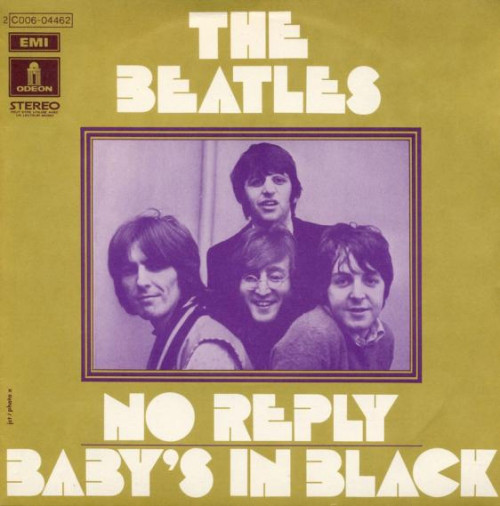
This song was written by John and Paul together. Baby’s In Black sounded different than most of their other songs at the time. The song was in 6/8 time similar to a Waltz and most Beatle songs to that point were in 4/4 time. The song was on the Beatles for Sale album. The album peaked at #1 in the UK and was taken apart for the American market with 8 of the 14 tracks released on Beatles 65 which peaked at #1 in 1965.
The song took a different approach. Baby’s In Black is about a man who is pursuing a woman, but the woman doesn’t return the interest because she is still in mourning for her previous lover, and the reason she always dresses in black.
I’ve always liked the song because it mixes different musical styles into one. The subject matter is also not a typical boy and girl love song.
Paul McCartney: “We got more and more free to get into ourselves,” McCartney remembers. “Our student selves rather than ‘we must please the girls and make money,’ which is all that ‘From Me To You,’ ‘Thank You Girl,’ P.S. I Love You’ is about…We wanted to write something a little bit darker, bluesy, the title’s dark anyway…more grown up rather than just straight pop. It was more ‘baby’s in black’ as in mourning. Our favorite color was black, as well.”
The depressing subject matter is hidden by the upbeat music.
There is speculation that the song was written about mourning the loss of Stuart Sutcliffe after he died of a sudden brain hemorrhage. The song was a 50/50 effort by both Lennon and McCartney but started by Lennon as a response to his own mourning process (which he never really got over). The “baby in black” would be photographer Astrid Kirchherr, who dated Sutcliffe before he died.
This is one of several Beatles songs with a dual melody line – “If I Fell” is another. McCartney and Lennon sang into the same microphone, making it hard to distinguish which is the main melody line. Sheet music of the song usually displays both.
This was the first 50/50 Lennon/McCartney song written since “I Want To Hold Your Hand” a year earlier. They wrote it together sitting practically nose to nose at John’s Kenwood Estate.
Baby’s In Black
Oh dear, what can I do? Baby’s in black And I’m feeling blue Tell me, oh what can I do? She thinks of him And so she dresses in black And though he’ll never come back She’s dressed in black
Oh dear, what can I do? Baby’s in black And I’m feeling blue Tell me, oh what can I do? I think of her But she thinks only of him And though it’s only a whim She thinks of him
Oh how long will it take Till she sees the mistake She has made? Dear what can I do? Baby’s in black And I’m feeling blue Tell me, oh what can I do?
Back before Elvis, before Vietnam war came along, Before the Beatles and Yesterday
I’m wrapping up the songs that reference the Beatles today…I thought Merle Haggard and Frank Zappa would be a good stopping point. Hope you enjoyed the posts.
This song has staying power because every generation longs for the culture of the ones before it. One could easily insert 21st-century phrasing into his classic hit, interchanging microwaves with iPhones, etc. Every single generation looks for a Golden Age, a time where they could pinpoint that everything was right in the world.
This song peaked at #2 in the Billboard Hot Country Song Charts and #1 in Canada in 1982.
Merle had 38 number one hits, 71 top ten hits, and 101 songs in the top 100 in the country charts. It’s hard to wrap my head around 38 number one songs on any chart.
Are The Good Times Really Over (I Wish a Buck Was Still Silver)
I wish a buck was still silver It was back when the country was strong Back before Elvis, before Vietnam war came along Before the Beatles and yesterday When a man could still work and still would Is the best of the free life behind us now And are the good times really over for good?And are we rolling downhill like a snowball headed for hell With no kinda chance for the flag or the liberty bell? Wish a Ford and a Chevy Would still last ten years like they should Is the best of the free life behind us now And are the good times really over for good?
I wish coke was still cola And a joint was a bad place to be It was back before Nixon lied to us all on T.V Before microwave ovens when a girl could still cook, and still would Is the best of the free life behind us now Are the good times really over for good?Are we rolling downhill like a snowball headed for hell With no kinda chance for the flag or the liberty bell Wish a Ford and a Chevy Would still last ten years like they should Is the best of the free life behind us now And are the good times really over for good?Stop rolling downhill like a snowball headed for hell Stand up for the flag and let’s all ring the liberty bell Let’s make a Ford and a Chevy That would still last ten years like they should ‘Cause the best of the free life is still yet to come And the good times ain’t over for good
Frank didn’t get played on commercial radio often. This is one of the few tracks that did get some airplay. The album peaked at #27 in the Billboard 100 in 1979.
I’m not familiar with a lot of Zappa’s catalog. The first song I remember liking by him was Catholic Girls off of this album. A friend of mine heavily into Zappa played me this concept album. The triple album came out as a double album and then a single album.
It’s pretty easy to see why it didn’t get radio play as the lyrics were full of profanity. The music is great… Zappa was one of the best guitarists around as well as a great all-around musician and songwriter.
From Songfacts about the album.
Running to 6 minutes 10 seconds, the title track of this triple concept album was obviously written from the heart, even though it is one of the few such songs which does not resort to out and out profanity. The song itself is fairly straightforward, but the uptempo music is both entertaining and witty. At the end, Joe is arrested for the crime of playing music. Zappa never got much airplay, but the few stations that played him often had this song in rotation.
Joe’s Garage is a popular name for real garages, though it remains to be seen if this is out of homage to Zappa or due to a lot of mechanics being Christened Joe!
In the liner notes to the album, Zappa makes a barely-passing reference to music being censored in Iran, which led some folks to believe the song was inspired by the Iran Hostage Crisis, but the American hostages weren’t taken until months after the album was released.
Zappa was an extremely outspoken enemy of religion, government, commercialism, and just about anything else, so this song and album are right in character. Joe’s Garage has parodies of a broad range of subjects – there’s “L. Ron Hoover” and the “First Church of Appliantology,” the Roman Catholic and Christian churches, lots of references to kinky sex (he also mocked that a lot), the “Central Scrutinizer” is kind of like Orwell’s Big Brother – referencing government censorship, making fun of “dope and LSD” and snorting lines of detergent, the music industry in general… you get the picture.
The ban-on-music thing in the story stems from the government’s “Total Criminalization” policy, where this new philosophy passes the legislation that states that “all humans are inherently criminals” and it’s the government’s job to keep making up laws to give them an excuse to throw everybody in jail.
Bottom line: You can’t narrow the theme of the album down to one thing. If anything, it was more Zappa’s general mockery of the whole capitalist-industrial military-religion complex, and mentioning Iran was just his way of saying “Look what could happen here! It happened there, after all.” Seeing as how this came out before the PMRC targeted Zappa for obscenity in lyrics which led to parental advisory stickers on the album, that kind of makes him a prophet.
Joe’s Garage
A boring old garage in a residential area with a teen-age band rehearsing in it. JOE (the main character in the CENTRAL SCRUTINIZER’S Special Presentation) sings to us of the trials and tribulations of garage-band husbandry.
Central Scrutinizer: We take you now, to a garage, in Canoga Park.
Frank Zappa: (It makes it’s own sauce…)
Joe: It wasn’t very large There was just enough room to cram the drums In the corner over by the Dodge It was a fifty-four With a mashed up door And a cheesy little amp With a sign on the front said “Fender Champ” And a second hand guitar It was a Stratocaster with a whammy bar
At this point, LARRY (a guy who will eventually give up music and earn a respectable living as a roadie for a group called Toad-O) joins in the song…
Larry: We could jam in Joe’s Garage His mama was screamin’ His dad was mad We was playin’ the same old song In the afternoon ‘n’ sometimes we would Play it all night long It was all we knew, ‘n’ easy too So we wouldn’t get it wrong All we did was bend the string like… Hey! Down in Joe’s Garage We didn’t have no dope or LSD But a coupla quartsa beer Would fix it so the intonation Would not offend yer ear And the same old chords goin’ over ‘n’ over Became a symphony We would play it again ‘n’ again ‘n’ again ‘Cause it sounded good to me ONE MORE TIME! We could jam in Joe’s Garage His mama was screamin’, “TURN IT DOWN!” We was playing’ the same old song In the afternoon ‘n’ sometimes we would Play it all night long It was all we knew, and easy too So we wouldn’t get it wrong Even if you played it on a saxophone We thought we was pretty good We talked about keepin’ the band together ‘N’ we figured that we should ‘Cause about this time we was gettin’ the eye From the girls in the neighborhood They’d all come over ‘n’ dance around like…
Twenty teen-age girls dash in and go STOMP-CLAP, STOMP-CLAP-CLAP…
So we picked out a stupid name Had some cards printed up for a coupla bucks ‘N’ we was on our way to fame Got matching suits ‘N’ Beatle Boots ‘N’ a sign on the back of the car ‘N’ we was ready to work in a GO-GO Bar
ONE TWO THREE FOUR LET’S SEE IF YOU GOT SOME MORE!
People seemed to like our song They got up ‘n’ danced ‘n’ made a lotta noise An’ it wasn’t ‘fore very long A guy from a company we can’t name Said we oughta take his pen ‘N’ sign on the line for a real good time But he didn’t tell us when These “good times” would be somethin’ That was really happenin’ So the band broke up An’ it looks like We will never play again…
Joe: Guess you only get one chance in life To play a song that goes like…
(And, as the band plays their little song, MRS. BORG (who keeps her son SY, in the closet with the vacuum cleaner) screams out the window…
Mrs. Borg: Turn it down! Turn it DOWN! I have children sleeping here… Don’t you boys know any nice songs?
Joe: (Speculating on the future) Well the years was rollin’ by, yeah Heavy Metal ‘n’ Glitter Rock Had caught the public eye, yeah Snotty boys with lipstick on Was really flyin’ high, yeah ‘N’ then they got that Disco thing ‘N’ New Wave came along ‘N’ all of a sudden I thought the time Had come for that old song We used to play in “Joe’s Garage” And if I am not wrong You will soon be dancin’ to…
Central Scrutinizer: The WHITE ZONE is for loading and unloading only. If you gotta load or unload, go to the WHITE ZONE. You’ll love it…
Joe: Well the years was rollin’ by (etc.)…
Mrs. Borg: I’m calling THE POLICE! I did it! They’ll be here… shortly!
Officer Butzis: This is the Police…
Mrs. Borg: I’m not joking around anymore
Officer Butzis: We have the garage surrounded If you give yourself up We will not harm you Or hurt you neither
Mrs. Borg: You’ll see them
Officer Butzis: This is the Police
Mrs. Borg: There they are, they’re coming!
Officer Butzis: Give yourself up We will not harm you
Mrs. Borg: Listen to that mess, would you?
Officer Butzis: This is the Police Give yourself up We have the garage surrounded
Mrs. Borg: Everday this goes on around here!
Officer Butzis: We will not harm you, or maim you (SWAT Team 4, move in!)
Mrs. Borg: He used cut my grass… He was very nice boy… That’s DISGUSTING!
Central Scrutinizer: This is the CENTRAL SCRUTINIZER… That was Joe’s first confrontation with The Law. Naturally, we were easy on him. One of our friendly counselors gave him A do-nut… and told him to Stick closer to church-oriented social activities.
I don’t believe in Elvis, I don’t believe in Zimmerman, I don’t believe in Beatles
Before recording this album, John and Yoko began “Primal Scream therapy,” which was a very emotional time for them. Lennon was dealing with the breakup of The Beatles and focusing on the death of his mother a decade earlier. His interviews at the time had a “scorched earth” feel about them. He basically was breaking ties with his past completely and starting anew.
John could be a walking contradiction.
In a 1969 interview John gave that was broadcast on the BBC recently he was asked about the “The Beatles bigger than Christ” he gave in 1966.
“It’s just an expression meaning the Beatles seem to me to have more influence over youth than Christ. Now I wasn’t saying that was a good idea, ‘cos I’m one of Christ’s biggest fans. And if I can turn the focus on the Beatles on to Christ’s message, then that’s what we’re here to do.” 1969.
This song is as strong as any of his Beatles songs. The word I would use would be Powerful to describe it. God was released on his debut album John Lennon/Plastic Ono Band album in 1970. The song is so personal that sometimes I feel uncomfortable listening to it.
When Lennon was recording this at Abbey Road studios, George Harrison was next door completing work on All Things Must Pass. George Harrison said “I was in one room singing ‘My Sweet Lord’, “and John was in another room singing ‘I don’t believe in Jesus, I don’t believe in nothing’.”
John Lennon: “I was going to leave a gap, and just fill in your own words: whoever you don’t believe in. It had just got out of hand, and Beatles was the final thing because I no longer believe in the myth, and Beatles is another myth. I don’t believe in it. The dream is over. I’m not just talking about the Beatles, I’m talking about the generation thing. It’s over, and we gotta – I have to personally – get down to so-called reality.”
From Songfacts
Lennon wrote this about the worship of false idols. He felt organized religion did more harm than good. In “Imagine,” he sang about a better world where there was “no religion.”
Lennon was not an atheist but believed that God was something different to everyone. He also believed that people focus too much on the teacher (God) rather than what is supposed to be taught. In songs like this one and “Imagine,” Lennon was trying to send the message that we should not let religion and other things get in the way of how we think life should be lived. In “Imagine,” “Living for today,” means to live as if there is no afterlife or god and to do the best you can. In this song, “I just believe in me,” states his belief in his life regardless of anything else.
At the time, Lennon had some hard feelings toward The Beatles, especially Paul McCartney. He made a statement that he was moving on with the line, “I don’t believe in Beatles.”
Billy Preston played the piano on this track. He also played on some of The Beatles’ songs, including “Get Back.” Preston, who came from a gospel background, was troubled by the song’s atheistic vibe but kept his feelings to himself. He had similar issues when performing “Sympathy For The Devil” on tour with the Rolling Stones.
Ringo Starr played drums. He and Lennon had a good relationship even after The Beatles broke up.
This contains the classic line, “The Dream Is Over.” This summed up the feelings of many who felt their idealistic goals of the ’60s were not going to come true.
In the January 1971 edition of Rolling Stone, Lennon said that this, “was put together from three songs almost.” He went on to the explain that the words for this “just came out of me mouth.” The former Beatle continued: “I had the idea that ‘God is the concept by which we measure pain,’ so that when you have a word like that, you just sit down and sing the first tune that comes into your head and the tune is simple, because I like that kind of music and then I just rolled into it. It was just going on in my head and I got by the first three or four, the rest just came out. Whatever came out.”
Among the list of idols in this song, which Lennon said he didn’t believe in was The Beatles. Lennon explained why to Rolling Stone:
Lennon starts this song with the line, “God is a concept by which we measure our pain.” He explained to Rolling Stone that, “pain is the pain we go through all the time,” Then added: “You’re born in pain. Pain is what we are in most of the time, and I think that the bigger the pain, the more God you look for.”
God
God is a concept By which we measure Our pain I’ll say it again God is a concept By which we measure Our pain
I don’t believe in magic I don’t believe in I-Ching I don’t believe in Bible I don’t believe in tarot I don’t believe in Hitler I don’t believe in Jesus I don’t believe in Kennedy I don’t believe in Buddha I don’t believe in mantra I don’t believe in Gita I don’t believe in yoga I don’t believe in kings I don’t believe in Elvis I don’t believe in Zimmerman I don’t believe in Beatles I just believe in me Yoko and me And that’s reality
The dream is over What can I say? The dream is over Yesterday I was the dream weaver But now I’m reborn I was the Walrus But now I’m John And so dear friends You just have to carry on The dream is over
In a hand painted night, me and Gypsy Scotty are partners, At the Hotel Flamingo, wearin black market shoes, This loud Cuban band is crucifying John Lennon
This song was released in 1996 and it came off the album Mr. Happy Go Lucky. The song peaked at #14 in the Billboard 100, #1 in Canada and #83 in the UK in 1996. It’s a very good pop song and Key West Intermezzo (I Saw You First), which was Mellencamp’s last US top 40 hit.
John Mellencamp and Cougar had 29 songs in the Billboard 100, 10 top ten hits and one number 1 (Jack and Diane). He released this two years after his minor heart attack in 1994. I’ve always liked this song…catchy riff and a good pop hook.
Key West Intermezzo (I Saw You First)
In a hand painted night, me and Gypsy Scotty are partners At the Hotel Flamingo, wearin black market shoes This loud Cuban band is crucifying John Lennon No one wants to be lonely, no one wants to sing the blues
She’s perched like a parrot on his tuxedo shoulder Christ, what’s she doing with him she could be dancing with me She stirs the ice in her glass with her elegant finger I want to be what she’s drinking, yeah I just want to be
I saw you first I’m the first one tonight I saw you first Don’t that give me the right To move around in your heart Everyone was lookin But I saw you first
On a moon spattered road in her parrot rebozo Gypsy Scotty is driving his big long yellow car She flies like a bird over his shoulder Se whispers in his ear, boy, you are my star
But I saw you first I’m the first one tonight Yes I saw you first Don’t that give me the right To move around in your heart Everyone was lookin’
In the bone colored dawn, me and Gypsy Scotty are singin’ The radio is playin, she left her shoes out in the back He tells me a story about some girl he knows in Kentucky He just made that story up, there ain’t no girl like that
But I saw you first I’m the first one tonight Yes I saw you first Don’t that give me the right To move around in your heart Everyone was lookin But I saw you first I saw you first
Will you remember Jerry Lee, John Lennon, T. Rex and old Moulty? It’s the end, the end of the seventies, It’s the end, the end of the century
Phil Spector produced the End of the Century album. This track was fitting, as Spector worked on a lot of the music that influenced The Ramones. Spector changed their sound to a more radio-friendly pop/rock record.
The voice that opens this song with the words, “Come on, let’s rock and roll with the Ramones” is Sean Donahue, a disc jockey who worked at radio stations in San Francisco (KSAN) and San Jose (KOME, KSJP).
The album peaked at #44 in the Billboard 100 in 1980. Different band members had problems with Spector. The Ramones worked fast live and in the studio but Spector was methodical about his work.
Dee Dee Ramone on Phil Spector:
He levelled his gun at my heart and then motioned for me and the rest of the band to get back in the piano room … He only holstered his pistol when he felt secure that his bodyguards could take over. Then he sat down at his black concert piano and made us listen to him play and sing “Baby, I Love You” until well after 4:30 in the morning.
Marky Ramone denied this…
From Songfacts
This song is a tribute to the music of the ’50s and ’60 that influenced The Ramones. Here’s a breakdown of the lyrical references:
“Hullabaloo” – A UK TV show featuring music and dancing that aired 1965-1966.
“Upbeat” – The Upbeat Show, which was a Cleveland TV show (also with music and dancing) that aired 1964-1971.
“Shindig” – The first prime time Rock music show, many top acts performed on the program. It aired 1964-1966.
“Ed Sullivan” – Host of The Ed Sullivan Show, a popular variety show that lasted more than 20 years. Many famous musicians appeared on the show, including The Beatles, The Doors and The Rolling Stones.
“Murray The K” – Murray “The K” Kaufman, a legendary disc jockey who helped promote rock n’ roll in the States on his radio show and through concerts he helped organize. He championed The Beatles, The Rolling Stones and Bob Dylan.
“Alan Freed” – Another very influential disc jockey, Freed is credited with coining the term “Rock And Roll.”
“Jerry Lee” – Jerry Lee Lewis was a rock originator known for his electrifying performances.
“John Lennon” – Most punk bands wouldn’t claim Lennon and The Beatles as an influence, but The Ramones were a nuanced group that shared an appreciation of his work.
“T. Rex” – Glam Rock originators known for their outrageous costumes and stage presence.
“Ol’ Moulty” – Victor Moulton, who was the drummer in a group called The Barbarians.
Under Spector’s control, he took The Ramones in a new direction, giving the songs on the album a pop sheen and radio-friendly sound. There is a prominent saxophone on the track, which was played by Steve Douglas, who was a member of Spector’s “Wrecking Crew” and played on many of his famous productions.
Spector developed a reputation as being a bit of a maniac, which in part can be attributed to statements Dee Dee Ramone made about working with him. Dee Dee claimed the Spector pulled a gun on him at one point, and was a tyrant in the studio. Spector did some work with Yoko Ono the following year, but became very reclusive until the ’00s, when he produced an album for the English band Starsailor that was released in 2003. In February 2003, Spector was accused of shooting and killing a nightclub hostess at his home.
The closing lyrics, “It’s the end of the ’70s, it’s the end of the century” imply that the musical century was essentially over. The line provided the album title.
In our interview with drummer Marky Ramone, he said that one the band put down their tracks, Phil Spector threw the works (horns, strings, percussion) at the songs on End of the Century, especially this one. “It’s mountainous the way that song is,” he said. “He had a lot of great studio musicians playing on that album just to create a wall of sound, which he was known for. That song took a while. There’s a lot of parts in it.”
Marky adds that the story about Spector pulling a gun in the studio is overblown. He says that while Spector did carry a gun and would sometimes take it off to work, he never threatened anyone with it.
The Ramones made a music video for this song that was directed by Mark Robinson, who also did their clip for “Rock ‘N’ Roll High School.” It was one of the few videos available to MTV when the network launched in 1981, but they gave it very little airplay. MTV tried to program a rock format at the time, and were desperate for videos by American bands in that genre. The Ramones fit the bill, but their videos didn’t have the production value to match what was coming out of Europe.
The intro is meant to elicit the sound of a DJ enthusiastically talking up the song at a radio station.
Do You Remember Rock and Roll Radio?
(This is Rock ‘n’ roll radio, come on, let’s rock ‘n’ roll with the Ramones)
Rock’n, rock ‘n’ roll radio, let’s go Rock’n, rock ‘n’ roll radio, let’s go Rock’n, rock ‘n’ roll radio, let’s go Rock’n, rock ‘n’ roll radio, let’s go
Do you remember Hullabaloo Upbeat, Shindig and Ed Sullivan, too? Do you remember rock ‘n’ roll radio? Do you remember rock ‘n’ roll radio?
Do you remember Murray the K Alan Freed, and High Energy? It’s the end, the end of the seventies It’s the end, the end of the century
Do you remember lying in bed With the covers pulled up over your head Radio playin’ so no one can see? We need change, and we need it fast Before rock’s just part of the past ‘Cause lately, it all sounds the same to me Whoah-whoah, oh
Rock’n, rock ‘n’ roll radio, let’s go Rock’n, rock ‘n’ roll radio, let’s go Rock’n, rock ‘n’ roll radio, let’s go Rock’n, rock ‘n’ roll radio, let’s go
Will you remember Jerry Lee John Lennon, T. Rex and old Moulty? It’s the end, the end of the seventies It’s the end, the end of the century
Do you remember lying in bed With the covers pulled up over your head Radio playin’ so no one can see? We need change, and we need it fast Before Rock’s just part of the past ‘Cause lately, it all sounds the same to me Whoah-whoah, oh
Rock’n, rock ‘n’ roll radio, let’s go Rock’n, rock ‘n’ roll radio, let’s go Rock’n, rock ‘n’ roll radio, let’s go Rock’n, rock ‘n’ roll radio, let’s go
(This is rock ‘N’ roll radio, stay tuned for more rock ‘n’ roll)
I was living in London, With the girl from the summer before, It was the year of the Beatles, It was the year of the Stones
On a cold December evening, I was walking through the Christmas tide, When a stranger came up and asked me If I’d heard John Lennon had died
This song referenced both Johnny Ace the R&B Artist who supposedly have shot himself in a game of Russian roulette in 1954, JFK and John Lennon who was killed on December 8, 1980.
I remember the song on the Simon & Garfunkel reunion concert in Central Park video. When Paul started the part about Lennon a man rushed the stage, shocking Paul especially since it was under a year since Lennon’s murder.
“The Late Great Johnny Ace” is a song by Paul Simon, which is on the 1983 Hearts and Bones album.
The Late Great Johnny Ace
I was reading a magazine And thinking of a rock and roll song The year was 1954 And I hadn’t been playing that long When a man came on the radio And this is what he said He said I hate to break it To his fans But Johnny Ace is dead Well, I really wasn’t Such a Johnny Ace fan But I felt bad all the same So I sent away for his photograph And I waited till it came It came all the way from Texas With a sad and simple face And they signed it on the bottom From the Late Great Johnny Ace It was the year of the Beatles It was the year of the Stones It was 1964 I was living in London With the girl from the summer before It was the year of the Beatles It was the year of the Stones A year after J.F.K. We were staying up all night And giving the days away And the music was flowing Amazing And blowing my way On a cold December evening I was walking through the Christmas tide When a stranger came up and asked me If I’d heard John Lennon had died And the two of us Went to this bar And we stayed to close the place And every song we played Was for the Late Great Johnny Ace





 PowerPop... An Eclectic Collection of Pop Culture