In 1984 Willie M. ”Wimp” Stokes Jr., described as a Chicago underworld figure who was gunned down on the steps of Roberts Motel at 79th Street and Vincennes Avenue. Such a violent death was not unheard of in Willie the Wimp`s social circles-but the style of his funeral was.
Willie’s dad, Willie Morris “Flukey” Stokes gave his son an extravagant goodbye. He was in the same line of work as his son.
If you want to see the coffin with Mr. Stokes inside… you can go to here “Willie The Wimp and Cadillac Coffin.” I didn’t really want to post that.
Bill Carter and Ruth Ellsworth wrote the song after seeing a newspaper column about the story. Bill Carter released his version on his 1985 album Stompin’ Grounds. Stevie Ray Vaughn started to play the song in concert and it was released on his live album Live Alive in 1986.
Stevie was in the upper echelon of guitar players…right along with Hendrix and Clapton.
Willie The Wimp
Willie the Wimp was buried today, They laid him to rest in a special way. Sent him off in the finest style That casket-mobile really drove ’em wild Southside Chicago will think of him often Talkin’ ’bout Willie the Wimp and his Cadillac coffin, Willie the Wimp and his Cadillac coffin
That casket, it looked like a fine Seville He had a vanity license and a Cadillac grille Willie was propped up in the driver’s seat He had diamonds on his fingers and a smile sweet Fine red suit had the whole town talkin’ Talkin’ ’bout Willie the Wimp and his Cadillac coffin Willie the Wimp and his Cadillac coffin
Oh, Cadillac to Heaven he was wavin’ the banner He left like he lived, in a lively manner With a-hundred dollar bills in his fingers tight He had flowers for wheels and a-flashin’ headlights He been wishin’ for wings, no way he was walkin’ Talkin’ ’bout Willie the Wimp and his Cadillac coffin Yeah, Willie the Wimp and his Cadillac coffin
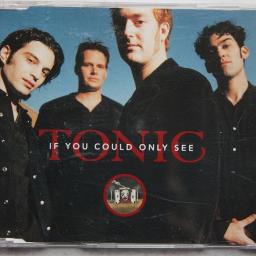
I remember this song in the 90s and never knew much about the song or band. It does have a catchy hook. The song was released to radio and MTV, but in the interest of album sales, it was not sold as a single. This made the song ineligible for the Billboard Hot 100 but pushed sales of their debut album Lemon Parade past one million. The song peaked at #1 in the Billboard Mainstream Rock Charts in 1997.
Tonic frontman Emerson Hart wrote this song after a tense phone call with his mother. Hart was 21 years old and planning to get married – not what his mother had in mind. She tried to talk him out of it, but you can’t argue with love. Emerson told her: “If you could only see the way she loves me, then maybe you would understand,” and then he hung up.
In the end, his mother was right: it didn’t work out with the girl and they never got married.
From Songfacts
This was Tonic’s first single, but it almost didn’t make the album. The band got a deal with Polydor Records after playing clubs for a few years in the Los Angeles area. When it came time to record their debut album, Emerson Hart wasn’t sure if they should use “If You Could Only See,” since it was a very vulnerable song and he wasn’t sure how it would be received. Polydor, however, loved it and made sure it was the debut single.
The song made #1 on the Mainstream Rock chart and received very consistent airplay – it lasted an astonishing 63 weeks on the Airplay chart, peaking at #11 in December 1997, long after it had been released.
Tonic had a minor hit with “Open Up Your Eyes” (#68 Airplay), but never came close to matching “If You Could Only See.”
The music video finds Emerson Hart searching desperately for the girl who is being kept away from him. It was directed by Ramaa Mosley, whose other credits include the Creed videos for “What’s This Life For” and “Higher,” and the movie The Brass Teapot.
Mosley looked to French cinema for inspiration – notably the 1960 film Breathless and 1963 movie Contempt. “I started envisioning this combination of a love story mixed with this kind of communist oppression,” she said in her Songfacts interview. “I locked myself in my house and listened to the song hundreds of times and the story just kept building.”
If You Could Only See
If you could only see the way she loves me Then maybe you would understand Why I feel this way about our love And what I must do If you could only see how blue her eyes can be when she says
When she says she loves me Well you got your reasons And you got your lies And you got your manipulations They cut me down to size Sayin’ you love but you don’t You give your love but you won’t If you could only see the way she loves me
Then maybe you would understand Why I feel this way about our love And what I must do If you could only see how blue her eyes can be when she says
When she says she loves me Seems the road less traveled Show’s happiness unraveled And you got to take a little dirt
To keep what you love That’s what you gotta do Sayin’ you love but you don’t You give your love but you won’t You’re stretching out your arms to something that’s just not there
Sayin’ you love where you stand Give your heart when you can If you could only see the way she loves me Then maybe you would understand Why I feel this way about our love And what I must do If you could only see how blue her eyes can be when she says When she says she loves me
Sayin’ you love but you don’t You give your love but you won’t Sayin’ you love where you stand Give your heart when you can
If you could only see the way she loves me Then maybe you would understand Why I feel this way about or love And what I must do If you could only see how blue her eyes can be when she says When she says she loves me
This song was on Blood On The Tracks, a brilliant album by Bob released in 1975. This wasn’t a hit but it was a great song. The album though was a hit…peaking at #1.
As with other Dylan songs, the words keep me in this one. I also like the way he sings it…he sings it like he has lived it. People tell me it’s a sin, To know and feel too much within, I still believe she was my twin, but I lost the ring, She was born in spring, but I was born too late, Blame it on a simple twist of fate.
This album was made when he was having trouble with his wife Sara. Dylan denies the album is about the two of them.
In Rolling Stone 500 Greatest Albums of all time in the early 2000s, Blood on the Tracks came in at Number 16.
Jacob Dylan about Blood on the Tracks: ‘When I’m listening to ‘Subterranean Homesick Blues,’ I’m grooving along just like you. But when I’m listening to Blood on the Tracks, that’s about my parents.’
From Songfacts
This song is from Blood on the Tracks, the 15th studio album by Bob Dylan, which made the album charts at #1 in the US and #4 in the UK. Blood on the Tracks is also legendary amongst Bob Dylan fans and critics, regarded as one of the high points of his career and standard against which future Bob Dylan albums were compared.
Dylan’s son Jakob Dylan has stated that the songs from Blood on the Tracks are “his parents talking.” Although Dylan denies that the album content is autobiographical, most of the lyrics have a confessional nature.
Covers of “Simple Twist of Fate” include Joan Baez (1975), The Jerry Garcia Band (1991), Concrete Blonde (1994), Sean Costello (2005), The Format (2005), Bryan Ferry (2007), Jeff Tweedy (2007), and Stephen Fretwell (2007). The Jeff Tweedy cover was also used on the soundtrack for the film I’m Not There .
A Simple Twist Of Fate
They sat together in the park As the evening sky grew dark She looked at him and he felt a spark Tingle to his bones ‘Twas then he felt alone And wished that he’d gone straight And watched out for a simple twist of fate
They walked along by the old canal A little confused, I remember well And stopped into a strange hotel With a neon burnin’ bright He felt the heat of the night Hit him like a freight train Moving with a simple twist of fate
A saxophone someplace far-off played As she was walkin’ on by the arcade As the light bust through a beat-up shade Where he was waking up She dropped a coin into the cup Of a blind man at the gate And forgot about a simple twist of fate
He woke up, the room was bare He didn’t see her anywhere He told himself he didn’t care Pushed the window open wide Felt an emptiness inside To which he just could not relate Brought on by a simple twist of fate
He hears the ticking of the clocks And walks along with a parrot that talks Hunts her down by the waterfront docks Where the sailors all come in Maybe she’ll pick him out again How long must he wait? One more time, for a simple twist of fate
People tell me it’s a sin To know and feel too much within I still believe she was my twin But I lost the ring She was born in spring But I was born too late Blame it on a simple twist of fate
Well written and great pop song. I remember it from the movie Scrooged where now that film and this song goes hand in hand. Nineteen years after this song was a hit for Jackie DeShannon, Annie Lennox and Al Green covered it for the 1988 film Scrooged. Their version reached #9 in the US and #28 in the UK and reached the Top 40 in five other countries.
DeShannon co-wrote this song with her brother Randy Myers and Jimmy Holiday.
Jackie is a great songwriter and was inducted into the Songwriting Hall Of Fame in 2010. Other songs that she wrote or co-wrote are Bette Davis Eyes, What The World Needs Now is Love, Santa Fe / Beautiful Obsession and many more.
This song peaked at #4 in the Billboard 100 and #12 in Canada in 1969.
Jackie DeShannon:“My brother Randy was playing this little riff and I said, ‘Gee, I really like that riff, that’s great.’ All of a sudden, ‘Think of your fellow man, lend him a helping hand, put a little love in your heart,’ came just like that. I owe some of that to my mom because she was always saying that people should put a little love in their heart when things are not so good. I’d like to say it was very difficult, but it was one of those songs you wait a lifetime to write.”
Jimmy Page was said to write Tangerine about DeShannon after their breakup.
From Songfacts
She is best known as a singer, but Jackie DeShannon is one of the most talented tunesmiths of her time – she was inducted into the Songwriters Hall of Fame in 2010. She wrote many of her own songs, including this one, which she composed with her younger brother Randy Myers (Jackie’s real name is Sharon Lee Myers) and a Soul singer at her label (Liberty Records), Jimmy Holiday.
In our interview with Jackie DeShannon, she told the story:
Jimmy Holiday’s contribution came after Jackie and her brother started composing it, as he helped polish the song. Holiday, DeShannon and Myers went on to write Jackie’s hits “Love Will Find A Way” (#40, 1969) and “Brighton Hill” (#82, 1970).
DeShannon recorded a demo of this song which she had a hard time beating in the recording session. In our interview, she recalled struggling to get the right feel. “After about eight hours we finally got it and I just felt that I had done probably one of my best vocals ever,” she said. “But when I came back in to hear it somehow my vocal was erased. Somebody must have hit something. I called my mom and I said, ‘You know what, I’m just heartbroken. I’ve probably done the best vocal ever – at least it felt to me that it was right on the button – and I have to go do it again.’ So I went right back in there fast, before I lost the muse. When I got to hear the new vocal I felt that, of course, I wished I could have had the other one. But who’s to say? Maybe this was the better vocal.”
The song was released as the first single from the album in June of 1969, and it gained momentum when a radio station in Atlanta started playing it. In August, the New York radio station WABC made it a “Pick of the Week,” and stations around the country jumped on it, sending the song to its peak chart position of #4 on August 30. Said DeShannon: “The airplay was great, and in those days if you had a record in rotation, that could be very good money. I was actually able to buy a car for my dad, and I bought a house for my parents.”
Put A Little Love In Your Heart
Think of your fellow man, lend him a helping hand
Put a little love in your heart
You see, it’s getting late, oh, please don’t hesitate
Put a little love in your heart
And the world will be a better place
And the world will be a better place for you and me
You just wait and see
Another day goes by, and still the children cry
Put a little love in your heart
If we want the world to know, we won’t let hatred grow
Put a little love in your heart
And the world will be a better place
And the world will be a better place for you and me
You just wait and see, wait and see
Take a good look around and if you’re lookin’ down
Put a little love in your heart
I hope when you decide kindness will be your guide
Put a little love in your heart
And the world will be a better place
And the world will be a better place for you and me
You just wait and see
People now
Put a little love in your heart
Each and every day
Put a little love in your heart
There’s no other other
Put a little love in your heart
We ought to
Put a little love in your heart
Come on and
Put a little love in your heart
I first heard the Linda Ronstadt version when I was younger but I’ve grown to like this one just as well. The Everly Brothers version peaked at #8 in the Billboard 100, #16 in Canada and #4 in the UK in 1960.
Linda’s version peaked at #2 in the Billboard 100 and #1 in Canada in 1975.
Phil Everly wrote this in his car, parked outside an A&W root beer stand. He took inspiration from his on-again, off-again romance with Jackie Ertel-Bleyer, the stepdaughter of Cadence Records founder, Archie Bleyer. Phil and Jackie got married in 1963 and divorced in 1972.
From Songfacts
One of their classic songs, this tune finds the Everly Brothers fed up with the constant heartache that leaves them wondering, “When will I be loved?”
The Everly Brothers had already moved from Cadence Records to Warner Bros. when their former label issued this as a single in 1960. Hoping to shift from their signature rockabilly style to mainstream pop-rock, they were already achieving their goal as the pop-oriented “Cathy’s Clown” climbed to #1. The release of “When Will I Be Loved” was not only a throwback to their old sound, but it also threatened to derail their success by splitting airplay among their other tunes. But the public couldn’t get enough of the Everlys and they notched four Top 10 hits that year, including the #8 entry “When Will I Be Loved.”
Linda Ronstadt had even greater success when she released this as the second single from her 1974 album, Heart Like A Wheel. Aside from peaking at #2 on the Hot 100, it became her first #1 hit on the Country chart.
Several other artists have recorded this, including John Denver, Tanya Tucker, Gram Parsons, Rosemary Clooney, Manfred Mann, and The Little River Band, while Dolly Parton frequently included it in her live repertoire. As part of the English folk-rock collective The Bunch, Sandy Denny and Linda Thompson covered it on the 1972 covers album, Rock On. Nick Lowe and Dave Edmunds included it on their 1980 EP, Nick Lowe & Dave Edmunds Sing The Everly Brothers. John Fogerty and Bruce Springsteen also recorded it as a duet for Fogerty’s 2009 album, The Blue Ridge Rangers Rides Again.
Green Day singer Billie Joe Armstrong sang this with Miranda Lambert at the 2014 Grammy Awards in honor of Phil Everly, who died of lung disease earlier that year.
Cabaret singer Amanda McBroom sang this on the 1985 Magnum P.I. episode “Let Me Hear The Music.” Jamison Belushi also performed it on her dad James Belushi’s sitcom According to Jim in the 2008 episode “Jami McFame.”
When Will I Be Loved
I’ve been made blue, I’ve been lied to When will I be loved I’ve been turned down, I’ve been pushed around When will I be loved
When I meet a new girl that I want for mine She always breaks my heart in two, it happens every time I’ve been cheated, been mistreated When will I be loved
When I meet a new girl that I want for mine She always breaks my heart in two, it happens every time I’ve been cheated, been mistreated When will I be loved
Spring training has started and baseball will be returning soon. It’s a good day to listen to John Fogerty’s Centerfield. This was John Fogerty’s comeback after being away from the charts since 1975.
The song peaked at #44 in the Billboard 100 in 1985. The album Centerfield peaked at #1 in the Billboard Album Charts in 1985.
Along with “Talkin’ Baseball” and “Take Me Out To The Ballgame,” this quickly became one of the most popular baseball songs ever. It’s a fixture at ballparks between innings of games and plays at the Baseball Hall of Fame in Cooperstown, New York.
John Fogerty:“I’d hear about Ruth and DiMaggio, and as my dad and older brothers talked about the Babe’s exploits, their eyes would get so big. When I was a little kid, there were no teams on the West Coast, so the idea of a Major League team was really mythical to me. The players were heroes to me as long as I can remember.”
“It is about baseball, but it is also a metaphor about getting yourself motivated, about facing the challenge of one thing or another at least at the beginning of an endeavor. About getting yourself all ready, whatever is necessary for the job.”
From Songfacts
This song was inspired by Fogerty’s childhood memories of baseball, and although he didn’t play the game, he loved watching it and hearing the stories his father would tell about the legendary New York Yankees centerfielder Joe DiMaggio, who like Fogerty was from San Francisco.
Fogerty left Creedence Clearwater Revival in 1972 and released solo albums in 1973 and 1975 that sold poorly. For the next 10 years, Fogerty refused to record because of legal battles with his record company, but when Centerfield was finally released in 1985, it hit the mark thanks to this title track. A song about baseball was a risk, as the sport isn’t exactly rock-worthy. In the MLB.com interview, Fogerty said: “Over the years it seemed like sports songs just didn’t qualify into the rock-and-roll lexicon. There was that unwritten distinction. It was never considered rock-and-roll. And I realized creating this song would very much put baseball in a rock-and-roll setting. I expected to be roundly thrashed by owners of the flame.”
One of Fogerty’s idols – Chuck Berry – inspired the lyrics, “Rounding third he was heading for home, it was a brown eyed handsome man,” which is lifted from Berry’s song “Brown Eyed Handsome Man.”
Baseball legends mentioned in this song: Joe DiMaggio, Willie Mays, and Ty Cobb.
The second verse refers to the legendary Mighty Casey from the epic poem Casey At The Bat. At the end of the story, Casey strikes out. >>
The line, “It’s a-gone and you can tell that one good-bye” comes from the catchphrase of baseball announcer Lon Simmons, who called games for the San Francisco Giants. He would often say, “Tell it goodbye” when the Giants hit a home run.
Fogerty produced this track and played all the instruments.
On July 25, 2010, in honor of the 25th anniversary of “Centerfield”‘s release, Fogerty played the song at the Major League Baseball Hall of Fame induction ceremonies, where he became the first musician honored by the Hall of Fame – at least the baseball one. Fogerty is in both the Songwriters and Rock and Roll Hall of Fames.
At the ceremony, Fogerty donated a custom-made baseball-bat-shaped guitar to the Baseball Hall of Fame.
The 1984 Major League Baseball All-Star Game was held at Candlestick Park in Fogerty’s hometown of San Francisco. This led to erroneous reports that he watched the game from the center field bleachers, leading to this song. Among the publications to report this was Billboard Publications Rock Movers & Shakers.
When George W. Bush was campaigning for president of the US in 2000, he told a reporter this was his favorite song. Bush used to own part of the Texas Rangers baseball team, and liked the line “Put me in coach, I’m ready to play.”
Brad Paisely played “Centerfield” at an outdoor festival when he was 13 years old, something he told Fogerty about many years later. After the conversation, Fogerty hit him up for his 2013 album Wrote a Song for Everyone, where he performed his songs with contemporary musicians. Paisely picked a deep cut: “Hot Rod Heart” from Fogerty’s 1997 solo album Blue Moon Swamp.
Fogerty has always been a huge baseball fan; the first book he ever read was Lou Gehrig: Boy of the Sandlot.
When his boys played Little League, Fogerty always got a kick out of listening to this song when it was played during warm-ups.
Centerfield
Well, I beat the drum and hold the phone The sun came out today We’re born again, there’s new grass on the field A-roundin’ third and headed for home It’s a brown-eyed handsome man Anyone can understand the way I feel
Oh, put me in, coach, I’m ready to play today Put me in, coach, I’m ready to play today Look at me, I can be centerfield
Well, I spent some time in the Mudville Nine Watching it from the bench You know I took some lumps, when the mighty Case struck out So say hey, Willie, tell the Cobb And Joe DiMaggio Don’t say it ain’t so, you know the time is now
Oh, put me in, coach, I’m ready to play today Put me in, coach, I’m ready to play today Look at me, I can be centerfield
Yeah, got it, I got it
Got a beat-up glove, a home-made bat And a brand new pair of shoes You know I think it’s time to give this game a ride Just to hit the ball and touch ’em all A moment in the sun It’s a-gone and you can tell that one good-bye
Oh, put me in, coach, I’m ready to play today Put me in, coach, I’m ready to play today Look at me (yeah), I can be centerfield
Oh, put me in, coach, I’m ready to play today Put me in, coach, I’m ready to play today Look at me, gotta be, centerfield Yeah
This song was from what I think was John Mellencamp’s best album Scarecrow and the peak of his career.
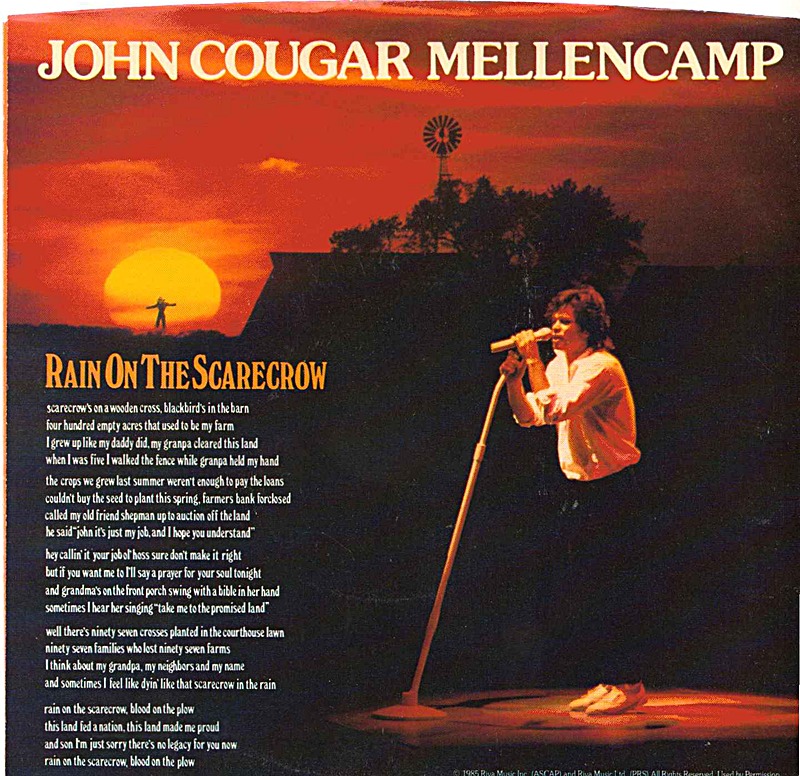
This song is about the financial difficulties farmers in the Midwest US face… difficulties that can go as far as having their farms repossessed by banks. Mellencamp wrote the song with George Green, who he worked with on many tracks, including “Hurts So Good.”
He has taken an active role in helping American farmers. Along with Neil Young and Willie Nelson, he regularly plays at the Farm-Aid concerts to help raise money.
The song peaked at #21 in the Billboard 100 in 1986. The album peaked at #2 in 1985.
From Songfacts
“Our songs always came about the same way: talk around the kitchen table,” Mellencamp told Rolling Stone. “I had just played ‘Small Town’ for him. He said, “I don’t know why these towns are going out of business” – towns like Freetown and Dudleytown, Indiana. We couldn’t figure out why they were disappearing. We did our research and wrote this song – Reagan had been using grain against the Soviet Union and all sorts of other things. Talking to people was heartbreaking. Nobody wanted to lose their farm.”
When the banker forecloses on the farm in this song, Mellencamp introduces himself into it:
He said, “John it’s just my job and I hope you understand” Hey, calling it your job ol’ Hoss sure don’t make it right
This bit was culled from the 1967 movie Cool Hand Luke, where the boss man puts Paul Newman’s character, Luke, in “the box” (solitary confinement), telling him, “Sorry, Luke. I’m just doing my job. You gotta appreciate that.”
Luke replies: “Nah, calling it your job don’t make it right, Boss.”
Another track on the album, “Lonely Ol’ Night,” also uses dialogue from a Paul Newman movie: the 1963 film Hud. In that one, a character asks, “It’s a lonesome ol’ night, isn’t it?”
Rain On The Scarecrow
Scarecrow on a wooden cross blackbird in the barn Four hundred empty acres that used to be my farm I grew up like my daddy did my grandpa cleared this land When I was five I walked the fence while grandpa held my hand
[Chorus] Rain on the scarecrow blood on the plow This land fed a nation this land made me proud And son I’m just sorry theres no legacy for you now Rain on the scarecrow blood on the plow Rain on the scarecrow blood on the plow
The crops we grew last summer weren’t enough to pay the loans Couldn’t buy the seed to plant this spring and the farmers bank foreclosed Called my old friend schepman up to auction off the land He said john its just my job and I hope you understand Hey calling it your job ol hoss sure dont make it right But if you want me to Ill say a prayer for your soul tonight And grandmas on the front porch swing with a Bible in her hand Sometimes I hear her singing take me to the promised land When you take away a mans dignity he cant work his fields and cows
There’ll be blood on the scarecrow blood on the plow Blood on the scarecrow blood on the plow
Well there’s ninety-seven crosses planted in the courthouse yard Ninety-seven families who lost ninety-seven farms I think about my grandpa and my neighbors and my name and some nights I feel like dying like that scarecrow in the rain
[Chorus]
Rain on the scarecrow blood on the plow This land fed a nation this land made me so proud And son I’m just sorry they’re just memories for you now Rain on the scarecrow blood on the plow Rain on the scarecrow blood on the plow
The Baby’s were formed in 1976 and they broke up in 1981. They had 8 songs in the Billboard 100 and two songs in the top 2.
Back On My Feet Again peaked at #33 in the Billboard 100 in 1980. The song was on the album Union Jacks released in 1980. It peaked at #42 in 1980. The band’s first two singles from the album failed until this one hit.
This is the song I remember the most by them. It was written by Dominic Bugatti, Frank Musker, and John Waite.
Lead singer John Waite on how the Babys got their name: “The name was meant to be a joke. We took the name simply because the record companies wouldn’t listen to any bands they thought were rock & roll. I mean, they wanted sure-fire teen bands, pre-teen bands. We couldn’t get anybody down to hear us to get a record deal, so we called ourselves The Babys. We thought we’d keep the name just for two weeks. Then, the word got around in London that there was a band playing rock & roll called The Babys and it seemed so off the wall, so completely crazy, that it was worth taking a shot with. It really appealed to everyone’s sense of humor.”
Back On My Feet Again
I was so lonely until I met you Told myself I’d get by without love Drownin’ my sorrows, avoiding tomorrows Kind of felt that I just had enough
You light up my face with your jokes and your smiles And the way that you came every night Don’t know what you got, but I’m sure glad I found you Could be wrong but it sure feels right
And here I am I’m back on my feet again Here I am I’m back on my feet again
Surprised at myself for the way that I feel So happy that you’re here with me Some women I’ve known, have left me with nothing But I guess that was just meant to be
And here I am I’m back on my feet again Here I am I’m back on my feet again
I was down for the count I was down, I was beat, I was cryin’ I was cornered and hurt I was hidin’ my face, sick of tryin’
I was so lonely until I met you Told myself I’d get by without love Drowning my sorrows, avoiding tomorrows Kind of felt that I just had enough
And here I am I’m back on my feet again Here I am I’m back on my feet again
Yeah, here I am I’m back on my feet again Here I am I’m back on my feet again
Ooh yeah, here I am I’m back on my feet again Here I am I’m back on my feet again
Here I am, yeah I’m back on my feet again Here I am I’m back on my feet again
The title alone is worth a listen or two. Loretta had some great song titles.
The song peaked at #1 in the Billboard Country Charts in 1967. The song also earned Lynn her very first Grammy nomination for Best Country & Western Performance.
The song was written by Loretta Lynn and Peggy Sue Wright. Peggy Sue Wright is Loretta’s younger sister.
Loretta Lynn: “I looked at what she had on paper, and I kind of knew what she was trying to say. It’s like when there’s twins, the old saying is, ‘What one can’t think of, the other one can.’ I’ve always had this feeling with Peggy that I am kind of inside her head. Maybe it’s because she means so much to me. We can look at each other and know what the other is thinking. Sometimes it’s not good to be like that, but when the song was finished, we both thought it was great.”
From Songfacts
In her first #1 country hit, Loretta Lynn is fed up with her alcoholic husband who gets drunk with his buddies and comes home expecting to get frisky with his neglected wife. Lynn could certainly relate to the scenario, as almost all of the turmoil in her nearly 50-year marriage was caused by her husband’s alcoholism, but a different marriage inspired the song. Her sister Peggy Sue was struggling with the same issues in her first marriage and brought the song idea to Lynn, who fleshed it out. Peggy Sue was following Lynn’s path as an aspiring singer who was trying to carve out a career while raising children and making her marriage work.
Peggy Sue, who went on to marry singer/songwriter Sonny Wright, released her debut album, Dynamite!, in 1969.
In 1967 Lynn’s brother Jay Lee Webb released the answer song “I Come Home A-Drinkin’ (To a Worn Out Wife Like You),” which peaked at #21 on the country chart.
Lynn became the first female country singer to have a gold-certified album when Don’t Come Home A-Drinkin’ (With Lovin’ On Your Mind) earned the honor in 1970, with over 500,000 copies sold.
Tammy Wynette covered this on her debut album, Your Good Girl’s Gonna Go Bad, in 1967.
Gretchen Wilson sang this on the 2010 album Coal Miner’s Daughter: A Tribute to Loretta Lynn.
This was used on the 2007 Friday Night Lights episode “I Think We Should Have Sex.”
Don’t Come Home A-Drinkin’ (With Lovin’ on Your Mind)
Well you thought I’d be waitin’ up when you came home last night You’d been out with all the boys and you ended up half tight But liquor and love they just don’t mix leave the bottle or me behind And don’t come home a drinkin’ with lovin’ on your mind
No don’t come home a drinkin’ with lovin’ on your mind Just stay out there on the town and see what you can find ‘Cause if you want that kind of love well you don’t need none of mine So don’t come home a drinkin’ with lovin’ on your mind
You never take me anywhere because you’re always gone And many a night I’ve laid awake and cried here all alone Then you come in a kissin’ on me it happens every time No don’t come home a drinkin’ with lovin’ on your mind
No don’t come home a drinkin’ with lovin’ on your mind Just stay out there on the town and see what you can find ‘Cause if you want that kind of love well you don’t need none of mine So don’t come home a drinkin’ with lovin’ on your mind No, don’t come home a drinkin’ with lovin’ on your mind
One of my favorite songs by Creedence Clearwater Revival. The song peaked at #2 in the Billboard 100, #19 in the UK, and #5 in Canada. If you want proof that life isn’t fair… Green River was kept from #1 because of the novelty bubblegum song “Sugar, Sugar” by The Archies.
The song is an example of a perfect rock song. Great lick, lyrics, and wonderful guitar fills by John Fogerty.
The song was on the album Green River which peaked at #1 in the Billboard Album Chart.
John Fogerty:“Green River is really about this place where I used to go as a kid on Putah Creek, near Winters, California. I went there with my family every year until I was ten. Lot of happy memories there. I learned how to swim there. There was a rope hanging from the tree. Certainly dragonflies, bullfrogs. There was a little cabin we would stay in owned by a descendant of Buffalo Bill Cody. That’s the reference in the song to Cody Jr. [“Up at Cody’s camp I spent my days…”
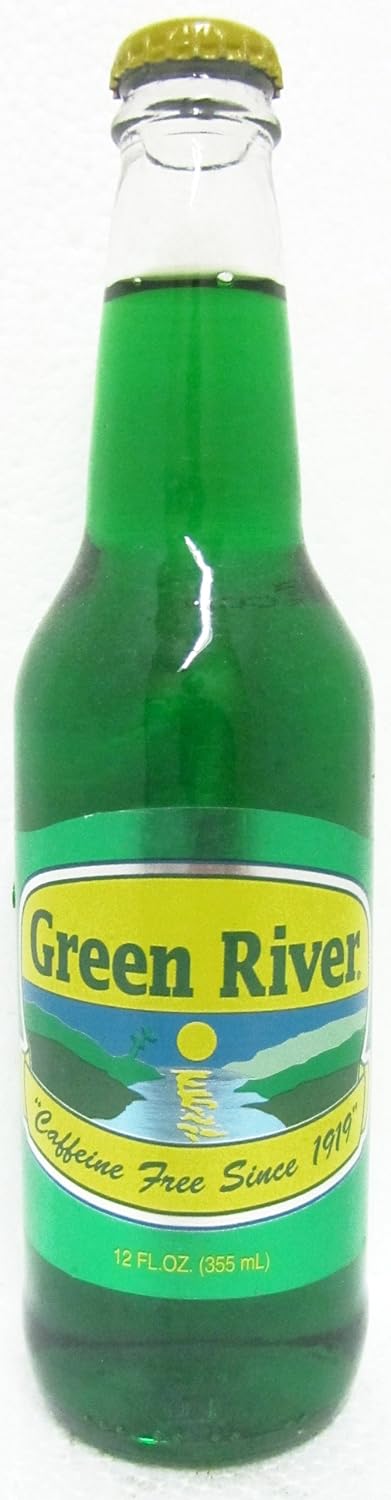
The actual specific reference, Green River, I got from a soda pop-syrup label. You used to be able to go into a soda fountain, and they had these bottles of flavored syrup. My flavor was called Green River. It was green, lime-flavored, and they would empty some out over some ice and pour some of that soda water on it, and you had yourself a Green River.”
From Songfacts
John Fogerty has said that Green River is his favorite Creedence Clearwater Revival album, in part because it sounds like the ’50s albums by the likes of Elvis Presley and Johnny Cash that came out of Sun Records in Memphis.
Asked about his songwriting by Mojo magazine, John Fogerty replied: “More common is me fooling around on the guitar coming up with a riff or a lick or even just a tone which sparks some kind of creativity. Your mind gets a vibe, like the lick for ‘Green River’ – that’s what it sounded like, a green river, haha. And that was a title I had carried around since I was about eight years old.”
Green River
Well, take me back down where cool water flow, yeh Let me remember things I love Stoppin’ at the log where catfish bite, Walkin’ along the river road at night, Barefoot girls dancin’ in the moonlight
I can hear the bull frog callin’ me Wonder if my rope’s still hangin’ to the tree Love to kick my feet way down the shallow water, Shoe fly, dragon fly, get back t your mother Pick up a flat rock, skip it across Green River
Up at Cody’s camp I spent my days, oh, With flat car riders and cross-tie walkers Old Cody, Junior took me over, Said, you’re gonna find the world is smouldrin’ An’ if you get lost come on home to Green River Well, come home
This song was the B side to Get Back. This song was credited to John and Paul but it’s a clear John song that he wrote directly to Yoko. Don’t Let Me Down should have been on the Let It Be album in my opinion. It would have made it a stronger album but Phil Spector decided to took it out.
This one is one of my favorite late Lennon Beatle songs. I liked the time signature change in this song. All measures are in 4/4 time except for the eighth measure, which is in 5/4, the extra beat needed in order to fit in John’s first verse lyric “Nobody ever loved my like she…”
The song peaked at #35 in the Billboard 100 in 1969. It’s a powerful and sincere love song by John.
Billy Preston, who The Beatles met when he was on tour with Little Richard in 1962, played keyboards on this track. Preston was one of the few outside musicians (excluding members of orchestras) to play on any Beatles song.
George Harrison brought Preston in to play on the sessions. It was a smart move by George. Not only did Preston bring his talents in the mix but his presence helped smooth the tensions the band had at the time. He did the same thing on the White Album sessions by bringing Eric Clapton in to play on While My Guitar Gently Weeps.
From Songfacts
John Lennon dedicated this song to Yoko Ono. It was the first song he wrote for Yoko, whom he married on March 20, 1969.
This was one of the songs The Beatles played at their impromptu rooftop concert in 1969. The concept of the album was The Beatles performing new songs for a live audience, with film footage of their rehearsals used to make a documentary TV special. George Harrison didn’t like the idea, and when things got tense during recording, he left the sessions and returned only after they agreed to cancel the live performance. The Beatles were still under contract to make another movie, so they decided to use the rehearsal footage as their last movie, Let It Be. In order to end the movie, they needed a big scene, so they went to the roof of Apple Records and started playing. John Lennon forgot some of the words to this song while the Beatles were playing their rooftop concert.
When Apple Records remixed the album Let It Be and released it in 2003 as Let It Be… Naked, this was included. An alternate take was used. It was the only song on the new album that did not appear on the original.
Lennon asked Ringo to crash his cymbals loudly to “give me the courage to come in screaming.”
Billy Corgan’s band Zwan covered this. They rearranged the entire song so only the melody was the same. They added a guitar solo at the end. Others artists to cover the song include Randy Crawford, Crown of Thorns, Dylan & Clark, Garbage, Gene, Marcia Griffiths, Taylor Hicks, Julian Lennon, Annie Lennox, Maroon 5, Matchbox Twenty, The Persuasions, Phoebe Snow, Stereophonics and Paul Weller. >>
Garbage lead singer Shirley Manson is from Edinburgh, and in 1999 they played this song at the opening of the newly-elected Scottish Parliament, which was celebrating autonomy after 300 years of British rule.
Don’t Let Me Down
Don’t let me down, don’t let me down Don’t let me down, don’t let me down
Nobody ever loved me like she does Oh, she does, yeah, she does And if somebody loved me like she do me Oh, she do me, yes, she does
Don’t let me down, don’t let me down Don’t let me down, don’t let me down
I’m in love for the first time Don’t you know it’s gonna last It’s a love that lasts forever It’s a love that had no past
Don’t let me down, don’t let me down Don’t let me down, don’t let me down
And from the first time that she really done me Oh, she done me, she done me good I guess nobody ever really done me Oh, she done me, she done me good
Don’t let me down, don’t let me down Don’t let me down
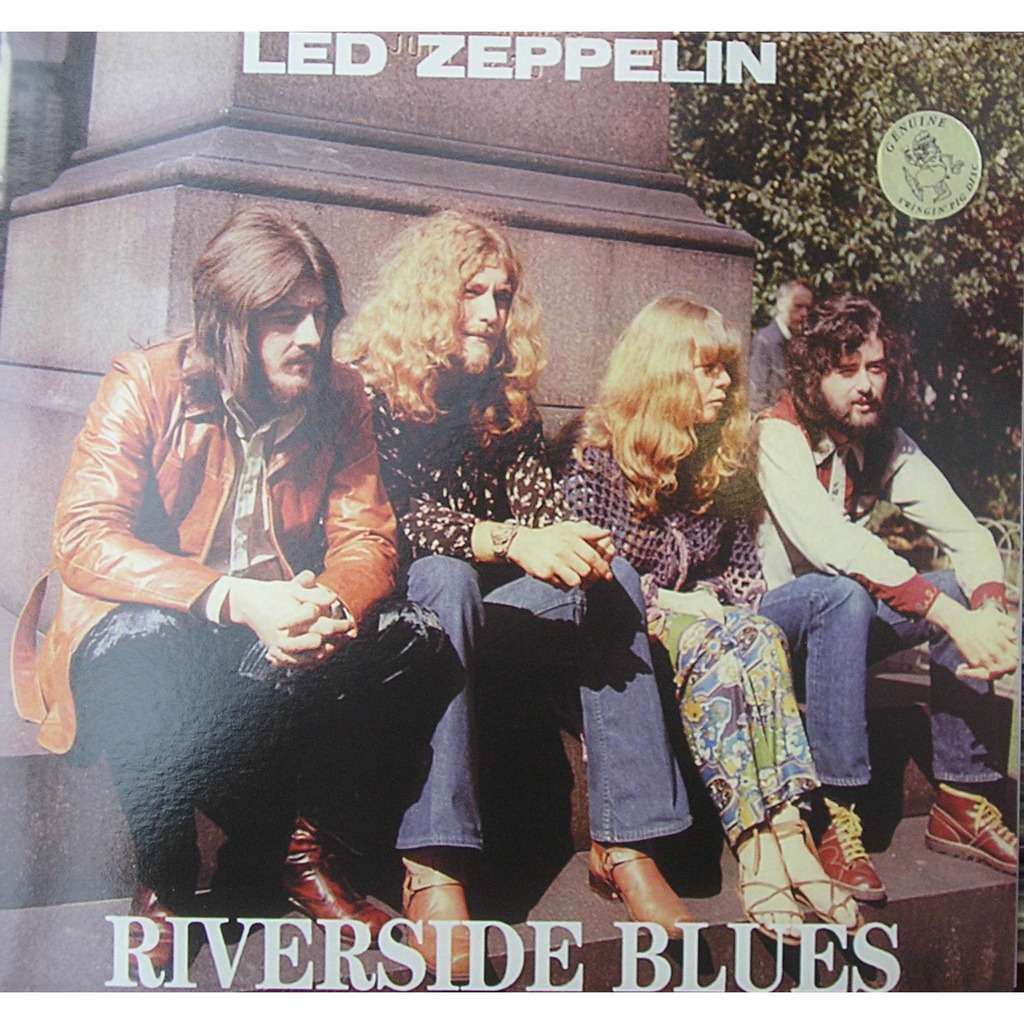
This was on their last album Coda after John Bonham died in 1980. Coda was released in 1982 and peaked at #6 in the Billboard Album Charts in 1983.
Led Zeppelin first played this for a BBC session in 1969, but the song was never released on an album. It was placed on the Box Set in 1990, and it was also made a bonus track on the Coda album for the Complete Studio Recordings.
This was written and originally recorded by blues great Robert Johnson. Led Zeppelin borrowed heavily from American blues music…some would say “borrowed” is too kind of word… but they did introduce some of that music to new fans.
From Songfacts
Jimmy Page used a 12-string acoustic guitar to play this song.
In the third verse, it sounds like Robert Plant mistakenly sings “My baby geen bone” instead of ‘My baby been gone.”
The lyric, “I’ve had no lovin’ since my baby been gone” came from B.B. King’s “Woke Up This Morning (My Baby Was Gone).”
To get the fast bass beats, John Bonham used “triplets” on the bass drum – he would use the tip of his toe.
Traveling Riverside Blues
Asked sweet mama, Let me be her kid She said, “You might get hurt if you don’t keep it hid”
Well I know my baby, If I see her in the dark I said I know my rider, If I see her in the dark
Now, I goin’ to Rosedale, Take my rider by my side Still barrelhouse, If it’s on the riverside, yeah I know my baby, Lord, I said, “is really sloppy drunk” I know my mama, Lord, a brownskin, but she ain’t no plum
See my baby, tell her, Tell her hurry home Had no lovin’, since my baby been gone See my baby, Tell hurry on home I ain’t had, Lord, my right mind, Since my rider’s been gone
Hey, she promises, She’s my rider I wanna tell you, She’s my rider I know you’re mine, She’s my rider She ain’t but sixteen, But she’s my rider
I’m goin’ to Rosedale, Take my rider by side Anybody argue with me man, I’ll keep them satisfied Well, see my baby, tell her, Tell her the shape I’m in Ain’t had no lovin’, Lord, since you know when
Spoken: Why don’t you come into my kitchen
She’s a kindhearted lady. She studies evil all the time She’s a kindhearted woman. She studies evil all the time
Squeeze my lemon ’til the juice runs down my leg Squeeze it so hard, I’ll fall right out of bed Squeeze my lemon, ’til the juice runs down my leg
Spoken: I wonder if you know what I’m talkin’ about
Oh, but the way that you squeeze it girl I swear I’m gonna fall right out of bed
She’s a good rider She’s my kindhearted lady I’m gonna take my rider by my side I said her front teeth are lined with gold She’s gotta mortgage on my body, got a lien on my soul She’s my brownskin sugar plum…
This song was probably the first song that made me aware of The Velvet Underground. This song was on the album Loaded. Lou Reed wrote this song and the album was an attempt to write more of a commercial album.
This was Reed’s attempt at writing a hit for the Velvet Underground, who were highly influential, but commercially doomed. Loaded was the band’s last album, and the title was a reference to the record company mandate that the album be “Loaded with hits.”
The album was released on November 15, 1970. Loaded was ranked 110 on Rolling Stone‘s list of the 500 greatest albums of all time.
From Songfacts
The Velvet Underground leader Lou Reed wrote this song as a surreal look at the life of a rock star. Reed included the song in his live sets; it appeared on his album Live at Max’s Kansas City in 1972 and on another live album, Rock n Roll Animal, in 1974. The version on Rock n Roll Animal, which was recorded at a New York show on December 21, 1973, features the twin-guitar work of Steven Hunter and Dick Wagner, who Reed employed to rock out his songs on tour.
Released as a single, this live version of the song heralded a new sound for Reed, one he quickly abandoned when he fired Hunter and Wagner at the end of the tour and disavowed the album. Reed released his intentionally awful Metal Machine Music album the following year, while his bygone guitarists joined Alice Cooper on tour, with Wagner becoming Cooper’s songwriting partner. In our interview with Dick Wagner, he explained: “He claims that he didn’t like the Rock n’ Roll Animal album, but at the time he sure loved it. A lot of the songs were from the Velvet Underground days, and I wanted to take them out of that placid performance of the songs and make it more for the concert stage and the stadiums, so I did some majestic arranging with some of the songs – that’s what I do. Within the context of the band and how to deliver the songs, it really worked. I guess Lou doesn’t really like it that much, but that’s kind of a lie.”
There was a great deal of acrimony during recording of the album, and Reed left before it was finished. In his absence, “Sweet Jane” was edited down, with a wistful coda removed from the song. This angered Reed, who told Rolling Stone magazine that if he knew they were going to press on with the album, “I would have stayed with them and showed them what to do.” The full version of the song can be heard on the album Live at Max’s Kansas City, recorded in 1969.
This song appears on the album 1969: The Velvet Underground Live, which was released in 1974. This is the double album with the famous gatefold revealing a leggy model in sparkling go-go boots and hot pants showing some can, on a vibrant green background; very sought-after by today’s VU collectors. There, “Sweet Jane” has a significantly different chord progression and lyrics; it was still a work-in-progress. Captured on the bootleg recording of Lou Reed’s last night performing live with The Velvet Underground, which happened through the tail end of the Loaded sessions, is one Jim Carroll. As told in The Velvet Underground: An Illustrated History of a Walk on the Wild Side, Carroll can be heard ordering a Pernod and discussing the drug Tuinal. Carroll would later write The Basketball Diaries.
Reed did a parody version on his 1979 album Live – Take No Prisoners.
The original lyrics were, “Jane in her corset, Jack is in his vest, and me I’m in a rock n’ roll band.” Lou changed them to “Jack is in a corset, Jane is in a vest” to portray the wackiness of rock stars.
Mott the Hoople covered this on their All the Young Dudes album, which was also produced by David Bowie – Reed fully endorsed this cover and even did a reference vocal to help them out. Another version Reed liked was the one recorded by Brownsville Station on their 1973 album Yeah!.
Other notable covers of this song include versions by Cowboy Junkies, 2 Nice Girls, Phish, The Kooks, Gang of Four, and the Red Hot Chili Peppers. Reed himself appeared with Metallica (Metallica!) on October 25, 2009 at Madison Square Garden in New York City to perform “Sweet Jane” at the concert to celebrate the 25th Anniversary of the Rock and Roll Hall of Fame.
Q Magazine rated “Sweet Jane” at #18 on its list of 100 Greatest Guitar Tracks, and Guitar World rated it at #81 on its list of the 100 Greatest Guitar Solos, while Rolling Stone ranked it #335 on their list of the 500 Greatest Songs of All Time.
Sweet Jane
Standin’ on a corner Suitcase in my hand Jack’s in his car, says to Jane, who’s in her vest, And me, I’m in a rock n’ roll band. Ridin’ in a Stutz Bearcat, Jim You know,those were different times All the poets studied rows of verse, And those the ladies rolled their eyes
Sweet Jane, sweet Jane, sweet Jane
Now, Jack, he is a banker And Jane, she is a clerk And the both of them are saving up their moneys And when they come home from work Sittin’ by the fire The radio does play The classical music there, Jim The march of the wooden soldiers All you protest kids You can hear Jack say, get ready, ah
Sweet Jane, come on baby,sweet Jane, oh-oh-a,sweet Jane
Some people, they like to go out dancing And other peoples, they have to work. Just watch me now And there’s even some evil mothers Well they’re gonna tell you that everything is just dirt Y’know that, women, never really faint And that villains always blink their eyes, woo And that, y’know, children are the only ones who blush And that, life is, just to die And, everyone who ever had a heart, oh That wouldn’t turn around and break it And anyone who ever played a part, whoa And wouldn’t turn around and hate it
Sweet Jane! Whoa-oh-oh! Sweet Jane! Sweet Jane Sweet Jane
Heavenly wine and roses Seem to whisper to her when he smiles Heavenly wine and roses Seem to whisper to her, hey when she smiles
Lala, lala,lala, lala, lala, lala, lala,lala
Sweet Jane Sweet Jane Sweet Jane Sweet Jane Sweet Jane
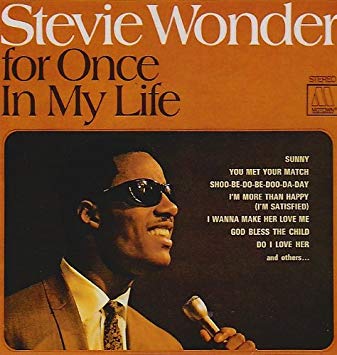
Great song by Stevie Wonder. It peaked at #2 in the Billboard 100 in 1968.
This was written by the Motown songwriters Ron Miller and Orlando Murden and was originally recorded in 1966 by a singer named Jean DuShon, who was signed to Chess records.
Other versions of this song to this point were long, drawn-out ballads. Stevie Wonder was the first to pick up the tempo and use an upbeat arrangement. Wonder’s version, however, sat in the Motown vaults for nearly a year before Gordy finally released it in 1968. This became the hit record and definitive version of the song.
From Songfacts
Miller had DuShon record the song as a demo but liked her version so much that he thought she should sing it. Record company politics ensued as Berry Gordy, the head of Motown, was not pleased with one of his songwriters’ compositions going to other labels. He made sure to have his artists record the song, and the first to do so was Barbara McNair, who performed it later in 1966 on a TV special and released it on her album Here I Am that year. The next Motown act to record it was The Temptations, who released it in 1967 on their album In a Mellow Mood.
The song is about finding that special someone who gives you a feeling of boundless happiness. Wonder was just 17 when he first recorded it.
Ron Miller wrote a few more Motown favorites, including “Heaven Help Us All,” “Yester-Me, Yester-You,” “Yesterday” and “A Place In The Sun” for Stevie Wonder, and “Touch Me In The Morning” for Diana Ross. He also reworked “I’ve Never Been To Me” into a hit for Charlene.
The Temptations version featured lead vocals by Paul Williams. It became the showcase song for Williams at their live shows.
Frank Sinatra and Tony Bennett both recorded this song, with Bennett’s version hitting the Hot 100 at #91 – one year before Stevie Wonder charted with it. Bennett often sang it in concert, and in 2006 he performed a slow version with Stevie Wonder for his album Duets: An American Classic. This version won a Grammy for Best Pop Collaboration with Vocals. At the awards ceremony, Wonder dedicated the Grammy to his mother, who died in 2006. Bennett then thanked his sponsor – Target department stores.
British singer-songwriter Emeli Sande recorded this for the Hulu miniseries Four Weddings and a Funeral. Other versions have also been used in these TV shows:
Happy Endings (“Brothas and Sisters” – 2013) Glee (“Wonder-ful” – 2013) by Kevin McHale Fringe (“Brown Betty” – 2010; “6B” – 2011) The West Wing (“Welcome To Wherever You Are” – 2006) The King Of Queens (“Sold-Y Locks” – 2006) Boston Legal (“Breast In Show” – 2006) Entourage (“Exodus” – 2005)
The Nanny (“The Wedding” – 2008)
Good Times (“That’s Entertainment, Evans Style” – 1978)
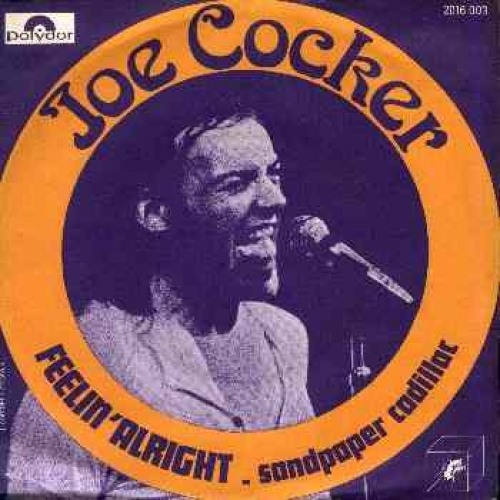
Dave Mason wrote this song and recorded it with Traffic in 1968. Included on their self-titled second album, it was released as a single but it didn’t hit the charts in America and didn’t place at all in the UK.
The following year, Joe Cocker recorded what has become the most popular version of the song, peaking at #33 in Billboard 100 in 1972 with a more upbeat rendition. He included it in his set at Woodstock.
Joe Cocker did great covers of songs. Many of Cocker’s hits were covers, including “With A Little Help From My Friends,” “The Letter,” and “You Are So Beautiful.” He made a career out of soulful interpretations of other people’s songs. When Paul McCartney wrote “She Came In Through the Bathroom Window” he gave it to Joe Cocker to record.
From Songfacts
This is one of those songs where the title belies the meaning. The singer is tormented by a breakup and asking “Are you feeling alright,” with the retort, “I’m not feelin’ too good myself.”
In our interview with Dave Mason, he explained: “It’s just a song about a girl. It’s just another relationship gone bad.”
Dave Mason wrote this song with the title “Not Feelin’ Too Good Myself,” which is more accurate in terms of the song’s meaning, but less marketable. The original Traffic version of the song, filled with the corresponding melancholy, was issued as “Feelin’ Alright?” – the question mark providing a vital clue to the content. Joe Cocker’s version scrapped the punctuation and was issued as “Feeling Alright,” which is how it was listed on most subsequent covers.
This song was written while Dave Mason was visiting the Greek island of Hydra. “I was trying to write the simplest thing I could come up with,” he told us. “Two chords was it.”
Mason had left the band when he wrote the song (he split before their first album was released), but when he returned to New York after his time in Hydra, he ran into his bandmates, who were working on the group’s second album. They reached an accord, and Mason came back into the fold, contributing this song and “You Can All Join In,” as well as “Vagabond Virgin,” which he wrote with the band’s drummer Jim Capaldi.
Soon after the album was released in October 1968, Mason once again left the band, and a month later they broke up, with Winwood forming Blind Faith. In 1969, a third Traffic album called Last Exit was cobbled together from live recordings and unused studio tracks.
Traffic lead singer Steve Winwood played on Joe Cocker’s With A Little Help From My Friends album, but not on his cover of this song, which was on the tracklist. Cocker’s version featured the ace Los Angeles bass player Carol Kaye, Paul Humphrey on drums, Artie Butler on piano, and percussion from David Cohen and Laudir de Oliveira.
A distinguishing feature of Cocker’s cover is the female backing vocals, which were comprised of three of the most powerful Soul singers of the era: Brenda Holloway, Merry Clayton and Patrice Holloway. Clayton can also be heard on the Rolling Stones’ “Gimme Shelter.”
At least 45 different acts have recorded this song. Mongo Santamaria took it to #96 US in 1969, and Grand Funk Railroad made #54 with their 1971 version. Other artists to record it include Three Dog Night, Lou Rawls, the 5th Dimension, Rare Earth, Gladys Knight & the Pips, Paul Weller, the Jackson 5, Maceo Parker and Isaac Hayes.
In 1976, Cocker performed this on Saturday Night Live. John Belushi joined him on stage doing his famous impersonation of Cocker’s spastic stage movements. Cocker didn’t know Belushi was going to come on stage, but wondered what was going on when John asked him before the show what he would be wearing during the performance.
The song found a good home on the various FM rock formats of the early ’70s, and Joe Cocker’s version later became a classic rock staple. In 1972, after Grand Funk Railroad charted with the song, Cocker’s was re-released, this time making #33 US.
Billy Gibbons and Dusty Hill of ZZ Top, Keith Richards, Kid Rock, Tom Petty, Jackson Browne, Jeff Lynne, Steve Winwood, and music director Paul Shaffer performed this at the 2004 Rock and Roll Hall of Fame induction ceremony.
The Jackson 5 performed part of this song on a 1971 TV special hosted by Diana Ross. Nine years later, Michael Jackson sang on Dave Mason’s track “Save Me.”
Feelin’ Alright
Seems I got to have a change of scene ‘Cause every night I have the strangest dreams Imprisoned by the way it could have been Left here on my own or so it seems I got to leave before I start to scream But someone’s locked the door and took the key
You feelin’ alright? I’m not feelin’ too good myself Well, you feelin’ alright? I’m not feelin’ too good myself
Boy you sure took me for one big ride Even now I sit and wonder why And when I think of you I start myself to cry out I just can’t waste my time, I must keep dry Gotta stop believin’ in all your lies ‘Cause there’s too much to do before I die, hey
You feelin’ alright? I’m not feelin’ too good myself You feelin’ alright? I’m not feelin’ too good
Don’t get too lost in all I say Though at the time I really felt that way But that was then, and now you know it’s today I can’t get off, I guess I’m here to stay ‘Til someone comes along and takes my place, yeah With a different name, oh, and a different face
You feelin’ alright? I’m not feelin’ too good myself Yeah, not feeling too good myself Oh, woah, I’m not, well I’m not feeling good myself You can turn away, feeling, almighty I’m not feeling too good myself









 PowerPop... An Eclectic Collection of Pop Culture