Albatross is an instrumental from Fleetwood Mac…the 60’s version of the band with the great guitar player Peter Green. I first heard about the song in a book. The Beatles were recording Abbey Road and they played this song constantly through the sessions. You can hear the reverb effect used on Sun King by Lennon that resembles Albatross.
When this song was released, Fleetwood Mac was six years away from their pop conversion of the Stevie Nicks/Lindsey Buckingham era. The lineup on this track was Peter Green (vocals, guitar), John McVie (bass), Danny Kirwan (guitar), and Mick Fleetwood (drums). The song was released on November 22, 1968, with ‘Jigsaw Puzzle Blues’ (written by the band’s James Kirwan) on the B-side.
It remains one of the band’s most recognizable songs from their early blues- period. The song peaked at #1 on the UK Charts, #45 in Canada, and #4 on the Billboard Bubbling Under the Hot 100 Charts (per Wiki) in 1969. Peter Green wrote this song. Albatross was re-released in 1973 peaking at #2 on the UK Charts. In 1989, it was released again and peaked at #96 on the UK Charts…and in 2020-2023 it was released yet again and peaked at #8 on the UK Singles Charts. The song keeps on giving.
Funny enough…this song remains their only #1 UK song! That surprises me with the later commercial success they had. Few bands could evolve like they did. Genesis is one and David Bowie is another one that pulled off different sounds but remained popular.
The title came from a bird called The Albatross, which sailors regarded as a sign of bad luck. That is where the saying “like an Albatross around your neck” came from. Green was also influenced by the Santo and Johnny song Sleep Walk…which you can hear that sound in this. Green also said some of it came from notes that Clapton would play with the John Mayall Bluesbreakers on the song The Last Meal but just slowed down. Peter Green would replace Eric in that band.
Peter Green remains one of my favorite guitar players. My admiration for him has grown through the years. Sleep Walk from Santo and Johnny remains one of my favorite instrumentals and I can hear it in this clearly…makes me like it more.
Danny Kirwan: Well, that was Monsieur Peter Green – I called him Monsieur, you know – and I played with him. On “Albatross” he told me what to do, all the bits I had to play.
George Harrison: “So we said, ‘Let’s be Fleetwood Mac doing Albatross, just to get going.’ It never really sounded like Fleetwood Mac… but that was the point of origin.”
I’ve heard of this band for so long but never listened to many of their songs. This one is right up my alley…raw, garage-sounding, and slightly punk. They formed in London in 1963. They were known for their raw sound and rebellious image, they are often cited as one of the most influential bands of the 1960s and 1970s. They didn’t have a lot of hits but their sound was copied.
This song was released in 1964, and The Pretty Things was probably the scruffiest band around in 1964… and that includes the Stones.
The song peaked at #10 in the UK and #34 in Canada in 1964. The song was a stand-alone single. They would release their self-titled debut album in 1965. The song was written by Johnny Dee, the manager of a British band at the time called The Fairies.
The Pretty Things continued to evolve after “Don’t Bring Me Down” exploring different musical styles including psychedelia and hard rock. Despite numerous lineup changes and challenges, they remained active for decades, maintaining a cult following.
In 1968 they released the album S.F. Sorrow, one of the first rock operas, predating The Who’s Tommy. It is a concept album that tells the story of a character named Sebastian F. Sorrow from birth to death. Though not a commercial success at the time, it has since been recognized as a groundbreaking work and a classic of that genre.
Don’t Bring Me Down
I’m on my own, nowhere to roam I tell you baby, don’t want no home I wander round, feet off the ground I even go from town to town I said I think this rock is grand Say I’ll be your man Don’t bring me down, don’t bring me down
I met this chick, the other day And then to me, she said she’ll stay I get this pad, just like a cave And then we’ll have, our living made And then I’ll lead her on the ground My head is spinning round Don’t bring me down, don’t bring me down
I, I, I, I, I need a lover ’cause someone new And then to her I will be true I’ll buy her furs and pretty things I’ll even buy a wedding ring But until then I’ll settle down? Say I’ll be your man Don’t bring me down, don’t bring me down
Until then I’ll settle down? Say I’ll be your man Don’t bring me down, don’t bring me down Don’t bring me down
I hope everyone is having a great weekend. I’ve told people that I love blogging on the weekends because I use this time to explore more than I do during the week. I’ve posted about The Blasters before and this time it’s the brothers…Dave and Phil Alvin. I like stories about making deals with the Devil and this song falls right into that. It’s been explored in movies and books…this theme is always interesting.
I think the Devil is playing guitar on this one…because it is wicked sounding. No, that is Dave Alvin and his playing and tone are perfect. You cannot get a better tone than what he has on this. When I first heard it… that guitar stood out so much.
Dave and Phil Alvin are the brothers who founded The Blasters. This 2015 album was the duo’s second album called, Lost Time. When Dave left The Blasters in 1986 it created a riff but in 2012…a near-death experience for Phil..reunited the brothers to record a new album of Big Bill Broonzy songs called Common Ground.
The song was written by Oscar Brown Jr. an American singer, songwriter, playwright, poet, and civil rights activist. This song came from Brown’s musical called KICKS & CO. in 1961. They opened it up in Chicago but it closed early. It made it to Broadway 35 years later.
It’s a well-written song thanks to Brown and it works today.
Mr. Kicks
Permit me to introduce myself, the name is Mr. Kicks I dwell in a dark dominion way down by the river Styx The devil has sent me here because I’m full of wicked tricks And I’m such a popular fellow among all you lunatics I teach a course in ruination from the Devil’s text For fools who can’t withstand temptation, Step right up you’re next I hail from a hollow hell hole down around the river Styx Allow me to introduce myself the name is Mister Kicks When a old wolf starts a prowlin’ Out among the young lambs howling Don’t you know he’s looking for kicks? When a young cat full of sly tricks Spends his evenings chasing fly chicks Ten to one he’s looking for kicks Kicks is always in demand Cause kicks is full of fun and laughter Lots of folks get out of hand Because it’s only kicks they’re after Shady lady and her lover operating undercover She knows sin and virtue don’t mix Her momma raised her prim and proper But now wild horses couldn’t stop her When she’s on a manhunt for kicks Oh kicks, looking for kicks Just kicks, nothing but kicks I’m satan’s simple servant sent to get in a fix So look me up just anytime The name is mr., name is mr., Name is Mister Kicks
I’ve heard a lot about this band but never listened to them much. Yesterday I did and they were stacked with great musicians. They have a big blues punch and melodic songs.
I just started to listen to many of their songs and this one caught my attention because of the tight bass intro. That is when I noticed a little of Santana’s sound in there as well. This song is a brief 2:20. If you get a chance on Spotify or Youtube…check them out. So far I’ve been going through their first 4 albums.
They are a British blues rock band formed in 1965 by guitarist Kim Simmonds. They are one of the pioneering bands of the British blues rock scene and bands like The Rolling Stones and John Mayall’s Bluesbreakers.
Over the years, the band’s lineup has changed numerous times, with Simmonds being the only constant member. Savoy Brown has released over 30 albums, with their early work being highly influential in the blues-rock genre.
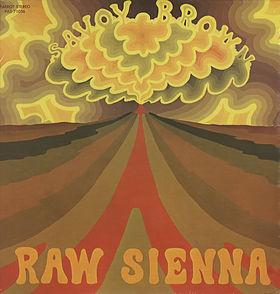
They have Kim Simmonds’ expressive guitar work and the band’s tight rhythm section. The song was on the album Raw Sienna released in 1970. The album peaked at #75 in Canada and #121 on the Billboard Album Chart. It was written by the then lead singer Chris Youlden who would be with Savoy Brown from 1967 to 1970.
A Hard Way To Go
Ain’t got time for doubts or fears Ain’t got time for shallow tears Ain’t got time to bare my soul Because I still got a hard way to go
Said that you got a losing hand Ain’t no point in you raising sand Ain’t got time to bare your soul Because I still got a hard way to go
And it’s a crying shame That you can’t lay the blame On anybody else but yourself
Wish that you had my sympathy You ain’t got no hold on me And my heart is getting cold And I still got a hard way to go
And it’s a crying shame That you can’t lay the blame On anybody else but yourself
Last week I had a UK-flavored week…this week I’m going to have a southern feel.
Right before recording the Allman’s Brothers and Sisters album…Gregg brought a song in for the Brothers and they rejected it because it didn’t fit as well with them. Gregg wanted to expand and use the folk and the California vibe that he had. He thought…I’ll just make my own album. The Allman Brothers fully supported him in this.
In the sixties, Gregg and Duane were in the band Hourglass… Gregg roomed with Jackson Browne for a while. Gregg has stated that he picked up a lot from Browne on songwriting. They kept that relationship for the rest of their lives. Gregg did this song that was written by Browne. He slowed it down and added some more soul to it and Jackson ended up changing the way he did it to match this live. The song was the B side to the biggest hit on the album, Midnight Rider. Allman would continue to play this throughout his career.
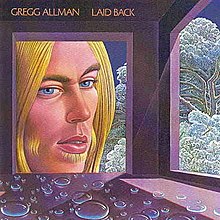
This song was on Gregg’s first solo album Laid Back released in 1973. He recorded this album while recording the great Brothers and Sisters album with the Brothers. He was also battling addiction brought on by the loss of his brother Duane and the passing of bassist Berry Oakley.
The song has a history dating back to the 1960s. Nico of the Velvet Underground recorded it first in 1967. The Nitty Gritty Dirt Band did it in 1968. According to Secondhandsongs the song has been covered 75 times!
Allman went on tour with Laid Back which included a string orchestra. The tour was a huge success and helped to chart the album at #13 on the Billboard Album Charts and #19 on the Canadian Charts.
Allman’s recording somewhat overshadowed Browne’s version and many have called Allman’s version the definitive version. Jackson Browne even alluded to that as well. Greg Allman and Jackson Browne covered it in 2014. Just my two cents…it’s hard to beat Allman’s voice and his soulful feel.
Jackson Browne: Gregg Allman was one of the most gifted singers of the last fifty years. We became friends in LA in the late sixties when he and Duane were in The Hourglass. He was a blues singer first, and he was so natural, and so soulful, that when he sang songs that were written in a major scale, he found all the most soulful and expressive passages through those changes. It was just how he heard it. That’s how it was with my song, These Days. He slowed it down, and felt it deeply, and he made that song twice as good as it was before he sang it. I got to speak with him in the week before he passed, and I got to tell him how much his music and his friendship has meant to me. He recently recorded one of my early songs, Song For Adam, and he and Don Was sent it to me to sing on, and I did. That song, the way he sang it and where he sang it from – at the end of his life – well, he completed that song, and gave it a resonance and a gravity that could only have been put there by him.
Jackson Browne Version
Allman and Browne…I kept the quick bio and interview with Don Was in at the beginning.
These Days
Well I’ve been out walking I don’t do that much talking these days These days- These days I seem to think a lot About the things that I forgot to do And all the times I had the chance to I’ve stopped my rambling I don’t do too much gambling these days, These days- These days I seem to think about How all the changes came about my ways And I wonder if I’d see another highway I had a lover I don’t think I’ll risk another These days, these days And if I seem to be afraid To live the life that I have made in song It’s just that I’ve been losing so long I’ve stopped my dreaming I won’t do too much scheming These days, these days These days I sit on corner stones And count the time in quarter tones to ten Please don’t confront me with my failures I had not forgotten them
Underneath a pork pie hat Until hell freezes over Maybe you can wait that long But I don’t think Ronnie Milsap’s gonna ever Record this song
I somehow missed this Hiatt song. I absolutely love the guitar on this track. Come to find out there is a reason I like it. Ry Cooder is on guitar, Nick Lowe on bass, Jim Keltner on drums, and Paul Carrack on keyboards and backing vocals. Later on, B.B. King and Eric Clapton covered this song.
Hiatt had only four days to make an album and this song kicked off his 1987 album Bring The Family. The song has a cool groove and shuffle to it. Hiatt was in Nashville at the time when he took a trip with his family to Memphis which of course inspired this song.
He mentions Ronnie Milsap in this song. At the time Nashville was known to make slick country songs. They would produce the soul out of a song. Milsap was listening though. On his next album, he recorded a John Hiatt song called Old Habits Are Hard To Break and yes… he inserted some Memphis funk in the song. Probably more than Hiatt could have thought at the time. Another thing that was happening at this time was Dwight Yoakam and Steve Earle were shaking Nashville out of its rut.
Hiatt found himself drawn to the city’s renowned musical history and culture. I’m not sure how it was in the 1980s as much but now on Beale Street, there is always something interesting going on.
John Hiatt: “It sounds like a car with four bald tires, it’s like a four-man groove sputtering down the road, and I really like the record for that.”
John Hiatt: “It’s a day trip, only three hours, and it’s a terrific city, I’d been there before and there is truly something in the air, although there’s nothing going on musically speaking, they say. It’s just a great town and one of the only truly integrated cities in America, it seemed to me, where black people and white people actually live together in the neighborhoods and not only that, seem to get along I was real impressed by that.”
John Hiatt and The Goners…featuring Sonny Landreth…I really like this live cut. They add another dimension to the song.
Memphis in the Meantime
I got some’n’ to say little girl You might not like my style But we been hangin’ around this town Just a little too long a while You say you’re gonna get your act together Gonna take it out on the road But if I don’t get out o’ here pretty soon My head’s going to explode Sure I like country music And I like mandolins But right now I need a Telecaster Through a Vibrolux turned up to 10
Let’s go to Memphis in the meantime baby Ahw, Memphis in the meantime girl Let’s go to Memphis in the meantime baby Memphis in the meantime girl
I need a little shot of that rhythm baby Mixed up with these country blues I wanna trade in these ol’ cowboy boots For some fine Italian shoes Forget the mousse and the hairspray sugar We don’t need none of that Just a little dab’ll do ya girl Underneath a pork pie hat Until hell freezes over Maybe you can wait that long But I don’t think Ronnie Milsap’s gonna ever Record this song
Lets go to Memphis in the meantime baby Let’s go to Memphis in the meantime girl Lets go to Memphis in the meantime baby Let’s go to Memphis in the meantime girl
Maybe there’s nothin’ happenin’ there But maybe there’s somethin’ in the air Before our upper lips get stiff Maybe we need us a big ol’ whiff
If we could just get off-a that beat little girl Maybe we could find the groove At least we can get ourselves a decent meal Down at the Rendezvous ‘Cause one more heartfelt steel guitar chord Girl, it’s gonna do me in I need to hear some trumpet and saxophone You know sound as sweet as sin And after we get good and greasy Baby we can come on home Put the cow horns back on the Cadillac And change the message on the Cordaphone But
Lets go to Memphis in the meantime baby Let’s go to Memphis in the meantime girl Lets go to Memphis in the meantime baby Let’s go to Memphis in the meantime girl
I’m a talking about Memphis I’m talkin’ ’bout Memphis Memphis
Last week I ran across the one-off “supergroup” The Buzzin’ Cousins that John Mellencamp formed with Joe Ely, Dwight Yoakam, John Prine, and James McMurtry. I thought I would look around for any more that I don’t know about.
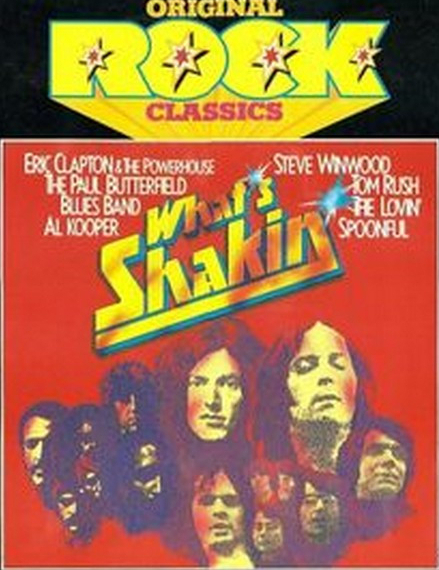
Many of you probably know this band but I had no clue about it. It’s been called different things like Eric Clapton’s Powerhouse. This band featured Eric Clapton, Jack Bruce, Steve Winwood, Paul Jones (Manfred Man) Pete York (Spencer Davis Group drummer), and Ben Palmer (piano, previously played with Clapton and Jones as a member of the Roosters and the Grands) and they recorded this in 1966.
This was meant to be and was a short-term one-off band that included some heavy players back in the day and huge historically. They recorded three songs that appeared on the Elektra Records compilation What’s Shakin’ in 1966. A fourth song, “Slow Blues”, was recorded but remains unreleased to this day.
It’s been said that I Want To Know was written by Paul Jones but he used his wife’s name in the credit…Sheila McLeod. I would guess for contract reasons. Also due to contractual restrictions, Stevie Winwood is listed as Steve Angulo. The songs are I Want To Know (Shelia McLeod), Steppin Out (Memphis Slim), and Crossroad (Robert Johnson) which Cream would later cover.
Later on these songs were released on collections by Eric Clapton, Jack Bruce, and Steve Winwood. This was around the time that Jack Bruce was in Manfred Man.
I’m going to include their released discography here…all three songs.
I Want To Know
I want to know why do you always run around
I want to know why do you always run around
Every man I know is watching you pull me down
I want to know, do you really mean to hurt me
I want to know, do you really mean to hurt me
Well, I’m tryin’ to understand the dirty way you always treat me
I want to know if I can come home every night
I want to know if I can come home every night
Well, oh woman, oh woman, why can’t you try to treat me right
I wanna know, I wanna know
Hey hey I want want, I wanna know, oo oh
All right, what do you say
Well woman, oh woman, why can’t you try to treat me right
The harmonica intro to this song is dirty as hell. You can hear the slide cutting in like a knife while the rhythm is chugging along. The song was written by Sleepy John Estes, son of a Tennessee sharecropper and blind in one eye, in 1930. He wrote it as Milk Cow Blues. It was recorded in Memphis with piano, mandolin, and Este’s guitar.
Leaving Trunk was on Taj Mahal’s self-titled debut album released in 1968. Like Ry Cooder two years after…he had a great band backing him up. On slide guitar and harmonica is Taj Mahal. The great Jesse Ed Davis is on slide guitar also on this album as well as Ry Cooder on rhythm guitar.
He covered songs written by Estes, Robert Johnson, himself, Sonny Boy Williamson II, and Blind Willie McTell. Leaving Trunk is a song that has been covered by many artists over the years, and it continues to be a favorite among blues fans. Secondhandsongs.com says it has 39 different versions to date. Everyone from Bob Willis to The Black Keys has covered this song. This album played a big part in influencing Duane Allman with Statesboro Blues.
I’ve listened to this album in the past few days I’ve been off of work. I’ve been rotating this one and the debut album of Ry Cooder. The slide guitar work on this album is blistering. I can’t state the importance of this album enough. I can see why Duane Allman was so inspired by it. I won’t go through the complete story but Duane was sick with a cold and his brother Gregg gave him a bottle of Coricidin and this album for Duane’s birthday. Below Gregg Allman tells it.
Gregg Allman: And then I looked on the table and all these little red pills, the Coricidin pills, were on the table. He had washed the label off that pill bottle, poured all the pills out. He put on that Taj Mahal record, with Jesse Ed Davis playing slide on “Statesboro Blues,” and starting playing along with it. When I’d left those pills by his door, he hadn’t known how to play slide. From the moment that Duane put that Coricidin bottle on his ring finger, he was just a natural.
Looking back on it, I think that learning to play slide was a changing moment in his life, because it was like he was back in his childhood—or maybe not his childhood, because it never seemed to me like Duane was a child, so it was more like going back to his first days of playing the guitar. He took to the slide instantly and mastered it very quickly. He practiced for hours and hours at a time, playing that thing with a passion—just like he did when he first learned to play the guitar.
Leaving Trunk
I went upstairs to pack my leavin’ trunk
I ain’t see no blues, whiskey made me sloppy drunk
I ain’t never seen no whiskey, the blues made me sloppy drunk
I’m going back to Memphis babe, where I’ll have much better luck
Look out mama you know you asked me to be your king
She said, “You kiddin’ man, if you want it, keep it hid
But please don’t let my husband, my main man catch you here
Please don’t let my main man, my husband catch you here”
The blues are mushed up into three different ways
One said, “Go the other”, two said, “Stay”
I woke up this mornin’ with the blues three different ways
You know one say, “Go baby, I want to hang up”
The other two said, “Stay”
Wake up mama, I got something to tell you
You know I’m a man who loves to sing the blues
Now you got to wake up baby, mama now
I got something, I got something to tell you
Well, you know I’m the man, I’m the man
Oh yes, and I love to sing the blues
Come on Davis
Come on, come on
I went upstairs to pack my leavin’ trunk, you know
I ain’t see no blues or whiskey made me sloppy drunk
I never seen no whiskey, the blues made me sloppy drunk
I go home baby and I lay down on the lawn
It’s nice to be back to normal… no holiday is mentioned in this song!
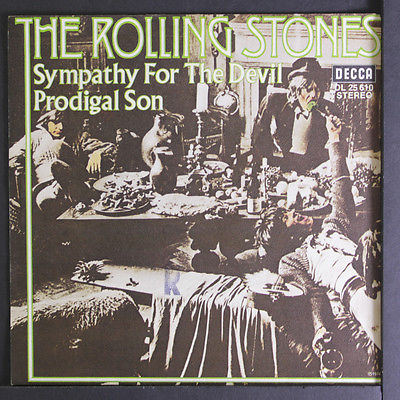
When I bought Beggars Banquet I knew about Sympathy for the Devil and Street Fighting Man… this song drew me into the rest of the album. I love the acoustic blues played by Keith. It sounds old…really old. This album doesn’t have a bad track on it to me.
This sounds like what influenced the Stones in the first place. This album is one of the Stones’ great ones and the first one produced by Jimmy Miller. Prodigal Son has remained one of my favorite Stones tracks.
Beggars Banquet peaked at #5 in the Billboard Album Charts, #3 in the UK, and #3 in Canada in 1969.
This song was written by Robert Wilkins, a reverend who recorded Delta Blues in the 1920s and 1930s. Keith Richards enjoyed Blues music and admired the work of Wilkins in the ’60s, which is how The Stones came across this song. Robert Wilkins’ original version was titled “That’s No Way To Get Along.” The Stones gave their version the title “Prodigal Son.”
The Prodigal Son is a story told in the Bible (Luke 15: 11-32) about a father who has two sons. The younger son asks for his inheritance early and goes off to spend the money on hedonistic pursuits. After wasting all the money, he comes home repentant, and the father welcomes him with a feast in his honor. This doesn’t go over well with the older son, who feels that he should be rewarded for good behavior, but the father stresses the value of forgiveness.
Prodigal Son
Well a poor boy took his father’s bread and started down the road Started down the road Took all he had and started down the road Going out in this world, where God only knows And that’ll be the way to get along
Well poor boy spent all he had, famine come in the land Famine come in the land Spent all he had and famine come in the land Said, “I believe I’ll go and hire me to some man” And that’ll be the way I’ll get along
Well, man said, “I’ll give you a job for to feed my swine For to feed my swine I’ll give you a job for to feed my swine” Boy stood there and hung his head and cried Cause that is no way to get along
Said, “I believe I’ll ride, believe I’ll go back home Believe I’ll go back home Believe I’ll ride, believe I’ll go back home Or down the road as far as I can go” And that’ll be the way to get along
Well, father said, “See my son coming home to me Coming home to me” Father ran and fell down on his knees Said, “Sing and praise, Lord have mercy on me” Mercy
Oh poor boy stood there, hung his head and cried Hung his head and cried Poor boy stood and hung his head and cried Said, “Father will you look on me as a child?” Yeah
Well father said, “Eldest son, kill the fatted calf, Call the family round Kill that calf and call the family round My son was lost but now he is found Cause that’s the way for us to get along” Hey
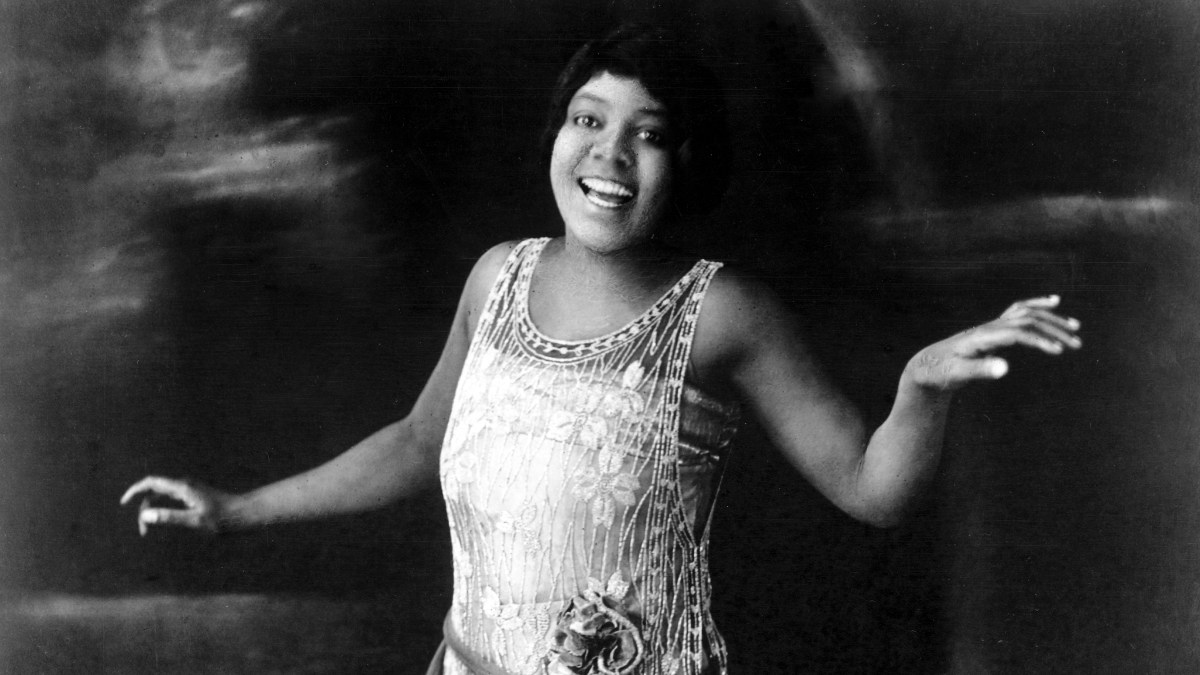
When I heard this woman sing…I was shocked. Listen to the purity of her voice…she still amazes me. We cannot forget the pioneers of any genre. Artists like Mahalia Jackson, Janis Joplin, and Norah Jones have all given Bessie Smith credit as their inspiration.
It seems like the female singers I like the most have a growl to their voices. That includes Janis Joplin, Aretha Franklin, Willie Mae Thorton, and yes Bessie Smith.
Within 10 months of signing Smith, the Columbia label sold two million records. Over the next four years, her sales reached six million. But she sang a wider repertoire than most, in her traveling tent show, on theatrical tours, and, later, in jazz clubs. The blues made Smith the highest-paid black entertainer of her era, but she was just as adept at singing show tunes and more popular Tin Pan Alley songs, which became the basis of many early jazz standards. Those record sales don’t sound as high now but remember this was in the 1920s!
This song came out in 1923 and peaked at #6 on the Billboard 100… I just looked it up…Billboard first published a chart in 1894.
Whenever I hear Bessie Smith I hear pain and greatness all at once. I’ve written about her song No One Loves You When You’re Down And Out and I’ve been revisiting her lately. This song was written by Charles Warfield and Clarence Williams in 1919. It’s been covered by Louie Prima and Frank Sinatra.
I got into Bessie Smith from listening to Janis Joplin and reading about her. Bessie’s voice sends chills up my spine…that is my litmus test. This particular song grabs me because of Smith’s voice and the recording vibe. She sings it, means it, and she damn well lived it. The sound of the record and her voice is just unbeatable. Yes, we have digital now but digital could not give you this sound.
Smith took care of her own…she moved her sister and other family to live near her in Philadelphia and supported them financially when they squandered her money.
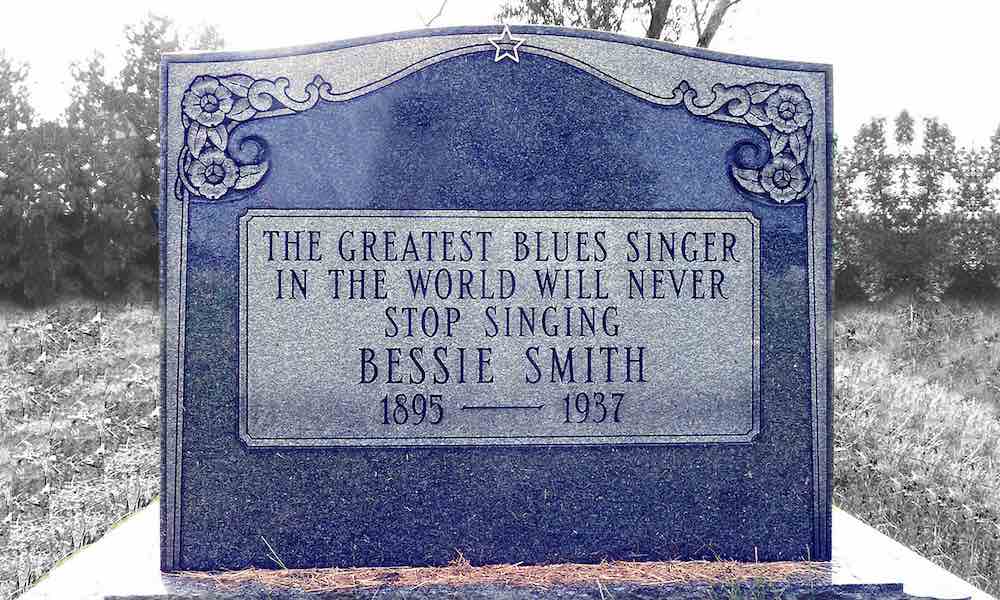
She died from injuries in a car accident in 1937, having not recorded a song in years, more than 5,000 people attended her funeral. Her grave had no headstone. There wasmoney for a headstone apparently, but her estranged husband spent it on something or someone else.
Janis Joplin helped buy Smith’s headstone in 1971…two weeks before her own untimely death. But the real story was the other person who helped buy the stone. That was Juanita Green… a little girl whom Smith once told to give up singing and stay in school.
Louis Armstrong: “I say, ‘Look here Bessie, you got change for a hundred? And she say, ‘Sure my man.’ She raised up her dress standing and there was, like, [you know,] how a carpenter keeps his nails? Man, so much money in the apron under her skirt that killed me.”
Danny Barker a New Orleans musician: “If you have a church background, like people who came from the South as I did, you would recognize a similarity between what she was doing and what those preachers and evangelists from there did, and how they moved people … Bessie did the same thing on stage.”
Baby Won’t You Please Come Home
I’ve got the blues, I feel so lonely
I’ll give the world if I could only
Make you understand
It surely would be grand
I’m gonna telephone my baby
Ask him won’t you please come home
‘Cause when you’re gone
I’m worried all day long
Baby won’t you please come home
Baby won’t you please come home
I have tried in vain
Evermore to call your name
When you left you broke my heart
That will never make us part
Every hour in the day
You will hear me say
Baby won’t you please come home, I mean
Baby won’t you please come home
Baby won’t you please come home
‘Cause your mama’s all alone
I have tried in vain
Nevermore to call your name
When you left you broke my heart
That will never make us part
Landlord gettin’ worse
I’ve got to move May the first
Baby won’t you please come home, I need money
Baby won’t you please come home
I just read a Joplin book and anyone who follows me knows what that means…a few Janis Joplin posts are coming.
She wasn’t here to be conventional or a cookie-cutter person. She was here to blaze a path and leave her mark…and she did just that.
I owned the album Pearl a long time ago and loved it. Through the years I also got her greatest hits and was wrapped up in those songs. I had forgotten about this funky song…and I use funky in the best way. It reaffirmed what a singer should be about to me…giving 100 percent of yourself every time out there.
On her last album, she was produced by Paul Rothchild who wanted Janis to use less of her brash voice to give more. He also worked on her dynamics which worked perfectly with this album and song. She was working with her 3rd band in two years…and this one was the best one no doubt. I liked Big Brother but she HAD to scream to get over those loud guitars. She was taking more of an R&B/soul/funk/blues/rock approach unlike her strictly rock/blues approach with Big Brother. She had more nuances on this album and her voice never sounded better.
Half Moon was written by John Hall and his first wife, the former Johanna Schier. It was picked as the B-side to Me and Bobby McGee. At the time, John was a struggling musician and Johanna was a writer for The Village Voice. Johanna was assigned an interview with Joplin, who suggested the couple write a song for her. Joplin wanted Johanna to write a song about how she was feeling about a man she met in Rio Janeiro and was planning to marry in the future after he finished what he was doing.
It was the first song they wrote together, and a huge break for the couple, who were able to buy a house and a sailboat with the royalties. John Hall got a lot of credibility in the rock realm from co-writing it, and his career took off. A few years later, he formed the group Orleans, which had hits with two songs he wrote: “Still The One” and “Dance With Me.”
I never realized what it meant when I heard people say…”the artist always gives everything of themselves” until I saw clips of Joplin, Springsteen, and Hendrix. They go out on a limb on stage and risk a train wreck to give you that raw excitement. In today’s world of pre-packaged high-priced Las Vegas style shows…you get a slick show with dancers (I never understood that) without a bit of soul. Sure…the live acts sound exactly like their records and that can be tedious after a while. Some love that…and more power to them but I like the emotional roller coaster journey you take with an artist like Joplin…and she gives you that feeling on studio albums also.
The amazing thing about Pearl is that all of the vocals were called “scratch” takes…meant to be redone later on. She was planning to replace all of her vocals…she went all out anyway so I don’t see how she could have improved on them. Funny thing about the album…the original producer was no other than Todd Rundgren…Janis got rid of him right off the bat because she could not relate to him. Paul Rothchild (Door’s producer) took over and just fell for Janis’s voice and Janis.
I included a live version she did a few months before her death on the Dick Cavett show. When she grabs that mic…there is no doubt who is in charge. There is no screaming in this…just pure soul/blues singing…I love the high notes and dynamics…and she just plain kicked ass on this song.
Pearl peaked at #1 on the Billboard Album Charts, #1 in Canada, and #20 in the UK in 1971.
John Hall:“It was numerological and astrological in nature. And it also had an alliterative repetition that was kind of captivating. It wasn’t rhyming, exactly, but it was an internal rhyme, perhaps you could say. It’s a device that poets use and that songwriters use to not just have the end of lines rhyme or the end of verses rhyme, but to have sort of a foreshadowing of that and words inside each line.”
Half Moon
Half moon, night time sky
Seven stars, heaven’s eyes
Seven songs on seven seas
Just to bring all your sweet love home to me
Hey, you fill me like the mountains
Yeah, yeah, yeah, yeah
You fill me like the sea, Lord
Not coming past but still at last
Your love brings life to me
Your love brings life to me, hey
Rings of cloud and arms aflame
Wings rise up to call your name
Sun rolls high, Lord, it burns the ground
Just to tell about the first good man I found
Yeah, you fill me like the mountains
Yeah, yeah, yeah, yeah
You fill me like the sea, Lord
Not coming past but still at last
Your love brings life to me
Your love brings life to me
Oh, oh, oh, oh, oh, oh yeah
Half moon on night time sky
Seven stars, heaven’s eyes
Seven songs on seven seas
Just to bring all your sweet love home to me
Hey baby, you fill me like the mountains
Yeah, yeah, yeah, yeah
You fill me like the sea, Lord
Not coming past honey still at last
Lord, you fill me like the mountains
Yeah, yeah, yeah, yeah
You fill me like the sea, Lord
Not coming past but still at last
Hey, you fill me like the mountains
Yeah, yeah, yeah, yeah
You fill me like the sea, oh Lord
You’re not coming past, honey, still at last
Your love brings life to me
Your love brings life to me
Your love, la la la la la, la
Won’t you bring life to me
I said you’re gonna ride around
When I’m on a little home babe
Bring it on home, you bring it on home
Bring it on home, bring it on home
I said your love brings life to me, yeah
This song has always reminded me of Midnight Rambler by the Stones. What caught my attention and I listened to it twice to make sure I heard it right. At the end Bon Scott says something and I could have sworn it was what Mork from Mork and Mindy used…Shazbot Nanu Nanu…and it was! Scott was a big fan of the show.
California serial killer Richard Ramirez (The Night Stalker, The Valley Intruder or The Walk-In Killer)talked about how he loved the band and Highway To Hell was his favorite album. One of Ramirez’s AC/DC hats was discovered at a crime scene and put on the news as evidence. That started an uncomfortable link with the band. His killing spree started in 1984, and in 1989 Ramirez was convicted of 13 murders. Around the Los Angeles area, Ramirez would typically sneak into houses at night and rape or murder the occupants…hence the nicknames.
Of course, the band wanted nothing to do with this psychopath. It was rumored that the song “Night Prowler” compelled him to kill. The song describes a man sneaking into a woman’s house. It started the rumors again that the band’s name stood for “Anti-Christ Devil’s Children,” but it was actually something seen on the back of a sewing machine that they thought would make an interesting name. . Years earlier The Beatles were linked to a crazy Charles Manson because of a song also.
It was one of the last songs Scott recorded with the band. It was recorded in the spring of 1979 right before the album was released. After the tour, Scott would die on February 19, 1980, of acute alcohol poisoning.
Highway To Hell peaked at #17 on the Billboard Album Charts, #40 in Canada, #46 in New Zealand, #13 in Australia, and #8 in the UK in 1979.
Angus Young has said the song has nothing to do with stalkers or evil people. The song was credited to the Young brothers and Bon Scott.
Angus Young:“The idea came from when I was young, growing up in suburban Australia; we didn’t have air conditioning, and it was very hot. So if it was a very hot night, I’d open up the window. There was an alleyway next to our house and I used to get all of these animal night visitors. Sometimes they’d jump on the window ledge or attempt to come in. I’d see their shadows on the wall. These animals were always having a party late at night. For me, they were the ‘Night Prowlers’.”
Night Prowler
Somewhere a clock strikes midnight
And there’s a full moon in the sky
You hear a dog bark in the distance
You hear someone’s baby cry
A rat runs down the alley
And a chill runs down your spine
And someone walks across your grave
And you wish the sun would shine
‘Cause no one’s gonna warn you
And no one’s gonna yell attack
And you don’t feel the steel
‘Til it’s hangin’ out your back
I’m your night prowler, asleep in the day
Night prowler, get outta my way
Yeah I’m the prowler, watch out tonight
Yes I’m the night prowler, when you turn out the light
Too scared to turn your light out
‘Cause there’s somethin’ on your mind
Was that a noise outside the window
What’s that shadow on the blind
As you lie there naked
Like a body in a tomb
Suspended animation as I slip into your room
I’m your night prowler, asleep in the day
Yeah I’m the night prowler, get outta my way
Look out for the night prowler, watch out tonight
Yes I’m the night prowler, when you turn out the light
I’m your night prowler, asleep in the day
Yes I’m the night prowler, get outta my way
Look out for the night prowler, watch out tonight
Yes I’m the night prowler, when you turn out the light
I’m your night prowler, break down your door
I’m your night prowler, crawling across your floor
I’m the night prowler, make a mess of you, yes I will
Night prowler
And I’m telling this to you
There ain’t nothing
There ain’t nothing
Nothing you can do
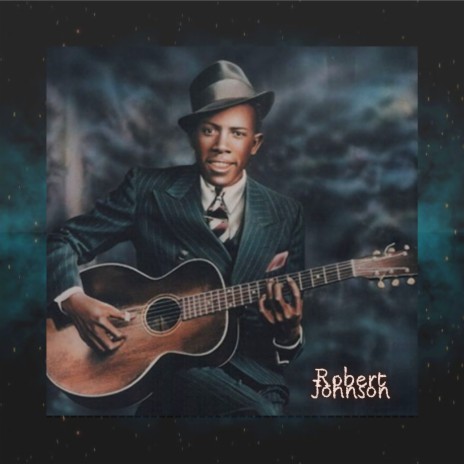
This is an old Robert Johnson song that I’ve always liked. I learned about this song from a bootleg of Leon Russell, George Harrison, Ringo Starr, and Eric Clapton many years ago. Eric wasn’t in the best of shape when this was recorded during the Bangladesh rehearsals. George takes the solo in this blues song and makes it fit really well. I added this version along with Johnson at the bottom of the post.
Robert Johnson recorded it on November 23, 1936, at the Gunter Hotel in San Antonio, Texas and it was produced by Don Law. Johnson only recorded 29 songs in total with 13 surviving outtakes. In one hotel room, Johnson performed and in a second adjoining room, the recording equipment was housed.
In 1990 the compilation album The Complete Recordings was released and peaked at #80 in the Billboard Album Charts. It also won a Grammy Award in 1991 for “Best Historical Album. This song has had over 100 known cover versions by other artists.
Robert Johnson was a huge influence on guitarists such as Eric Clapton, Jimi Page, Peter Green, Brian Jones, and many more. He sounded different than his peers at the time which could have contributed to him not being better known in the 1930s. His style was ahead of his time and it took til the 1960s for him to catch on. In 1961, King of the Delta Blues Singers was released with 16 of his songs on the album…a generation of musicians was influenced.
Johnson died in 1938 at the age of 27. Some say Johnson had been flirting with a married woman at a dance, and she gave him a bottle of whiskey poisoned by her husband…he died two days after drinking it. That is not known for sure but we will probably never know.
Eric Clapton – His music is like my oldest friend, always in the back of my head and on the horizon. It’s the finest music I’ve ever heard. I’ve always trusted its purity. And I always will.’ I don’t know what more you could say….”
Bob Dylan: If I hadn’t heard the Robert Johnson record when I did, there probably would have been hundreds of lines of mine that would have been shut down—that I wouldn’t have felt free enough or upraised enough to write.
Come On In My Kitchen
You better come on in my kitchen Well, it’s goin’ to be rainin’ outdoors Ah, the woman I love, took from my best friend Some joker got lucky, stole her back again You better come on in my kitchen It’s goin’ to be rainin’ outdoors
Oh, she’s gone, I know she won’t come back I’ve taken the last nickel out of her nation sack You better come on in my kitchen It’s goin’ to be rainin’ outdoors Oh, can’t you hear that wind howl? Oh, can’t you hear that wind would howl? You better come on in my kitchen Well, it’s goin’ to be rainin’ outdoors
When a woman gets in trouble, everybody throws her down
Lookin’ for her good friend, none can be found You better come on in my kitchen
Babe, it’s goin’ to be rainin’ outdoors Wintertime’s comin’, it’s gon’ be slow You can’t make the winter, babe, that’s dry, long, so You better come on in my kitchen, ’cause it’s goin’ to be rainin’ outdoors
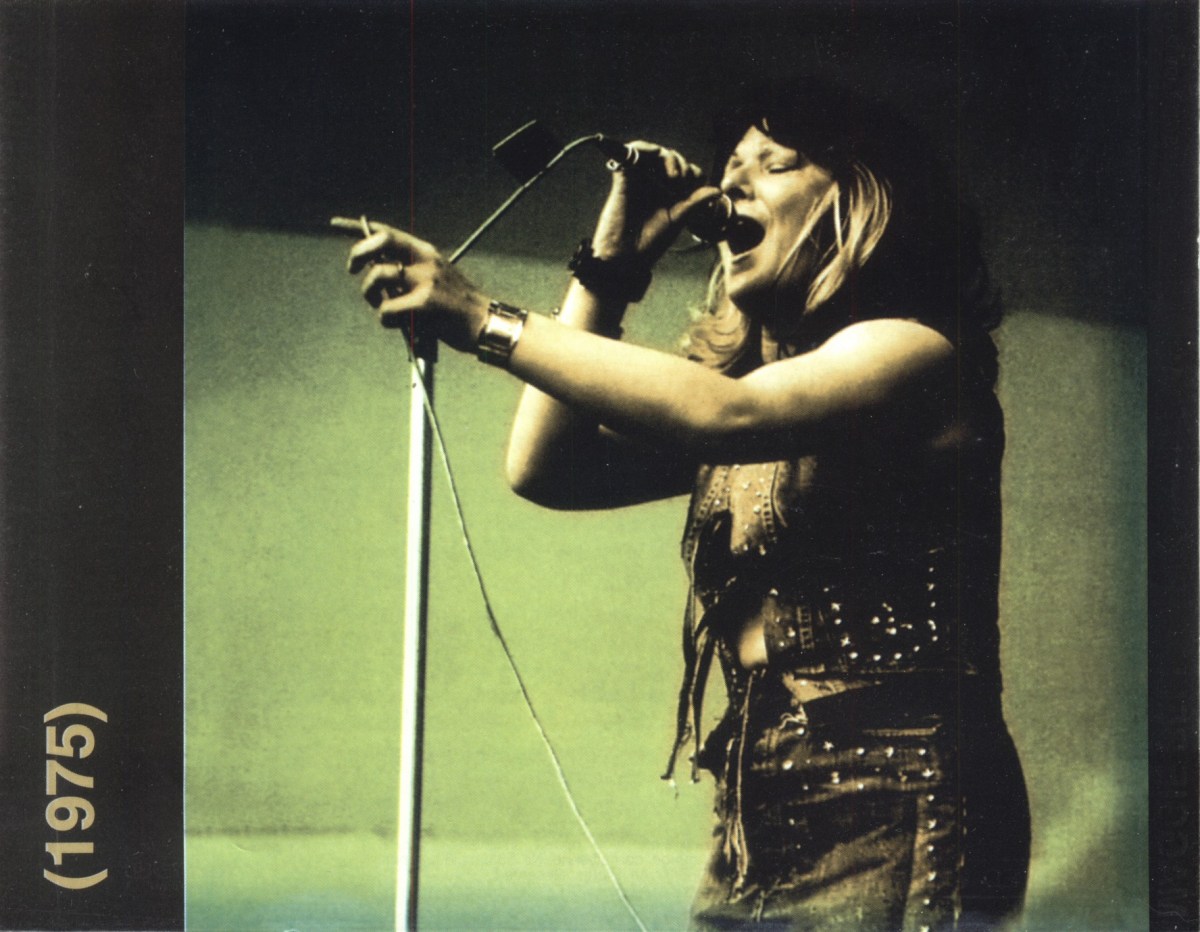
When I heard Maggie Bell a few years ago…the Scottish-born singer blew me away with her voice. A very big Janis vibe to her. I’ve read that she was called the UK’s Janis Joplin but she had her own style.
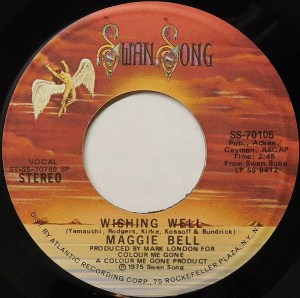
This song was on the album Suicide Sal released in 1975 on Led Zeppelin’s new record label Swan Song. The song was composed by John “Rabbit” Bundrick, Simon Kirke, Paul Kossoff, Paul Rodgers, and Tetsu Yamauchi. Wishing Well was a song by the band Free and it was originally released in 1972. Maggie puts her spin on it and I love it.
Jimmy Page played on this album and I love the funky bass groove that opens the song. The song didn’t chart but she would later have a top 40 song in the UK with the song Hazell.
Maggie Bell was the former lead singer of Stone The Crows. Peter Grant signed the band and had big plans for them. He was the most powerful manager in rock at that time because of Led Zeppelin. The band would come to a tragic end though. Guitarist Leslie Harvey was electrocuted and died on stage at the Top Rank in Swansea on May 3, 1972. He was the only one in position on the stage. Bell has said: “It was a fluke, we were standing at the side of the stage; we hadn’t even started yet. Leslie said to the audience: ‘There’s a technical hitch,’ and he touched the microphone and the guitar. And that was it.” The road crew overlooked one loose ground wire.
Steve Howe of Yes helped fill in for some shows for the band after that. Jimmy McCulloch then joined them and they released an album with some songs by Harvey and a couple by McCulloch who would later join Paul McCartney and Wings. The band was over in 1973 but Peter Grant continued to manage Maggie til the early eighties.
Bell was in shock for years afterward but she said: “I thought to myself: ‘Am I going to give all this up and go back up to Scotland and have two kids?’ I mean, this was a dream we’d planned. Peter said there would be no legal problems if I didn’t want to carry on. I said no, there was a plan. I was going to make sure that I finished the journey. I’m seventy-six years old, I’m still doing it. I mean, the body’s falling apart, but the voice is still fabulous!”
You can hear Maggie Bell sing on Every Picture Tells Story by Rod Stewart. She was credited as having “vocal abrasives.” I don’t think I ever heard Maggie Bell on American radio which is a shame.
Wishing Well
Take off your hat, kick off your shoes
I know you ain’t goin’ anywhere
Run ’round the town singin’ your blues
I know you ain’t goin’ anywhere.
You’ve always been a good, good friend of mine,
But you’re always sayin’ “Farewell”
And the only time that you’re satisfied
Is when you dream from the wishing well.
Throw down your gun you might shoot yourself.
Or is that what you’re tryin’ to do?
Put up a fight you believe to be right
Someday the sun will shine through.
You’ve always been a good, good friend of mine,
But you’re always sayin’ “Farewell”
And the only time you’re satisfied
Is when you dream, dream from the wishing well.
And I know what you’re wishing for
Love in a peaceful world
Love in a peaceful world
Love in a peaceful world
You’ve always been a good, good, good friend of mine,
But you’re always sayin’ “Farewell”
And the only time that you’re satisfied
Is with your feet in the wishing well.
This one is a great deep cut by Led Zeppelin. It was on Led Zeppelin III and is looked over but it has a great riff by Jimmy Page. It’s nice to find a Zeppelin song that hasn’t been played to death…the guitar riff is killer on this song.
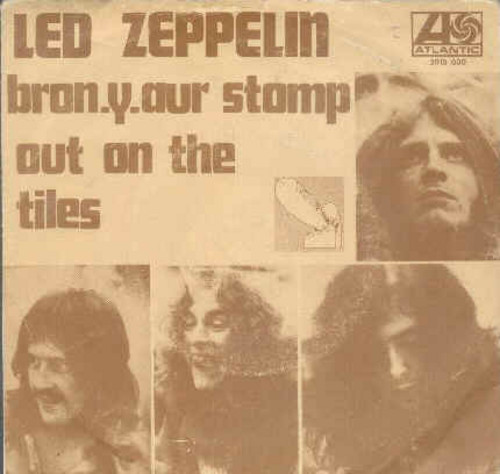
In Japan, this was mistakenly placed on the B-side of “Immigrant Song” rather than “Hey, Hey What Can I Do.” Those copies are rare collector’s items.
Bron-Yr-Aur 1970
Bron-Yr-Aur Now
Robert Plant remembered an 18th-century cottage called Bron-Yr-Aur he had visited in his youth and felt it would be a great place to temporarily escape life in the fast lane and commune with nature. Plant invited his co-writer, guitarist Jimmy Page, and in the spring, the two men took their instruments and supplies to the retreat to recharge their batteries. The place had no running water or electricity at the time.
Robert Plant: “It was time to take stock, and not get lost in it all, and what better way to keep it real than at a place with no electricity, candles for light, water from a stream, and an outside toilet?”
Many fans didn’t embrace Led Zeppelin III like their first two albums. The band would routinely bludgeon their audiences with hard rock. This album had a lot of acoustic mixed in with rock guitar. I think it’s the most underrated album in their catalog. The next two albums would combine these two elements perfectly. Led Zeppelin III was the turning point of Led Zeppelin…after that album. To my ears…this is when Led Zeppelin grew up musically.
Led Zeppelin III peaked at #1 in the US, Canada, and UK in 1970-71.
Drummer John Bonham would talk about going “out on the tiles,” meaning to bars – the title is a British term for going out on the town. Jimmy Page wrote this song around the phrase. Bonham, along with Page and Robert Plant, got a writing credit on the track.
Jimmy Page: “That’s ambient sound. Getting the distance of the time lag from one end of the room to the other and putting that in as well. The whole idea, the way I see recording, is to try and capture the sound of the room live and the emotion of the whole moment and try to convey that. That’s the very essence of it. And so, consequently, you’ve got to capture as much of the room sound as possible.”
Jimmy Page: “When Robert and I went to Bron-Yr-Aur we weren’t thinking: ‘Let’s go to Wales and write.. The original plan was to just go there, hang out and appreciate the countryside. The only song we really finished while we were there was That’s The Way, but being in the country established a standard of traveling for inspiration and set a tone for Led Zeppelin III.”
Below Jason Bonham tells the story of Out On The Tiles
Out On The Tiles
As I walk down the highway all I do is sing this song
And a train that’s passin’ my way helps the rhythm move along
There is no doubt about the words are clear
The voice is strong, is oh so strong
I’m just a simple guy, I live from day to day
A ray of sunshine melts my frown and blows my blues away
There’s nothing more that I can say but on a day like today
I pass the time away and walk a quiet mile with you
All I need from you is all your love
All you got to give to me is all your love
All I need from you is all your love
All you got to give to me is all your love
Oh yeah, oh yeah
Oh yeah, oh yeah
I’m so glad I’m living and gonna tell the world I am
I got me a fine woman and she says that I’m her man
One thing that I know for sure gonna give her all the loving
Like nobody, nobody, nobody, nobody can
Standing in the noonday sun trying to flag a ride
People go and people come, see my rider right by my side
It’s a total disgrace, they set the pace, it must be a race
And the best thing I can do is run
All I need from you is all your love
All you got to give to me is all your love
All I need from you is all your love
All you got to give to me is all your love
Oh yeah, oh yeah
Oh yeah, oh yeah
Oh yeah, oh yeah, oh yeah













 PowerPop... An Eclectic Collection of Pop Culture