Little Richard – Lucille

Little Richard isn’t just a singer he is a force of nature. I think he would have been successful now or any decade. He is one of the best singers I’ve heard in rock and roll. His voice is brash, intense, rough, soulful, and magical. He takes you to the edge of the cliff and when you think he will go over he pulls it back.

The song peaked at #1 on the Billboard R&B chart, #21 on the US pop chart, and #10 on the UK charts.

Little Richard wrote this song. This was released at a time when Richard was hot…he sold millions of records in 1956 and 1957. His songs were also very successful for other artists, who sometimes outsold him with his own songs.

“Lucille” was covered by The Everly Brothers, who matched Richard’s #21 peak position on the charts with their version in 1960. Waylon Jennings had a #1 Country hit when he recorded this on his 1983 album It’s Only Rock and Roll, and other artists to cover the song include Van Halen, Deep Purple, Johnny Winter, Bill Haley & His Comets, Otis Redding, AC/DC and The Hollies.

Little Richard: “I don’t know what inspired me to write it, it may have been the rhythm.” Certainly, the lyrics serve the rhythm, with the nonsensical first line “Lucille, won’t you do your sister’s will” scanning to the beat.

From Songfacts

This song began as a ballad Richard wrote called “Directly From My Heart to You,” which he recorded as a member of The Johnny Otis band in 1955. “Directly From My Heart to You” was released by Peacock Records as a B-side, and when Little Richard recorded for Specialty Records in September 1955, he tried recording the song for his first album. It didn’t make the cut, but Richard’s career took off, and when he needed another single in 1957, he revived the song, but gave it the sound that made him a star, speeding up the tempo considerably.

The lyrics were completely rewritten, and Richard went to a common theme for his hits: a girl’s name. If Lucille was based on a real woman who broke Richard’s heart, he isn’t saying.
If there was a real Lucille, it would probably be either Richard’s (female) lover Lee Angel, or his mentor Steve Reeder Jr., who performed under the name Esquerita. Little Richard hasn’t kept a lot of secrets, so it’s more likely that he did make up Lucille. His next single was also named after a girl: “Jenny, Jenny.”

In a 1999 interview with Mojo magazine, Richard explained: “The effects and rhythms you hear on my songs, I got ’em from the trains that passed by my house. Like ‘Lucille’ came from a train – Dadas-dada-dada-dada, I got that from the train.”

Other popular Lucille’s in music: B.B. King’s guitar is named Lucille, and Kenny Rogers had a hit with different song with the same title in 1977 – his is the one that goes, “You picked a fine time to leave me Lucille…”

The Everly Brothers 1960 version broke new ground but using several guitarists on the track all at once. Recorded in Nashville and arranged by Don Everly, that sound later appeared on Roy Orbison’s hit “(Oh) Pretty Woman.”

In 1993, Little Richard sang this on Sesame Street as “Rosita,” in tribute to the blue monster of the same name.

Lucille

Lucille, won’t you do your sister’s will?
Oh, Lucille, won’t you do your sister’s will?
Well, you ran away and left, I love you still.

Lucille, please, come back where you belong.
Oh, Lucille, please, come back where you belong.
I been good to you, baby, please, don’t leave me alone.

Lucille, baby, satisfy my heart.
Oh, Lucille, baby, satisfy my heart.
I slaved for you, baby, and gave you such a wonderful start.

I woke up this morning, Lucille was not in sight.
I asked her friends about her but all their lips were tight.
Lucille, please, come back where you belong.
I been good to you, baby, please, don’t leave me alone.

Johnny Cash – I Walk The Line

A signature song for Cash.

“I Walk the Line” was recorded at Sun Studios for Sun Records in Memphis, Tennessee. A 24-year-old Cash is said to have written the lyrics in just 20 minutes as the words about his then-wife, Vivian Liberto, flowed out of him.

Recorded in April 1956, Cash’s first #1 was sped up at the urging of Sun Studios owners Sam Phillips. Jack Clements, who worked with Cash, recalled: “I wasn’t impressed with Cash at first, because I like recordings with class… And Cash seemed rough, but ‘I Walk The line’ was a class recording.”

While performing the song on his TV show, Cash admitted that his eerie hum at the beginning of each verse was to get his pitch. The song required Cash to change keys several times while singing it.

Cash wanted to record the song at a much slower tempo, making it a ballad. Sam Phillips, encouraged him to speed up the track, it became the song that we remember.

Bob Dylan on the song: “It was different than anything else you had ever heard,” “A voice from the middle of the Earth.”

From Songfacts

One of his most famous songs, this song details Johnny Cash’s values and lifestyle. It is a promise to remain faithful to his first wife, Vivian, while he is on the road.

“Walk The Line” was the title of the 2005 Cash biopic, starring Joaquin Phoenix as Cash and Reese Witherspoon as June Carter. 

Carl Perkins suggested the title “I Walk The Line” while on tour with Cash. 

A version by Megan Wyler and Adem Ilhan was used in popular Levi’s commercials that aired in 2006. 

On March 31, 1971, Cash closed out the finale of his television series The Johnny Cash Show with this song. The show had run since June 7, 1969, and drew a substantial audience, but was eliminated as part of the “rural purge” that cancelled many popular shows because they didn’t appeal to the younger generation of television viewers who were primarily concerned with things like the Vietnam War, rock and roll, and the Hippie counterculture.

The Voice contestant Craig Wayne Boyd reached #84 on the Hot 100 following a November 24, 2014 performance of the song on the show where he reinterpreted it as a slow, soulful ballad. It was the tune’s first appearance on the chart since Jaye P. Morgan’s cover reached #66 in 1960.

I Walk The LIne

I find it very, very easy to be true
I find myself alone when each day is through
Yes, I’ll admit that I’m a fool for you
Because you’re mine, I walk the line

As sure as night is dark and day is light
I keep you on my mind both day and night
And happiness I’ve known proves that it’s right
Because you’re mine, I walk the line

You’ve got a way to keep me on your side
You give me cause for love that I can’t hide
For you I know I’d even try to turn the tide
Because you’re mine, I walk the line

I keep a close watch on this heart of mine
I keep my eyes wide open all the time
I keep the ends out for the tie that binds
Because you’re mine, I walk the line

Because you’re mine, I walk the line

My Top Ten Favorite Guitar Solos

These are my favorite guitar solos. Some of these solos are intricate but some are pretty simple. I picked ones out that I have always liked. Some of them are not considered great but I always thought they were memorable. They caught my ear for one reason or another.


1. Cream – Crossroads – A live solo by Eric Clapton. He pulls notes out of the air and turns this cover of the Robert Johnson song into a great rock track.

2. Beatles – While My Guitar Gently Weeps – One of the few times someone else played on a Beatles track. This was Eric Clapton playing this solo. Eric played his guitar through a Leslie cabinet to make it more “Beatlely”

3. Jimi Hendrix – All Along The Watchtower – Jimi made this Bob Dylan song into his own.

4. Dire Straits – Sultans of Swing – I can hum this one all the way through. I know it better than the lyrics.

5. Elvis Presley – That’s Alright Mama – Scotty Moore nails this solo. It’s very simple but it’s perfect.

6. The Rolling Stones – Sympathy For The Devil – Keith’s solo compliments the song perfectly.

7. Led Zeppelin – Heartbreaker – My favorite solo by Jimmy Page

8. Tom Petty – Breakdown – Mike Campbell’s solo is just as part of the song as the lyrics are…

9. Queen – We Will Rock You – Not a difficult solo but catchy. This solo was one of the first ones that I ever noticed. Brian May plays solos you can hum.

10. Badfinger – Baby Blue – A very simple solo but it fits this great power-pop song.


Abbott and Costello… Who’s On First?

Abbott and Costello’s most famous routine. Whether you are a baseball fan or not…it is enjoyable. I wanted to know who wrote the routine or what inspired it.

Some have said “Who’s on First” was based on the names of actual minor leaguers and cup-of-coffee big leaguers such as Honus J. Hoehe (Who), Allie Watt (What) and Isaiah Donough (I Dunno)… but that sounds a little too good to be true.

Most historians believe that it was derived from various early skits performed in burlesque houses including one called “The Baker Scene” (which played on multiple meanings of the word “loaf,” from bread to laziness) and another routine named “Who Dyed” (about a man named “Who”). Various comics and comedy teams over the years expanded on the bit and varied it from show to show. Eventually, somehow, the subject of baseball got involved.

Over the years, usually in obituaries, various comedy writers (including Michael Musto, John Grant, and Irving Gordon) have been credited with the final form of “Who’s On First?” but determining full ownership has proven to be impossible.
Ultimately, one thing is for sure… Abbott and Costello made it their own.


One Froggy Evening

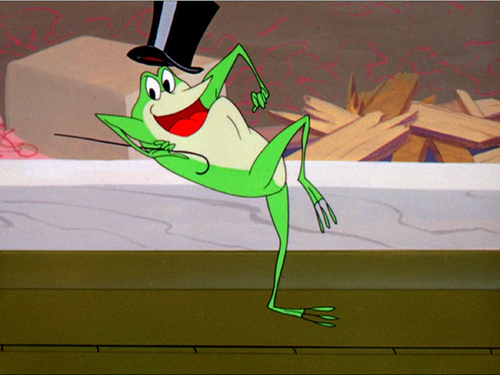
Steven Spielberg called this cartoon short “the Citizen Kane of animated shorts.” It was written by Michael Maltese and directed by Chuck Jones.

This is my favorite cartoon short. The short story is told without dialog…just singing in parts.

If you want to teach someone about Greed… watch this short. Instead of appreciating what he had…he wasn’t happy unless he could make money off of the frog.

The story is great. A 1955 construction worker is on a demolition site and pries open a box from 1892 found in the cornerstone of the building. Out of the box comes an old frog that climbs to the lid. The frog looks up at the construction worker and suddenly pulls up a top hat and coattails and starts singing “Hello my Honey, Hello my Baby…” and continues with the song.

The worker then starts dreaming of a theater marque with the picture of the frog…”He Sings”, “Talks”, and “Dances” with a picture of the frog.

He rents a theater and presents his frog to the audience. Right before the crowd settles in with the curtain down…the Frog starts singing and dancing away but stops the instant the curtain rises. The audience boos and throws vegetables.

That is his dilemma.  The frog will only sing for this one guy. Not for paying crowds, not talent agents, ONLY HIM. Slowly he is driven mad, not so much by the frog but by his own failed plans with the frog. Failing to recognize the special gift he has, he sees the building going up and sticks the frog back into the cornerstone. Years pass, and when the laser demolition-man is vaporizing the building with his 21st-century technology, what does he find? Our friend the singing frog. The space suited construction worker from 2056 starts dreaming of the money he can make from the frog… And so the cycle continues.


Let’s All Go To The Lobby!

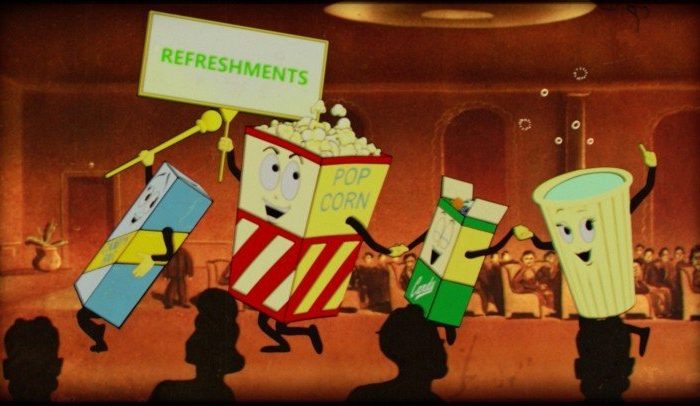
“Let’s All Go To The Lobby” is an animated short from the 1950’s that was played before movies and during drive-in intermissions.

This advertisement is beyond catchy. It’s hard to get it out of your head. Plus, who doesn’t want to see singing popcorn, candy, and a drink? I KNOW I DO!

I see this occasionally at the theater when they are showing an older movie.

In 1957 Chicago-based Filmack Studios released the trailer animated by the producer of Popeye, Dave Fleischer, as part of a series of similar Technicolor shorts to promote the newly installed concession stands in theaters across the country.

Filmack has continued selling copies in the decades since its production. The company estimates that 80% of independent theaters have screened the film at various points.

In 2000, “Let’s All Go to the Lobby” was selected for preservation in the National Film Registry by the Library of Congress as being culturally, historically, or aesthetically significant.

So everyone… Let’s Go Out To The Lobby!!!!

Let’s All Go To The Lobby

Let’s all go to the lobby
And get ourselves a treat

Delicious things to eat
The popcorn can’t be beat
The sparkling drinks are just dandy
The chocolate bars and nut candy
So let’s all go to the lobby
And get ourselves a treat
Let’s all go to the lobby
And get ourselves a treat

Little Richard – Good Golly, Miss Molly

No one has a voice like Little Richard. His voice would have worked in any generation. He has one of the most primal aggressive voices I’ve ever heard. He sings these rockers great but he also can sing ballads.

Little Richard recorded this song in 1956 and it was released in 1958. The song peaked at #10 in the charts and #4 in the R&B Charts in 1958… as well as #8 in the UK.

The song is ranked #94 on the Rolling Stone magazine’s list of the 500 Greatest Songs of All Time. Good Golly, Miss Molly was written by John Marascalco and Robert “Bumps” Blackwell.

From Songfacts

The title was taken from the pet phrase of one of Little Richard’s favorite DJ’s, Jimmy Pennick. Musically, the song was inspired by the sax player Jackie Brenston, famous for singing lead and playing with Ike Turner on the song “Rocket 88.”

Like most of Little Richard’s songs, this contains a lot of innuendo (“sure like to ball”) but most people were too busy listening to the music to notice, or didn’t get the reference. At the time, the most common meaning for “balling” was dancing; only later did it became a popular euphemism for oral sex. The term later took on a new meaning when it came describe a lavish and extravagant lifestyle, with these guys flashing their cash known as “ballers.”

This song was a huge influence on many musicians in the early years of rock and roll. Speaking with Songfacts, Roger Reale, who was in the group Rue Morgue with Mick Ronson, said: “It’s revolutionary, rebellious and celebratory all in one, starting with that rolling piano intro, before moving into a totally unique vocal performance. I had never heard such a direct, crazed, almost otherworldly vocal before in my life.”

Little Richard’s publisher sued Creedence Clearwater Revival over their song “Travelin’ Band,” which they claimed lifted from “Molly.” A settlement was reached with Creedence giving up some of their royalties.

Good Golly, Miss Molly

Good golly Miss Molly, sure like to ball.
Good golly, Miss Molly, sure like to ball.
When you’re rockin’ and a rollin’, can’t hear your momma call.

From the early, early mornin’ till the early, early night
When I caught Miss Molly rockin’ at the house of blue light.
Good golly, Miss Molly, sure like to ball.
When you’re rockin’ and a rollin’ can’t hear your momma call.

Momma, poppa told me: “Son, you better watch your step.”
If I knew poppa’s momma’s, have to watch my poppa myself.
Good golly, Miss Molly, sure like to ball.
When you’re rockin’ and a rollin’, can’t hear your momma call.

Good golly Miss Molly, sure like to ball.
Good golly, Miss Molly, sure like to ball.
When you’re rockin’ and a rollin’, can’t hear your momma call.

I am going to the corner, gonna buy a diamond ring.
Would you pardon me kiss me ting-a-ling-a-ling.
Good golly, Miss Molly, sure like to ball.
When you’re rockin’ and a rollin’ can’t hear your momma call.


A Christmas Carol 1951

There have been many versions of this great story. This is the version that I like the most. The great Alastair Sim plays Ebenezer Scrooge and he is the reason I like this so much. When I think of the Scrooge… I think of him.

The movie is in black and white which turns some people off but it makes it that much better to me. The effects they use are obviously not CGI but they get the point across well and serve the story. I like the scene where the ghost of Jacob Marley is warning Ebenezer of being greedy…the two were not on the set at the same time…it looked really good for being 1951…or anytime for that matter.

So get some eggnog or hot butter rum and sit back and watch this great movie.

From IMDB…spoilers

Ebenezer Scrooge (Alastair Sim) is a greedy businessman who thinks only of making money. For him, Christmas is, in his own words, a humbug. It has been seven years since his friend and partner, Jacob Marley (Sir Michael Hordern), died and on Christmas Eve. Marley’s ghost tells him he is to be visited during the night by three spirits. The Ghost of Christmas Past (Michael Dolan) revisits some of the main events in Scrooge’s life to date, including his unhappy childhood, his happy apprenticeship to Mr. Fezziwig (Roddy Hughes), who cared for his employees, and the end of his engagement to a pretty young woman due to a growing love of money. The Ghost of Christmas Present (Francis De Wolff) shows him how joyously is nephew Fred (Brian Worth) and his clerk, Bob Cratchit (Mervyn Johns), celebrate Christmas with those they love. The Ghost of Christmas Yet to Come (Czeslaw Konarski) shows him what he will leave behind after he is gone. Scrooge awakens on Christmas morning, a new man intent on doing good and celebrating the season with all of those around him.

Cast

  • Alastair Sim (Ebenezer Scrooge)
  • Kathleen Harrison (Mrs. Dilber)
  • Mervyn Johns (Bob Cratchit)
  • Hermione Baddeley (Mrs. Cratchit)
  • Michael Hordern (Jacob Marley)
  • Glyn Dearman (Tiny Tim)

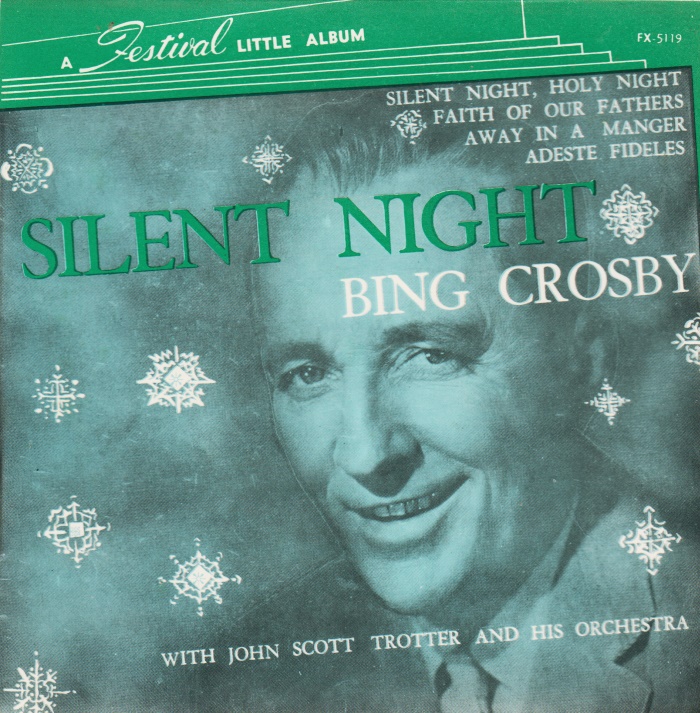
Bing Crosby – Silent Night

This song is not only my favorite Christmas Carol… I think it’s up there with the best songs ever written. I hope everyone has a great Christmas/Holiday.

There are over 26,000 different versions of “Silent Night” on Spotify, meaning you could listen to a different rendition of the carol every night for 72 years.

Halfway through December 1818, the church organ in St. Nicholas in Oberndorf, 11 miles north of Salzburg in what is now Austria, broke (a popular version of the story claims that mice had eaten out the bellows). The curate, 26-year-old Josef Mohr, realized it couldn’t be repaired in time to provide music on Christmas Eve. He told his troubles to his friend, a headmaster and amateur composer named Franz Gruber, while giving him as a present a poem he had written two years earlier. Gruber was so taken by the rhythm of the poem that he set it to music, and on Christmas Eve there was music after all. Mohr played his guitar while the pair sang the song. It was the first public performance of “Stille Nacht” or as we know it “Silent Night.”

It is believed that Silent Night has been translated into over 300 languages around the world, and it is one of the most popular carols of all time.

From Songfacts

Bing Crosby’s version became his best-seller of the 1930s.

Music licensing company PPL announced in December 2010 that this carol tops the list of Britain’s “most recorded Christmas song of all time.” Said Mike Dalby, Lead Reporting Analyst at PPL: “Silent Night is a beautiful carol which encapsulates the feeling of Christmas entirely. Everyone from punk band The Dickies right through to Sinead O’Connor has recorded it, which exemplifies just how much it resonates with all different types of artists.”

According to PPL, Sinead O’Connor’s 1991 recording was the most popular version of the carol in Britain.

When the organ builder finally did show up to repair the St. Nicholas organ, he was given a copy of the “Silent Night” composition and brought it home. From there, traveling folk singers got a hold of it and began incorporating the carol into their repertoire. It didn’t make its way to America until 1839.

As the song gained traction throughout Europe, Franz Gruber composed several different orchestral arrangements. He donated all profits from the carol to local charities for children and the elderly, and eventually died penniless.

According to Steve Sullivan’s Encyclopedia of Great Popular Song Recordings, Crosby, a devout Catholic, refused to record the religious song, arguing it would be “like cashing in on the church or the Bible.” Crosby met with Father Richard Ranaghan, a priest trying to raise money for overseas missions, and decided to donate the royalties to the cause. But Ranaghan died in a car accident later that year, so the money went to several charities throughout the US and abroad.

This song lends itself to interpretation because the first four bars are all on the same chord. Jim Brickman explains: “There’s room to treat it dynamically in a different way: in the tempo, in the sounds and silences, in the time signature.”

Silent Night

Silent night, holy night.
All is calm, all is bright.
‘Round yon virgin mother and child.
Holy infant so tender and mild.
Sleep in heavenly peace,
Sleep in heavenly peace.

Silent night, holy night.
All is calm, all is bright.
‘Round yon virgin mother and child.
Holy infant so tender and mild.
Sleep in heavenly peace,
Sleep in heavenly peace.

Johnny Cash – Cry! Cry! Cry!

No one crosses genres like Johnny Cash. I’ve seen rockers, heavy metal, and country fans like Johnny.

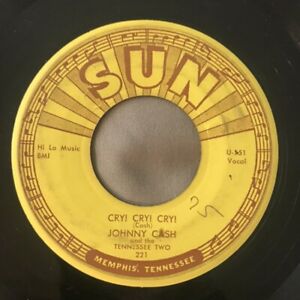
After Cash returned home from the Air Force and signed with Sun Records, he gave Sam Phillips the song “Hey Porter.” Phillips asked for a ballad for the B-side, so Cash went home and quickly wrote “Cry! Cry! Cry!” literally overnight. It became his first big hit.

“Cry! Cry! Cry!” was released and sold over 100,000 copies. The song was originally released in 1955 and reached #14 in the charts at the time. This song was the B side to Hey Porter.

Elvis Costello did a fantastic cover of this song in 1982 as the B side to I’m Your Toy. 


Cry! Cry! Cry!

Everybody knows where you go when the sun goes down.
I think you only live to see the lights uptown.
I wasted my time when I would try, try, try.
‘Cause when the lights have lost their glow, you’ll cry, cry, cry.

Soon your sugar-daddies will all be gone.
You’ll wake up some cold day and find you’re alone.
You’ll call for me but I’m gonna tell you: “Bye, bye, bye, “
When I turn around and walk away, you’ll cry, cry, cry,

You’re gonna cry, cry, cry and you’ll cry alone,
When everyone’s forgotten and you’re left on your own.
You’re gonna cry, cry, cry.

I lie awake at night to wait ’til you come in
You stay a little while and then you’re gone again
Every question that I ask, I get a lie, lie, lie
For every lie you tell, you’re gonna cry, cry, cry

When your fickle love gets old, no one will care for you.
Then you’ll come back to me for a little love that’s true.
I’ll tell you no and then you’ll ask me why, why, why?
When I remind you of all of this, you’ll cry, cry, cry.

You’re gonna cry, cry, cry and you’ll want me then,
It’ll hurt when you think of the fool you’ve been.
You’re gonna cry, cry, cry.


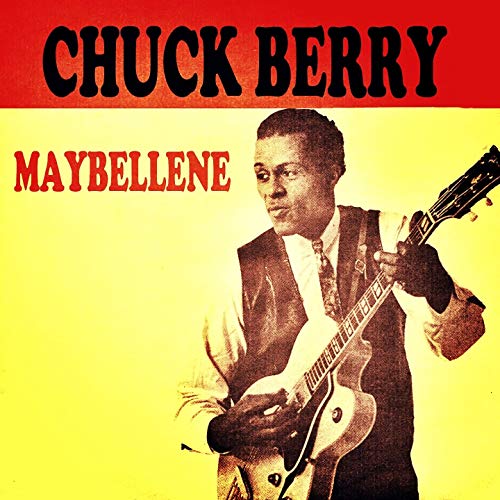
Chuck Berry – Maybellene

Chuck Berry was THE first guitar hero in Rock and Roll. He was also rock’s first poet. This song evolved out of “Ida Red,” a hillbilly song by Bob Wills and The Texas Playboys from the early ’50s. Berry heard that song on the Country radio station KMOX in St. Louis but didn’t know who recorded it.

Not only is the music great with the steady beat… but those lyrics. The motor cooled down the heat went down, And that’s when I heard that highway sound, the Cadillac a-sittin’ like a ton of lead, a hundred and ten half a mile ahead, the Cadillac lookin’ like it’s sittin’ still, and I caught Mabellene at the top of the hill

You can see what is happening in the song in your head with no problem… no MTV story video needed. He was one of the best descriptive lyricist rock and roll has ever had.

The song made it to #5 in the Billboard Pop Chart in 1955.


From Songfacts

Berry had never recorded, but when he went to Chicago to see Muddy Waters perform, he stayed in town to pitch himself to Leonard Chess of Chess Records, who asked him to come back the next week with some original songs. Berry returned with his bandmates Johnnie Johnson (piano) and Eddie Hardy (drums), and a demo reel with four songs, including “Ida Mae.” That’s the one Leonard Chess liked best, but he asked Berry to change so there wouldn’t be any confusion with “Ida Red” and to fend off any copyright claims. Berry changed the lyrics, turning it into a song about fast cars – one of his favorite topics. It was the first song the band recorded, and it proved a challenge: they recorded 36 takes.

This song tells the story of a girl who keeps cheating on her man. Various cars appear in the lyrics; Berry sings about chasing Maybellene in his V8 Ford while she drag races a man in a Cadillac with her Coupe de Ville.

There are a few different stories floating around about how the song got its name. Berry has said that Maybellene was the name of a cow in child’s nursery rhyme, but Johnnie Johnson recalled that there was a box of Maybellene mascara in the office, which gave Leonard Chess the idea for the title.

Chess Records gave the disc jockey Alan Freed a cowriting credit on this song (and also some cash) in exchange for playing it on the radio. Deals like this led to the Payola scandals, which led to rules prohibiting record companies from paying DJs to play their songs. Marshall Chess, the son of Chess founder Leonard Chess, recalled to The Independent newspaper May 27, 2008: “He [Freed] played the hell out of Chuck’s first record, ‘Maybellene’, because of that. My father says he made the deal, and by the time he got to Pittsburgh, which was half a day’s drive away, my uncle back at home was screaming, ‘What’s happening? We’re getting all these calls for thousands of records!'”

Deals like this were perfectly legal and fairly common at the time, but when the government took action in 1959, Freed refused to admit to taking Payola, insisting he was acting as a consultant to the music industry. Holding steadfast to this position, the radio and TV stations he worked for fired him, and his career never recovered. In contrast, Dick Clark admitted to taking cash and gifts, and simply stopped doing so when it was declared illegal. He was able to grow his media empire considerably after the scandal.

Berry was 29 years old when he recorded this song, but he knew that his audience was teenagers, so he wrote the song to appeal to that crowd – the ones fascinated with cars and experiencing young love. Berry also took care to sing it as clearly as possible so it would have more crossover appeal with a white audience. His strategy worked: the song went to #1 on the R&B chart and also made #5 on the Pop chart.

Chuck Berry was a rock and roll original, but he didn’t consider this a rock song. Said Berry: “‘Maybellene’ was very much a country song, with country lyrics. Maybe a little faster but basically it was country.”

Soon after this was released, Elvis Presley started performing it at some of his live appearances. Many other artists also recognized its propulsive appeal and covered the song. British acts – notably The Beatles and The Rolling Stones – often recorded Berry’s songs, but the UK act that grabbed this one was Gerry and the Pacemakers, who included it on their 1963 debut album How Do You Like It?

Other artists to cover the song include George Jones, The Searchers, Jerry Lee Lewis and Foghat.

The B-Side of the single was a slow blues song called “Wee Wee Hours.”

One-third of the composing credit went to Russ Fratto for the sole purpose of making sure that Berry got more royalties than Alan Freed (Fratto was a local DJ who was a close friend of Berry’s). He agreed to give Berry his share. In those days, it was common to give Freed a composer credit in exchange for airplay on his show. Freed would get royalties, and the song would become a hit.

A version by Johnny Rivers reached #12 in the US in 1964.

Later in 1955, Fats Domino released his own song with a three-syllable girl in the title: “I Can’t Go On (Rosalie).”

Berry died in 2017, the same year Fats Domino passed away. Jon Batiste and Gary Clark, Jr. paid tribute at the Grammy Awards in 2018 by performing “Maybellene” and “Ain’t That A Shame.”


Maybellene

Maybellene, why can’t you be true
Oh Maybellene, why can’t you be true
You’ve started back doin’ the things you used to do

As I was motivatin’ over the hill
I saw Mabellene in a Coup de Ville
A Cadillac arollin’ on the open road
Nothin’ will outrun my V8 Ford
The Cadillac doin’ about ninety-five
She’s bumper to bumper, rollin’ side by side
Maybellene
Why can’t you be true
Oh Maybellene, why can’t you be true
You’ve started back doin’ the things you used to do

The Cadillac pulled up ahead of the Ford
The Ford got hot and wouldn’t do no more
It then got cloudy and started to rain
I tooted my horn for a passin’ lane
The rainwater blowin’ all under my hood
I know that I was doin’ my motor good
Maybellene
Why can’t you be true
Oh Maybellene, why can’t you be true
You’ve started back doin’ the things you used to do

Oh, Maybellene
Why can’t you be true
Oh Maybellene, why can’t you be true
You’ve started back doin’ the things you used to do

The motor cooled down the heat went down
And that’s when I heard that highway sound
The Cadillac a sittin’ like a ton of lead
A hundred and ten half a mile ahead The Cadillac lookin’ like it’s sittin’ still
And I caught Mabellene at the top of the hill
Maybellene
Why can’t you be true
Oh Maybellene, why can’t you be true
You’ve started back doin’ the things you used to do

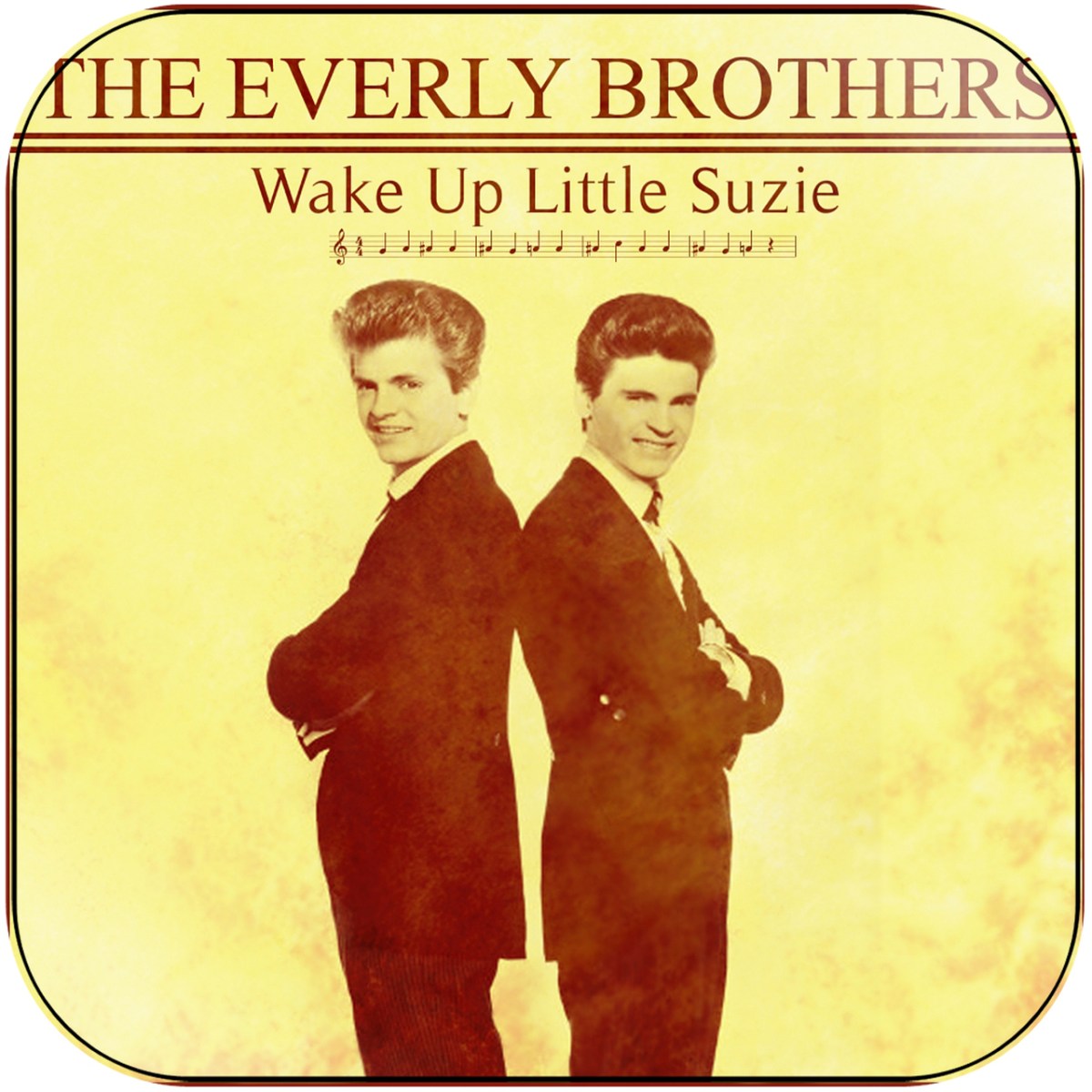
Songs That Were Banned: Everly Brothers – Wake Up Little Suzie

The lines “We both fell sound asleep / Wake up, little Suzie, and weep / The movie’s over, it’s four o’clock / And we’re in trouble deep” were suggestive enough to cause the song to be banned by several radio stations. Although it’s pretty clear the Suzie and her date were at the movies but that didn’t matter.

As with the case of other songs being banned…it only made it more appealing to teenagers at the time. The song peaked at #1 in Billboard and #2 in the UK in 1957.

This was written by the husband and wife team of Felice and Boudleaux Bryant, who wrote most of The Everly Brothers songs in the ’50s. Their songs were also recorded by Bob Dylan, Elvis, and Buddy Holly.

From Songfacts

This is about a young couple who fall asleep at the drive-in, realize they are out past curfew, and make up a story to tell Susie’s parents.

Some Boston radio stations banned this because of the lyrics, which imply that the young couple spent the night together. At the time, staying out late with a girl was a little controversial.

For The Everly Brothers, this was the first of four US #1 hits. It also went to #1 on the Country & Western charts.

At an appearance on The Oprah Winfrey Show while campaigning for President in year 2000, George W. Bush was asked by Oprah what his favorite song was. He said: “Wake Up Little Susie – by Buddy Holly.”

Simon & Garfunkel played this at their 1981 concert in Central Park. The live recording was released as a single the next year and hit #27 in the US.

Chet Atkins played guitar on this. Atkins, who died of cancer in 2001, was a Nashville musician who created a distinctive sound using a three-fingered picking technique.

This was a labor of love for the songwriting duo. “We persevered with ‘Wake Up Little Susie’ for many hours,” Boudleaux recalled to Country Music People. “I started writing one night, kept trying to get my ideas down, but it just wouldn’t happen. Finally I woke Felice, who took one listen to what I had so far achieved and came up with the final touches that I couldn’t get. The Everlys liked the song, but like me had problems with getting it right in the studio. They worked a whole three-hour session on that one song and had to give up, they just couldn’t get it right. We all trooped back to the studio the next day and got it down first take. That’s the way it happens sometimes.”

Wake Up Little Susie

Wake up, little Susie, wake up
we’ve both been sound asleep, wake up, little Susie, and weep
The movie’s over, it’s four o’clock, and we’re in trouble deep
Wake up little Susie
Wake up little Susie, well

Whatta we gonna tell your mama
Whatta we gonna tell your pa
Whatta we gonna tell our friends when they say ?ooh-la-la?
Wake up little Susie
Wake up little Susie, well

I told your mama that you’d be in by ten
Well Susie baby looks like we goofed again
Wake up little Susie
Wake up little Susie, we gotta go home

Wake up, little Susie, wake up
The movie wasn’t so hot, it didn’t have much of a plot
We fell asleep, our goose is cooked, our reputation is shot
Wake up little Susie
Wake up little Susie, well

Whatta we gonna tell your mama
Whatta we gonna tell your pa
Whatta we gonna tell our friends when they say “ooh-la-la”
Wake up little Susie


The Isley Brothers – Shout

First time I heard this song was in the brilliant comedy Animal House by the fictional group Otis Day and the Knights. The movie was such a big hit that many people thought Otis Day And The Knights were a real group, so they went on tour. They did very well, selling out many of the places they played and released an album in 1989 called Shout. Otis Day’s real name is DeWayne Jessie.

This song was recorded in its first take during the studio session. Shout was never a big chart success (#47), but it sold over a million copies and became a rock and R&B classic. The Isley Brothers bought their mother a house in New Jersey with the proceeds from this. She was living in Cincinnati.

After Shout got some attention, RCA records signed the Isleys to a record deal despite concerns that people would not understand what they were singing.

From Songfacts

The Isleys wrote this on the spur of the moment at a Washington, DC, concert in mid-1959. As they performed Jackie Wilson’s “Lonely Teardrops,” Ronald Isley ad-libbed, “WELLLLLLLLLLL… you know you make me want to SHOUT” and Rudy and O’Kelly joined in on the improvisation. The audience went wild and afterwards, RCA executive Howard Bloom suggested putting it out as their first RCA single. >>

This evolved out of the call-and-response style The Isleys grew up singing in church. The organist from their church, Professor Herman Stephens, played on the song.

The Isley Brothers did not consider this a song at first. It was just a “thing” they would do onstage and the crowd would go nuts. They knew they were onto something when Jackie Wilson, who they were opening for, started using the stop-and-go style in his show.

This song has its own dance. When The Isleys sing the “little bit softer now” part, you go a little lower, then gradually rise up for the “little bit louder now part.” For the rest of the song, you just jump around and go crazy. It’s an easy dance, which makes it popular at weddings, proms, and other events where many rhythmically-challenged people end up on the dance floor.

The 1978 movie Animal House featured this in a famous scene where the frat brothers danced to it. The movie starred John Belushi and became a classic, helping revive interest in the song as well as the dance associated with it. In 2003, the group MxPx recorded a new version for the 25th anniversary DVD release of the movie.

In the UK, this is the song that introduced the singing sensation Lulu. The Scottish singer came to London at age 15 and recorded a version of the song with her group Lulu & The Luvvers that made it to #7 on the UK charts. Early on, Lulu often performed in Blues clubs where the song was a great fit. She soon became a very successful actress as well, appearing in the film To Sir With Love and scoring a #1 US hit with the title track.

Lulu, just 13 at the time, was introduced to the song by the Scottish rocker Alex Harvey, who she saw perform it in a Glasgow club called The Scene. Lulu added it to her act with The Luvvers, and it became their first hit when Lulu sang it at an audition for Decca records. She had a terrible cold when she recorded it, which gave her a rougher sound that suited the song.

The Isleys developed this on tours of black theaters in the late ’50s. They were usually low on the bill with other R&B acts.

The B-side of the single was “Shout Part 2,” an even wilder version.

The Isley Brothers next 4 singles tanked. They did not have another hit until “Twist And Shout” in 1962.

A cover version by Joey Dee And The Starlighters was a US Top 10 hit in 1962.

Shout

Well

You know you make me wanna (Shout!)
Kick my heels up and (Shout!)
Throw my hands up and (Shout!)
Throw my head back and (Shout!)
Come on now (Shout!)

Don’t forget to say you will
Don’t forget to say, yeah
Yeah, yeah, yeah, yeah
(Say you will)
Say it right now baby
(Say you will)
Come on, come on
(Say you will)
Say it, will-a you
(Say you will)
Come on now!

(Say) say that you love me
(Say) say that you need me
(Say) say that you want me
(Say) you wanna please me
(Say) come on now
(Say) come on now
(Say) come on now

(Say) I still remember
(Shooby-doo-wop-do-wop-wop-wop-wop)
When you used to be nine years old
(Shooby-doo-wop-do-wop-wop-wop-wop)
Yeah yeah!
I was a fool for you, from the bottom of my soul, yeah!
(Shooby-doo-wop-do-wop-wop-wop-wop)
Now that you’ve grown, up
(Shooby-doo-wop-do-wop-wop-wop-wop)
Enough to know, yeah yeah
(Shooby-doo-wop-do-wop-wop-wop-wop)
You wanna leave me, you wanna, let me go
(Shooby-doo-wop-do-wop)

I want you to know
I said I want you to know right now, yeah!
You been good to me baby
Better than I been to myself, hey! hey!
And if you ever leave me
I don’t want nobody else, hey! hey!
I said I want you to know-ho-ho-hey!
I said I want you to know right now, hey! hey!

You know you make me wanna
(Shout-woo) hey-yeah
(Shout-woo) yeah-yeah-yeah
(Shout-woo) all-right
(Shout-woo) come on now!
(Shout) come on now!
(Shout) yeah, yeah, yeah
(Shout) yeah, yeah, yeah (good sound)
(Shout) all-alright (good sound)
(Shout) it’s all-alright (good sound)
(Shout) all-alright (good sound)
(Shout) all-alright (aah)

Now wait a minute!
I feel alright!
(Yeah yeah, yeah yeah!)
Now that I got my woman
I feel alright!
Every time I think about you
You been so good to me
You know you make me wanna
(Shout-woo) lift my heels up and
(Shout-woo) throw my head back and
(Shout-woo) kick my heels up and
(Shout-woo) come on now
(Shout-woo) take it easy
(Shout-woo) take it easy (higher)
(Shout) a little bit softer now (woo)
(Shout) a little bit softer now

(Shout) a little bit louder now

(Shout)
Hey!
Hey!
Hey!
Hey!
Hey!
Hey!
Hey!
Hey!

Shout now!
Jump up and shout now (woo)

Everybody shout now
Everybody shout now
Everybody, shout, shout
Shout, shout, shout

Buddy Holly – Blue Days Black Nights

This is a Holly song that you don’t hear much and has been a favorite of mine. The sessions didn’t go the way that Buddy would have liked. His songs had more of a country feel than Holly would have liked.

I really like the rockabilly guitar played by Sonny Curtis.  It was recorded at Bradley’s Barn in Nashville Tn in January 26, 1956.

This was Buddy Holly’s first single in April 1956, “Blue Days, Black Nights” was not a Buddy Holly composition; it was written by Ben Hall. The song was the B side to Love Me.

Due to a misspelling on Holly’s recording contract, his name was changed from Holley to Holly. This release is the first to use this spelling, He would go with that spelling the rest of his career.


Blue Days Black Nights

Blue days, black nights
Blue tears keep on fallin’, for you dear
Now you’re gone
Blue days, black nights
My heart keeps on calling for you dear
And you alone

Memories of you make me sorry
I gave you reason to doubt me
But now you’re gone and I am left here all alone
With blue memories, I think of you


Blue days, black nights
I didn’t realize I would miss you
The way I do
And now somehow I know I will pay
For the times I have made you blue

Buddy Holly – True Love Ways

This beautiful song was written by Buddy Holly and Norman Petty.. recorded with the Ray Ellis orchestra on October 21, 1958. Holly wrote “True Love Ways” for his wife, Maria Elena Holly, as a wedding gift.

True Love Ways was not released until March 1960, after Buddy Holly’s tragic death, when it was included on the album, The Buddy Holly Story, Vol. 2, on the Coral label. The song’s melody was inspired by one of Buddy’s favorite black gospel hymns, “I’ll Be Alright,” which was recorded by The Angelic Gospel Singers.

The song peaked at #25 in the UK in 1960…it also recharted in the UK at #10 in 2018.

From Songfacts

This was co-written by Buddy and Norman Petty and recorded in October 1958. Petty was Buddy Holly’s first producer and owned the studio in Clovis, New Mexico where all of Buddy’s first recordings were made (Lubbock did not have a recording studio at the time).

This and “It Doesn’t Matter Any More” were Buddy’s first recordings to use orchestral string arrangements, which accentuated his vocal mannerisms. The strings were arranged by Dick Jacobs. 

Notable covers include versions by Mickey Gilley, Peter & Gordon, and The Royal Philharmonic.

This wasn’t released until after Holly’s death in 1959. After he died in a plane crash, the album The Buddy Holly Story was released, which contained many of his early hits. This album came out a few months later and included many of his lesser-known or never released songs.

True Love Ways

Just you know why
Why you and I
Will bye and bye
Know true love ways

Sometimes we’ll sigh
Sometimes we’ll cry
And we’ll know why
Just you and I
Know true love ways

Throughout the days
Our true love ways
Will bring us joys to share
With those who really care

Sometimes we’ll sigh
Sometimes we’ll cry
And we’ll know why
Just you and I
Know true love ways

Throughout the days
Our true love ways
Will bring us joys to share
With those who really care

Sometimes we’ll sigh
Sometimes we’ll cry
And we’ll know why
Just you and I
Know true love ways