I have to thank obbverse for introducing this song. This song was on the 1976 album The Best Of The Band. It was also released as a non-album single in 1975, along with “The Weight” in the UK.
This is one I didn’t pay much attention to at first. It sat on that best of record surrounded by their giant songs. But over time, I would give it a listen or two. When obbverse mentioned it…I kept it on my playlist and realized how great a song it is. I also found an alternative version with Levon singing it. Something about Danko’s version, though, that makes it sound so personal.
The song was written by Robbie Robertson; like most Band material, it was shaped by everyone in the room. The sound is rooted in the group’s style, but the direction feels more centered.
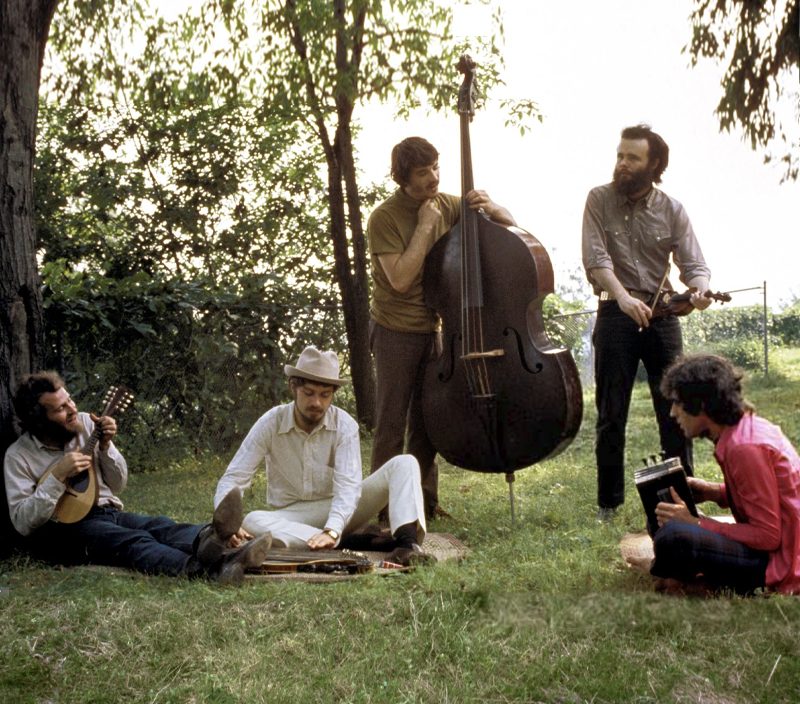
Some bands have great voices and tight harmonies. The Beatles and The Beach Boys, to name a few, but The Band’s harmonies were loose, yet at the same time just as tight in their own way. They had that back porch and bluegrass sound. Their music sounded spontaneous, but it was well-crafted. They always left enough raw edge to keep it interesting.
Robbie Robertson’s words and melodies were Americana flowing through a Canadian who had part-Jewish and Native-Canadian roots. He would read one movie screenplay after another. It helped him with his songwriting to express the images he had in his head. Robbie also took stories Levon told him of the South and shaped them into songs.
Twilight
Over by the wildwood Hot summer night We lay in the tall grass Till the mornin’ light If I had my way I’d never Get the urge to roam But a young man serves his country An old man guards the home Don’t send me no silly salutations Or silly souvenirs from far away Don’t leave me alone in the twilight ‘Cause twilight is the loneliest time of day I never gave it a second thought It never crossed my mind What’s right and what’s not I’m not the judgin’ kind I can take the darkness, oh Storms in the skies But we all got certain trials Burnin’ up inside Don’t put me in a frame upon the mantel ‘Fore memories grow dusty old and gray You don’t leave me alone in the twilight ‘Cause twilight is the loneliest time of day And don’t leave me alone in the twilight ‘Cause twilight is the loneliest time of day
I was revisiting Bob Dylan and The Band’s The Basement Tapes album. How could that many great songs come in one collection? And that is just the original version, not the expanded versions released since. I didn’t grow up with this album, unfortunately. I grew up with TheBand’s Greatest Hits; the irony is, I didn’t have the greatest at all by this band with that package.
This one was written by Richard Manuel and Robbie Robertson. It’s easy to forget that this song was never meant for public ears. These were friends, playing in a basement in West Saugerties (in the Big Pink), playing for themselves after the chaos of Dylan’s electric 1966 tour. Was Katie a real person? We probably will never know, but it is widely believed to be a reference to the folk singer Karen Dalton, a friend of Bob Dylan and a popular figure in the Greenwich Village folk scene in the 1960s.
The song opens with Richard Manuel’s gospel type piano and that half-broken voice of his. Manuel was a master of singing the heartache between the notes. When Richard Manuel sings it, you believe every cracked note. Rick Danko chipped in with his usual ragged and real vocal harmonies. Those harmonies would make a pure pop producer cry, but for roots music, it’s beyond perfection. It’s those back porch vocals that are real and keep the song grounded.
Among Dylan fans, some were upset that some Band-only songs were on here. Some thought that this release would be wall-to-wall Dylan. That caused some head-scratching among Dylan diehards. In truth, Robbie Robertson and The Band had a big hand in shaping what eventually became The Basement Tapes. Robbie helped assemble and clean up the collection, selecting from reels upon reels of material recorded in 1967 at Big Pink in Woodstock. He included Band-only tracks like this song,Bessie Smith, Orange Juice Blues, and Ain’t No More Cane, not because they were Dylan-free, but because they fit the mood. Fitting the mood is what The Band did best.
Robbie Robertson:“Because of all this stuff the Hawks had been through, [we had] a maturity in our musical taste, in our approach. We didn’t feel a part of what was happening at that time out in the world. We weren’t very good at being trendy. It wasn’t that we tried not to do anything, it was just we were evolving to a place and a musicality that had subtleties. Music was just getting louder and more abrasive.
“I understood the attitude and the anger and the excitement of everything that was happening, but we’d already done that. I started with Ronnie Hawkins and screaming on my guitar. [laughs] And now to be able to really play and think: we didn’t use these phrases at the time, but it’s what you leave out — and less is more. There was something about things that just slipped in and what that did to your heartbeat and how it made you feel. It was sexy and it was beautiful and sad and a celebration all at the same time. I thought that’s where we’ve grown to and that’s where we’re going with this.”
Katie’s Been Gone
Katie’s been gone since the springtime She wrote one time and sent her love Katie’s been gone for such a long time now I wonder what kind of love she’s thinkin’ of
Dear Katie If you can hear me I can’t wait to have ya near me
Dear Katie, since ya caught that bus Well, I just don’t know how things are with us I’m still here and you’re out there somewhere
Katie laughed when I said I was lonely She said, “There’s no need to feel that way” Katie said that I was her only one But then I wonder why she didn’t wanna stay
Dear Katie, if I’m the only one How much longer will you be gone? Oh, Katie, won’t ya tell me straight How much longer do I have to wait?
I’ll believe you But please come through I know it’s wrong to be apart this long You should be here, near me
Katie’s been gone and now her face is slowly fading from my mind She’s gone to find some newer places And left the old life far behind Dear Katie, don’t ya miss your home? I don’t see why you had to roam
Dear Katie, since you’ve been away I lose a little something every day I need you here, but you’re still out there Dear Katie, please drop me a line Just write, Love, to tell me you’re fine
Oh, Katie, if you can hear me I just cant wait to have you near me I can only think Where are you What ya do, maybe there’s someone new
This song is for Song Lyric Sunday for Jim Adams’s blog. This week’s prompt is a song off a debut album. I picked The Band and their debut album, Music From Big Pink, released in 1968.
Every once in a while, a song doesn’t just sound like it was written in stone; it feels like it was. I Shall Be Released is one of those songs. That’s the magic of The Band. They could turn a Dylan lyric into a backwoods hymn, all soul and no showbiz.
There is a very solemn song with a religious hymnal feel to it. The song is not commercial, not meant to be a hit, sell a million copies, but just pure music at its best. There are no pretensions or gimmicks…this is the Band at one of its many peaks.
Richard Manuel, whose voice always sounded like it was teetering on the edge of breaking, whether from emotion, exhaustion, or both, delivers a vocal here that’s just haunting. He makes Dylan’s already powerful lyrics sound like the final words of a man who’s seen too much and still manages to believe that salvation might come… someday.
Bob Dylan wrote this in 1967, but his version was not officially released until 1971 on his Greatest Hits Vol. II album. The Band, which backed up Dylan on his first electric tour, recorded it for Music From Big Pink, their first album. Their version is the most well-known. Bob wrote it after his motorcycle accident in 1966. Some have said the song represents Dylan’s search for personal salvation.
Everyone under the sun has covered this song, but the Band’s own rendition was released first and is probably the best-known version.
The song was the B side to The Weight released in 1968. Music From The Big Ping peaked at #30 in the Billboard 100 and #18 in Canada. That wasn’t the biggest thing, though…the album helped change the landscape of popular music from the psychedelic harder rock to more earthy roots music.
I Shall Be Released
They say everything can be replaced They say every distance is not near So I remember every face Of every man who put me here
I see my light come shining From the west down to the east Any day now, any day now I shall be released
They say every man needs protection They say that every man must fall Yet I swear I see my reflection Somewhere so high above this wall
I see my light come shining From the west down to the east Any day now, any day now I shall be released
Now, yonder stands a man in this lonely crowd A man who swears he’s not to blame All day long I hear him shouting so loud Just crying out that he was framed
I see my light come shining From the west down to the east Any day now, any day now I shall be released
In Turntable Talk Dave said: This time around, we’re going Sans Sophomore Slump. We all remember the triumphant debuts to the scene by The Knack, Meat Loaf, the Ramones…but how many recall, let alone listen to ‘But the Little Girls Understand’, ‘Dead Ringer’s or ‘Leave Home’… the follow-ups for them? In other words a great 2nd album by any artist. Many times, that 2nd album is rushed, or the artist used all of their songs for the first album. The example I use is The Knack. It was a great fun first album and a bad second.
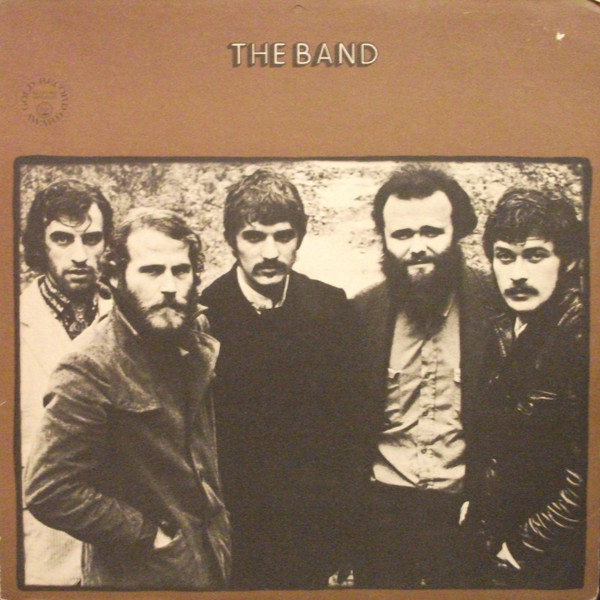
Thank you, Dave, for including me in this so I can talk about this great album. There were a few that came to mind while doing this. The Who’s A Quick One, Van Morrison’s Astral Weeks, Carole King Tapestry, and many more but I decided on this great Americana band that was actually most Canadian. The album is called The Band, and its nickname is The Brown Album. Their first album was Music From Big Pin,k and it was released in 1968. This album was released in 1969.
They recorded this album not in a recording studio but at Sammy Davis’s house in California. They remodeled the adjacent pool house into a recording studio. The Band fashioned a makeshift workshop environment similar to the one at their former home, Big Pink. The album peaked at #2 in Canada, #9 on the Billboard 100, and #25 in the UK.
The album is said to be a concept album about a past America. It’s an album that every rock fan should own. While even novice fans of the group likely know classics like “The Night They Drove Old Dixie Down” and “Up on Cripple Creak,” the record is an amazing listening experience from beginning to end. Robbie Robertson’s lyrics weave fluidly from one song to the next, while the musical accompaniment never disappoints.
Robertson wasn’t just a songwriter. He was more of a director and screenwriter, tailoring roles that played to the strengths of his three leading men. He did have 3 lead singers to work with who could have fronted 3 other bands. They knew each other so well that he could pick who sang what and when. His songwriting process had more in common with films than rock songs. Robertson would go to flea markets and antique stores to purchase screenplays. That’s how he wrote songs…like it was a screenplay.
The man not only was a great storyteller, but many of his songs were mini-movies you could visualize. Who couldn’t imagine the drunkard and his sweetheart defender Bessie betting on horses up on Cripple Creek? Those are not just songs; they are visual pictures sent through music that only Robertson could write. We continue to benefit from his hard work and gift…and always will.
Manuel was the most versatile singer in the Band. He was called the lead singer if someone asked. Manuel took the lead vocals on Across The Great Divide, Rockin’ Chair, and Jawbone, and shared it in King Harvest. Of all the singers, Manuel is overlooked more than the other two. It’s probably because he wasn’t singing lead on the huge “hits” such as The Weight, Up On Cripple Creek, and The Night They Drove Old Dixie Down. He does sing on one of my favorite Band songs ever…King Harvest (Has Surely Come). I didn’t realize how great a voice he had until I heard him sing Georgia On My Mind.
Levon had that great southern voice that was earthy and soulful. Robertson knew just when to use Levon, and he did strengthen Robertson’s songs. Rick Danko had the most vulnerable voice of all three. I never quite heard a voice like his before or since. The amount of talent they had was staggering. I’m talking about voices here, but I haven’t even mentioned the musical skills of these guys. Garth Hudson, who recently passed, played keyboards like NO other. I mean no other. He made a massive wall of sound in the background that identified them from other bands. His approach to his sound was so unique that it’s not copied much because it has to be in the right musical surroundings. Robertson has said that there was no one like him period.
This album contains some of their best-known and best tracks. Let’s look at some of the tracks. Now, is this as good as Music from Big Pink? I think so and in some ways, I like it more. I think it was their best album when all is said and done. I could yack and yack more…but just listen to the album!
Across The Great Divide, Rag Mama Rag, The Night They Drove Old Dixie Down, Up On Cripple Creek, Whispering Pines, King Harvest (Has Surely Come), When You Are Awake, Jemima Surrender, Rockin’ Chair, Look Out Cleveland, Jawbone, and The Unfaithful Servant.
Happy Thanksgiving! Watching The Last Waltz is just as part of Thanksgiving as the meal with the family…that and listening to Alice’s Restaurant.
The Band on Thanksgiving in 1976 at Winterland. The film starts off with THIS FILM MUST BE PLAYED LOUD! A cut to Rick Danko playing pool and then it then to the Band playing “Don’t Do It”…the last song they performed that night after hours of playing. Through the music and some interviews, their musical journey and influences are retraced.
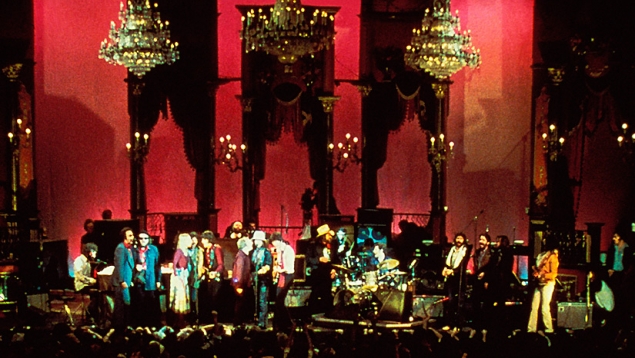
This film is considered by many the best concert film ever made. It was directed by Martin Scorsese. I love the setting with the chandeliers that were from the movie Gone With The Wind. The quality of the picture is great because it was shot with a 35-millimeter camera which wasn’t normally done with concerts.
Before the Band and guests hit the stage, Bill Graham, the promoter, served a Thanksgiving dinner to 5000 people that made up the audience with long tables with white tablecloths.
The Band’s musical guests included
Ronnie Hawkins, Bob Dylan, Neil Young, Dr. John, Paul Butterfield, Van Morrison (my favorite performance), Joni Mitchell, Eric Clapton and Muddy Waters
The Staple Singers and Emmylou Harris also appear but their segments were taped later on a sound stage and not at the concert.
Robbie wanted off the road earlier and that is what the Last Waltz was all about…the last concert by The Band with a lot of musical friends. He was tired of touring and also the habits the band was picking up… drugs and drinking. Richard Manuel, in particular, was in bad shape and needed time.
The rest of the Band supposedly agreed but a few years later all of them but Robbie started to tour as The Band again. Richard Manuel ended up hanging himself in 1986. Rick Danko passed away in 1999 at the end of a tour of a heart attack attributed to years of drug and alcohol abuse. Levon Helm died of cancer in 2012.
The Band sounded great that night and it might be the best version you will ever hear of The Night They Drove Old Dixie Down.
The Last Waltz is a grand farewell to a great band and a film that I revisit at least twice a year… once always around Thanksgiving.
The complete concert is at the bottom…without cuts.
Everlasting summer filled with ill-content This government had us walkin’ in chains This isn’t my turf This ain’t my season Can’t think of one good reason to remain
I will say that my favorite Canadian export is The Band. Combine the 4 Canadians with one southern American and you have gold…no scratch that… you have diamonds. Something I will confess about this band… after I’ve heard songs like The Weight, all of my life, sometimes I don’t realize or forget…wow that is great songwriting! I guess because those songs are so ingrained in my head and I don’t give them as much notice but I want to say something about that now. After posting Daniel and the Sacred Harp and now Acadian Driftwood…my respect for Robbie Robertson’s songwriting knows no bounds. This is songwriting at its best. Don’t get me wrong…I always knew those popular songs were great but I took The Band for granted for a while.
Robertson was inspired by the history of the Acadians, a group of French settlers in Canada who were forcibly removed from their land during the Great Expulsion (Le Grand Dérangement) between 1755 and 1764. This event scattered the Acadians across various regions, including Louisiana, where they became known as Cajuns. He was also influenced by Henry Wadsworth Longfellow’s 1847 poem Evangeline, which describes the deportation of Acadians
Just like with Daniel And The Sacred Harp this song showcases the vocals of Rick Danko, Levon Helm, and Richard Manuel. Each takes a turn singing different parts of the song, contributing to the narrative’s depth and meaning. There were some other Americana bands but none sounded like The Band.
Who would even think about writing a song about this subject? The song was on the Northern Lights – Southern Cross album released in 1975. The album peaked at #27 in Canada and #26 on the Billboard Album Charts.
Anyway…now when I listen to The Weight, Cripple Creek, The Night They Drove Old Dixie Down, and the other well-known Band songs…I will stop and listen a little more carefully.
Acadian Driftwood
The war was over and the spirit was broken
The hills were smokin’ as the men withdrew
We stood on the cliffs
Oh, and watched the ships
Slowly sinking to their rendezvous
They signed a treaty and our homes were taken
Loved ones forsaken
They didn’t give a damn
Try’n’ to raise a family
End up the enemy
Over what went down on the plains of Abraham
Acadian driftwood
Gypsy tail wind
They call my home the land of snow
Canadian cold front movin’ in
What a way to ride
Oh, what a way to go
Then some returned to the motherland
The high command had them cast away
And some stayed on to finish what they started
They never parted
They’re just built that way
We had kin livin’ south of the border
They’re a little older and they’ve been around
They wrote a letter life is a whole lot better
So pull up your stakes, children and come on down
Fifteen under zero when the day became a threat
My clothes were wet and I was drenched to the bone
Been out ice fishing, too much repetition
Make a man wanna leave the only home he’s known
Sailed out of the gulf headin’ for Saint Pierre
Nothin’ to declare
All we had was gone
Broke down along the coast
But what hurt the most
When the people there said
“You better keep movin’ on”
Everlasting summer filled with ill-content
This government had us walkin’ in chains
This isn’t my turf
This ain’t my season
Can’t think of one good reason to remain
We worked in the sugar fields up from New Orleans
It was ever green up until the floods
You could call it an omen
Points ya where you’re goin’
Set my compass north
I got winter in my blood
Acadian driftwood
Gypsy tail wind
They call my home the land of snow
Canadian cold front movin’ in
What a way to ride
Ah, what a way to go
Happy Thanksgiving! Watching The Last Waltz is just as part of Thanksgiving as the meal with the family…that and listening to Alice’s Restaurant.
The Band on Thanksgiving in 1976 at the Fillmore West. The film starts off with THIS FILM MUST BE PLAYED LOUD! A cut to Rick Danko playing pool and then it then to the Band playing “Don’t Do It”…the last song they performed that night after hours of playing. Through the music and some interviews, their musical journey and influences are retraced.
This film is considered by many the best concert film ever made. It was directed by Martin Scorsese. I love the setting with the chandeliers that were from the movie Gone With The Wind. The quality of the picture is great because it was shot with a 35-millimeter camera which wasn’t normally done with concerts.
Before the Band and guests hit the stage, Bill Graham, the promoter, served a Thanksgiving dinner to 5000 people that made up the audience with long tables with white tablecloths.
The Band’s musical guests included
Ronnie Hawkins, Bob Dylan, Neil Young, Dr. John, Paul Butterfield, Van Morrison (my favorite performance), Joni Mitchell, Eric Clapton and Muddy Waters
The Staple Singers and Emmylou Harris also appear but their segments were taped later on a sound stage and not at the concert.
Robbie wanted off the road earlier and that is what the Last Waltz was all about…the last concert by The Band with a lot of musical friends. He was tired of touring and also the habits the band was picking up… drugs and drinking. Richard Manuel, in particular, was in bad shape and needed time.
The rest of the Band supposedly agreed but a few years later all of them but Robbie started to tour as The Band again. Richard Manuel ended up hanging himself in 1986. Rick Danko passed away in 1999 at the end of a tour of a heart attack attributed to years of drug and alcohol abuse. Levon Helm died of cancer in 2012.
The Band sounded great that night and it might be the best version you will ever hear of The Night They Drove Old Dixie Down.
The Last Waltz is a grand farewell to a great band and a film that I revisit at least twice a year… once always around Thanksgiving.
The complete concert is at the bottom…without cuts.
His father said son you’ve given in, you know you won your harp But you lost in sin.
Do you ever play an album and skip a certain song to get to the next? When I first got the album Stage Fright I remember the order was The Shape I’m In, The W.S. Walcott Medicine Show, Daniel and the Scared Harp, and then the title song which I loved (I can’t remember yesterday but I can remember the order of songs from the 1980s when I got the album). I would skip this one like an idiot…which yes I was. Later on, I played it through…and fell head over heels in love with this song. It has become my favorite on the album.
What a beautiful song from The Band on their Stage Fright album. It’s one of the most fascinating songs they ever did. It’s fast becoming a favorite of mine by them. Robbie Robertson’s songwriting in this is incredible.
This story song is close to Robert Johnson‘s story of selling his soul to the devil to be able to play like he did. It’s a song based on the Faust story. I always enjoyed stories about selling your soul for an item or an ability. In movies also…like The Devil and Daniel Webster. If you are wondering what the Faust story is…here is a brief definition I found: a German necromancer or astrologer who sells his soul to the devil in exchange for knowledge and power.
Also, I must add…Sacred harp music is a religious folk music named for Benjamin Franklin White’s The Sacred Harp (1844) using four-shape shape note notation… Its old-time spirituals are sung a cappella… the “sacred harp” is the human voice singing hymns to God.
Robbie seemed to be going for an Appalachian sound in this song and succeeded. He also made it sound biblical against the backdrop of the American South long ago.
Robbie used the words ‘sacred harp’ but this harp is a physical one. What kind of harp is it? To blues players, it’s a mouth harp or harmonica. Could it be a harp as the kind angels play? The song’s vocals are shared between Levon Helm and Richard Manuel. Manuel sings the part of “Daniel” in this song and Levon is the narrator of the story.
The end of the song is chilling. He played out his heart just the time to pass But as he looked to the ground, he noticed no shadow did he cast. The Band never played Daniel and the Sacred Harp live.
Stage Fright peaked at #5 on the Billboard Album Charts, #6 in Canada, and #15 in the UK in 1970. The album has some of my favorite songs by the Band on it. The Shape I’m In, Stage Fright, The W.S. Walcott Medicine Show, and this one.
Robbie Robertson: I was so obsessed that I was stealing everything in sight. From Fred Carter, Roy Buchanan, the Howlin’ Wolf records. I came a long way in a short time, and people used to kid me, saying, “What is it with this guy? Did he sell his soul?”
Robbie Robertson: Roy Buchanan was only three or four years older than me, but he’d been around quite a bit for his age. He told me a lot of stories, crazy stories about how he was half-wolf, half man. They were like the stories you heard about Robert Johnson selling his soul to the devil. We know these are just silly stories, but at the same time they’re fascinating American mythology. Like we’d be sitting in a room playing together and I’d ask Buchanan how he’d figured out some lick and he’d say, “Well, I can’t really tell you,” clearly implying that he, too, had made some sort of pact. Years later, it became obvious he was playing a game with me.
An alternate take…
Daniel And The Sacred Harp
Daniel, Daniel and the sacred harp
Dancing through the clover
Daniel, Daniel would you mind
If I look it over
I heard of this famous harp years ago back in my hometown
But I sure never thought old Daniel be the one to come and bring it around
Tell me Daniel how the harp came into your possession
Are you one of the chosen few who will march in the procession?
And Daniel said
The sacred harp was handed down, from father unto son
And me not being related, I could never be the one
So I saved up all my silver and took it to a man
Who said he could deliver the harp, straight into my hand
Three years I waited patiently
‘Till he returned with the harp from the sea of Galilee
He said there is one more thing I must ask
But not of personal greed
But I wouldn’t listen I just grabbed the harp
And said take what you may need
Now Daniel looked quite satisfied, and the harp it seemed to glow
But the price that Daniel had really paid, he did not even know
Back to his brother he took his troubled mind
And he said dear brother I’m in a bind
But the brother would not hear his tale
He said Old Daniel’s gonna land in jail
So to his father Daniel did run
And he said oh father what have I done
His father said son you’ve given in, you know you won your harp
But you lost in sin.
Then Daniel took the harp and went high on the hill
And he blew across the meadow like a whippoorwill
He played out his heart just the time to pass
But as he looked to the ground, he noticed no shadow did he cast
Gonna see Miss Brer Foxhole Bright diamonds at her teeth She is pure gold down underneath
I’ve talked about it before…a title can draw a person in a song. This one begs to be listened to. Sometimes they don’t live up to the title but this one does. Although Robbie Robertson wrote this, Levon Helm’s vocals brought this piece of Americana to life. He owns this song. He grew up near Helena, Arkansas, and heard stories of traveling Medicine Shows coming in and out of town. When he was a kid he got to see some of these shows. Robertson later translated that into this song.
Helena, Arkansas was the home of the King Biscuit Time radio show. It debuted in 1941. Performers such as Sonny Boy Williamson II would be on the show. The show was the thing that really crystallized blues music in that area. It is said that Muddy Waters and B.B. King would come home from working in the fields every day just to listen to the King Biscuit hour.
This song was on their 3rd album Stage Fright. By this time, Robertson was having trouble writing songs. The brotherhood they all shared was getting complicated because of outside influences. Robertson also had a baby daughter and pregnant wife at home. The songs were great though.
Stage Fright peaked at #5 on the Billboard Album Charts, #6 in Canada, and #15 in the UK in 1970. The album has some of my favorite songs by the Band on it. The Shape I’m In, Stage Fright, and this one.
Robbie Robertson: I wrote about a traveling medicine show I had heard Levon speak of years earlier, something between a carnival sideshow and the African American origins of rock and roll. We recorded “The W. S. Walcott Medicine Show” and another take of “Daniel and the Sacred Harp” with Todd at a studio in the city, and these turned out to be a couple of our favorite tracks. That put the finishing touches on what we could pull out of the hat for this record. I was worn out from this process and trying to maintain a stable family life with my baby daughter and pregnant wife.
The W.S. Walcott Medicine Show
When your arms are empty, got nowhere to go
Come on out and catch the show
There’ll be saints and sinners
You’ll see losers and winners
All kinds of people you might want to know
Once you get it, you can’t forget it
W.S. Walcott medicine show
You know he always holds it in a tent
And if you’re looking for the real thing
He can show you where it went
There’s a young faith healer, he’s a woman stealer
He will cure by his command
When the music’s hot then you might have to stand
To hear the Klondike Klu Klux Steamboat Band
Don’t you sweat it, you can’t forget it
W.S. Walcott medicine show
I’d rather die happy than not die at all
For a man is a fool who will not heed the call
Gonna see Miss Brer Foxhole
Bright diamonds at her teeth
She is pure gold down underneath
She’s a rock and roll singer and a true dead ringer
For something like you ain’t never seen
Once you get it, you can’t forget it
W.S. Walcott medicine show
W.S. Walcott medicine show
W.S. Walcott medicine show
Power Pop Friday will be back next week. Thank you for tuning in this week as we talked about these great Canadian artists…I’ve had a blast with them. There is one band that I didn’t get to cover because I ran out of days…well actually more…but Blue Rodeo will be coming up soon on a Friday.
The Band is my favorite Canadian export. Well, I will say Canadian although one member…Levon Helm was from Arkansas but the rest are Canadians. CB mentioned this song not long ago so I used it after listening to it again. It is quite a complex song. I can’t believe I’ve never posted it but better late than never.
The Band was so rootsy… They had it all – rawness, competence, sublimity, experience, originality, and roots. The five different instruments were not five different instruments…they were one. In the liner notes to one of their greatest hits it states… the music is unusually complex, making use of odd verse patterns and tricky rhythmic suspensions and modifying the natural sounds of instruments for various calculated effects. But because of the way the record sounds, none of this calls attention to itself…it sounds effortless.
Robertson said he’d been immersed in the novels of John Steinbeck at this time. I’ve read where The Grapes of Wrath is a big influence on this song. Rock critic Greil Marcus has written that King Harvest might be the finest song that Robertson has ever written. The song is told from the point of view of a poverty-stricken farmer- detailing everything that has happened to his farm- then a union organizer appears and makes promises that things will soon improve.
Richard Manuel is the singer of King Harvest. King Harvest is a great finishing track to one of the greatest albums ever made. The album was their second album called The Band (The Brown Album). The album peaked at #2 in Canada, #9 on the Billboard 100 in 1970. This is their highest-charting album in their home country.
The song is credited solely to guitarist Robbie Robertson, although drummer-singer Levon Helm claimed that “King Harvest” was a group effort. It’s been covered by Blue Rodeo, Bruce Hornsby, and many more.
Robbie Robertson: “It’s just a kind of character study in a time period. At the beginning, when the unions came in, they were a saving grace, a way of fighting the big money people, and they affected everybody from the people that worked in the big cities all the way around to the farm people. It’s ironic now, because now so much of it is like gangsters, assassinations, power, greed, insanity. I just thought it was incredible how it started and how it ended up.”
Robbie Robertson: In the story to me, it’s another piece I remember from my youth, that people looking forward, people out there in the country somewhere, in a place … we all know it, may have been there, may have not … but there’s a lot of people that the idea of come Autumn, come Fall, that’s when life begins. It is not the Springtime where we kinda think it begins. It is the Fall, because the harvests come in.
Levon Helm: Some of the lyrics came out of a discussion we had one night about the times we’d seen and all had in common. It was an expression of feeling that came from five people. The group wanted to do one song that took in everything we could muster about life at that moment in time. It was the last thing we cut in California, and it was that magical feeling of ‘King Harvest’ that pulled us through. It was like, there, that’s The Band.
King Harvest (Has Surely Come)
Corn in the fields
Listen to the rice when the wind blows ‘cross the water
King Harvest has surely come
I work for the union ’cause she’s so good to me
And I’m bound to come out on top
That’s where she said I should be
I will hear every word the boss may say
For he’s the one who hands me down my pay
Looks like this time I’m gonna get to stay
I’m a union man, now, all the way
The smell of the leaves
From the magnolia trees in the meadow
King Harvest has surely come
Dry summer, then comes fall
Which I depend on most of all
Hey, rainmaker, can’t you hear the call?
Please let these crops grow tall
Long enough I’ve been up on Skid Row
And it’s plain to see, I’ve nothing to show
I’m glad to pay those union dues
Just don’t judge me by my shoes
Scarecrow and a yellow moon
And pretty soon a carnival on the edge of town
King Harvest has surely come
Last year, this time, wasn’t no joke
My whole barn went up in smoke
Our horse Jethro, well he went mad
And I can’t remember things bein’ that bad
Then there comes a man with a paper and a pen
Tellin’ us our hard times are about to end
And then, if they don’t give us what we like
He said, “men, that’s when you gotta go on strike”
Corn in the fields
Listen to the rice when the wind blows ‘cross the water
King Harvest has surely come
Happy New Year to all my readers. This is my first post of the year other than the New Years’ post this morning at 12:01 AM CST. My next post in one hour will be just for all of my readers…
My friend CB (Cincinnati Baby Head) reminded me of this song not too long ago…so thank you CB. Man…wasn’t The Band a truly great band? Not many bands could get away with a name like that…but it is no question they lived up to it. They made pure music for the people…
Standin’ by your window in pain A pistol in your hand And I beg you, dear Molly, girl, Try and understand your man the best you can.
Not a good way to start your day.
Canada has given us Neil Young, The Guess Who, BTO, and many more but…to me, this band was their best export.
The Band had 3 great singers and a good one in Robbie. Robertson wrote most of the songs and wrote for the other three voices. He was smart enough to step aside and let his bandmates sing his songs. Not many singer/songwriters would do that but it worked well.
This song was on their second album called The Band released in 1969. The album is one of the best albums ever. It contained these songs, Up On Crippled Creek, The Night They Drove Old Dixie Down, Whispering Pines, Rag Mama Rag, and more.
They recorded this album not in a recording studio but at Sammy Davis’s house in California. They remodeled the adjacent pool house into a recording studio. The Band fashioned a makeshift workshop environment similar to the one at their former home, Big Pink.
The album peaked at #2 in Canada, #9 on the Billboard 100, and #25 in the UK. This song was not released as a single.
Levon Helm:“Sometimes we would grow the songs from scratch, right there in the pool-house, sometimes we would just pull them out of thin air. We had story songs, we had picture songs and we had songs that emulated things we had heard. One thing that helped is that we had two different styles of rhythm section, with Richard and me swapping drum duties. That was done mainly to accommodate Garth’s ability to trade instruments around. Of course, Garth could play percussion, woodwind, bass—just about anything.”
Across The Great Divide
Standin’ by your window in pain A pistol in your hand And I beg you, dear Molly, girl, Try and understand your man the best you can.
Across the Great Divide Just grab your hat, and take that ride Get yourself a bride And bring your children down to the river side
I had a goal in my younger days I nearly wrote my will But I changed my mind for the better I’m at the still, had my fill and I’m fit to kill
Across the Great Divide Just grab your hat, and take that ride Get yourself a bride And bring your children down to the river side
Pinball machine and a queen I nearly took the bus Tried to keep my hands to myself They say it’s a must, but who can ya trust? Harvest moon shinin’ down from the sky A weary sign for all I’m gonna leave this one horse town Had to stall ’til the fall, now I’m gonna crawl Across the Great Divide
Now Molly dear, don’t ya shed a tear Your time will surely come You’ll feed your man chicken ev’ry Sunday Now tell me, hon, what ya done with the gun?
Across the Great Divide Just grab your hat, and take that ride Get yourself a bride And bring your children down to the river side
Happy Thanksgiving! Watching The Last Waltz is just as part of Thanksgiving as the meal with the family…that and Alice’s Restaurant which is coming.
The Band on Thanksgiving in 1976 at the Fillmore West. The film starts off with THIS FILM MUST BE PLAYED LOUD! A cut to Rick Danko playing pool and then it then to the Band playing “Don’t Do It”…the last song they performed that night after hours of playing. Through the music and some interviews, their musical journey and influences are retraced.
This film is considered by many the best concert film ever made. It was directed by Martin Scorsese. I love the setting with the chandeliers that were from the movie Gone With The Wind. The quality of the picture is great because it was shot with a 35-millimeter camera which wasn’t normally done with concerts.
Before the Band and guests hit the stage, Bill Graham, the promoter, served a Thanksgiving dinner to 5000 people that made up the audience with long tables with white tablecloths.
The Band’s musical guests included
Ronnie Hawkins, Bob Dylan, Neil Young, Dr. John, Paul Butterfield, Van Morrison (my favorite performance), Joni Mitchell, Eric Clapton and Muddy Waters
The Staple Singers and Emmylou Harris also appear but their segments were taped later on a sound stage and not at the concert.
Robbie wanted off the road earlier and that is what the Last Waltz was all about…the last concert by The Band with a lot of musical friends. He was tired of touring and also the habits the band was picking up… drugs and drinking. Richard Manuel, in particular, was in bad shape and needed time.
The rest of the Band supposedly agreed but a few years later all of them but Robbie started to tour as The Band again. Richard Manuel ended up hanging himself in 1986. Rick Danko passed away in 1999 at the end of a tour of a heart attack attributed to years of drug and alcohol abuse. Levon Helm died of cancer in 2012.
The Band sounded great that night and it might be the best version you will ever hear of The Night They Drove Old Dixie Down.
The Last Waltz is a grand farewell to a great band and a film that I revisit at least twice a year… once always around Thanksgiving.
The complete concert is at the bottom…without cuts.
The great Garth Hudson gives us a wonderful intro to this song. In live shows, the song became a Hudson showcase, with him improvising wildly on organ (and later, on synthesizer) before cutting into the song. This improvisation came to be known as “The Genetic Method.” .Eventually the improvisation quoted Bach’s “Fugue in D Minor” and followed into the song’s main riff. Only part of the improvisation was included on the actual album cut.
Garth Hudson was the Band’s secret weapon according to Robertson. Back when they were backing Ronnie Hawkins….they asked the classically trained Hudson to join them. His parents didn’t like the idea but… Hudson agreed to join the band on two conditions: that Hawkins buy him a Lowrey organ, and that he be paid an extra $10 a week to give music lessons to the other Hawks. After that he was in The Band.
This gem came from Music From Big Pink in 1968. The song is credited to Robbie Robertson. Levon Helm said that he and Richard Manual wrote the lyrics to the song.
I was talking to another blogger the other day about the Band. They lived up to their name more than about any other band. Not only did they all contribute to songs…not writing…but all of them did contribute some but they all could play each others instruments.
Music From Big Pink was a huge influence on other artists back then and to this day. George Harrison and Eric Clapton were two that were influenced by it. Eric even had ideas of joining the Band. You can hear it in music at that time. Psychedelic was out and more Americana or roots music was in. The album’s influence far outweighed it’s chart position.
The album peaked at #18 in Canada and #30 in the Billboard Album Chart. It has to be on the list of best debut albums of all time.
Robbie Robertson:When Garth played the intro to “Chest Fever,” which he called “The Genetic Method,” I was reminded there was no other keyboard player in rock ’n’ roll who had his improvisational abilities and imagination.
Robbie Robertson:“It’s kind of a hard love song,” “But it’s a reversal on that old rock & roll thing where they’re always telling the girl, ‘He’s a rebel, he’ll never be any good.’ This time, it’s the other way around.”
From Songfacts
The Band’s guitarist, Robbie Robertson, felt he needed a counterbalance for the album’s centerpiece, “The Weight.” He wrote the music for the song solely for that purpose.
Robertson, drummer Levon Helm, and pianist Richard Manuel improvised lyrics (Robertson often calls them meaningless) over the course of the song. Those lyrics remain unchanged on the track, although they loosely tell a story of a man thrown aside by a hard-drinking, fast-talking woman who subsequently literally becomes sick with love for her.
This was the opening song for the Band’s set at the Woodstock Festival in 1969.
Chest Fever
I know she’s a tracker Any style that would back her They say she’s a chooser But I just can’t refuse her She was just there, but then she can’t be here no more
And as my mind unwheels I feel the freeze down in my knees But just before she leaves, she receives
She’s been down in the dunes And she’s dealt with the goons Now she drinks from a bitter cup I’m trying to get her to give it up She was just here, I fear she can’t be there no more
And as my mind unwheels I feel the freeze down in my knees But just before she leaves, she receives
It’s long, long when she’s gone I get weary holding on Now I’m coldly fading fast I don’t think I’m gonna last very much longer
She’s stoned said the Swede, And the moon calf agreed But I’m like a viper in shock With my eyes in the clock She was just there somewhere and here I am again
And as my mind unweaves I feel the freeze down in my knees But just before she leaves, she receives
It doesn’t get much better than this. This wasn’t a huge hit but it doesn’t mean that much when it’s The Band.
The Band did this song by playing musical chairs with the instruments. Most of them grabbed something different than what they normally played. Levon (drummer) sang and played Mandolin, Richard Manuel (piano) played drums, Rick Danko (bass) played fiddle, Garth Hudson (keyboards) played uprigtht piano and producer John Simon played Tuba.
Robbie Robertson wrote the song and was the only one playing their normal instrument…guitar.
The song peaked at #57 in the Billboard 100, #46 in Canada, and #16 in the UK in 1970. The song was on their second album The Band.
Songfacts
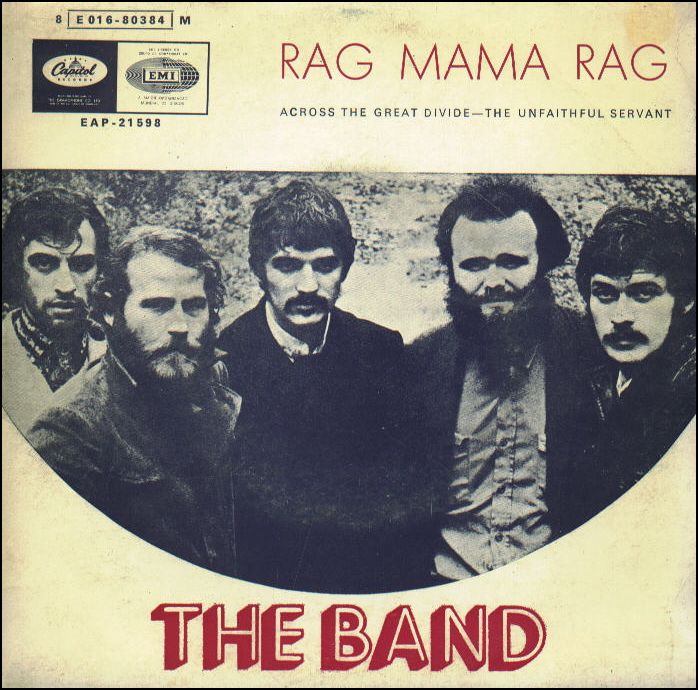
One of the Band’s first big European hit singles, “Rag Mama Rag” has some unusual instrumentation. Lead pianist Richard Manuel played drums, drummer Levon Helm played mandolin and sang lead, and bassist Rick Danko played a fiddle. This left the bass spot open on this track, and it was filled by the album’s producer, John Simon. He improvised a bassline on tuba, although he had no idea how to play the instrument. >>
Robbie Robertson is the only songwriter credited on this track, although other members of the group claim they made contributions. The song finds Levon Helm trying to convince his girl to come back home so she can “rag all over” his house. What he has in mind in unclear: “rag” could mean playing ragtime music (a possibility, considering the line “rosin up the bow”), but he might have more prurient intentions.
Rag Mama Rag
Rag Mama rag, can’t believe its true. Rag Mama Rag, what did you do? Crawled up to the railroad track Let the four nine-teen scratch my back
Sag mama sag now What’s come over you Rag Mama Rag, I’m a pulling out your gag. Gonna turn you lose like an old caboose, Got a tail I need a drag.
I ask about your turtle, And you ask about the weather, Well, I can’t jump the hurdle And we can’t get together.
We could be relaxing in my sleeping bag, But all you want to do for me mama Is rag Mama rag there’s no-where to go, Rag Mama rag. Come on resin up the bow.
Rag Mama rag, where do ya roam? Rag Mama rag, bring your skinny little body back home. Its dog eat dog and cat eat mouse, you can You can rag Mama rag all over my house.
Hail stones beating on the roof, The bourbon is a hundred proof, Its you and me and the telephone Our destiny is quite well known.
We don’t need to sit and brag. All we gotta do is Rag Mama rag Mama rag. Rag Mama rag Where do you roam? Rag Mama rag, bring your skinny little body back home
The first Band album I ever bought was The Best of The Band. When I heard “The Shape I’m In” I knew I was going to like them. I knew the hits of course but the songs I never heard of at that point were great. I then started to buy their albums and loving this band. The song was off on the album Stage Fright and was a B side to the song “Time To Kill.”
There is a great version on The Last Waltz which is below. Robbie wrote the song for Richard to sing and at that time Levon, Rick, and Richard were heavy into heroin and drinking. The song peaked at #64 in Canada.
Robbie Robertson talks some about writing this song
At one time, there was talk that if you wanted to play like the angels, you had to dance with the devil—that heroin was a gateway to music supremacy. That myth was yesterday, but the power of addiction was still in full force. It hit me hard that in a band like ours, if we weren’t operating on all cylinders, it threw the whole machine off course. This was the first time that writing songs was painful for me. In some cases I couldn’t help but reflect on what was happening behind the curtain. I wrote “The Shape I’m In” for Richard to sing, “Stage Fright” for Rick, and “The W. S. Walcott Medicine Show” for Levon—all with undertones of madness and self-destruction. While watching Richard pound out the rhythm on the clavichord, I couldn’t help but see the irony as he sang out, “Oh, you don’t know, the shape I’m in.”
The Shape I’m In
Go out yonder, peace in the valley Come downtown, have to rumble in the alley Oh, you don’t know the shape I’m in
Has anybody seen my lady This livin’ alone would drive me crazy Oh, you don’t know the shape I’m in
I’m gonna go down by the water But I ain’t gonna jump in, no, no I’ll just be lookin’ for my maker And I hear that that’s where she’s been?
Oh, out of nine lives, I spent seven Now, how in the world do you get to Heaven Oh, you don’t know the shape I’m in
I’ve just spent 60 days in the jail house For the crime of having no dough, no no Now here I am back out on the street For the crime of having nowhere to go
Save your neck or save your brother Looks like it’s one or the other Oh, you don’t know the shape I’m in
Now two young kids might start a ruckus You know they feel you’re tryin’ to shuck us Oh, you don’t know the shape I’m in







 PowerPop... An Eclectic Collection of Pop Culture