TV Draft Round 9 – Pick 1 – Dave Selects – Jeopardy

Welcome to the Hanspostcard TV Draft. I hope you will enjoy it! Today’s post was written by Dave at https://soundday.wordpress.com/

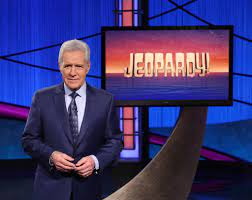
Today I’ll take “Great TV Shows” for $400. As you might have guessed the answer, and my next show to cover for this event, is Jeopardy!

Jeopardy! is a show so familiar it seems to hardly need any description. After all, it’s been around longer than many of its contestants, and longer than I (or many of the other columnists taking part here) have been. It’s been parodied on Saturday Night Live, sung about jokingly by Weird Al Yankovic and plays a part in the plot of Groundhog Day. Few and far between are those of us who’ve not at least seen part of an episode in passing somewhere along the line. Such an iconic part of the culture it’s become that even the opening theme with booming introduction – “this is JEOPARDY!” – is instantly identifiable by most. But that aside, let’s look at the show a little anyway.

https://www.youtube.com/watch?v=njPzMyRGq9c

Jeopardy! Is a long-running game show, in which three contestants play against each other trying to answer questions correctly to win. Or actually, answer “answers”…we’ll get to that. How long-running? It premiered in 1964, and has been running most of the time since, although in slightly different formats and shown on different providers. The current version has been running daily since 1984. Merv Griffin created it and also created the similarly-popular Wheel of Fortune which not coincidentally often runs right before or after Jeopardy! in many markets. Although he’s credited with creating it, and his name appears on the credits day after day, he credits his wife with being the one who had the basic idea.

Back around the end of 1963, he and his wife were sitting around, talking about his desire to create a game show for TV. She commented that quiz shows were popular and quite good, but there hadn’t been any since the 1958 “Game Show Scandal”, in which it was found certain contestants on the shows Dotto and Twenty-one had been given the answers so the producers could control who would win and come back, based on who they felt would be most popular with their viewers rather than their skill or even luck. The game idea was still good, but the concept had been tarnished. They wagered almost six years was enough time passed to give it another go. She then suggested the twist – why not give answers and have contestants guess the question. Merv recalled “she fired a couple of answers at me – ‘5280’ – and the question of course would be ‘how many feet in one mile?’” He liked it and quickly took the idea to NBC, who bought it sight unseen.
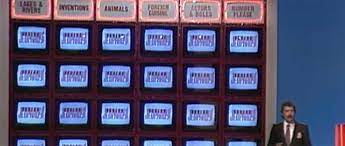
jeopardy early board

NBC ran it, filming in New York, weekdays from 1964 through ’75, and added a nighttime weekly version which they syndicated in 1974. All the time, Art Fleming was the host who introduced the contestants and asked the, err “answers.” It had finally run its course by summer ’75, but they resurrected it again for the ’78-79 season, again with Fleming at the helm in the Big Apple. That lasted just one season, but it didn’t stay gone too long. In 1984, a new version began, running daily (five days a week), still produced by Griffin’s company, but this time shot in L.A. and sold for syndication. It wasn’t exclusive to one network, but most local stations in the U.S. had an hour of free time to program what they wanted between the evening news and “primetime shows”, so in the vast majority of cities, (as well as in Canada), one station or another ran Jeopardy!  The basic show was still the same, but this time there was a new host – big-haired, moustached Alex Trebek, a Canadian with limited experience as a game show host but a personality that fit.

In case you’ve not seen it, the game is broken into three parts, “Jeopardy”, “Double Jeopardy” and “Final Jeopardy.” The first two take up most of the show, and consist of contestants picking mystery questions (or “answers”) from a board, which is made up of a grid of 30 boxes. There are six categories, and five question/answers in each. Each one is worth a certain value, in the first round being $200, 400, 600, 800 and 1000 and in “double Jeopardy” , you guessed it, double that amount. (If you didn’t guess it, you might not quite be Jeopardy! material.) Players who buzzed in first and gave the correct response for each won that amount of money…but if they were wrong, the amount was subtracted from their score. So it paid to be quick on the buzzer…and sure of your knowledge of the category. “Final Jeopardy” consisted of one answer all three would be given and had to answer (with the question) in 30 seconds. They could wager any or all of the amount of money they’d accrued so far in the game, and like the earlier bits, they’d win it if they were right, but lose it if wrong. Put together a run of correct answers and a bit of moxie in “Final Jeopardy” and you can do very well – James Holzhauer won a record $131127 in a 2019 episode. The game winner went home with that money, and got invited back to play the next day, whereas the second and third place finishers got a small consolation prize – typically $1000 and $2000 , which some bitterly noted didn’t pay their costs to actually go to L.A. and pay for a hotel … the show doesn’t pay expenses.

The game demands quick reflexes and a good, wide-ranging knowledge of…well, the more the better. While Art Fleming has criticized the “new” version (new as in the past 38 years), for being “dumbed down” by Hollywood, and it is true there are often some questions about pop culture, there are also still more about things like ancient history or American geography. Esquire tabulated many years of shows and found the most frequently-used categories were “Before and After”, “Literature”, “Science” , “Word Origins” and “American History” while the most-used ones for Final Jeopardy are “American Presidents” and “Word Origins.”  Readers Digest compiled the ten that seemed to be hardest for contestants, and they included “Classical Music”,and “Canadian Cities” (sample : “Residents of this Saskatchewan city are called ‘Moose Javians’” , for question “What is Moose Jaw?”) . But it wasn’t only Canadian geography the mostly-American contestants had trouble with; so too did their own American because “States that Flow Together” also made the difficult list. That one had two states, with the last letter of one being the first of the next. Somehow no one could figure out “MissourI and Illinois” for the clue “one has St. Louis, the other has East St. Louis!”  Of course, sometimes they like to have a little fun too, and at times the categories seem a little loopy – “Superb Owl” (all about owls on , yes Super Bowl week); “Songs for Your Cat,” “Hertz so Good” (about electricity)…

The show seems to hit the sweet spot between being so esoteric it requires a phD and so simple or celebrity-based anyone who watches Entertainment Tonight could run the board. Similarly, Alex Trebek hit the perfect spot as the host (for over 8000 episodes from ’84 until his death late in 2020; the final one he made aired in January ’21; until the final days of his illness he missed just one show…an April 1 edition where he traded places with Wheel of Fortune‘s Pat Sajak as an April Fool’s joke); warm and fatherly enough, with just enough self-deprecating humor to balance his occasional raised eyebrow and seeming hint of condescension when dealing with less-than-swift contestants. He won seven Emmys for it and became a household name and beloved celebrity; so much so that just who was going to replace him became headline news for months.  So far, the answer appears to be Ken Jennings, who along with Big Bang Theory-alum Mayim Bialik have hosted the vast majority of post-Trebek shows. Jennings is an obvious choice, himself being the most famous, and by some accouts, most successful contestant ever on Jeopardy! Jennings won 74-straight shows in 2004, winning over $2.5 million and later won $1 million more on a “Greatest of All Time” tournament between past big winners. (From time to time, they have special tournaments, like ones for college students and “Celebrity Jeopardy!” where stars – mainly actors, but some athletes, writers, even politicians – try to win money for charity. Takeaway from those – no wonder Stephen King can cram so many details into his novels. The man seems to know everything!)  Jennings turned his run on Jeopardy! Into several books, online and magazine columns and a rare level of celebrity based on…just being pretty darn smart!

The hype, for lack of a better word, surrounding Trebek’s unfortunate demise (losing a long battle to cancer) and picking his replacement has only helped Jeopardy! Its ratings have risen of late, with some of Trebek’s final episodes being watched by over 14 million at time or airing and many more later on streaming services; Entertainment Weekly reported this year that it currently is the most-watched “regular” TV show based on viewers watching it live…an amazing feat for a game show which through syndication doesn’t even necessarily play in every market. Maybe it’s Trebek and Ken Jennings, or maybe I hold out hope, it’s something different. At a time when everything seems to be being dumbed down from our news to our movies to our elected officials, maybe some of us are appreciating a show where it actually pays to be smart… to know a little about the Nile River or European history or great American literature.

Jeopardy! is a show I’ve enjoyed now and then since I was a kid and Trebek was young and had a huge Afro. As I got older and Trebek’s facial hair shrank, I actually found myself watching more, playing along. It was also one of the few shows my parents were both fond of too; my Mom sometimes would phone me up and ask in exasperation “did you see Final Jeopardy? How did they not know Dickens was the answer!!” or the like; when I spent about half a year living with my Dad as he got on in years, it became nearly a nightly routine for us to go down to the basement after dinner and watch Jeopardy!, trying to shout out the answers fastest. He never did well if it was about Lady Gaga or baseball, but he could rock the history and current events categories. Needless to say, I miss both my parents, and also Alex Trebek but I’m pretty glad I can still try to fit  a bit of Jeopardy! in to the routine still and learn a little something with it. Memorable contestants, every topic under the sun, learning while playing… what is “great game show” Merv?
TV Draft Round 8 – Pick 8 – Paula Selects – Curb Your Enthusiasm

Welcome to the Hanspostcard TV Draft. I hope you will enjoy it! Today’s post was written by Paula at http://paulalight.com

Curb Your Enth

Curb Your Enthusiasm

 Omgosh I love this show! Larry David, the co-creator of Seinfeld, created the Curb concept and launched the show post-Seinfeld in October 2000. He stars in every episode as a fictionalized version of himself ~ a wealthy entertainment professional living a posh life in Los Angeles who doesn’t quite get the hang of social interaction and focuses on what he considers insults while committing many missteps himself. I guess fictionalized Larry might be “on the spectrum,” though that isn’t discussed. Cheryl Hines stars as his wife/ex-wife and Jeff Garlin is hilarious as his manager. Susie Essman plays Jeff’s wife and imo she is the funniest character with the best lines. Also very funny is J.B. Smoove, a hurricane refugee whom Larry and Cheryl shelter; he ends up as a regular, living in Larry’s guest quarters. The episodes where Smoove tries to find a “Mary Ferguson” to take the place of a Mary Ferguson who ditched him and their travel plans are absolutely side-splitting.

But I’m jumping ahead ~ the MF eps are in S11 (the latest one). Yep, Curb goes up to 11, and Larry has confirmed that there will be a Season 12. I’m so excited! If you don’t watch this show, but are a Seinfeld fan, I highly recommend catching up. Curb is also about the minutiae of daily life and the small misunderstandings that can morph into big dramas and ruin relationships. The show was developed from a one-hour comedy show that Larry did in 1999, which was shot as a “mockumentary.” Curb continues that style, with Larry outlining each ep and then relying on the actors to provide funny improvisational dialog, which is called retroscripting (all info is from Wikipedia). The show has been a huge success ~ nominated for 47 Emmy Awards and winning the 2002 Golden Globe for Best TV Series (music/comedy).

One of my favorite eps is S3e9 when Larry and Cheryl are still married and she has her family over for the Christmas holidays. Larry is Jewish, and he has no idea that the cookies Cheryl and fam have baked are for a special manger scene they’re going to set up. He eats the baby Jesus and everyone is mad at him. Season 4 starts out with several great eps, including such fab guest stars as Mel Brooks and Ben Stiller. This Season features a theme of Larry getting one “free pass” from Cheryl to be unfaithful during their marriage and he wants to cash it in, resulting in several hilarious attempts. Cheryl and Larry renew their wedding vows during this season and have a big argument over whether to love each other until death (Larry’s preference) or for all eternity (Cheryl’s). In S6 and beyond, Cheryl and Larry split up for good, and we get to see Larry going on dates, getting served with a fatwa, opening a spite store, and being forced to cast a terrible actress in his new show when her burglar uncle drowns in Larry’s unfenced pool. Larry ends up trapped in a relationship with an unattractive city council member (Tracey Ullman) in hopes of revoking the law about fencing pools, and Smoove says Larry is putting “bad miles” on his penis.

Can’t wait for S12!

~*~

Paula Light is a poet, novelist, flash fiction fan, cupcake connoisseur, mom, grandma, cat mommy, etc. Her blog can be found at http://paulalight.com.

TV Draft Round 8 – Pick 7 – Keith Selects – Sherlock

Welcome to the Hanspostcard TV Draft. I hope you will enjoy it! Today’s post was written by Keith at https://nostalgicitalian.com/

Sherlock

We have come to the eighth round of the Hanspostcard TV Show Draft. I have already picked Columbo and Perry Mason, and for this round I have another mystery show. I’ve noticed a few of the other participants have picked some great BBC shows, so I guess it is now my turn. For this round, I pick Sherlock.

The series ran from 2010 – 2017. Series 1 aired in 2010, Series 2 in 2012, a Christmas mini-episode ran in 2013, Series 3 ran in 2014, a special “period” show aired in 2016, and Series 4 aired in 2017. What I love about this show is the modern take on a classic character. Having Sherlock Holmes solving crimes in modern day was the draw for me and it did not disappoint.

When-is-Sherlock-season-5-out-2332236

The Premise

The show features Sherlock Holmes, who is a “consulting detective”, along with his flatmate Dr. John Watson solving crimes in a modern-day London. He helps Detective Inspector Greg Lestrade, who at first is a bit suspicious of Sherlock. Over time, however, he realized Sherlock’s intelligence and ability to help solve various crimes and considers him an asset.

Dr. Watson documents their adventures on his personal blog and Sherlock becomes a sort of celebrity. This leads to a lot of press coverage and ordinary people and the British government seeking out Sherlock for help with cases.

The show features various crimes and villains, however, a recurring feature is the battle between Holmes and his archenemy, Jim Moriarty. Many of the stories in the series have been adapted from Sir Arthur Conan Doyle’s Sherlock Holmes books.

Who’s Responsible?

1478100200-gettyimages-579682418

Steven Moffat and Mark Gatiss were both writers for another BBC show – Dr. Who. They were both huge fans of Sherlock Holmes. They were both no stranger to taking Victorian stories and adapting it for television. The two men spent many hours during train rides discussing creating a new series featuring Sherlock Holmes. Moffat’s wife suggested that the two begin developing the show before someone else stole the idea.

The Cast

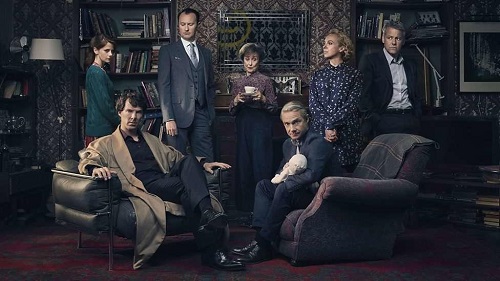
Sherlock Holmes – Benedict Cumberbatch

Sherlock

According to Moffat and Gattis, Benedict Cumberbatch was immediately the guy they wanted to play Holmes. They had seen him perform in Atonement and thought he was perfect. A producer said that he was the only one they actually saw for the role. According to one article: “The part is modelled as a charismatic secondary psychopath or “High functioning sociopath” as Sherlock self-describes, unlike Doyle’s rendering as a primary psychopath, thereby allowing more opportunity or ambiguity for traits of empathy.” Cumberbatch told the Guardian, “There’s a great charge you get from playing him, because of the volume of words in your head and the speed of thought—you really have to make your connections incredibly fast. He is one step ahead of the audience and of anyone around him with normal intellect. They can’t quite fathom where his leaps are taking him.”

Dr. John Watson – Martin Freeman

Martin-Freeman-Sherlock-Season-5-pic

Actor Matt Smith was originally the actor Moffat and Gattis had in mind to play Watson, but there was something about him, the chemistry with Cumberbatch, and the way he played the character that they didn’t like (They would eventually cast him in Dr. Who). Eventually, Martin Freeman won the role. Moffat says of Freeman, (he is) “the sort of opposite of Benedict in everything except the amount of talent… Martin finds a sort of poetry in the ordinary man. I love the fastidious realism of everything he does.” Freeman, when considering his character, says he is “a ‘moral compass’ for Sherlock, who does not always consider the morality and ethics of his actions.

Detective Inspector Lestrade – Rupert Graves

lastrade

According to Moffat and Gattis, many auditioned for the role, but they all seemed to have a comedic take on the role. The creators liked Graves’ approach to it and he was cast. There is some great interplay between Lestrade and Holmes throughout the series. He works for Scotland Yard.

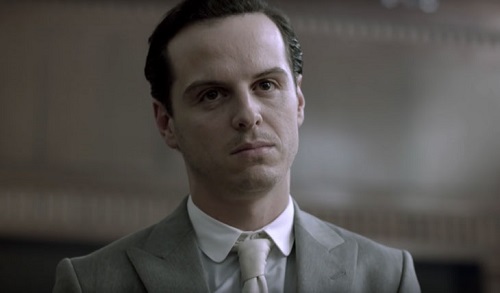
Jim Moriarty – Andrew Scott

james-moriarty-1

Scott is fantastic as Moriarty! Moffat said, “We knew what we wanted to do with Moriarty from the very beginning. Moriarty is usually a rather dull, rather posh villain so we thought someone who was genuinely properly frightening. Someone who’s an absolute psycho.” They certainly achieved this. There were times I was genuinely freaked out by his performance! The creators never intended to have a “confrontation” scene between Holmes and Moriarty, but then they saw Scott’s audition and they knew that they HAD to!

Other Cast Members

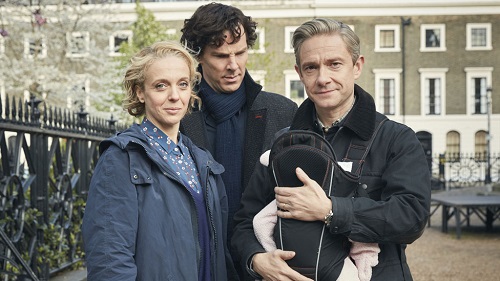
Amanda Abbington – Mary (Morstan) Watson

_93096723_freeman1_bbc

At the time of the series, Amanda Abbington was Martin Freeman’s real life partner. She was cast to play John Watson’s girlfriend/wife.

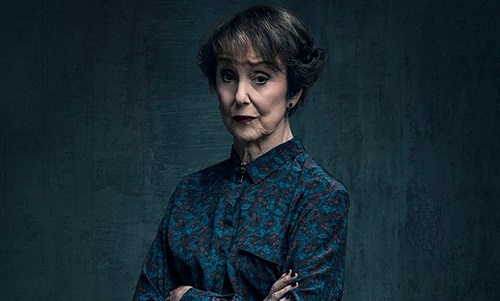
Mrs. HudsonUna Stubbs

Sherlock S4 - Generic

Mrs. Hudson is Holmes’ and Watson’s landlady. She brings a wonderful bit of comedic dialog to every interaction and scene. Interesting story – Una has known Benedict Cumberbatch since he was 4 years old and she has worked with his mother!

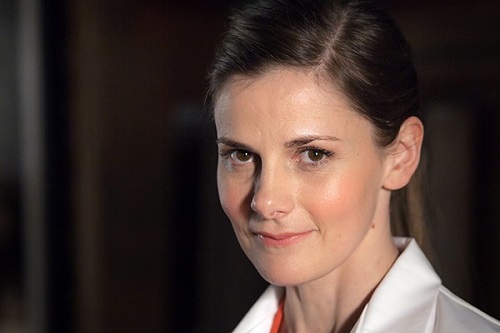
Molly HooperLouise Brealey

louise-brealey-600x400

Molly Hooper works at a morgue at a London hospital. She also has an apparent crush on Sherlock. Because of her work position and crush on him, Sherlock frequently exploits her to let him examine or perform experiments on victims’ bodies. In the first episode of the series she allows him to hit a corpse with a riding crop to see how it might bruise in post mortum.

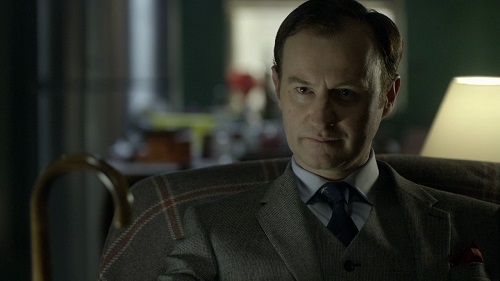
Mycroft Holmes – Mark Gattis

sherlock-103-02345

(SPOILER ALERT) When Mycroft first appears in the series, you really have no idea who he is. He is this mysterious man who tries to get Watson to spy on Sherlock for him. You only learn later on that he is Sherlock’s brother. Mycroft is even more skilled at deduction, correcting Sherlock on occasion and beating him in deduction exercises, as well as lacking enthusiasm for “legwork”. His intellect is borderline superhuman. The sibling rivalry between the two lead to some very good scenes.

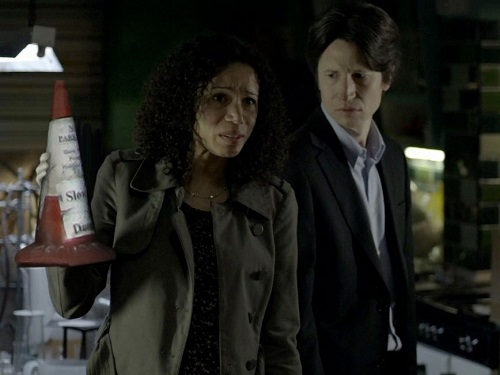
Sally Donovan & Phillip Anderson – Vinette Robinson & Jonathan Aris

tumblr_m2ns6fDmeZ1rslrfio1_r1_1280

Srgt. Sally Donovan often works with Lestrade on cases. She resents Sherlock’s presence at crime scenes and treats him with extreme disrespect and rudeness, cruelly calling him a “freak” to his face, and warns Watson that Sherlock is a psychopath who will one day get bored of catching killers and become one himself.

Phillip Anderson is originally a member of the Metropolitan Police’s Forensic Services. From the series opening, it is clear that Anderson and Sherlock have history of mutual dislike with Sherlock repeatedly humiliating Anderson and Anderson refusing to assist him at crime scenes.

Why I Picked It

Growing up, I had read a few of the Sherlock Holmes books. I has seen Basil Rathbone as Sherlock Holmes in movies, and certainly heard many old time radio shows featuring Holmes and Watson. I was intrigued to see just how Sherlock would play out in modern times.

I began to watch the first episode and all it took was the first meeting of Sherlock and Watson, and I was hooked. The way Sherlock is able to tick off things about Watson after just a couple minutes was awesome. Here is that scene:

Pardon me while I sort of digress for a moment.

One of the shows I considered picking in the draft was House, M.D. starring Hugh Laurie. I had heard it said that House was based on Sherlock Holmes. House would often make brilliant deductions about the his patients, and often was able to rattle off things about people because of his keen sense of observation – just like Sherlock Holmes. When I began to watch Sherlock, I immediately noticed just how much the two were alike.

The two characters are very similar. Check out the following links:

https://screenrant.com/house-ways-similar-sherlock-holmes/

https://screenrant.com/house-show-sherlock-holmes-comparison-similarities/

Now, back to why I picked it. I love a good mystery, obviously. I was fascinated by the way Sherlock worked and how he figured things out. Sherlock is a bit different that my earlier picks of Columbo and Perry Mason. I loved watching him sort through all the things that helped get him to the final conclusion.

I love good characters. This show is full of them. There are times I laugh out loud at some of the interactions. One of my favorite exchanges between Sherlock and Lestrade happens in the first episode. Sherlock, Watson and Lestrade are in a room and Sherlock yells, “Shut up!” Lestrade answers back, “I didn’t say anything.” Sherlock adds quickly, “You were thinking. It’s annoying!”

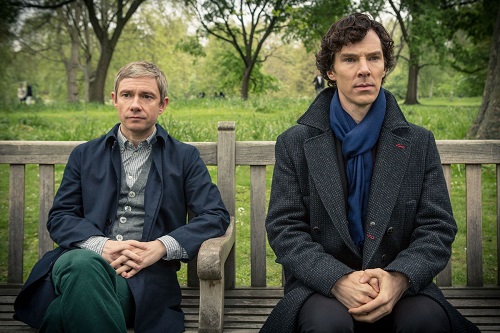
Holmes and Watson are the perfect team. They play well off each other. The same holds true for Cumberbatch and Freeman. Their chemistry is magical. I remember seeing the Sherlock Holmes movies with Robert Downey Jr. and Jude Law and thinking they had good chemistry, but Cumberbatch and Freeman’s chemistry is far superior.

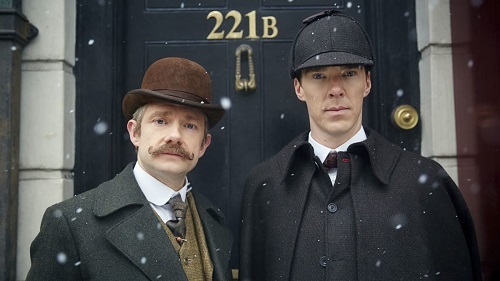
In between Series 3 & 4, Sherlock aired a special on New Years Day of 2016. The Abominable Bride was set in Victorian London. Set in the time of the original books, it takes Sherlock out of the modern day and places him back where we all know him from. Moffat stated that “The special is its own thing. We wouldn’t have done the story we’re doing, and the way we’re doing it, if we didn’t have this special. It’s not part of the run of three episodes. So we had this to do it … It’s kind of in its own little bubble.”

OLD

The special won an Emmy for Outstanding Television Movie at the 2016 Primetime Emmy Awards. If you only watch one episode – I’d suggest this one.

The final episode of Sherlock aired in 2017. Steven Moffat stated that He and Mark Gattis had fifth series plotted out, but weren’t ready to fully produce it. Whether or not a new series of shows will come to fruition is still up in the air.

SH3_Ep2rel_5.0

When Benedict Cumberbatch was asked about whether or not Sherlock would make more episodes, he said, “I’m the worst person to ask because my slate’s pretty, pretty full at the moment, as is Martin’s and all the other key players involved. So, who knows? Maybe one day, if the script’s right. And I say ‘the script,’ maybe it could be a film rather than the series. Who knows?” 

Sherlock is a multi award winning show full of mystery, adventure, comedy, and fun. If you have never seen it, I highly recommend it.

The game is on!!

The-Sherlock-series-of-BBC-s-tv-show-Gets-a-prank-back

TV Draft Round 8 – Pick 6 – Liam Selects – Siskel & Ebert

Welcome to the Hanspostcard TV Draft. I hope you will enjoy it! Today’s post was written by Liam at https://othemts.wordpress.com/

  • Opening Soon at a Theater Near You (1975–1977) – WTTW, Chicago
  • Sneak Previews (1977–1982) – PBS
  • At the Movies (1982–1986) – Syndication
  • Siskel & Ebert & the Movies (1986–1999) – Syndication

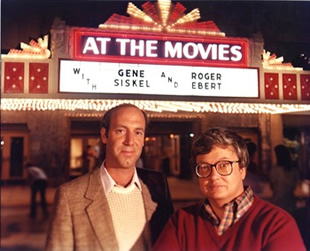
In 1975, WTTW-TV (the local PBS outlet for Chicago) brought together two film critics, Gene Siskel and Roger Ebert for a movie review show called Opening Soon at a Theater Near You. Siskel wrote film reviews for the Chicago Tribune starting in 1969 while Ebert began his career as a film critic at the Chicago Sun-Times in 1967.  In 1975, Ebert became the first film critic to receive a Pulitzer Prize.  This was a time when there was a heated rivalry between the two Chicago newspapers, and members of the small field of film criticism, there was a professional rivalry between Siskel and Ebert as well, bordering on animosity.

The show started off roughly as each critic attempted to assert their personality and get one over on their opponent (not to mention that neither one had much experience in front of a camera).  Over time they gradually eased up and started having more of a conversation about the movies.   Working together proved to be more effective inspiring one another with insights.  Siskel and Ebert started to become friends in real life as well. Despite all of this, some of the best TV drama came when they disagreed and argued about a movie, but always with respect for their opponent as an individual.

https://www.youtube.com/watch?v=zLV6kl2Z6mg

After two seasons on WTTW, the show was retooled as Sneak Previews and broadcast nationally on PBS.  The pair left PBS in 1982 for a syndicated show produced by Tribune Entertainment called At the Movies.  In 1986, after a contract dispute, they created another syndicated show called Siskel & Ebert & the Movies (later shortened to Siskel & Ebert) produced by Walt Disney television. All the shows shared some common characteristics, reviewing a handful of new releases in each episode, with special episodes focusing on the Oscars, Siskel & Ebert’s best movies of the year, and a deep focus on the work of an individual artists.  The shows ended with a roundup of the movies discussed with Siskel & Ebert each giving a thumbs up or thumbs down for each movie.  “Two thumbs up” became a coveted phrase for movie promoters to include in their advertisements.

It’s unfortunate that the whole thumbs up/thumbs down thing became such a cultural touchstone, because Siskel & Ebert offered a much deeper appraisal of movies than that shorthand could ever offer.  I found a website called Siskel & Ebert Movie Reviews where full episodes of the show have been uploaded.  Watching some shows reminds me how deep they would go into their discussion of the films as well as sharing extended clips of the movies.  It seems a foreign concept today when everyone is so worried about “spoilers,” but I remember going to the movies back in the 1980s knowing a whole lot about what I was going to see thanks to Siskel & Ebert, and it helped me enjoy the movies more.

Siskel & Ebert essentially democratized film criticism.  When the show started in the 1970s, it was a time when foreign films were getting screened regularly in the U.S. for the first time, and older American movies were getting rereleased.  Siskel & Ebert loved “highbrow” art movies, and promoted them on their show but never in a snooty manner.  Instead they made these films more accessible to wider audiences.  In the 1980s, home video made even more movies more widely available and the always included home media releases in their shows as well.  The duo could also find great entertainment in “lowbrow” Hollywood movies and weren’t afraid to say what they liked and why they were still great movies.  Of course, they also didn’t hold back on bad movies, and covered them in features like “Dog of the Week” with Spot the Wonder Dog barking an introduction.

Gene Siskel died of a brain tumor in 1999.  A private man he did not share the extent of his illness outside his family so his sudden death took his partner Roger Ebert off guard.  Ebert continued the show with rotating guest hosts for a time before partnering up with Richard Roeper from 2000 to 2008.  Ebert was struck with cancer of the thyroid and salivary glands in 2002 and in 2006 had his lower jaw surgically removed.  Always contrary to Siskel, Ebert was open to sharing his health problems with the public, particularly in the intimate documentary movie Life Itself.  Unable to speak, Ebert continued to review movies in print, publishing them on his website RogerEbert.com until his death in 2013.

TV Draft Round 8 – Pick 5 – Mike Selects – Star Trek: Voyager

Welcome to the Hanspostcard TV Draft. I hope you will enjoy it! Today’s post was written by Mike at https://musiccitymike.net

Star Trek: Voyager

Let me begin by saying that I really don’t care much for science fiction. My family can confirm how I am on record for falling asleep in the movie theater for Star Wars and Lord of the Rings movies. I guess my brain finds little appeal for fantasy. So, what is it about Star Trek: Voyager that makes it different?

Well, this attraction started with Star Trek: The Next Generation which my family and I watched together and which I would likely pick as a favorite should there be a second round to this draft. Together, we binge-watched all of TNG on DVD, and in true geekiness, kept a spreadsheet where we rated each episode on a 1 to 5 scale. Our watching continued with Voyager, but our nerdom didn’t include the spreadsheet after Mom dropped out.

So, this leaves me to try and explain both how Star Trek overcome my disdain for sci-fi and why I favor (ever so slightly) Voyager over The Next Generation.

I guess what makes me somewhat of a Trekkie, is how these shows extend the history of our planet into the future and explore the unknown expanse of our galaxy. We see the development of technology (some of which has since come to pass) and experience the remarkable acceleration of the speed of travel (unlikely to ever happen). As a child, I always enjoyed books about the future and Trek provided me with a continuation of this fascination. Perhaps my attraction takes root in the fact that there is some probability to some of what is presented in Trek.

On the other hand, as the name itself implies, Star Wars focused more on wars and battles with much more emphasis on alien fantasy rather than the evolution of Earthlings.

As for The Next Generation, everything about it was fabulous and more than satisfied my needs. The casting was perfect, the technological advances were exciting and sometimes realistic, and the stories were fantastic. However, while the same can be said for Voyager, there was just something about it that attracted me even more.

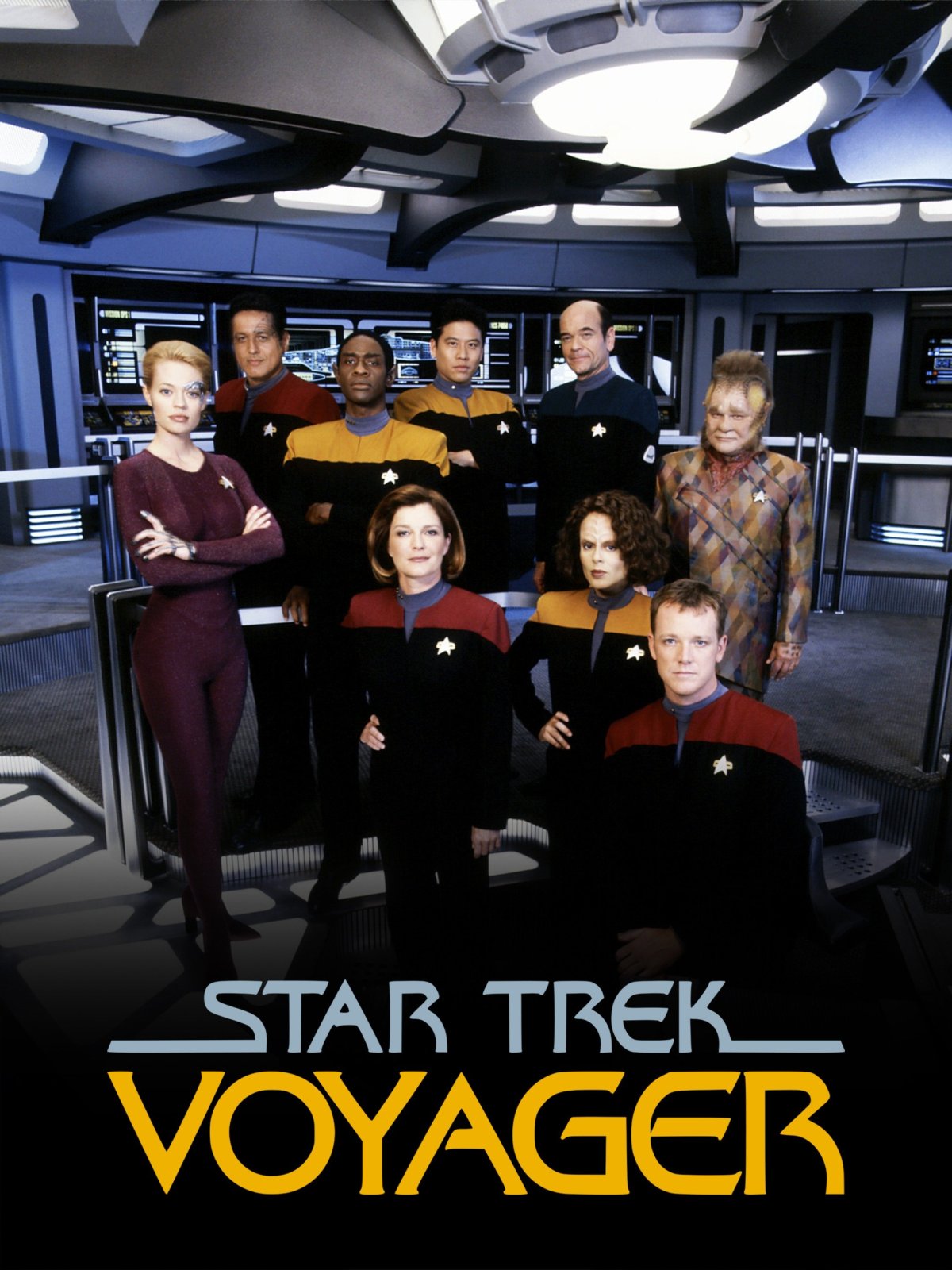
As brilliant as Patrick Stewart was as Captain Jean-Luc Picard on TNG, so was Kate Mulgrew as Captain Kathryn Janeway on Voyager. Let’s just stop there and call it even. Likewise, both casts matchup well with Data on TNG and Seven of Nine on Voyager getting the nods as my favorites. Touché again.

But perhaps what puts Voyager over the top is simply the passage of time, both fictionally in the scripts and, as to the tools available for filming. As to the former, Starfleet technology advanced especially in the use of the Holodeck, a recreational device in which crewmembers freely interacted in an imaginary setting of their choice. To the latter, TV special effects just got better and for the first time in the Trek series were enhanced through the use of CGI (“Computer Generated Images). TNG had made a giant leap however in this regard when compared to the original Star Trek series which at times often completely lost the feel of traveling through outer space.

Voyager lasted seven seasons (1995-2001). It started just after and ran concurrently with Deep Space Nine which failed to catch my fancy along with the other subsequent Trek series that have maintained the franchise. So, if like me, sci-fi is not your thing, like me, you might find enjoyment in Voyager. On the other hand, if you regularly attend Trekkie conventions, where do you rank Voyager amongst the Star Trek canon?

TV Draft Round 8 – Pick 4 – John Selects – The Two Ronnies

Welcome to the Hanspostcard TV Draft. I hope you will enjoy it! Today’s post was written by John from The Sound Of One Hand Typing.

Sunday nights at the Holton house in Chicago would see Mary and I in front of the TV at 10 PM, watching Monty Python’s Flying Circus, Dave Allen At Large (which it doesn’t look like anyone choe for this; maybe I’ll write it up later), The Two Ronnies, and Doctor Who.

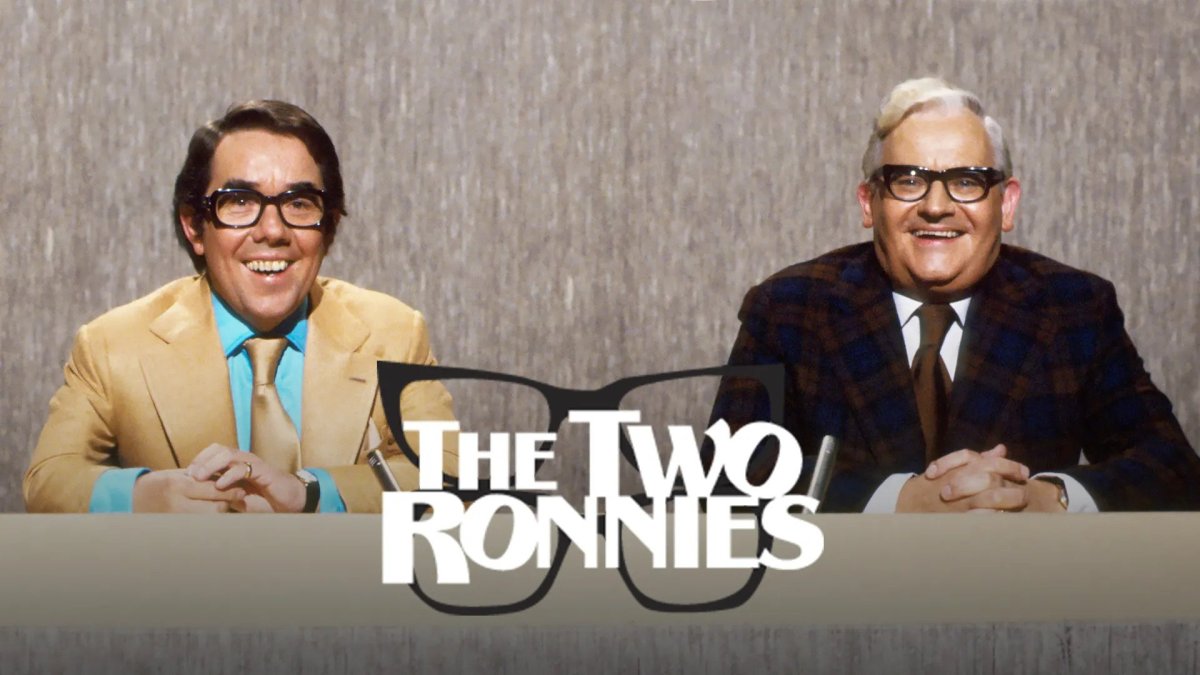
The Two Ronnies was a comedy and variety show that ran on the BBC from April 1971 to December 1987. It starred British comedians and actors Ronnie Corbett and Ronnie Barker. They met in 1963 when Corbett was a bartender at The Buckstone Club in Haymarket, London, and Barker was making a name for himself in the West End and on radio. They first appeared on The Frost Report with John Cleese, but their big break came when they improvised through an eleven minute technical issue at the BAFTA Awards in 1970. In the audience was Bill Cotton, head of Light Entertainment for the BBC, who signed them to a contract.

Personality- and appearance-wise, the two looked completely different: Barker was big, heavy, and spoke with a blue-collar accent, while Corbett was short, slight, and spoke with more of an upper-class accent. They didn’t become a comedy team like Morecambe & Wise and continued to work on separate projects while they were doing the show. They had some of the best comedy writers working with them, including most of the cast of Monty Python’s Flying Circus (John Cleese, Eric Idele, Michael Palin, and Terry Jones), and Spike Milligan, and Corbett wrote some sketches using the pseudonym “Gerald Wiley.” The humor was, for its time, off-color, relied on double-entendres and what would now be considered not politically correct and sometimes downright offensive. Kind of a higher-class The Benny Hill Show.

The show started and ended with a “news broadcast,” where the two would take turns reading humorous fake news items, such as “Someone broke into the local police station and stole all the toilet seats. Police have nothing to go on.” During the rest of the show, they would do comedy sketches together and separately. For example, “Swedish Made Simple.”

Another with the two: “The Inventor’s Convention.”

An example of Barker working alone is “TV Symbols.”

During each show, Corbett would sit in a chair and tell a joke, getting sidetracked as he was telling it.

The last sketch of the show was usually a musical one, in the grand tradition of the British musical theater. Some of the earlier shows had a continuing story instead of the musical number; I don’t recall seeing any of them when they were broadcast on WTTW in Chicago. I have a couple of examples. This is “Yeomen of the Guard.”

Another: “The Sultan’s Harem.”

The show would end as it began, with Corbett and Barker reading some late “news items,” and with a running gag, where Corbett would say, “that’s all we have time for, so it’s good night from me,” and Barker would say “And it’s good night from him.”

All the shows have been released on DVD. Many of them are available from eBay. Britbox or Acorn might have them available as well. Many of their sketches and musical numbers can be found on YouTube as well.

TV Draft Round 8 – Pick 2 – Dave Selects – SCTV

Welcome to the Hanspostcard TV Draft. I hope you will enjoy it! Today’s post was written by Dave at https://soundday.wordpress.com/

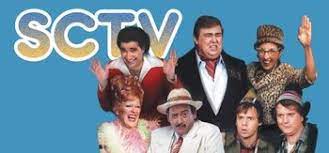
SCTV

For my next pick in this TV event, I go to a show that always made me laugh hysterically…and make me feel a bit proud. SCTV was not only one of the funniest and most creative shows of its era, it was Canadian to boot.

SCTV stands for “Second City Television”, because it sprung forth from Second City. That was (and remains to this day) a ground-breaking comedy troupe and theater from Chicage (America’s “Second City”). It opened its doors in 1959, and by 1961 was making stars out of people like Joan Rivers and Alan Arkin with their creative comedy sketches. But instead of just playing their home city, the organization had big dreams – ones they’ve fulfilled as they describe themselves as “the most influential and prolific comedy empire in the world.”  They began touring with their show and found an enthusiastic response in Toronto when they played there in 1963. Second City took note, and ten years later opened a second club there, in its early months “no air conditioning, no liquor license and almost no audience.” That quickly changed though as they moved to a bigger venue and found homegrown wits like Catherine O’Hara, Dave Thomas and John Candy.

Only a couple of years in, there was interest in making it into a TV show. Once the idea was hatched to do a show about “the world’s smallest TV station”, the cast was on board. They saw endless possibilities of skits involving actual TV shows they could satirize, goofy commercials and behind-the-scenes follies involving the fictional station’s management. Global TV (a Canadian network) was interested and put them on air in 1976, with a half-hour show. After a couple of years, they canceled it but soon an independent company in Edmonton bought the idea, moved the players to the Prairies and resurrected it, soon selling the show to Canada’s premier network, CBC. A few stations in the U.S. began running re-runs, and soon NBC came knocking, wanting a replacement for the Midnight Special. They ran it for a couple of years as a 90-minute late night show (rather akin to Saturday Night Live)  but were said to be rather lacking in commitment to it, and after two seasons axed it when the crew refused to re-jig the show to run on Sunday evenings against 60 Minutes. (NBC also wanted it made much more G-rated, family-oriented humor rather than the edgy satire they SCTV was making.) At that time Cinemax cable in the U.S. and a Canadian subsidiary revived it for one final season of 45 minute shows. By 1984 when it wrapped up, they’d made 135 episodes of varying length and production quality…and created both some big-name stars and some entirely memorable characters.

SCTV‘s original cast was largely kept in tact through the years and was a goldmine of comic talent. They were essentiallly unknown then but wouldn’t stay that for long.  Andrea Martin, Catherine O’Hara, John Candy, Eugene Levy, Rick Moranis, Joe Flaherty, Harold Ramis… funny each one in their own right but brilliant together in an ensemble. Of them, only Ramis was brought in from American Second City; Moranis came in directly from a background of being a radio DJ in Toronto! We see their ongoing work in so many great comedy films like Home Alone, Ghostbusters, My Big Fat Greek Wedding, Splash and TV shows like Schitt’s Creek.  In terms of launching great careers in comedy, it’s probably second only to Saturday Night Live…and that one has had an advantage of  40 more years of talent to be culled from.

That alone made the show noteworthy, but it was great because of the strength of the shows themselves and the sketches they created. The station which was set in the imaginary town of Melonville was run by Guy Caballero, a boss played by Joe Flaherty, whose character was as shady as his suit was blinding white. Guy was confined to a wheelchair… but quick to jump up and run away when threatened. His station was inhabited by regulars like boozy, washed up playboy-type Johnny LaRue (Candy), and the owner, leopard-print clad cougar Edith Prickley (Martin), and the hapless local news team of dim-witted Earl Camembert (Levy) and hard-nosed Floyd Robertson (Flaherty). Between the workplace bits we got to see the fine programming of SCTV…things like Bill Needle’s ascerbic talk show, Count Floyd’s “Monster Horror Chiller Theater” (which sometimes boasted titles like the “3D House of Cats”… you simply had to see it to appreciate the “3D” effect!) , kids show “Mrs Falbo’s Tiny town” and various movies, usually parodies of real hit ones. And in between we’d get commercials for local businesses like Harry, the Guy with the Snake on His Face and his adult video store.  Like the Simpsons later, the shows were funny enough at face value but took on an added level of hilarity when one was wise to exactly what they were spoofing.

About 40 years has passed since it went off the air, but even the thought of things like the opening scene of “Mrs. Falbo’s Tiny Town” (remember her trying to drive?), Flaherty as Count Floyd (the frustrated late night movie host dressed as a vampire who often had to admit, “well that wasn’t very scary, kids…”) John Candy as Paul Fistinyourface, the angry high school teen on the TV dance show or as Gil Fisher “The Fishin’ Musician” crack me up. Speaking of the last, “The Fishin’ Musician” with Candy as Gil, the fisherman with his guide Ol’ Willie (who looked a lot like Willie Nelson and took the fishing boat ‘out into the weeds’ every time, natch) was their way of allowing for musical numbers. Through the years bands like Rough Trade, The Tubes and Boomtown Rats went fishin’ with Gil…and playing a little number or two. In retrospect, years later it became even funnier seeing Bob Geldof as a disgruntled punker with the Boomtown Rats and acting as a high school tough in their parody of To Sir with Love , “Teacher’s Pet” (with Eugene Levy as Ricardo Montalban, an ongoing spoof on the show, being the Corinthian lether-loving teacher).

It was a different kind of humor, probably ahead of its time and perhaps to Americans, a wee bit odd. I’m frequently told, living in the U.S., that I have a different sense of humor than many Americans; I think Canada is a cultural “bridge” between the States and Britain, and that applies to our comic sensibilites too. SCTV found the happy medium to be edgy for the mainstream but not so much so as to be confounding or alienating.  All that said, ironically, the ongoing skit on SCTV I found the most tiresome was the one that was probably it’s most popular and the one which reveled in its Canadianism – Bob and Doug McKenzie and the “Great White North.” But no one hits it out of the park every time…SCTV is remembered because it did more often than not. When a show of largely social satire from four decades back can still make me fall on the floor laughing, they must have been something special. And they were.

TV Draft Round 8 – Pick 1 – Lisa Selects – New Tricks

Welcome to the Hanspostcard TV Draft. I hope you will enjoy it! Today’s post was written by Lisa at https://tao-talk.com/

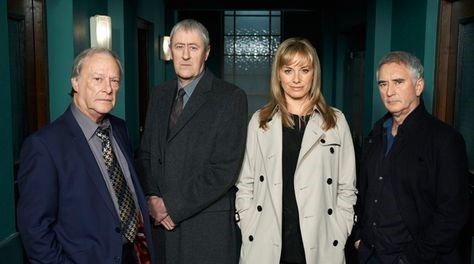
Pic1l. – r. Jack, Gerry, Sandra, and Brian

Although I had another series slated for this spot, I changed my mind again. I noticed I had no series chosen with a female lead, and that just isn’t cool in my book. Instead of whatever it was, now it is the UK’s BBC Series, “New Tricks,” which ran for 12 seasons (107 episodes,) from 2003 – 2015. Originally airing on BBC, it is now available, depending on season, on BBC Video, Acorn Media, or BBC First.

I remember browsing titles at the library’s online database and happening across it. I immediately loved the premise for the series, which describes a very talented and rising star in the law enforcement ranks being asked to lead a newly formed task force to work cold cases. The team is a group of older, already retired detectives that are being asked to come out of retirement to try to crack old cases that have remained unsolved for sometimes twenty years or more. The genres of New Tricks are comedy and crime.

Cute video about how team was formed:

Pic2Amanda Redman as Deputy Superintendant Sandra Pullman
The Cast:
Amanda Redman as Deputy Superintendant Sandra Pullman is the tough-edged, wise-cracking career law enforcement rising star. Sandra has never married and has no children. She has a nice home that she doesn’t seem to get very much time to relax in and enjoy as the tacit understanding with her team is that she is available to them 24/7; and they do take her up on it. Sandra’s mother lives in assisted living; but the two feel mutually uncomfortably incompatible with each other. Sandra preferred her late father, who was also a police officer, and there is a sense that Sandra’s mother resents her for choosing her dad over her. At the same time Sandra’s mom has never told Sandra the whole truth about her dad, whose story does get slowly revealed over time.

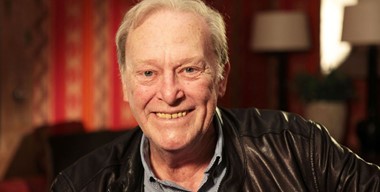
Pic3Dennis Waterman as Gerry Standing

Dennis Waterman plays Gerry Standing, a man who has been divorced a few times and has at least a few babymama’s. He is always complaining that his ex-wives are draining him dry with child support. Gerry has got a roving eye for the ladies and is frequently trying to make time with a “tasty piece of skirt.” It doesn’t take much to imagine he might be multiply divorced because of that tendency. That said, he’s very friendly with all of his ex-wives and his daughters, and his ex-wives and daughters are all friendly with each other. Poor Gerry doesn’t stand a chance with all of that estrogen power. As the series rolls on there is a suggestion that Gerry might have had some crooked or at least semi-crooked history while he was a detective before. He also may have/had a problem with gambling, which can always lead a person down a crooked path. Gerry lives alone in a nice home. Once in awhile he does get lucky and finds a date.

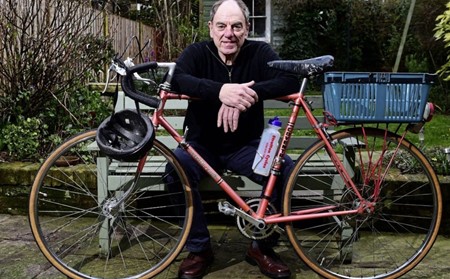
Pic4Alun Armstrong as Brian Lane

Alun Armstrong plays Brian Lane. Brian is married to Esther, who is played by Susan Jameson. Brian is what some might call an odd duck. His history is that of a raging alcoholic that has gone to rehab and remains sober; mental health issues manifest themselves in myriad Aspergersian perceptions, beliefs, and actions. Brian is highly intelligent and has a tendency to obsess over cases and lots of other things. He’s a master of internet and other records searches and has the analytic capacity to synthesize clues into often viable theories. He’s frequently trying new hobbies or practicing old ones. He rides his bike everywhere (not sure if he lost his driver’s license from drunk driving or not.)

Pic5Susan Jameson as Esther
Esther is an endearing character, but she doesn’t take much of Brian’s guff. At the same time, she is there for him, steadfast, calm, and catering to him in a way that keeps him emotionally regulated (with the help of his prescription medications.) Esther has made a lovely home atmosphere and keeps her own mind and body active with socializing with friends and with hobbies. She is also very welcoming of the other team members, as they, along with the work, also help to keep Brian stable.

Pic6

James Bolam as Jack Halford

James Bolam plays Jack Halford. Jack is a widower whose wife, Mary, was killed, where the details of her death are revealed over time. Jack has a shrine of his wife set up in his back yard. He has regular conversations with her spirit that remains very much alive to Jack. Jack is the most by-the-book of the team, both with regulations and with ethics. Don’t ask Jack to bend the rules; he’s likely to box your ears. Jack is another excellent clue analyzer. He probably has the worst temper of the bunch and gets stressed out a lot.

Pic7

Anthony Calf as D.A.C. Strickland

Anthony Calf plays D.A.C. Strickland. Strickland is the administrator who hired Sandra and lays out his expectations for the Cold Case Team (UCOS is its official acronym that sometimes gets made fun of.) If I remember correctly all four of them are resistant to all of the others at first for one reason or another. Strickland is a very sharp-minded strategist who knows what he’s doing and is often several moves ahead of everyone else. His presentation is deadpan, but his humor is sharp. Even though he seems intimidating, Sandra can usually wheedle what she needs out of him. When the team is successful, he, of course, makes sure everyone knows he is the one who made it happen.

The other main cast characters are other team members who replace the main four, but only after many seasons have passed. I watched the series through season 10, but stopped after more of the original people were gone than remained. I can’t say a lot about these other folks other than who they are and who they played.

Pic8

l. – r.: Gerry, Danny, Sasha, and Steve

Denis Lawson as Steve McAndrew
Nicholas Lyndhurst as Danny Griffin
Tamzin Outhwaite as DCI Sasha Miller

Most every episode there is a new villain or villains; very few carry over beyond one. The locations vary from urban to rural. One of my favorite episodes (a 2-part) is set at The Rock of Gibraltar.

Writing and Directing Credits
Writing credits on every episode go to Nigel McCrery and Roy Mitchell, with almost 40 others getting credits over the 12 seasons. There were 25 different directors, with Julian Simpson directing the most, at 17.

Synopsis: As already described above, the team has been pulled together to solve cold cases. Although Sandra was on an upward trajectory, she’s been convinced to give this project a chance. I think it is sold as having potential to put a nice feather in her professional cap. Gerry is convinced because he needs the money to pay child support. Brian needs to be consumed with work to keep himself sane so he jumps at the chance. Jack is lost without his beloved Mary and agrees because he has nothing better to do in his solitude. As the team members orient themselves to each other and solve a few cases, things begin to fall together with them. All three guys don’t take Sandra very seriously until they begin to see she’s a tough bird who isn’t going to tolerate any guff from any of them. What follows is a grudging admiration for her management and crime-solving skills, that over time becomes a trusting and bonding for all of them. That said, it doesn’t mean she doesn’t have to bust their chops from time to time.

Impressions: My years as a team member in a juvenile probation department has me very much appreciating, “New Tricks.” When you’re dealing with dangerous crimes and criminals you had better know your co-workers have your back. I love how they all work together. They team up all sorts of ways, from two-somes, three-somes, or all-somes. They also frequently socialize together after work. They are available to each other 24/7, as you never know when a piece of the puzzle falls together and you want to share it with your buds. I love the humor in the show also. Brian is the most obvious nutcase that gets into some way-out situations, but all of them play into the humor together. Sandra has the cosmos in her eyes and her expressions are priceless. Gerry has some hilarious expressions and situations also. Jack is the most serious one of the bunch but even he lightens up from time to time.

In conclusion, the combined investigative experience of the team is impressive, and they all have long memories from their earlier work days. It really comes in handy when they are investigating long-cold cases. I also don’t think I’ve ever seen a TV series that focuses only on cold cases. I love the title, and I love the unspoken message that older people still have a lot to give to better their communities.

Montage set to music: https://youtu.be/AGuOHIN65ow

Grade: 9

Etc.: filmed in London; The theme song for the series is performed by Dennis Waterman (Gerry Standing). The song “End of the Line” is originally by the Traveling Wilburys. I’m very sorry to say I just learned that Dennis Waterman, who played Gerry, passed away on 5/8. After watching a YouTube (https://youtu.be/q8Hmp5lvF4A) I also learned that he was once considered the “hottest man on TV.”

Awards: 1 win and 4 nominations

Intro with theme song video:

TV Draft Round 7 – Pick 8 – Keith Selects – The Honeymooners

backdrop-1920
Welcome to the Hanspostcard TV Draft. I hope you will enjoy it! Today’s post was written by Keith at https://nostalgicitalian.com/

For my next pick in the Hanspostcard TV Show Draft is one that is one of my all time favorites. I don’t remember when I first was introduced to this show, but I am guessing my dad had something to do with it. Early on in the draft, I chose Police Squad, which only aired 6 episodes. This show is known for its “Classic 39” – The Honeymooners.

This isn’t my first blog about the show. Some time ago, I took part in a “Favorite TV Episode” Blogathon and picked 2 of my favorite episodes to present. You can read that blog here:

https://nostalgicitalian.com/2019/03/22/some-favorite-tv-episodes/

When you think about 50’s TV shows, there was very little struggle involved. Think about it. I Love Lucy, The Adventures of Ozzie and Harriet, The Andy Griffith Show, and Leave it to Beaver all showed families who were living in nice homes or apartments, showed no signs of financial struggles, and while there may be a misunderstanding here and there, it was mostly “bliss.” In 1955-1956, however, The Honeymooners focused on two couples from New York, who were struggling to get by.

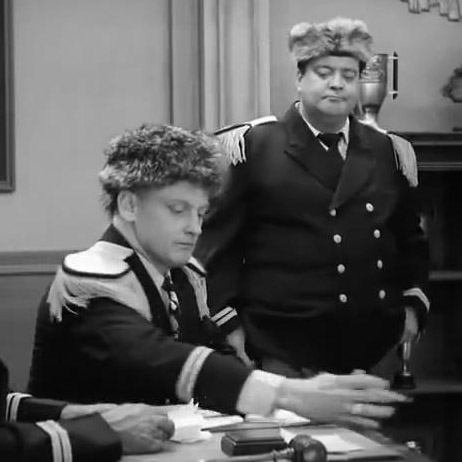
The show focused on the lives of Ralph (Jackie Gleason) and Alice Kramden (Audrey Meadows), and Ed (Art Carney) and Trixie Norton (Joyce Randolph). One article I found on the show says this about Gleason’s Kramden character: Ralph was the get-rich-quick scheming, short-tempered, soft-hearted guy who was always striving for greatness, but never made it out of that two-room Brooklyn apartment. And that’s one of the main attractions for even the most casual of viewers: the characters are so identifiable. As Jackie himself said at the time, “Everything we did could have happened. People like the show, because we are them.”

The show began as a simple sketch on the DuMont Television Network, on the Cavalcade of Stars. The original hosts were Jack Carter and Jerry Lester, but in July of 1950 comedian Jackie Gleason took over the hosting duties. In the process, Gleason took the struggling show and turned it around to be a hit. The show, which featured comedy skits and a number of different performers each week, was broadcast live in front of a theater audience. In 1951, Jackie and his writers came up with the idea for a sketch called The Honeymooners. It was about a struggling couple living in Brooklyn who frequently fought, but in the end, there was no question that they loved each other.

Leonard Stern was a writer on both The Honeymooners and The Jackie Gleason Show. In an interview with the Archive of American Television he stated, “We started doing one sketch of The Honeymooners every five or six weeks and the response of people on the street was tremendous. So we started doing them every other week. Eventually, though, everyone, including Jackie, lost interest in the other characters in the different sketches, so we started to do them every week until the fatigue level hit its high and we’d have to take a break. I think Gleason had fun doing them, because he recognized the impact Kramden and Alice and Norton and Trixie were having on the audience. I’m not a great fan of ratings, but let me say that 53% of the total television audience was watching the show. There’s nothing like that in existence today. It was astonishing and the show itself was live. Remember, the audience of 3,000 people filled that theater. You earned your laughs. It was a resounding success and very exhilarating for all of us. It was opening night every week.”

honeymooners-406064

When Gleason left the Dupont Network and went to CBS, he hosted the Jackie Gleason Show, where the Honeymooners sketches continued. In the 1952 season, the sketches usually ran between seven and 13 minutes. In the following season, and those sketches ran for a minimum of 30 minutes, and sometimes longer. Then, in the 1954-55 season, they actually filled the entire hour of The Jackie Gleason Show and was doing so well in the ratings that it occasionally surpassed the viewership of I Love Lucy. That is almost unheard of!

In the 1955-56 season, The Jackie Gleason Show literally became The Honeymooners! It aired as a half-hour sitcom that was filmed in front of a studio audience. In total, 39 episodes were produced, and these episodes are the ones that are still being broadcast today. These 39 episodes are the ones that most people remember.

I read an article that said Jackie Gleason had actually been given a three-year contract from CBS for 78 episodes of The Honeymooners to be produced in the first two seasons. The contract also included an option for a third season of 39 more. For whatever it is worth, Gleason felt the quality of the scriptwriting couldn’t be maintained, and the show was mutually canceled by him and CBS.

honeymooners-ralph-alice

A Closer Weekly article says: What’s particularly impressive about The Honeymooners living on the way it has is the fact that back in the day, there needed to be a minimum of 100 episodes of a show available so that local stations could run it five days a week. Any less made syndication difficult, since the cycle would be repeated that much sooner. But then there was The Honeymooners, with a mere 39 episodes to offer up, yet it worked. And continues to do so.

In a 1996 appearance on The Tonight Show with Johnny Carson, Jackie was asked why the show ended. He told Carson, “We were running out of ideas. I liked The Honeymooners and I liked doing them, and I didn’t want to denigrate them by forcing scenes that didn’t mean anything. So I wanted to quit, but they didn’t believe me. They thought I had another job someplace, but I didn’t. I’m glad I did stop them, because what we had done was good and if we had gone any further, we might have spoiled it.”

Those “Classic 39” are classic for a reason. They are still funny. The situations that The Kramdens and the Nortons muddle through every week will make you laugh, cry, think, and smile. They still hold up today. Each one of them has memorable scenes and quotable lines.

In one episode Ralph tells his boss he is a great golfer and is immediately asked to go play around with him. Now Ralph needs to learn how to play – and fast. He finds the perfect teacher in his best friend Ed Norton. In pure Art Carney fashion, Ed reads from a book that you must “address the ball,” to which he takes the club, stands in front of the ball, looks down and says, “Hello, Ball!”

CaGM5jOWAAA7Sr0

An episode of the show was featured in the movie Back To The Future. When Marty McFly winds up in 1955, a family is watching the episode The Man From Space. Intending to win the $50 first prize at the Racoon Lodge’s costume ball, Ralph decides to create his own outfit. And what an outfit! After appropriating (among other things) a faucet, a pot, a radio tube, and the icebox door, he presents himself as the Man from Space.

9889_1

In another episode, Alice says she wants to go dancing. Ralph has Ed come over to teach him how to dance. Ralph’s outfit is hilarious (he tells Alice it is “what all us cats where! I’m hip!”). The dance (to the song The Hucklebuck) is worth the watch.

PmDm7tMV5BNzk3MGZjMjQtMTFhZi00ZmJkLWI4ZTMtZDk1NmJkYWRiNzM0XkEyXkFqcGdeQXVyMzI3NTM1OQ@@._V1_

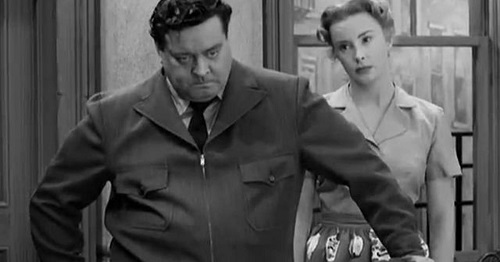
To me, sometimes the funniest stuff can be as simple as Ralph’s face …

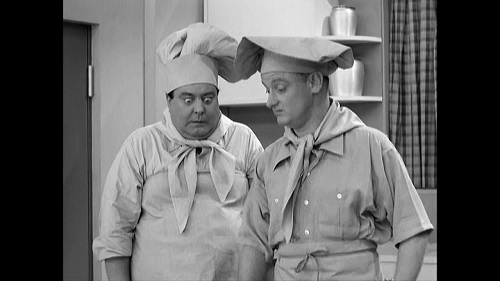
In another classic episode, Ralph and Norton appear on a TV commercial trying to sell their Handy Housewife Helper, a kitchen gadget that can, among other things, open cans, remove corns, and “core an apple.” In the inspired, ad-lib-laden episode, “Chef of the Future” Ralph demonstrates the wonders of the gizmo to “Chef of the Past” Norton. Rehearsal goes great, but in front of live cameras, Ralph freezes up.

chef

Art Carney was the perfect second banana. The play between him and Gleason is classic. In one episode Norton’s sleepwalking becomes a waking nightmare for Ralph. Ralph can’t get any sleep because he’s been asked to keep his pal from wandering off on late-night strolls around the neighborhood.

sleep9_orig

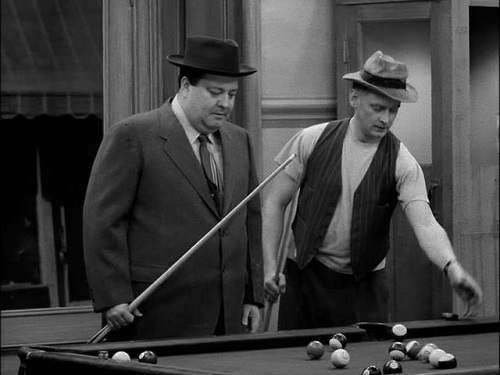
Another classic episode takes place at the pool hall where Ralph gets into an argument with the diminutive guy named George. “My friend is even bigger than me,” he tells Ralph. “I have a friend Shirley that’s bigger than you,” Ralph counters. But then he comes eye-to-chin with George’s friend, the towering Harvey, who challenges Ralph to a fight. This prompts Norton to observe: “He’s even bigger than your friend Shirley.”

PDVD_102

Many of the plot lines from the classic episodes made it into the Joe Piscopo and Eddie Murphy novelty hit “The Honeymooners Rap.”

In the 1980’s, Jackie Gleason announced that in his vault he had found a number of Honeymooners skits from The Jackie Gleason Show that had been shot on Kinescope, which is a way of filming directly through a lens that actually focused on the screen of a video monitor. 107 of those skits were released on DVD and syndicated to television stations. These would have been shot before the “Classic 39” and two of them stand out to me.

Jackie had been a guest star on the Jack Benny Show, so Jack makes an appearance as the Kramden’s landlord. The rent is being raised and Ralph is mad. When there is a knock on the door, Ralph opens it and Jack Benny is standing there. The audience chuckles in anticipation. Ralph calls to Alice that “the Landlord’s here” and the audience erupts. Benny stands there quietly as Ralph reads him the riot act! He calls him a “penny pincher” (which plays into Benny’s “cheap” character”) and says that he pinches a penny so hard that when he is through “both heads and tails are on the same side of the coin!”

benny

In another lost episode, Ralph must lose weight for work. All through the episode, he is starving. Finally, he is left alone in the apartment and sitting at the kitchen table. He notices a cake pan. He lifts the lid and sees the cake. His eyes bulge and he goes nuts. As he is about to tear into the cake Alice walks in. “Everybody get back,” he yells! The brief 3 minutes of him staring at the cake before getting ready to eat it is comedy genius!

screenshot-400

As brilliant as Jackie Gleason was as Ralph Kramden, he never won an Emmy Award for it. Art Carney, however, won 5 Emmys for Best Supporting Actor on The Honeymooners and the Jackie Gleason Show.

The Honeymooners influenced a huge 1960s cartoon – The Flintstones. It is a blatant rip-off of the show and was a huge hit. It is said that Gleason considered suing Hanna-Barbera Productions because of the similarities, but decided that he did not want to be known as “the guy who yanked Fred Flintstone off the air”

E9v6fSFXIAM1gqrKihew-1449851094-754-list_items-frats_honeymooners

Water Buffalo members and Racoon members

The Honeymooners is over 65 years years old! Joyce Randolph, who played Trixie Norton is 97 years old and still going strong. I wonder if Gleason ever thought that those 39 episodes would still find an audience today and that they would still bring much laughter.

In 1990, Audrey Meadows joined Bob Costas on Later to discuss the show. You can see that footage here:

If you have never seen an episode, I encourage you to do so. The two episodes I mentioned in a previous blog are good places to start – TV or Not TV or A Matter of Record. Most are available on Youtube.

Thanks for reading!

TV Draft Round 7 – Pick 7 – Liam Selects – The Rocky and Bullwinkle Show

Welcome to the Hanspostcard TV Draft. I hope you will enjoy it! Today’s post was written by Liam at https://othemts.wordpress.com/

The Rocky and Bullwinkle Show

(1959 – 1964)

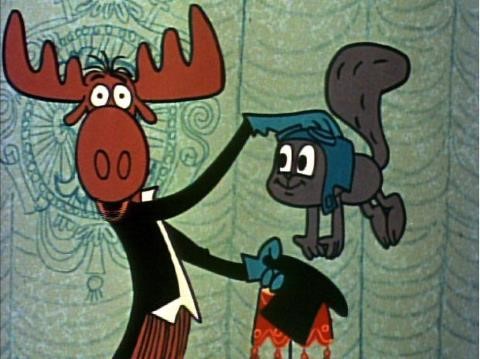
When you have an animated series featuring talking animals, the natural inclination is to file it under “Children’s Entertainment.”  And yet The Rocky and Bullwinkle Show featured witty wordplay, spoofs of popular culture, self-referential humor, and political satire (particularly regarding the Cold War). You can tell that network execs were confused by the fact that they sometimes aired the show in prime time and sometimes on Saturday morning.  During the show’s five season run from 1959 to 1964 it also switched networks.  For the first two seasons it was on ABC and called Rocky and His Friends. Then it moved to NBC and became The Bullwinkle Show.  CBS never gave it a shot but the show lived on in syndication under the names The Rocky Show, The Rocky and Bullwinkle Show, The Adventures of Rocky and Bullwinkle, and The Adventures of Bullwinkle and Rocky. Whew!

Ok, but beyond this rocky (pun intended) broadcast history, what was the show about?  Jay Ward created the show to be an ongoing adventure serial about a moose and a squirrel. Animator Alex Anderson created many of the characters but declined to work on the show itself.  Ward hired Bill Scott as head writer and co-producer of the show, as well as writers Chris Hayward and Allan Burns. General Mills came on board as the show’s main sponsor. The ongoing serial featured four main characters, two heroes and two villains:

  • Rocket J. Squirrel (a.k.a. Rocky the Flying Squirrel), voiced by June Foray, is a noble all-American kid in squirrel form who serves as the straight man to his partner Bullwinkle’s antics. His catchphrase is “Hokey smokes!”
  • Bullwinkle J. Moose, voiced by Bill Scott, is a good-hearted and optimistic, but very dimwitted moose. He and Rocky are roommates in the fictional town of Frostbite Falls, Minnesota.  He attended Wossamotta U. on a football scholarship.
  • Boris Badenov, voiced by Paul Frees, is a spy from the fictional nation of Pottsylvania (a thinly disguised amalgamation of countries behind the Iron Curtain.). He is constantly up to no good and scheming on a plan given to him by his Fearless Leader or concocting his own criminal conspiracy. He proudly introduces himself as the “world’s greatest no-goodnik.”
  • Natasha Fatale, voiced by June Foray, is another Pottsylvania spy and Boris’ partner in crime. The design of Boris and Natasha are inspired by Charles Addams’ characters Gomez and Morticia Addams.

Over five seasons and 163 episodes, Rocky & Bullwinkle and Boris & Natasha appeared in 28 different serialized story arcs. The shortest serial had only 4 chapters while the longest had 40!  And this was in the days before DVD box sets and streaming video made binge watching possible, so the creators of the show put a lot of faith in the audience remembering what happened earlier in the story.

A typical 23-minute episode would have two segments of a Rocky & Bullwinkle serial, each ending on a cliffhanger (and a bad pun).  Additionally, the show would have a couple of supporting features drawn from the following:

  • Dudley Do-Right of the Mounties – In a parody of silent film melodramas, the brave but dumber-than-Bullwinkle mounted policeman Dudley Do-Right (Bill Scott) attempts to foil the plots of the villainous Snidley Whiplash (Hans Conried). This usually requires rescuing Nell Fenwick (June Foray), whom Dudley loves, but she in return is only fond of his horse.
  • Aesop and Son – Old fables are retold in a comical way by Aesop (Charles Ruggles) and his son, Junior (Daws Butler).
  • Fractured Fairy Tales – Edward Everett Horton narrates fairy tales updated with modern themes and a lot of puns.
  • Peabody’s Improbable History – Mister Peabody (Bill Scott), a genius talking dog, adopts a boy named Sherman (Walter Tetley). Since the boy needs exercise, Peabody invents a time machine called the WABAC. They travel to various historical events to see what “really” happened.
  • Bullwinkle’s Corner – Bullwinkle attempts to be cultured by reading poetry with comical results.
  • Know-it All – Bullwinkle, who we have already noted is quite dim, attempts to be the authority of various topics while Boris Badenov undermines his efforts.

The one great flaw of The Rocky and Bullwinkle Show is its animation style.  Television animation of the 50s and 60s relied on the practices of limited animation such as reusing simple backgrounds and the stilted motions of the characters to save money.  But even by the standards of limited animation, The Rocky and Bulwinkle Show’s animation was choppy and full of visible flaws.  General Mills insisted on outsourcing the animation to the Mexican studio Gamma Productions S.A. de C.V, and Ward was never happy with the quality.  But ultimately, the witty scripts and terrific voice acting made the poor quality animation irrelevant to the show becoming a classic.

The Rocky and Bullwinkle Show legacy lives on in syndicated reruns.  Despite never being a morning person, I went through a phase as a teenager in the late 1980s where I would get up to watch it at 6am before school!  The show has also been released in various home media formats.  Attempts to revive the show in the 1970s and 80s failed but it eventually found its way to the big screen.  Boris and Natasha: The Movie (1992) and Dudley Do-Right (1999) were live-action adaptations that both bombed. A live-action/animated hybrid movie The Adventures of Rocky and Bullwinkle (2000) was also poorly received.  Mr. Peabody & Sherman (2014) from DreamWorks Animation got much better reviews and spun off a Netflix series (2015-2017).  DreamWorks Animation Television followed up with a reboot series of The Adventures of Rocky and Bullwinkle (2018-2019) on Amazon Prime Video.  I have not watched any of these having remained loyal to the original work of Jay Ward and company.

TV Draft Round 7 – Pick 6 – Mike Selects – Friday Night Lights

Friday Night Lights

Welcome to the Hanspostcard TV Draft. I hope you will enjoy it! Today’s post was written by Mike at https://musiccitymike.net

Friday Night Lights

Back in the 1960s when I attended high school in New Jersey, high school football was important, but as I would later realize when I moved to Texas in the 1970s, maybe just not that important. While we went to all the games and rooted for our friends on the field, outside of a pretty lame pep rally at school on Friday afternoon, there wasn’t that much more to it. And if you looked hard the next day, you probably could find the box score in the Sports pages of the local morning paper.

Although I was warned, I still could not believe it until I saw it myself, that in Texas, the local TV stations showed filmed highlights of high school football on game nights. It also seemed that locals talked more about their favorite high school team than they did about the Cowboys or the Oilers. Then there were these large football fields all over town where on Friday nights in the fall and winter you would get stuck in traffic and yes, see those stadium lights!

This Texas phenomenon was dubbed Friday Night Lights and first memorialized in a 1990 non-fiction book that chronicled a small-town team in Odessa, Texas. In 2004, it was adapted for the big screen and was later made into the fictionalized television series that ran five seasons from 2006-2011. After the television version captured my heart on several levels, I went back and watched the movie only to quit after about 15 minutes. It was no match for the television series, and I just could not let it spoil my love for what I had seen on the small screen.

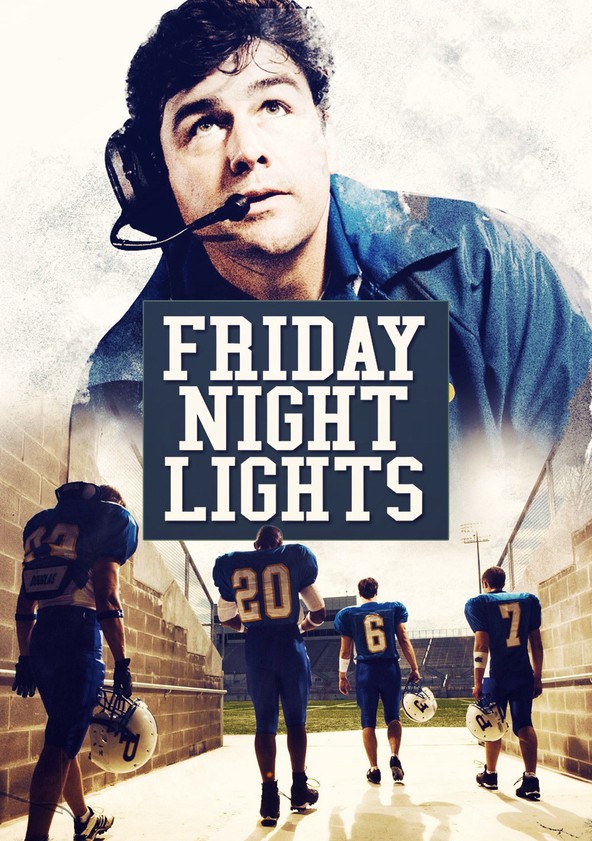
It goes without saying that having a love for football will make Friday Night Lights a more enjoyable experience, but the show does more than just portray Texas high school football. It features one of the best television families of all time with Kyle Chandler and Connie Britton playing parents to both their own child as well as the high schoolers they coach and counsel, respectively.

The show includes just about everything those high school years were about in addition to football. You see all the ups and downs of being a teenager in the 1980s brought on by social pressures and challenging relationships and of course the inevitable interference from sex, drugs, and alcohol. In addition to the coach’s family, there are several other family dynamics in play with storylines to follow.

Then there’s the football! As far as fictionized sports go, the drama of each season as well as of individual games is expertly depicted creating both the excitement of victory and the heartbreak of defeat. The show also works in all the behind-the-scenes stuff very well including the interfering influence of the local community and the pressure felt by the players, some of whom dreamed of playing in college and beyond.

Like any good show, Friday Night Lights is packed with emotion and runs us through cycles of bringing us down with setbacks later lifting our spirits through redemption. It’s a roller coaster ride for sure and features many great young actors who shine throughout the series. The show also deserves acclaim for its filming technique where most scenes were shot in a single take giving it a more natural feel.

Although it never scored a touchdown in the ratings, Friday Night Lights was a critical success, and it eventually received some Emmy nods in its final two seasons. The show is a must if you like football but don’t mind remembering how tough it was to go through school. I’m glad I gave it a try because it was well worth it despite bringing back some old memories I’d rather forget.

PS – There is one quick personal story that is too memorable for me not to share. While in the middle of obsessively streaming this show on-line, I took a respite from the annual East Nashville Tomatofest event on a hot summer’s afternoon to watch an episode in a coffee shop. Can you imagine my surprise when I walked out the door and immediately came upon actress Connie Britton, then star of the Nashville TV series, walking by pushing a baby stroller!

TV Draft Round 7 – Pick 5- John Selects – Burn Notice

Welcome to the Hanspostcard TV Draft. I hope you will enjoy it! Today’s post was written by John from https://thesoundofonehandtyping.com

Burn Notice aired on the USA Network from 2007 to 2013, 111 episodes in all. It was created by Matt Nix, based in Miami, and was a single-camera show.

l-r: Sharon Gless, Bruce Campbell, Jeffrey Donovan, Gabrielle Anwar.

Michael Westen (Jeffrey Donovan) is a spy. Or he was, until, in the middle of an operation, he gets a call informing him that he’s been burned, identified as an unreliable or risky operative. This comes as he’s closing a deal with a group of Nigerians, who take him out, beat him and leave him for dead. He wakes up sometime later in a hotel, being tended to by his former girlfriend Fiona Glenanne (Gabrielle Anwar), a former member of the IRA, who tells him that he’s in Miami, his hometown.

At this point, he has nothing: no work history, no money, no contacts in the intelligence community; in essence, he doesn’t exist. He’s being surveilled constantly, and knows that, if he leaves Miami, he’ll be arrested. He needs to do something for money, and, more importantly, find out who burned him and why. He enlists the help of Sam Axe (Bruce Campbell), a retired operative and Michael’s best friend, in his pursuits. Sam has no money (he hits on older women to sustain himself) and is known as “the guy who knows a guy.” Both Michael (Army Rangers, Green Berets) and Sam (Navy SEAL) have a Special Forces background, which makes their work as private investigators a natural fit. Fiona invites herself to help them, and her contributions (mostly with firearms) are not insignificant.

Michael’s mother, Madeline (Sharon Gless), usually sits at home, smoking cigarettes and fretting about Michael and his brother Nate (Seth Peterson), but she occasionally gets involved in Michael’s business. One interesting example: when Michael needed a list of names from the DMV, he sent his mother in to get it, where she worked with (and became friends with) a clerk played by Tyne Daly (a reunion of the lead characters in the ’80’s series Cagney & Lacey).

In the fourth season, Michael inadvertently burns another agent, Jesse Porter (Coby Bell). The two eventually reconciled and Jesse joined the group for the remainder of the series.

The shows themselves relied on action and, more importantly, narration by Westen as to what he was doing and why he was dong it, as though he was narrating a training film for operatives. It was a show that had a lot of supporting characters (many of whom were only in one episode) and several interesting subplots. Michael does manage to work his way back into the CIA, only to be hunted, arrested, shot at, and bullied. His friends stood with him, his brother died helping him dispose of a particularly psychopathic agent, and Madeline makes the ultimate sacrifice for him at the end of the series.

There was a prequel movie made, Burn Notice: The Fall of Sam Axe, that aired toward the end of the series, that focused on Sam during his days as a SEAL. Tod Goldberg wrote five tie-in novels that were particularly good that you can probably get at your local used bookstore (that’s where I got mine).

I really enjoyed the series because the characters, as wild and off-the-wall as they seemed, were very relatable. You can feel the heat between Michael and Fiona as their relationship goes from “former lovers” to “lovers,” you can appreciate the friendship between Michael, Sam, and Jesse, and witness Maddie’s love for her sons and Michael’s friends. The series doesn’t seem to be running on TV, but relatively inexpensive used copies of the DVD’s are available on eBay.

TV Draft Round 7 – Pick 4 – Max Selects – Life On Mars

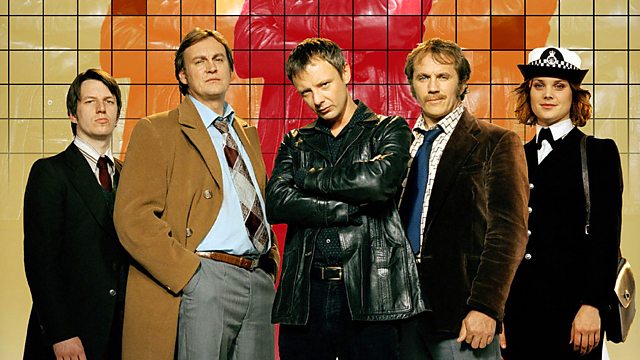
One of the reasons I started to blog in the first place back in 2017 was to tell people about this British show. The storyline is perfect for me. Life On Mars was made in 2006-2007 so for me, this is brand new! This one caught my attention immediately. The series only has 16 episodes total so it doesn’t take a lot of your time. Unlike America…they don’t usually milk a program to its last drop. 

If any of you are looking for something different…watch it! 

This is the show I most wanted to post about other than the Twilight Zone. It has Time Travel and the early seventies…whats not to like?

Life on Mars is simply great. I’m talking about the BBC original version… NOT the American version. Sometimes I wonder why instead of remaking a series as great as this… why not just show the superior British version in America in prime time? Do they think that it would be impossible for people to understand British accents? Why remake something that is inferior to the original?

The plot is about a police officer (Sam Tyler) in 2006 who gets hit by a car and wakes up in 1973…he doesn’t know if he has traveled through time, gone mad, or is in a coma. When he wakes he is a cop (Detective Inspector) in 1973 and has to deal with a non PC world that is vastly different from where he just came from… People do things with feel more than data gathering etc.

Same begins to understand that the modern world he came from didn’t have everything right. There is room for hunches and gut feelings. Gene sees that some of Sam’s ways work well on cases. The continue to learn from each other but it takes a while. Gene is not above framing a guilty man with little evidence while Sam pleads with him not to. Sam also learns to trust his inner instinct instead of just by the numbers police work. 

Sam had grown up in that neighborhood and he meets his mother and father but of course, they don’t see him as their son…he was only 4 years old at that time. None of the characters know he is from 2006. He only tells one person…Annie Cartwright and she doesn’t believe him. She thinks he received a concussion and this is a side effect. When Sam watches TV by himself…sometimes the people on a show will know who he is and try to communicate. The famous UK Test Card Girl will also come to life. 

They get the era down almost perfectly. The soundtrack is outstanding. The song in which the show is named is my favorite David Bowie song. I found music in this show that I had never known about…like Atomic Rooster’s  The Devil’s Answer…just to pick out one. It has one of the best soundtracks I’ve heard. Plus I never get tired of hearing the title track. 

They asked Paul McCartney if they could use Live and Let Die and he flatly refused. They sent him a few episodes to look at…he agreed instantly after that. The sequence to Live and Let Die is great. This show borrowed heavily from the UK 1970s Cop show The Sweeney…which is a great show itself. 

They made a sequel later on called Ashes To Ashes about a modern female police officer that gets trapped in the 80s with an older version of the original characters except for Sam and Annie. I would recommend watching that one also. I know of two bloggers (Hanspostcard and Lisa) who have watched this show because I recommended it…they both seemed to have liked it. Just DONT get the American version…it’s very cheesy and ends bad.

You can watch this show on Amazon Prime. 

For fans of the show… this was announced in March of 2022.

Life on Mars co-creator Matthew Graham has confirmed that he and his longtime collaborator Ashley Pharoah have scripted the pilot episode to a proposed sequel series.

News broke in 2020 that the team were developing a follow-up titled Lazarus, which would tie up the story that began in Life on Mars and continued in Ashes to Ashes.

The Characters are:

Gene Hunt

Chief Inspector Gene Hunt (Philip Glenister): – One of the best tv characters…EVER. Politically Incorrect to the core but a decent human being although he doesn’t always show it. He is Sam’s superior and although he won’t admit it much…he does respect Sam and Sam begrudgingly respects him. He does police work the old way…by feeling and hunches and it irritates Sam to no end. One of my favorite lines by him is “You are surrounded by armed bastards.” and “Your son, Mrs Bathurst, was a cold-hearted killer. And if there is a hell, he’s going there to be poked up the arse with sharp fiery sticks, forever and ever, Amen!”

The interplay between Gene Hunt and his crew is great:

Gene Hunt: “I think you’ve forgotten who you’re talking to.”
Sam Tyler: “An overweight, over-the-hill, nicotine-stained, borderline-alcoholic homophobe with a superiority complex and an unhealthy obsession with male bonding?”
Gene Hunt: “You make that sound like a bad thing.”

Chris Skelton: “I wonder what killed him?”
Gene Hunt: “That would be the bloody enormous hole in his chest where the bullet went in!”

Sam Tyler

Sam Tyler (John Simm): A modern man stuck in 1973 and he must work on police cases without a computer or data. He learns from Gene also…he doesn’t want to admit it but he finds out that the old hunches work out at times more than the data gathering. Both Sam and Gene need each other and when they are not fighting…they compliment each other rather well.

Annie Cartwright

Annie Cartwright (Liz White): A female in police at a time where women were often ignored, underused, undermined, and taken for granted. Annie is a bright woman, she studied for a psychology degree, wants to help people, deals with sexism well, has to be wary of what she says in front of the men, and leaves the situation otherwise she may get sacked. She slowly gets accepted by the team as a detective and helps solve a lot of cases. She ended up being one of my favorite characters. 

Ray Carling

Ray Carling (Dean Andrews): Ray is a tough-minded man who prefers brutality and corruption to do things Sam’s way. He is the one against Sam the most. Carling had applied for promotion to DI (Detective Inspector) that Sam got.

Chris Skelton

Chris Skelton (Marshall Lancaster): Chris is extremely naive and is learning on the job. He is generally regarded as a waste of space by Hunt throughout both series and plays only minor roles in the storylines that unfold. Skelton finally proves himself by saving Hunt, Tyler, and Annie Cartwright from death when he shoots and kills a criminal at point-blank range.

Here are some clips…the bottom three are short. 

https://www.youtube.com/watch?v=BFq2TT-tjZM

TV Draft Round 7 – Pick 3 – Dave Selects – Downton Abbey

Welcome to the Hanspostcard TV Draft. I hope you will enjoy it! Today’s post was written by Dave at https://soundday.wordpress.com/

The Brits seem to have a knack for making high-quality TV shows that stand the test of time. Max already looked at one of the funniest comedies of all-time, Fawlty Towers, and for my next pick I look at a British drama that I, like most of North America, fell in love with unexpectedly – Downton Abbey. Like Fawlty Towers, part of their secret of success was for it to not overstay its welcome, nor rush out vast quantities of inferior episodes.

When Downton Abbey first appeared (2011 in North America, a few months after its debut in the UK), there was quite a buzz about it. At the time, my sweetie and I were still a long-distance relationship and she talked about it enthusiastically every week; it had become her first “must-see” show since Friends ended, I think. But despite her great reviews and descriptions of it being believable and full of surprises, I was a bit skeptical. After all, it was basically a story about British nobility set a hundred years ago. That didn’t grab my fancy right away. Anyhow, when we ended up together, the series was midway through its run, and she wanted to keep watching, obviously. After a couple of episodes, I was not only hooked, but needed to go back to the start to find out how they arrived at their present “point B” – see what the “point A” was in effect. I’m very glad I did. It’s become one of my all-time favorite shows, and right now, she and I are trying to watch the series together again before it disappears off Netflix next week (I won’t mind buying a season or two on DVD since we likely won’t run through all six years of it before June.)

For those who somehow aren’t at least vaguely aware of the show (which might be difficult in this day and age given the media hype about the subsequent movies of it which have been made), Downton Abbey looks at one big British noble family in the early-20th Century, the Crawleys (who through the eccentricities of British protocol are also referred to as “Granthams”). I’m no expert on nobility, but to simplify, it would be fair to suggest they are like a lower-end royal family, living in a huge, stately erstwhile castle (the namesake of the show) on a huge estate, with a small village being part of their holdings. However, they’re also responsible for the upkeep of the land and village, so it’s not all a champagne and caviar carefree life for the Crawleys. The show involves the lives of their family, as well as the servants who work for them in the Abbey – a cast of cooks, maids, butlers, footmen and so on who are every bit as interesting as the landowners. And yes, it’s better than that sounds!

The Crawleys are headed by Robert, played by veteran actor Hugh Bonneville who seemed to be born for the part, a middle-aged, traditional man who is dubbed “Lord Grantham.”  He’s married to an American though, Cora, who brought a good deal of cash…and an air of comparative casualness… to the estate. They had three daughters, eldest Mary, middle Edith and youngest Sybil, who were all in their late teens or early-20s when the show began and each quite a handful for their parents in their own way. And the scene-stealer, and probably the real power in the family, Robert’s mother, termed the “Dowager”, played with some of the best lines in the entire series by superstar of the British screen, Maggie Smith.

Meanwhile, “downstairs”, the household staff is run with a stern frown and hand from Carson, the aging and ever-so traditional butler; and Mrs. Hughes, the softer and slightly more progressive head of the female staff. Under them are a host of various positions – head cook Mrs. Patmore, her assistant cooks, scullery maids, the conniving Mrs. O’Brien, the head maid and her bedroom maids, ladies’ maids, footmen and valets. Among the most interesting of them are Mr. Bates and Anna; Lord Grantham’s personal valet and the daughters maid and attendant. Bates comes in with a limp and a dignity second only to Carson…and the combination of impeccable discretion and devotion to the job paired with a murky background and a vaguely sinister air around him. Bates seems loyal to a fault but also a man you don’t want to get on the wrong side of. Robert once notes to Carson when they hear a rumor Bates had stolen silverware on another job, “I could more imagine Bates an assasin than a thief.”  He and Anna, sweet but sharing his devotion to the job, fall in love…with complications.

The show was created by Julian Fellowes, who’d won an Academy Award before for Best Screenplay for the loosely-similar themed Gosford Park. A stickler for detail, he hired a member of the Royal Family’s household staff (a historian in himself) as an advisor. As one actor, a minor character in the show pointed out “there were definitely a few times when I was told to sit differently or take my hands out of my pockets. And every meal, we’re reminded ‘You shouldn’t hold a fork this way’.” If an earl’s daughter had to know which fork and spoon to use for every course, and how to hold them precisely, so too did the Downton actors portraying them. One of the few complaints thrown at the show is that most of the staunchly Church Of England family seem somewhat anti-Catholic and the very few Black people who appear are tolerated, barely, only in a role as entertainers. As the Washington Post put it, Lord Grantham is “xenophobic…but at least historically accurate.”  There were coaches for accents, and historians deciding on accurate costumes for all, staff and nobility alike.

Fellowes’ attention to detail, as well as glorious cinematography, elegant sets and English countryside scenery, helped make the show popular. How popular? Well, in Britain, where it ran on ITV, during its third and fourth seasons, it averaged nearly 12 million viewers a week, or one in five adults in the land. Over here, despite being on PBS, it drew over five milllion a week, their biggest success since Ken Burns’ Civil War series. Since then it’s been seen in over 200 countries, sold in the millions on DVD and been a big draw for Netflix, besides launching the spinoff movies.

But the authenticity was only one of the minor selling points that make it a must-see. (The following few paragraphs do contain a few spoilers, beware if you haven’t seen the whole series.)  There were many others, many having to do with the universal themes it depicts. Fashions, slang, music, even common values change, but things like workplace backstabbing, marital discord and problematic children will always be with ut.  They might have been British, and living a century ago in either privilege (the Crawley’s and their friends) or servitude (the staff), but there was lots in their lot we can still relate to. Like the problematic kids.

Early on in the series, Lady Mary, all of 22 or 23 at the time, is seduced by a handsome Turkish ambassador visiting the estate…who happens to have the misfortune of dying whilst “with” her in her bed. A scandal like that could bring shame on the entire family and render her “un-marriageable”…so of course her jealous younger sister Edith sends off a letter spilling the beans to the dead man’s embassy. Sybil, the youngest is arguably the prettiest and definitely the kindest of the girls, but also a rebel who wants to work, vote and eventually falls for the family’s driver, a servant and worse, a common Irishman. The family has to reconcile whether their love for doing things properly – bluebloods marrying bluebloods – is more important than their love for their daughter and her spirit.

Robert and Cora have to deal with ups and downs in their marriage, and things like downsizing. So much an unwelcome catch phrase of the past couple of decades, even then it became a necessity in their household as revenue dwindles while staff numbers kept rising on the estate. The at times toxic workplace environment is all too familiar. Footmen scheme against each other, the kitchen maids waste time trying to attract the footmen who inevitably seem interested in someone else, some sneak out to smoke and gossip on the clock…change the décor and background music and it could believably be a modern hotel or office. Carson at times has to hold his nose and be pragmatic and advance less-qualified people just to quell in-house staff battles and keep the peace.

And of course, the world is changing. It was changing in 1922 just as it is in 2022. During Season 2, World War I is raging and Lord Grantham’s son-in-law and heir to the estate is in the trenches with a previously disliked footman from his estate. Then the Spanish flu wipes out people on the estate as well as in the town. Sadly, when the show first came out around 2013, many assumed pandemics were as much ancient history as the hand-cranked phonographs they listened to music in Downton with. Robert and Carson hate change and have trouble dealing with the reality of the new world, brought to their doors by newcomers like Matthew (the middle-class lawyer who ends up marrying Mary) and worse, Branson, the Irish chauffeur reluctantly brought into the family fold. Most of the female staff seem a little more pragmatic and reluctantly open to the inevitable. Even telephones are viewed with suspicion – “is this an instrument of communication or torture?” the Dowager scowls while looking at the household’s first one, noticing the young people’s fascination with it.

Speaking of which, the old Dowager had some of the most memorable lines of this or any other series of late; the master of the subtle insult and way of putting things in proportion despite her displeasure – when the man dies in Mary’s bed, she notes “it could only happen to a foreigner. No Enlgishman would dream of dying in someone else’s house.”  When Cora smiles at her after one of her other comments and says “I’ll take that as a compliment,” the dowager sniffs “then I must have said it wrong.”  Little wonder she won three Emmys on her own for the Best Supporting Actress role in it.

But most importantly, it was well-written and the characters realistic. Rather like All in the Family that Paula covered this week, it was fairly written and the characters, rich and poor alike had both redeeming and negative traits…although some had more of one than the other!  And they’re full of surprises. Bates can’t stand Thomas, the footman who has tried to force him out (to make room for his own promotion) by trying to implicate him in some household thefts. The valet threatens to punch Thomas’ pearly teeth out the back of his head when he toys with a kitchen maid he has no interest in. But when another footman tries to blackmail the household and force Thomas out without any reference for the “crime” of being gay and not concealing it well enough, it’s Bates who rallies to his defence. Few saw that coming. He’d just spent time in prison for a crime he’d not committed but was set up for and feels for others who are being punished for things for which they’re not guilty, and that overrides his personal dislike for Thomas. As the years go by, we see the characters grow (except for the unfortunate ones killed off along the way – another factor in its unique success,Fellowes wasn’t afraid of rocking the boat and eliminating even popular characters…did we mention Sybil was the most popular of the daughters?) – and weather storms they face, dealing with a new world they’re not quite prepared for. Which might make them very much like us and those we know, work with and love.

A history lesson, well-written, well-acted, well-shot, and with enough cliffhangers and unexpected twists to make it a roller-coaster. No wonder the show, through its six seasons and 52 episodes, won at least 15 Emmys, was named by Elle the “best TV show” around and has resulted in two popular big screen movies so far (by the way, I saw the first, and while a perfectly nice-looking and interesting film, it was a bit pedestrian and lacked much of the intrigue of the TV series.)

A great show, and a great reminder to me that sometimes great things come in unexpected places.

TV Draft Round 7 – Pick 2 – Lisa Selects – Trailer Park Boys

Welcome to the Hanspostcard TV Draft. I hope you will enjoy it! Today’s post was written by Lisa at https://tao-talk.com/

TPB1

l.-r.: Julian, Bubbles, Ricky

I know that originally I was going to write about the mixed martial arts series, Kingdom, but it had too much of a Ray Donovan vibe, so I decided to write about Trailer Park Boys, a beloved series that I haven’t watched all episodes of but have watched dozens of them. The series started out with a movie pilot first in 1999, where the boys are introduced. Between 2001 and 2018, twelve seasons were made. Set mostly in Nova Scotia, Canada with also some in New Brunswick; but to be honest it doesn’t matter what geographical location it is set at because what matters is that it is set a trailer park. There is a wealth of very cool trivia on the show at imdb. This is one piece about “the” trailer park :

The first 4 seasons were filmed in different trailer parks in Nova Scotia, Canada. The pilot was filmed in Spryfield, Nova Scotia. The first season was filmed in Sackville, the second in Dartmouth, the third in Lakeside, the fourth in Dartmouth again (in a different park than the second). For the Christmas special and season 5 and onward, they have used a park they purchased in Dartmouth.

OK, where do I begin to talk about the varied residents of the fictional Sunnyvale Trailer Park?It’s probably best to introduce the three main characters, Ricky, Julian, and Bubbles, best friends from way back, all of them pretty shiftless petty criminals who love to smoke weed and scheme their harebrained schemes. Around them revolves an endlessly entertaining cast of characters. You wouldn’t think life in Sunnyvale could sustain a pilot movie and twelve seasons, but the comedic genius of creator, Mike Clatterburg, and through the comedic skills of the cast, its shine has not only been sustained but rebooted for new audiences to love and laugh with when Netflix added it to the roster.

Characters
John Paul Tremblay plays Julian. Dark hair, handsome, and always carrying a glass of rum and coke with clinking ice. He often comes up with ideas that sound like they might work if he had a crew that wasn’t so bat-sh*t crazy in their various ways. Inevitably, the plan goes awry, and if he and the crew are lucky all they get out of it is caught. Several times though, Julian is sent back to prison. He knows his boys will wait for him to get things going again once he’s out. Julian is fairly unlucky in love. He’s tried a few relationships but they aren’t sustained.

Rob Wells plays Ricky. Ricky is hands-down the most outrageous and shifty one of the three guys. Ricky has a potty mouth, and I’ll admit it took me a bit to get used to his profanity. Another bit of trivia from imdb about that:

Throughout Season 1 to Season 7, including the Christmas Special, but not the movies, the word “fuck” is said a total of 1,284 times (averaging 46 times an episode). The word “shit” is said a total of 967 times (averaging 31 an episode). From all uses of the words, 74.3% of the time, it is said from Ricky.

TPB2

l.-r.: Lucy, Sarah (in the back,) Mrs. Leahy, and Trinity

Ricky is the only one of the three that has a family. His on again, off again girlfriend, Lucy, played by Lucy Decoutere, lives most of time with her friend, Sarah, played by Sarah Dunsworth, who is always trying to talk Lucy out of having anything to do with Ricky; yet the chemistry is strong between Ricky and Lucy and they always keep getting back with each other, if only for a night. Ricky and Lucy have a daughter, Trinity, played by Jeanna Harrison. Ricky adores Trinity and makes it his mission – when he’s not scheming with his buddies or in prison – to teach Trinity the ropes about life in the trailer park. The things he teaches her are wildly inappropriate for a child or anyone who hopes to lead a law-abiding lifestyle. Ricky’s dad, Ray, played by Barrie Dunn, also lives in the park. Ray is in a wheelchair and collects disability checks from the government, but at some point you begin to wonder just how disabled Ray is. Another aspect of Ricky is his educational aspiration. Ricky has only made it to Grade 6, and his dream is to go on and get his Grade 7. Finally, Ricky is a smooth talker extraordinaire. You will be amazed at the things Ricky is able to talk his way out of!

Mike Smith plays Bubbles. I think part of the reason Bubbles has the nickname he does is his thick coke bottle bottom glasses which look like big bubbles over his eyes; the glasses give the effect of blowing his eyes way out of proportion to his face through magnification. He has a particularly humorous and endearing way of talking. Bubbles lives in a garden shed in somebody’s yard and has two great passions: shopping carts and kitties. He nabs the beat up carts that have rolled into the gully from the edge of the mall parking lot. I know he fixes them up and I think he sells them back to the mall. Bubbles is a soft touch for kittens and has turned his shed into both a sanctuary and a shrine to them. Bubbles has a strict moral sense about things and often speaks the voice of reason when it comes to some of Ricky and Julian’s schemes. Even so, he can be convinced to bend a little, and when he’s in, he’s in all the way. His love for his buddies is consistent and unshakable. In a later season, we meet Bubbles’ alter ego in the form of wise-cracking and cruel ventriloquist puppet named Conky.

Now that the three “boys” and a few others are introduced, it is time to meet some of the other residents of the park.

TPB3
Randy and Mr. Jim Leahy

John Dunsworth (Sarah’s real-life dad) plays Mr. Jim Leahy. Jim is married to the owner of Sunnyvale, Mrs. Barb Leahy, played by Shelley Thompson. Jim is a “whole hog” functional alcoholic that is seldom, if-ever, sober. Jim is the manager of the trailer park, who is ever-vigilant about trying to bust the boys while they are carrying out their schemes, but is also extremely unsuccessful in doing so. They are just too wily for him. Jim is also gay. Jim’s somewhat younger lover is Randy, played by Patrick Roach. Randy has been a gigolo in the past, regardless of gender. He’s an opportunist. Randy’s trademark is white pants that ride under his big beer gut, which is always in view as Randy seldom (never?) wears a shirt. I can’t remember if Randy drinks, and it seems he’s trying to get Jim to slow down. Randy gets very sexually adventurous with Mr. Leahy. He also acts as Mr. Leahy’s joined-at-the-hip (in more ways than one!) sidekick in trying to bust the boys. When Mrs. Leahy catches on about Jim and Randy, they break up and she starts a relationship with Sam, played by Sam Tarasco. Sam is a veterinarian that can be handy to patch the boys up when they get into scrapes. Sam likes to grill out and have picnics.

TPB4

Cory and Trevor

Just when you think Ricky, Julian, and Bubbles have reached the bottom (or is it the top?) of the trailer park food chain, there is Cory, played by Cory Bowles, and Trevor, played by Michael Jackson. Cory and Trevor idolize Ricky and Julian and are on stand-by to assist in carrying out scams with them. Most of the time they don’t question their roles; yet even when something tells them it’s not a good idea, it doesn’t take much convincing to get their help.

TPB5

Tyrone and J-Roc

Aspiring rappers J-Roc, played by Jonathan Torrens and Tyrone, played by Tyrone Parsons, have their own entrepreneurial side schemes going on which are usually separate from the boys’ but sometimes they intersect.

Last but not least are law enforcement who keep getting called by Mr. Leahy, who used to be a police officer and so has somewhat of an “in” with them, to investigate the crimes the boys are involved with, but again, the boys are too slick for the law. Officer George Green, played by George Green is one; Detective Ted Johnson, played by Jim Swansburg, is another.

The format of the show is that a camera crew follows the boys around to document what living in a trailer park is like. Without going into the nitty gritty of the plots, now that you’ve met the characters you can imagine what kinds of hilarious plots they get engaged in. Although the show clearly is making fun of people who live in trailer parks, and with the folks in this show, they are definitely worthy of being made fun of, you also get to love each and every one of them.

I don’t think you can find these DVDs at your local library. They are being streamed on Netflix. You can probably find some out on YouTube. They are well-worth hunting down.

Genre: Comedy
Grade: 10
Etc.: Warning: extreme profanity; drug (weed) and crime-oriented themes; LGBTQIA+ friendly; some crazy gun play
Awards: 4 wins and 22 nominations

Warning: lots of profanity in the video

Sources:
imdb trivia
Julian, Bubbles, Ricky image
Lucy, Sarah, Mrs. Leahy, Trinity image
Randy and Mr. Leahy image