Max’s Drive-In Movie – Sunset Boulevard

“I am big. It’s the pictures that got small.”

I didn’t find this movie until the 90s. In the late eighties, I was watching and reading about every silent movie and artist that I could. Clara Bow, Buster Keaton, and Charlie Chaplin were at the top of my list. Back then, you had to get book after more books. I would also find ads in magazines of people selling silent movies on VHS. 

In a  Keaton book, I saw this as a film credit. I then read some about the great Billy Wilder, director, screenwriter, and producer,  and I had to watch it. The movie did not disappoint. Buster’s part was nothing more than a cameo, but the movie more than made up for it. It’s funny how we find some movies. This would be high on top of my movie list. I’ve watched it so many times that I’ve lost count. I always notice something that I didn’t before. I keep hoping a change will happen, Joe will do something different, or just go back home. 

Billy Wilder’s Sunset Boulevard isn’t just a film noir. It’s a Hollywood horror story soaked in pool water and silent film ghosts. The real trick Wilder pulls here is making you feel both horror and heartbreak. Norma isn’t really a villain or a relic; she’s an open wound. She’s clinging to her dreams like a one-hit wonder who never got the memo that the charts moved on. And Joe Gillis? He’s the guy who sells out until he’s got nothing left but a typewriter and a guilty conscience.

The movie was released in 1950. By 1950, the first great silent film stars of the 20s were aging, and there was interest in knowing what happened to them. The Norma Desmond character was thought to be a composite of Mary Pickford, who lived her life in seclusion, Clara Bow, who had a mental illness, as well as some other silent greats. The name was a combination of silent-film star Norma Talmadge and silent movie director William Desmond Taylor, who was mysteriously shot and killed… and remains unsolved to this day..

The star of this movie, without a doubt, is Gloria Swanson as Norma Desmond. When we first meet Norma, we think she is just an over-the-top, egocentric former silent era actress. Slowly, we see what a psychotic existence she lives, and it only gets worse. Norma still thinks she is adored by millions. Her chauffeur, Max Von Mayerling, helps perpetuate this lie. We find out why as the movie goes along, and it is shocking. It will blow up in his face, but he never quits building her up.

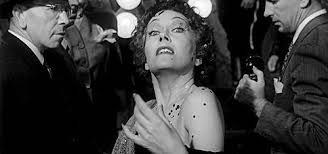
The final scene is chilling. Norma Desmond is in a catatonic state, asking for a close-up. Her eyes alone will send a shiver down your spine. The movie is full of great actors and actresses. The focus is on William Holden, Gloria Swanson, and Erich Von Stroheim. Holden was a great actor who appeared in movies such as The Bridge on the River Kwai, Stalag 17, and The Wild Bunch. Erich Von Stroheim plays Max, and in the twenties, Erich was a silent movie actor but best remembered as an avant-garde director in the 1920s. Gloria Swanson was a very successful silent movie actress who made a successful move to sound pictures. She also appeared on Broadway in the 40s and 50s. She started many production companies in the 1920s and 30s.

PLOT (Spoilers)

Screenplay writer Joe Gillis was desperately trying to sell his stories, but Hollywood did not want to listen. Joe had talent, but he wasn’t trying to write something great…just something that would sell. He was going to have to return home to Dayton, Ohio, a failure if something didn’t happen and soon. His car was getting repossessed, and he was trying to hide it just for a little while. While being chased by creditors, he parks it in a decrepit old mansion. Little did he know that former silent movie star Norma Desmond still lived there.  She used to be a big (“I am big, it’s the pictures that got small”) star.

Joe Gillis ended up being invited to stay to edit Norma’s film screenplay that she wrote. That screenplay was going to be her return to film.  One thing leads to another, and Joe ends up being a kept man, and he doesn’t like it one bit. As time goes by, life at Norma’s mansion…it gets darker and darker. Joe is stuck there working on Norma’s horrible screenplay while playing the good boy. He gets new clothes, perks, and is not wanting for anything…except freedom. There is a price to be paid for being kept by Desmond. He sneaks out and sees a young girl whom he writes with and falls for, but cannot break Norma’s grip.

__________________________________________

The movie was written by Charles Brackett and Billy Wilder. It was directed by Billy Wilder and released in 1950. This movie is one of the greats. It’s a movie that anyone who is a film fan must watch.

“Alright, Mr. DeMille, I’m ready for my close-up” 

Yes, she was indeed ready…she spent years getting ready for her final starring role. Just not the role you would think.
The Dick Cavett Show

I remember being a kid and how ABC, which was our “channel 2,” never came in clearly. The picture was snowy, but I still recall catching glimpses of The Dick Cavett Show. Of course, I also remember Johnny Carson—he and Cavett were the two big talk show hosts of the time. While it might be sacrilegious to say, I always favored Cavett over Carson. Even as a kid, Cavett seemed more interesting.

The Dick Cavett Show on ABC was a smart alternative to The Tonight Show with Johnny Carson. Cavett frequently booked intellectuals and gave them time for extended, in-depth conversations. You truly got to know his guests—he took more than 10 minutes, unlike the rushed format of today. There were no distractions, no flashy sets, just meaningful conversations. That was the key: Cavett didn’t just interview his guests… he had real conversations with them. No gimmicky skits, just an authentic exchange.

Cavett had his critics. Some called him a snob, a name-dropper, or too controversial. All three were true—and I loved it. Yes, he went to Yale, and yes, he dropped names. But honestly, if I’d spent time with people like Groucho Marx, I’d name-drop too. Cavett’s guest list was legendary: John Lennon, Jimi Hendrix, Katharine Hepburn, Bette Davis, and so many more. He embraced the counterculture, but he also joked about the counterculture, staying balanced in his approach. In modern times, Conan O’Brien and David Letterman came closest to that spirit…and Charlie Rose as far as having conversations. 

One of Cavett’s trademarks was his unique mix of guests. Where else would you see Janis Joplin, Raquel Welch, and Gloria Swanson sharing the same stage? His early 1970s ABC show was the pinnacle of his career. When he booked a rare or special guest, he often dedicated the entire episode to them. Bette Davis and Katharine Hepburn each had an entire show to themselves. Can you imagine that happening today? Is it because today’s stars aren’t as compelling, or has the audience’s attention span shrunk too much to appreciate such depth?

Cavett also thrived on risk. He hosted Norman Mailer and Gore Vidal, who famously clashed, and another episode featured Salvador Dalí, Lillian Gish, and Satchel Paige. These combinations were bold, and they worked. Even Johnny Carson admitted that Cavett was the only talk show host who could’ve seriously challenged him, though ABC’s third-place standing in the network race kept Cavett from overtaking Carson’s dominance.

This isn’t a knock on Johnny at all—his show set the blueprint for today’s talk shows. But Cavett offered something different: a smarter, more thoughtful experience. Watching his episodes now feels like opening a time capsule. While some moments are tied to their time, much of it remains timeless. Hearing from legends like Marlon Brando and Katharine Hepburn, who rarely did talk shows, is especially fascinating.

It wasn’t one of those “Hi, my name is Miss/Mr. So-and-So, my favorite color is blue, and goodbye until next time I have something to promote” situations. With Dick Cavett, you really got to know the person. He had a knack for drawing out something truly interesting. My favorite interview is the one with George Harrison. It didn’t seem promising at first—George wasn’t particularly eager to be on any show at the time—but Dick managed to get him to open up. You could see Cavett’s relief when George finally warmed up. This interview, which came right after John and Yoko’s appearance, turned out to be one of George’s best.

Here are some YouTube comments for these older talk shows:

I’m amazed when I go back and watch interviews from older talk shows, because it’s more quiet and the celebrity hosts and celebrity guests actually engage in authentic conversation with pure respect.

Jimmy Fallon should watch this video. No stupid laughing constantly, no sound effects and no fake laughter from the host. Just a meaningful conversation

Man no wonder podcasts have taken over. This interview was far more interesting and informative than any late night tv interview we get these days.

Hollywood (1980)

If you have the slightest bit of interest in documentaries or in silent movies, this is the series to watch. Not only is it a great wealth of info on the silent era…it’s one of the best documentaries I’ve ever watched. It is made up of 13 different one-hour sections. It’s quite a series at 676 minutes.

All of these are on youtube. I have them listed at the bottom… just click on the links I gave. If a link doesn’t work…just copy the title of the episode on youtube and it will show up. If you want to watch a couple give it a try…I would suggest Episode 8: Comedy – A Serious Business and Episode 12: Star Treatment (The Great Stars Of The Silent Films).

There is one misconception about silent films that most have. When you think of a silent film what do you think of? Some people think of the hard-to-see Keystone cops running about like they snorted Peru… that is NOT what most silent films looked like. They played at normal speed and the cinematography was breathtaking in many of them. They are as clear as any movie you will watch if the print has been taken care of or restored.

Kevin Brownlow's Outstanding 1980 Documentary Miniseries HOLLYWOOD is  Online | Austin Film Society

There was a problem with some prints after the silent era. The holes in the film were at a different gauge for the then-modern film projectors and they played them fast and transferred them fast…that meant everything was sped up.

This documentary is to the Silent Era what Ken Burns Civil War doc is to the Civil War. It starts with the pioneers of the movies to the very end when sound took over and changed and some people say ruined an art form. When movies were silent…they were international…no need for translations…just different text. The sound changed all of that and silent movies were at their height.

You get to know the great directors, actors, actresses, cameramen, stuntmen, and movie moguls.

They interviewed these ladies and gentlemen in the late seventies and it was many of their last appearances on film before they passed away. I’m thankful that Kevin Brownlow got this finished and we now have first-hand knowledge of films’ most exciting eras.

I do wish sound pictures would have been held off a few years. The studios weren’t ready for talking pictures. The first “talky” pictures were clumsy and still. The mics had to be placed in flower vases and other stationary places. The silent artists perfected the art of pantomime. Most had great quality (especially in the 20s) that looked better than movies 40 years later. One problem was with the early transfers from the films…now with Criterion and others cleaning up the transfers…we can watch these beautiful movies the way they were intended.

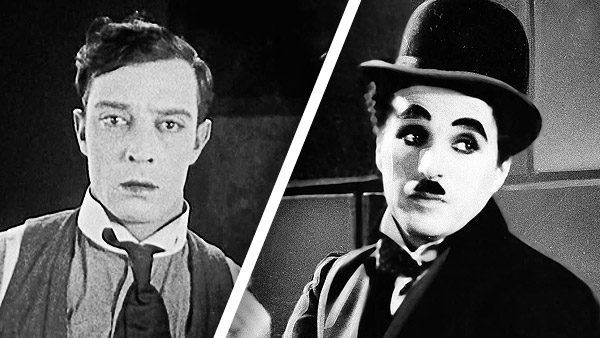
Just like today, you had your formula movies and your great movies. In my opinion, I think the best genre of silent movies is comedies. Not Keystone Cops…they are more like cartoons than films. For me, it would be Charlie Chaplin and Buster Keaton. They both had some of the most subtle and genius gags. Many of their gags have been copied to this day. There were others like Harry Langdon and Harold Lloyd that were popular.

I know it’s a big task BUT…if you like documentaries or silent movies…this series is worth it! Every episode is out there on youtube.

Critically Acclaimed: We've Got Mail #10 | Buster Keaton vs. Charlie  Chaplin!

Here are the different episodes.

Episode 1: Pioneers (Groundbreakers Of Film)

Episode 2: In The Beginning (Birth Of Cinema)

Episode 3: Single Beds And Double Standards (Censorhip) 

Episode 4: Hollywood Goes To War (World War I)

Episode 5: Hazard Of The Game (Stunts And Stuntmen) 

Episode 6: Swanson & Valentino (The 2 Great Hearthrobs Of The Silent Films)

Episode 7: Autocrats (The Great Directors) 

Episode 8: Comedy – A Serious Business

Episode 9: Out West (Westerns) 

Episode 10: The Man With The Megaphone (The Evolution Of Directors)

Episode 11: Trick Of The Light (The Cameraman) 

Episode 12: Star Treatment (The Great Stars Of The Silent Films)

Episode 13: End Of An Era (The Birth Of Talking Pictures)

Clara Bow - Hollywood Star Walk - Los Angeles Times

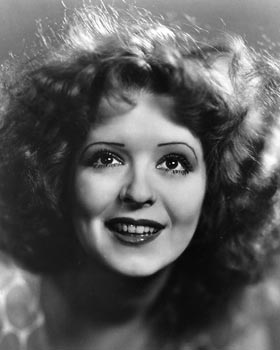
This is the 12th episode and it is about two people…John Gilbert and Clara Bow. Clara Bow is my favorite actress of all time…and yes that includes today.

The cast listing is below the video.

Actors

  • Mary Astor
  • Eleanor Boardman
  • Louise Brooks
  • Olive Carey
  • Iron Eyes Cody
  • Jackie Coogan
  • Dolores Costello
  • Viola Dana
  • Douglas Fairbanks Jr.
  • Janet Gaynor
  • Leatrice Joy
  • Lillian Gish
  • Bessie Love
  • Ben Lyon
  • Marion Mack
  • Tim McCoy
  • Colleen Moore
  • Charles ‘Buddy’ Rogers
  • Gloria Swanson
  • Blanche Sweet
  • John Wayne
  • Eva von Berne
  • Lois Wilson

Directors 

  • Dorothy Arzner
  • Clarence Brown
  • Karl Brown
  • Frank Capra
  • George Cukor
  • Allan Dwan
  • Byron Haskin
  • Henry Hathaway
  • Henry King
  • Lewis Milestone
  • Hal Roach
  • Albert S. Rogell
  • King Vidor
  • William Wyler.

Choreographer: Agnes de Mille,

Writer: Anita Loos,

Writer: Adela Rogers St. Johns,

Press Agent/writer: Cedric Belfrage,

Organist: Gaylord Carter,

Cinematographers: George J. Folsey, Lee Garmes and Paul Ivano,

Writer:  Jesse L. Lasky, Jr.,

Special Effects Artist A. Arnold Gillespie, Lord Mountbatten

Agent Paul Kohner

Producer/writer Samuel Marx

Editors William Hornbeck and Grant Whytock

Property Pan: Lefty Hough

Stuntmen Bob Rose, Yakima Canutt: Paul Malvern, and Harvey Parry, Rudolph Valentino’s brother Alberto Valentino

English set Designer Laurence Irving

The Dick Cavett Show


The Dick Cavett Show on ABC  was a smart alternative to the Tonight Show with  Johnny Carson and Cavett frequently booked intellectuals for extended and in-depth conversations

You actually got to really know the guests. He took more than 10 minutes, unlike today…there were no distractions, no busy sets just great conversations.

The knock on Cavett was….snob, name-dropper and controversial guests. All three were correct and I loved it. Yes, he attended Yale and yes he was/is a name dropper…If I got to hang out with people like Groucho Marx I would be a name dropper also… you better believe it. He would book John Lennon, Jimi Hendrix, Katharine Hepburn, Bette Davis, and many more. He welcomed the counterculture and Nixon hated him…that is a seal of approval for me.

He would mix and match guests….Janis Joplin, Raquel Welch and Gloria Swanson on the same show…together!

His ABC show in the early 70s was the best out of all of his different shows (PBS, CBS, USA Network). If he had a special rare guest he would only have that one guest for the entire show or sometimes two…

He had Norman Mailer and. Gore Vidal going at it… One show featured Salvador Dalí, Lillian Gish, and Satchel Paige. He took chances and it paid off… Johnny Carson once said that Dick Cavett was the only one that could have given him a serious challenge…but ABC then was a distant 3rd in the network race. 

This is not knocking Johnny whatsoever. Johnny’s show is the blueprint of today’s talk shows…Cavett just gave you a smarter show.

Watching the shows now it’s like watching a time capsule. Not everything is topical though. To hear Marlon Brando and Katherine Hepburn who hardly ever did talk shows is very interesting.

It was NOT… hey my name is Miss fill in the blank and my favorite color is blue…bye until next time I need to plug something… You really got to know the person and Dick could usually bring out something interesting. My favorite interview of George Harrison is by Dick. It didn’t look promising at first but George finally warmed up to a very relieved Cavett… this one was right after John and Yoko were guests.

https://www.youtube.com/watch?v=XRyyiSLwZfY

Cavett and the 72 Rolling Stones Tour

Cavett and Woody Allen