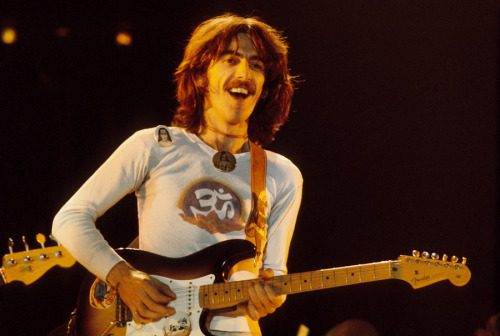
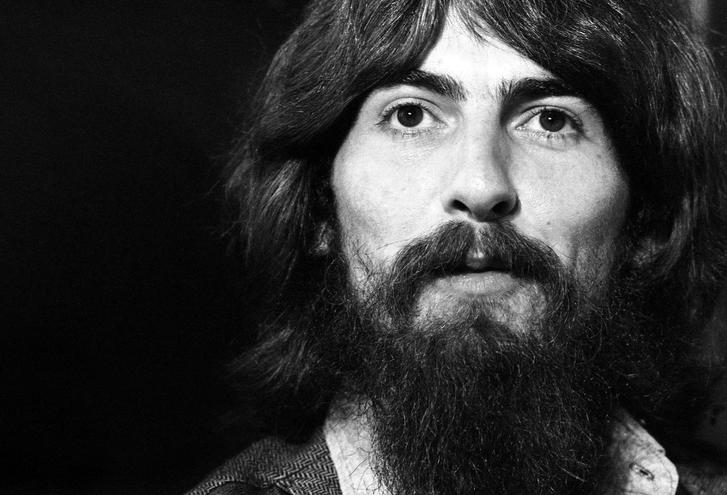
Everyone who knows me knows that John is my favorite Beatle, but since I’ve been blogging, I’ve met a lot of people who have been won over by George. I’ve always liked George, but I’ve probably delved more into his catalog than I did before because of people’s enthusiasm about him. I know many bloggers now who consider him their favorite out of The Beatles, including Lisa from tao-talk.com, who ironically, inspired this post from her John Lennon post on Sunday. Enthusiasm rubs off, so I thought I would list my top ten favorite George songs. For some of Lisa’s posts about George, check here, here, here, here, and here. George’s popularity has grown a great deal in the past few years.
I can only imagine how he felt being in a band that contained two of the top songwriters of the 20th Century. Unlike John and Paul, George didn’t start writing songs until 1963-1964. John and Paul had been writing songs since 1956. He was influenced by both of them, and I think he influenced them later on. Songs like Something, you can hear McCartney’s influence. With Taxman I can hear some of John in that one.
You may notice something about this list. It leaves off his two biggest hits. My Sweet Lord and I’ve Got My Mind Set On You. Maybe I’ve heard them too many times, I don’t know, but the other ones hit me more. I’m also going to leave off Beatles (and Wilburys) songs that George wrote. If I made a list of John’s songs (which I will now), I won’t include his Beatles songs because I think they belong to all four, not just John.
I switched my number one and two songs a little while back. They are close to me, but the number one song has won me over again and again.
All Things Must Pass
This is not only my favorite George Harrison song, but I also think it’s one of the best solo Beatles songs, period.
This 1970 George Harrison song is on the album All Things Must Pass. He brought it up during the Let It Be sessions; they went over it, and it sounded fantastic for a rehearsal…you could hear it taking shape. George was mindful of the TV show concert of some kind on Let It Be (it wasn’t decided yet). He wanted to play acoustic and was afraid the acoustic would get lost live. All the songs they did on Let It Be live on the rooftop…were rockers. They went through the song over 30 times. They picked it back up before the concert, but George dropped it. George wanted to do more of a rocker.
To me, it’s the greatest non-officially recorded Beatles song. When all the Beatles’ voices came together in the chorus while rehearsing this one…a shiver went through me. None of them could reproduce those vocals apart.
2. Isn’t It A Pity
I think this one gets forgotten, and it shouldn’t be that way. It was the B side to My Sweet Lord and I think it’s the superior side. George said he wrote it in 1966, but it didn’t see the light of day until 1970.
It resembles Hey Jude in its structure.
3. What Is Life
What an uplifting song this is. It’s a slice of guitar-pop ecstasy. Power pop? Soul-pop? Sunshine fuzz-rock? However you tag it, it belongs high on anyone’s list of 1970s songs.
4. Blow Away
I bought this album, which was in a cut-out bin at a record store and I was surprised how good this album was. This is a song that doesn’t come up as much when you hear George’s music. Much like Isn’t It A Pity…it gets forgotten. It’s nothing earth-shattering or complicated about this song… It’s just a truly great pop single.
5. Any Road
This song was released posthumously, and it remains one of my favorite George songs. It pretty much sums up his philosophy, and I love it. It seemed like a final message from George to everyone.
I heard this song before George passed away…a live version of it by him on a VH1 special that he was on. The interviewer kept pushing him to do a song…I’m glad he did now. When I heard it, I smiled because it was so George. With George’s songs, you could expect a good melody, slide guitar, and his own nugget of knowledge that he left behind.
This song was on George’s last album, Brainwashed, in 2003. George wrote the song in 1988 while working on a video for “Cloud Nine.”
I would follow with these songs.
6: Crackerbox Palace –I first saw the video of this song on television in the seventies. I might have seen it on the SNL broadcast…probably a repeat. A good catchy song by George off of his Thirty-Three & 1/3 album.
7: Give Me Love (Give Me Peace on Earth) – Another positive song from George. George Harrison said this about the song: “Sometimes you open your mouth and you don’t know what you are going to say, and whatever comes out is the starting point. If that happens and you are lucky, it can usually be turned into a song. This song is a prayer and personal statement between me, the Lord, and whoever likes it.”
8. When We Was Fab – It was nice to hear him having fun with his legend instead of the bitterness that all of them had for a short time.
9. Devil’s Radio – From what I read about George, as a kid, he didn’t like the neighbors knowing his business and hated gossip…this song says that plain and clear about the press as well.
10. The Art of Dying – Harrison wrote these lyrics while he was still a Beatle. He found it hard to get many of them on Beatles albums because there was only so much room. The good side is that when The Beatles broke up, he had a backlog full of songs.
I’ve been listening to All Things Must Pass recently and the songs are really consistent on that album.
Harrison wrote these lyrics while he was still a Beatle. He found it hard to get many of them on Beatles albums because there was only so much room. The good side is when The Beatles broke up, he had a backlog full of songs.
Phil Collins was brought in to play the congos on this song. He played for 90 minutes and got blisters on his fingers from playing them for so long. Unfortunately for Collins…his version didn’t make the cut. George Harrison had a great sense of humor and pranked Collins in later years.
Collins met Harrison several more times over the years, and the pair became friendly… friendly enough for Harrison to prank Collins. In 2001, shortly before Harrison’s death, he put out a remastered version of All Things Must Pass and around the same time sent Collins what he claimed was a version of the track on which he had played featuring the drummer’s missing Congas handiwork.
George had the percussionist Ray Cooper play out of time on the tape and that is what he sent to Collins. Phil later said: “I got a tape from George of the song that I played with the congas quite loud, I thought, Oh my god, this sounds terrible. In fact, it was a Harrison joke. He’d recorded [percussionist] Ray Cooper. [He said] said, ‘Play bad, I’m going to record it and send it to Phil.’ I couldn’t believe that a Beatle had actually spent that much time on a practical joke for me.” He did have a connection to the Beatles… As a kid, he was an extra in the Beatles movie A Hard Day’s Night but was edited out. Harrison did credit Collins on the 2001 remastered version of All Things Must Pass.
All the members of Derek and the Dominos played on this track and it was produced by Phil Spector.
George Harrison credits his first experience with LSD as being the doorway to his spiritual awakening and introduction to Hinduism. Harrison said that during the LSD trip, he thought of Yogis of the Himalayas running through his mind. He began to think about death and that is how this song came about.
George Harrison passed away on November 29, 2001 after a long battle with cancer. He was not afraid of death, as he believed it would take him to a better place. Before he passed, Paul and Ringo visited him and spent the day telling jokes and talking about times in Liverpool. He did tell Paul McCartney one to stop fighting with Yoko…that life was too short. Paul honored that wish and started to communicate with Yoko.
George Harrison: In the scriptures and in the Bhagavad Gita it says there’s never a time when you didn’t exist and will never be a time you cease to exist. The only thing that changes is our bodily conditioned soul comes in the body and we go from birth to death and it’s death how I look at it. It is like taking your suit off, you know the soul is in these three bodies and one body falls off.
Acoustic Demo
Art Of Dying
There’ll come a time when all of us must leave here
Then nothing sister Mary can do
Will keep me here with you
As nothing in this life that I’ve been trying
Could equal or surpass the art of dying
Do you believe me?
There’ll come a time when all your hopes are fading
When things that seemed so very plain
Become an awful pain
Searching for the truth among the lying
And answered when you’ve learned the art of dying
But you’re still with me
But if you want it
Then you must find it
But when you have it
There’ll be no need for it
There’ll come a time when most of us return here
Brought back by our desire to be
A perfect entity
Living through a million years of crying
Until you’ve realized the Art of Dying
Do you believe me?
It was touching to see Paul cover this great George Harrison song in the Concert For George…a year after George passed away. I don’t think Paul really got this song until he performed it. Not only did he do it in that concert but he would play it live occasionally after that. He knocks it out of the park with this version.
It’s simply one of the best songs George ever wrote. It was the title track of his debut album released in 1971. The song was worked up with the Beatles during the Get Back sessions and started to sound really good. It wasn’t rejected…they just moved on with different songs. There were songs they worked up that ended up on McCartney’s debut album as well. The same with John Lennon’s Gimme Some Truth.
A few days before George passed…Paul and Ringo joined him and talked about old times. George also told Paul to start getting along with Yoko because as he very well knew…life is too short. Paul did just that.
Paul McCartney:“I sat with him for a few hours when he was in treatment just outside New York. He was about 10 days away from his death, as I recall. We joked about things – just amusing, nutty stuff. It was good. It was like we were dreaming. He was my little baby brother, almost, because I’d known him that long. We held hands. It’s funny, even at the height of our friendship – as guys – you would never hold hands. It just wasn’t a Liverpool thing. But it was lovely.”
Eric Clapton: The only minor difficulty arose over who should sing “Something.” Olivia thought I should sing it. Paul McCartney had been doing it on the ukulele in his shows and wanted to do it that way, and I wanted Paul to sing “All Things Must Pass,” which I considered the key song of the whole event. In the end, we compromised and Paul and I did “Something” as a duet, and later in the show he performed a brilliantly soulful version of “All Things.” It was a great night, and everybody who was there or has seen the DVD agrees that it was the perfect sendoff for a man we all loved, and who gave us over the years so much beautiful music.
‘Those guys’ (Beatles) inability to express love for one another was classic, the exception is Ringo, who says [in the film], ‘I love George, and George loved me.’ That wouldn’t have been so easy for Paul.’”
“Paul had to admit that he didn’t know ‘All Things Must Pass,’ and that was an awful thing to confront. It was huge humble-pie stuff for Paul to be among these people who he may have thought had a better relationship with George than he did.
“But I believe Paul missed George as much as — if not more than — anybody.”
All Things Must Pass
Sunrise doesn’t last all morning A cloudburst doesn’t last all day Seems my love is up and has left you with no warning It’s not always gonna be this grey
All things must pass All things must pass away
Sunset doesn’t last all evening A mind can blow those clouds away After all this, my love is up and must be leaving It’s not always gonna be this grey
All things must pass All things must pass away
All things must pass None of life’s strings can last So, I must be on my way And face another day
Now the darkness only stays the night time In the morning it will fade away Daylight is good at arriving at the right time It’s not always gonna be this grey
All things must pass All things must pass away All things must pass All things must pass away
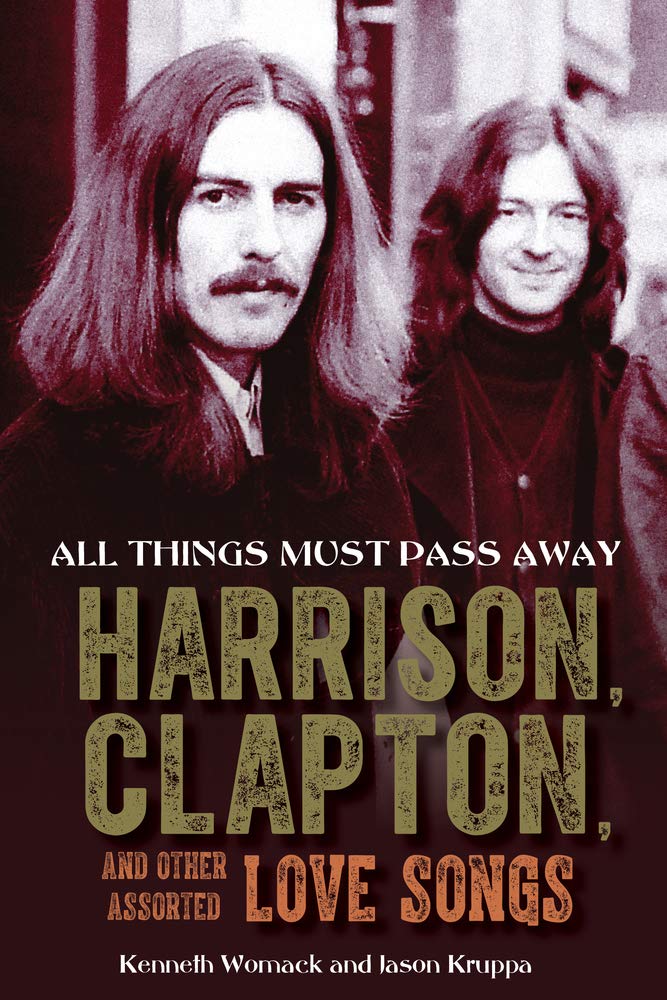
As a huge Beatles and Clapton fan, I was hoping to find out things I didn’t know…I certainly did. No revelation about The Beatles but many about George who just started his life without them.
I’m more familiar with Harrison than Clapton but I did know some about him. They go through each artist’s history up until around 1972 and then do highlights after that. The book centers around the making of Harrison’s album All Things Must Pass and Clapton’s Derek and the Dominos Layla and Assorted Love Songs and their friendship.
The authors picked a point in time to concentrate on (70-72) …and they did in detail. From Phil Spector to the “Apple Scruffs” outside the studio’s door. They also cover Duane Allman, Tom Dowd, and more helping out Clapton on the Layla album.
Harrison and Clapton had a genuine and later complicated friendship that started in earnest in 1966 when they met while Clapton was in Cream and George in the Beatles. Out of the two, George had a better childhood with a caring family and later his family with the Beatles. The Beatles were tight like brothers and although they fought…it was a love and closeness there.
Clapton had a rocky childhood where he was raised by his grandparents and his sister, he found out later, was really his mom. He felt abandoned and that partly explains the reason Clapton never stayed in a band more than a few years. He never wavered in his friendship with Harrison though.
The book would not be complete without getting into the Patti Boyd-George Harrison-Eric Clapton triangle. Clapton wanted Patti for years, but she resisted him, and he turned into a heroin addict. They didn’t get together until Harrison and Boyd split up and Clapton got off heroin. The cause of the Harrison Boyd separation was said not to have anything to do with Clapton. Drugs and a certain affair that they could not get past was part of it.
They remained friends for the rest of their lives and while they always got along…George would occasionally throw a verbal jab about Boyd and Clapton…which was his sense of humor but uncomfortable sometimes for Clapton and those around, but he never said anything publicly about it.
George and Eric helped each other musically throughout their careers. Clapton formed a backing band for a tour of Japan in the early 90s for Harrison.
After George’s death…George’s wife Oliva called on Clapton to put together a show… Concert for George…with musicians from Harrison’s past. That show was Concert for George. There were many special moments in that show. The one for me personally would be Paul McCartney singing All Things Must Pass.
I’ve posted many of Harrison’s songs but I avoided this one because it is so well known… but after hearing it yesterday I couldn’t resist anymore. The opening chords with the slide part is perfect. The song was/is hugely popular and peaked at #1 as My Sweet Lord/Isn’t It A Pity in the Billboard 100, #1 in the UK, #1 in Canada, #1 in New Zealand.
After Harrison died, this was re-released in the UK, where it once again went to #1. Proceeds from the single went to the Material World Charitable Foundation, which Harrison started in 1973 to support charities that work with children and the poor.
It came off the album “All Things Must Pass” which was a triple album and suddenly George was the Beatle that was finally heard and on top of the world…and it is arguably the best album by an ex-Beatle.
In 1971, Harrison was accused of copying its melody from the Chiffons’ 1963 song “He’s So Fine.” Eventually, the United States district court ruled that Harrison was guilty of subconscious plagiarism, and Harrison developed an extreme paranoia about songwriting for many years. Later on, George would write and record “This Song” as a response to what happened.
Harrison did a parody of this along with the “Pirate Song” with Monty Python…video is below.
From Songfacts
This was Harrison’s first single as a solo artist, and it was his biggest hit. The song is about the Eastern religions he was studying.
Highly unusual for a hit song, Harrison repeats part of a Hindu mantra in the lyric when he sings, “Hare Krishna… Krishna, Krishna.” When set to music, this mantra is typically part of a chant, that acts as a call to the Lord. Harrison interposes it with a Christian call to faith: “Hallelujah” – he was pointing out that “Hallelujah and Hare Krishna are quite the same thing.”
In the documentary The Material World, Harrison explains: “First, it’s simple. The thing about a mantra, you see… mantras are, well, they call it a mystical sound vibration encased in a syllable. It has this power within it. It’s just hypnotic.”
In 1971, Bright Tunes Music sued Harrison because this sounded too much like the 1963 Chiffons hit “He’s So Fine.” Bright Tunes was controlled by The Tokens, who set it up when they formed the production company that recorded “He’s So Fine” – they owned the publishing rights to the song.
During the convoluted court case, Harrison explained how he composed the song: He said that in December 1969, he was playing a show in Copenhagen, Denmark, with the group Delaney and Bonnie, whose piano player was Billy Preston (who contributed to some Beatles recordings). Harrison said that he started writing the song after a press conference when he slipped away and started playing some guitar chords around the words “Hallelujah” and “Hare Krishna.” He then brought the song to the band, who helped him work it out as he came up with lyrics. When he returned to London, Harrison worked on Billy Preston’s album Encouraging Words. They recorded the song for the album, which was released on Apple Records later in 1970, and Harrison filed a copyright application for the melody, words and harmony of the song. Preston’s version remained an album cut, and it was Harrison’s single that was the huge hit and provoked the lawsuit, which was filed on February 10, 1971, while the song was still on the chart.
In further testimony, Harrison claimed he got the idea for “My Sweet Lord” from The Edwin Hawkins Singers’ “Oh Happy Day,” not “He’s So Fine.”
When the case was filed, Harrison’s manager was Allen Klein, who negotiated with Bright Tunes on his behalf. The case was delayed when Bright Tunes went into receivership, and was not heard until 1976. In the meantime, Harrison and Klein parted ways in bitter fashion, and Klein began consulting Bright Tunes. Harrison offered to settle the case for $148,000 in January 1976, but the offer was rejected and the case brought to court.
The trial took place February 23-25, with various expert witnesses testifying. The key to the case was the musical pattern of the two songs, which were both based on two musical motifs: “G-E-D” and “G-A-C-A-C.” “He’s So Fine” repeated both motifs four times, “My Sweet Lord” repeated the first motif four times and the second motif three times. Harrison couldn’t identify any other songs that used this exact pattern, and the court ruled that “the two songs are virtually identical.” And while the judge felt that Harrison did not intentionally copy “My Sweet Lord,” that was not a defense – thus Harrison was on the hook writing a similar song without knowing it. Harrison was found guilty of “subconscious plagiarism” in a verdict handed down on August 31, 1976.
Assessing damages in the case, the judge determined that “My Sweet Lord” represented 70% of the airplay of the All Things Must Pass album, and came up with a total award of about $1.6 million. However, in 1978 Allen Klein’s company ABKCO purchased Bright Tunes for $587,000, which prompted Harrison to sue. In 1981, a judge decided that Klein should not profit from the judgment, and was entitled to only the $587,000 he paid for the company – all further proceeds from the case had to be remitted back to Harrison. The case dragged on until at least 1993, when various administrative matters were finally settled.
The case was a burden for Harrison, who says he tried to settle but kept getting dragged back to court by Bright Tunes. After losing the lawsuit, he became more disenfranchised with the music industry, and took some time off from recording – after his 1976 album Thirty Three & 1/3, he didn’t release another until his self-titled album in 1979. He told Rolling Stone, “It’s difficult to just start writing again after you’ve been through that. Even now when I put the radio on, every tune I hear sounds like something else.”
This was recorded at Abbey Road studios using the same equipment The Beatles used. There were some familiar faces at the sessions who had contributed to Beatles albums, including John Lennon, Yoko Ono, Billy Preston and Eric Clapton. Bobby Whitlock was friends with Harrison and Clapton, and played keyboards on the album. When we spoke with Whitlock, he shared his thoughts:
“That whole session was great. George Harrison, what a wonderful man. All the time that I ever knew him, which was from 1969 to his passing, he was a wonderful man. He included everyone on everything he did because there was enough for all.”
Whitlock adds, “All during the sessions, the door would pop open and in would spring three or four or five Hare Krishnas in their white robes and shaved heads with a pony tail coming out the top. They were all painted up, throwing rose petals and distributing peanut butter cookies.” (For more on these sessions, check out our full Bobby Whitlock interview)
This was the first #1 hit for any Beatle after the band broke up. Harrison was the first Beatle to release a solo album. He came out with Wonderwall Music, a soundtrack to the movie Wonderwall, in 1968.
When this song was released, the phrase “Hare Krishna” was associated with a religious group called the International Society for Krishna Consciousness, whose members would often approach passengers in airports, seeking donations and trying to solicit members. Individuals in this group became popularly known as “Hare Krishnas,” with a generally negative connotation.
Artists who record chant music often face a negative reaction from listeners who don’t understand the mantras. When we spoke with Krishna Das, the leading American chant musician, he explained: “‘My Sweet Lord’ is very clear and very beautiful, but the problem is that English has been appropriated by Western religion and it’s very hard to talk about spiritual things in a song that doesn’t get too ‘organized religion-y,’ you know? And then you get a lot of people who have a negative reaction to that as well. You can get a lot of negativity from the organized religion people. Like, ‘This isn’t our Jesus. This isn’t the way it is.'”
Phil Spector produced this and sang backup. With the blessing of Harrison and John Lennon (and over the objections of Paul McCartney), Spector produced the last Beatles album, Let It Be.
In an interview with Howard Stern, Peter Frampton verified that he played lead guitar on “My Sweet Lord.” According to Frampton, Harrison was a fan of his and invited him to the studio, where he handed Frampton his legendary Les Paul. Frampton assumed he was going to play rhythm, but Harrison said he wanted him to play lead, so Frampton did. Frampton wasn’t officially credited for this (just as Eric Clapton wasn’t credited on “While My Guitar Gently Weeps”), but rumors circulated for years.
Harrison released a new version, “My Sweet Lord 2000,” when he reissued All Things Must Pass.
Producer Phil Spector thought “My Sweet Lord” was the commercial hit of the album, and everyone else resisted him on that. According to Phil, George and others worried about how the public might react to the religious overtones and the Hare Krishna influence.
George Harrison parodied “My Sweet Lord” during Eric Idle’s Rutland Weekend Television Christmas special on December 26, 1975, turning it into “The Pirate Song.” >>
Artists to cover this song include Aretha Franklin, Johnny Mathis, Richie Havens, Nina Simone, Peggy Lee and Julio Iglesias. The Chiffons also covered the song in 1975 amidst the plagiarism lawsuit over their song “He’s So Fine.”
The guitar riff on America’s 1975 #1 hit “Sister Golden Hair” was inspired by this track. That song was produced by George Martin, who worked on most of The Beatles albums.
Gerry Beckley, who wrote “Sister Golden Hair” and sang lead, said in his Songfacts interview: “I very openly tip my hat there to ‘My Sweet Lord’ and George Harrison. I was such a fan of all The Beatles but we knew George quite well and I just thought that was such a wonderful intro.”
U2 performed this as a tribute at their show in Atlanta on November 30, 2001, the night after Harrison died.
George Harrison and Monty Python.
My Sweet Lord
My sweet Lord Hm, my Lord Hm, my Lord
I really want to see you Really want to be with you Really want to see you Lord But it takes so long, my Lord
My sweet Lord Hm, my Lord Hm, my Lord
I really want to know you Really want to go with you Really want to show you Lord That it won’t take long, my Lord (hallelujah)
My sweet Lord (hallelujah) Hm, my Lord (hallelujah) My sweet Lord (hallelujah)
I really want to see you Really want to see you Really want to see you, Lord Really want to see you, Lord But it takes so long, my Lord (hallelujah)
My sweet Lord (hallelujah) Hm, my Lord (hallelujah) My, my, my Lord (hallelujah)
I really want to know you (hallelujah) Really want to go with you (hallelujah) Really want to show you Lord (aaah) That it won’t take long, my Lord (hallelujah)
Hmm (hallelujah) My sweet Lord (hallelujah) My, my, Lord (hallelujah)
Hm, my Lord (hare krishna) My, my, my Lord (hare krishna) Oh hm, my sweet Lord (krishna, krishna) Oh-uuh-uh (hare hare)
Now, I really want to see you (hare rama) Really want to be with you (hare rama) Really want to see you Lord (aaah) But it takes so long, my Lord (hallelujah)
Hm, my Lord (hallelujah) My, my, my Lord (hare krishna) My sweet Lord (hare krishna) My sweet Lord (krishna krishna) My Lord (hare hare) Hm, hm (Gurur Brahma) Hm, hm (Gurur Vishnu) Hm, hm (Gurur Devo) Hm, hm (Maheshwara) My sweet Lord (Gurur Sakshaat) My sweet Lord (Parabrahma) My, my, my Lord (Tasmayi Shree) My, my, my, my Lord (Guruve Namah) My sweet Lord (Hare Rama)
(hare krishna) My sweet Lord (hare krishna) My sweet Lord (krishna krishna) My Lord (hare hare)




 PowerPop... An Eclectic Collection of Pop Culture