Kinks – Who’ll Be The Next In Line

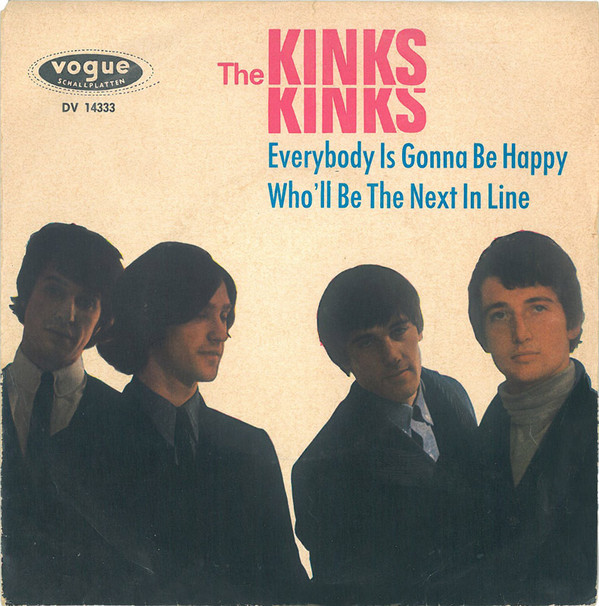
I never get tired of the Kinks. In July 1965, The Kinks released Who’ll Be The Next In Line as a single. This one is a very rocky song with a Kinks riff. 

It was first released as the B-side to “Everybody’s Gonna Be Happy” in Britain. The single only made to #17 in the UK. Reprise in America thought Who’ll Be The Next In Line was the best song and released it as the A side with Evrybody’s Gonna Be Happy” as the B. 

The song peaked at #34 in the Billboard 100 and #25 in Canada in 1965.

Running to just under two minutes, the song title has no question mark, although its authorship does. Released on the Reprise label, the B-side of “Everybody’s Gonna Be Happy” is credited on the record itself to R. Davies (Ray Davies) and on another pressing as R. Davies/Kassner. This latter appears to be a misprint; Edward Kassner was the man who launched the band’s career, and his name should have appeared below the songwriter credit rather than as part of it.

Here is the B side Everybody’s Gonna Be Happy

Who’ll Be The Next In Line

Who’ll be the next in line?
Who’ll be the next in line for heartache?
Who’ll make the same mistakes I made over you?
Who’ll be the next in line?
For you?
Who’ll be the next in line?
Who’ll be the next to watch your love fade?
All your affections finally fade away.
There’ll be no use in sighing.
Who’ll be the next in line?
For you?
One day you’ll find out when I’m gone,
I was the best one you had,
I was the one who gave you love.
Who’ll be the next in line?
Who’ll be the next in line for heartaches?
Who’ll make the same mistakes I made over you?
There’ll be no use in sighing.
Who’ll be the next in line?
For you?
One day you’ll find out when I’m gone,
I was the best one you had,
I was the one who gave you love.
Who’ll be the next in line?
Who’ll be the next in line for heartaches?
Who’ll make the same mistakes I made over you?
Who’ll be the next in line?
For you?
For you?

Twilight Zone – The Mighty Casey

★★★  June 17, 1960 Season 1 Episode 35

If you want to see where we are…HERE is a list of the episodes.

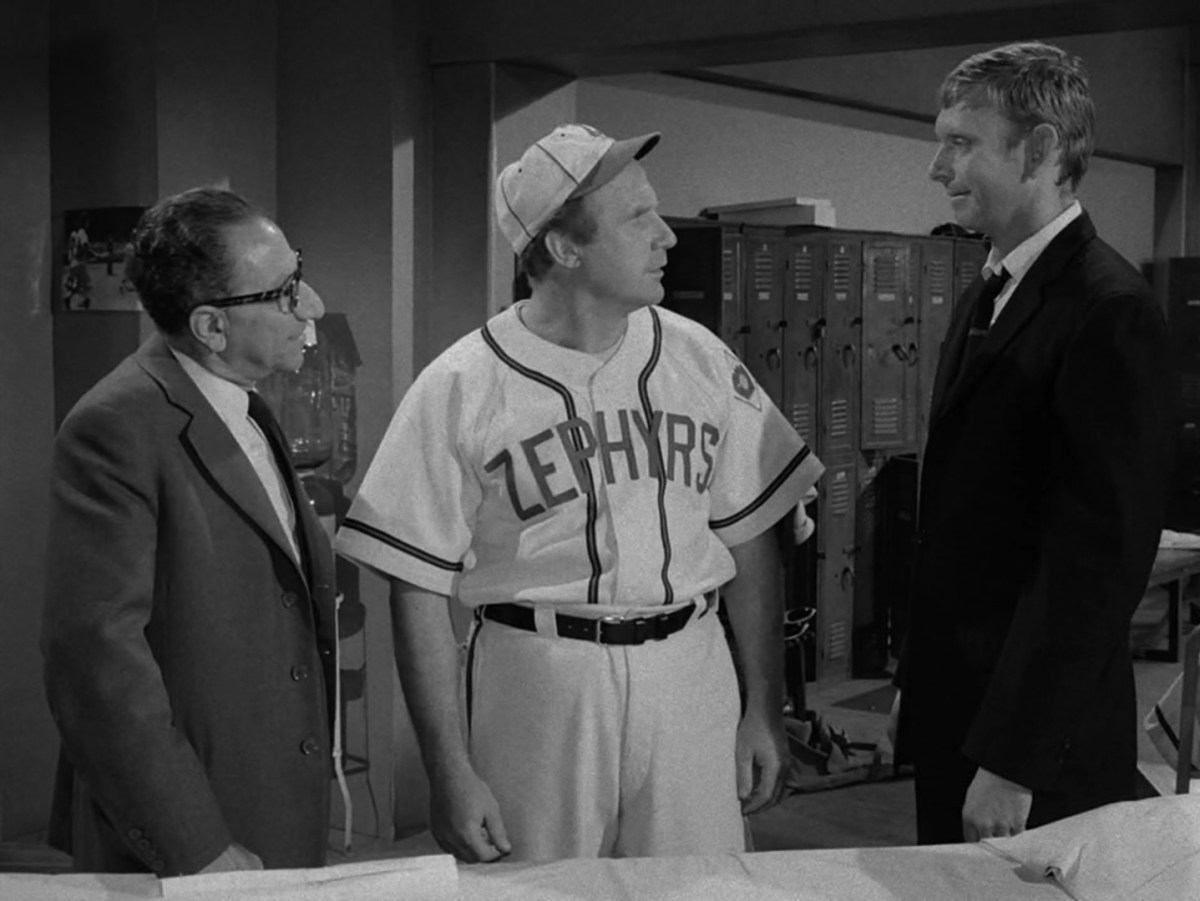
I’m a huge baseball fan and this one is a fun one. It’s a light hearted episode that features Jack Warden who is a frustrated manager. This is an episode that I watch once in a while but it’s not one on my heavy rotation. The plot is somewhat forced but it’s meant to be fun. Baseball fans would like this one.

This says a lot about Rod Serling….Paul Douglas, who had drinking habits, was originally cast to play McGarry but on set began to look red and read raspingly, and it wasn’t until his coronary-related death days after the episode was completed that it was realized he had been suffering poor health rather than reaction to drink. Because the episode was supposed to be a comedy, Rod Serling was reluctant to let it be broadcast with Douglas’ impending death essentially captured on film.

When CBS refused to pay for the episode to be re-shot, Serling personally underwrote the $27,000 it cost to have Jack Warden brought in to replace Douglas and to have some scenes re-done with Warden in place of Douglas.

The only shot that survived in the  broadcast version with Paul Douglas. You cannot tell it’s him but his back is to the camera. Serling had the humanity and dignity that he often wrote about.

File:The Mighty Casey.png

The closing narration was referencing the Dodgers that had moved to LA a few years before this was made by team owner Walter O’Malley, but in the following season after this aired, 1961, Sandy Koufax emerged as a future Hall of Famer, winning 129 games over the next 6 seasons with an ERA of 2.19. His teammate, Don Drysdale, won 111 games with an ERA of 2.88. The Dodgers won three pennants (1963, 1965, 1966) in those six years and two World Series (1963, 1965)…so Serling’s crystal ball was working.

This show was written by Rod Serling

Rod Serling’s Opening Narration: 

What you’re looking at is a ghost, once alive but now deceased. Once upon a time, it was a baseball stadium that housed a major league ball club known as the Hoboken Zephyrs. Now it houses nothing but memories and a wind that stirs in the high grass of what was once an outfield, a wind that sometimes bears a faint, ghostly resemblance to the roar of a crowd that once sat here. We’re back in time now, when the Hoboken Zephyrs were still a part of the National League, and this mausoleum of memories was an honest-to-Pete stadium. But since this is strictly a story of make believe, it has to start this way: once upon a time, in Hoboken, New Jersey, it was tryout day. And though he’s not yet on the field, you’re about to meet a most unusual fella, a left-handed pitcher named Casey.

Summary

Mouth McGarry is the manager of the Hoboken Zephyrs professional baseball team. They are perennial losers and are already so far back in the standings that they have no chance of winning the pennant. McGarry is approached by Dr. Stillman who has a solution for him, Casey, who seems to be an ideal pitcher, the best McGarry has ever seen. The catch is that Casey is a robot. McGarry is eager to win and decides to use Casey without telling anyone. When his ruse is discovered, Dr. Stillman agrees to give Casey a heart to make him more human. The results aren’t quite what McGarry had hoped for.

If you cannot see the video below…here is a LINK to the complete episode. There were no snippets on youtube. 

Rod Serling’s Closing Narration:

Once upon a time, there was a major league baseball team called the Hoboken Zephyrs, who, during the last year of their existence, wound up in last place and shortly thererafter wound up in oblivion. There’s a rumor, unsubstantiated, of course, that a manager named McGarry took them to the West Coast and wound up with several pennants and a couple of world championships. This team had a pitching staff that made history. Of course, none of them smiled very much, but it happens to be a fact that they pitched like nothing human. And if you’re interested as to where these gentlemen came from, you might check under ‘B’ for Baseball – in The Twilight Zone.

CAST

Rod Serling … Narrator (voice)
Jack Warden … Mouth McGarry
Abraham Sofaer … Dr. Stillman
Robert Sorrells … Casey
Alan Dexter … Beasley
Don Kelly … Monk (as Don O’Kelly)
Jonathan Hole … Team Doctor
Rusty Lane … Commissioner

Twilight Zone – The After Hours

★★★★★  June 10, 1960 Season 1 Episode 34

If you want to see where we are…HERE is a list of the episodes.

This one is a classic… a 5-star episode. As surprise endings go…this one is near the top. This episode lacks explanation for things but that makes it more mysterious. There is no big moral lesson here just a great episode.

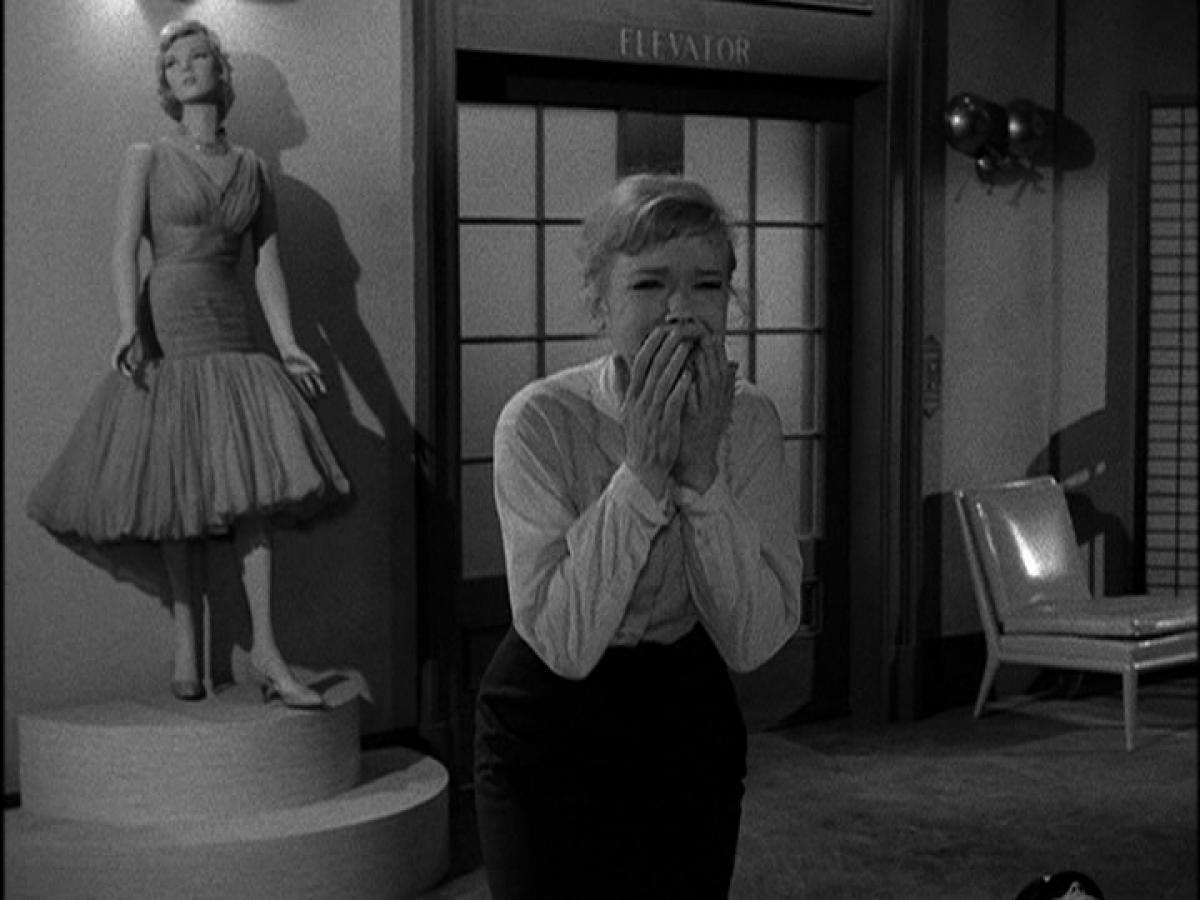
Anne Francis’s portrayal of Marsha White was great. She is demanding and a little whiny at first but when you see the nightmare situation she is in…you understand why. She wonders how many of the store workers know her name and so much about her…and we wonder the same thing. This is the first appearance of Anne Francis in the starring role of a Twilight Zone episode. She would appear again in the season four episode “Jess-Belle”.

The twist totally took me off guard the first time I watched this one. The 1985 Twilight Zone redid this one and it was a mess.

Here is something interesting. The band 9fm (short for Ninth Floor Mannequin) song “Below the Ninth Floor” was inspired by “The After Hours.”

This show was written by Rod Serling

Rod Serling’s Opening Narration: 

Express elevator to the ninth floor of a department store, carrying Miss Marsha White on a most prosaic, ordinary, run-of-the-mill errand.

Miss Marsha White on the ninth floor, specialties department, looking for a gold thimble. The odds are that she’ll find it—but there are even better odds that she’ll find something else, because this isn’t just a department store. This happens to be The Twilight Zone.

Summary

Marsha White is looking for a gold thimble as a gift for her mother. She can’t find it anywhere in the store and an elevator operator suggests she try the 9th floor. She arrives there to find it abandoned but a sales clerk suddenly appears and has just what she is looking for. On the way back down to the main floor, she realizes the thimble she bought is scratched and goes to the complaints department where she is told there is no 9th floor in the building. She is shocked however to see a mannequin that looks just like the woman who served her. A return to the absent floor reveals the explanation to her dilemma.

Rod Serling’s Closing Narration:

Marsha White, in her normal and natural state, a wooden lady with a painted face who, one month out of the year, takes on the characteristics of someone as normal and as flesh and blood as you and I. But it makes you wonder, doesn’t it, just how normal are we? Just who are the people we nod our hellos to as we pass on the street? A rather good question to ask . . . particularly in the Twilight Zone.

CAST

Rod Serling … Narrator (voice)
Anne Francis … Marsha White
Elizabeth Allen … Saleswoman
James Millhollin … Mr. Armbruster
John Conwell … Elevator Man
Patrick Whyte … Mr. Sloan
Nancy Rennick … Miss Keevers

Twilight Zone – Mr. Bevis

★★★1/2  June 3, 1960 Season 1 Episode 33

If you want to see where we are…HERE is a list of the episodes.

This episode is one of the light hearted Twilight Zones. Some TZ reviewers have a problem with them but I never have…although I would not rate them as the best. Mr. Bevis played by Orson Bean is an oddball but in 2021 he would probably be considered a hipster. He seems to be happy with his lot in life despite his struggles.

He is given a chance at success by his all business like guardian angel J. Hardy Hempstead played by the character actor Henry Jones. Mr. Bevis will find out that with success comes responsibilities. Are physical comforts and security worth losing yourself over? Personally I think you can have both and we will see what Mr. Bevis will do. The episode borrows a portion from It’s A Wonderful Life.

This episode served as a pilot for a spin-off series where Burgess Meredith was to play Bevis, but the series was not ordered once Rod Serling learned he declined the role.

This episode features 4 prolific and noticeable character actors in the history of TV and motion pictures. According to IMDB, Henry Jones, William Schallert, Charles Lane and Vito Scotti combined have a total of 1200 acting credits.

This show was written by Rod Serling

Rod Serling’s Opening Narration: 

In the parlance of the twentieth century, this is an oddball. His name is James B. W. Bevis, and his tastes lean toward stuffed animals, zither music, professional football, Charles Dickens, moose heads, carnivals, dogs, children, and young ladies. Mr. Bevis is accident prone, a little vague, a little discombuberated, with a life that possesses all the security of a floating crap game. But this can be said of our Mr. Bevis: without him, without his warmth, without his kindness, the world would be a considerably poorer place, albeit perhaps a little saner…Should it not be obvious by now, James B. W. Bevis is a fixture in his own private, optimistic, hopeful little world, a world which has long ceased being surprised by him. James B. W. Bevis, on whom Dame Fortune will shortly turn her back, but not before she gives him a paste in the mouth. Mr. James B. W. Bevis, just one block away from The Twilight Zone.

Summary

James B.W. Bevis is, by almost any definition, eccentric. He drives a car that once was Henry Ford’s dream, he likes zither music and makes model ships. He’s a bookkeeper by profession and his desk at work is always cluttered. He likes to bring in children at Christmas-time to sing carols. It all leads to him being fired. While drowning his sorrows at a nearby bar, he meets none other than his guardian angel who shows him that life can be considerably different for him if he wishes it….but is he prepared to make the changes necessary to obtain that lifestyle?

***Note…this is not a great clip and doesn’t tell you a lot but on youtube it’s hard to get a decent clip of the TZ because of a strong copyright hold by CBS I would presume.

Rod Serling’s Closing Narration:

Mr. James B. W. Bevis, who believes in a magic all his own. The magic of a child’s smile, the magic of liking and being liked, the strange and wondrous mysticism that is the simple act of living. Mr. James B. W. Bevis, species of twentieth-century male, who has his own private and special Twilight Zone.

CAST

Rod Serling … Narrator (voice)
Orson Bean … James B.W. Bevis
Henry Jones … J. Hardy Hempstead
Charles Lane … Mr. Peckinpaugh
Horace McMahon … Bartender
William Schallert … Policeman at Accident
Florence MacMichael … Margaret
Dorothy Neumann … Landlady
Vito Scotti … Peddler
House Peters Jr. … Policeman Writing Ticket
Colleen O’Sullivan … Michelle (as Coleen O’Sullivan)
Timmy Cletro … Boy

Twilight Zone – A Passage for Trumpet

★★★★  May 20, 1960 Season 1 Episode 32

If you want to see where we are…HERE is a list of the episodes.

This show was written by Rod Serling

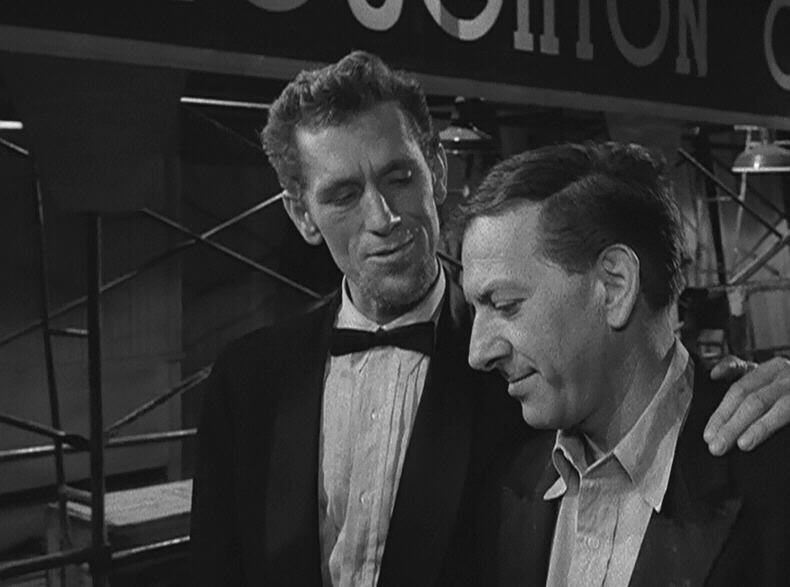
Jack Klugman was a great character actor and he was always excellent in the four Twilight Zones that he was in. In this one he conveys depression, suicidal behavior, and alcoholism.

This is a touching episode that works well. It shines the spotlight on a down on his luck alcoholic trumpet player…and this visit in The Twilight Zone gives a chance for salvation if he takes it . This is not a scary, weird, or funny episode…it’s a well written story that works outside of the Twilight Zone. 

John Anderson who plays the Angel Gabriel is believable as a jazz goatee wearing Gabriel. Rod Serling must have been a lover of jazz music because there are a few episodes that feature jazz players and he has the lingo down. 

When Baron is talking to Joey in the alley, he compares him to three famous trumpeters of the big band era. Harry James was a trumpet playing band leader known for his technical proficiency as well as his tone. Max Kaminsky played with big bands like Tommy Dorsey and Artie Shaw, his style was full toned and economical in the style of Louis Armstrong. And Billy Butterfield played trumpet, flugelhorn, and coronet with Artie Shaw, Les Brown, and Benny Goodman.

Rod Serling’s Opening Narration: 

Joey Crown, musician with an odd, intense face, whose life is a quest for impossible things like flowers in concrete or like trying to pluck a note of music out of the air and put it under glass to treasure…Joey Crown, musician with an odd, intense face, who, in a moment, will try to leave the Earth and discover the middle ground – the place we call The Twilight Zone.

Summary

Musician Joey Crown is down on his luck. An alcoholic, he can’t find work because no one trusts him. Broke, he hocks his trumpet but then steps in front of truck which knocks him onto the sidewalk. He awakens in a strange world where no one can see him and he presumes that he has died. He eventually bumps into someone who can in fact see him, a fellow horn player who tells him that it’s still within Joey’s power to decide on life or death.

Rod Serling’s Closing Narration:

Joey Crown, who makes music, and who discovered something about life; that it can be rich and rewarding and full of beauty, just like the music he played, if a person would only pause to look and to listen. Joey Crown, who got his clue in the Twilight Zone.

CAST

Rod Serling … Narrator (voice)
Jack Klugman … Joey Crown
John Anderson … Gabriel
Frank Wolff … Baron
Mary Webster … Nan
James Flavin … Truck Driver
Ned Glass … Pawnshop Man

Twilight Zone – The Chaser

★★★  May 13, 1960 Season 1 Episode 31

If you want to see where we are…HERE is a list of the episodes.

This is another “be careful what you wish for” episode. This one starts off as one of the  light hearted episodes but it’s the Twilight Zone… it turns dark near the end. The real star of this episode is John McIntire  as Professor A. Daemon…the man who has any powder, liquid, or potion that you will need. When you are done with your need…he has an answer for that also. I love the warning that he gives Roger about the love potion and how Roger blissfully ignores the wise man.

This episode gives “glove cleaner” a whole new meaning.

The episode is not without it’s charm but it doesn’t cross over to a great one. The twist at the end is interesting.

This was the only first season episode that was not written by one of the Big Three (Rod Serling, Charles Beaumont, Richard Matheson).

The professor is named A. Daemon, a play on words for A Demon as evidenced by the outcome.

George Grizzard (Roger Shackleforth) wears the same smoking jacket worn by Rod Taylor (H. George Wells) in The Time Machine.

This show was written by  Robert Presnell Jr. and  John Collier

Rod Serling’s Opening Narration: 

Mr. Roger Shackelforth. Age: youthful twenties. Occupation: being in love. Not just in love, but madly, passionately, illogically, miserably, all-consumingly in love – with a young woman named Leila, who has a vague recollection of his face and even less than a passing interest. In a moment, you’ll see a switch, because Mr. Roger Shackelforth, the young gentleman so much in love, will take a short, but very meaningful journey into the Twilight Zone.

Summary

Roger Shackleforth’s infatuated with Leila, a young woman who wants nothing to do with him. Whilst monopolizing a pay phone, someone waiting to make a call refers him to Professor A. Dæmon, a seller of books, notions and potions, who – the man says – can help Roger with his love problem.. Though the Professor tries to dissuade him, Roger happily buys the potion for $1, anyways. It most certainly works. But 6 months later, Roger returns to the Professor – to find a solution to his new problem…

Rod Serling’s Closing Narration:

Mr. Roger Shackelforth, who has discovered at this late date that love can be as sticky as a vat of molasses, as unpalatable as a hunk of spoiled yeast, and as all-consuming as a six-alarm fire in a bamboo and canvas tent. Case history of a lover boy, who should never have entered the Twilight Zone.

CAST

John McIntire … Prof. A. Daemon
Patricia Barry … Leila
George Grizzard … Roger Shackleforth
J. Pat O’Malley … Homburg
Marjorie Bennett… Old Woman
Barbara Perry … Blonde Woman
Rusty Wescoatt … Tall Man
Duane Grey … Bartender (uncredited)
Rod Serling … Narrator (voice) (uncredited)

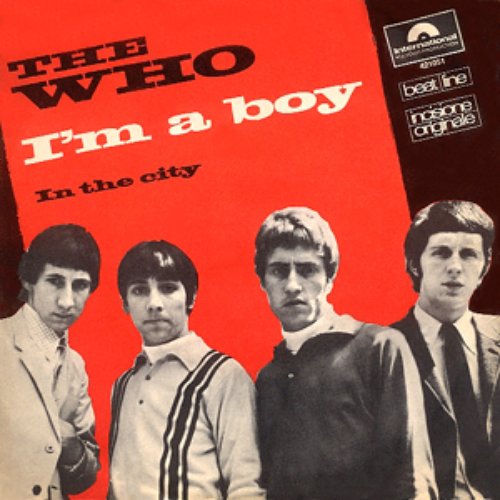
Who – I’m A Boy

My name is Bill, and I’m a head case

Now THAT is a lyric worth exploring.

Pete Townshend wrote this for a Rock Opera he was composing called “Quads,” which was about a future where parents could choose the sex of their children. That opera never happened. I have to wonder if Townshend had this old title in mind when a few years later he came up with the title for “Quadrophenia.”

I’m A Boy was released as a single in 1966. The song peaked at #2 in the UK and #2 in New Zealand. The song was not heard much in America or Canada at the time. Many of their singles would finally come to the light when the great compilation album Meaty Beaty Big and Bouncy was released in 1971. They did a live version and included it on the live album Live At Leeds released in 1970.

Released as the B-side of the single was “In the City”, the first and last song credited to the songwriting collaboration of John Entwistle and Keith Moon. Entwistle referred to it as rip-off of Jan and Dean, a group that was a favorite of Moon’s.

Roger Daltrey: “I always thought The Who went through a weird period after ‘My Generation’ (November 1965) that lasted until we did ‘Magic Bus’ (October 1968). I thought it all went a bit sloppy. But ‘I’m A Boy’ and ‘Pictures Of Lily’ were from that period when I’d been allowed back into the band (Daltrey had been asked to leave after beating up Keith Moon over his heavy use of amphetamines). My ego had been crushed. I was insecure and it showed in my voice. When I first heard those songs, I was like, ‘Oi, what’s this all about?’ I didn’t think I could find the right voice for them. You can hear it when you listen to them now, but my insecurity made those songs sound better. It was a happy accident.”

From Songfacts

This is about a boy whose mother wants him to be a girl, while the boy longs to assert his real sexual identity. The controversial subject of cross-dressing was probably the reason why this failed to reach the American Top 100.

Daltrey told Uncut magazine: “On ‘I’m A Boy’, I tried to sing it like a really, really young kid, like an eight-year-old. Not the voice of an eight-year-old but the sentiment – and I think that came across.”

I’m A Boy

One girl was called Jean Marie
Another little girl was called Felicity
Another little girl was Sally Joy
The other was me, and I’m a boy

My name is Bill, and I’m a head case
They practice making up on my face
Yeah, I feel lucky if I get trousers to wear
Spend evenings taking hairpins from my hair

I’m a boy, I’m a boy
But my ma won’t admit it
I’m a boy, I’m a boy
But if I say I am, I get it

Put your frock on, Jean Marie
Plait your hair, Felicity
Paint your nails, little Sally Joy
Put this wig on, little boy

I’m a boy, I’m a boy
But my ma won’t admit it
I’m a boy, I’m a boy
But if I say I am, I get it

I want to play cricket on the green
Ride my bike across the street
Cut myself and see my blood
I want to come home all covered in mud

I’m a boy, I’m a boy
But my ma won’t admit it
I’m a boy, I’m a boy, I’m a boy
I’m a boy, I’m a boy, I’m a boy, I’m a boy
I’m a boy, I’m a boy, I’m a boy

Twilight Zone – Nightmare as a Child

★★★★  April 29, 1960 Season 1 Episode 29

If you want to see where we are…HERE is a list of the episodes.

I really like the cast in this. Terry Burnham as the child Markie has no trace of a child in her performance which is why it works. This one could have been a Hitchcock episode. Janice Rule and Shepperd Strudwick play their parts perfectly. Strudwich is especially creepy. The show has a slow build up, to watch Helen…slowly trying to find her self while putting the pieces together one piece at a time.

Helen gets aggravated talking to Markie and you can see what is going on. She knows something is different about this kid. Helen can’t grasp who this kid is…or maybe doesn’t want to grasp it. Markie gets as frustrated as us viewers and finally clues Helen in and pulls no punches.

The amnesia card is played in this one but unlike some shows it works in this. Markie seems to represent Helen’s  repressed memories. This episode would work without any real supernatural content.

Janice Rule’s character Helen Foley was named after Rod Serling’s drama teacher. The name Helen Foley was used again in the 1983 Twilight Zone movie.

This show was written by Rod Serling

Rod Serling’s Opening Narration: 

Month of November, hot chocolate, and a small cameo of a child’s face, imperfect only in its solemnity. And these are the improbable ingredients to a human emotion, an emotion, say, like—fear. But in a moment this woman, Helen Foley, will realize fear. She will understand what are the properties of terror. A little girl will lead her by the hand and walk with her into a nightmare.

Summary

Helen Foley is a school teacher who when arriving home one day meets a little girl, Markie, sitting on the steps just outside her apartment door. Helen invites her in and gives her a cup of hot cocoa. Strangely however, Markie seems to know a great deal about her – that she doesn’t like marshmallows in her cocoa or that she has a scar on her elbow. She also knows what Helen did earlier that day including seeing a somewhat familiar man, Peter Selden, behind the wheel of a car. When Selden arrives at her apartment a few moments later he says he worked for her mother but Helen has no memory of what happened to her mother all those years ago. As her memories return however, she finds herself in grave danger.

Rod Serling’s Closing Narration:

Miss Helen Foley, who has lived in night and who will wake up to morning. Miss Helen Foley, who took a dark spot from the tapestry of her life and rubbed it clean—then stepped back a few paces and got a good look at the Twilight Zone.

CAST

Rod Serling … Narrator (voice)
Janice Rule … Helen Foley
Shepperd Strudwick … Peter Selden
Terry Burnham … Markie
Michael Fox … Doctor
Joseph V. Perry … Police Lieutenant (as Joe Perry)

Twilight Zone – A Nice Place to Visit

★★★★★  April 15, 1960 Season 1 Episode 28

If you want to see where we are…HERE is a list of the episodes.

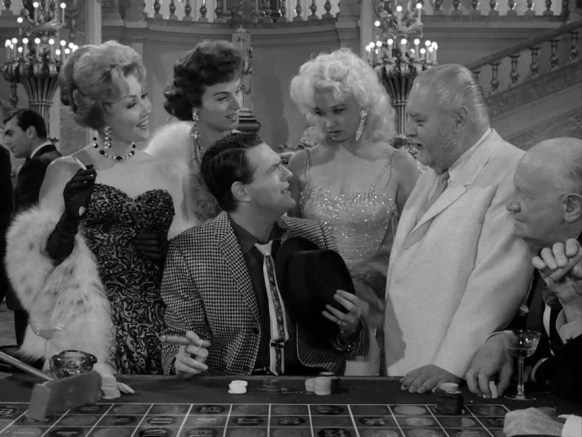
This is a great one. You will see Mr. French from Family Affair like you have never seen him before. The acting and the twist both are top notch in this episode. I’ve watched this many times and it just keeps getting better. The Twilight Zone can highlight the dregs of society better than any other show I know. Rocky Valentine is not a well known criminal, just a lowlife, and a drag on humanity. A man who doesn’t have a thought for anyone but himself.

There is a fantastic last line given by Pip (Sebastian Cabot) to Rocky. it sums up the episode…which I won’t give away here. (The video below gives it away). On a deeper level this episode has an interesting proposition. When you get everything  you want… and everything goes your way… how can that be a bad thing? We find out how in this episode.

Mickey Rooney was the first choice to play Valentine. In a memo to Rod Serling, Charles Beaumont suggested, should Rooney not be available, that Serling himself consider playing the part. Serling declined and Rooney ended up being unavailable.

Sebastian Cabot had to bleach his hair white for the role and it took three months for the actor’s hair to return to its original dark color.

This show was written by Charles Beaumont

Rod Serling’s Opening Narration: 

Portrait of a man at work, the only work he’s ever done, the only work he knows. His name is Henry Francis Valentine, but he calls himself “Rocky”, because that’s the way his life has been – rocky and perilous and uphill at a dead run all the way. He’s tired now, tired of running or wanting, of waiting for the breaks that come to others but never to him, never to Rocky Valentine. A scared, angry little man. He thinks it’s all over now but he’s wrong. For Rocky Valentine, it’s just the beginning.

Summary

Rocky Valentine is a small-time hood who has been on the wrong side of the law for most of his life. After robbing a pawn shop, he is gunned down by the police and awakens to be met by Mr. Pip, who describes himself as a guide to his new surroundings. Rocky can’t quite believe where he’s ended up as he can have anything he desires. He’s living in a beautiful apartment, never loses at the casino and is always surrounded by beautiful women. What good deed could he have done in life to deserve this. After a month or so however the shine of having anything and everything wears off.

The video has spoilers.

Rod Serling’s Closing Narration:

A scared, angry little man who never got a break. Now he has everything he’s ever wanted – and he’s going to have to live with it for eternity – in The Twilight Zone.

CAST

Larry Blyden … Henry Francis ‘Rocky’ Valentine
Sebastian Cabot … Mr. Pip
John Close … Cop (uncredited)
Barbara English … Dancing Girl (uncredited)
Charles Fogel … Casino Patron (uncredited)
George Ford … Casino Patron (uncredited)
Peter Hornsby … Croupier (uncredited)
Robert McCord … Waiter (uncredited)
Bill Mullikin … Parking Attendant (uncredited)
Nels P. Nelson … Short Cop (uncredited)
Murray Pollack … Casino Patron (uncredited)
Rod Serling … Narrator (voice) (uncredited)
Norman Stevans … Casino Patron (uncredited)
Wayne Tucker … Croupier (uncredited)
Sandra Warner … Girl (uncredited)

Twilight Zone – The Big Tall Wish

★★★★  April 8, 1960 Season 1 Episode 28

If you want to see where we are…HERE is a list of the episodes.

This was an important episode regardless of the story. It’s well documented that Rod Serling was against bigotry. He not only talked the talk, he put it into action with this episode with a nearly all black cast. After the airing of this episode, which was revolutionary for American television, The Twilight Zone was awarded the 1961 Unity Award for Outstanding Contributions to Better Race Relations.

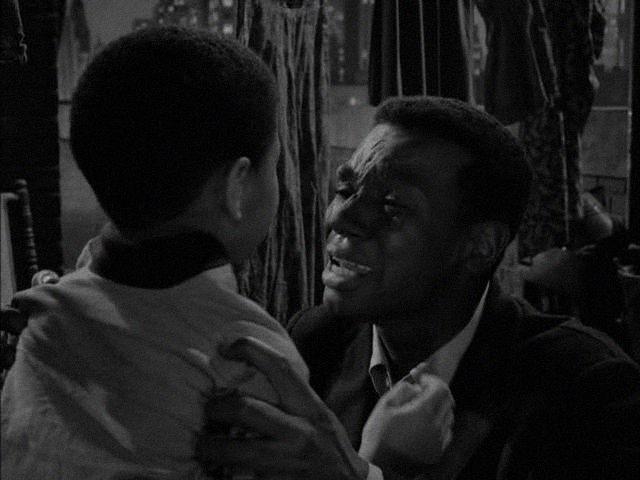
It is a good episode. A child that believes in magic and a jaded boxer who long ago lost his belief. It explores the innocence in children and what little is left in adults.

The child tries to make the aging jaded boxer Bolie believe in the magic of wishing but Bolie just cannot do it. In the world Bolie lives in, wishing and hoping for the hardships to end, is never going to happen. The only real choice is to struggle through each day and fight if necessary when things block your path. The ending of this one surprised me.

This show was written by Rod Serling

Rod Serling’s Opening Narration: 

In this corner of the universe, a prizefighter named Bolie Jackson, 183 pounds and an hour and a half away from a comeback at St. Nick’s Arena. Mr. Bolie Jackson, who, by the standards of his profession is an aging, over-the-hill relic of what was, and who now sees a reflection of a man who has left too many pieces of his youth in too many stadiums for too many years before too many screaming people. Mr. Bolie Jackson, who might do well to look for some gentle magic in the hard-surfaced glass that stares back at him.

Summary

Bolie Jackson is a professional boxer whose best years are behind him. He’s well-liked in his neighborhood and adored by Henry, a young lad who lives next door. He hurts his hand in an altercation with sleazy boxing manager and as a result is badly beaten in a televised boxing match. He’s apparently down and out for the count but young Henry has a special ability – something his mother calls the big wish – that changes the outcome of the match. When Bolie learns what he’s done he refuses to believe in what Henry’s done with the inevitable consequences

Rod Serling’s Closing Narration:

Mr. Bolie Jackson, 183 pounds, who left a second chance lying in a heap on a rosin-spattered canvas at St. Nick’s Arena. Mr. Bolie Jackson, who shares the most common ailment of all men, the strange and perverse disinclination to believe in a miracle, the kind of miracle to come from the mind of a little boy, perhaps only to be found in the Twilight Zone.

CAST

Rod Serling … Narrator (voice)
Ivan Dixon … Bolie Jackson
Steven Perry … Henry Temple
Kim Hamilton … Frances Temple
Walter Burke … Joe Mizell
Henry Scott … Thomas

Twilight Zone -Execution

★★★★  April 1, 1960 Season 1 Episode 26

If you want to see where we are…HERE is a list of the episodes.

Albert Salmi was a wonderful character actor. He would appear in two more Twilight Zones and all of them involved time travel. You could see Albert on TV shows through the 80s. This is a looked over episode that I do enjoy but it’s not without it’s faults. The way the time travel happens is unique but it’s the delivery that gets a little clumsy. I give it 4 stars because of the plot and the way they showed an 19th century primitive dropped into the loud modern world.

My biggest fault with this episode is the foolish way Professor Manion (Russell Johnson) handles Joe Caswell (Albert Salmi) after knowing what kind of man he was after he got there. Salmi’s acting is the standout in this. He is great at playing bad guys. Caswell is a hot-tempered sociopath who has no conscious. He makes a believable time traveler from the old west.

Watch for Russell Johnson (as Professor Manion) who will be remembered as the Professor off of Gilligan’s Island.

This show was written by  Rod Serling and  George Clayton Johnson

Rod Serling’s Opening Narration: 

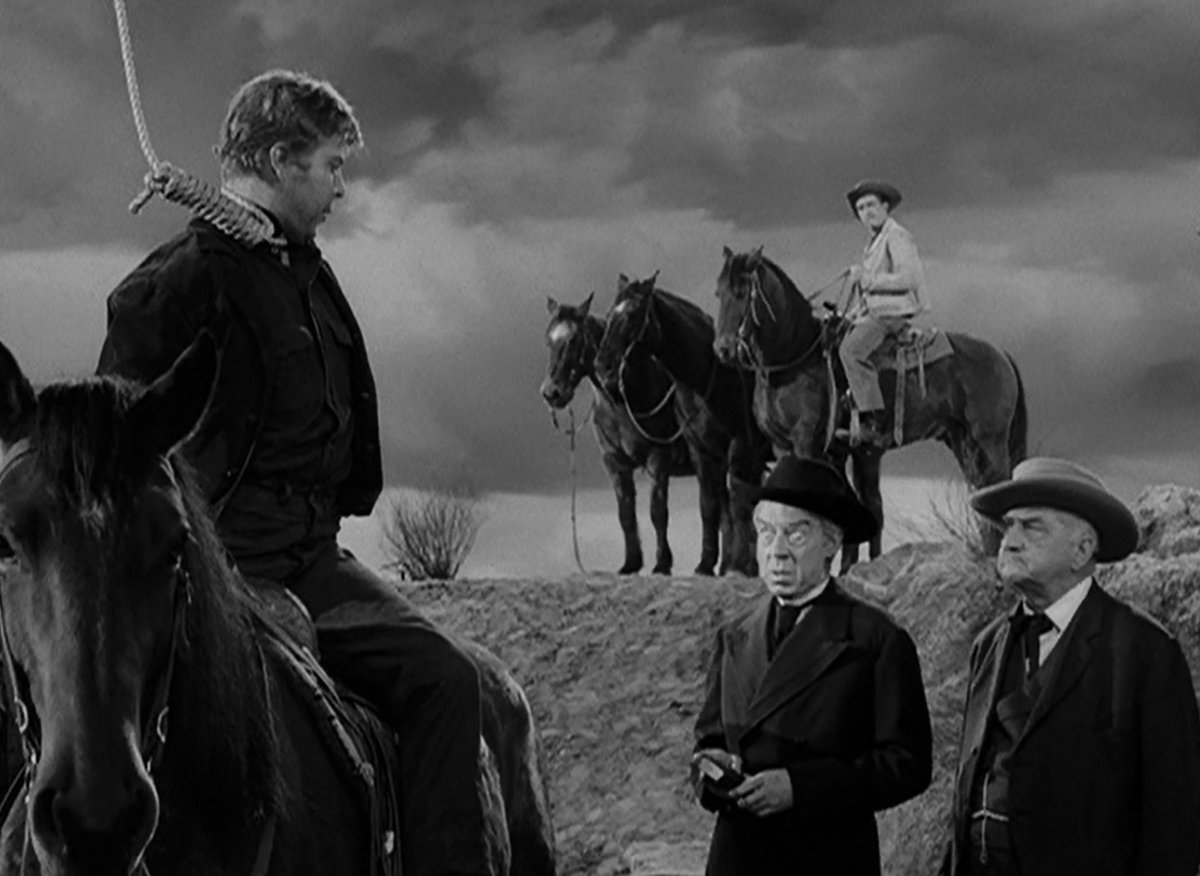
Commonplace—if somewhat grim—unsocial event known as a necktie party, the guest of dishonor a cowboy named Joe Caswell, just a moment away from a rope, a short dance several feet off the ground, and then the dark eternity of all evil men. Mr. Joe Caswell, who, when the good Lord passed out a conscience, a heart, a feeling for fellow men, must have been out for a beer and missed out. Mr. Joe Caswell, in the last, quiet moment of a violent life.

Summary

In the late 19th century, Joe Caswell is about to be hanged for murder, when he vanishes into thin air. He’s been snatched by Prof. Manion’s time machine and brought 80 years into the future. Caswell was selected at random and Manion can see the rope marks on his neck. Caswell is eager to see his new world but Manion wants to send him back. When Caswell runs off into the night, his new world proves to be too much for him. Justice is served in the end and a murderer hangs.

Rod Serling’s Closing Narration:

This is November 1880, the aftermath of a necktie party. The victim’s name—Paul Johnson, a minor-league criminal and the taker of another human life. No comment on his death save this: justice can span years. Retribution is not subject to a calendar. Tonight’s case in point in The Twilight Zone.

CAST

Rod Serling … Narrator (voice) (uncredited)
Albert Salmi … Joe Caswell
Russell Johnson … Prof. Manion
Than Wyenn … Paul Johnson
George Mitchell … Old Man
Jon Lormer … Minister
Fay Roope … Judge
Richard Karlan … Bartender
Joe Haworth … TV Cowboy (uncredited)

The Magnificent Seven

Hanspostcard is hosting a movie draft from 12 different genres…this is my Western entry.

There have been actors and musicians that exuded cool…Steve McQueen would be one of the top ones…and he was just starting in this movie…and not the star. 

This cast is just incredible… Along with McQueen, you have Charles Bronson, James Coburn,  Eli Wallach, Robert Vaughn, Horst Buchholz,  Brad Dexter,  and the great Yul Brynner. We are not talking about cameos here…Brynner is the unquestioned leader of this band of mercenary gunfighters…but money is not the most important thing to most of them. They believe in Brynner’s character and the adventure.

I could go through talking about each actor, but I won’t…there are a few I’ll touch on. Eli Wallach… did a masterful portrayal of Calvera. He is one actor that I would have loved to have met. His personality was so big in films, but he didn’t over act…he was just that good.

The actor that caught my attention the most in this was the newcomer of the seven. Chico, played brilliantly by Horst Buchholz. His character was young, impatient, cocky, but a nice kid who you saw grow in the movie. He wanted to join the six fighters, but he wasn’t accepted until he persisted and wore Chris Larrabee Adams (Yul Brynner) down.

John Sturges directed this movie and also The Great Escape plus Gunfight at the O.K. Corral. This movie was not shot on some studio backlot somewhere. It was real locations and it showed.

A brief look at the plot. A gang of bandits terrorizes a small Mexican farming village each year. They ride in and take what they want like the village is their own personal store. Several of the village elders send three of the farmers into the United States to search for gunmen to defend them. They end up with seven, each of whom comes for a different reason. They must prepare the town to beat an army of thirty bandits who will arrive wanting food. In came the Magnificent Seven to defend the village and teach the farmers how to fight.

A little trivia about the movie. Yul Brynner had a major role in casting, and he wanted Steve McQueen in the movie. At the time McQueen was in a television western called Wanted: Dead or Alive.

They ended up not getting along because McQueen supposedly was trying to upstage Brynner. When McQueen was dying of cancer he called Brynner and made up with him for the trouble in the film. McQueen said: “I had to make it up with Yul ’cause without him I wouldn’t have been in that picture.”

It’s not only a great western, it has comedy, drama, and most of all…all the characters are real. There is a reason some of them were huge at the time and others went on to be not only popular but legends. 

CAST

Yul Brynner … Chris Larabee Adams
Eli Wallach … Calvera
Steve McQueen … Vin Tanner
Horst Buchholz … Chico
Charles Bronson … Bernardo O’Reilly
Robert Vaughn … Lee
Brad Dexter … Harry Luck
James Coburn … Britt
Jorge Martínez de Hoyos … Hilario (as Jorge Martinez de Hoyas)
Vladimir Sokoloff … Old Man
Rosenda Monteros … Petra
Rico Alaniz … Sotero
Pepe Hern … Tomas
Natividad Vacío … Villager (as Natividad Vacio)
Mario Navarro … Boy with O’Reilly


Twilight Zone – People Are Alike All Over

★★★★ March 25, 1960 Season 1 Episode 25

If you want to see where we are…HERE is a list of the episodes.

***Special announcement Watch all you can this month on Netflix because Netflix is not streaming the Twilight after June 30th…Fellow blogger Blackwing666 posted this here. If there was ever a show you would think about purchasing… The Twilight Zone would a great one.

Roddy McDowall was one of my favorite TV actors. He normally plays caring, worried,  and vulnerable characters. This episode is another story on human nature…earth bound and Martians…are they the same all over? Sam Conrad will find out. It’s a good episode but doesn’t jump in the great category. 

SPOILERS Below

You can take this episode in many ways…is it a commentary on humans being a caged animal instead of its keeper? Possibly a prelude to the Planet of the Apes?  Does it comment on luxuries entrapping us when they become necessitates or just human nature? Its a very good episode of the Twilight Zone .

The living room set is the same one seen in The Twilight Zone: Third from the Sun (1960). It is a redressed version of George’s living room from The Time Machine

Rod Serling changed a couple of elements from the original source story (Brothers Beyond The Void, by Paul W. Fairman) for this episode. In the original story the protagonist is Marcusson and Conrad is only in the beginning of the story as Marcusson makes the trip to Mars alone. Serling also changed the climatic utterance from the story’s mundane “People are the same everywhere,” to his more poignant version. It isn’t clear why Serling changed the story and made Conrad the protagonist.

This show was written by Rod Serling and Paul W. Fairman

Rod Serling’s Opening Narration: 

You’re looking at a species of flimsy little two-legged animal with extremely small heads, whose name is Man. Warren Marcusson, age thirty-five. Samuel A. Conrad, age thirty-one. They’re taking a highway into space, Man unshackling himself and sending his tiny, groping fingers up into the unknown. Their destination is Mars, and in just a moment we’ll land there with them.

Summary

Biologist Sam Conrad is scheduled to go on a mission to Mars and is genuinely concerned about what they will find there. The mission commander, Mark Marcusson, tells him there’s nothing to worry about as he firmly believes that God made everyone in his image; no matter what they find, he is certain that people are alike all over. They crash-land on Mars and Marcusson dies from his injuries. Conrad is happy to find that the people of Mars are very human-like, friendly and intelligent. They provide him with a home and promise him much more. Too late, however, he realizes that, just as Marcusson had said, people are alike all over.

Complete episode here

Rod Serling’s Closing Narration:

Species of animal brought back alive. Interesting similarity in physical characteristics to human beings in head, trunk, arms, legs, hands, feet. Very tiny undeveloped brain. Comes from primitive planet named Earth. Calls himself Samuel Conrad. And he will remain here in his cage with the running water and the electricity and the central heat as long as he lives. Samuel Conrad has found The Twilight Zone.

CAST

Rod Serling … Narrator (voice) (uncredited)
Roddy McDowall … Sam Conrad
Susan Oliver … Teenya
Paul Comi … Marcusson
Byron Morrow … Martian
Vic Perrin … Martian
Vernon Gray … Martian
Herbert Winters … Martian Observer (uncredited)

Twilight Zone – Long Live Walter Jameson

★★★★1/2  March 18, 1960 Season 1 Episode 24

If you want to see where we are…HERE is a list of the episodes.

How would you like to live thousands of years? Mr. Jameson was given that option that many of us would love to have…but it’s not without it’s downfalls. Like the episode “Escape Clause” this episode explores immortality except in this one the main character is sophisticated but can be just as selfish. Even with his considerable life experiences some things don’t sink in.

Compared to shows in 2021 this episode is paced slow but that is a great thing. The story has room to breathe and is laid out in front of us. Living forever looks great on paper but in real time it would be hard to lose people you love over and over again… and lose yourself in parts and pieces in the process.

This is a great episode and an interesting view on immortality.

This episode deals with immortality. The entire cast all lived exceptionally long lives. Kevin McCarthy lived to be 96, Estelle Winwood was 101 when she passed away, Edgar Stehli passed away shortly after turning 89, and Dodie Heath turned 90 in August of 2018.

McCarthy died September 11, 2010 at the age of 96, having earned an acting credit as late as the year he died, more than 50 years after this episode was produced.

This show was written by Charles Beaumont

Rod Serling’s Opening Narration: 

You’re looking at Act One, Scene One, of a nightmare, one not restricted to witching hours of dark, rainswept nights. Professor Walter Jameson, popular beyond words, who talks of the past as if it were the present, who conjures up the dead as if they were alive…In the view of this man, Professor Samuel Kittridge, Walter Jameson has access to knowledge that couldn’t come out of a volume of history, but rather from a book on black magic, which is to say that this nightmare begins at noon.

Summary

Walter Jameson is a successful history professor. He’s been teaching for 12 years and has proven to be very popular with his students for his ability to bring his subject to life. He is engaged to Susanna Kittridge, his good friend Professor Sam Kittridge’s daughter. One thing that Professor Kittridge has noticed about Walter is that he doesn’t seem to have aged one bit in the 12 years they have known each other. Walter admits that he is far older than anyone can imagine but before he and Susanna can elope, someone from his past pays him a visit.

Rod Serling’s Closing Narration:

Last stop on a long journey, as yet another human being returns to the vast nothingness that is the beginning and into the dust that is always the end.

CAST

Rod Serling … Narrator (voice) (uncredited)
Kevin McCarthy … Prof. Walter Jameson / Tom Bowen / Maj. Hugh Skelton
Edgar Stehli … Professor Sam Kittridge
Estelle Winwood … Laurette Bowen
Dodie Heath … Susanna Kittridge (as Dody Heath)

Twilight Zone – A World of Difference

★★★★  March 11, 1960 Season 1 Episode 23

If you want to see where we are…HERE is a list of the episodes.

This is the kind of story that the Twilight Zone excels at. Vanishing into a fantasy world of your own design forever. They explored this plot device more than once in episodes like The Sixteen-Millimeter Shrine and A Stop at Willoughby just to name a few. Don’t worry though because the variations are so good that you would not mind more.

You think Arthur Curtis  is just a white-collar worker until you hear the word “cut.” He is an actor on a set but to him…he is the character he is playing. Howard Duff plays Arthur Curtis who is really Gerry Raigan. You get the feeling you would not like Raigan at all. It seems he has a drinking problem and an ex-wife that just despises him. You start seeing the reason why Arthur Curtis was born. 

Duff is very believable as Curtis…You see the worried look in his eyes yet he is hanging on to Arthur Curtis. 

When Gerry’s ex-wife demands he give her a check, she spells out the last name as “Raigan”. This isn’t the expected way to spell it, which may have been deliberate, so as to not associate the character with Ronald Reagan, the then-President of the Screen Actors Guild.

Look for David White…who became famous a few years later for the character Larry Tate in Bewitched. 

This show was written by Richard Matheson

Rod Serling’s Opening Narration: 

You’re looking at a tableau of reality, things of substance, of physical material: a desk, a window, a light. These things exist and have dimension. Now this is Arthur Curtis, age thirty-six, who also is real. He has flesh and blood, muscle and mind. But in just a moment we will see how thin a line separates that which we assume to be real with that manufactured inside of a mind.

Summary

Arthur Curtis is sitting his office chatting with secretary about plans for his daughter’s birthday party and that he and his wife will be flying off for a couple of days of rest and relaxation. Suddenly he hears someone yell “cut” and he realizes he on a movie sound stage. He can’t understand what has happened to him. Everyone refers to him as Gerry Reagan, but he insists that he is Arthur Curtis. He runs off but can’t find any of the familiar landmarks he knows such as his house or his place of work. He is desperate to return to the world of Arthur Curtis but that window of opportunity may be closing on him.

Rod Serling’s Closing Narration:

The modus operandi for the departure from life is usually a pine box of such and such dimensions, and this is the ultimate in reality. But there are other ways for a man to exit from life. Take the case of Arthur Curtis, age thirty-six. His departure was along a highway with an exit sign that reads, “This Way To Escape”. Arthur Curtis, en route to the Twilight Zone.

CAST

Howard Duff … Arthur Curtis / Gerry Raigan
David White … Brinkley
Frank Maxwell … Marty Fisher
Eileen Ryan … Nora Raigan
Gail Kobe … Sally
Peter Walker … Sam
Susan Dorn … Marion Curtis
Bill Idelson … Kelly (as William Idelson)