

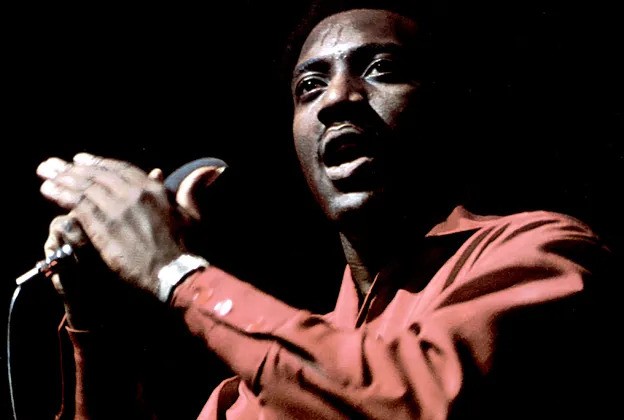
I love this genre of music. I really could put these songs in any order I wanted and it would work. I had to leave so many off…I could easily make this list with 100 different artists but I wanted the page to actually load so you could read it. This is just a partial list…if you like it I could do a part II one day.
James Carr – Pouring Water On A Drowning Man
No…his name is not a household name like the rest of the list but this song just gets to me every single time I listen to it. If you don’t listen to any other song on this post…give this one a try. I dropped Sam Cooke from this list because of Carr but I like this song that much.
His voice and that wonderful guitar. Pouring Water on a Drowning Man charted at #85 on the Billboard 100 and #23 on the R&B Chart in 1966. This song is so easy to listen to. Great guitar sound and Carr’s voice is wonderful. The small intro is worth it. The guitar can sound can seem so deceptively easy but it’s not to be right. He lived in Memphis and was called “the world’s greatest Soul Singer” but he had a bipolar disorder and that made it hard for him to tour because of the depression.
At one time he was mentioned along with Otis Redding and they had the same manager for a while. The guy had a great voice. Check his other music out.
Arthur Conley – Sweet Soul Music
Otis Redding believed in Conley’s talent. In January 1967 Redding and his managers, Phil Walden (future ABB manager) and his brother Alan Walden (future Lynyrd Skynyrd manager) brought Conley to producer Rick Hall’s FAME Studios in Muscle Shoals, Alabama. Conley recorded two singles at FAME Studios but they were not successful and Hall did not want to work with Conley anymore.
By this time Otis was fed up and took Conley himself to FAME and used his own band. With Jimmy Johnson Engineering they recorded Sweet Soul Music. It was a million-selling single. It peaked at #2 on the Billboard 100, #2 in the R&B Charts, and #7 in the UK in 1967.
It was written by Conley and Otis Redding. It was based on “Yeah Man” by Sam Cooke and was a tribute to soul singers. The songs mentioned in this song are “Going To A Go-Go,” “Love’s a Hurtin’ Thing,” “Hold On I’m Coming,” “Mustang Sally” and “Fa-Fa-Fa-Fa-Fa (Sad Song).” The artists mentioned are Otis, Wilson Pickett, Sam and Dave, James Brown, and Lou Rawls.
Marvin Gaye – Let’s Get It On
I never checked the statistics…but I have to think there had to be a baby explosion nine months after “Let’s Get It On” was released in 1973. Anyone born in 1974 may owe their very existence to this song.
This song’s co-writer Ed Townsend also produced the album with Marvin and co-wrote the three other songs on the first side of the disc, including “Keep Gettin’ It On.” He wrote with Marvin again on songs for Marvin’s 1978 album Here, My Dear.
This song peaked at #1 in the Billboard 100, The guitar and voice are excellent in this song. There is no guessing what this song is about.
Otis Redding – Shake
This song was a highlight when watching the Monterey Pop Festival. Otis had the voice, charisma, and loads of talent. Shake was written and originally recorded by Sam Cooke. Cooke’s version reached #7 on the Billboard 100. Cooke was a huge influence on Otis Redding; along with Shake, Redding also recorded covers of Cooke’s A Change Is Gonna Come, Chain Gang, Cupid, Nothing Can Change This Love, Wonderful World, and You Send Me.
The song peaked at #47 on the Billboard 100 in 1967. Otis was on his way to superstardom. Otis made a huge impact at the 1967 Monterey Pop Festival along with The Who, Jimi Hendrix, and Janis Joplin.
The Reverend Al Green – Let’s Stay Together
I never tire of hearing his voice. This song almost wasn’t released because Green hated the thin sound of his falsetto. Producer Willie Mitchell said: “The only fight I ever had with him was about ‘Let’s Stay Together,’ because he thought ‘Let’s Stay Together’ was not a hit.” It did pretty well for a song Green didn’t think was a hit.
The song peaked at #1 in the Billboard 100, #7 in the UK, and #14 in Canada in 1972. Let’s Stay Together also spent nine weeks at the top of the Billboard Hot Soul Singles chart.
It was selected by the Library of Congress as a 2010 addition to the National Recording Registry, which selects recordings annually that are “culturally, historically, or aesthetically significant.
…
 PowerPop... An Eclectic Collection of Pop Culture