

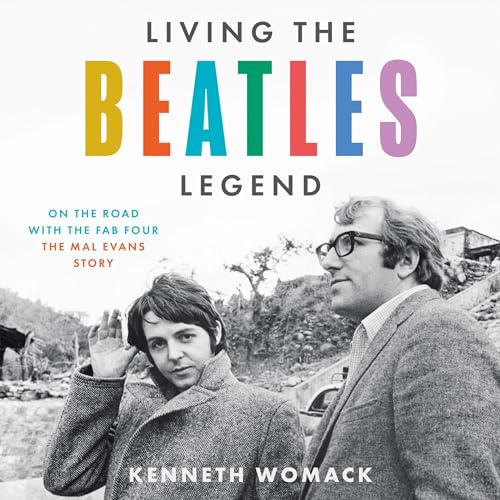
I’ve been waiting on this book since I read about the Beatles in the 70s as a kid. I knew the story…after a showdown with police Mal Evans was shot and killed on January 5, 1976. He was working on his autobiography at the time. Evans was the last person you would think would die that way…and in this case…he wanted it. Could the police have handled it better? Yes, but Mal had said that is how he wanted to go out. He forced the situation. He was only 40 years old.
Mal Evans along with Neil Aspinal were the roadies for the Beatles. Imagine that…2 roadies for the world’s biggest band. Mal worked at a telephone company in the early ’60s but he loved rock and roll…especially Elvis Presley. He would go see bands at the Cavern and struck up a friendship with George Harrison. George told him since he loved music…take a part-time job as a bouncer at The Cavern. The Beatles automatically liked him from the start. He was a big guy at 6’4″ but he never wanted to use violence. More times than not…he talked his way out of trouble. Aspinal was their only roadie and when Love Me Do and then Please Please Me came out…they needed another person because Aspinal was worn out.

The book covers his entire life and of course, focuses on the years 1963 – 1976. It’s a wonder we have the book at all. All of Mal Evan’s diaries and papers were lost for 12 years after he died. They were discovered by a paralegal who was looking through the basement of a publishing company. They were stored in 6 banker boxes so he had a lot of material including original lyrics to many Beatle songs. He kept about everything and you could say he was the Beatle’s first historian.
He made his mark in history. He was a talent scout for Apple and signed The Iveys which later became Badfinger. Without him pushing them they probably would not have been signed. After the Beatles broke up he continued to work for them as solo artists. Mal loved the Beatles and they in turn trusted him and Neil more than anyone else. He tried a few things like songwriting and he did get some songs covered. He also did a bit of acting appearing in a few of the Beatles movies and also a few with Ringo. When making sure The Beatles had some private space in public he would keep fans away to a point…but was always nice. He said he didn’t want to be rude to the fans who made the Beatles who they were.
His son Gary helped Womack with this book including full access to all of the papers left behind by Mal. His family were the ones who suffered. He was gone most of the time especially when the Beatles were touring. After touring was over he moved his family to London but still was rarely home.
I would highly recommend this book. Kenneth Womack had full access to his diaries and used many of the entries. This book turned up a lot of things about them that I had no clue about. It also gave a different look at their personalities on an everyday basis. Near the end, Mal went to the 2nd Beatles convention and spoke. He started to battle depression in the seventies after living in California and missing his wife and kids back in London. He picked up a girlfriend in California and that made his guilt worse. Drugs also affected him in the end.
If you are a Beatles fan…get the book. I wrote this book review originally with over 15 paragraphs but I was telling his story more than critiquing the book. At the end, Mal was working on his book and lined up a publishing deal. All the Beatles signed off on it and wanted to see Mal succeed. He was known for his kindness and loyalty. He told each Beatle in 1974 that he was leaving to do his own thing but continued to help them out.
- Mal appeared in every Beatles movie but Yellow Submarine and you see him throughout Get Back.
- He produced “No Matter What” by Badfinger
- He helped Paul write Fixing A Hole and Sgt Peppers Lonely Hearts Club Band
- The original producer of Keith Moon’s solo album
If anyone is interested…I’m including some of the Foreward by his son Gary Evans.
This book is the product of decades of toil. It would not have been possible without the initial determination of my father, Mal Evans, to capture the Beatles’ story as it unfolded before him. He knew, even in his earliest days as a bouncer at the Cavern Club door, that the boys were something special. As he traveled with them across the whole of England and, eventually, the world, he recorded his memories in the pages of his diaries and filled up notebooks with his drawings and recollections, all the while taking thousands of candid photographs and saving ephemera of all shapes and sizes—a receipt here, a scrap of lyrics there.
When my dad sat down to compose his memoir for Grosset and Dunlap in 1975, he realized the difficulty inherent in taking up a pen to capture his thoughts. Fortunately, he was aided by a stenographer, who transcribed his words to the letter, and by the sage advice of Ringo Starr: “If you don’t tell the truth,” he told my dad, then “don’t bother doing it.” And so, Dad did.
On January 4, 1976, when he simply couldn’t stomach the act of living another day, my father orchestrated his own demise in a Los Angeles duplex. He left behind the fruits of decades of collecting, along with a full draft of his memoir, which he planned to call Living the Beatles’ Legend: 200 Miles to Go. He had even gone so far as to plot out the book’s illustrations, with the assistance of a friend who had served as an art director, and mocked up a couple of cover ideas.
My dad’s death threw all this into disarray. For a time, Grosset and Dunlap made various attempts at publishing Living the Beatles’ Legend, but my mother, Lily, understandably distraught over her estranged husband’s tragic death, simply wanted his collection to be returned to our family back in England, so that we could sort things out for ourselves. As we later learned, in the days after my father died in Los Angeles, Grosset and Dunlap transported the materials from L.A. to New York City, eventually placing them in a storage room in the basement of the New York Life Building.
And that’s where they sat for more than a dozen years, to be rescued from the garbage heap only by the quick thinking of Leena Kutti, a temporary worker who discovered my dad’s materials—along with the diaries, the photographs, and the memoir—recognizing she was in the presence of a most unusual archive. When her efforts to raise the alarm with the publishing house fell on deaf ears, Kutti took it upon herself to march uptown to the Dakota, where she left a note for Yoko Ono, one of the few genuine heroes in the strange progress of my father’s artifacts. In short order, Yoko alerted Neil Aspinall, my dad’s counterpart during the Beatles years. With the assistance of some shrewd Apple lawyering, Neil saw to it that the collection was finally delivered to our family home in 1988.
For several years, my dad’s manuscripts and memorabilia were stored in our attic. I would periodically dip into them and reacquaint myself with the person whom I had lost when I was fourteen years old. Thumbing through the materials reminded me why I loved my father so dearly, in spite of the flaws that drove him away from us and led to his death at age forty. Over the years, my family has struggled with the idea of sharing Mal’s story. Then, in 2004, a forger created an international sensation when he claimed to possess Dad’s collection in a suitcase full of artifacts he had discovered in an Australian flea market. The news was quickly picked up and shared across the globe with much fanfare before it was proven to be a hoax.
To stem the ensuing confusion, my mum and I consented to a 2005 interview with the Sunday Times Magazine, even going so far as to allow the publication of a few excerpts from my dad’s diaries. The tide began to change for us in July 2018, when I decided to follow in my father’s, and the Beatles’, footsteps and retrace the famous “Mad Day Out” photo session on its fiftieth anniversary. I was joined that day by my good friend, actor and playwright Nik Wood-Jones. Along the way, we had the remarkable good fortune to cross paths with filmmaker and Beatles aficionado Simon Weitzman, who was on a similar mission.
As my friendship with Simon developed, I confided in him about the ongoing challenge of sharing my dad’s story with the world. He assured me that he knew just the guy to make it happen. Through Simon, I met Ken Womack via Zoom in 2020, during the first few months of the Covid-19 pandemic. Ken had already authored several books about the Beatles, but more important, Simon trusted him implicitly. Almost as soon as we began working together, I knew that Ken was the right collaborator to tell my dad’s story with the historical integrity it required. Over the years, I have come to understand the ways in which Beatles fans the world over adore “Big Mal,” and to his credit, Ken has been able to honor that connection while also mining the truth of my dad’s life, warts and all.
Working with our friends at HarperCollins, we are proud to share the present book with you—a full-length biography detailing my dad’s life with (and without) the Beatles. A second, even more richly illustrated book will follow in which we provide readers with highlights from my dad’s collection, including the manuscripts he compiled, the contents of his diaries, numerous drawings and other ephemera, along with a vast selection of unpublished photographs from our family archives and from his Beatle years.
The present effort simply wouldn’t have been possible without the saving graces of people like Leena Kutti, Yoko Ono, Neil Aspinall, Simon Weitzman, and Nik Wood-Jones. And now, thanks to Ken, readers will be able to experience my dad’s story with the vividness it deserves. Ken, you kindly lent me your ears over the past three years; I got by with more than a little help from you, my friend.
My father meant the world to me. He was my hero. Before Ken joined the project, I thought I knew my dad’s story. But what I knew was in monochrome; now, some three years later, it is like The Wizard of Oz, my dad’s favorite film, when the scene shifts from black-and-white Kansas to the dazzling multicolored brilliance of Oz. Ken has added so much color, so much light to my dad’s story. He has shown me that Mal Evans was the Beatles’ greatest friend. Yes, Big Mal was lucky to meet the Beatles, but the Beatles possessed even more good fortune when, for the first time, all those years ago, my dad happened to walk down the Cavern Club steps. The rest is music history.

 PowerPop... An Eclectic Collection of Pop Culture
Nice post ✍️
LikeLike
Wow. What a backstory Max. Kinda crazy I never thought of The Beatles having roadies for some reason lol. But why wouldn’t they right?!! Learn something new everyday here at your place.
LikeLiked by 2 people
They didn’t have those massive systems that hanged they do today…which was good…well except for the audience who couldn’t hear a damn thing over the screaming lol…
LikeLike
Sounds like a book that would be interesting, I might get a copy. Sad about his ending, I had no idea of that. He seemed utterly normal & balanced in ‘Get Back’.
LikeLiked by 2 people
Oh he was at that time…it’s when the Beatles broke up that he started to experience it more and more…and the usual seventies story of drugs…and his family so far a away.
From what everyone said…a nicer guy you will never find.
LikeLiked by 3 people
yeah, not an unusual story , prone to depression so more likely to over-indulge in drugs or drinking which will probably make the depression worse, and being physically distanced from those he loved (for whatever reason). Still, I can’t fault the police at all, if he had a rifle (even if it turned out to only be an air one) and was threatening they have no real choice but to take him down. Even if they had Tasers like they do now, they likely wouldn’t have been able to get close enough to him to deploy it.
LikeLiked by 2 people
He TOLD them to take him down…it was like half said…suicide by cop…which is terrible because those cops have to live with that everyday.
I said tear gas but there was a little girl on the same floor..
LikeLiked by 1 person
I just finished reading this book. Such a heartbreaking tale of a flawed but beautiful person.
LikeLiked by 1 person
Thanks for stopping by…yes it is. I’ve read about Mal since I was a kid and he was exactly how I pictured him in many ways. The ending I never knew much about except what happened.
LikeLiked by 1 person
Evans was shot and killed by police at his home in Los Angeles, when he threatened officers with what turned out to be an air rifle.
LikeLiked by 1 person
He wanted it all to happen. With his personality it’s very doubtful he would have tried anything…the policemen were newer and should have had tear gas or something else but there was a little girl upstairs in another room so they were thinking of her….
He had everything to live for…it was so crazy…I think drugs had more to do with it than anything…the depression didn’t help of course.
LikeLiked by 2 people
A case of “suicide by cop” before the term was known.
LikeLiked by 2 people
Can’t wait to read this
LikeLiked by 1 person
It’s a sad and happy story combined.
LikeLiked by 1 person
I expect a mix
LikeLiked by 1 person
Hard drugs don’t help those, for want of a better word(s) afflicted by mental issues. If its not prescribed by a trained professional, don’t use it. And I’m not a Yoko fan usually, especially when she ‘sings’, but it seems like she really came through here.
On another point, imagine being Leena, slogging through the dark basement, dusting off those boxes and finding hidden treasures- imagine the dawning reality, then the rapture and the cold sweats.
LikeLiked by 1 person
Oh I know…you know it had to be tempting for her to keep a lyric page or two…BUT…back in 88 we didn’t have Ebay and the market hadn’t taken off yet. In dollar value…those 6 boxes are a fortune….but that isn’t the important thing…48 years after his senseless death…we finally get to hear his words…I so happy Leena found it and was a good person and persistent. Her boss wanted her to pitch it.
LikeLiked by 1 person
I’m completely ignorant about this stuff and Mal”s story . Really enlightening post today Max.
LikeLiked by 1 person
This book definitely sounds interesting. What a sad story in the end. I read elsewhere that none of the ex-Beatles showed up at Mal’s funeral. While I imagine there were specific reasons, I still find this pretty sad as well, given how close Mal was to them.
LikeLiked by 1 person
They didn’t show up because they didn’t want a media circus for his family. The book also has a touching story of George Harrison stopping by 6 years after he died and playing with his kids and talking to his wife….he also apologized for something and he did give the family money also when Mal was killed.
LikeLiked by 2 people
So glad that people involved were on the ball in recognizing the archive’s value, keeping it safe, and being able to get it in a form to share with the world. So sorry Mal found himself in a mental state where he didn’t want to go on. He left behind a grieving family 😦
LikeLiked by 1 person
I wished he would have reached out to someone…
LikeLiked by 1 person
The thing about that lifestyle, everybody pretty much is in the same boat. Maybe it could be a new specialty for mental health practitioners.
LikeLiked by 1 person
They need it.
LikeLiked by 1 person
Like Deke said, wow, what a story! I believe I’ve heard of Mal Evans but would not have remembered any details about him or his involvement with the Beatles. That’s a wonderful foreward by his son.
LikeLiked by 1 person
Thanks Jeff…it’s an interesting look at how a person could go from being on top of the world to an awful end.
LikeLiked by 1 person
someone just bought me The Lost Album Of The Beatles book, not read it yet but it’s an idea Ive always wanted to follow-up 🙂
LikeLiked by 1 person
I’ve seen that book but I haven’t got it yet… this one is really good.
LikeLiked by 1 person