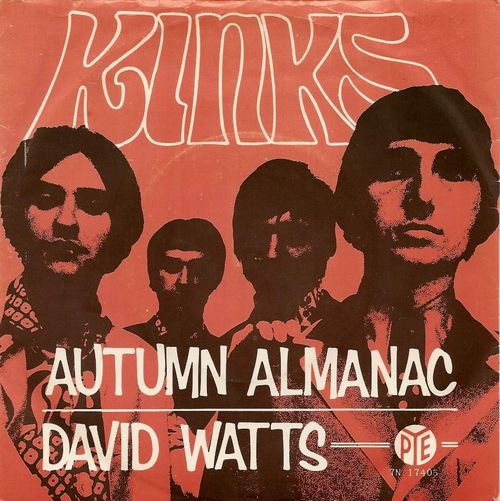
Kinks Weeks – Autumn Almanac … number1sblog.com

I’ve been visiting Stewart at Number1sblog for a few years. His blog never lets me down. Learning about #1 songs in the UK and how different the American charts can be from them. He is currently in the year 1998 but travel back to see the previous years also. He always gives you a quality take on every #1 song. 

The Kinks, ‘Autumn Almanac’

Thanks, Max, for giving us the space to write about our favourite songs from Britain’s third-best band of the 1960s. And yes, the Kinks were the sixties ‘third’ British band. Forget the Who, or the Hollies. Don’t dare mention Manfred Mann or Herman’s Hermits! In bronze position, behind the Beatles and the Stones, stand Muswell Hill’s finest.

The Kinks scored twelve top ten hits, and three number ones, between 1964 and 1967, with their last big chart hit of the sixties being ‘Autumn Almanac’. And if you needed an example of why many non-Brits might not choose the Kinks as the ‘60s third-best band, then this is the perfect record.

Not many pop songs talk of sweeping leaves, of crawly caterpillars, buttered currant buns, or of rheumatic backs. Nothing very rock ‘n’ roll there. Nor is there in the middle-eight: I like my football on a Saturday, Roast beef on Sundays, All right… It’s quintessential Kinks: tongue-in-cheek vignettes of British life. Not as famous as Terry and Judy from ‘Waterloo Sunset’, the unnamed aristocrat in ‘Sunny Afternoon’, or the legendary ‘Lola’, but every bit as vital. No wonder Blur’s Damon Albarn named ‘Autumn Almanac’ as his favourite Kinks’ record, given that he spent much of the nineties trying to recreate it…

But before it all gets too cozy and twee, Ray Davies turns his attention to British ideas of respectability, and the class system. This is my street, And I’m never gonna leave it… If I live to be ninety-nine… The singer is trapped in his lower-middle class environment. Everyone he meets, seems to come from his street, and he can’t get away… No social climbing allowed.

For this to be the Kinks final Top 10 record of the decade is fitting. It’s the culmination of their move away from the garage rock of ‘You Really Got Me’, through to more traditional, folksy pop. ‘Autumn Almanac’ is at one moment crunchy guitars, the next a trombone-led, music hall singalong.

But while it’s easy to claim that the Kinks were too ‘British’ for American audiences, leading to less chart success as the sixties went on; that’s not quite the full picture. The fact that they had been banned from touring the States since 1965 thanks to their habit of attacking one another on stage was probably a much more pressing reason.

Still, maybe it was a blessing in disguise, for the touring ban coincided with a change in their sound. Their hard-rocking early hits are great, but for me the classic Kinks period starts with the hilariously catty ‘Dedicated Follower of Fashion’, through ‘Dead End Street’, and the timeless ‘Waterloo Sunset’, to this. My answer might change depending on which time of year it is, but ‘Autumn Almanac’ will always be close to the top of my ‘Best Kinks Songs’ list.

Kinks Weeks – Apeman … onceuponatimeinthe70s.com

I’m very happy to have Colin Jackson from Once Upon A Time In The 70’s guest host my blog today. Colin Jackson and Paul Fitzpatrick who both run Once Upon A Time In The 70’s grew up in Bearsden, a northern suburb of Glasgow, Scotland. They were school friends from the age of five until in 1974, aged sixteen, Paul left school to start a career working with fashion and sportswear brandsTheir paths would not cross again for forty-four years, during which time Colin pursued a career in Banking. Their site will take you back in time…just as well as a time machine!

THE KINKS: ‘Apeman’

Should Andy Murray have been born ten years either side of when he was, he’d have been the best tennis player of his generation. As it was, despite two Olympic gold medals and three Grand Slam titles amongst goodness knows how many other achievements, he will be forever mentioned almost as an afterthought in any conversation of the greatest players of the 2000s – possibly all time.

Damn those Federer, Nadal and Djokovic fellas!

A similar fate befell The Kinks, and Ray Davies in particular. Maybe they wouldn’t have gone down in history as the best band ever, but they certainly would have benefitted from a greater appreciation.

Damn those Lennon and McCartney and Jagger and Richards fellas!

Then again, I suppose it could be argued that without the Beatles and Stones, The Kinks wouldn’t have capitalised on The British Invasion of America.

Whatever, throughout the ‘60s and ‘70s The Kinks were always playing catch-up in the popularity stakes, despite their critical acclaim and string of hits. Sticking within those two decades, the band had nineteen Top 40 hits here in the UK, including three Number 1s. Not bad on any level.

I must confess, though, that I too am guilty of overlooking them in favour of (most definitely) The Rolling Stones and (yes, probably even) The Beatles. Which is a terrible admission to make, when I take a proper look at the prolificacy of Davies’s writing.

I’d not long turned twelve years old when this single was released. My musical bias had not yet been shaped. I just liked what I liked. I had no idea of what was ‘cool’ or otherwise. It would be a year further down the line before I decided I was a fan of The Sweet and John Kongos … but there was something about ‘Apeman’ I found so appealing.

Perhaps it was the catchy hook. Or maybe it was the (now cringeworthy) faux Caribbean accent during the short, spoken word passage. Or maybe, most likely it was, the silly video of some geezer dressed up like a gorilla and following the band around a most ‘un-jungle-like’ wet and miserable (London?) park.

It certainly wouldn’t have been the lyrics – not at that age. In fact, as I’ve alluded in the past, I’m still a bit of a philistine when it comes to song lyrics.  However, even a very young ‘me’ was aware of the Cold War at that time, and the line about not wanting to die in a nuclear war did hit home.

Ray Davies had of course by this time already shown a great deal of social conscience and disdain for the forsaking of tradition. I’m sure others will cover these, but think of ‘Dead End Street,’ ‘Autumn Almanac’ and ‘The Village Green Preservation Society’ for starters. So, for him to display the utopian spirit of peace and freedom would have come as no surprise who already appreciated his work.

Davies had (has) a knack of making serious comment from entertaining, upbeat and melodic songs. Almost fifty-four years on from ‘Apeman’ peaking at #5 in the UK charts, sadly nothing much appears to have changed. Indeed, the words are perhaps even more pertinent today:

… So I’m no better than the animals sitting

In the cages in the zoo man

‘Cause compared to the flowers and the birds and the trees

I am an apeman

I think I’m so educated and I’m so civilized

‘Cause I’m a strict vegetarian

But with the over-population and inflation and starvation

And the crazy politicians

I don’t feel safe in this world no more

I don’t want to die in a nuclear war

I want to sail away to a distant shore and make like an apeman


________

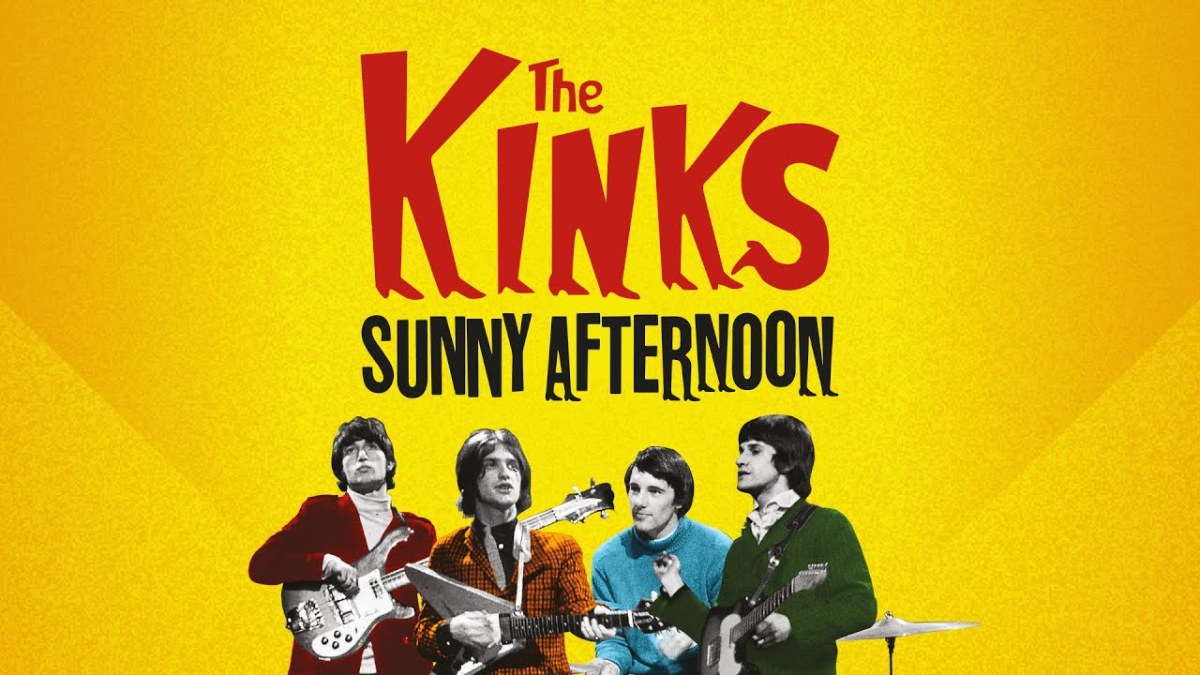
Kinks Weeks – Sunny Afternoon …eclecticmusiclover.com

I’ve been going to Jeff’s site for years at https://eclecticmusiclover.com. He features newer music on his blog from a large range of bands. He does a lot of great work there… often getting inside information and interviews with the bands themselves. Go check Jeff out…he is a fine writer. 

I’m honored to be included in Max’s series on The Kinks, and my pick is their 1966 single “Sunny Afternoon”, which ranks among my top ten favorites of their songs. I was 11 when the song came out and I remember liking it a lot, not only because of its catchy, upbeat melody but also for the lines “Save me, save me, save me from this squeeze. I gotta big fat mama trying to break me” which, being an 11-year-old, I found pretty funny. Though I didn’t fully comprehend the deeper meaning of the lyrics at the time, my guess was that the song was generally about a guy’s discontent over his current life situation.

Written by Kinks frontman Ray Davies while he was at home suffering from a bad cold, “Sunny Afternoon” was inspired by the high levels of progressive tax imposed by the British Labour government of Harold Wilson (a subject also covered by the Beatles in their song “Taxman”), as well as a host of difficult issues he was facing at the time. Despite the Kinks’ immense success, group tensions, lawsuits, an unrealistic workload and unsupportive management was making them miserable. Davies was also dealing with new fatherhood, and had even left the band for a while.

In writing the song, Davis composed the melody first, then created an alter ego to express his feelings. He later recalled: “The only way I could interpret how I felt was through a dusty, fallen aristocrat who had come from old money as opposed to the wealth I had created for myself.” In order to prevent the listener from sympathizing with the song’s protagonist, a spoiled aristocrat bemoaning the loss of his vast unearned wealth, Davies said, “I turned him into a scoundrel who fought with his girlfriend after a night of drunkenness and cruelty.” (Songfacts)

Regarding those lyrics I loved as a kid, Davies explained in a 2016 interview with Q magazine: “My mother was quite large. But that also alludes to the government, the British Empire, trying to break people.”

Davies was still suffering from his cold on the day he recorded the song on May 13, 1966, and now that I know this, his nasal congestion is apparent in his vocals, which nevertheless still sound great to me. He recalled to Q magazine: “I did it in one take and when I heard it back I said, ‘No, let me do it properly,’ but the session was out of time. So that was the vocal. I heard it again the other day. I was 22 but I sound like someone about 40 who’s been through the mill. I really hang on some of the notes. A joyous song, though, even if it’s suppressed joy. I had real fun writing that.” Backing vocals were sung by Dave Davies, Kinks bassist Pete Quaife, and Ray Davies’ then wife Rasa.

With its strong music hall vibe (a type of British theatrical entertainment similar to American vaudeville that was popular from the early Victorian era through World War I, characterized by a mix of popular songs, comedy and specialty acts), “Sunny Afternoon” was a continuation of the stylistic departure from the band’s earlier hard-driving, power chord songs like “You Really Got Me” and “All Day and All of the Night” that began with 1965’s “A Well Respected Man”. Besides Davies’ wonderful vocals, I love Pete Quaife’s jaunty bass riff, session musician Nicky Hopkins’ spirited piano, and the charming little musical touches like the harmonica, tambourine and lively percussion heard throughout the track.

Released as a single on June 3, 1966, “Sunny Afternoon” went to #1 on the UK Singles Chart that July, where it spent three weeks. The song also reached #1 in Ireland, Canada, the Netherlands and Norway, and peaked at #14 on the Billboard Hot 100 chart in the U.S. It was later included on their fourth album Face to Face, released in October 1966, as well as becoming the title track for their 1967 compilation album.

The promotional video produced for the single featured the band performing in a cold, snowy environment, in sharp contrast to the lyrics about enjoying a sunny afternoon.

Kinks Weeks – Living On A Thin Line …christiansmusicmusings.wordpress.com

Christian and I share a lot of the same musical tastes. It’s odd because neither one of us grew up with The Beatles in real-time or that great 60s generation. We both grew up in the 80s but share a lot of the same likes. He has a very cool informative site that is a must if you are a music fan. He goes over older music and newer music much more than I do. Go see him at https://christiansmusicmusings.wordpress.com/

A Kinks Song I Dig: Living on a Thin Line

When Max, who writes the great PowerPop blog, came knocking to see whether I’d like to participate in a song series dedicated to The Kinks I replied, ‘sure!’ After all, next to The Beatles, The Rolling Stones and The Who, they are my favorite ‘60s band.

I also knew right away what my pick would be, which may seem a bit strange. After all, the British group has many great songs. As an ‘80s song, it’s also not the most obvious choice, especially considering I tend to favor the band’s ‘60s output over what they released in subsequent decades: Living on a Thin Line.

One distinct feature of Living on a Thin Line is that it was written by Kinks lead guitarist and backing vocalist Dave Davies instead of his older brother Ray Davies who penned most of the group’s songs. The track first appeared in November 1984 on the Kinks’ 21st studio album Word of Mouth. Two months later, it was also released separately as a 12-inch promotional radio single in the U.S., backed by Ray Davies track Sold Me Out.

Living on a Thin Line, one of two songs Dave wrote for the album, was a reflection on the Kinks’ long and difficult career, as well as his disdain for politicians, he noted in his 1997 biography Kink. Another influence was what he viewed as the deterioration of English identity in the 20th century and a sense of nostalgia for the old days.

In a July 2022 interview with UK paper The Independent, conducted in the wake of Dave’s memoir that’s also titled Living On a Thin Line, he gave a more narrow explanation of the song. “Living on a Thin Line is about us,” he said, meaning The Kinks. For context, the story notes at the time he wrote it, Dave had started to worry The Kinks had become Ray’s backing band and, quoting the article, poured his feelings about how their relationship had become an uneasy tightrope into lyrics ostensibly about the decline of England.

Here’s a live version of the song, which apparently was captured in 1984 during the Word of Mouth Tour in Frankfurt, Germany. Setlist.fm documents a concert The Kinks played at the city’s Festhalle on November 23, 1984. Damn, I wish I would have been there!

Living on a Thin Line has received praise from critics as one of the best songs written by Dave Davies who also penned some other Kinks songs, most notably the great Death of a Clown. “In ‘Living on a Thin Line’ – a dark variation on Ray’s own death-of-England’s-glory songs – brooding, goose-stepping chords and moping Pink Floyd synths underscore the desperate effectiveness of Dave’s nervous croon,” opined Rolling Stone’s David Fricke. Even Robert Christgau had something nice to say about the song, calling it the second-best on the Word of Mouth album after Come Dancing.

Living on a Thin Line also gained some exposure on TV. It was featured three times in a 2001 episode of The Sopranos titled University. According to Wikipedia, producer Terence Winter said it was the series’ most asked-about song. Living on the Thin Line was also used during the credits in the finale of HBO series Vice Principals.

Sources: Wikipedia; The Independent; Setlist.fm; YouTube

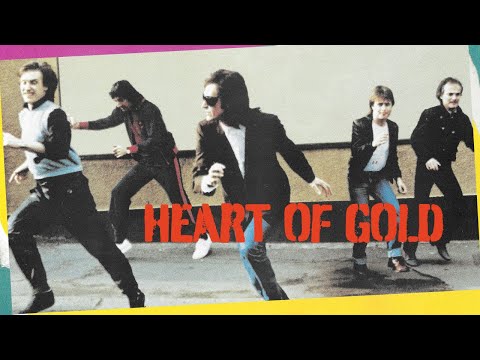
Kinks Weeks – Heart Of Gold …soundday.wordpress.com

Dave grew up in Canada, now resides in Texas, and has been passionate about music for as long as he can remember. Unfortunately, a brief foray into buying keyboards during his high school years didn’t equate to making music people were passionate about doing anything with but avoiding!  He writes a daily music blog, A Sound Day, looking at memorable music events from album releases to artist birthdays to important concerts and more. You can find Dave at https://soundday.wordpress.com.

Thanks Max, for inviting me to be a part of this “forum.” I look forward to seeing what other music fans come up with, what their reactions are to The Kinks and which songs from the band’s 25-or-so year run they choose to highlight.

It would be easier and more obvious to do the Beatles or Rolling Stones instead, but The Kinks are perhaps a more interesting choice since they’ve always been sort of on the periphery of major headline stardom and to many are an afterthought when discussing the ’60s and the British Invasion. I don’t put them on an even footing with the other two bands but the Kinks certainly deserve a bit more respect. A good chunk of their catalog is unknown to most, myself included.

My first thought when asked to write about a song of theirs was “Come Dancing”, their superb 1983 comeback hit, but that title had already been claimed. Which was actually good because it made me think a bit more and re-examine some more of their songs. Still, I knew I wanted to do something off State of Confusion, the album that put them back on hit radio after a fairly long absence, in North America at least. It was indeed the first album of theirs I bought and to date, still the only studio album – not a greatest hits sort of compilation – that I’ve had.

Though the Kinks showed up on the scene at approximately the same time as the Beatles and the Stones, they never quite matched their success and weren’t adopted nearly as much by “oldies” or “Classic Rock” radio stations. So as a kid growing up in the ’70s, I was aware of and quite liked some of their big hits – the quirky, scandalous for the times “Lola”, the rock staples like “All Day and All of The Night” and the nicely pop-py “Victoria”  but they were never at the forefront of my musical thoughts.

I noticed and liked their hard-rocking “Destroyer” in 1981; think I even bought the 45. But I really only began to appreciate their real talent with State of Confusion. I heard enough of it on radio to go out and buy it, and when I did, I found myself liking almost all the tracks and playing it end to end quite often. I really became aware of what a great lyricist Ray Davies was – how he could paint such aural pictures, and match opposing feelings like joy and sorrow, optimism and realism so well in a song. Thus, how he captured the nuances of life!

Also clear to me was that the band, like most good ones, was varied. They put together both great fist-pumping rockers and beautifully melodic pop tunes. This, ironically, annoyed their label boss Clive Davis. For some reason he thought this would cause, well a “State of Confusion” among fans and limit their appeal. Instead, I think the opposite was true. However, he wanted to market them exclusively as a hard rock act and didn’t like songs like “Come Dancing” or “Don’t Forget to Dance” since they were hardly companion pieces to Ozzy Osbourne or AC/DC for radio.

Many of their best tunes are rock; many are “pop”. But “Heart of Gold” falls somewhere in between, rather best described as “power pop” – so where better than the Power Pop Blog for it to show up!

The song tells of a young woman who is embittered and seems to have a tough demeanor, but he realizes has a “heart of gold” underneath that “tough exterior”.  In the song she was “the apple of your father’s eye” until a younger sister came along and she found “all the affection suddenly gone.”  Random, fictitious thoughts from Ray… or about someone he knew? Many think the latter.

Ray had been in a serious relationship with Chrissie Hynde for a couple of years or more at the time the song appeared. In fact, they’d just had a baby together, Natalie Hynde. Rather mirrored in the lyrics. However, all wasn’t rosy for the pair; soon after they split up and she married Jim Kerr from Simple Minds, making the song all the more poignant and an admirable expression if it was indeed about his soon-to-be ex, who certainly showed a  tough exterior in public.

Musically, I love the upbeat song and especially the jangly playing of Ray’s brother Dave, the band’s lead guitarist. Despite being contentious as anything, the two brothers were always the core and heart of The Kinks. On this one they manage to pull off a very retro-’60s sound yet keep it modern with solid production (which Ray did himself). While mirroring their ’60s heyday, it also showed a keen ear-to-the-ground awareness of the new alternative rock sounds just beginning to show up – R.E.M., The Smiths and yes, The Pretenders. It was lost on me back then, but re-listening to “Heart of Gold”, the first thing that jumped out at me is how much it sounds like a Pretenders song. It is easy in fact to imagine Chrissie singing it instead of Ray. So similar are the stylings I went to the liner notes to see if any of The Pretenders were on the song. They aren’t, but I’m betting they were in Ray’s mind when he was putting the song down on paper. Indeed, Rolling Stone noted the same, saying it “has the jangly, quasi-folk rock sound of the present hit ‘Back on the Chain Gang’” by the Pretenders.

The song wasn’t released as a single, so like many other worthy Kinks songs, it was never widely known. A shame. I’ll give the last word over to Rolling Stone again, who at the time stated “nobody but The Kinks could have made such a record in 1983 and no band deserves more to be at the top.”

Kinks Weeks – Kinky, Romantic, & Purple? …mojohorizon.home.blog

I’ve been visiting Cork’s site for years and it’s one of my favorite blogs to visit. I’ve read posts about Eric Clapton, Sasquatch, Frozen Pizza, Iron Maiden, movies, blues songs, and many more. Take a visit to his site at https://mojohorizon.home.blog/ it’s totally worth it. 

Made you look! This isn’t an exploration of the erotic — sorry, if you’re disappointed. It’s a comparison of recordings. The song is called “She’s Got Everything”. It’s a pretty generic title, but it’s definitely in the hidden gem category. I came to know The Romantics’ version of this song when I was a college student. (You might be more familiar with “What I Like About You” which precedes it on their self-titled release.) Both songs are in the world of three-chord-or-so garage rock. I used to hear the songs back-to-back at college parties when enough people were feeling loose enough to dance.

If I had a time machine, I’d go back and yell, “It’s a TWIN SPIN!!” in the middle of them. I can honestly say I actually saw people doing “the monkey” to this song in the late 80’s and early 90’s. The song rocks! It’s got a great feel to it. Loud, fast, raucous. What more could you want?

If I’m not mistaken, I had The Romantics album on vinyl and discovered “She’s Got Everything” was actually written and sung by The Kinks’ Ray Davies from the liner notes. It took me awhile to find it or find it in a collection I wanted. It was apparently the B side to “Days.” The original version of “She’s Got Everything” by The Kinks is worth a listen.

I’m biased towards The Romantics version, but I love The Kinks and the songwriting of Ray Davies. Naturally, Ray’s brother Dave Davies plays an aggressive-sounding lead guitar solo on the track. “Pretty ringlets in her hair” is my favorite line from this song. I don’t think I’ve ever heard the word ringlets used in song outside of this example. (I always pictured a ringlet as a ribbon or something, but it’s a style of “princess curls” a la Shirley Temple.)

I recently listened to The Kinks’ tune again and dialed in the little instrumental bit around the 1:30 mark. When I listened to it, I heard the first few seconds of Deep Purple’s “Woman from Tokyo.” Listen to the DP tune around 8 seconds into it.

Deep Purple’s song didn’t come out until 1973. Did they own a copy of the 1968 Kinks release “She’s Got Everything”? I don’t know, but it’s just what I hear. The two songs are in different keys, but both feature the same chord changes of I to V, which is a distinct feature.

Till next time, keep your Mojo on the Horizon!

Kinks Weeks – A Rock ‘n’ Roll Fantasy …jimadamsauthordotcom.wordpress.com

I want to welcome my friend Jim to Kinks Weeks. Jim’s site is https://jimadamsauthordotcom.wordpress.com . I hope you can check it out. He has music and other subjects and…when I have a question about The Grateful Dead…Jim is the man I go to. He tackles one of my favorite Kinks songs today. He also has Song Lyric Sunday that is fun to participate in…and I have on a few occasions. Take it away Jim…

Still Have a Way to Go

Ray Davies wrote the Kinks song ‘A Rock ‘n’ Roll Fantasy’ which was released on their 1978 seventeenth studio album Misfits and the single charted #30 in the US.  The lyrics to this song are written as a one-way conversation till the very end when he finally gets a response, where a musician (let’s assume, this is Ray Davies) is talking to another member in the band and Ray is trying to convince them not to quit, but the other musician lets him know that he doesn’t want a rock ‘n’ roll lifestyle.  Ray wants the guy to hang in there, because this could just be a bump in the road and if they can get through this period, the sky is the limit.  Ray relates a story to this band member that is thinking about leaving the group about a guy (most likely, Dan the fan) that he knows who lives on his block that lives for rock and plays records all the time.  When this neighbor of his feels the world is closing in, he turns his stereo way up high in order to live the rock ‘n’ roll fantasy on the edge of reality.  Davies tells this wavering musician that he has nothing left to prove, because the King is dead, and even if the undecided musician quits the group, that he will still be playing in it, as he feels like he has just begun since there is plenty of life left in him.  While Ray was writing this song, he learned that Elvis Presley had died, which influenced the “the King is dead” lyrics.  He was in New York at the time, and when he looked out his window late at night, he saw a single light on in one of the buildings.  Davies imagined that light being the apartment of an ardent Elvis fan, which became the character Dan the Fan in the song.

The Kinks were going through a rough period around this time, with their guitarist Dave Davies wanting to quit touring, and their keyboard player (piano, organ, synthesizer) for the past 8 years John Gosling and bass player Andy Pyle leaving after only one album, both decided that Misfits would be their last album with the group.  For a long time, the Kinks were immersed in concept albums and theatrical rock operas where they stopped making hit songs, till their 1977 previous album Sleepwalker.  Davies learned his lesson and although Misfits didn’t have the punch like their earlier songs, it did feature a more rock-oriented style giving the Kinks a commercial rebirth.  The Kinks signed with Arista Records in 1977 and Misfits was the second of 6 albums recorded on this label. 

‘A Rock ‘n’ Roll Fantasy’ was the Kinks best showing on the charts since their hit with ‘Lola’ eight years previously.  

Hello you, hello me
Hello people we used to be
Isn’t it strange, we never changed
We’ve been through it all, yet we’re still the same

And I know, it’s a miracle we still go
For all we know, we might still have a way to go

Hello me, hello you
You say you want out, want to start anew
Throw in your hand, break up the band
Start a new life, be a new man

But for all we know, we might still have a way to go
Before you go, there’s something you ought to know

There’s a guy in my block, he lives for rock
He plays records day and night

And when he feels down he puts some rock ‘n’ roll on
And it makes him feel alright

And when he feels the world is closing in
He turns his stereo way up high

He just spends his life living in a rock ‘n’ roll fantasy
He just spends his life living on the edge of reality
He just spends his life in a rock ‘n’ roll fantasy

He just spends his life living in a rock ‘n’ roll fantasy
He just spends his life living on the edge of reality
He just spends his life in a rock ‘n’ roll fantasy

He just spends his life living in a rock ‘n’ roll fantasy
Look at me, look at you
You say we’ve got nothing left to prove
The King is dead, rock is done
You might be through, but I’ve just begun

I don’t know, I feel free and I won’t let go
Before you go, there’s something you ought to know

Dan is a fan and he lives for our music
It’s the only thing that gets him by
He’s watched us grow and he’s seen all our shows
He’s seen us low and he’s seen us high

Oh, but you and me keep thinking
That the world’s just passing us by

Don’t want to spend my life living in a rock ‘n’ roll fantasy
Don’t want to spend my life living on the edge of reality
Don’t want to waste my life hiding away any more

Don’t want to spend my life living in a rock ‘n’ roll fantasy

Brothers At Arms – Ray and Dave Davies

I thought this was appropriate today since tomorrow will kick off two weeks of Kinks songs. A huge Thank You to Randy from mostlymusiccovers.com for publishing all of these that him and I wrote.

We all know the great album Brothers in Arms from Dire Straits, but sometimes those brothers are “at arms” rather than in them. In part two of the mini-series Max (that’s me!), from PowerPop, talks about the “Rock ‘Em Sock ‘Em” Siblings of Ray and Dave Davies of the legendary band The Kinks.

Ray Davies was born in 1944 and Dave in 1947 in Muswell Hill, North London. One of the granddads of rock’s sibling rivalries starts with the Davies brothers. Ray Davies, as the lead vocalist and principal songwriter of The Kinks, often clashed with his younger brother Dave Davies, who played lead guitar in the band. Their tumultuous relationship was fueled by creative differences, sibling rivalry, and personal conflicts. The two have admitted coming to blows many times right before shows.

Ray Davies is known for being a perfectionist and prickly at the best times. Dave is known as a free spirit who likes to go with the flow. The Kinks were formed in 1963 by the brothers and included Peter Quaife and Mick Avory. Their first success came the following year with worldwide hits such as You Really Got Me, All Day and All of the Night, and Tired of Waiting for You all top 10 hits in the UK and America. The Kinks never got to the level of The Who, Beatles, or Stones. One of the reasons was because they were banned for 4 years from touring in America for using non-union roadies during a tour. Another rumor was bad behavior, but it seems the non-union help rings truer.

They were the youngest in a family with 6 sisters. At age 13 Ray was thrilled by being gifted a guitar by his 31-year-old sister Rene, but she died the same night. Dave, got an underage girl pregnant when they were both 15 and the parents kept the couple apart. Dave remembers fighting Ray and he knocked Ray down once and thought he seriously hurt him. He goes over to check on Ray and Ray pummeled him. Nice.

When Ray got married in 1964, he made Dave the best man, but Dave was smashed and could not function at the wedding. At Dave’s 50th birthday party…Ray came in and smashed the cake and left. In 2013 they got together again and wrote some songs in Ray’s kitchen in harmony. It only lasted a short time. They started an old argument over the song.

‘You Really Got Me”. Dave said that yes, his older brother wrote the riff and the song, but he cut a slit in the amp speaker to make that sound. Ray refused to acknowledge how important that sound was to the success of the song. Underneath it all though they do love each other and protect each other from
other people. They are not above fighting with each other though. In 2021 there was a statement by the brothers that they were going to regroup and record again. We can only hope that they make it to the end and finish it.

A duet by the brothers!

Kinks – Dead End Street

There’s a crack up in the ceilingAnd the kitchen sink is leakingOut of work and got no moneyA Sunday joint of bread and honey

I’ve posted a lot by The Kinks but there are always more great songs I never covered and this is one of them. I like this one more than some of their huge hits…it’s a great song…catchy and meaningful.

Another Ray Davies song on the struggles of working-class life in Britain during the 1960s, focusing on themes of poverty, social inequality, and hopelessness. Not only in Britain in the 60s but extends to now as well all over. The title of the song says it all of being in a vicious cycle. This is just another example of Ray Davies’s brilliant songwriting. When you read the Ray Davies quotes at the bottom you will see where he was coming from.

Dead End Street was released in 1966 as a non-album single. It was quite successful peaking at #5 in the UK, #4 in New Zealand, #28 in Canada, and #73 on the Billboard 100. At that time, Ray, Dave, Pete Quaife, and Mick Avory were the Kinks. Also joining them was again…super session piano player Nicky Hopkins. It would be easier to list the songs Hopkins didn’t play on during the sixties. Quaife did not play bass on this song because of a scooter accident but John Daulton subbed for him.

Ray Davies said that Shel Talmy produced the song but he wanted more of a pop beat so they tricked Talmy. Ray Davies said:  “He finished the track and said, ‘That’s great,’ and went home. Then we pretended to leave but came back to the studio and re-recorded the song. We played it to him the next day and he said, ‘See what I mean, there’s nothing wrong with it.’ He thought we were playing him his version.”

The video of this song shows the boys dressed as undertakers and it was directed by Ray himself.

Ray Davies: I wrote it around the time I had to buy a house and I was terrified. I never wanted to own anything because my dad had never owned property. He’d inherited from his dad that he had to rent all his life. So I still have inbuilt shame of owning anything. It’s guilt.”

Ray Davies: “My whole feeling about the ’60s was that it’s not as great as everyone thinks it is. Carnaby Street, everybody looking happy, that was all a camouflage. That’s what Dead End Street was about.

Dave Davies: “A song full of character, pathos, yet containing an underlying sense of hope. Reflecting a fondness for the past but at the same time expressing a determination and yearning for change.

“Anguished voices calling to a heartless world. A world where the plight of the ordinary person mattered little. “

Dead End Street

There’s a crack up in the ceilingAnd the kitchen sink is leakingOut of work and got no moneyA Sunday joint of bread and honey

What are we living for?Two-roomed apartment on the second floorNo money coming inThe rent collector’s knocking, tryna get in

We are strictly second classWe don’t understand

Why we should be on dead end street(Dead end!) People are living on dead end street(Dead end!) I’m gonna die on dead end streetDead end street (yeah!)Dead end street (yeah!)

On a cold and frosty morningWipe my eyes and stop me yawningAnd my feet are nearly frozenBoil the tea and put some toast on

What are we living for?Two-roomed apartment on the second floorNo chance to emigrateI’m deep in debt and now it’s much too late

We both want to work so hardWe can’t get the chance

People live on dead end street(Dead end!) People are dying on dead end street(Dead end!) I’m gonna die on dead end streetDead end street (yeah!)Dead end street (yeah!)

People live on dead end street(Dead end!) People are dying on dead end street(Dead end!) I’m gonna die on dead end streetDead end street (yeah)Dead end street (yeah)

Dead end street (yeah)Head to my feet (yeah)Dead end street (yeah)Dead end street (yeah)Dead end street (yeah)

How’s it feel? (Yeah)How’s it feel? (Yeah)Dead end street (yeah)Dead end street (yeah)Dead end street (yeah)

Yeah, yeahYeah, yeahYeah, yeahYeah, yeahYeah, yeahYeah, yeahYeah, yeahYeah, yeah

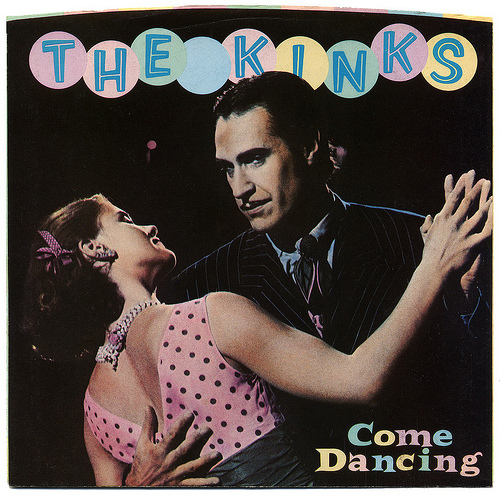
Kinks – Come Dancing

I saw the Kinks on this tour. This remains one…if not the best concert I’ve ever attended. They were in their early forties and all over the stage. In 1983 this song peaked at #6 on the Billboard 100, #6 in Canada, and #12 in the UK.

Heineken Beer Bottle

When I was watching them, Ray kept drinking from a Heineken green bottle. He ended up tossing that bottle to a person in the audience.  During intermission, I went to the lobby and I talked to the guy that had the bottle. He said he would keep that forever…he was an intense Kinks fan. I bet that guy still has that bottle somewhere…and I would have done the same thing.

This song got heavy play on MTV at a time when I would watch the channel. I’ve always liked the Kinks. They get forgotten but deserve their place beside the Beatles, Who, and Stones…I used to say those three bands are the holy trinity of rock…but I have to add the Kinks…making it the 4 walls that hold the building up.

It was on their State of Confusion album. I bought it as it came out without hearing a song because I loved Give The People What They Want so much. It’s par for the course that Davies met resistance from record company head Clive Davis on this single. Davis didn’t want this song released as a single…he thought it was too British and vaudevillian

He wrote it as a reflection on his childhood and the dance halls of his youth. The song is particularly personal to him, as it was inspired by his older sister, Rene, who had a profound impact on his early life. Rene had given Ray his first guitar that he had tried to talk his parents into. On that same night, Rene passed away from a heart attack on her way to the  Lyceum Ballroom…a dance hall on Ray’s 13th birthday.

Ray Davies: Clive Davis didn’t want to put it out, because he thought it was too vaudevillian, too English. It was only the video that convinced him. It went on MTV when it first started, and they couldn’t stop rotating it.

Ray Davies:  “I wanted to regain some of the warmth I thought we’d lost, doing those stadium tours. ‘Come Dancing’ was an attempt to get back to roots, about my sisters’ memories of dancing in the ’50s.”

Come Dancing

They put a parking lot on a piece of land
When the supermarket used to stand
Before that they put up a bowling alley
On the site that used to be the local pally
That’s where the big bands used to come and play
My sister went there on a Saturday
Come dancing
All her boyfriends used to come and call
Why not come dancing, it’s only natural
Another Saturday, another date
She would be ready but she’s always make him wait
In the hallway, in anticipation
He didn’t know the night would end up in frustration
He’d end up blowing all his wages for the week
All for a cuddle and a peck on the cheek
Come dancing
That’s how they did it when I was just a kid
And when they said come dancing
My sister always did
My sister should have come in a midnight
And my mom would always sit up and wait
It always ended up in a big row
When my sister used to get home late
Out of my window I can see them in the moonlight
Two silhouettes saying goodnight by the garden gate
The day they knocked down the pally
My sister stood and cried
The day they knocked down the pally
Part of my childhood died, just died
Now I’m grown up and playing in a band
And there’s a car park where the pally used to stand
My sister’s married and she lives on an estate
Her daughters go out, now it’s her turn to wait
She knows they get away with things she never could
But if I asked her I wonder if she would
Come dancing
Come on sister, have yourself a ball
Don’t be afraid to come dancing
It’s only natural
Come dancing
Just like the pally on a Saturday
And all her friends will come dancing
Where the big bands used to play

Kinks – Where Have All The Good Times Gone

I haven’t had a Kinks post in quite a while so I thought I would have one today. It’s always a good day to have a Kinks song. I’ve said this before but one of my favorite concerts was The Kinks in 1983 at the Grand Ole Opry House.

Ray Davies and nostalgia go together. He often writes about his past, the past, or preserving the past as in The Village Green Preservation Society. That is one of the many reasons I always liked his writing. I think of him…or should I say I think of Bruce Springsteen as the British Ray Davies. They write about the every day way of life in their respective countries.

The band was going through a rough time in 1965. Guitarist Dave Davies and drummer Mick Avory had an on-stage fight which resulted in Avory nearly decapitating Davies with a cymbal, Dave was left unconscious in a pool of blood. Avory ran away, terrified that he had killed him.

This was thought to have led to them getting banned from touring America. The other theory was The American Federation of Musicians delisted the Kinks not because of any rowdy behavior… It was simply because the band wanted to use non-union help during a concert tour. I tend to believe the latter.

This song was the B side to Till The End of the Day. The single peaked at #8 in the UK, #36 in Canada, and #50 on the Billboard 100 in 1965. The song was also released in 1973 with the flip side of Lola. The single didn’t chart. It was originally on the album The Kink Kontroversy.

Van Halen covered this song on their 1982 album Diver Down. David Bowie also covered it on his album Pin Ups.

Ray Davies:  “We’d been rehearsing ‘Where Have All the Good Times Gone’ and our tour manager at the time, who was a lot older than us, said, ‘That’s a song a 40-year-old would write. I don’t know where you get that from.’ But I was taking inspiration from older people around me. I’d been watching them in the pubs, talking about taxes and job opportunities.”

Ray Davies: “I wanted to write a song my dad or relatives could sing, they always talked about how great it was before or during the war – I think every generation thinks that way.” “It’s got that hard edge The Kinks had, but at the same time, it’s got a reflective, poignant lyric.”

Where Have All The Good Times Gone

Well, lived my life and never stopped to worry ’bout a thing
Opened up and shouted out and never tried to sing
Wondering if I’d done wrong
Will this depression last for long?

Won’t you tell me
Where have all the good times gone?
Well, once we had an easy ride and always felt the same

Time was on our side and I had everything to gain
Let it be like yesterday
Please let me have happy days
Won’t you tell me

Where have all the good times gone?
Ma and Pa look back at all the things they used to do
Didn’t have no money and they always told the truth

Daddy didn’t have no toys
And mummy didn’t need no boys
Won’t you tell me
Where have all the good times gone?

Where have all the good times gone?
Well, yesterday was such an easy game for you to play
But let’s face it things are so much easier today
Guess you need some bringing down

And get your feet back on the ground
Won’t you tell me
Where have all the good times gone?

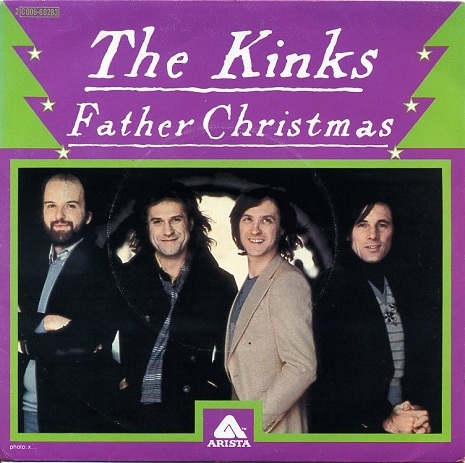
Kinks – Father Christmas

We will kick off a Christmas week after today. I will still have my Max Picks but the rest will be Christmas shows, songs, and movies.

This song always brings a smile to my face. Any Kinks Christmas song would have to be different…and this one is. It’s great for cynical people on Christmas and can be enjoyed by Christmas lovers too.

Kinks - Christmas

I’ve always liked this raw and rough Christmas song. A writer at the NME wrote, “Successful Xmas songs are more about mood than specifics, but as this is an anti-Christmas song, it’s fine.” This is the kind of song you would expect from Ray Davies. Anti-Christmas or not…it has become a popular classic Christmas song that gets airplay every year.

The single was released during the height of punk rock and certainly exudes a punk attitude. Dave Davies told ABC Radio that he “always thought The Ramones would do a great version of it. I don’t know why they didn’t do it.”… thinking about it…Dave was right…it would have fit them perfectly.

The song was released in 1977 with the B-side Prince Of  The Punks. The track was included on the Arista compilation Come Dancing with The Kinks and is also available as a bonus track on the CD reissue of the Kinks’ 1978 album Misfits.

In England, Father Christmas is the personification of Christmas, in the same way as Santa Claus is in the United States. Although the characters are now synonymous, Father Christmas and Santa Claus historically have separate entities, stemming from unrelated traditions.

Ray Davies on performing the song as an opening act in the 70s: 

“When the record came out we were on tour with a very successful band at the time supporting them,” he recalled during an interview with Southern California radio station KSWD. “I went on dressed as Santa at the end of the show to do ‘Father Christmas.’ And the other band found it hard to follow us. The following night with the same band I went to run on but there was a bunch of heavies preventing me from running on stage. And I was protesting. But the people said, ‘The Kinks didn’t do an encore but Santa Claus was there and they were stopping him from going on stage.'”

Top 10 alternative Christmas bangers - The Gryphon

From Songfacts: First written about in Tudor England and pre-dating the first recording of Santa Claus, Father Christmas was a jolly, well-nourished man who typified the spirit of good cheer at Christmas, bringing peace, joy, good food and wine and revelry. In time, the tradition merged with America’s Santa Claus with both riding in a reindeer-pulled sleigh carrying a sackful of toys that lands on the roofs of houses that contain good children. The mythical, white bearded Santa/Father Christmas then enters the properties through their chimneys clutching gifts for the well-behaved little ones inside.

Father Christmas

When I was small I believed in Santa Claus
Though I knew it was my dad
And I would hang up my stocking at Christmas
Open my presents and I’d be glad

But the last time I played Father Christmas
I stood outside a department store
A gang of kids came over and mugged me
And knocked my reindeer to the floor

They said
Father Christmas, give us some money
Don’t mess around with those silly toys
We’ll beat you up if you don’t hand it over
We want your bread so don’t make us annoyed
Give all the toys to the little rich boys

Don’t give my brother a Steve Austin outfit
Don’t give my sister a cuddly toy
We don’t want a jigsaw or monopoly money
We only want the real mccoy

Father Christmas, give us some money
We’ll beat you up if you make us annoyed
Father Christmas, give us some money
Don’t mess around with those silly toys

But give my daddy a job ’cause he needs one
He’s got lots of mouths to feed
But if you’ve got one I’ll have a machine gun
So I can scare all the kids on the street

Father Christmas, give us some money
We got no time for your silly toys
We’ll beat you up if you don’t hand it over
Give all the toys to the little rich boys

Have yourself a merry merry Christmas
Have yourself a good time
But remember the kids who got nothin’
While you’re drinkin’ down your wine

Father Christmas, give us some money
We got no time for your silly toys
Father Christmas, please hand it over
We’ll beat you up so don’t make us annoyed

Father Christmas, give us some money
We got no time for your silly toys
We’ll beat you up if you don’t hand it over
We want your bread so don’t make us annoyed
Give all the toys to the little rich boys

Kinks – All Day and All of the Night

Happy Monday everyone…if that is possible. I hope you all had a good weekend.

This simple riff is raw and cutting like Louie, Louie, and Wild Thing…and became a staple of garage bands forever.

The sound of the guitar was revolutionary. Dave Davies got the dirty guitar sound by slashing the speaker cone on his amplifier with a razor blade. The vibration of the fabric produced an effect known as “fuzz,” which became common as various electronic devices were invented to distort the sound. At the time, none of these devices were available to Dave, so Davies would mistreat his amp to get the desired sound, often kicking it.

The song peaked at #7 on the Billboard 100, #4 in Canada, #5 in New Zealand, and #2 in the UK in 1964. It’s punk…raw rock and roll to the core. The guitar was really distorted and hard for the time.

The record executives in their wisdom didn’t like this song when they heard it. They said the guitar sounded like a barking dog. Later on, the Doors would borrow this melody for Hello I Love You.

One of my favorite things about these early Kinks singles is Dave Davies’s solos. They were always driving and exciting…and yes Dave played on this song, not studio musician Jimmy Page.

The Kinks would revisit this melody with the song “Destroyer” off of the “Give The People What They Want” album.

James Hetfield from Metallica: “schooled on early riff-rock by this man [Ray Davies] and his band – The Kinks”.

Ray Davies:“I cranked up my guitar more than on ‘You Really Got Me’, when we went into the studio, everybody knew what they were doing. I think we did it in three takes… the first time the band heard it was when I ran through it with them at the soundcheck, afterwards we drove back down to London, got up in the morning, and finished the song by midday”.

Ray Davies getting the truth out…this is what he said about the rumor of Jimmy Page playing on this record: “I remember Page coming to one of our sessions when we were recording ‘All Day And All Of The Night.’ We had to record that song at 10 o’clock in the morning because we had a gig that night. It was done in three hours. Page was doing a session in the other studio, and he came in to hear Dave’s solo, and he laughed and he snickered. And now he says that he played it! So I think he’s an asshole, and he can put all the curses he wants on me because I know I’m right and he’s wrong.”

Ray Davies: ” I was a rebellious, angry kid anyway, but that had a profound effect on me. I was full of rage.” That anger was coupled with the frustration that The Kinks song ‘You Really Got Me’ just wasn’t translating in a studio setting. “I could easily have slashed my wrists,” but I had a little green amplifier, an Elpico, that was sounding crap. I thought, ‘I’ll teach it’ – and slashed the speaker cone. It changed the sound of my guitar. Then, when I wired that amp up to another, a Vox AC30, it made it a lot, lot louder”.

Dave Davies: “A little later, I was very depressed and fooling around with a razor blade. I could easily have slashed my wrists, but I had a little green amplifier, an Elpico, that was sounding crap. I thought, “I’ll teach it” – and slashed the speaker cone. It changed the sound of my guitar. Then, when I wired that amp up to another, a Vox AC30, it made it a lot, lot louder.“

All Day and All of the Night

I’m not content to be with you in the daytime
Girl I want to be with you all of the time
The only time I feel alright is by your side
Girl I want to be with you all of the time
All day and all of the night

I believe that you and me last forever
Oh yeah, all day and nighttime yours, leave me never
The only time I feel alright is by your side
Girl I want to be with you all of the time
All day and all of the night
Oh, come on

I believe that you and me last forever
Oh yeah, all day and nighttime yours, leave me never
The only time I feel alright is by your side
Girl I want to be with you all of the time
All day and all of the night
All day and all of the night-time
All day and all of the night

Kinks – Autumn Almanac

This is a very sophisticated complex pop song…the melody and the way everything connects just fit so perfectly. This was released as a non-album single in between 1967’s Something Else by the Kinks and 1968’s The Kinks Are the Village Green Preservation Society.

I love hearing this song around Autumn. Out of all the seasons, Fall is my favorite season of all. Like spring…it doesn’t last long enough. With Fall comes the relief of 95+ temps and 90 percent humidity here.

Waterloo Sunset' came to Ray Davies in a dream — FT.com

Ray has said the words were influenced by his Dad’s old drinking buddy named Charlie. Remember me saying that it was a complex song? It has around 19 different chords in it…songs written around this time had around oh… 3 to 5 chords. Comparing it to another Kinks song Dedicated Follower of Fashion… which had around 5 chords.

The best way I’ve heard this song described is by Andy Partridge (I have the entire long quote at the bottom) of XTC…he said it was like a miniature movie, basically, that unravels itself as you are listening to it...that is a perfect way of describing it.

The song was released in 1967 and it peaked at #3 in the UK, #13 in Canada, and #17 in New Zealand. At that time The Kinks were Ray Davies, Dave Davies, Pete Quaife, and Mick Avory on drums. On this recording, the in-demand session man Nicky Hopkins played the Mellotron.

Ray Davies: “The words were inspired by Charlie, my dad’s old drinking mate, who cleaned up my garden for me, sweeping up the leaves. I wrote it in early autumn, yeah, as the leaves were turning color.”

Andy Partridge of XTC on the song: It’s a miniature movie, basically, that unravels itself as you are listening to it, and it has all these little movements or scenes. And they all seem to take place in the kind of mythical cozy London that the Ealing studios always had in their films, like The Lavender Hill Mob. The song just keeps turning and changing; you see a new facet every few seconds. But there’s nothing unsettling about the fact that there are so many parts. Normally that would just be the death of a song, it would just scramble peoples brains.

The lyrics are very everyday. There’s no “calling occupants of interplanetary craft” in it. All the language in it is what you’d say over a cup of tea. It’s like a roller-coaster, but it’s not a high-speed chromium-plated space-age roller-coaster – it’s this slow creaking wooden baroque kind of roller-coaster. There are some lovely moments in it, like that sections that starts “Friday evening…..” It starts off in this mournful minor thing, and you think, “Oh dear, Friday evening, the end of something,” and then suddenly: “People get together” – it clicks into major, and becomes very optimistic. It just lifts your heart up another rung. And there’s something very plain and uplifting about [from the chorus] “yes, yes, yes,” this repetition of the affirmative.

The woodiness of “Autumn Almanac” is really appealing. Everything sounds like sticks and branches and planks. The whole song is wallpapered in dead leaves, as far as I’m concerned. The [the Kinks] touched on this same sort of thing later on, in “Shangri-La” and “Lavender Hill,” but it was more mannered, a bit more ponderous.

Damn, I wish I’d written this song. I’ll probably spend my life trying to. It’s such a huge ghost; my entire songwriting career has been trying to exorcise it.

Dave Davies: “I was playing through ‘Autumn Almanac’ [recently] and it’s a phenomenal recording. You can understand why it has lasted so long.”

Autumn Almanac

From the dew-soaked hedge creeps a crawly caterpillar
When the dawn begins to crack
It’s all part of my autumn almanac
Breeze blows leaves of a musty-colored yellow
So I sweep them in my sack
Yes, yes, yes, it’s my autumn almanac

Friday evenings, people get together
Hiding from the weather
Tea and toasted, buttered currant buns
Can’t compensate for lack of sun
Because the summer’s all gone

La-la-la-la, la-la-la-la
Oh, my poor rheumatic back
Yes, yes, yes, it’s my autumn almanac
La-la-la-la, la-la-la-la
Oh, my autumn almanac
Yes, yes, yes, it’s my autumn almanac

I like my football on a Saturday
Roast beef on Sundays, all right
I go to Blackpool for my holidays
Sit in the open sunlight

This is my street, and I’m never gonna leave it
And I’m always gonna to stay here
If I live to be ninety-nine
‘Cause all the people I meet
Seem to come from my street
And I can’t get away
Because it’s calling me (come on home)
Hear it calling me (come on home)

La-la-la-la, la-la-la-la
Oh, my autumn Armagnac
Yes, yes, yes, it’s my autumn almanac
La-la-la-la, la-la-la-la
Oh, my autumn almanac
Yes, yes, yes, yes, yes, yes, yes, yes

Bop-bop-boom-bop-bop-boom-bop-bop-boom-bop-bop-boom (whoa!)

Yes, yes

Kinks – See My Friends

This is a song that should have been a bigger hit. Mick Jagger and Paul McCartney were fans of this song. Dave Davies remembered Paul jokingly telling him “You bastards! How dare you! I should have made that record!”

This song is about the loss of Ray’s sister, who lived for a time in Ontario, Canada. Upon her return to England she developed a sickness and died while dancing at a night club. Just before she died she gave Ray his first guitar for his 13th birthday.

He wrote the song while traveling in India years later when he heard about the significance of the Ganges river in the Indian death ritual. Two years later he again used the metaphor of crossing a river in his beautiful song Waterloo Sunset.

The song peaked at #10 on the UK Charts in 1965.

Ray Davies: “A bit more care should have been taken with it. I think (producer) Shel Talmy went too far in trying to keep in the rough edges. Some of the double tracking on that is appalling. It had better songs on it than the first album, but it wasn’t executed in the right way. It was just far too rushed.”

Ray Davies: “It’s more about you’ve lost the female love of your life, therefore you only have your friends left. That little interchange – ‘She is gone’ – is the sound of someone who is completely distraught. It’s more about camaraderie than homosexuality. But then it borders on that. You go out for a pint with the blokes and then it gets to that moment… (whispery laughter) and they’re singing to one another pissed, and they hug one another.”

See My Friends

See my friends,
See my friends,
Layin’ ‘cross the river,

See my friends,
See my friends,
Layin’ ‘cross the river,

She is gone,
She is gone and now there’s no one left
‘cept my friends,
Layin’ ‘cross the river,

She just went,
She just went,
Went across the river.

Now she’s gone,
Now she’s gone,
Wish that I’d gone with her.

She is gone,
She is gone and now there’s no one left
‘cept my friends,
Layin’ ‘cross the river,

She is gone and now there’s no one else to take her place
She is gone and now there’s no one else to love
‘cept my friends,
Layin’ ‘cross the river,

See my friends,
See my friends,
Layin’ ‘cross the river,

See my friends,
See my friends,
Layin’ ‘cross the river,