

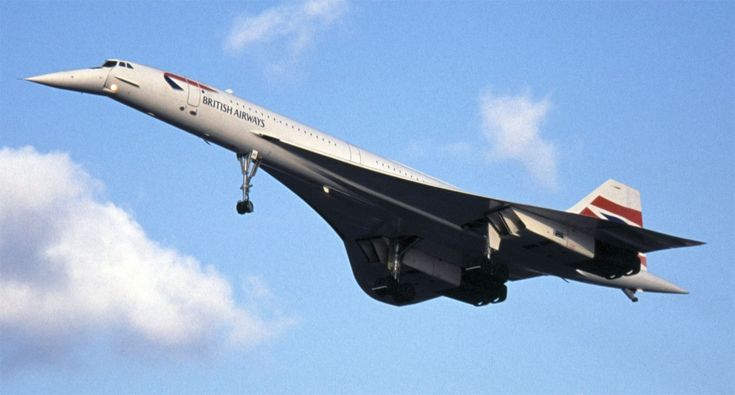
When I started this blog…I had no idea that I would concentrate on single songs. I was going to cover pop culture and I did at the beginning more. I would like to get one in every now and then.
Today… everything seems to be bigger, stronger, and faster. That isn’t true though with a certain passenger airplane. A flight from New York to London now will take around 7 hours and 35 minutes to 8 hours and 10 minutes long. How fast would that flight be in the 1970s on the Concorde? That would take you a cozy three-and-a-half hours. The fastest flight was two hours and fifty-two minutes. It would travel at 1,354 mph. It was more than twice the speed of sound.
I’m not a huge airplane guy but this aircraft fascinated me and I always wanted to ride on one. The nose cone would come down so the pilots could see the runway…it looked like something from a Scifi movie. It would reach Mach 2 between London and New York. I would see pictures of it as a kid or on the news and I thought it was the coolest plane I’d seen. I probably still do. I do remember complaints about the sonic boom.
In November 1962, the British and French governments signed a treaty to jointly develop the Concorde. The Concorde prototype made its maiden flight on March 2, 1969. After some more prototypes, they tested and made modifications, including addressing issues with noise, fuel efficiency, and environmental impact. received its airworthiness certificate in 1975, with the first commercial flights beginning on January 21, 1976, by British Airways and Air France.
There was a plan for a Concorde-type supersonic plane in the US called a Boeing 2707. It would have gone 3 times the speed of sound and held 277 passengers compared to the 100 passengers the Concorde held. It was too expensive to build and was called “the most expensive aircraft never built.” Here is a picture of a 1966 mock-up of the 2707.

In 1977, it cost £431 to fly one way onboard Concorde between London and Washington. Adjusted for inflation, that’s about £2,200 ($2,800) in today’s money. However, fare prices gradually went up, and by 1996, a roundtrip across the Atlantic would generally be priced at around $12,500 in today’s money. So it was very expensive. The meals and service were great but it was cramped inside compared to other airplanes at the time. It was also noisy…
All together… two prototypes, two pre-production aircraft, two development aircraft, and 14 production aircraft for commercial service. All of them except the two pre-production builds are preserved in museums.
This all leads us to why the Concorde is in museums now and not in the sky. The price, noise, and it was so expensive to operate. Every hour in the sky had to have 22 hours of maintenance. Also on July 25, 2000, the Concorde crashed. It was shortly after takeoff and 109 people died onboard plus 4 on the ground. That was its only crash. They did go on until 2003 but officially retired the plane that year.
A New York Times writer wrote this about the food served. “What followed the coffee was a breakfast of fresh papaya, guava, pineapple, strawberries and mangoes, croissants and brioche that might have come from a Paris bakery, a pretty good approximation of eggs benedict and a soufflé Gruyère, all washed down with Piper‐Heidsieck Cuvée Diplomatique. The china, of course, was Limoges.”
This video shows the take-off from inside the plane by a passenger.




 PowerPop... An Eclectic Collection of Pop Culture