Hail! Hail! Rock ‘N’ Roll

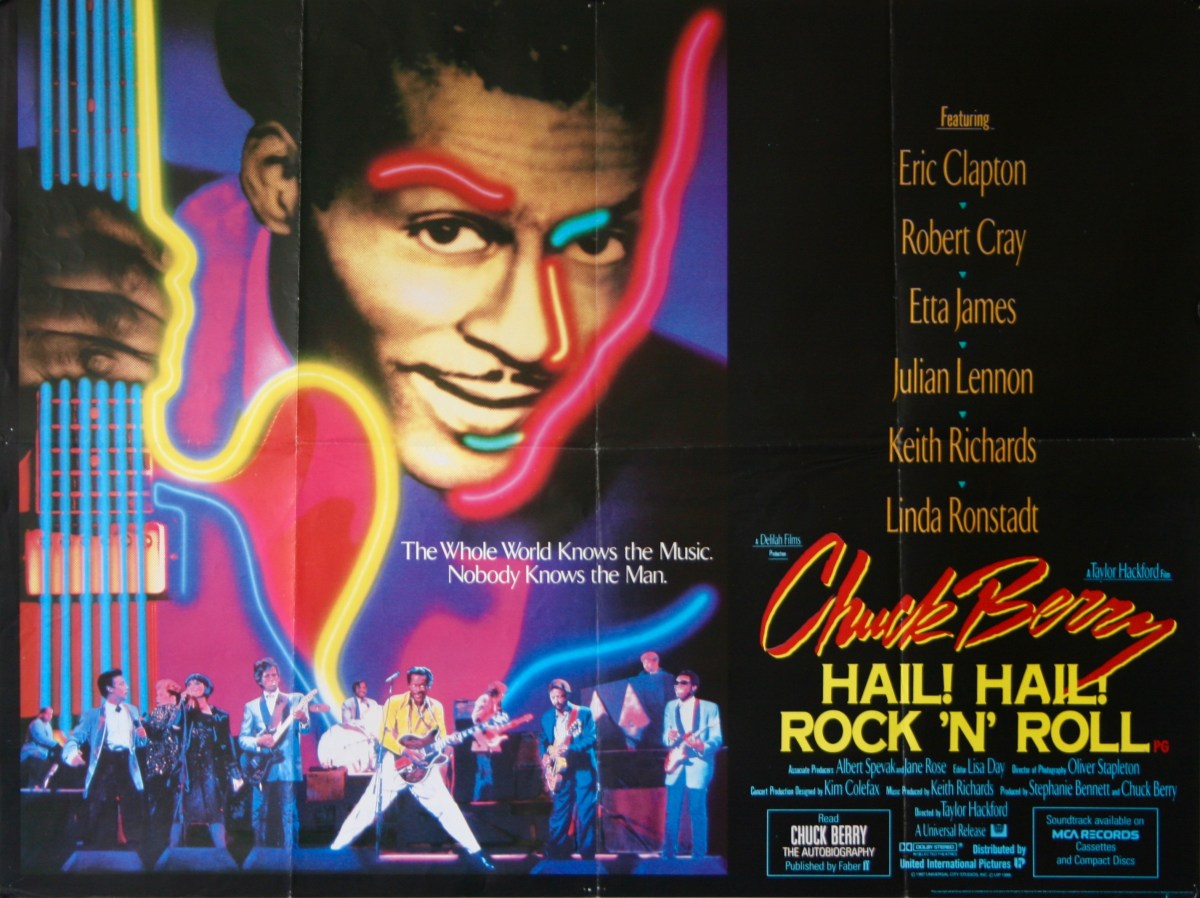
This is one of the best rock and roll documentaries that’s out there. A great documentary and probably the best that Chuck has ever sounded. He had a hell of a band behind him, and his songs did the heavy lifting. Pure poetry-driven songs about life with a huge backbeat. The band was incredible… Keith Richards, Robert Cray, the great Johnnie Johnson (Chuck’s original piano player), Steve Jordan, Bobby Keys, Chuck Leavell, and Eric Clapton are guests on a few songs. More than Chuck or the band…  It’s a great showcase for those wonderful songs Chuck wrote for all of us. 

This documentary starts off in 1986 with Chuck Berry reminiscing about the Cosmopolitan Club, where he played in the earlier days. The film centers around Chuck Berry’s 60th birthday and Keith Richards assembling an All-Star Band to support Chuck in concert. Chuck had been touring since the 60s by traveling from town to town and playing with any pickup band he found. All he brought was his guitar. He would get paid with cash in a paper bag in many places. That was his motivation more than playing with a good band. Chuck could be very sloppy playing live, but he did keep that great feel.

Chuck could also be difficult, to say the least. Keith was determined that Chuck was going to be backed by a great band for this concert… Chuck was Keith’s idol, but Chuck seemed to want to give Keith as much trouble as possible. Richards says in the documentary that Chuck was the only man who hit him that he didn’t hit back. During the rehearsals for the song “Carol”, you can feel the tension in the air between the two.

Seeing Keith’s reaction to Chuck at times is worth the price of admission, and I’m glad Keith was persistent and patient and got this done. It’s great footage of Chuck playing his classics. The concert at the Fox Theatre ended up a success. Chuck sounded great, and so did the band. I will be forever grateful they did this show, and we get to see Chuck Berry at his best. 

During the documentary, there are some great comments by Little Richard, Bo Diddley, Bruce Springsteen, Jerry Lee Lewis, Willie Dixon, and more. Some of the artists that came on and sang were Etta James, Linda Ronstadt, and Julian Lennon. Chuck was a complicated man, but he was a poet as well. I can’t recommend this documentary enough. If you are a music fan you should like it. Chuck Berry may have influenced Rock and Roll more than anyone else.

My favorite story is from Bruce Springsteen. Bruce and the E Street Band volunteered to back up Chuck Berry for a show in the early seventies. Being Chuck’s temporary pickup band must have been nerve-wracking for musicians. Chuck didn’t tell them what songs he was playing or what key…this is Bruce’s quote “About five minutes before the show was timed to start, the back door opens and he comes in. He’s by himself. He’s got a guitar case, and that was it, I said ‘Chuck, what songs are we going to do?’ He says, ‘Well, we’re going to do some Chuck Berry songs.’ That was all he said!”

Below is the video. it’s not extremely clear but watchable.

Bo Diddley – Road Runner

The bands I was in always did this song. I didn’t know this version at the time though…it was The Who’s version that we went by. That riff was a powerful guitar riff that kicked in after edging down the strings.

This song was written by Bo Diddley who came up with the ultimate riff with the song Bo Diddley. This song was released in 1959 and it peaked at #20 in the Billboard R&B Charts and #75 on the Billboard 100. It has been covered by many artists over the years and featured in various movies, TV shows, and commercials.

Bo Diddley was born Ellas Bates. He had his name changed to Ellas McDaniels when he was adopted. He took his stage name from a one-stringed Deep South instrument, the Diddley Bow.

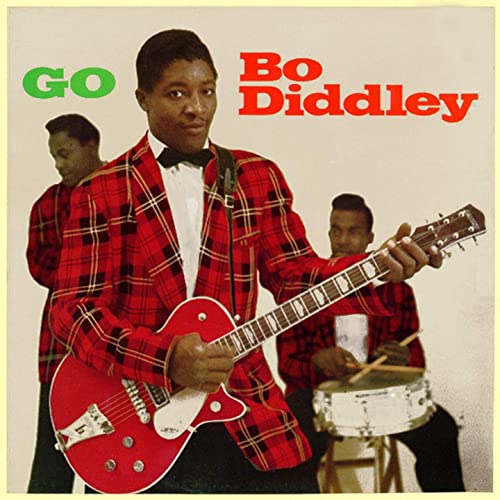
You can be cool… but not Bo Diddley playing his square guitar cool… he was a great guitarist and showman.

Bo Diddley guitar

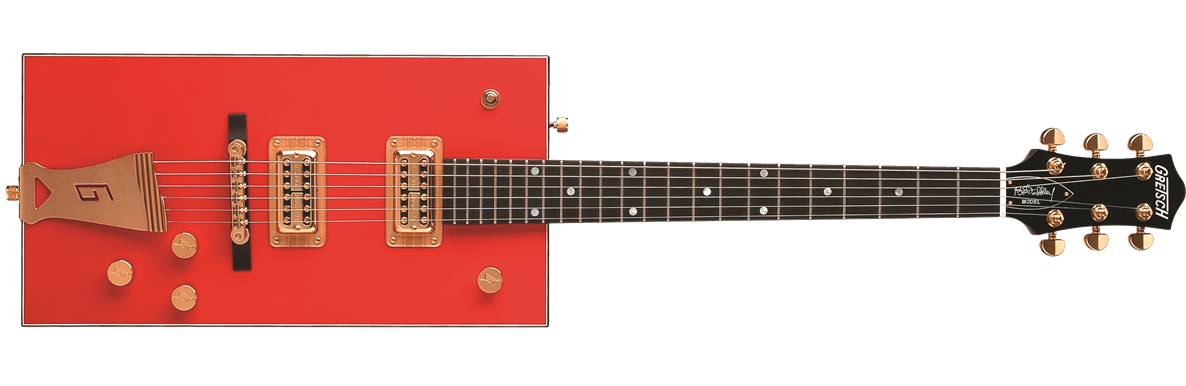
I always loved his square guitar. He built a guitar that looked like no other. He designed and constructed a custom-built square-shaped guitar for himself, he then commissioned Gretsch Guitars and Kinman Guitar Electrix to build further custom-built square-shaped models for him.

Road Runner

I’m a road runner honey,Beep! Beep!

I’m a road runner honey,And you can’t keep up with me,I’m a road runner honey,And you can’t keep up with me,Come on, let’s race,Baby baby, you will see,Here I come,Beep! Beep!

Move over honey,Let me by,Move over baby,Let this man by,I’m gonna show you baby, look out your head,Gonna put some dirt in your eye,Here I go!

Oh yea, how am I doin?Beep! Beep!

Take my hand baby,I’m gonna prove to you that I’m a road running man,I wanna show you something,That I’m the fastest in the land,Now let me by,Beep! Beep!Oh yea, you said you’s fast,But it don’t look like you gonna last,Goodbye! I’ve got to put you down,I’ll see you some day,Baby, somewhere hangin’ around.

Buddy Holly – Bo Diddley

I never knew that Buddy Holly covered this song…somehow I missed or forgot that he covered it.

This was recorded back in 1956 as one of his first recordings. It wasn’t released until 4 years after he died. The original version is just Buddy on guitar and vocals and Jerry Allison on drums. Producer Norman Petty then overdubbed the other instruments with help from a band called The Fireballs.

I consider him the beginning of power pop. His Fender playing a clean jangling melody. Songs like Maybe Baby, Peggy Sue, and Words of Love influenced future artists like The Beatles, Hollies, Bob Dylan, and the list is endless. He wrote his own songs and is still influencing artists today with a recording career that only lasted less than three years.

Buddy Holly’s music is still relevant almost sixty years after he passed away in 1959. He didn’t have a big voice like Elvis, Little Richard, or some of his peers but he wrote and crafted beautiful melodies for his voice to weave through.

This song peaked at #4 on the UK Charts and #116 on the Billboard 100 in 1963. The song was on an album called Reminiscing. The album peaked at #2 on the UK Album Charts and #40 on the Billboard Album Charts.

Not only was he a great songwriter but also a great producer and he would have only got better. Unlike many of his fifties counterparts, I believe that Buddy Holly would have fit in the music scene post-Beatles. I always thought his best songs were in front of him. Most of his music transcends the fifties and would have fit nicely in the sixties.

Here are two versions…the bottom WITH the overdubs and the other the original raw recording. 

Bo Diddley

Bo Diddley buy baby a diamond ringIf that diamond ring don’t shineHe gonna take it to a private eyeIf that private eye can’t see

He better not take that ring from meWon’t you come to my house back at homeTake a-my baby on away from homeLove a-that photo, where ya beenUp to your house and gone againBo Diddley caught a fat cat

To make a-pretty baby a Sunday hatBo Diddley caught him a nanny goatTo make a pretty baby a Sunday coatBo Diddley, Bo Diddley have you heardMy pretty baby says she wants a bird

….

Captain Beefheart – Diddy Wah Diddy

I’ve heard Captain Beefheart off and on through the years. To put it lightly…he was different.

Captain Beefheart was born Don Van Vliet and was a prodigy sculptor in his childhood. I first heard about him from a Beatles book…as I did with a lot of the artists I know. John and Paul were fans of his albums Trout Mask Replica and Safe As Milk.

This is one of Captain Beefheart’s most conventional and accessible songs and it has a nasty sound to it that I like. It has a great blues feel to it. Like Frank Zappa…he wasn’t for everyone. Speaking of Frank Zappa, he grew up with Vliet in California and they hung out as teenagers. Both of them bring something different to the table.

I would like to explore more of his music in the future. His music can be very abstract as he will switch tempos and experiment. I go in knowing I’m not going to be hearing many radio-friendly songs and I found a lot of songs that I like. I’ve been listening to Captain Beefheart closely for a few weeks now… I like a lot of what I’m hearing. He took chances like no one else.

This song was released as a promotional single back in 1966 with the B side as  “Who Do You Think You’re Fooling.” Diddy Wah Diddy was written by Willie Dixon and Bo Diddley. Bo Diddley released this song in 1956.

There are two stories about how he got his name – the one he gave to David Letterman was that he chose it because he had a “beef in his heart” about how humanity was ruining the environment.

The second was in one of  Frank Zappa’s biographies. “His girlfriend, Laurie, lived in the house with him, along with his Mom (Sue), his Dad (Glen), Aunt Ione and Uncle Alan… The way Don got his ‘stage name’ was, Uncle Alan had a habit of exposing himself to Laurie. He’d piss with the bathroom door open, and if she was walking by, mumble about his appendage – something along the lines of: ‘Ahh, what a beauty! It looks just like a big, fine beef heart.”

I have more to come from Captain Beefheart. I want to dip into some of his non-conventional songs.

The B-Side Who Do You Think You’re Fooling

Diddy Wah Diddy

I gotta gal down in Diddy Wah Diddy
(Diddy Wah)
Ain’t no town an it ain’t no city
(Diddy Wah)
She loves her man, just is a pity
Crazy ’bout my gal in Diddy Wah Diddy

(Diddy Wah)
This little girl is sweet as she could be
(Diddy Wah)
I know she’s in love with me
(Diddy Wah)
A lovely face, she’s so pretty
(Diddy Wah)
But she’s still way down in Diddy Wah Diddy

(Diddy Wah, Diddy Wah, Diddy)

Ain’t no town, an it ain’t no city
But oh, how they love in Diddy Wah Diddy)

(Diddy Wah)
(Diddy Wah)
(Diddy Wah)

(Diddy Wah)
She kissed me all the time
(Diddy Wah)
She gonna turn me outta my mind
(Diddy Wah)
Anything, she says she’s ready
(Diddy Wah)
Run right back to Diddy Wah Diddy
(Diddy Wah)
(Diddy Wah)
(Diddy Wah)
(Diddy Wah)

Ain’t no town, ain’t no city
Lord, how they love in Diddy Wah Diddy)

(Diddy Wah)
(Diddy Wah)

Muddy Waters – Mannish Boy

One of the best riffs in blues or rock. It’s been recycled in so many songs but never loses its bite. This song was a reworking of the Bo Diddley song “I’m A Man.” Great song by the great Muddy Waters.

Muddy recorded several versions of this song through the years. He recorded the original at Chess Records in Chicago in 1955. One of the reasons I love this song so much is because the guitar line is easy to play but very memorable. Waters used the same basic riff on his song “Hoochie Coochie Man.” George Thorogood also used it for his song “Bad To The Bone.”

The song peaked at #51 in the UK in 1988 and #5 in the R&B Charts in 1955.

Muddy Waters originally recorded this in 1955, then re-recorded it in 1977 for his Hard Again album in a version produced by Johnny Winter. The song was written by Muddy Waters, Mel London, and Bo Diddley.

He was born McKinley Morganfield in Rolling Fork, Mississippi, around 1913. Nicknamed “Muddy” as a child, he worked on the huge Stovall cotton plantation before following the northward migration of African Americans to Chicago, where he drove a truck and signed to Chess Records, a tiny blues label run by two émigré Polish brothers, Leonard and Phil Chess. As Muddy Waters, he established himself as a pioneering electric blues musician in the early 1950s.

Mannish Boys

Oh, yeah
Oh, yeah

Everything gonna be alright this mornin’
Now, when I was a young boy
At the age of five
My mother said I was gonna be
The greatest man alive
But now I’m a man
I’m age twenty-one
I want you to believe me, honey
We having lots of fun

I’m a man (yeah)
I spell M
A, child
N
That represent man
No B
O, child
Y
That spell mannish boy
I’m a man
I’m a full-grown man
I’m a man
I’m a rollin’ stone
I’m a man
I’m a hoochie-coochie man

Sittin’ on the outside
Just me and my mate
I’m made to move
Come up two hours late
Wasn’t that a man?
I spell M
A, child
N
That represesnt man
No B
O, child
Y
That spell mannish boy
I’m a man
I’m a full-grown man
I’m a man
I’m a rolllin’ stone
I’m a man
Full-grown man
Oh, well
Oh, well

Bo Diddley – Bo Diddley

You know you have confidence when you name a song after yourself. Bo Diddley was born Ellas Bates. He had his name changed to Ellas McDaniels when he was adopted. He took his stage name from a one-stringed Deep South instrument, the Diddley Bow.

Diddley was trained on the violin as a child, but switched to guitar (to emulate John Lee Hooker) when his sister gave him one for a Christmas present.

Originally titled “Uncle John,” the song was rejected by the owners of Chess Records because the original lyrics were “too dirty” for the white American record-buying public. In response, Diddley re-wrote the lyrics and named the song after himself. From this point forward, Diddley often put his name in his songs.

 Its lyrics are based on the traditional lullaby titled “Hush Little Baby”, and it prominently features the Bo Diddley beat that the singer made famous.

The single was a double A side if there ever was one. Bo Diddley on one side and I’m A Man on the other. It peaked at #1 on the R&B Charts in 1955. 

From Songfacts

Diddley took his longtime partner Jerome Green to play the maracas on the recording. Green’s efforts were fed through an echo chamber to get the desired effect.

The Bo Diddley riff was incorporated into many rock’n’roll songs. Examples include “Not Fade Away” (Buddy Holly), “Willie and the Hand Jive” (Johnny Otis Show), “Cannonball” (Duane Eddy), “Hey Little Girl” (Dee Clark), “I Want Candy” (Strangeloves), “Bad Blood” (Neil Sedaka), and “Faith” (George Michael).

Contrary to popular belief, this did not make the Billboard Top Singles chart, but it did hit #1 on the Rhythm and Blues chart.

Diddley’s sole Top 40 his was recorded four years later – “Say Man” – a tape of Diddley and Green swapping insults in a bar. Instruments were added in the studio, and a #20 hit was born.

Bo Diddley performed this on his Ed Sullivan Show appearance November 20, 1955. Sullivan wanted Diddley to sing “Sixteen Tons,” but Diddley played this song anyway, which didn’t go over well with the host. Diddley was never asked back.

Bo Diddley

Bo diddley bought his babe a diamond ring
If that diamond ring don’t shine
He gonna take it to a private eye
If that private eye can’t see
He’d better not take the ring from me

Bo diddley caught a nanny goat
To make his pretty baby a Sunday coat
Bo diddley caught a bear cat
To make his pretty baby a Sunday hat

Mojo come to my house, ya black cat bone
Take my baby away from home
Ugly ole mojo, where ya bin
Up your house, and gone again

Bo diddley, bo diddley have you heard?
My pretty baby said she wasn’t for it

Bo Diddley – Who Do You Love?

I remember this song as a teenager by George Thorogood. Bo Diddley was a little funkier than his rock and roll peers. He developed that wonderful riff that will live on forever where ever rock and roll is played. I could play this over and over on the guitar and never get tired of it. You can be a beginner at guitar but once you learn this…it sounds better than any other riff you can play…you can play it soft or loud…it doesn’t matter. The riff or  beat has been called “The Bo Diddley Beat.”

The rhythm to this version is just infectious. Bo Diddley (Ellas McDaniel) wrote this song. It was released in 1956 but did not reach the charts…that boggles the mind.

In 2004, Rolling Stone magazine ranked Bo Diddley’s original song at number 133 on their list of the “500 Greatest Songs of All Time.”

You can be cool… but not Bo Diddley playing his square guitar cool… great guitarist and showman.

I always loved his square guitar. He built a guitar that looked like no other. He designed and constructed a custom built square shaped guitar for himself, he then commissioned Gretsch Guitars and Kinman Guitar Electrix to build further custom built square shaped models for him.

Solid Body :: G6138 Bo Diddley, "G" Cutout Tailpiece, Ebony Fingerboard,  Firebird Red

From Songfacts

The title is a play on the word “Hoodoo,” which is a folk religion similar to Voodoo and also popular in the American South. Many blues musicians mentioned Hoodoo in their songs and like Diddley, conjured up images of the skulls, snakes and graveyards.

George Thorogood And The Destroyers recorded a popular cover on their 1978 album Move It On Over. In 1982, Diddley appeared in Thorogood’s video for “Bad To The Bone.” It was good timing, since MTV was new didn’t have many videos.

British blues rockers Juicy Lucy had a #14 hit in the UK in 1970 with their version of this song.

Who Do You Love?

I walk forty-seven miles of barbed wire
I use a cobra snake for a necktie
I got a brand new house on the roadside
Made from rattlesnake hide
I got a brand new chimney made on top
Made out of a human skull
Now come on take a walk with me, Arlene
And tell me, who do you love?

Who do you love?
Who do you love?
Who do you love?
Who do you love?
Who do you love?

Tombstone hand and a graveyard mind
Just twenty-two and I don’t mind dying

Who do you love?
Who do you love?
Who do you love?
Who do you love?

I rode a lion to town, used a rattlesnake whip
Take it easy Arlene, don’t give me no lip

Who do you love?
Who do you love?
Who do you love?
Who do you love?

Night was dark, but the sky was blue
Down the alley, the ice-wagon flew
Heard a bump, and somebody screamed
You should have heard just what I seen

Who do you love?
Who do you love?
Who do you love?
Who do you love?

Arlene took me by my hand
And she said ooo-wee, Bo, you know I understand

Who do you love?
Who do you love?
Who do you love?
Who do you love?

Toronto Rock and Roll Revival 1969

Since I posted Paul McCartney’s Concert for Kampuchea yesterday I thought I would concentrate on the festival John Lennon popped up at in 1969… The Toronto Rock and Roll Revival. Unlike Kampuchea which was spread out on multiple days and nights, this festival was held on one day September 13, 1969.

John Lennon and the Plastic Ono Band just played fifties songs plus John’s new song that Beatles rejected…Cold Turkey. The reason for the fifties’ songs was because the band had limited time to rehearse and they wanted to do songs they all knew.

It was a great festival lineup but it’s remembered mostly by John Lennon’s participation. The Doors were the headliners and John only agreed to do it

The concert was conceived by promoters John Brower and Ken Walker with financial backing from Eaton’s department store but stymied by poor ticket sales, the venture began to lose support. The festival was almost canceled but Brower called Apple Records in the UK to ask John Lennon to emcee the concert. Lennon agreed to appear on the condition he would be allowed to perform.

The Lennons flew in from England with a makeshift band that included Eric Clapton, Klaus Voormann, Alan White, and Yoko. They arrived at the backstage area at about 10 p.m, while Cat Mother and the All Night Newsboys were singing Good Old Rock ‘n’ Roll to an audience of about 20,000.

Lennon was quoted as saying “I threw up for hours until I went on” because it had been three years since he played live in a concert setting. The band went on and did a good job…ragged but it was a hastily assembled band with only a rehearsal on the plane ride and backstage.

John Lennon:  “The ridiculous thing was that I didn’t know any of the lyrics. When we did Money and Dizzy, I just made up the words as I went along. The band was bashing it out like hell behind me. Yoko came on stage with us, but she wasn’t going to do her bit until we’d done our five songs….Then after Money there was a stop, and I turned to Eric and said, ‘What’s next?’ He didn’t know either, so I just screamed out ‘C’mon!’ and started into something else.”

Little Richard: “I remember the show that people were throwing bottles at Yoko Ono. They were throwing everything at her. Finally, she had to run off the stage. Oh, boy, it was very bad.”

John Lennon: And we tried to put it out on Capitol, and Capitol didn’t want to put it out. They said, ‘This is garbage; we’re not going to put it out with her screaming on one side and you doing this sort of live stuff. And they just refused to put it out. But we finally persuaded them that, you know, people might buy this. Of course it went gold the next day.”

John Lennon and Yoko’s setlist

  • Blue Suede Shoes.
  • Money (That’s What I Want)
  • Dizzy Miss Lizzy.
  • Yer Blues.
  • Cold Turkey.
  • Give Peace a Chance.
  • Don’t Worry Kyoko (Mummy’s Only Looking for Her Hand in the Snow)
  • John John (Let’s Hope for Peace)

Performers 

John Lennon and the Plastic Ono Band

Whiskey Howl

Bo Diddley

Chicago

Junior Walker and the All Stars

Tony Joe White

Alice Cooper

Chuck Berry

Cat Mother and the All Night News Boys

Jerry Lee Lewis

Gene Vincent

Little Richard

Doug Kershaw

The Doors

Kim Fowley The Master of Ceremonies

Screaming Lord Sutch