
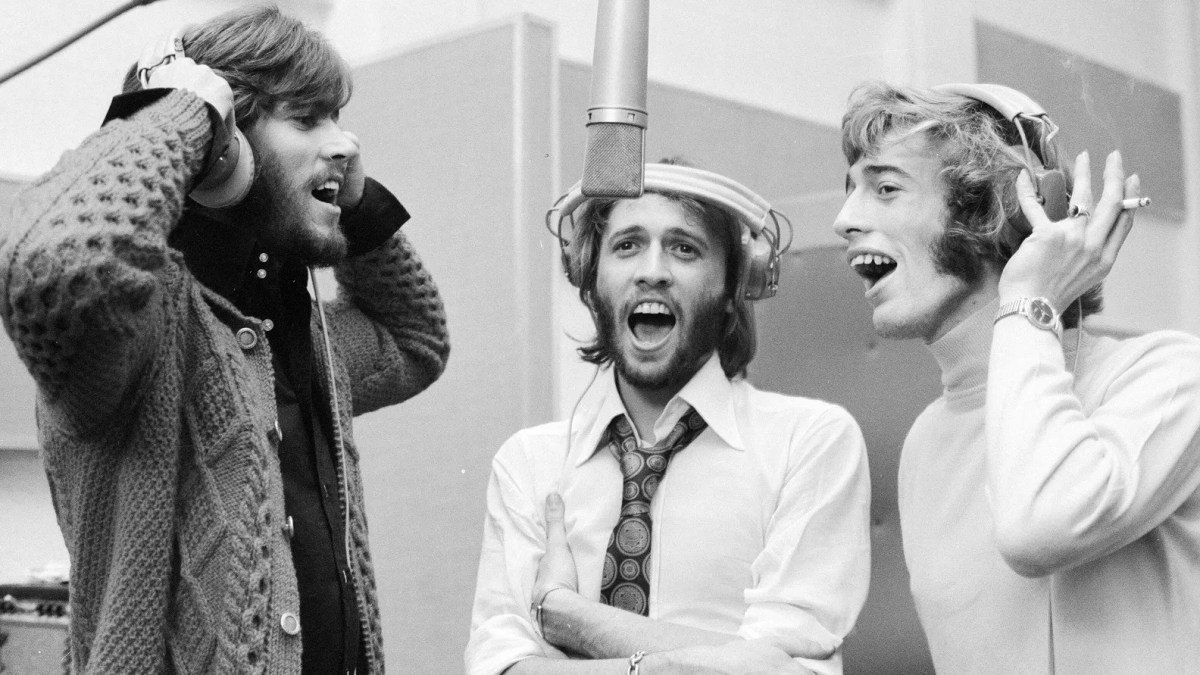
Brothers At Arms – The Bee Gees

We all know the great album Brothers in Arms from Dire Straits, but sometimes those brothers are “at arms” rather than in them. In this part of the mini-series Randy, from mostlymusiccovers.com, talks about the “Rock ‘Em Sock ‘Em” Siblings of the Bee Gees.

“To Love Somebody” was written by Robin and Barry Gibb. It was released as a single in 1967 and reached #41 in their native UK. The song did better elsewhere making several top 10s and #17 on the Hot 100. It would be a cover by Michael Bolton released in 1992 that put it at #1 on the Adult Contemporary charts in Canada and the US. It has endured to become a classic with over 210 versions of the song.

Formed in 1958 with brothers Barry, Robin and Maurice. After the family’s move to Australia they found their first success, just the three boys returned to their native UK in 1967. They would go on to sell an estimated 200 million records, post nine #1s on the Hot 100 and entered the top five of the most successful bands in history.

Life was not so easy, with an unreliable father they became the bread winners for the family at a very young age. Despite the pressures the boys got on quite well, until the dreaded “S” word enter in. Success. Their first #1 in the UK was “Massachusetts” in 1967. Robin sang lead on it and it was a position he was not willing to give up. The in-fighting began.

This is not perhaps the level of fighting on the same scale as some of our other brother groups, but they were not producing any hits and Robin was really at the heart of a split up in 1969. The reconciliation produced their first US #1 Hot 100 hit, “How Can You Mend a Broken Heart” in 1971. It was very much an autobiographical song. Success is fleeting in the music business and another downturn followed as their next album was a flop. By 1975 they had all moved to the US. Both Robin and Maurice struggled mightily with addiction problems. Robin seemed to tolerate the more democratic Barry becoming the defacto leader, but there were tensions. Not enough though to stop them from reinventing themselves yet again.

The Disco era and Saturday Night Fever saw them rise to incredible worldwide success with eight Hot 100 #1 hits in the mid to late 1970s. Younger brother Andy would join in the success. Everyone knows the rise and fall of Disco, and no one paid a heavier price than the Bee Gees. All of a sudden no one wanted to hear a Bee Gees song. In fact, they were and are still hated by some. I was not a disco fan, but I was a Bee Gees fan, and I took my fair share of ribbing for it.

Despite all this turmoil surrounding them, only minor tensions erupted, and Barry, Maurice and Robin would discover other people respected their songwriting abilities. First came “Woman in Love” by Barbra Streisand, and then “Islands in the Stream” by Dolly Parton and Kenny Rogers, both worldwide #1 smash hits. And also, songs for Dionne Warwick, Diana Ross and others. So, the brothers Gibb had risen from the ashes for yet a third time but as songwriters. And then remarkably a fourth time, as recording success returned once again and they placed four more songs in the top 10 in the UK in the 90s.

Maurice would die at age 53 in 2003 and despite attempts to regroup, the band that was the Bee Gees were effectively no more. Younger brother Andy had died in 1988 and Robin in 2012. Barry the oldest, has continued to record and perform.

Bee Gees – Jive Talkin’

The rhythm of this song drew me in when I was younger. Jive Talkin’ has a strong R&B feel to it. This song started it all for the disco era Bee Gees. This was the first big disco hit for The Bee Gees. They became icons of the era, singing in falsetto harmonies over dance beats.

You couldn’t go anywhere without hearing them blare out of the radio at that time. This song peaked at #1 in the Billboard 100, #1 in Canada, 5 in the UK, and #4 in New Zealand in 1975.

The Bee Gees had an incredible 9 Number 1 hits, 15 Top Ten hits, and 43 songs in the Billboard 100. They have sold more than 220 million records worldwide, making them one of the world’s best-selling artists of all time


From Songfacts

This was called “Drive Talking” in its early stages, but producer Arif Mardin suggested the change to “jive” to play to teenage sensibilities. “Jive Talkin'” is a term for slang.

The rhythm was inspired by the chunka-chunka-chunka sound of a car rolling over a bridge crossing Biscayne Bay near Miami. Robin Gibb explained to The Mail On Sunday November 1, 2009: “We’d already thought up the title for this song, but it wasn’t until Barry, Maurice and I drove from Biscayne Bay to Miami that we realized what the tune was going to be. We had the idea as we passed over a bridge. Some tar noises made a rhythmic sound on the wheels of our car, which created the feel to the type of song we wanted to write. We finished the song at the Criteria studios that day.”

They had seven more #1 hits in the disco era, but the band went out of style at the same time as white leisure suits. The group, which had considerable success before the disco era, took a lot of heat in the press. This criticism would weigh on them in later years as they felt that accusations of selling out and creating popular schlock were out of line. They would often point out that disco became homogenized in the years after they got to it, and that their sound was really an extension of R&B.

This was a comeback song for the group. They were very successful as contemporary singers in the late ’60s and early ’70s, but the two albums they released before Main Course flopped, and it looked like their careers were over.

Knowing that a new Bee Gees single would be met with skepticism by radio programmers, their label sent promotional singles to stations with plain, white labels, giving no indication as to what the name of the song was, or who it was by. The plan worked: the song was added to playlists and revived the fortunes of the group.

Along with several other Bee Gees hits, this was featured on the soundtrack to Saturday Night Fever in 1977. Along with “You Should Be Dancing,” it was one of two previously released Bee Gees songs used – they wrote five more specifically for the film. The set became the best-selling soundtrack album of all time, until it was outsold by The Bodyguard soundtrack.

This was an R&B track that did very well in the black charts in America. The Bee Gees were one of the first white groups to explore that territory.

Former Fugees singer Pras sampled this on his song “Blue Angels.”

Jive Talking

It’s just your jive talkin’
You’re telling me lies, yeah
Jive talkin’
You wear a disguise
Jive talkin’
So misunderstood, yeah
Jive talkin’
You really no good

Oh, my child
You’ll never know
Just what you mean to me
Oh, my child
You got so much
You’re gonna take away my energy

With all your jive talkin’
You’re telling me lies, yeah
Good lovin’
Still gets in my eyes
Nobody believes what you say
It’s just your jive talkin’
That gets in the way

Oh my love
You’re so good
Treating me so cruel
There you go
With your fancy lies
Leavin’ me lookin’
Like a dumbstruck fool
With all your

Jive talkin’
You’re telling me lies, yeah
Jive talkin’
You wear a disguise
Jive talkin’
So misunderstood, yeah
Jive talkin’
You just ain’t no good

Love talkin’
Is all very fine, yeah
Jive talkin’
Just isn’t a crime
And if there’s somebody
You’ll love till you die
Then all that jive talkin’
Just gets in your eye

Jive talkin’
You’re telling me lies,yeah
Good lovin’
Still gets in my eyes
Nobody believes what you say
It’s just your jive talkin’
That gets in the way

Love talkin’
Is all very fine, yeah
Jive talkin’, just isn’t a crime
And if there’s somebody
You’ll love till you die
Then all that jive talkin’
Just gets in your eye, yeah yeah

Oh jive talkin’
Jive talkin’
Oh jive talkin’