When I first started to pay attention to the lyrics to this song…I would have bet Mr. Fogerty wrote it under the influence while looking out his back door. John said the song was written for his son Josh, who at the time was three years old. It was inspired by the Dr. Seuss book And To Think I Saw It On Mulberry Street. In the book a kid is watching a parade go by with wondrous and magical animals and characters. Fogerty put the action “out my back door” to a place he could escape to.
The song was on the album Cosmo’s Factory… arguably Creedence’s best album. The song peaked at #2 in the Billboard 100 in 1970. Creedence had 16 songs in the top 100 in their short career but no number 1’s. Five songs peaked at #2. I never understood that but that is a post for another day. They were on a small label..Fantasy Records.
The album did peak at #1 in 1970.
There’s a giant doing cartwheels, a statue wearin’ high heels. Look at all the happy creatures dancing on the lawn. A dinosaur Victrola list’ning to Buck Owens.
Great imagination John…
From Songfacts
Much like The Beatles “Lucy In The Sky With Diamonds,” many people thought this was about drugs when it was really an innocent song inspired by a child. According to the drug theory, the “Flying Spoon” was a cocaine spoon, and the crazy animal images were an acid trip. This was even less plausible than the Beatles misinterpretation since Creedence Clearwater Revival was never into psychedelic drugs.
This is played in the film The Big Lebowski.
The album cover shows Creedence Clearwater Revival’s rehearsal space, which is not their original digs: they started rehearsing in a shed in the backyard of their drummer Doug Clifford’s house. Clifford once said it was “better than working in a factory,” so their rehearsal rooms became known as “The Factory.” Clifford’s nickname was Cosmo, so this space was known as “Cosmo’s Factory.”
John Fogerty played a bit of dobro on this track. He’s seen holding the instrument on the cover of the 1969 album Green River, but “Lookin’ Out My Back Door” is the only time he played it on a Creedence song. In 1993, he bought a dobro at a vintage guitar show and set out to master the instrument, playing it for hours on end and using it on his 1997 solo album Blue Moon Swamp. He got some help along the way from Jerry Douglas, a preeminent dobro player who was part of Alison Krauss’ band Union Station.
Lookin’ Out My Back Door
Just got home from Illinois lock the front door oh boy! Got to sit down take a rest on the porch. Imagination sets in pretty soon I’m singin’
Doo doo doo lookin’ out my back door.
There’s a giant doing cartwheels, a statue wearin’ high heels. Look at all the happy creatures dancing on the lawn. A dinosaur Victrola list’ning to Buck Owens.
Doo doo doo lookin’ out my back door.
Tambourines and elephants are playing in the band. Won’t you take a ride on the flyin’ spoon? Doo doo doo. Wond’rous apparition provided by magician.
Doo doo doo lookin’ out my back door.
Tambourines and elephants are playing in the band. Won’t you take a ride on the flyin’ spoon? Doo doo doo. Bother me tomorrow, today, I’ll buy no sorrows.
Doo doo doo lookin’ out my back door.
Forward troubles Illinois, lock the front door oh boy! Look at all the happy creatures dancing on the lawn. Bother me tomorrow, today, I’ll buy no sorrows.
I have always liked this song. I saw this song listed in my friend Hanspostcard‘s countdown of the songs of 1969 a few months ago and I have been listening to it ever since.
I Got A Line On You peaked at #25 in 1969. Randy California wrote this song and it was on their second album The Family That Plays Together which peaked at #22 in 1969. Spirit was formed in 1967 in Los Angeles. Randy California (born as Randy Craig Wolfe)(guitars, vocals), Mark Andes (bass), and Jay Ferguson (vocals, percussion). With the addition of California’s stepfather Ed Cassidy on drums, and keyboard player John Locke.
Jimi Hendrix gave Randy Wolfe the nickname Randy California.
I Got A Line On You
Let me take you, baby, down to the river bed Got to tell you somethin’, go right to your head I, I got a line, I got a line on you, babe I, I got a line, I got a line on you, babe
Gotta put your arms around me with every bit of your love If you know what to do, I’ll make love to you We got the right line to make it through these times
I, I got a line, I got a line on you, babe I, I got a line, I got a line on you, babe
Now listen, our winter’s almost over This summer, she’s comin’ on strong I can love you, love you, love you Love you all year long
I, I got a line, I got a line on you, babe I, I got a line, I got a line on you, babe I, I got a line, I got a line on you, babe I, I got a line, I got a line on you, babe
I, I got a line, I got a line on you, babe I, I got a line, I got a line on you, babe
Jim from newepicauthor hosts Song Lyric Sunday and this week the theme is Clothing/Hat/Pants/Scarf/Shirt/Shoes/Tie… so here is Another Day… The song was written by Sir Paul McCartney… though he wasn’t a Sir when he wrote this song.
Slipping into stockings, stepping into shoes
Dipping in the pocket of her raincoat
This song doesn’t get played like some other Paul songs but I’ve always thought it had a charm about it. It always reminded me a little of the song Two Of Us from Let It Be.
Paul recorded this in New York in 1970, during the sessions for his album Ram. Although it was the first single of McCartney’s solo career, “Another Day” was actually written and previewed during The Beatles’ Let It Be Sessions in 1969. It was not included in the original Ram album though.
A reference to this song came from John Lennon’s not so nice song aiming his anger at Paul with this lyric: “The only thing you done was Yesterday, and since you’ve gone you’re just Another Day“
Paul on Another Day: I like the idea of writing songs about ordinary people and day-to-day lives, and Another Day is one of them. We all get up in the morning and do our usual stuff, yet somehow – even through it all – there are often magic moments. We recorded it in New York with the help of Phil Ramone and it was a hit which, at that time, was especially pleasing.
The song peaked at #5 in 1971 on the Billboard 100
Another Day
Every day she takes a morning bath she wets her hair
Wraps a towel around her as she’s heading for the bedroom chair
It’s just another day
Slipping into stockings, stepping into shoes
Dipping in the pocket of her raincoat
It’s just another day
At the office where the papers grow she takes a break
Drinks another coffe and she finds it hard to stay awake
It’s just another day
Do do do do do do, it’s just another day
So sad, so sad
Sometimes she feels so sad
Alone in her apartment she’d dwell
Till the man of her dreams come to break the spell
Ah, stay, don’t stand her up
And he comes and he stays but he leaves the next day
So sad
Sometimes she feels so sad
As she posts another letter to the sound of five
People gather ’round her and she finds it hard to stay alive
It’s just another day
Do do do do do do, it’s just another day
So sad, so sad
Sometimes she feels so sad
Alone in her apartment she’d dwell
Till the man of her dreams come to break the spell
Ah, stay, don’t stand her up
And he comes and he stays but he leaves the next day
So sad
Sometimes she feels so sad
Every day she takes a morning bath she wets her hair
Wraps a towel around her as she’s heading for the bedroom chair
It’s just another day
Slipping into stockings, stepping into shoes
Dipping in the pocket of her raincoat
It’s just another day
Do do do do do do, it’s just another day
I’ve always liked Loretta Lynn…I’ve met the lady and she was one of the most down to earth people I’ve ever met. I do remember this song being played when I was really young…that title has to get your attention. Being married to her husband Doolittle (Oliver Vanetta “Doolittle” Lynn), was not an easy task, but he was an influence in all of her songs, including her next single “Don’t Come Home A-Drinkin’ (With Lovin’ on Your Mind),”
Loretta made a comeback in the early 2000’s with Jack White producing Van Lear Rose in 2004.
Loretta had a very successful career. She had 16 number 1 hits, 51 Top Ten hits, and 76 Songs in the top 100 in the country charts. This song peaked at #2 in the Billboard Hot 100 Country Charts in 1966.
Loretta talked about the inspiration to write this song: “When I wrote ‘You Ain’t Woman Enough (To Take My Man),’ this little woman come backstage, and she said, ‘Loretta, my husband didn’t bring me to the show tonight.’ She said, ‘He’s got a girlfriend, and he brought her. She’s sitting out in that second row with my husband.’ And we kind of pulled the curtain back and looked at him. I looked around at that lady that came backstage, and I said, ‘Honey, she ain’t woman enough to take your man.’ I went in the dressing room right then and wrote that song before the show ever started.”
From Songfacts
The biggest hit of Loretta Lynn’s career to this point, “You Ain’t Woman Enough” went to #2 on the Country charts and the You Ain’t Woman Enough album hit #1. Written by Lynn, it shows her strong side, as she confronts a woman who is going after her man. No wilting flower, Lynn makes it clear that she’s not going to give up on her man – especially to this common floozy. She sings:
Donna Jean Godchaux often performs this song and sang it on stage when she was a vocalist with The Grateful Dead. Another popular cover is by the husband and wife duo Joey + Rory, who released it as a download in 2010. When we spoke with Joey Feek of Joey + Rory, she told us: “I didn’t know a lot of Loretta’s story until later in my young adult life, and then watching Coal Miner’s Daughter and reading the book. Just the strength that she had – she just said what she thought, and she didn’t have anything to hold back. There were parts of it that I just loved, because she was innocent. And on ‘You Ain’t Woman Enough,’ Loretta was raising that flag about supporting her man and standing beside him and fighting for him and everything else. She held that flag way before any other female country artist did. And then we have a song like ‘Cheater,’ and there’s some parallels there. I just love Loretta. You just can’t help but love her, and you hear her talk and she’s honest with every word that she says. She doesn’t hide a thing.”
Lynn says there was a time when a woman went after her husband and she had to put a stop to it. She took this woman to “Fist City.”
You Ain’t Woman Enough (To Take My Man)
You’ve come to tell me something you say I ought to know That he don’t love me anymore and I’ll have to let him go You say you’re gonna take him oh but I don’t think you can ‘Cause you ain’t woman enough to take my man
Women like you they’re a dime a dozen you can buy ’em anywhere For you to get to him I’d have to move over And I’m gonna stand right here It’ll be over my dead body so get out while you can ‘Cause you ain’t woman enough to take my man
Sometimes a man start lookin’ at things that he don’t need He took a second look at you but he’s in love with me Well I don’t know where they leave you oh but I know where I’ll stand And you ain’t woman enough to take my man
Women like you they’re a dime a dozen you can buy ’em anywhere For you to get to him I’d have to move over And I’m gonna stand right here It’ll be over my dead body so get out while you can ‘Cause you ain’t woman enough to take my man No, you ain’t woman enough to take my man
This song jumps out of the radio right at you. The horn section is great and so is Van’s voice in this song. Robert Christgau, writing in the Village Voice in 1971, described “Domino” as one of the “superb examples of Morrison’s loose, allusive white r&b.”
Domino peaked at #9 in 1971 on the Billboard 100. It was on the album His Band and the Street Choir which peaked at #32 on the Billboard Album Charts in 1971. Like I said in another post…I bought this album without knowing much about it except Blue Money and Domino…because it was Van Morrison and I wasn’t disappointed.
Van Morrison: “The record company was asking me for singles, so I made some like “Domino”, which was actually longer but got cut down.”
From Songfacts
This song is a musical tribute to Morrison’s inspiration, Fats Domino. Its musical style combines those of Irish Celtic (something that people from Ireland are terribly proud of) and urban contemporary gospel.
In his 1989 book The Heart of Rock and Soul, The 1001 Greatest Singles Ever, Dave Marsh ranks this song at #197.
Morrison’s then wife, Janet Planet, sang vocals on the album.
On this track, Morrison’s used lyrics from an earlier song he wrote titled “Down the Maverick.”
“Down the Maverick” referred to a radical artists’ colony started by Hervey White in Woodstock, New York. The Maverick still exists today as part of the Woodstock Art Colony.
Domino
Don’t want to discuss it I think it’s time for a change You may get disgusted Start thinkin’ that I’m strange
In that case I’ll go underground Get some heavy rest Never have to worry About what is worst and what is best (get it)
Oh oh Domino (all right) Roll me over Romeo There you go Lord have mercy
I said oh oh Domino Roll me over Romeo There you go Say it again
I said oh oh Domino I said oh oh Domino, dig it
There’s no need for argument There’s no argument at all And if you never hear from him That just means he didn’t call or vice versa That depends on wherever you’re at Or and if you never hear from me That just means I would rather not
Oh oh Domino Roll me over Romeo There you go Lord have mercy I said oh oh Domino Roll me over Romeo
There you go Say it again Oh oh Domino I said oh oh Domino.
Hey Mr. DJ I just want to hear some rhythm and blues music On the radio On the radio On the radio Uh-uh, all right Uh-uh, all right Uh-uh, all right Uh-uh Hear the band One more time
The Nashville Ramblers was a band from San Diego. The song “The Trains” was recorded in 1985 for a compilation album American Heart and Soul. they also recorded 2 other songs for the album… an original called “Nashville Rambling” and a cover of a Golliwog (pre-Creedence Clearwater Revival) song called “Fragile Child.”
Steven Van Zandt called the song “one of the examples most indescribably beautiful romantic nostalgia, disguised in a pop song.”
Personally, I’ve grown to really like this song. I wish I would have known about it in the 80s.
There is not much out there on this group. Youtube does have some performances. This song did not chart because it was hardly known about. The band wasn’t known until 20 years after this was recorded and their song was released on another compilation album. The song has a cult following.
I found this bit of info…It’s really interesting and a very good song. The song would have worked in 65 as well. It’s a shame that a wider audience never knew about them. I’ve been playing it to anyone that would listen.
Recorded in 1985, “The Trains” by THE NASHVILLE RAMBLERS is one of the greatest pop songs of the entire era. Aided and abetted by ace producer MARK NEILL (Black Keys), the band expertly channeled their key influences—Beatles, Remains, Hollies, Everly Brothers, and others—and shaped them into something fresh, urgent and breathtakingly original. A heart-stopping melody, evocative lyrics, a driving beat, soaring harmonies, a dynamic, reverb-soaked production—to hear “The Trains” was to fall in love with it. And every time you heard it, you fell in love again. However, outside a small circle of fans, though, very few people ever heard it. In an era when do-it-yourself was how-it-was-done, the Ramblers waited for somebody else to do it for them. Nobody did—not really anyway. In 1986 “The Trains” and one other Ramblers song appeared on an obscure UK-only compilation, but few people noticed. The moment was lost—if it was ever there at all—and “The Trains” slipped quietly back underground to become a whispered secret passed through the years between a growing coterie of admirers. Many discovered the song for the first time in 2005 when it was included on Rhino’s Children of Nuggets box set—by then it was almost 20 years old. Fully remastered by Mark Neill directly from the original vaccum tube analog 3-track master tape, this shiny black 45rpm single and packaged in a deluxe hard cover picture sleeve, it’s paired with a terrific, previously unreleased version of the Golliwogs’ “Fragile Child” recorded at the same session. Edition of 1,000 copies.
If you know any more info please comment.
I just found this wiki page…just translate to English
She acts unaware of her smile or the scent of her hair When she leaves a room she takes everyone’s eyes out their heads But I hurt too much to let her bring me down But when she’s not around I can hear the trains underground When I’m alone I can feel the sun going down How can I explain all the reasons she frightens me so When she has the power to burn me right down to my soul But then every night I see her in my dreams But the days in between She tears me apart at the seams Once I was strong She’s taught me what loneliness means
No, nobody else could understand her like I do So I gotta make her realize she loves me too And I do I really do
But then every night I see her in my dreams But the days in between She tears me apart at the seams Once I was strong She’s taught me what loneliness means She acts unaware of her smile or the scent of her hair When she leaves a room she takes everyone’s eyes out their heads But I hurt too much to let her bring me down But when she’s not around I can hear the trains underground Once I was strong I can feel the sun going down I can hear the trains underground I can feel the sun going down I can hear the trains underground
I owned East Side Story the fourth album by Squeeze and this song caught my attention right off. This album drew comparisons to the Beatles especially in Rolling Stone Magazine at the time.
The album peaked at #44 on the Billboard 100 in 1981. Elvis Costello and Roger Bechirian produced this album.
Piccadilly
She’s not a picture above somebody’s fire She sits in a towel with a purple hair dryer, She waits to get even with me. She hooks up her cupcakes and puts on her jumper Explains that she’ll be late to a worrying mother, She meets me in Piccadilly. A begging folk singer stands tall by the entrance His song relays worlds of most good intentions, A fiver a ten p in his hat for collection.
She talks about office she talks about dresses She’s seen one she fancies her smile is impressing, So maybe I’ll treat her someday. We queue among strangers and strange conversation Love’s on the lips of all forms of engagements, All queuing to see tonight’s play.
A man behind me talks to his young lady He’s happy that she is expecting his baby, His wife won’t be pleased but she’s not been round lately.
The play was so dreadful we left in a hurry We escaped in the rain for an Indian curry, At the candle lit Taj Mahal. My lips to a napkin I called for a taxi The invite of eyes made it tense but relaxed me, My mind took a devious role.
The cab took us home through a night I’d not noticed The neon club lights of adult films and Trini Lopez, My arm around love but my acting was hopeless.
We crept like two thieves from the kettle to the fire We kissed to the sound of the silence that we’d hired, Now captured, your love in my arms. A door opened slightly a voice spoke in worry Mum went to bed without wind of the curry, Our secret love made its advance.
Like Adam and Eve we took bite on the apple Loose change in my pocket it started to rattle, Heart like a gun was just half of the battle.
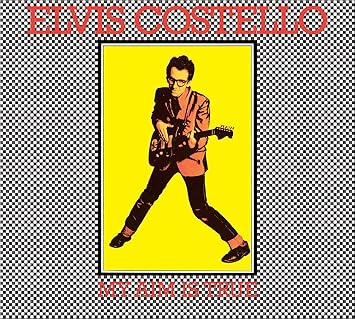
Great song and great performance by Elvis Costello and the Attractions. The song was written by Nick Lowe and first released in 1974 by the band he was in called Brinsley Schwarz named after their guitar player.
The American and Canadian release of Elvis’s album Armed Forces contained this song. The album peaked at #10 on the Billboard 100 in 1979.
Nick Lowe on writing the song: “I wrote the song in 1973, and the hippie thing was going out, and everyone was starting to take harder drugs and rediscover drink. Alcohol was coming back, and everyone sort of slipped out of the hippie dream and into a more cynical and more unpleasant frame of mind. And this song was supposed to be an old hippie, laughed at by the new thinking, saying to these new smarty-pants types, ‘Look, you think you got it all going on. You can laugh at me, but all I’m saying is, ‘What’s so funny about peace, love, and understanding?’ And that was the idea of the song. But I think as I started writing it, something told me it was too good idea to make it into a joke. It was originally supposed to be a joke song, but something told me there was a little grain of wisdom in this thing, and not to mess it up.”
From Songfacts
This was written by Nick Lowe and originally recorded by his band Brinsley Schwarz in 1974. Despite a wealth of talent and great deal of promotional support, Brinsley Schwarz never managed a hit, but were very influential to artists like The Clash and Elvis Costello. Nick Lowe became a very successful producer and scored a hit as a solo artist with “Cruel To Be Kind.”
Costello and Lowe were both signed to Stiff Records, and Costello’s version, credited as “Nick Lowe & His Sound” was first released as the B-side of Lowe’s 1978 single “American Squirm.” Costello’s version was more energetic and had more Pop appeal. It was included on American editions of Costello’s 1979 album Armed Forces. With its simple message of unity and love in a troubled world, the song became an anthem for peace and tolerance, and was recorded by many artists, including A Perfect Circle, Lucy Kaplansky, The Flaming Lips and The Wallflowers.
This lifts from the Judee Sill song, “Jesus Was A Cross Maker,” Lowe told The A.V. Club: “I always would ‘fess up that there is one lick in the tune I did steal from Judee Sill. She had a song called ‘Jesus Was A Cross Maker’ at about that time that I really thought was a super song. I haven’t heard that song for many years, but I always think I took a little lick from Judee’s song.”
In 1992, this was covered by Curtis Stigers for the Whitney Houston film, The Bodyguard. The film’s soundtrack album went on to sell 44 million copies worldwide, landing Lowe a large royalty check that financed his less commercial music. Lowe told The Telegraph: “It was a tremendous piece of good fortune. I made an astonishing amount of money from that.”
This appears in the 2003 movie Lost in Translation, where Bill Murray sings a karaoke version.
This was sung by Stephen Colbert, John Legend, Elvis Costello (in a bear suit), Feist, Toby Keith, and Willie Nelson on the TV special A Colbert Christmas: The Greatest Gift of All! after John Legend told Stephen that he (Stephen) didn’t understand Christmas.
(What’s So Funny ‘Bout) Peace, Love, and Understanding
As I walk through This wicked world Searchin’ for light in the darkness of insanity. I ask myself
Is all hope lost? Is there only pain and hatred, and misery? And each time I feel like this inside, There’s one thing I want to know:
What’s so funny ’bout peace love & understanding? Ohhhh What’s so funny ’bout peace love & understanding? And as I walked on Through troubled times
My spirit gets so downhearted sometimes So where are the strong And who are the trusted? And where is the harmony?
Sweet harmony. ‘Cause each time I feel it slippin’ away, just makes me want to cry. What’s so funny ’bout peace love & understanding? Ohhhh What’s so funny ’bout peace love & understanding?
So where are the strong? And who are the trusted? And where is the harmony? Sweet harmony.
‘Cause each time I feel it slippin’ away, just makes me want to cry. What’s so funny ’bout peace love & understanding? Ohhhh What’s so funny ’bout peace love & understanding? Ohhhh What’s so funny ’bout peace love & understanding?
When I first heard this song as an eight-year-old in 1975 I thought wow…The Monkees are singing about Clarksville Tennessee…right up the road from me! Well no they were not but ignorance is bliss. It ended up fitting Clarksville TN very well because Bobby Hart (co-writer) said the song was written as a protest song against Vietnam but they had to hide that because it was The Monkees.
The song is about a guy who gets drafted and goes to fight in the war. The train is taking him to an army base, and he knows he may die in Vietnam. At the end of the song, he states, “I don’t know if I’m ever coming home.”
Bobby Hart said: “We were just looking for a name that sounded good. There’s a little town in Northern Arizona I used to go through in the summer on the way to Oak Creek Canyon called Clarksdale. We were throwing out names, and when we got to Clarksdale, we thought Clarksville sounded even better. We didn’t know it at the time, [but] there is an Air Force base near the town of Clarksville, Tennessee – which would have fit the bill fine for the storyline. We couldn’t be too direct with The Monkees. We couldn’t really make a protest song out of it – we kind of snuck it in.”
Tommy Boyce and Bobby Hart, a songwriting team came up with many songs for The Monkees. They also wrote songs for Chubby Checker and Jay & the Americans.
The only Monkee to appear on this was Mickey Dolenz singing the lead vocal. The Monkees would get beat down by the music press because they didn’t play their own instruments. Some bands like the Beach Boys used the same session musicians. Peter Tork and Michael Nesmith were good musicians who played long before the Monkees. Later on, they DID play their own instruments starting with their 3rd album Headquarters and still had hits. As far as Rock and Roll Hall Of Fame…they should be inside the Hall. The Monkees influenced many young kids through more than just one generation.
Last Train To Clarksville peaked at #1 on the Billboard 100 in 1966. They followed this up with another number 1 with I’m A Believer.
From Songfacts
Bobby Hart got the idea for the lyrics when he turned on the radio and heard the end of The Beatles “Paperback Writer.” He thought Paul McCartney was singing “Take the last train,” and decided to use the line when he found out McCartney was actually singing “Paperback Writer.” Hart knew that The Monkees TV series was pitched as a music/comedy series in the spirit of The Beatles movie A Hard Day’s Night, so he knew emulating The Beatles would be a winner. To do that, he made sure to put a distinctive guitar riff in this song, and wrote in the “Oh No-No-No, Oh No-No-No” lyrics as a response to the Beatles famous “Yeah Yeah Yeah.”
The only Monkee to appear on this song was Micky Dolenz, who sang lead. The four members of the group were chosen from over 400 applicants to appear on a TV show based on The Beatles movie A Hard Day’s Night. The show was about a fictional band, so the members were chosen more for their looks and acting ability than for their musical talent.
Session musicians played on the Monkees albums, usually some combination of Glen Campbell, Leon Russell, James Burton, David Gates, Carol Kaye, Jim Gordon and Hal Blaine. According to the liner notes on the 1994 reissue of the album, however, members of a group called the Candy Store Prophets did the instrumental backing on this track at a session that took place July 25, 1966 at RCA Victor Studios in Hollywood. The Candy Store Prophets were Tommy Boyce and Bobby Hart’s band, and included Boyce on acoustic guitar, Gerry McGee on electric guitar, Larry Taylor on bass and Billy Lewis on drums. Additional musicians on this track were Wayne Erwin and Louie Shelton on guitar, and Gene Estes on percussion.
Often reported as having played guitar on this track is Jesse Ed Davis, a Native American whose accomplishment included backing George Harrison at the Concert for Bangla Desh and playing the solo on Jackson Browne’s first hit, “Doctor My Eyes.”
This was The Monkees’ first single. It was released shortly after their TV show started on NBC and got a lot of publicity as a result. The Monkees followed it up with another hit, “I’m A Believer,” and had several more chart entries before their show was canceled in 1968. Eventually, the group wrote their own songs and played their own instruments.
When this song was released as a single, it went straight to #1, knocking “96 Tears” by ? & the Mysterians down to #2.
The Monkees took a lot of heat when they became successful recording artists without playing on their songs. Their drummer Micky Dolenz explained in The Wrecking Crew film: “I think there was a lot of resentment in the recording industry that we’d come out of nowhere, left field, and sort of just shot right to the top without having to kind of go through the ropes. The music industry back then was pretty crooked, and some people say even to this day. And I didn’t know at the time anything about the business end of it, but all of the sudden, the radio stations, the rack jobbers, the distributors, all these people that had a lot of power at that time – all of the sudden, they had to start playing the Monkees songs; they had to start racking them, they had to start distributing them. They had no choice. It was just so huge because of the television show. And that’s the first time anything like that had ever happened. And I think that probably created a lot of resentment.”
There is a certain lyrical dissonance in this song, as the upbeat music is contrasted with lyrics about being shipped off to war. Carol Kaye, who played bass on the session, told Songfacts, “The tempo of the tune was a good tempo. And that’s the main thing is to keep that tempo going. Back in the ’60s, you’re playing for people who dance. And if the tempo is 1-2-3-4, that’s a dance tempo. So you’re going to keep the tempo up, that’s important. So no, the mood of the song is not critical if the tempo is high, if the tempo is fast. If it’s slow, yeah, it’s kind of critical, and it depends upon how much is happening in the tune, too.”
One of the key elements of the song came out of sheer exhaustion. Micky Dolenz explains: “We were working 24/7. Normally, you do a TV series – eight, 10 hours a day – and go home. But after filming the show, I would go into the studio and sometimes record two or three lead vocals a night. So, it’s all a bit of a blur. That middle bit, there were words to that. Bobby Hart tells the story that I said, ‘It’s midnight, I have to be on the set at six. I can’t learn to sing that.’ He said, ‘Okay, just go ‘Doo-doo-doo-doo-doo-doo-doo-doo…’ You never know, if I’d sang all those words, it might not have worked.”
Last Train To Clarksville
Take the last train to Clarksville And I’ll meet you at the station You can be there by four-thirty ‘Cause I’ve made your reservation, don’t be slow Oh, no, no, no Oh, no, no, no
‘Cause I’m leaving in the morning And I must see you again We’ll have one more night together Till the morning brings my train and I must go Oh, no, no, no Oh, no, no, no
And I don’t know if I’m ever coming home
Take the last train to Clarksville I’ll be waiting at the station We’ll have time for coffee-flavored kisses And a bit of conversation Oh, no, no, no Oh, no, no, no
Take the last train to Clarksville Now I must hang up the phone I can’t hear you in this noisy railroad station all alone I’m feeling low Oh, no, no, no Oh, no, no, no
And I don’t know if I’m ever coming home
Oh
Take the last train to Clarksville And I’ll meet you at the station You can be here by four-thirty ‘Cause I’ve made your reservation, don’t be slow Oh, no, no, no Oh, no, no, no
And I don’t know if I’m ever coming home Take the last train to Clarksville Take the last train to Clarksville Take the last train to Clarksville Take the last train to Clarksville
This was recorded over a two-month period using top Los Angeles session musicians. The Beach Boys didn’t play any instruments on the track. About 90 hours of studio time and 70 hours of tape were used, and at least 12 musicians played on the sessions. It’s hard to know whose performances ended up on the record, but some of the musicians involved were Glen Campbell (lead guitar), Carol Kaye (Electric Bass), Lyle Ritz (Standup Bass), Hal Blaine (drums), Larry Knechtel (organ) and Al de Lory (piano).
Brian Wilson has said that Capital Records thought the song was too long at 3:35 and had psychedelic overtones. Brian had to plead with them to release it. It peaked at #1 on the Billboard 100, #1 in the UK, #2 in Canada, and #1 in New Zealand in 1966. The song was written by Brian Wilson and Mike Love.
Brian Wilson: “My mother used to tell me about vibrations. I didn’t really understand too much of what she meant when I was a boy. It scared me, the word ‘vibrations’ – to think that invisible feelings existed. She also told me about dogs that would bark at some people, but wouldn’t bark at others, and so it came to pass that we talked about good vibrations.”
Ok… A Theremin was used in the song. I was always fascinated by this invention. This unique instrument was invented in 1920 by Russian Léon Theremin. Jimmy Page would play one in the middle of Led Zeppelin concerts…Before we get to Good Vibrations lets see Léon Theremin play his invention.
From Songfacts
Brian Wilson called this song a “Pocket Symphony,” and experimented with it over the course of 17 recording sessions. At the time, it was the most expensive pop song ever recorded, costing about $50,000 to make.
Brian Wilson worked on this obsessively. At the time, he stayed home and wrote music while the rest of the band toured. Wilson was just starting a very bizarre phase of his life where he would spend long periods in bed and work in a sandbox. During this period, many considered him a genius because of the groundbreaking songs and recording techniques he came up with.
Brian Wilson played bass when the Beach Boys went on the road, but he brought in Carol Kaye to play bass guitar and Lyle Ritz to play upright bass on these sessions. Kaye recalled in a Songfacts interview, “He did the very first take on that with Ray Pohlman at Goldstar and scrapped that. And the other 12 dates I’m playing on – that’s 36 hours – he did not change that bass part all during that time. He changed all the rest of the music, he didn’t change the bass part. This is what he wrote. It was both bass players at that point – I’m playing the upper part and Lyle’s playing the lower part. If you listen to jazz, that’s the feel that he wrote.”
Beach Boys lead singer Mike Love wrote the lyrics for this song, which he told us were “basically a flowery poem.” The song seems to describe a really good acid trip, and while there is nothing specifically in the lyrics about drugs, Love admits that the psychedelic vibe was an influence on his words. Said Love: “It was this flowery power type of thing. Scott McKenzie wrote “If you’re going to San Francisco, be sure to wear some flowers in your hair,” and there were love-ins and all that kind of thing starting to go on.
So the track, the music of ‘Good Vibrations,’ was so unique and so psychedelic in itself. Just the instrumental part of it alone was such a departure from what we have done, like ‘Surfin’ USA’ and ‘California Girls’ and ‘I Get Around’ and ‘Fun, Fun, Fun,’ all of which I had a hand in writing. I wanted to do something that captured this feeling of the track and the times, but also could relate to people. Because I thought that the music was such a departure that who knows how well it would relate to Beach Boys fans at that time.
The one thing that I figured is an absolute perennial is the boy/girl relationship, the attraction between a guy and a girl. So I came up with that hook part at the chorus. It didn’t exist until I came up with that thought. Which is ‘I’m pickin’ up good vibrations, she’s giving me the excitations.’ ‘Excitations’ may or may not be in Webster’s Dictionary, however, it rhymes pretty well with ‘good vibrations.’ It was kind of a flower power poem to suit the times and complement the really amazingly unique track that Cousin Brian came up with.” (Here’s our full Mike Love interview.)
The unusual, high-pitched sound in this song was produced using an electro-theremin, which produces a similar sound to a traditional theremin, an instrument that uses electric current to produce sound (you don’t touch a theremin to play it, but move your hand across the electric field). The theremin was invented in 1919, but was very hard to play, and ended up being used mostly as a sound effects device.
Brian Wilson was familiar with the instrument, as it was used to create eerie sounds in low budget horror movies like The Day the Earth Stood Still and It Came from Outer Space. When he put cellos on “Good Vibrations,” he envisioned an unusual high frequency sound to go along with them, and he thought of the instrument. Wilson couldn’t track down a real theremin, but found an inventor named Paul Tanner who’d been a trombonist with the Glenn Miller Orchestra between 1938-’42. Tanner had developed a similar device with Bob Whitsell called an electro-theremin, which unlike a regular theremin, had no antennas. Tanner was brought in to play the device on the recording.
A huge challenge was re-creating the sound of the theremin for live performances. On the road, they used a modified synthesizer with a ribbon controller that Mike Love would play. In the ’90s, another inventor named Tom Polk created a device called a tannerin, which created a similar sound using a sliding knob and manual volume control. This was much easier to play, and Brian Wilson used it for his 1999 comeback tour.
When Wilson went back to work on the Smile album, he used the tannerin on his new version of “Good Vibrations,” which appeared on the 2004 album. The device was seen at the 2012 Grammy Awards when The Beach Boys performed the song.
Brian Wilson called this song “the summation of my musical vision. A harmonic convergence of imagination and talent, production values and craft, songwriting and spirituality.” He wrote it while on LSD, which explains why the song is the musical embodiment of a spectacular acid trip.
This was recorded in fragments – six different LA studios were used in the recording process, and tape from four of these studios was used in the final cut of the track. It was the first pop song pieced together from parts. In the next few years, The Beatles did a lot of this, as they took various unfinished songs they had written and combined them to make one. >>
Brian Wilson started writing this while recording The Beach Boys’ Pet Sounds album. Once the album was finished, he focused on this song. Wilson was not happy about the poor reviews critics gave Pet Sounds, which today is considered a landmark record, so he worked even harder on this.
Most of The Beach Boys songs featured the vocals of either Mike Love or Brian Wilson, but Carl Wilson was the lead singer on this one. Beach Boy drummer Dennis Wilson was initially tagged to sing the lead vocal but eventually brother Carl was chosen. Dennis claimed to have played the organ on the “na na na na na na” build up. >>
This was the beginning of what was going to be an album called Smile. Wilson recorded the album in about 50 sessions, but it was never released. Considered a “lost album,” Wilson finally finished it in 2004. When he played the album on tour that year, “Good Vibrations” got a rousing response.
This was the last US #1 hit for The Beach Boys until “Kokomo” went to #1 22 years later, setting the record for longest gap between #1 hits on the Hot 100. This record was broken by Cher when “Believe” hit #1 in 1999, 25 years after her previous chart-topper,
In the ’80s, Sunkist used this song in popular commercials for their orange soda (“I’m drinking up good vibrations, Sunkist orange soda taste sensation…”). The vocalist on these spots was Jim Peterik, who was working as a jingle singer at the time but would later form Survivor and co-write all of their hits, including “Eye of the Tiger.” Peterik and Brian Wilson would later cross paths when they worked together on the Beach Boys comeback song “That’s Why God Made the Radio.”
In 2005, a Broadway musical called Good Vibrations opened. The show was based on Beach Boys songs, but failed to find an audience; it closed less than three months later.
Brian Wilson was the only songwriter credited on this track until a 1994 lawsuit awarded Mike Love composer credit for his contributions to the lyrics on this and 34 other Beach Boys songs. Love maintains that Murry Wilson (Brian’s father), handled the publishing details and screwed him out of the songwriting credits.
Todd Rundgren covered this in 1976 on his Faithful album. True to the album’s name, Todd went to great lengths to reproduce every vocal and instrumental aspect of the song (along with several other ’60s hits). Rundgren’s almost-exact copy was a minor hit single on its own, reaching #34 US
Good Vibrations
I-I love the colorful clothes she wears And the way the sunlight plays upon her hair I hear the sound of a gentle word On the wind that lifts her perfume through the air
I’m pickin’ up good vibrations She’s giving me the excitations (oom bop bop) I’m pickin’ up good vibrations (good vibrations, oom bop bop) She’s giving me the excitations (excitations, oom bop bop) I’m pickin’ up good vibrations (oom bop bop) She’s giving me the excitations (excitations, oom bop bop) I’m pickin’ up good vibrations (oom bop bop) She’s giving me the excitations (excitations)
Close my eyes, she’s somehow closer now Softly smile, I know she must be kind When I look in her eyes She goes with me to a blossom world
I’m pickin’ up good vibrations She’s giving me excitations (oom bop bop) I’m pickin’ up good vibrations (good vibrations, oom bop bop) She’s giving me excitations (excitations, oom bop bop) Good, good, good, good vibrations (oom bop bop) She’s giving me excitations (excitations, oom bop bop) Good, good, good, good vibrations (oom bop bop) She’s giving me excitations (excitations)
Ah, ah, my my, what elation I don’t know where but she sends me there Oh, my my, what a sensation Oh, my my, what elation Oh, my my, what
Gotta keep those lovin’ good vibrations a-happenin’ with her Gotta keep those lovin’ good vibrations a-happenin’ with her Gotta keep those lovin’ good vibrations a-happenin’
(Ahh)
Good, good, good, good vibrations (oom bop bop) She’s giving me the excitations (excitations, oom bop bop) I’m pickin’ up good vibrations
Na na na na na, na na na Na na na na na, na na na (bop bop-bop-bop-bop, bop) Do do do do do, do do do (bop bop-bop-bop-bop, bop) Do do do do do, do do do (bop bop-bop-bop-bop, bop)
This is a lively song by Van the Man…Van Morrison. First heard this song after I bought the Van Morrison album Saint Dominic’s Preview in the 80s without knowing any song on it…I didn’t need to…it was Van Morrison. Van is one of my favorite singers…it’s not just his voice but the way he phrases his words. If you ever get a chance to see him live…do it. I got that honor (The Pay The Devil tour) once and I have to say he sounded better live than on record and that doesn’t happen a lot.
The song peaked at #62 on the Billboard 100 in 1972. This song is an obvious tribute to the great Jackie Wison.
The opening track of Saint Dominic’s Preview, this is a tribute to Jackie Wilson, one of Morrison’s influences. Released as the first single from the album, it charted at #61 on the Hot 100.
Guitarist Doug Messenger recalled the recording of the song to Uncut: “Jackie Wilson Said was totally disorganized. He didn’t know where anything went, and no one seemed to know what to do with it. Van went away and the band worked on the basic structure. When he came back we went through it a couple of times and he was real happy because all of a sudden it seemed to be making sense. He said, ‘I think it’s coming together,’ which is what he always said when he felt it was working.”
“I remember he said to the drummer, Ricky Schlosser, ‘When I sing “boom boom boom,” hit the tom and the kick drum at the same time.’ We ran through it once or twice, and the first recorded take is what’s on the album. It was all over the place, but somehow it worked. Even when he ad-libbed at the end -‘One more time’- somehow we all kept it together. At the end, Van was smiling like a Cheshire Cat. ‘I think we got it!’ We tried a second take and – of course – it all fell apart.”
The song was used as the opening theme for the 1991 comedy movie Queens Logic.
This was covered by Dexys Midnight Runners on their 1982 album Too-Rye-Ay. Released as a single, it reached #5 on the UK singles chart.
Jackie Wilson Said (I’m in Heaven When You Smile)
Jackie Wilson said It was Reet Petite Kinda love you got Knock me off my feet Let it all hang out Oh, let it all hang out And you know I’m so wired up Don’t need no coffee in my cup Let it all hang out Let it all hang out
Ding a ling a ling Ding a ling a ling ding Ding a ling a ling Ding a ling a ling ding Do da do da I’m in heaven, I’m in heaven I’m in heaven, when you smile When you smile, when you smile When you smile And when you walk Across the room You make my heart go Boom boom boom Let it all hang out Baby, let it all hang out And every time You look that way Honey child, you make my day Let it all hang out Like the man said let it all hang out
Ding a ling a ling Ding a ling a ling ding Ding a ling a ling Ding a ling a ling ding Do da do da I’m in heaven, I’m in heaven I’m in heaven, when you smile When you smile I’m in heaven, I’m in heaven I’m in heaven, when you smile One more time I’m in heaven, I’m in heaven I’m in heaven, when you smile When you smile
The song was on the album Out of the Blue which was a favorite of mine. The song peaked at #35 on the Billboard 100 and #6 in the UK in 1978.
Jeff Lynne locked himself away to write this album: “It was dark and misty for two weeks, and I didn’t come up with a thing. Suddenly the sun shone and it was, ‘Wow, look at those beautiful Alps.’ I wrote Mr. Blue Sky and 13 other songs in the next two weeks.”
The song renewed its popularity with the inclusion on the Guardians of the Galaxy Vol 2 soundtrack.
From Songfacts
This song closes the side of the Out Of The Blue album known as “Concerto For A Rainy Day.” The lyric is suitably uplifting, following the concept of a rainy day that comes to an end.
Jeff Lynne has a “blue” streak: Other songs he wrote for ELO include “Out of the Blue” and “Midnight Blue.” Lynne is from the Birmingham area in England, where the Birmingham Football Club (or as Americans call it, “soccer team”) is called the Birmingham Blues. The “blues” in these songs are in some way a tribute to his team.
The synthesized voice at the end of the song sings, “Please turn me over” because in the old days when we used to listen to our music on vinyl, we had to turn the record over to hear the other side.
In 2003, this was featured in commercials for the Volkswagen convertible Bug. The spot shows a man slogging through his workday until he stops to look out a window and sees what’s out there. The song was also used in commercials for Sears.
This is played before the start of every football (soccer) match played by Birmingham City Football Club (nickname: “The Blues”). Many fans of the club associate the song with a former player (and later manager), Trevor Francis, who, through his association with the club in the ’70s, was believed to be friends with supporter Jeff Lynne.
This was used as the theme song to the short-lived series on NBC called LAX, which starred Heather Locklear and Blair Underwood as the runway and terminal managers, respectively.
This song was used in the Jim Carrey movie Eternal Sunshine of the Spotless Mind and was also featured in the movie Martian Child with John Cusack.
Jeff Lynne and Richard Tandy of ELO performed this song with Ed Sheeran at the Grammy Awards in 2015. ELO, which never won a Grammy, had returned to action in 2014 with a concert at Hyde Park in London.
According to data provided by music discovery app Shazam, Lynne, Tandy and Sheeran’s performance provided the most Shazamed moment of the entire telecast.
This plays during the opening credits of the 2017 movie Guardians of the Galaxy Vol. 2 in what director James Gunn called “the most hugely insane shot I’ve ever done.” Like the first film, the soundtrack is made up of ’70s hits that Chris Pratt’s character plays throughout on a Walkman.
Mr. Blue Sky
Sun is shinin’ in the sky There ain’t a cloud in sight It’s stopped rainin’ everybody’s in the play And don’t you know It’s a beautiful new day, hey hey
Runnin’ down the avenue See how the sun shines brightly in the city On the streets where once was pity Mr. Blue Sky is living here today, hey hey
Mr. Blue Sky please tell us why You had to hide away for so long (so long) Where did we go wrong?
Hey you with the pretty face Welcome to the human race A celebration, Mr. Blue Sky’s up there waitin’ And today is the day we’ve waited for
Oh Mr. Blue Sky please tell us why You had to hide away for so long (so long) Where did we go wrong?
Hey there Mr. Blue We’re so pleased to be with you Look around see what you do Everybody smiles at you
(Mr. Blue Sky, Mr. Blue Sky) (Mr. Blue Sky)
Mr. Blue, you did it right But soon comes Mr. Night creepin’ over Now his hand is on your shoulder Never mind I’ll remember you this I’ll remember you this way
Mr. Blue Sky please tell us why You had to hide away for so long (so long) Where did we go wrong?
Hey there Mr. Blue (sky) We’re so pleased to be with you (sky) Look around see what you do (blue) Everybody smiles at you
One of my top Cheap Trick songs. Robin Zanders voice sounds great in this Beatle-esque song.
This song peaked at #32 on the Billboard 100 and #12 in Canada in 1980. The song was on the Dream Police album that peaked at #6 in 1979 in the Billboard album chart. Voices was written by Rick Nielsen.
Rick Neilsen on Voices: We started off with the chorus as opposed to building up to the chorus. Because it’s like you know “Voices,” okay, and that’s the same thing with “Dream Police,” you know, you hear voices in your head or somebody’s just messing with your brain and hears voices. You hear something, it’s like you didn’t know what you were listening for until you heard the voices. Somebody, your mind’s eye, has some talking to do to you.
From Songfacts
Long before their earnest #1 hit “The Flame,” Cheap Trick released another ballad: “Voices.” It’s a love song of sorts:
I fell in love with you again
Please, can I see you every day?
Except that it’s coming from inside his own head. “You hear voices in your head or somebody’s just messing with your brain and hears voices,” the song’s writer, guitarist Rick Nielsen, told The A/V Club. “You hear something, it’s like you didn’t know what you were listening for until you heard the voices. Somebody, your mind’s eye, has some talking to do to you.”
The “title track of the album,” has a similar theme, with the singer dealing with someone else inside his head. Both songs also use a string section.
Arnold Levine directed the video for this song, which was done on the same shoot for the “Dream Police” clip.
Voices
You didn’t know what you were lookin’ for Til you heard the voices in your ear
Hey, it’s me again Plain to see again Please can I see you every day
I’m a fool again I fell in love with you again Please can I see you every day
You didn’t know what you were lookin’ for Til you heard the voices in your ear You didn’t know what you were lookin’ for Til you heard the voices in your ear
Words don’t come out right I try to say it oh so right I hope you understand my meaning
Hey, it’s me again I’m so in love with you again Please can I see you every day
You didn’t know what you were lookin’ for Til you heard the voices in your ear You didn’t know what you were lookin’ for Til you heard the voices in your ear
I remember every word you said (Word you said) I remember voices in my head (In my head) I remember ever word you said (Word you said)
I heard your voice-it Your voice is-cool voices Warm voices Just what I needed, too Words don’t seem right But its Cool voices-warm voices Your voice is Just what I needed for Love is the word-it’s Warm voices-your voice is Cool voices Just what I needed, too I heard your voice-it was Your voice is-cool voices Warm voices
Just what I needed, too Just what I needed, too Just what I needed, too
My 19-year-old son came in tonight and said a quick Hi Dad…he then muttered: “I Can’t Let Maggie Go… Honeybus.” I, of course, asked him what the hell he was talking about. He told me it was a song by a band named Honeybus (I thought it was a new band) and to listen to it because he couldn’t get it out of his head. I didn’t ask him where he heard this song but it stuck with me …late 60s light pop.
The band formed in London in 1967. After hitting with this song they were on the front page of music magazines Disc and Music Echo. The song peaked at #8 in the UK in 1968…but this would be their only hit.
I Can’t Let Maggie Go
She makes me laugh, she makes me cry, with a twinkle of her eye She flies like a bird in the sky She flies like a bird and I wish that she was mine She flies like a bird, oh me, oh my I see her sigh Now I know, I can’t let Maggie go
We walk here and we walk there People stop and people stare ‘Cause she flies like a bird in the sky She flies like a bird and I wish that she was mine She flies like a bird, oh me, oh my I see her sigh Now I know, I can’t let Maggie go
She flies like a bird in the sky She flies like a bird and I wish that she was mine She flies like a bird, oh me, oh my I see her sigh Now I know, I can’t let Maggie go
Oh yes, she flies like a bird in the sky She flies like a bird and I wish that she was mine (Oh yes, I wish that she was mine) She flies like a bird, oh me, oh my I see her sigh Now I know, I can’t let Maggie go
This song has been played a lot on radio and I try to stay away from posting songs like that but I still love it…and will turn it up when it comes on.
The song peaked at #7 on the Billboard 100, #5 in Canada, #2 in New Zealand, and #7 in the UK in 1974. The song was on Paul’s best-known album Band On The Run. The album was #1 in the US, Canada, and the UK.
It was a terrific single…I like the B side (Let Me Roll It) as much as the A-side. Tony Visconti, who did a lot of production work for David Bowie and Thin Lizzy, did the orchestration on this song.
From Songfacts
“Jet” was the name of a black Labrador that Paul McCartney and his wife Linda owned; the dog provided the title for the song. The McCartney’s owned a variety of animals, and at the time their brood included a Golden Lab named Poppy, a Dalmatian named Lucky, and the old Sheepdog Martha (from the Beatles song “Martha My Dear”). “Jet” was chosen not because he was Paul’s favorite, but because the name makes a very stadium-ready title, perfect for throwing your fist in the air when it’s performed in an arena. The song is really about freedom; McCartney did something similar when he used an amusement park ride as the title for a song about madness in “Helter Skelter.”
Paul’s wife Linda gave some clues to the thought process behind “Jet” when she said in 1976: “He wanted that one to be totally mad. Paul’s had a lot of practice in the studio. He’s done some very trippy things. Every now and then he remembers how much he loves it.”
Speaking with GQ in 2018, Paul McCartney told the story behind this song: “I was in a songwriting mood and I was up in Scotland. I just thought, OK, I just gotta go somewhere and try and write a song. We happened to have a little pony that was called Jet on the farm. I took my guitar and hiked up this great big hill. I found myself a place which was in the middle of nature, and just sat there and started making up a song.
I don’t know where all the words came from. Well I know where ‘Jet’ came from – I liked the name. The words are probably about me and my father-in-law. The early days of getting married and when your father-in-law is kind of a nuisance. He’s probably the ‘Major’ in it but it’s only a song so you kind of work your things out.
That one was written halfway up a mountain in Scotland, then recorded in Nigeria. I was wondering where to record and I fancied getting out of England, so I asked my record label which is EMI to supply me with a list of all the studios they had around the world – I knew they had a lot. One was in China, one was in Rio de Janeiro and one was in Lagos, Nigeria. So, I went, Yeah Lagos, come on, because I like African music a lot. I love the rhythms of African music so I chose that not realizing that it would be a really basic little studio. We kind of built half the studio. They didn’t have a vocal booth, so we had to explain to them: you take some wood, you get some glass and you put it in like that. So we built the vocal booths. But it was kind of nice, I liked the primitive aspect of it and being in Africa was a pretty interesting experience.”
It’s possible to read a deep meaning into the lyrics, “I thought the Major was a lady suffragette,” but David Bowie’s song Suffragette City was released the previous year, and it’s likely the word “suffragette,” which is a term for a woman fighting for the right to vote, was floating around in McCartney’s mind.
Linda McCartney was an official member of the band, and she was often maligned in the press as being dead weight. Her contributions on stage were rarely pronounced, which was probably the way the audio engineers mixing the shows liked it, but on live performances of this song you can kind of hear her playing the Mellotron if you listen carefully.
The Australian rock band Jet got their name from this song. McCartney and The Beatles were a big influence on them.
This was released as a single with “Mamunia” as the B-side, but three weeks later “Let Me Roll It” replaced it.
Jet
(Jet, Jet) (Jet) I can almost remember their funny faces That time you told them you were going to marrying soon And Jet I thought the only lonely place was on the moon
(Jet, Jet)
Jet was your father as bold as the sergeant major How come he told you that you were hardly old enough yet And Jet I thought the major was a lady suffragette
(Jet, Jet)
Ah mater want Jet to always love me Ah mater want Jet to always love me Ah mater, much later
(Jet)
And Jet I thought the major was a lady suffragette (Jet, Jet)
Ah mater want Jet to always love me Ah mater want Jet to always love me Ah mater, much later
Jet with the wind in your hair Of a thousand laces Climb on the back and we’ll go for a ride in the sky And Jet I thought that the major was a little lady suffragette
(Jet, Jet) And Jet you know I thought you was a little lady suffragette (Jet) A little lady My little lady, yes