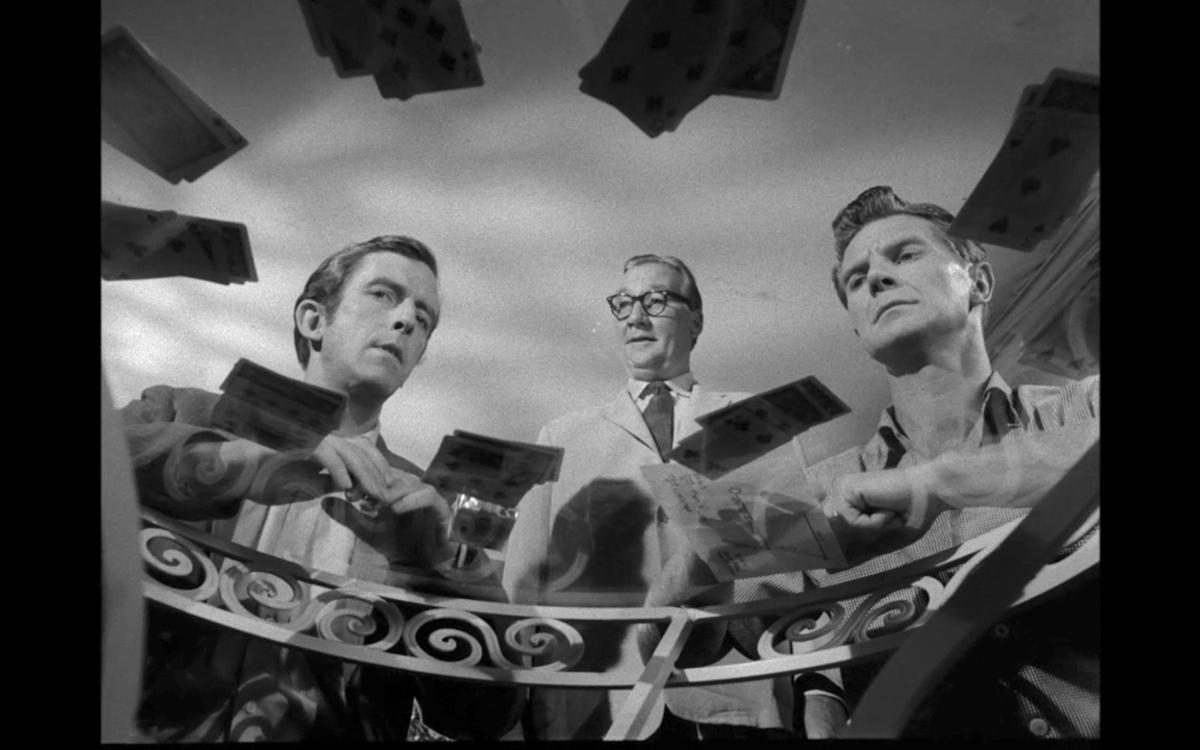
Twilight Zone – Long Live Walter Jameson

★★★★1/2  March 18, 1960 Season 1 Episode 24

If you want to see where we are…HERE is a list of the episodes.

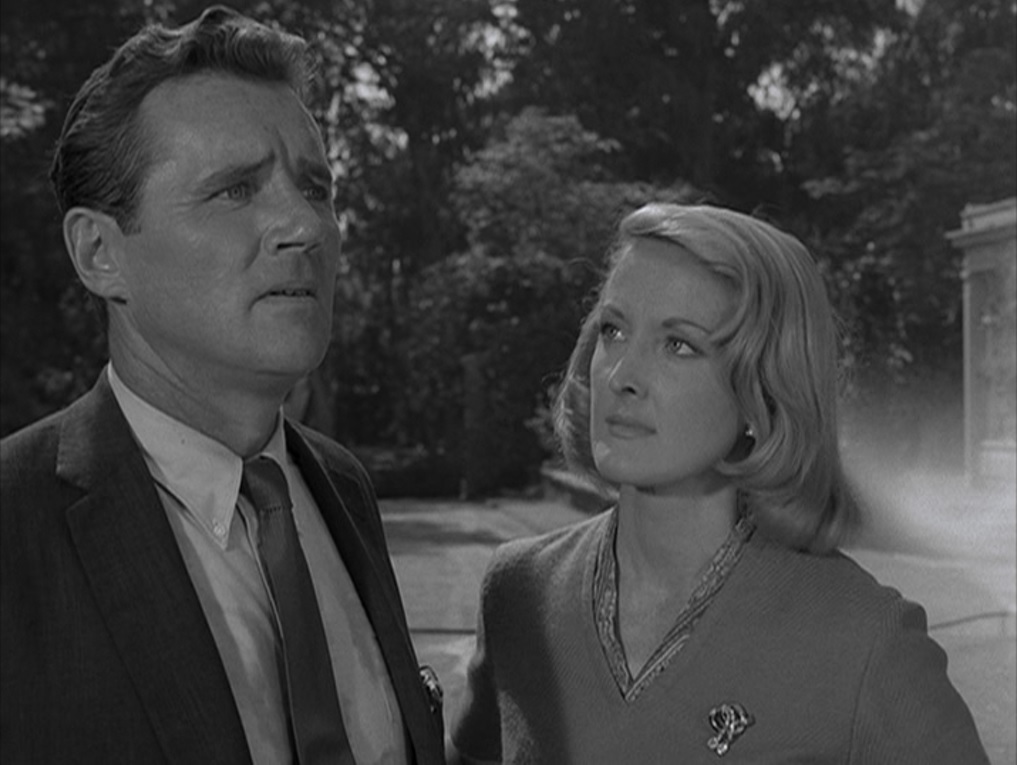
How would you like to live thousands of years? Mr. Jameson was given that option that many of us would love to have…but it’s not without it’s downfalls. Like the episode “Escape Clause” this episode explores immortality except in this one the main character is sophisticated but can be just as selfish. Even with his considerable life experiences some things don’t sink in.

Compared to shows in 2021 this episode is paced slow but that is a great thing. The story has room to breathe and is laid out in front of us. Living forever looks great on paper but in real time it would be hard to lose people you love over and over again… and lose yourself in parts and pieces in the process.

This is a great episode and an interesting view on immortality.

This episode deals with immortality. The entire cast all lived exceptionally long lives. Kevin McCarthy lived to be 96, Estelle Winwood was 101 when she passed away, Edgar Stehli passed away shortly after turning 89, and Dodie Heath turned 90 in August of 2018.

McCarthy died September 11, 2010 at the age of 96, having earned an acting credit as late as the year he died, more than 50 years after this episode was produced.

This show was written by Charles Beaumont

Rod Serling’s Opening Narration: 

You’re looking at Act One, Scene One, of a nightmare, one not restricted to witching hours of dark, rainswept nights. Professor Walter Jameson, popular beyond words, who talks of the past as if it were the present, who conjures up the dead as if they were alive…In the view of this man, Professor Samuel Kittridge, Walter Jameson has access to knowledge that couldn’t come out of a volume of history, but rather from a book on black magic, which is to say that this nightmare begins at noon.

Summary

Walter Jameson is a successful history professor. He’s been teaching for 12 years and has proven to be very popular with his students for his ability to bring his subject to life. He is engaged to Susanna Kittridge, his good friend Professor Sam Kittridge’s daughter. One thing that Professor Kittridge has noticed about Walter is that he doesn’t seem to have aged one bit in the 12 years they have known each other. Walter admits that he is far older than anyone can imagine but before he and Susanna can elope, someone from his past pays him a visit.

Rod Serling’s Closing Narration:

Last stop on a long journey, as yet another human being returns to the vast nothingness that is the beginning and into the dust that is always the end.

CAST

Rod Serling … Narrator (voice) (uncredited)
Kevin McCarthy … Prof. Walter Jameson / Tom Bowen / Maj. Hugh Skelton
Edgar Stehli … Professor Sam Kittridge
Estelle Winwood … Laurette Bowen
Dodie Heath … Susanna Kittridge (as Dody Heath)

Twilight Zone – A World of Difference

★★★★  March 11, 1960 Season 1 Episode 23

If you want to see where we are…HERE is a list of the episodes.

This is the kind of story that the Twilight Zone excels at. Vanishing into a fantasy world of your own design forever. They explored this plot device more than once in episodes like The Sixteen-Millimeter Shrine and A Stop at Willoughby just to name a few. Don’t worry though because the variations are so good that you would not mind more.

You think Arthur Curtis  is just a white-collar worker until you hear the word “cut.” He is an actor on a set but to him…he is the character he is playing. Howard Duff plays Arthur Curtis who is really Gerry Raigan. You get the feeling you would not like Raigan at all. It seems he has a drinking problem and an ex-wife that just despises him. You start seeing the reason why Arthur Curtis was born. 

Duff is very believable as Curtis…You see the worried look in his eyes yet he is hanging on to Arthur Curtis. 

When Gerry’s ex-wife demands he give her a check, she spells out the last name as “Raigan”. This isn’t the expected way to spell it, which may have been deliberate, so as to not associate the character with Ronald Reagan, the then-President of the Screen Actors Guild.

Look for David White…who became famous a few years later for the character Larry Tate in Bewitched. 

This show was written by Richard Matheson

Rod Serling’s Opening Narration: 

You’re looking at a tableau of reality, things of substance, of physical material: a desk, a window, a light. These things exist and have dimension. Now this is Arthur Curtis, age thirty-six, who also is real. He has flesh and blood, muscle and mind. But in just a moment we will see how thin a line separates that which we assume to be real with that manufactured inside of a mind.

Summary

Arthur Curtis is sitting his office chatting with secretary about plans for his daughter’s birthday party and that he and his wife will be flying off for a couple of days of rest and relaxation. Suddenly he hears someone yell “cut” and he realizes he on a movie sound stage. He can’t understand what has happened to him. Everyone refers to him as Gerry Reagan, but he insists that he is Arthur Curtis. He runs off but can’t find any of the familiar landmarks he knows such as his house or his place of work. He is desperate to return to the world of Arthur Curtis but that window of opportunity may be closing on him.

Rod Serling’s Closing Narration:

The modus operandi for the departure from life is usually a pine box of such and such dimensions, and this is the ultimate in reality. But there are other ways for a man to exit from life. Take the case of Arthur Curtis, age thirty-six. His departure was along a highway with an exit sign that reads, “This Way To Escape”. Arthur Curtis, en route to the Twilight Zone.

CAST

Howard Duff … Arthur Curtis / Gerry Raigan
David White … Brinkley
Frank Maxwell … Marty Fisher
Eileen Ryan … Nora Raigan
Gail Kobe … Sally
Peter Walker … Sam
Susan Dorn … Marion Curtis
Bill Idelson … Kelly (as William Idelson)

Twilight Zone – Mirror Image

★★★1/2  February  26, 1960 Season 1 Episode 21

If you want to see where we are…HERE is a list of the episodes.

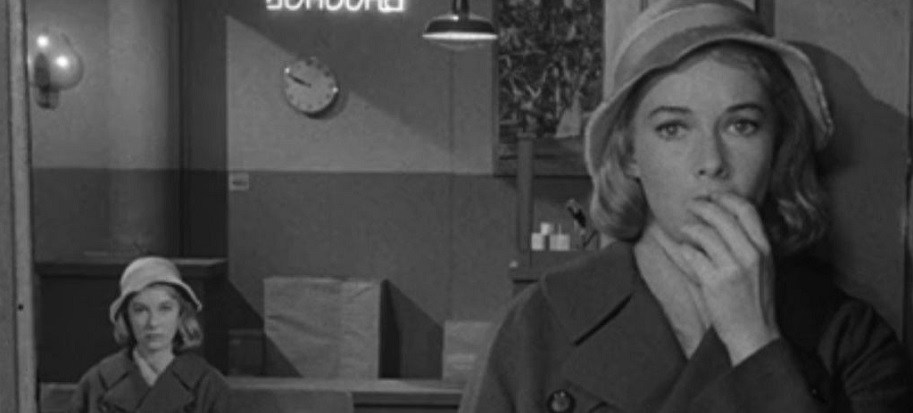
This is an odd one…but odd translates to good in the Twilight Zone. This one has no bad or good people…just an odd bus station where it all happens. What would you do if you looked across the room and saw yourself? That person not only looked just like but also carried a suitcase or bag just like you. 

Vera Miles plays Millicent Barnes who swears she has seen herself. She starts to get paranoid and tells Paul Grinstead (Martin Milner) this and she starts to break down…then Grinstead,  who obviously likes her and then starts to pity her does what he thinks is best…or so he thought. It could have ended a bit better. I just felt it never resolved itself. A good Twilight Zone and not a failure but not as good as some of the better ones. 

A stand out character actor in this one is Joseph Hamilton playing the grumpy put upon Ticket Agent.

The reason I remember this episode so well is because of Martin Milner . He would start filming Route 66 after this and became a star…later on he would become a bigger star known to the world as Pete Malloy on Adam 12. 

The cities mentioned in this episode (Cortland, Syracuse, Tully, and Binghamton) all lie along Hwy. 11 in central upstate New York. The use of these places is an homage by Rod Serling to his childhood. He was born in Syracuse and lived in Binghamton until he graduated high school. Even when he lived in Hollywood during his heyday, he maintained a home in Binghamton.

It was after filming this story that Martin Milner went to film the pilot episode of Route 66 (1960), which made him a star.

This show was written by Rod Serling

Rod Serling’s Opening Narration: 

Millicent Barnes, age twenty-five, young woman waiting for a bus on a rainy November night. Not a very imaginative type is Miss Barnes: not given to undue anxiety, or fears, or for that matter even the most temporal flights of fantasy. Like most young career women, she has a generic classification as a, quote, girl with a head on her shoulders, end of quote. All of which is mentioned now because, in just a moment, the head on Miss Barnes’ shoulders will be put to a test. Circumstances will assault her sense of reality and a chain of nightmares will put her sanity on a block. Millicent Barnes, who, in one minute, will wonder if she’s going mad.

Summary

Millicent Barnes is waiting in the bus station waiting for her bus to Cortland to arrive. The weather outside is dreadful and the bus is over half an hour late already. When she inquires the station clerk chides her for constantly asking when it will arrive. The only thing is (she thinks) it’s the first time she’s asked him anything. When she goes to the ladies room the cleaning lady suggests she was just in there, she begins to worry that she’s going mad. A good Samaritan, Paul Grinstead, tries to help her out but soon realizes that there may be an explanation for what is happening after all.

Rod Serling’s Closing Narration:

Obscure and metaphysical explanation to cover a phenomenon. Reasons dredged out of the shadows to explain away that which cannot be explained. Call it ‘parallel planes’ or just ‘insanity’. Whatever it is, you’ll find it in the Twilight Zone.

CAST

Rod Serling … Narrator (voice)
Vera Miles … Millicent Barnes
Martin Milner … Paul Grinstead
Joseph Hamilton … Ticket Agent (as Joe Hamilton)
Naomi Stevens … Washroom Attendant
Therese Lyon … Old Woman (as Terese Lyon)
Ferris Taylor … Passenger
Edwin Rand … Bus Driver

Twilight Zone – Elegy

★★★★  February 19, 1960 Season 1 Episode 20

If you want to see where we are…HERE is a list of the episodes.

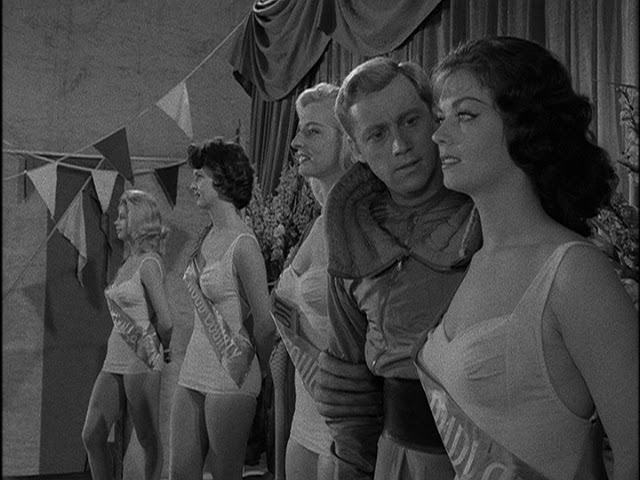
This episode gets to me when I see it. You feel the confusion of the astronauts as they land on a planet that everything is frozen in time…literally frozen in time. Everybody on this strange planet is just standing or sitting  still. A beauty pageant is going on, men fishing and they are all still.

After exploring everywhere an older man finally talked to them…Jeremy Wickwire (I love that name). He explains what is going on and where they are… and then does something just terrible.

It’s an good episode and the Twilight Zone will explore this plot a little more in the future. We are certainly on a great streak of shows…only broken by The Fever.

The flashing dials in the spaceship seen right after landing are the same ones used in Forbidden Planet

Charles Beaumont wrote this years earlier under the guidance and influence of Beaumont’s literary mentor, Ray Bradbury…THAT is some mentor.

This show was written by Charles Beaumont

Rod Serling’s Opening Narration: 

The time is the day after tomorrow. The place: a far corner of the universe. A cast of characters: three men lost amongst the stars. Three men sharing the common urgency of all men lost. They’re looking for home. And in a moment, they’ll find home; not a home that is a place to be seen, but a strange unexplainable experience to be felt.

Summary

In a far corner of the universe, a spaceship with three astronauts lands on a planet with gravity and air conditions virtually identical to that on Earth. Their surroundings appear as Earth did 200 years ago but the planet has two suns so they’re fairly certain they didn’t somehow end up back home. People however seem to be frozen in time. They eventually stumble upon Jeremy Wickwire, who is the caretaker for the locale. His explanation of what he is and where they are defies belief but in the end, he does grant them their wish.

This one is a good episode. I will admit the first time I watched it…I hadn’t worked out the twist.

Rod Serling’s Closing Narration:

Kirby, Webber, and Meyers, three men lost. They shared a common wish—a simple one, really. They wanted to be aboard their ship headed for home. And fate—a laughing fate—a practical jokester with a smile stretched across the stars, saw to it that they got their wish with just one reservation: the wish came true, but only in the Twilight Zone.

CAST

Cecil Kellaway … Jeremy Wickwire
Jeff Morrow … Kurt Meyers
Don Dubbins … Peter Kirby
Kevin Hagen … Captain James Webber
Walter Bacon … Beauty Contest Guest (uncredited)
Frank Baker … Hotel Guest (uncredited)
George Boyce … Minor Role (uncredited)
Barbara Chrysler Barbara Chrysler … Beauty Contestant (uncredited)
Alphonso DuBois … Minor Role (uncredited)
Joseph Glick … Rally Spectator (uncredited)
Chester Hayes … Ice Cream Man (uncredited)
Jimmie Horan … Minor Role (uncredited)
June McCall … Beauty Contestant (uncredited)
William Meader … Minor Role (uncredited)
Spec O’Donnell … Poker Player (uncredited)
Charles Perry … Spectator at Rally (uncredited)
Joe Ploski … Beauty Contest Guest (uncredited)
Paul Power … Farmer (uncredited)
Rod Serling … Narrator (voice) (uncredited)
Stephen Soldi … Minor Role (uncredited)
Jack Stoney … Finch (uncredited)
Martin Strader … Minor Role (uncredited)
Walton Walker … Minor Role (uncredited)
Sally Yarnell … Waitress (uncredited)

Twilight Zone – The Purple Testament

★★★★ February 12, 1960 Season 1 Episode 19

If you want to see where we are…HERE is a list of the episodes.

A horrible “what if” power that Lt. Fitzgerald (William Reynolds) has… when he looks at his fellow soldiers… he knows which ones are about to die. A powerful episode and one that was remade in the 80s Twilight Zone reboot but it didn’t come close to this one. 

One thing that struck me about actor William Reynolds…he looks like he could have walked out of 2021. Most of the time on older shows most actors and actresses look from that time period…he looks like he could be starring in a movie or TV show today. 

Rod Serling served in the US Army’s 511th Parachute Infantry Regiment, 11th Airborne Division, during the liberation of the Philippines, where this episode is set.

The night of the planned air date, a plane carrying Richard L. Bare (Director) and William Reynolds crashed in the Caribbean Sea, injuring both (though not seriously). It is believed that during their swim to land, they discussed the episode that night and Bare requested Reynolds not to look at him. He later admitted that he commended Buck Houghton’s decision to reschedule rather than use the incident for publicity.

This is episode 19 of season one…we are over halfway through the first season. 

This show was written by Rod Serling

Rod Serling’s Opening Narration: 

Infantry platoon, U.S. Army, Philippine Islands, 1945. These are the faces of the young men who fight, as if some omniscient painter had mixed a tube of oils that were at one time earth brown, dust gray, blood red, beard black, and fear—yellow white, and these men were the models. For this is the province of combat, and these are the faces of war.

Summary

In the Philippines in 1945, Army Lt. Fitzgerald has developed the disturbing ability to look into his men’s faces and know who will be killed in the next battle. He says it’s like a light is shined on their faces. His superior, Capt. Phil Riker, consults the medical officer but he finds nothing conclusive. Fitzgerald passes out when visiting one of his wounded men in the hospital after he sees the light on his face. When he sees the light on Riker’s face, he begs him not to go out. After they return from the military operation, he sees that there will be one other casualty that day.

Rod Serling’s Closing Narration:

From William Shakespeare, Richard the Third, a small excerpt. The line reads, ‘He has come to open the purple testament of bleeding war.’ And for Lieutenant William Fitzgerald, A Company, First Platoon, the testament is closed. Lieutenant Fitzgerald has found the Twilight Zone.

CAST

Rod Serling … Narrator (voice)
Dick York … Capt. Phil Riker
William Reynolds … Lt. Fitzgerald
William Phipps … Sergeant
Barney Phillips … Capt. E.L. Gunther
S. John Launer … Lieutenant Colonel
Michael Vandever … Smitty
Paul Mazursky … Orderly
Marc Cavell … Freeman
Warren Oates … Jeep Driver
Ron Masak … Harmonica Man

Twilight Zone – The Last Flight

★★★★1/2  February 5, 1960 Season 1 Episode 18

If you want to see where we are…HERE is a list of the episodes.

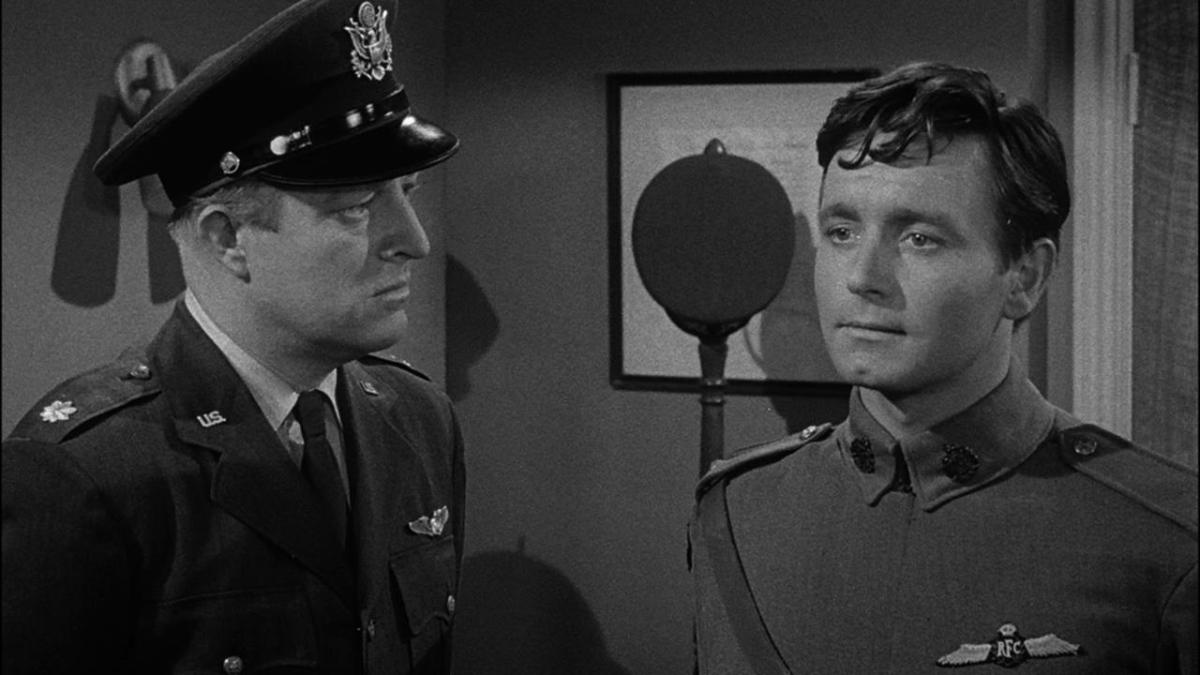
This is one of my most watched episodes of the Twilight Zone. I love time travel and this one is wonderful. Kenneth Haigh plays Lt. William Terrance Decker a British soldier who took off in his plane in 1917 and landed in 1959 at an American Air Force base. He’s held captive with the Americans believing his actions to be a prank.

I like how this one has a resolution at the end. You find out how the event affected everyone…including old “Leadbottom.”

The show like most of the other episodes is very well written, acted, and executed. This is a great episode. I could have easily given this a 5 star rating. 

Richard Matheson wrote this episodes and he was one of my favorite writers of the show next to Serling. He would write 16 Twilight Episodes and among other things we would write for Star Trek the original series. 

On a side note…My friend Keith posted his 20 top Twilight Zones. 

This show was written by Richard Matheson

Rod Serling’s Opening Narration: 

Witness Flight Lieutenant William Terrance Decker, Royal Flying Corps, returning from a patrol somewhere over France. The year is 1917. The problem is that the lieutenant is hopelessly lost. Lieutenant Decker will soon discover that a man can be lost not only in terms of maps and miles, but also in time – and time in this case can be measured in eternities.

Summary

Trying to find his way home after a dogfight in World War I, Royal Flying Corps Flt. Lt. William Terrance Decker lands at a U.S. Air Force base 42 years in the future. No one believes him when he claims to be from 1917, thinking someone is trying to put one over on them. Decker himself admits that before suddenly leaping into the future he was actually flying away from an serial encounter and leaving his friend in a lurch. He also realizes that he may have an opportunity to rectify that situation.

Rod Serling’s Closing Narration:

Dialog from a play, Hamlet to Horatio: There are more things in heaven and earth than are dreamt of in your philosophy. Dialog from a play written long before men took to the sky: There are more things in heaven and earth and in the sky than perhaps can be dreamt of. And somewhere in between heaven, the sky, and the earth, lies the Twilight Zone.

CAST

Kenneth Haigh … Lt. William Terrance Decker
Alexander Scourby … Maj. Gen. George Harper
Simon Scott … Maj. Wilson
Robert Warwick … A.V.M. Alexander ‘Leadbottom’ Mackaye, R.A.F.
Harry Raybould … Corporal
Jerry Catron … Guard

Twilight Zone – The Hitch-Hiker

★★★★★  January 22, 1960 Season 1 Episode 16

If you want to see where we are…HERE is a list of the episodes.

There are episodes that are hard for me to rate but some…like this one…is really easy…it’s a 5 star classic without a second thought.

A beautiful young lady is traveling across the country and has a blow out. After she gets the tire fixed she is back on the road but keeps seeing this hitch hiker everywhere she goes. The lady (Nan Adams) is perfectly played by Inger Stevens. This has everything you would want out of a Twilight Zone. Great suspense, a little horror, and a Twilight Zone twist.

Lucille Fletcher got the idea for this story in 1940 when she and her husband Bernard Herrmann were driving cross-country from New York to California. On the first day of the trip they saw the same odd-looking man on the side of the road it two different locations. She found the occurrence rather eerie and thought it might be a good concept for a story.

In the original story, the character of Nan was a male, Ronald. Rod Serling believed that a female in the situation would be reacted to with more feeling by audiences. She was named after one of his daughters.

This show was written by Rod Serling and  Lucille Fletcher

Rod Serling’s Opening Narration: 

Her name is Nan Adams. She’s twenty-seven years old. Her occupation: buyer at a New York department store. At present on vacation, driving cross-country to Los Angeles, California from Manhattan…Minor incident on Highway 11 in Pennsylvania. Perhaps, to be filed away under “accidents you walk away from.” But from this moment on, Nan Adams’ companion on a trip to California will be terror. Her route: fear. Her destination: quite unknown.

Summary

Nan Adams is driving across country from Manhattan to Los Angeles. Apart from a blown tire, the trip has been more or less uneventful. That is until she begins to see the same man, over and over again, hitchhiking along the highway. No matter how far she goes or how far she drives, the hitchhiker always seems to be ahead of her. She also seems to be the only person who can see him. When Nan decides to call home, all is revealed.

Rod Serling’s Closing Narration:

Nan Adams, age twenty-seven. She was driving to California; to Los Angeles. She didn’t make it. There was a detour… through the Twilight Zone.

CAST

Inger Stevens … Nan Adams
Adam Williams … Sailor
Lew Gallo … Mechanic
Leonard Strong … The Hitch-Hiker
Russ Bender … Counterman
George Mitchell … Gas Station Man

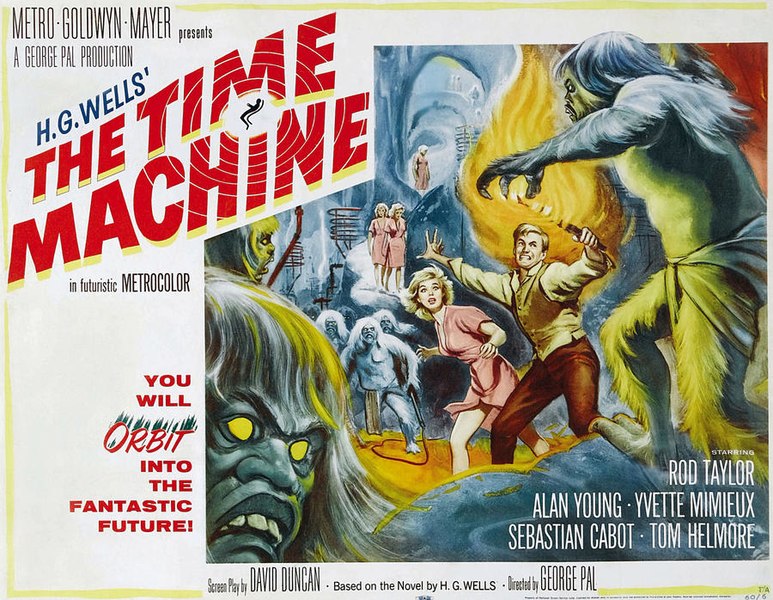
The Time Machine 1960

Hanspostcard is hosting a movie draft from 12 different genres…this is my Scifi entry.

I have always liked Time Travel movies and this one is one of the best  I’ve watched. The movie was based on the H.G. Wells book The Time Machine published in 1895. The way they present it is believable.

I somehow missed this movie until 2005. It stars Rod Taylor as George Wells, Alan Young as David Filby/James Filby , and the beautiful Yvette Mimieux as Weena and Alan Young. It also has Sebastian Cabot as Dr. Philip Hillyer.

Rod Taylor portrays George Wells, and he builds a Time Machine. Other than the Tardis (Doctor Who) it’s the coolest time machine I’ve seen. He builds a miniature one and while his friends watch, he turns the small machine on and it disappears into the future. His friends don’t really believe it. They question what good it will do if it really works? Who would buy it? George gets aggravated and takes off. I can’t say I blame him.

This time machine doesn’t physically move but just occupies the same space in the time.

He takes the machine for a test ride into the future. They had no CGI but they get across time travel fine. To show time passing they set up a mannequin across the street to show different clothing styles passing by with the time which is brilliant. Sometimes subtle ways are better than obvious ones.

George’s journey began on December 31, 1899 and he goes to October 12, 802,701 with some stops on the way. He witnesses some of the first and second World War and nuclear destruction. When he gets to 802,701 the adventure begins.

He ends up in a future society where all the people are young. They do nothing all day but play and eat…hmmm millennials? Just kidding…George shows this society there is a price they pay for playing all day. The young people there have no clue on what is going on. No laws, curiosity, and no anxiety for the future. They are sheep and they don’t even know or seem to care.

My favorite part of the movie is the creatures called the Morlocks with glowing eyes that live underground because they could not stand light. They provide the clueless land dwellers with food for obvious reasons. This is a truly classic movie. Don’t’ bother with the remake in 2002…get this version.

Alan Young does a great job as David Filby…George’s best friend and later David’s son…

My son watched this when he was 8 and feared the Morlocks but kept watching. He still watches it now. It was filmed in 1960 and the film won an Oscar for Best Effects, Special Effects. Does it measure up to today’s special effects? No,  but it gets the story across so if you like classic sci-fi you might like this one. I’ve seen it many times and never got tired of it.

CAST

  • Rod Taylor as H. George Wells
  • Alan Young as David Filby/James Filby
  • Yvette Mimieux as Weena
  • Sebastian Cabot as Dr. Philip Hillyer
  • Tom Helmore as Anthony Bridewell
  • Whit Bissell as Walter Kemp
  • Doris Lloyd as Mrs. Watchett
  • Paul Frees as voice of the Rings (uncredited)


Twilight Zone – I Shot an Arrow Into the Air

★★★★  January 15, 1960 Season 1 Episode 15

If you want to see where we are…HERE is a list of the episodes.

Serling like to show the best and worse of people and this episode has both. Edward Binns plays the honorable Col. Bob Donlin and Dewey Martin  plays the selfish Corey who folds under pressure in the worse way.  A space ship is launched and crashes on what seems an unknown asteroid…survival will be difficult for the 4 survivors of the crash. It’s hot, rocky, and no water in sight. Cory is determined to survive no matter what. It’s a very good episode…I went back between 3 1/2 and 4 but the twist pushes it over the top.

Rod Serling was at a party when he was approached by a woman named Madelon Champion who told Serling a what if story and this was it. Serling gave her $500 dollars on the spot and gave her a co-writing credit.

Rarely did this happen… here is a quote from Rod Serling: I got 15,000 manuscripts in the first five days. Of those 15,000, I and members of my staff read about 140. And 137 of those 140 were wasted paper; hand-scrawled, laboriously written, therapeutic unholy grotesqueries from sick, troubled, deeply disturbed people. Of the three remaining scripts, all of clearly poetic, professional quality, none of them fitted the show.

This is one of only four episodes that Rod Serling did a mid-episode narration

This show was written by Rod Serling and Madelon Champion

Rod Serling’s Opening Narration: 

Her name is the Arrow 1. She represents four and a half years of planning, preparation, and training, and a thousand years of science, mathematics, and the projected dreams and hopes of not only a nation, but a world. She is the first manned aircraft into space and this is the countdown. The last five seconds before man shot an arrow into the air.

Summary

This is the story of a group of spacemen who crash on what they think is an asteroid. Since they are doomed, the Captain tries to keep military protocol. Nevertheless, Cory, one of the men, becomes a survivalist. He becomes selfish and begins to take over. He kills. He steals water. He whines. The story works toward an ironic twist, bringing out the best and the worst in everyone. Patience goes out the window over water. Remember the two men fighting at the conclusion of Von Stroheim’s Greed. There is a bit of this because when our lives are on the line, we often try to hold on to every second we can. Cory can’t see honor or morality or order. It’s just to grasp for that one more drop of precious water.

Rod Serling mid-episode narration 

Now you make tracks, Mr. Corey. You move out and up like some kind of ghostly billyclub was tapping at your ankles and telling you that it was later than you’d think. You scrabble up rock hills and feel hot sand underneath your feet and every now and then, take a look over your shoulder at a giant sun suspended in a dead and motionless sky…like an unblinking eye that probes at the back of your head in a prolonged accusation.

Mr. Corey, last remaining member of a doomed crew, keep moving. Make tracks, Mr. Corey. Push up and push out because if you stop…if you stop, maybe sanity will get you by the throat. Maybe realization will pry open your mind and the horror you left down in the sand will seep in. Yeah, Mr. Corey, yeah, you better keep moving. That’s the order of the moment: keep moving.

Rod Serling’s Closing Narration:

Practical joke perpetrated by Mother Nature and a combination of improbable events. Practical joke wearing the trappings of nightmare, of terror, and desperation. Small, human drama played out in a desert 97 miles from Reno, Nevada, U.S.A., continent of North America, the Earth and, of course, the Twilight Zone.

CAST

Dewey Martin … Corey
Edward Binns … Col. Bob Donlin
Ted Otis … Pierson
Harry Bartell … Langford
Leslie Barrett … Brandt
Boyd Cabeen … Technician (uncredited)
Rod Serling … Narrator (voice) (uncredited)

Twilight Zone – Third From the Sun

★★★★★  January 8, 1960 Season 1 Episode 14

If you want to see where we are…HERE is a list of the episodes.

The first thing about this  episode that catches my eye is the camera work. The angles they used were really interesting and keeps this episode fresh.

I run across people who have never seen the Twilight Zone…there are a few episodes I point them to…this is one of them. This has everything a great episode has… the great casting, story, and the surprise at the end.

This one has one of my very favorite twists at the end. At the time of this episode it had to hit home for many people…The Cold War and fear of nuclear annihilation were ever-present. Fritz Weaver did an amazing job of relating the fear and paranoia of an oncoming disaster.

Edward Andrews played Carling a security officer who is unlikable at first sight. He toys with the two families determined to block their secret plans for an escape. The more I see this episode the more I really dislike this guy…he played the part very well.

Some trivia: The background noises heard aboard the ship in the final scene were later reused in Star Trek. During the closing scene, the main characters are depicted aboard a spaceship, a reuse of the ship created for Forbidden Planet

This show was written by Rod Serling and Richard Matheson

Rod Serling’s Opening Narration: 

Quitting time at the plant. Time for supper now. Time for families. Time for a cool drink on a porch. Time for the quiet rustle of leaf-laden trees that screen out the moon, and underneath it all, behind the eyes of the men, hanging invisible over the summer night, is a horror without words. For this is the stillness before storm. This is the eve of the end.

Summary

William Sturka works as a hydrogen specialist in a highly secure plant. Conditions are tense and there are constant rumors of war. The latest is that it’s going to happen in the next 48 hours. Unbeknownst to his wife Eve and daughter Jody, he and his friend Jerry Riden have been planning an escape of sorts for themselves and their families. Jerry is a test pilot and they plan to steal the government’s latest spacecraft heading off to a planet they believe may sustain life. Their biggest challenge is Carling, a security officer who seems to be onto their plan.

Rod Serling’s Closing Narration:

Behind a tiny ship heading into space is a doomed planet on the verge of suicide. Ahead lies a place called Earth, the third planet from the Sun. And for William Sturka and the men and women with him, it’s the eve of the beginning—in the Twilight Zone.

CAST

Fritz Weaver … William Sturka
Edward Andrews … Carling
Joe Maross … Jerry Riden
Denise Alexander … Jody Sturka
Lori March … Eve Sturka
Jeanne Evans … Ann Riden

Twilight Zone – The Four of Us Are Dying

★★★ 1/2  January 1, 1960 Season 1 Episode 13

If you want to see where we are…HERE is a list of the episodes.

The first episode of a brand new decade that would see the world change immeasurably.

This episode has a great what if story. What if… you could change your face just by looking at a picture or from memory? Many times in the Twilight Zone these talents are given to people who want more out of life than they have earned. Instead of using this for the good…we have a small time crook trying to take advantage people.

He had his own face and he ended up changing into 3 different faces. He would scanned the paper and changed into people who he could take advantage of their situation. They were going to cast the same actor and use makeup but they decided to cast 4 different actors with same eye color and build.

This show was written by  Rod Serling  and  George Clayton Johnson

Rod Serling’s Opening Narration: 

His name is Arch Hammer, he’s 36 years old. He’s been a salesman, a dispatcher, a truck driver, a con man, a bookie, and a part-time bartender. This is a cheap man, a nickel-and-dime man, with a cheapness that goes past the suit and the shirt; a cheapness of mind, a cheapness of taste, a tawdry little shine on the seat of his conscience, and a dark-room squint at a world whose sunlight has never gotten through to him. But Mr. Hammer has a talent, discovered at a very early age. This much he does have. He can make his face change. He can twitch a muscle, move a jaw, concentrate on the cast of his eyes, and he can change his face. He can change it into anything he wants. Mr. Archie Hammer, jack-of-all-trades, has just checked in at three-eighty a night, with two bags, some newspaper clippings, a most odd talent, and a master plan to destroy some lives.

Summary

Arch Hammer arrives in the city and checks into a seedy hotel. He looks like any other man but looks can be deceiving. Hammer has the ability to change his appearance at whim, a trick he definitely uses to his own advantage. He takes on the appearance of the recently deceased musician Johnny Foster. who died in a car accident. He goes to meet Maggie, a lounge singer who is mourning Foster’s death, and convinces her to run off with him. He then takes on the appearance of Virge Sterig, a gangster whose bullet-riddled body was recently found in the river. He then visits mob boss Penell who double-crossed him to get his share of the money their most recent job. An unplanned change of face doesn’t go over well, however.

Rod Serling’s Closing Narration:

He was Arch Hammer, a cheap little man who just checked in. He was Johnny Foster, who played a trumpet and was loved beyond words. He was Virgil Sterig, with money in his pocket. He was Andy Marshak, who got some of his agony back on a sidewalk in front of a cheap hotel. Hammer, Foster, Sterig, Marshak—and all four of them were dying.

CAST

Harry Townes … Arch Hammer
Phillip Pine … Virge Sterig
Ross Martin … Johnny Foster
Don Gordon … Andy Marshak
Harry Jackson … Trumpeter
Bernard Fein … Penell
Peter Brocco … Mr. Marshak
Milton Frome … Detective
Beverly Garland … Maggie

Twilight Zone – What You Need

★★★1/2 December 25, 1959 Season 1 Episode 12

If you want to see where we are…HERE is a list of the episodes.

This is a good solid episode but not a classic. The thing about the Twilight Zone is… even the average episodes (average for the Twilight Zone) can become personal favorites.

An old man (Pedott) with a gift that can give you what you need. It could be cleaning fluid, a bus ticket, or a pair of scissors. You would not believe so, but you would end up needing them. He doesn’t use his gift on anyone but the ones he does bestow things to…they are usually grateful. What you need could be something small or something important to save your life.

Enter Mr. Fred Renard played by Steve Cochran. He is a nobody…a nothing that wants to be a somebody and not earn it. He sees the old man with a gift and wants everything. Cochran plays this bad guy well. He is a bully and blames the world on his problems.

This show was written by Rod Serling and Henry Kuttner

Rod Serling’s Opening Narration: 

You’re looking at Mr. Fred Renard, who carries on his shoulder a chip the size of the national debt. This is a sour man, a friendless man, a lonely man, a grasping, compulsive, nervous man. This is a man who has lived thirty-six undistinguished, meaningless, pointless, failure-laden years and who at this moment looks for an escape—any escape, any way, anything, anybody—to get out of the rut. And this little old man is just what Mr. Renard is waiting for.

Summary

An old street vendor goes to a bar to sell his wares. However, he foresees what each costumer will need in a short period, selling precisely what they need. After selling in the bar, the crook Fred Renard mocks him and the peddler gives a pair of scissors for him. When Fred arrives at the hotel where he is lodged, his scarf is trapped on the elevator door and he only survives due to the pair of scissors. Now Fred believes that the peddler has a gift and he decides to force the old man to tell him the name of the horse that will win a race. The greedy Fred earns a large amount and seeks out the peddler threatening him again that the old man gives him a pair of shoes to Fred. But who needs the pair of shoes?

Rod Serling’s Closing Narration:

Street scene, night. Traffic accident. Victim named Fred Renard, gentleman with a sour face to whom contentment came with difficulty. Fred Renard, who took all that was needed—in The Twilight Zone.

CAST

Steve Cochran … Fred Renard
Ernest Truex … Pedott
Read Morgan … Lefty
Arlene Martel … Girl in Bar (as Arline Sax)
William Edmonson… Bartender
Doris Karnes … Woman
Fred Kruger … Man on Street
Norman Sturgis … Hotel Clerk

Twilight Zone – And When the Sky Was Opened

★★★★★ December 11, 1959 Season 1 Episode 11

If you want to see where we are…HERE is a list of the episodes.

This is one of my favorites. Rod Taylor from the Time Machine drives this episode. I won’t give out 5 star ratings on just anything but this one does it for me. Each character goes through the same situation and there is no way they can explain it to anyone else. There is a little…just a little of “It’s A Wonderful Life” in this one. When George Bailey goes to his mother’s door and she said she didn’t know him…because he didn’t exist. What would happen if a friend you have known for years was wiped out of existence in everyone’s memory but yours?

Halfway through, you get an idea of what is going to happen but that doesn’t matter. You can feel the desperation in Lieutenant Colonel Clegg Forbes (Rod Taylor) as he tries to put together what happened to his friend and why no one else knows…and then it starts happening to him. 

  Also (Spoiler!) the character Major William Gart quickly vanished at the end. Rod Serling explained in a lecture that without his fellow astronauts to anchor him to this world, he had no way of holding on. It furthered the idea that Rod Taylor’s Forbes’s denial kept him in the world longer, and having heard the story of Harrington’s disappearance and seeing Forbes taken out, he had no way of denying the possibility.

Look for Miss. Landers (Sue Randall) from Leave it to Beaver as the Nurse.

This show was written by Rod Serling and Richard Matheson

Rod Serling’s Opening Narration: 

Her name: X-20. Her type: an experimental interceptor. Recent history: a crash landing in the Mojave Desert after a thirty-one hour flight nine hundred miles into space. Incidental data: the ship, with the men who flew her, disappeared from the radar screen for twenty-four hours…But the shrouds that cover mysteries are not always made out of a tarpaulin, as this man will soon find out on the other side of a hospital door.

Summary

The X-20 experimental spacecraft recently returned after venturing into a 900 mile orbit around the Earth. At one point, the craft disappeared for about 20 seconds and then suddenly reappeared before crashing in the Mojave desert. One of the crew, Maj. William Gart broke his leg on reentry but is recovering. Another of the astronauts, Lt. Col. Clegg Forbes, visits him but is obviously quite shaken. His recollection is there were 3 astronauts in the craft but the newspaper accounts mention only two. The third was Col. Ed Harrington but Gart says he never heard of him. As Forbes remembers it, he and Harrington went out the night before and Harrington begins to have a sense of not belonging. He then vanishes. As he searches for his friend, he can find no one who ever met the man.

Rod Serling’s Closing Narration:

Once upon a time, there was a man named Harrington, a man named Forbes, a man named Gart. They used to exist, but don’t any longer. Someone – or something – took them somewhere. At least they are no longer a part of the memory of man. And as to the X-20 supposed to be housed here in this hangar, this, too, does not exist. And if any of you have any questions concerning an aircraft and three men who flew her, speak softly of them – and only in – The Twilight Zone.

CAST

Rod Serling … Narrator (voice) (uncredited)
Rod Taylor … Lieutenant Colonel Clegg Forbes
Jim Hutton … Major William Gart (as James Hutton)
Charles Aidman … Colonel Ed Harrington
Maxine Cooper … Amy
Paul Bryar … Bartender
Sue Randall … Nurse
Joe Bassett … Medical Officer
Lisabeth Field … Nurse (uncredited)
Logan Field … Investigator (uncredited)
John Launer … Mr. Harrington (uncredited)
Oliver McGowan … Officer (uncredited)
Gloria Pall … Girl in Bar (uncredited)
Bernard Sell … Bar Patron (uncredited)

Modern Times

Hanspostcard is hosting a movie draft from 12 different genres…this is my comedy entry.

This was/ the first feature length Chaplin movie I ever watched. It was his last “silent” movie. The year was 1936 and “talkies” had been around for almost a decade and certainly the most popular movie format in the 1930’s. Chaplin stubbornly decided to carry on with another silent movie and I’m glad he did.

Chaplin was a smart man…he knew the little tramp could not talk on screen…the character was over with if he did…finished. That was part of his mystic. Another reason was the beauty of silent film at the time. He had perfected the art and talkies were full of clumsy lines delivered with immobile cameras and primitive microphones. They were improving but when silent movies ended…an art was lost forever.

Other actors at the time didn’t have the power or clout to try this but it worked brilliantly for Chaplin.  It was one of the top-grossing films of 1936. This after being told no one would want to see a silent movie in 1936…Charlie was once again right.

Chaplin did like the fact that he could insert sound effects into the movie with the technology. He wrote, directed, acted,  produced and also wrote the music for this movie. Modern Times has Chaplin’s finest music score. His most recognizable and commercially viable song, “Smile,” emerged from a melody used by him in this movie.

The film is very relevant today. Charlie takes on the machine age as humans are treated like cattle. Chaplin takes a swipe at  capitalism , industrialization and human exploitation.

The little tramp is finding it difficult to survive in the modern mechanized world. Failing as a worker on a factory assembly line, he gets into a series of adventures and misadventures, which leads him meeting a young recently orphaned “gamine” who ran away rather than end up in an orphanage. They try to survive in the world together, both on the run from the law, although his previous stints behind bars… were to him more appealing than life outside in the cold modern world.

The question becomes… can Charlie and the gamine individually or together  find their place in the modern world with all the odds against them?

Some famous scenes are in this movie. Chaplin in the automatic feeding machine, Chaplin and his boss in the gears of the machinery, and Chaplin going insane trying to tighten bolts on every thing.

It is a great film to start watching Chaplin if you haven’t seen any of his previous movies. One of the many remarkable things about Charlie Chaplin is that his films continue to hold up, to attract, and entertain audiences…you will enjoy this one!

Twilight Zone – Judgment Night

★★★1/2 December 4, 1959 Season 1 Episode 10

If you want to see where we are…HERE is a list of the episodes.

Rod Serling served in WW2 and he does have quite a few episodes about war. It’s been said that you pay for everything you do in this life. The character Carl Lanser will be paying for an eternity. World War II hadn’t been over for 15 years when Judgment Night premiered. It was still fresh in everyone’s mind.

Serling had a message starting with this episode. When Nazi’s fall in the Twilight Zone they will get their comeuppance. Serling didn’t make light of Nazis, pull any punches,  or turn them into a cartoon stereotype. Carl is portrayed as someone who perpetuated a deep evil and will be punished by God for it…and punished he is.

I love the twist in this episode but I think it is a little slow moving…but still a good one to watch. There are better WWII episodes.

This show was written by Rod Serling

Rod Serling’s Opening Narration: 

Her name is the S.S. Queen of Glasgow. Her registry: British. Gross tonnage: five thousand. Age: Indeterminate. At this moment she’s one day out of Liverpool, her destination New York. Duly recorded on the ship’s log is the sailing time, course to destination, weather conditions, temperature, longitude and latitude. But what is never recorded in a log is the fear that washes over a deck like fog and ocean spray. Fear like the throbbing strokes of engine pistons, each like a heartbeat, parceling out of every hour into breathless minutes of watching, waiting and dreading… For the year is 1942, and this particular ship has lost its convoy. It travels alone like an aged blind thing groping through the unfriendly dark, stalked by unseen periscopes of steel killers. Yes, the Queen of Glasgow is a frightened ship, and she carries with her a premonition of death.

Summary

During World War II, a confused Carl Lancer finds himself as one of only a few passengers on a freighter, the S.S. Queen of Glasgow, traveling from London to New York. As he sits with other passengers, he begins to realize that he is the captain of a U-Boat that is at that very moment tracking the freighter with a view to sinking it. He also knows that in just over an hour the freighter will be attacked.

Rod Serling’s Closing Narration:

“The S.S. Queen of Glasgow, heading for New York, and the time is 1942. For one man it is always 1942—and this man will ride the ghost ship every night for eternity. This is what is meant by paying the fiddler. This is the comeuppance awaiting every man when the ledger of his life is opened and examined, the tally made, and then the reward or the penalty paid. And in the case of Carl Lanser, former Kapitan Lieutenant, Navy of the Third Reich, this is the penalty. This is the justice meted out. This is judgment night in the Twilight Zone.”

CAST

Rod Serling … Narrator (voice)
Nehemiah Persoff … Carl Lanser
Deirdre Owens … Barbara Stanley (as Deirdre Owen)
Patrick Macnee … First Officer McLeod
Ben Wright … Captain Wilbur
Leslie Bradley … Major Devereaux
Kendrick Huxham … Bartender
Hugh Sanders … Jerry Potter
Richard Peel … 1st Steward
Donald Journeaux … 2nd Steward
Barry Bernard … Engineer
James Franciscus… Lt. Mueller