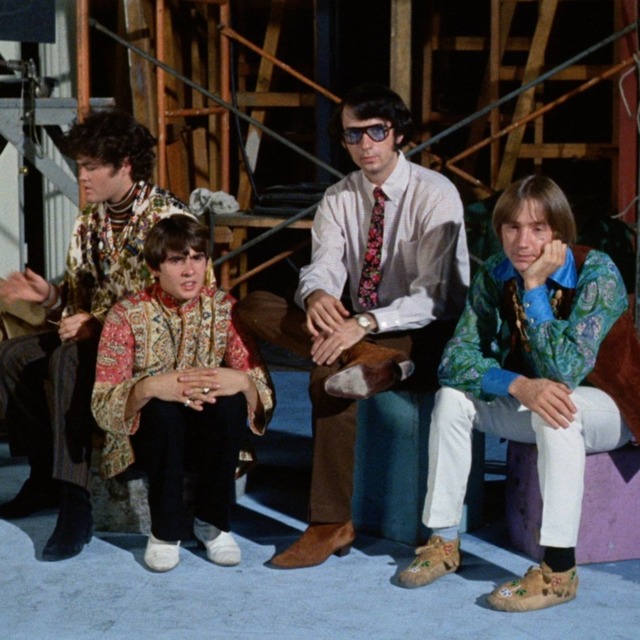
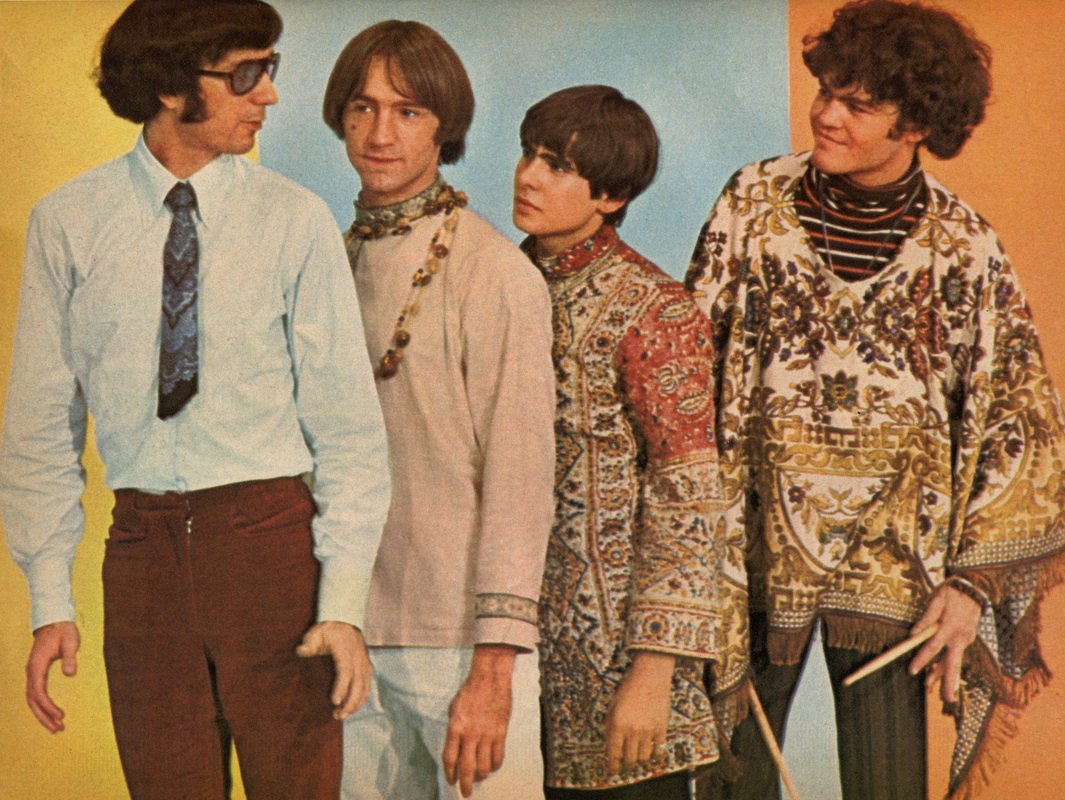
I was 7 and I had just borrowed the Monkees debut album from a cousin. I thought the band was still together and playing in the mid seventies. I had no clue they broke up years before. This is one of the songs I would wear out on the album.
The song stands out from the other songs on the album. This isn’t pop…it’s more like a country driven garage rock band song. I truly think Nesmith would have made it in the music business with or without the Monkees. He would soon write the Stone Poneys hit “Different Drum” that peaked at #13 in the Billboard 100 in 1967. This song was released on the debut album in 1966.
Mike Nesmith made it clear from the beginning he wanted to write songs. Nesmith was a talented songwriter. The shows creator Don Kirshner set him up to write with Carole King and Gerry Goffin. Michael wasn’t ungrateful and he commented that he liked both of them but he didn’t like being forced to write with someone else. Kirshner resented the rejection, feeling that a nobody like Nesmith should have flipped over the opportunity to work with two songwriting legends. In the end, though we did get this song.
Kirshner didn’t like having the band do anything but sing and act in the show. That didn’t last long with Nesmith leading them…by the third album the Monkees were playing their own instruments and writing some songs.
I just listened to it again for the first time in years and every nuance and word came back to me instantly. This was my first “favorite” Monkee song.
This was an album track not released as a single.
Sweet Young Thing
I know that something very strange Has happened to my brain I’m either feeling very good Or else I am insane The seeds of doubt you’ve planted Have started to grow wild And I feel that I must yield before The wisdom of a child
And it’s love you bring No that I can’t deny With your wings I can learn to fly Sweet young thing
People try to talk to me Their words are ugly sounds But I resist all their attempts To try and bring me down.. Turned on to the sunset Like I’ve never been before How I listen for your footsteps As you knock upon the door
And it’s love you bring No that I can’t deny With your wings I can learn to fly Sweet young thing
And it’s love you bring With dreams of bluer skies And all these things When I see it in your eyes Sweet young thing
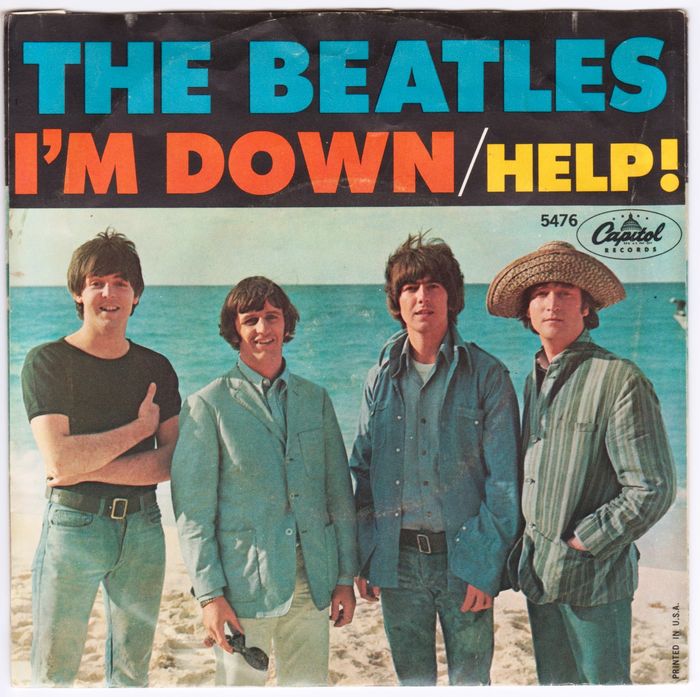
I have always liked this B side to Help! Not a bad B side at all.
It was credited to Lennon/McCartney but Paul McCartney wrote this track… in the style of Little Richard. American R&B singers like Richard were a big influence on The Beatles.
The Beatles used this as their closing number on 1965 North American and UK tours, and the 1966 World tour.
When the Beatles were recording this…Paul took a break after shredding his vocal cords and recorded the classic…Yesterday. John Lennon played the Hammond organ on this track. It was the first time Lennon played any kind of keyboard on a record. When The Beatles played this live, he often played an electric piano.
This was the first song ever recorded by Aerosmith. They used it as a demo which eventually got them a record deal. They used also recorded it in 1987 on their album Permanent Vacation.
Paul McCartney:“I’m not sure if John had any input on it, in fact I don’t think he did. But not wishing to be churlish, with most of these I’ll always credit him with 10 per cent just in case he fixed a word or offered a suggestion. But at least 90 per cent of that would be mine.”
From Songfacts
In this song, Paul McCartney plays the role of a poor sap wallowing in his misery. But the joke is on him, which the arrangement and backing vocals make clear. When he sings, “I’m down,” John Lennon and George Harrison retort in mocking fashion, with lines like “down on the ground.” It’s as if they’ve heard too much of his bellyaching and they’re sick of it.
A telling line is, “How can you laugh when you know I’m down?” You can only have so much sympathy for someone who won’t help himself. After that, you have to laugh.
The Beatles performed this on their third live Ed Sullivan Show appearance – September 12, 1965. Before The Beatles broke through in America, Sullivan was in the London airport when The Beatles returned from a tour of Sweden. When he saw the massive crowd there to greet them, he thought The Queen was arriving. When he found out the throngs were there for The Beatles, he made sure to book them on his show. He became a big fan and had them on whenever he could.
This was recorded at the same session with “Yesterday” and “I’ve Just Seen a Face.”
The Beastie Boys recorded a version of this in 1986. Michael Jackson, who owned the publishing rights to this and many other Beatles songs, would not allow them to release it.
Paul McCartney played this at the “Concert For New York,” a benefit show he helped organize in 2001 to help victims of the World Trade Center disaster. It was the first song of his set.
I’m Down
You tell lies thinking I can’t see You can’t cry ’cause you’re laughing at me I’m down (I’m really down) I’m down (Down on the ground) I’m down (I’m really down) How can you laugh when you know I’m down (How can you laugh) When you know I’m down
Man buys ring woman throws it away Same old thing happens everyday I’m down (I’m really down) I’m down (Down on the ground) I’m down (I’m really down) How can you laugh when you know I’m down (How can you laugh) When you know I’m down
We’re all alone and there’s nobody else You still moan, “Keep your hands to yourself!” I’m down (I’m really down) Oh baby, I’m down (Down on the ground) I’m down (I’m really down) How can you laugh when you know I’m down (How can you laugh) When you know I’m down, wow Baby I’m down
Oh baby, you know I’m down (I’m really down) Oh yes, I’m down (I’m really down) I’m down on the ground (I’m really down) Ah, Down (I’m really down) Oh baby, I’m upside down, a yeah, yeah, yeah, yeah, yeah I’m down (I’m really down) Oh baby, I’m down (I’m really down) I’m feeling upside down (I’m really down) Oh, I’m down (I’m really down) Baby, I’m down, yeah Oh baby, I’m down, yeah Baby I’m down (I’m really down) Well, baby I’m down (I’m really down) Well, baby, baby, baby (I’m really down) Oh baby, I’m down I’m down, down, down
Before we get to my number 1 episode…This has been so much fun I’m going to start a huge project. I want to review every Twilight Zone…all 156 episodes…so that will be next…my top 10 is not enough. I’ll start with S01E01 and work myself through and skip the 10 I’ve covered in this section. I’ve never rated shows or movies before but I will try that as well.
This one gets a 5 out of 5 ★★★★★
Since ratings are subjective to who ever is going it…this is my system
★★★★★ This would be an exceptional episode…to me anyway
★★★★☆ This would be above the already high standards of the show
★★★☆☆ This would be a good to very good episode
★★☆☆☆ This would be just a little below average, the 4th season might see this
★☆☆☆☆ This would be a don’t watch…I don’t think this will ever be seen but I’m watching them all over to be sure
Now for my number 1 Twilight Zone episode! This one has my favorite element…Time Travel. How cool would it be to go back and meet your 11 year old self? Episodes 2-156 could change in my rankings but this one remains my favorite.
They really did this episode right. They followed through with everything. You were not wanting for answers at the end. It wasn’t just Martin who figured out he was back in time. It resolves it self nicely…with a valuable lesson. There are spoilers past this.
If you are new to the Twilight Zone this is a great one to start with…
Rod Serling’s opening narration:
Martin Sloan, age thirty-six. Occupation: vice-president, ad agency, in charge of media. This is not just a Sunday drive for Martin Sloan. He perhaps doesn’t know it at the time, but it’s an exodus. Somewhere up the road he’s looking for sanity. And somewhere up the road, he’ll find something else.
Gig Young plays Martin Sloan who does a great job in this episode. Many people try to go back home but it’s never the same because of progress and change…Martin Sloan DOES go home and everything is the same…he even sees himself as a boy…and meets his parents…again. Also…watch out for a 4 year old Ron Howard…soon to be forever known as Opie on the Andy Griffith Show.
Rod Serling wrote this episode.
Martin Sloan (Gig Young), a 36-year-old executive, stops in a fuel station off an isolated country road. Not far away, 1.5 miles, is the sight of his hometown, Homewood, he’s very curious about all the kinds of things that shaped his childhood. Martin ventures to take a closer look, first he goes to an old shop where he used to get ice cream sodas. Martin is surprised to see the prices haven’t changed still a dime for a three scoop ice cream soda. Walking around Martin meets a kid, who is his old neighbor. It is then that he realizes he’s in 1934, when he was only 11-years-old. Things get complicated when he bumps into the young Martin, follows him to his house and meets with his parents. They won’t believe him when Martin says he’s in fact their grown up son. Later, Martin insists in talking with young Martin. He finds him on a carousel, where the child gets hurt falling. Martin will learn, after talking to his father, that every man has his own time and is perhaps better off not looking to the past.
Enough of my favorite episode…what is your favorite?
Rod Serling’s closing narration:
Martin Sloan, age thirty-six, vice-president in charge of media. Successful in most things but not in the one effort that all men try at some time in their lives—trying to go home again. And also like all men, perhaps there’ll be an occasion, maybe a summer night sometime, when he’ll look up from what he’s doing and listen to the distant music of a calliope, and hear the voices and the laughter of the people and the places of his past. And perhaps across his mind there’ll flit a little errant wish, that a man might not have to become old, never outgrow the parks and the merry-go-rounds of his youth. And he’ll smile then too, because he’ll know it is just an errant wish, some wisp of memory not too important really, some laughing ghosts that cross a man’s mind, that are a part of the Twilight Zone.
Tuesday Afternoon was on the classic concept album Days of Future Passed which was released in 1968. This song was released as a single and was the second single from Days of Future Passed (the first being “Nights in White Satin“). It was backed with a song called “Another Morning”.
Ever since I heard the intro on Strawberry Fields I’ve loved the mellotron. This song uses the instrument. I did read where it was hard to keep running because it used a series of tape loops and you played it by a keyboard.
Mike Pinder was the keyboard player for the Moody Blues and a founding member. He used to work for a company called Streetly Electronics, which made the instrument. He was one of the few musicians who could keep the device operational, and The Moody Blues became the first high-profile band to use it in live performances. It wasn’t always smooth… one their first American tour, the Mellotron burst open, spewing its tape out the back. After a break Pinder repaired the machine and the show continued on.
The “London Festival Orchestra”, which was the name Decca Records gave to their collection of classical musicians, played on this track. The original idea for the album was to record a rock version of a classical piece called “New World Symphony” by Dvorak.
The song peaked at #12 in the Billboard 100 and #24 in Canada in 1968.
Justin Hayward: “I sat down in a field, smoked a funny African cigarette, and that song just came out. It was a Tuesday afternoon.”
From Songfacts
Justin Hayward had a dog named Tuesday, but the song has nothing to do with the pooch. In his Songfacts interview, Hayward explained: “It just so happened we were sitting in the field together, that’s all. But it was a Tuesday afternoon and I did smoke a joint and it was down there where I come from in the West Country and this song just came out.”
On the album, this was listed as “Forever Afternoon (Tuesday?)” at the insistence of producer Tony Clarke.
Hayward was earning a living playing music by the time he was in his late teens, so unlike most working stiffs for whom Tuesday afternoon was a time to knuckle down and get some work done, that part of the week could be quite relaxing for him. “I did think about that and about being someone who’s been lucky enough never having to do a proper job,” he told us. “I wasn’t hampered by any of that kind of stuff.”
This song uses a Mellotron. The instrument is a keyboard which triggers taped loops of a chosen instrument recorded at different pitches. It is not synthesized sound, but actual instrument recordings. In this song the recorded loops were strings. The strange and unique quality of the sound comes from the warble in the tape loops as they play back.
Tuesday Afternoon
Tuesday afternoon I’m just beginning to see Now I’m on my way It doesn’t matter to me Chasing the clouds away
Something calls to me The trees are drawing me near I’ve got to find out why Those gentle voices I hear Explain it all with a sigh
I’m looking at myself reflections of my mind It’s just the kind of day to leave myself behind So gently swaying through the fairyland of love If you’ll just come with me you’ll see the beauty of Tuesday afternoon Tuesday afternoon
Tuesday afternoon I’m just beginning to see Now I’m on my way It doesn’t matter to me Chasing the clouds away
Something calls to me The trees are drawing me near I’ve got to find out why Those gentle voices I hear Explain it all with a sigh
This is a really good song by the Monkees. It was written by “Wildfire” author, Michael (Martin) Murphey and Owen Castleman and was an album track. If you watched a lot of their shows on reruns like I did…I knew their album tracks by heart. This would have been a good single. It has a great country/rock sound like most of his songs do.
It was on the album Pisces, Aquarius, Capricorn & Jones Ltd. that peaked at #1 in the Billboard 100, #2 in Canada and #5 in the UK in 1967.
Owens “Boomer” Castleman was the co-writer on this song and was a member of The Survivors, a pre-Monkees group that included Michael Nesmith, Bill Chadwick, Michael Martin Murphey, and John London.
What Am I Doing Hanging Round?
Just a loud mouth Yankee I went down to Mexico. I didn’t have much time to spend, about a week or so. There I lightly took advantage of a girl who loved me so. But I found myself a-thinkin’ when the time had come to go…
[Chorus:] What am I doin’ hangin’ round? I should be on that train and gone. I should be ridin’ on that train to San Antone, What am I doin’ hangin’ round?
She took me to the garden just for a little walk. I didn’t know much Spanish and there was no time for talk. Then she told me that she loved me not with words but with a kiss. And like a fool I kept on thinkin’ of a train I could not miss…
[Chorus]
Well it’s been a year or so, and I want to go back again. And if I get the money, well I’ll ride the same old train. But I guess your chances come but once and boy I sure missed mine. And still I can’t stop thinkin’ when I hear some whistle cryin’….
I’m going to write about my top 10 favorite TZ episodes in the next few weeks…Most of the Twilight Zones are like songs to me…to be enjoyed over and over. The Twilight Zone is not really an ordinary TV show. It’s THE TWILIGHT ZONE. This is my personal choice for #3 on my list.
Jason Foster is a wealthy person that is going to die…his daughter and her family are there to “visit” and they are truly awful people. This is one where justice gets served. Robert Keith is wonderful as Jason Foster and he has a surprise for his money hungry family waiting for him to die.
Rod Serling’s opening narration: Mr. Jason Foster, a tired ancient who on this particular Mardi Gras evening will leave the Earth. But before departing, he has some things to do, some services to perform, some debts to pay—and some justice to mete out. This is New Orleans, Mardi Gras time. It is also the Twilight Zone.
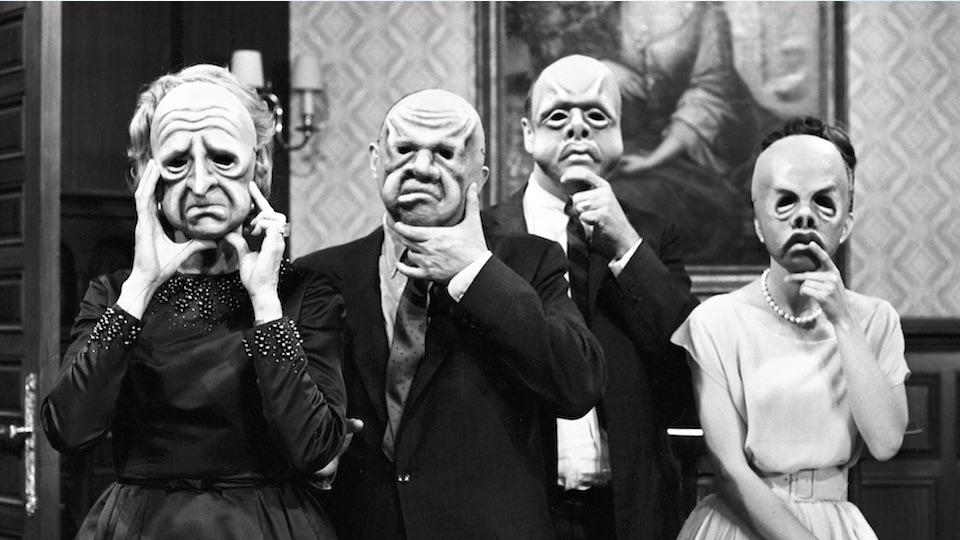
When Jason Foster’s doctor tells him that he could die at any moment, the wealthy Jason Foster gathers his heirs including his daughter Emily Harper, her husband Wilfred and their children Paula and Wilfred Jr. Jason doesn’t think much of any of them and it’s clear they can’t wait to get their hands on his fortune. It’s Mardi Gras time in New Orleans and he has one last request – for each of them to wear a carnival mask. Each of the masks is meant to reflect some aspect of their personality – and leave a lasting impression on them.
“The Masks” was the first and only episode of The Twilight Zone that was directed by a woman. Ida Lupino was known for making movies that commentated on the state of society and those who live under a specific social status.
Rod Serling wrote this great episode.
Jason Foster: You’re cruel and miserable people! Because none of you respond to love! Emily responds only to what her petty hungers dictate! Wilfred responds only to things that have weight and bulk and value! He feels books, he doesn’t read them! He appraises paintings, he doesn’t seek out their truth or their beauty! And Paula there lives in a mirror. The world is nothing more to her than a reflection of herself. And her brother… Humanity, to him, is a small animal, caught in a trap, to be tormented! His pleasure is the giving of pain. And from this, he receives the same sense of fulfillment most human beings get from a kiss or an embrace! You’re caricatures! All of you! Without your masks, you’re caricatures!
Rod Serling Closing Narration: Mardi Gras incident, the dramatis personae being four people who came to celebrate and in a sense let themselves go. This they did with a vengeance. They now wear the faces of all that was inside them—and they’ll wear them for the rest of their lives, said lives now to be spent in the shadow. Tonight’s tale of men, the macabre and masks, on the Twilight Zone.
It all started for me with a Simon and Garfunkel greatest hits package and I was instantly a fan.
Being a Beatle fan I always liked the version that Paul and George Harrison did on SNL in 1976 which was their highest rated episode up til that point. Paul played this and “Here Comes The Sun” with Paul Simon in 1976 on Saturday Night Live.
This was just the second Simon & Garfunkel single, following up “The Sound Of Silence,” which became a surprise hit when their record company added instrumentation and released it a year after it was first recorded. The duo had parted ways, but got back together in a hurry when “Sound of Silence” hit #1 in America.
The song peaked at #5 in the Billboard 100, #2 in Canada, #1 in New Zealand, and #9 in the UK in 1966. It appeared on the album Parsley, Sage, Rosemary and Thyme but they recorded it during the Sound of Silence album sessions.
Paul Simon: “That was written in Liverpool when I was traveling. What I like about that is that it has a very clear memory of Liverpool station and the streets of Liverpool and the club I played at and me at age 22. It’s like a snapshot, a photograph of a long time ago. I like that about it but I don’t like the song that much. First of all, it’s not an original title. That’s one of the main problems with it. It’s been around forever. No, the early songs I can’t say I really like them. But there’s something naive and sweet-natured and I must say I like that about it. They’re not angry. And that means that I wasn’t angry or unhappy. And that’s my memory of that time: it was just about idyllic. It was just the best time of my life, I think, up until recently, these last five years or so, six years… This has been the best time of my life. But before that, I would say that that was.”
From Songfacts
Paul Simon lived in Brentwood, Essex, England when he wrote this song. When traveling back from Wigan, where he was playing, he got stuck at the train station and wrote this. The song has a double meaning: literally, wanting for a ticket home to Brentwood, but on the other hand, yearning to go to his home in the US.
Along with “I Am A Rock,” this was recorded at a late-night session in New York City with producer Bob Johnston. Simon played acoustic guitar, and Ralph Casale was on electric. Johnston was working on Bob Dylan’s Highway 61 album around this time, and Casale recalls that drummer Bobby Gregg and organist Al Kooper – both Dylan regulars – played on this Simon & Garfunkel session as well.
Paul Simon performed this song with Billy Joel at Joel’s concert on August 4, 2015 at Nassau Coliseum in Long Island, New York. This was the last concert at the venerable arena, and Simon was a surprise guest. It marked the first time Joel and Simon ever sung together.
Peter Carlin called his 2016 novel about Paul Simon Homeward Bound. “Given the immigrant story beneath Paul’s life and work (what are his many musical re-creations if not the assimilation process writ in music over and over again) ‘Homeward Bound’ worked too well to ignore,” he explained.
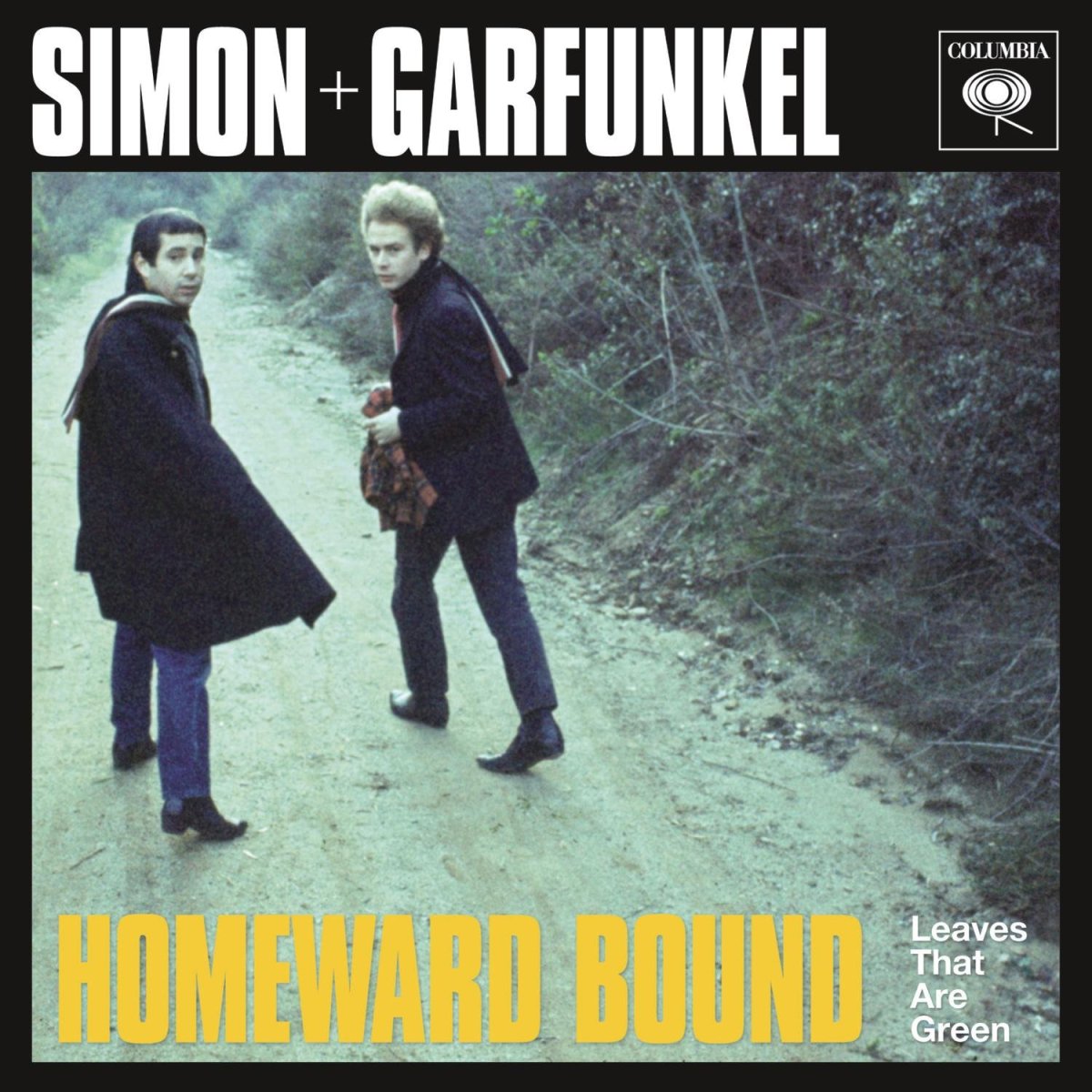
Homeward Bound
I’m sitting in the railway station. Got a ticket to my destination. On a tour of one-night stands my suitcase and guitar in hand. And every stop is neatly planned for a poet and a one-man band. Homeward bound, I wish I was, Homeward bound, Home where my thought’s escaping, Home where my music’s playing, Home where my love lies waiting Silently for me.
Every day’s an endless stream Of cigarettes and magazines. And each town looks the same to me, the movies and the factories And every stranger’s face I see reminds me that I long to be, Homeward bound, I wish I was, Homeward bound, Home where my thought’s escaping, Home where my music’s playing, Home where my love lies waiting Silently for me.
Tonight I’ll sing my songs again, I’ll play the game and pretend. But all my words come back to me in shades of mediocrity Like emptiness in harmony I need someone to comfort me. Homeward bound, I wish I was, Homeward bound, Home where my thought’s escaping, Home where my music’s playing, Home where my love lies waiting Silently for me. Silently for me.
I’m going to write about my top 10 favorite TZ episodes in the next few weeks…Most of the Twilight Zones are like songs to me…to be enjoyed over and over. The Twilight Zone is not really an ordinary TV show. It’s THE TWILIGHT ZONE. This is my personal choice for #4 on my list.
This one I will be giving it all away…more than I usually do…so just a warning.
This one I love and it’s one of the most memorable episodes. If you have never seen it…stop reading now. It’s one of my favorites (and supposedly Rod Serling’s favorite of all that he wrote).
It’s so heartbreaking at the end and I feel so much for Mr. Bemis. This one more than any other Twilight Zone surprised me a bit. It is one of the best twists of any Twilight Zone.
Rod Serling Opening Narration:Witness Mr. Henry Bemis, a charter member in the fraternity of dreamers. A bookish little man whose passion is the printed page, but who is conspired against by a bank president and a wife and a world full of tongue-cluckers and the unrelenting hands of a clock. But in just a moment, Mr. Bemis will enter a world without bank presidents or wives or clocks or anything else. He’ll have a world all to himself… without anyone.
The show was written by Rod Serling and Lynn Venable.
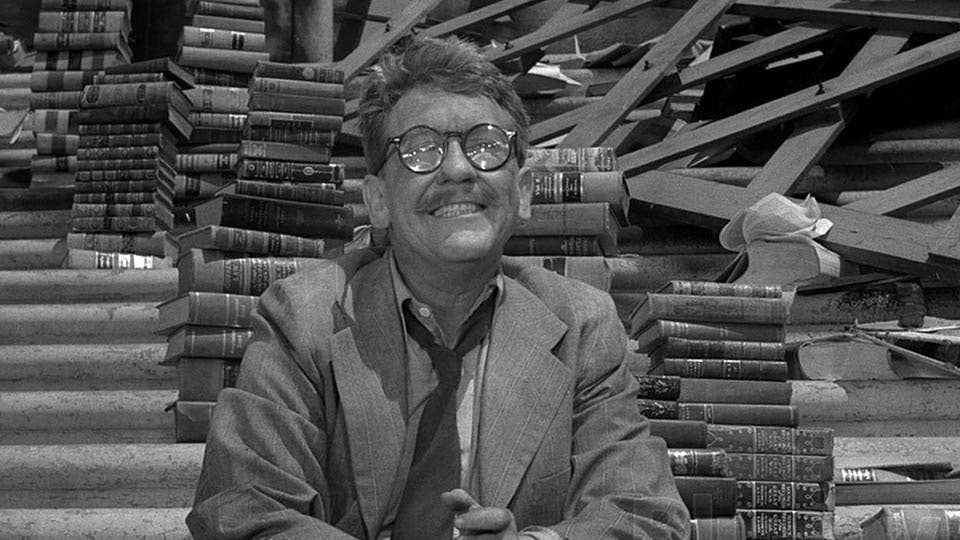
Henry Bemis (Burgess Meredith) is a bookish bank teller who has a childlike fascination for the written word…any written word be it books, periodicals, newspapers. He delights in taking any moment to read, through his incredibly thick “coke-bottle” glasses, even on his salaried time. He is consistently harassed by his wife, customers, and boss for his love of print to the point that he must sneak into the bank’s vault where he works to read on his lunch hour.
During one such visit, a nuclear bomb blast levels his city, leaving him unscathed, whereupon he exits to find that he has “time enough at last” to read all he wants when he finds the local library’s contents scattered about. At this point, (warning: spoiler!) he stacks the books into towers and rejoices in the solitude that will allow him to read everything he can…but in reaching for a particular book, his glasses slip off his face and smash….leaving him to mutter: “That’s not fair… that’s not fair at all… There was time now…. There was…all the time I needed!.. It’s not fair”. The scene then closes with the image panning away from a crying Bemis.
The Twilight Zones are mostly moral plays and justice usually is delivered to a guilty party. On this one, Mr. Bemis isn’t a bad guy. I can’t help but feel pity for Mr. Bemis. It’s not like he was anti-social. He tried to bond with people, although awkwardly, he did try.
He wasn’t the best worker but not terrible and he did read on his lunch breaks. If this episode has a bad “guy” it would be his boss and wife who took away the thing he loved the most. Maybe he was a little selfish and single-minded…but he paid an awfully big price…but the positive…he did survive!
Rod Serling Closing Narration:The best-laid plans of mice and men…and Henry Bemis, the small man in the glasses who wanted nothing but time. Henry Bemis, now just a part of a smashed landscape, just a piece of the rubble, just a fragment of what man has deeded to himself. Mr. Henry Bemis, in the Twilight Zone.
CAST
Burgess Meredith – Henry Bemis Vaughn Taylor – Mr. Carsville Jacqueline deWit – Helen Bemis (as Jaqueline deWit) Lela Bliss – Mrs. Chester
I love this era of the Stones. This song was about the record company putting pressure on the Stones to follow up their biggest to date…and their biggest hit ever, Satisfaction.
The song peaked at #1 in the Billboard 100, Canada, and the UK in 1965.
It was on the US album December’s Children (And Everybody’s) released in 1965 and it peaked at #4 in the Billboard Album Charts.
Keith Richards: “‘Get Off My Cloud’ was basically a response to people knocking on our door asking us for the follow up to ‘Satisfaction,’ which was such an enormous hit worldwide. This, to us, was mind-blowing. I mean not only was it a #1 record but, boom! We thought, ‘At last. We can sit back and maybe think about events.’ Suddenly there’s the knock at the door and of course what came out of that was ‘Get Off Of My Cloud.’ Because within three weeks, in those days hey, they want another single. And we weren’t quite ready for that. So it was our response to the knock at the door: Get off of my cloud. And I’m surprised that it did so well. I mean it has a certain charm but I really remember it as a knee-jerk reaction. And it came out better than I thought.”
Mick Jagger: “That was Keith’s melody and my lyrics. It’s a stop-bugging-me, post-teenage-alienation song. The grown-up world was a very ordered society in the ’60s, and I was coming out of it. America was even more ordered than anywhere else. I found it was a very restrictive society in thought and behavior and dress.”
From Songfacts
There was a bit of controversy over this song, as it sounded like it could be about drugs. Some radio stations shied away from the song.
Stones manager Andrew Long Oldham produced this.
Ian Stewart played piano on this track. Keith Richards explained: “That was just one of those things you could do in those days – shadow a guitar with a piano. As long as you didn’t make it obvious, it would add some different air to a track.”
The B-side of this single was “I’m Free,” which remained obscure until it was revived by The Soup Dragons in 1990.
In 1973 The Dramatics scored an R&B hit with “Hey You! Get Off My Mountain,” which also contained the chorus lyrics, “Hey You! Get Off My Cloud.”
Get Off Of My Cloud
I live in an apartment on the ninety-ninth floor of my block And I sit at home looking out the window Imagining the world has stopped Then in flies a guy who’s all dressed up just like a Union Jack And says, “I’ve won five pounds if I have his kind of detergent pack”
I says, “hey, you, get off of my cloud Hey, you, get off of my cloud Hey, you, get off of my cloud Don’t hang around ’cause two’s a crowd On my cloud, baby”
The telephone is ringing I say, “hi, it’s me, who is there on the line?” A voice says, “hi, hello, how are you?” “Well, I guess I’m doin’ fine” He says, “it’s three a.m., there’s too much noise Don’t you people ever want to go to bed? Just ’cause you feel so good Do you have to drive me out of my head?”
I says, “hey, you, get off of my cloud Hey, you, get off of my cloud Hey, you, get off of my cloud Don’t hang around ’cause two’s a crowd On my cloud, baby, yeah”
I was sick and tired, fed up with this And decided to take a drive downtown It was so very quiet and peaceful There was nobody, not a soul around I laid myself out, I was so tired And I started to dream In the morning the parking tickets were just Like a flag stuck on my window screen
I says, “hey, you, get off of my cloud Hey, you, get off of my cloud Hey, you, get off of my cloud Don’t hang around ’cause two’s a crowd On my cloud, baby”
“Hey, you, get off of my cloud Hey, you, get off of my cloud Hey, you, get off of my cloud Don’t hang around ’cause two’s a crowd On my cloud, hey, you
The organ intro to this song by Ray Manzarek is one of most iconic intros in rock. I first heard this song as a kid and automatically loved it. It is the song that the Doors are most known by. I like the album version that is longer and has more of a solo.
This was included on their first album and it was a huge hit. The song launched them to stardom. Before it was released, The Doors were an underground band popular in the Los Angeles area, but “Light My Fire” got the attention of a mass audience.
The producers of The Ed Sullivan Show asked the band to change the line “Girl we couldn’t get much higher” for their appearance in 1967. Morrison said he would, but sang it anyway. Afterwards, he told Sullivan that he was nervous and simply forgot to change the line. No that didn’t fly, and The Doors were never invited back.
The song peaked at #1 in the Billboard 100, #2 in Canada, #7 in New Zealand, and #7 in the UK in 1967. Frankly, that surprises me because I thought it would have been an international number 1.
This was the second single on their self-titled debut album. Break On Through (To The Other Side) was their debut single.
The four band members were credited for writing this song Jim Morrison, Robby Krieger, John Densmore, and Ray Manzarek.
Jim Morrison indicated in his notebooks that he disliked this song and hated performing it. He also seemed to resent that the popularity of the band derived from this song, which he had just a small part in writing.
The Doors didn’t have a bass player and none was credited because studio musicians were not credited. Carol Kaye claims it was her.
From Songfacts
Most of the song was written by Doors guitarist Robby Krieger, who wanted to write about one of the elements: fire, air, earth, and water. He recalled to Uncut: “I was living with my parents in Pacific Palisades – I had my amp and SG. I asked Jim, what should I write about? He said, ‘Something universal, which won’t disappear two years from now. Something that people can interpret themselves.’ I said to myself I’d write about the four elements; earth, air, fire, water, I picked fire, as I loved the Stones song, ‘Play With Fire,’ and that’s how that came about.”
Krieger came up with the melody and wrote most of the lyrics, which are about leaving inhibitions behind in flames of passion.
At first, the song had a folk flavor, but it ignited when Jim Morrison wrote the second verse (“our love become a funeral pyre…”) and Ray Manzarek came up with the famous organ intro. Drummer John Densmore also contributed, coming up with the rhythm. Like all Doors songs of this era, the band shared composer credits.
On the album, which was released in January 1967, the song runs 6:50. The group’s first single, “Break On Through (To The Other Side),” reached just #126 in America. “Light My Fire” was deemed too long for airplay, but radio stations (especially in Los Angeles) got requests for the song from listeners who heard it off the album. Their label, Elektra Records decided to release a shorter version so they had producer Paul Rothchild do an edit. By chopping out the guitar solos, he whittled it down to 2:52. This version was released as a single in April, and the song took off, giving The Doors their first big hit.
To many fans, the single edit was an abomination, and many DJs played the album version once the song took off.
Elektra founder Jaz Holzman recalled to Mojo magazine November 2010: “We had that huge problem with the time length – seven-and-a-half minutes. Nobody could figure out how to cut it. Finally I said to Rothchild, ‘Nobody can cut it but you.’ When he cut out the solo, there were screams. Except from Jim. Jim said, ‘Imagine a kid in Minneapolis hearing even the cut version over the radio, it’s going to turn his head around.’ So they said, ‘Go ahead, release it.’ We released it with the full version on the other side.”
This was the first song Robby Krieger wrote to completion. Jim Morrison did most of the songwriting for the album, but he needed some help and asked Krieger to step in. The 20-year-old guitarist asked him what to write about, and Morrison replied, “Something universal.”
There are some pretty basic, but effective, rhymes in this song:
fire liar higher mire pyre
A “funeral pyre” is a platform used in ceremonial cremations. The image evokes spirituality and ancient mythology, as well as death, one of Jim Morrison’s favorite topics. Robby Krieger objected to the line at first, but Morrison convinced him it would work in opposition to the love-based lyrics that dominate the song.
This was produced by Paul Rothchild and was recorded in late 1966 and then released in April 1967.
The song topped the Hot 100 for the first three weeks of July 1967. It sold over one million copies and was the first #1 hit for their record label Elektra.
This was the first rock song to feature both a guitar and keyboard in the instrumental section.
A blind, Puerto Rican singer named Jose Feliciano recorded a Latin-tinged version of this song that reached #3 in 1968 and won a Grammy for Best Contemporary Pop Vocal Performance, Male. For Feliciano, who also won the Best New Artist Grammy that year, the song was his breakout hit and introduced his style of acoustic, woodwind-heavy arrangements. Based on his “Light My Fire” performance, Feliciano was asked to sing the The Star Spangled Banner before Game 5 of World Series between the Tigers and Cardinals. He delivered the first non-traditional take on the National Anthem at a major sporting event, doing a slow, acoustic version and causing an uproar. Feliciano capitalized on the controversy by releasing his Anthem performance as a single, and it reached #50 in the US.
In 1968, Buick offered The Doors $75,000 to use this song in a commercial as “Come on Buick, light my fire.” With Morrison away, Krieger, Densmore, and Manzarek agreed to allow it. When Morrison found out, he pitched a fit and killed the deal.
This was the last song Jim Morrison performed live. It took place at the Doors concert at The Warehouse in New Orleans on December 12, 1970. Midway through the song, Morrison became exasperated and smashed his microphone into the floor, ending the show.
It was also the last song The Doors played live as a trio, as they continued without Morrison after his death. Their final performance took place at the Hollywood Bowl in Los Angeles on September 10, 1972.
According to Ray Manzarek on BBC Radio 2’s program Ray Manzarek’s Summer of Love, the baseline to “Light My Fire” was inspired by Fats Domino’s “Blueberry Hill.”
Manzarek told About.com how the keyboard solo came about: “It was exactly what we were doing at the time at Whisky a Go Go – letting the music take us wherever it might lead in a particular performance, just improvising. And that?s exactly the same way that solo came about.”
She was a first-call studio pro at the time and had performed on a lot of the hits that were recorded in Los Angeles, including many of Phil Spector’s productions. She told Songfacts regarding her involvement: “The Doors weren’t there. Just a couple of the guys were there in the booth. We cut the track. I’m playing on that, but I don’t like to talk about it, because there’s too many fanatics about that stuff. I’m a prude. I don’t do drugs. I think it’s stupid. I think for people to be into drugs and to die on stage, I think that’s so stupid, and totally unnecessary. So I stay away from even talking about that. But I am on the contract, yeah, I played on the hit of that.” (Here’s our full Carol Kaye interview.)
The extended organ and guitar solos in the album version of the song are based on two of John Coltrane’s works: his 1961 track “Ole,” and his jazz cover of the song “My Favorite Things” from the motion picture The Sound of Music.
Robby Krieger told Clash Music he put “every chord I knew into this song.” Most of the group’s songs to this point were three-chord compositions, so he wanted to do something more “adventurous.”
In concert, Robby Krieger never played the same guitar solo on this song. He would sometimes mix in bits of the Beatles song “Eleanor Rigby.”
Train covered this on the 2000 Doors tribute album Stoned Immaculate. Lead singer Pat Monahan sang with the remaining members (Manzarek, Krieger, Densmore) on the VH1’s Storytellers dedicated to the Doors. Other artists to cover the song include Jackie Wilson, Etta James, Shirley Bassey, Nancy Sinatra, Will Young, UB40, B. J. Thomas and Beastie Boys.
Light My Fire
You know that it would be untrue You know that I would be a liar If I was to say to you Girl, we couldn’t get much higher
Come on baby, light my fire Come on baby, light my fire Try to set the night on fire
The time to hesitate is through No time to wallow in the mire Try now we can only lose And our love become a funeral pyre
Come on baby, light my fire Come on baby, light my fire Try to set the night on fire, yeah
The time to hesitate is through No time to wallow in the mire Try now we can only lose And our love become a funeral pyre
Come on baby, light my fire Come on baby, light my fire Try to set the night on fire, yeah
You know that it would be untrue You know that I would be a liar If I was to say to you Girl, we couldn’t get much higher
Come on baby, light my fire Come on baby, light my fire Try to set the night on fire Try to set the night on fire Try to set the night on fire Try to set the night on fire
I’m going to write about my top 10 favorite TZ episodes in the next few weeks…Most of the Twilight Zones are like songs to me…to be enjoyed over and over. The Twilight Zone is not really an ordinary TV show. It’s THE TWILIGHT ZONE. This is my personal choice for #6 on my list.
Rod Serling’s Opening Narration: Missing: one frightened little girl. Name: Bettina Miller. Description: six years of age, average height and build, light brown hair, quite pretty. Last seen being tucked in bed by her mother a few hours ago. Last heard: ‘ay, there’s the rub,’ as Hamlet put it. For Bettina Miller can be heard quite clearly, despite the rather curious fact that she can’t be seen at all. Present location? Let’s say for the moment… in the Twilight Zone.
I always thought Poltergeist borrowed heavily from this Twilight Zone episode. Both girls were lost in another dimension and it Poltergeist plays out much like this episode. The inside of the dimension in this episode is done really well.
A couple awakens in the night to hear their daughter Tina crying. When the father, Chris, enters her bedroom, however, she is nowhere to be found. She can be heard as if she is still in the room, but not seen. Moments later, the family dog, Mac, runs into the room in a state of agitation, goes under the bed and vanishes just like Tina. Panicking, Chris and his wife Ruth call their physicist friend Bill, who comes over immediately and begins to investigate, moving the girl’s bed and looking for the “opening.”
Chris and Ruth are nonplussed, but suddenly Bills hand seems to disappear through the bedroom wall, and he explains that he thinks Tina and Mac are trapped in another dimension. He draws on the wall with chalk and outlines the opening, explaining the theories about alternate dimensions. Suddenly, Ruth realizes that she can no longer hear Tina. The adults move around the house in a frenzy and finally hear her voice again, seemingly coming from another place, as well as the dog’s barks. Bill says to let the dog lead her back out, and Chris repeatedly calls Mac… Will they get her out safely?
Rod Serling’s Closing Narration: The other half where? The fourth dimension? The fifth? Perhaps. They never found the answer. Despite a battery of research physicists equipped with every device known to man, electronic and otherwise, no result was ever achieved, except perhaps a little more respect for and uncertainty about the mechanisms of the Twilight Zone.
***I have posted my 10 favorite covers of Beatle songs at Keith’s site nostaligicitalian ***
This takes me back to riding with my dad and him wearing a Merle Haggard 8-Track out completely. I knew so many of Merle’s songs before I was 6. One big regret I have is that I never saw Merle Haggard live. Haggard would be legally pardoned for his past crimes by California’s Governor Ronald Reagan in 1971.
This song peaked at #1 in the US Hot 100 Billboard Country Charts in 1967.
Merle Haggard went to jail for robbery in 1957, and was released in 1960. This song is about how he felt that no matter what he did, who would always be known for his time spent in jail “branded” as an inmate.
He was serving his time at San Quentin prison when Johnny Cash performed there. That event changed his life.
Future Eric Clapton drummer Jim Gordon played on this song.
Branded Man
I’d like to hold my head up and be proud of who I am But they won’t let my secret go untold I paid the debt I owed them, but they’re still not satisfied Now I’m a branded man out in the cold
When they let me out of prison, I held my head up high Determined I would rise above the shame But no matter where I’m living, the black mark follows me I’m branded with a number on my name
I’d like to hold my head up and be proud of who I am But they won’t let my secret go untold I paid the debt I owed them, but they’re still not satisfied Now I’m a branded man out in the cold
If I live to be a hundred, I guess I’ll never clear my name ‘Cause everybody knows I’ve been in jai No matter where I’m living, I’ve got to tell them where I’ve been Or they’ll send me back to prison if I fail
I’d like to hold my head up and be proud of who I am But they won’t let my secret go untold I paid the debt I owed them, but they’re still not satisfied Now I’m a branded man out in the cold
In Jimi’s short life he must have stayed hooked up to a recording console 24/7. So many albums have been released posthumously.
The only Jimi Hendrix Experience studio recording of this song crops up on the 2010 Valleys of Neptune album. The documentary film Experience (1968) features the only version released during Hendrix’s lifetime.
The song was inspired by earlier American spirituals and blues songs which use a train metaphor to represent salvation. Hendrix recorded the song in live, studio, and impromptu settings several times between 1967 and 1970, but never completed it to his satisfaction.
It was also known as “Getting My Heart Back Together Again,” Hendrix often played this song live.
Hendrix first played it in studio on December 19, 1967. During a photo shoot session, he was given a guitar and asked to play something for the camera. The original tape was re-discovered in 1993 only and remastered by Eddie Kramer.
Hendrix producer/engineer Eddie Kramer: “It shows a complete at-oneness with his instrument. Jimi had a thought in his mind, and in a nanosecond it gets through his body, through his heart, through his arms, through the fingers, onto the guitar.”
From Songfacts
The version on Hendrix’s posthumous album, People, Hell & Angels, was drawn from Jimi’s first ever recording session with his old army pal, Billy Cox, and drummer Buddy Miles. He would later record the groundbreaking album Band Of Gypsys with the powerhouse rhythm duo. Co-producer John McDermott commented to Digital Spy: “Billy and Buddy understood how to set the tempo. If you listen to this recording, they play it the same way as they did on the Live At The Fillmore East album. They knew intuitively that the song should have a great, menacing groove; it shouldn’t be old-school, old-tempo, four-bar stuff. They wanted it to have a totally different feel, and that’s what makes it exciting.”
Hear My Train A Comin’
Hear my train a comin’ Hey Wait around the train station Waitin’ for that train Take me Take me away From this lonesome time A whole lot of people put me through a lot of changes And my girl done put me down
Tears burnin’ me Burnin’ me Way down in my soul Way down in my heart It’s too bad you don’t love no more, child Too bad you and me have to part, have to part baby Have to part
Hear my train is coming Hear my train is coming Hear my train is coming Hear my train is coming
Gonna make it bigger With all that’s still in my heart Gonna be a magic boy ooh child Gonna come back and buy this town An’ put it all in my shoe In my shoe baby You make love to me one more time girl So I give a piece to you baby Hey hey hey
Hear my train is coming Hear my train is coming Here come the rest of my soul Movin’ through the washer baby Hear my train a comin’ yeah yeah
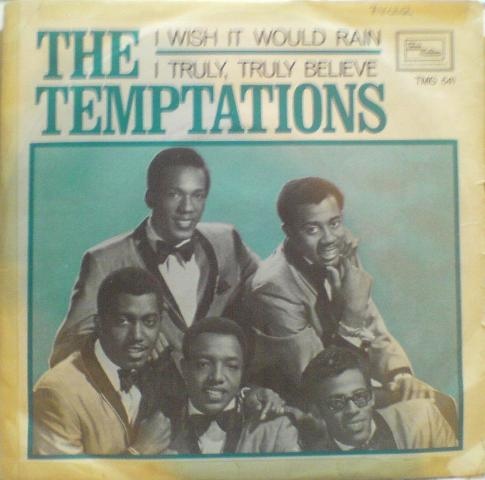
The Temptations classic lineup released this song in 1967 and peaked at #4 in the Billboard 100, #1 in the R&B charts, and #45 in the UK.
David Ruffin sings this song and you can feel the sadness and pain in his voice. The man had a tremendous voice. Naming my favorite Temptations song would be hard but this one would be near the top.
The song has been covered by Gladys Knight and the Pips, Marvin Gaye, Aretha Franklin and The Faces.
This song was released right before the psychedelic soul hit Cloud Nine and the bands style began to change.
It was written by Norman Whitfield, Barrett Strong, and Rodger Penzabene.
I Wish It Would Rain
Hmm hmm
Sunshine, blue skies, please go away A girl has found another and gone away With her went my future, my life is filled with gloom So day after day I stay locked up in my room I know to you, it might sound strange But I wish it would rain, oh yeah, yeah, yeah, yeah
‘Cause so badly I wanna go outside (such a lovely day) But everyone knows that a man ain’t supposed to cry Listen, I gotta cry ’cause crying eases the pain, oh yeah People this hurt I feel inside Words could never explain, I just wish it would rain, oh let it rain, rain, rain, rain, ooo baby
Let it rain, oh yeah, let it rain
Day in day out my tear-stained face Pressed against the window pane My eyes search the skies desperately for rain ‘Cause rain drops will hide my tear drops And no one will ever know that I’m crying Crying when I go outside To the world outside my tears I refuse to explain, ooo I wish it would rain, ooh, baby
Let it rain, let it rain I need rain to disguise the tears in my eyes Oh, let it rain Oh yeah, yeah, listen I’m a man and I got my pride ‘Til it rains I’m gonna stay inside, let it rain
I’m going to write about my top 10 favorite TZ episodes in the next few weeks…Most of the Twilight Zones are like songs to me…to be enjoyed over and over. The Twilight Zone is not really an ordinary TV show. It’s THE TWILIGHT ZONE. This is my personal choice for #7 on my list.
I have to watch these again before I write about them…Now I wish I would have made this my top 50.
Rod Serling Opening Narration:Portrait of a frightened man: Mr. Robert Wilson, thirty-seven, husband, father, and salesman on sick leave. Mr. Wilson has just been discharged from a sanitarium where he spent the last six months recovering from a nervous breakdown, the onset of which took place on an evening not dissimilar to this one, on an airliner very much like the one in which Mr. Wilson is about to be flown home—the difference being that, on that evening half a year ago, Mr. Wilson’s flight was terminated by the onslaught of his mental breakdown. Tonight, he’s traveling all the way to his appointed destination, which, contrary to Mr. Wilson’s plan, happens to be in the darkest corner of the Twilight Zone.
In this episode he plays a husband (Bob Wilson) who just suffered a nervous breakdown on a plane 6 months before. Him and his wife Julia were taking a flight and you could tell Bob was a nervous as soon as he boarded the plane. He had just spent 6 months in an institution getting over his breakdown and now his Doctor said he was ready to fly again. He sits by the window and the fun begins… after take off he thinks sees a creature of some sort out on the wing of the aircraft.
Because of the breakdown he is not sure he saw the creature or not. Bob starts freaking out and eventually gets a gun from an officer on the plane. Hmmm gun, nervous man, and a plane. Nothing good will come from that. Everyone thinks he is crazy…is he? This one is a thriller with a creepy creature.
Richard Matheson wrote this episode. He wrote 16 Twilight Zones in all.
This is an iconic episode of the Twilight Zone. It was redone in the 1983 movie Twilight Zone with John Lithgow in the title role. I’ll take the classic version though.
Rod Serling’s Closing Narration: The flight of Mr. Robert Wilson has ended now, a flight not only from point A to point B, but also from the fear of recurring mental breakdown. Mr. Wilson has that fear no longer… though, for the moment, he is, as he has said, alone in this assurance. Happily, his conviction will not remain isolated too much longer, for happily, tangible manifestation is very often left as evidence of trespass, even from so intangible a quarter as the Twilight Zone.




![Days of Future Passed [Expanded Version]](https://oldies-cdn.freetls.fastly.net/i/boxart/w340/06/63/600753066317.jpg?v=5)



 PowerPop... An Eclectic Collection of Pop Culture