Power Pop fan, Baseball, Beatles, Alternative music, old movies, and tv show fan. Also anything to do with pop culture in the 60s and 70s... I'm also a songwriter, bass and guitar player. Not the slightest bit interested in politics at all.
What do the Monkees and Dwight Yoakum have in common? They both covered this song.
Tomorrow’s Gonna Be Another Day is a song written by Tommy Boyce and Steve Venet that appears on The Monkees, the debut album of the Monkees.
Micky sang the lead on this song. He is the only Monkee on this recording but this setup fell away quickly as the band began to take ownership of their music and come into their own as musicians and songwriters by the 3rd album. This song has the same sound as Last Train To Clarksville…it is a nice pop song.
It was not released as a single but it was a solid song for the Monkees brand of pop.
Dwight Yoakam also covered this song. The song was on his album Tomorrow’s Gonna Be Another Day and was released in the summer of 2016.
Tomorrow Is Gonna Be Another Day
I’m gonna pack up my pain, I been a keepin’ in my heart, I’m gonna catch me the fastest train And make me a brand new start But that’s okay, Tomorrow’s gonna be another day, Hey, hey, hey. And I don’t care what they say Tomorrow’s gonna be, tomorrow’s gonna be, Tomorrow’s gonna be another day. Yay, yay, yay, Yay, yay, yay.
They say there’s a lotta fish, Swimmin’ in the deep blue sea, I’m gonna catch me a pretty one And she’ll be good to me. But that’s okay, Tomorrow’s gonna be another day, Hey, hey, hey. And I don’t care what they say Tomorrow’s gonna be, tomorrow’s gonna be, Tomorrow’s gonna be another day. Yay, yay, yay, Yay, yay, yay.
Well, I ain’t gonna think about ya, ‘Cause it ain’t no use no more, I’m gonna make it fine without ya, Just like I did before, I’m on my way. Tomorrow’s gonna be another day, Hey, hey, hey. And I don’t care what they say Tomorrow’s gonna be, tomorrow’s gonna be, Tomorrow’s gonna be another day. Yay, yay, yay, Yay, yay, yay.
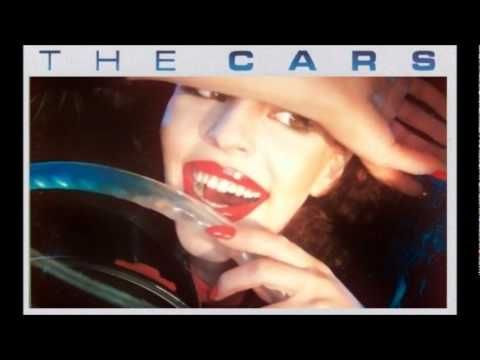
This song was on The Car’s great debut album that just keeps giving. “Good Times Roll” was released as the third single from the album.
Ric Ocasek wrote and sang lead on this song. None of the songs were huge hits but 6 songs off of the album still get played on radio today. Rolling Stone also ranked the album No. 284 in its “500 Greatest Albums of All Time” list.
This song peaked at #41 in the Billboard 100 and #74 in Canada in 1979.
Ric Ocasek: “I just remember when we did ‘Good Times Roll’ in the studio in England on the first record, and we heard back the vocals. I told Roy that I thought it was way, way too much. … But you know, it grew on me later and it sounded so smooth. It was a nice process to do it because Roy, you know, was fortunate enough to have a 40-track machine … so he could do layering of vocals a lot.”
Good Times Roll
Let the good times roll Let them knock you around Let the good times roll Let them make you a clown
Let them leave you up in the air Let them brush your rock and roll hair
Let the good times roll Let the good times roll Let the good times roll
Let the stories be told They can say what they want Let the photos be old Let them show what they want
Let them leave you up in the air Let them brush your rock and roll hair Let the good times roll Let the good times roll-oll Won’t you let the good times roll
Good times roll
If the illusion is real Let them give you a ride If they got thunder appeal Let them be on your side
Let them leave you up in the air Let them brush your rock and roll hair Let the good times roll Won’t you let the good times roll-oll Let the good times roll
Let the good times roll Won’t you let the good times roll Well let the good times roll Let ’em roll (good times roll)
Let the good times roll Let the good times roll Ooh let the good times roll Let ’em roll (good times roll)
Let the good times roll (Let the good times roll) Let the good times roll Good times roll (Let the good times roll) Let the good times roll Let ’em roll
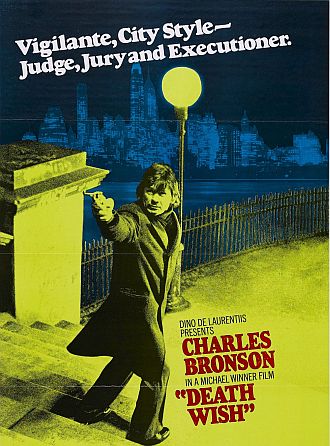
When I started to watch this movie…I thought it was going to be Charles Bronson randomly mowing down the people in New York City…but it had a purpose and was a pretty good movie.
There was some controversy when this movie was released because of Bronson being a vigilante. The critics who disliked the film complained that it irresponsibly exploited fear. They also claimed the film gave an exaggerated picture of crime in New York and that it glorified vigilantism… that it endorses violence as a solution to violence.
I enjoyed the film. New York in the mid-seventies makes a great atmosphere…although not a safe one. The movie is brutal but realistic.
On a side note…this movie is Jeff Goldblum’s film debut.
From IMDB
Open-minded architect Paul Kersey returns to New York City from vacationing with his wife, feeling on top of the world. At the office, his cynical coworker gives him the welcome-back with a warning on the rising crime rate. But Paul, a bleeding-heart liberal, thinks of crime as being caused by poverty. However, his coworker’s ranting proves to be more than true when Paul’s wife is killed and his daughter is raped in his own apartment. The police have no reliable leads and his overly sensitive son-in-law only exacerbates Paul’s feeling of hopelessness. He is now facing the reality that the police can’t be everywhere at once. Out of sympathy, his boss gives him an assignment in sunny Arizona where Paul gets a taste of the Old West ideals. He returns to New York with a compromised view on muggers…
Yes, this has been played to death but it still sounds good. No frills rock and roll from the early seventies.
I have a new appreciation for the song. The guys come over…well before the lockdown…and play music in my garage. Someone brought this one up and started to play it a couple of months ago and we started to play…it is a great song to play and hear live.
The song peaked at #4 in the Billboard 100, #4 in Canada, and #2 in the UK in 1970. It was featured on the Fire and Water album. In 1991, the song was remixed and re-released, reaching #8 in the UK again.
The song was written by Andy Fraser and Paul Rodgers.
This topped a 2010 online fan poll by UK radio station Planet Rock for the “Greatest Rock Singles.” Said Paul Rodgers: “When I started writing ‘All Right Now’ the lyrics and the melody flowed easily. It felt special and it’s still special to me and the fans. It’s a ‘must play’ in my solo set.”
Simon Kirke (Drummer):“‘All Right Now’ was created after a bad gig in Durham, England. Our repertoire at that time was mostly slow and medium paced blues songs which was alright if you were a student sitting quietly and nodding your head to the beat. However, we finished our show in Durham and walked off the stage to the sound of our own footsteps. The applause had died before I had even left the drum riser. When we got into the dressing room, it was obvious that we needed an uptempo number, a rocker to close our shows. All of sudden, the Inspiration struck (bass player Andy) Fraser, and he started bopping around singing ALL RIGHT NOW… He sat down and wrote it right there in the dressing room. It couldn’t have taken more than 10 minutes.”
Paul Kossoff was the guitar player and influenced a generation of guitar players before and after his early death in 1976.
From Songfacts
In the CD Molten Gold – An Anthology, Free drummer Simon Kirke explained:
Andy Fraser (Free’s Bass Player): “We’d started work on our third album, Fire and Water and things were going well. The idea for ‘All Right Now’ came about on a rainy Tuesday night in some god-forsaken minor city – I can’t remember where – in England. We were playing a college that could have held 2,000 but had something like 30 people out of their heads on Mandrax bumping into each other in front of us. They didn’t notice when we came on or when we went off.
Afterward, there was that horrible silence in the dressing room. To break the intensity, I started singing, ‘All right now…come on baby, all right now.’ As if to say, Hey, tomorrow’s another day. Everyone else started tapping along. That riff was me trying to do my Pete Townshend. We listened to everything, though: The Beatles, Stax and Motown, Gladys Knight And the Pips was one of our main influences then.
Paul (Rodgers) said he wrote the lyrics while he was waiting for us to pick him up for another gig. We used to have a dressing room amp, so every night we’d do the song and add a bit until we tested it live.”
This is the first hit song with vocals by Paul Rodgers. He later joined Bad Company and also played with The Firm and Queen.
This song really took off after Free’s performance at the Isle of Wight Festival on August 31,1970 at the East Aftom Farm, Aftom Down, where over 600,000 people attended. Los Angeles disc jockey Joe Benson told Paul Rodgers during an on air interview that “All Right Now” is playing over the airwaves somewhere around the world once every 45 seconds.
Free weren’t able to follow up this song with another hit, as the next single, “Stealer,” stalled at #49 in America and didn’t chart at all in the UK. In a Songfacts interview with Simon Kirke, he said: “It became a bit of an albatross around our necks, I have to say. Even though it elevated Free into the big leagues, it became a bit of an albatross because we couldn’t follow it. It became a huge hit all around the world, only because we wanted to have something that people could dance to, but then, of course, we had to follow it up, and Island Records were desperate for us to follow it up.
Really it was just a one-off for us, and when the follow-up to ‘All Right Now’ died a death – it was called “The Stealer” – and the album that followed, Fire and Water, from which ‘All Right Now’ was taken, when that didn’t do very well, we took it to heart and the band broke up. So, in an indirect way, ‘All Right Now’ was not very good for the band, I have to say.
But, by the same token, it’s been such a durable song. I play it in my solo shows, I played it with Ringo Starr and I think one of the highlights of my career.”
The album version is over a minute longer than the radio edit, which had a shorter guitar solo.
The song has soundtracked numerous commercials in the UK, most famously in 1990 when it featured in a TV ad for Wrigley’s chewing gum, which generated enough interest to return the tune to the UK charts. “I can’t keep track of where it’s turned up,” Paul Rodgers ruefully told The Independent April 7, 2010. “Island Records owned the publishing rights to all our songs in perpetuity. In theory, they’re supposed to call me and ask, ‘Can we use this song in this way?’ but they often don’t. I think if the money’s good enough, they just go, ‘Yes! Wrigley’s? YES!!'”
A less satisfactorily tie-in came when the song was used to advertise a foot-odor powder on television. “You use this stuff on your feet and the song comes on to signify that your feet are All Right Now, you see,” Rogers said acidly. “I rang Chris Blackwell about it. He had it taken off pretty smartly.”
The song has been covered by many bands and artists, including Mike Oldfield, Rod Stewart, Christina Aguilera, the Runaways and, ex-Wham! backing singers Pepsi & Shirlie.
When Paul Rodgers teamed up with Queen in 2004 to tour as Queen + Paul Rodgers, this was a regular part of their set list and a crowd favorite.
It’s Alright Now
There she stood in the street Smiling from her head to her feet I said hey, what is this Now baby, maybe she’s in need of a kiss I said hey, what’s your name baby Maybe we can see things the same Now don’t you wait or hesitate Let’s move before they raise the parking rate
All right now baby, it’s all right now All right now baby, it’s all right now
I took her home to my place Watching every move on her face She said look, what’s your game baby Are you tryin’ to put me in shame? I said “slow don’t go so fast, Don’t you think that love can last? She said Love, Lord above Now you’re tryin’ to trick me in love
All right now baby, it’s all right now All right now baby, it’s all right now
Yeah, it’s all right now Oh yeah
Let me tell you all about now Took her home to my place Watching every move on her face She said look, what’s your game Are you tryin’ to put me in shame? Baby,I said “slow don’t go so fast Don’t you think that love can last? She said love, Lord above Now he’s tryin’ to trick me in love
All right now baby, it’s all right now All right now baby, it’s all right now
All right now baby, it’s all right now All right now baby,baby,baby it’s all right now All right now baby, it’s all right now All right now baby, it’s all right now (All right now baby, it’s all right now) We are so happy together it’s alright,it’s alright,it’s alright (Everything alright) all right now baby, it’s all right now
I remember this song from the late 80s. The best I can remember it was on an alternative radio station. It’s a nice piece of jangly power pop that stuck with me for a while.
They are best known for this song…Crash and it was released in 1988. The song peaked at #5 in the Uk charts and #3 in the U.S. Billboard Modern Rock Tracks. They were not a one-hit-wonder though. They charted 5 top twenty songs in the U.S. Billboard Modern Rock Tracks…and charted 7 songs in the UK in their career but none as big as this one.
I f you like jangly power-pop like me…go check some of their vintage and new music out.
The Primitives formed during 1984 and created catchy and jangly songs that seemed to be influenced by 1960s pop and psychedelia. They were initially called an indie group and released their songs on their own label which was called Lazy.
The band then went on to sign with RCA records. While at RCA they released more original material but also re-recorded some of their earlier Lazy label songs.
They broke up in 1992 but reformed in 2009 and have been releasing albums and singles since then.
In 1994, the song was featured on the Dumb & Dumber movie soundtrack as “Crash (The ’95 Mix)”. This remix included additional guitars, percussion, organ, and backing vocals – none of which were performed by any of The Primitives.
Crash
Here you go, way too fast Don’t slow down, you’re gonna crash You should watch, watch your step Don’t look out, gonna break your neck
So shut, shut your mouth Cause I’m not listening anyhow I’ve had enough, enough of you Enough to last a lifetime through
So what do you want of me Got no words of sympathy And if I go around with you You know that I get messed up, too With you
Na na na na na na na na na Na na na na na na na na na
Here you go, way too fast Don’t slow down, you’re gonna crash You don’t know what’s been going down You’ve been running all over town
So shut, shut your mouth Cause I’m not listening anyhow I’ve had enough, enough of you Enough to last a lifetime through [Lyrics from: https:/lyrics.az/the-primitives/lovely/crash.html]
So what do you want of me Got no cure for misery And if I go around with you You know that I get messed up, too With you With you With you
Na na na na na na na na na (Slow down, you’re gonna crash) Na na na na na na na na na (Slow down, you’re gonna crash) Na na na na na na na na na (Slow down, you’re gonna crash) Na na na na na na na na na (Slow down, you’re gonna crash)
Na na na na na na na na na (Slow down, you’re gonna crash) Na na na na na na na na na (Slow down, you’re gonna crash) Na na na na na na na na na (Slow down, you’re gonna crash) Na na na na na na na na na (Slow down, you’re gonna crash) Na na na na na na na na na (Slow down, you’re gonna crash)
This song was on the Edmunds solo album Repeat When Necessary. It was released in 1979 on Led Zeppelin’s record label Swan Song. The album peaked at #54 in the Billboard 100 in 1979.
Crawling From The Wreckage peaked at #59 in the UK when released.
The musicians on the album are Edmunds, Lowe, Billy Bremner, and Terry Williams…known as Rockpile.
This song was written by Graham Parker…below are both versions.
Crawling From The Wreckage
Got out really early from the factory Drivin’ like a nut in the rain Don’t think I was actin’ so hysterically But I didn’t see a thing until it came Met the dumb suburbos in the takeaway Beating up the Chinee at the counter I put a few inside me at the end of the day I took out my revenge on the revolution counter
Crawlin’ from the wreckage, Crawlin’ from the wreckage You’d think by now at least that half my brain would get the message Crawlin’ from the wreckage, Crawlin’ from the wreckage Into a brand new car
In walks Bud with his exploding nose He’s been giving it maximum today Shouted, How the devil, you in trouble, I suppose All you ever do is run away Gunned up the motor inta hyperdrive I wasn’t gonna take any of that Don’t get bright ideas about a suicide ‘Cause all I ever hear is, Zoom, bam, fantastic
Crawlin’ from the wreckage Crawlin’ from the wreckage You’d think by now at least that half a brain would get the message Crawlin’ from the wreckage Crawlin’ from the wreckage Into a brand new car
Crawlin’, crawlin’, crawlin’ from the wreckage Crawlin’, crawlin’, crawlin’ from the wreckage Crawlin’, crawlin’, crawlin’ from the wreckage
Crawlin’ from the wreckage, Crawlin’ from the wreckage Bits of me are scattered in the trees and in the hedges Crawlin’ from the wreckage, Crawlin’ from the wreckage Into a brand new car
Nothin’ seems to happen that ain’t happened before I see it all through flashes of depression I drop my drink and hit some people runnin’ for the door Gotta make some kind of impression ‘Cause when I’m disconnected from the drivin’ wheel I’m only half the man I should be Metal hitting metal is-a all I feel Everything is good as it poss-i-bul-ly could be
Crawlin’ from the wreckage, Crawlin’ from the wreckage You’d think by now at least that half a brain would get the message Crawlin’ from the wreckage, Crawlin’ from the wreckage Into a brand new car
Crawlin’ from the wreckage, Crawlin’ from the wreckage Bits of me are scattered in the trees and in the hedges Crawlin’ from the wreckage, Crawlin’ from the wreckage Into a brand new car
Crawlin’ from the wreckage, Crawlin’ from the wreckage
This song is really positive and positive is a good thing right now.
Ray Davies wrote this song in 1979 during the Low Budget sessions. It was written about Ray’s failing marriage to Yvonne Gunner…his second marriage. The band tried to record it for their album Low Budget that year, but couldn’t make it work.
It ended up on the Album “Give The People What They Want.” That was the first new Kinks album I ever bought. It’s a good album…some punk influence along with what the Kinks do best.
This song peaked at #92 in 1982 in the Billboard 100. The album peaked at #15 in the Billboard Album Charts in 1981.
From Songfacts
“Better Things,” written by Kinks’ frontman Ray Davies, was a single released in August of 1981 in the US, but not until January of 1982 in the UK. It is a cheerful, uplifting song, and so it fulfills what seemed to be a rule with The Kinks’ later albums, to end each album on a positive note: See also “Get Up” from Misfits, and “Life Goes On” from Sleepwalker.
The single’s initial copies came with a lagniappe 7-inch vinyl containing live versions of “Lola” and “David Watts,” which had been recorded on American tours in 1979 and 1980.
Artists who have covered this song include Bouncing Souls, Dar Williams, and Fountains of Wayne, the last of which was for a tribute album The Modern Genius of Ray Davies, arranged by the British music magazine Mojo.
The last track on Give The People What They Want, this song changes the tone of the album, which to this point is very unsettling and cynical (the penultimate song is “A Little Bit of Abuse”). “It’s just a change, a musical trick,” Ray Davies told Creem. “But I really like the song, ‘Better Things.’ It gives me hope. And after a song like ‘A Little Bit Of Abuse,’ you need some hope.”
Better Things
Here’s wishing you the bluest sky And hoping something better comes tomorrow Hoping all the verses rhyme And the very best of choruses, too Follow all the doubt and sadness I know that better things are on the way
Here’s hoping all the days ahead Won’t be as bitter as the ones behind you Be an optimist instead And somehow happiness will find you Forget what happened yesterday I know that better things are on the way
It’s really good to see you rocking out And having fun Living like you’ve just begun Accept your life and what it brings I hope tomorrow you’ll find better things I know tomorrow you’ll find better things
Here’s wishing you the bluest sky And hoping something better comes tomorrow Hoping all the verses rhyme And the very best of choruses, too Follow all the doubt and sadness I know that better things are on the way
I know you’ve got a lot of good things happening up ahead The past is gone, it’s all been said So here’s to what the future brings I know tomorrow you’ll find better things I know tomorrow you’ll find better things I hope tomorrow you’ll find better things I know tomorrow you’ll find better things I hope tomorrow you’ll find better things
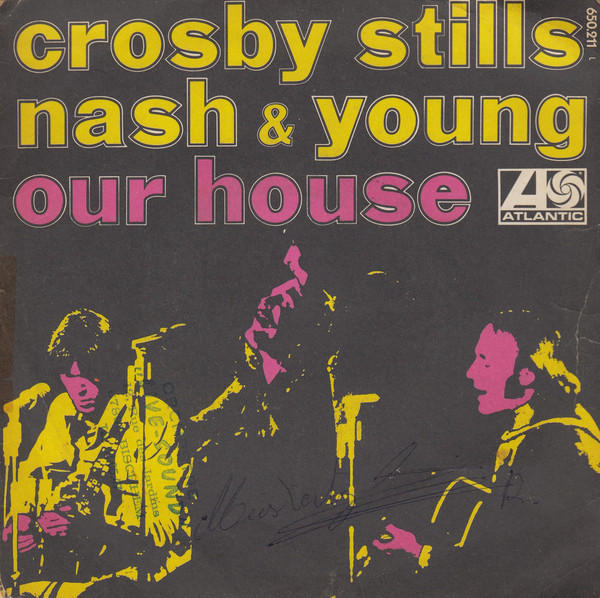
Our House…that is where most of us are today and for days to come. Here is a ballad that Graham Nash wrote for the Déjà Vu album. The first album to include Crosby, Stills, Nash, AND Young.
Graham Nash wrote this sentimental tune about his relationship living with Joni Mitchell in a cottage in LA’s Laurel Canyon around 1969. Mitchell and Nash were a romantic couple during the period in which Joni wrote the songs for Ladies Of The Canyon which, like Deja Vu, was released in 1970.
Our house peaked at #30 in the Billboard 100, #13 in Canada, and #19 in New Zealand in 1970.
Graham Nash: It was one of those gray cloudy days in Los Angeles that foreshadows the spring. When we got back and put our stuff down, I said, “I’ll light a fire”—she had an open fireplace with a stash of wood in the back—“why don’t you put some flowers in that vase you just bought. It’ll look beautiful. It’s kind of a bleak day. It’ll bring some more color into the room.” Then I stopped. I thought: Whoa! That’s a delicious moment. How many couples have been there: You light a fire, I’ll cook dinner. I thought that in the ordinariness of the moment there might be a profoundly simple statement. So Joni went out into the garden to gather ferns and leaves and a couple flowers to put in the vase. That meant she wasn’t at the piano—but I was! And within the hour, the song “Our House” was finished.
From Songfacts
Biographer Dave Zimmer shared what Graham Nash told him about the song in the 2007 CSNY Historian’s interview: “He once told me: ‘The time that Joni and I were living together was really interesting because I had left my band [The Hollies] successfully, I had left my country [England] successfully, I had been accepted here [Los Angeles, California], and I was feeling great. And Joni was feeling great, too; she had started to realize who she was and the fantastic work she was doing. She was painting and designing her second album cover, doing that self-portrait. And I remember being totally in awe of her. She’d go and make some supper and come down and we’d be eating, then she’d all of a sudden space out, go to the piano … to see her sit down and write ‘Rainy Night House’ and all those other things was just mind blowing.'”
According to Graham Nash’s biography Wild Tales, a famous line in this song had a very specific inspiration. He and Joni Mitchell went to an antiques store and she picked out a vase. When they got home, Nash said, “I’ll light the fire while you place the flowers in the vase that you bought today.” He stopped dead in his tracks and went immediately to the piano.
In the earliest live performances of the song, Nash would introduce it as being “about my woman.” He never used Mitchell’s name, though.
This was used in ’80s TV spots for Eckrich sausage and the Pacific Bell telephone company.
Our House
I’ll light the fire, you place the flowers in the vase that you bought today Staring at the fire for hours and hours while I listen to you Play your love songs all night long for me, only for me
Come to me now and rest your head for just five minutes, everything is good Such a cozy room, the windows are illuminated by the evening Sunshine through them, fiery gems for you, only for you
Our house is a very, very fine house with two cats in the yard, life used to be so hard, Now everything is easy ’cause of you and our la, la, la…
Our house is a very, very fine house with two cats in the yard, life used to be so hard, Now everything is easy ’cause of you and our
I’ll light the fire, while you place the flowers in the vase that you bought today
Love the Beggars Banquet album (1968) and this song in particular. Mick remembers the working class in this song. It was written by Mick and Keith.
It’s a mostly acoustic number, with Charlie Watts playing tabla and Ric Grech sitting in on fiddle. Grech was a violinist and bass player who was a member of the band Family in the ’60s and went on to play in Blind Faith with Eric Clapton. He also played on Gram Parsons’ solo albums in the ’70s, and he appears on Ron Wood and Ronnie Lane’s 1976 Mahoney’s Last Stand project.
Dave Mason, who did some session work for Jimi Hendrix and was a member of the band Traffic, played the mandolin on this song.
The song wasn’t released as a single but it’s a great song like most of what’s on Beggars Banquet.
Drummer Charlie Watts: “On Factory Girl, I was doing something you shouldn’t do, which is playing the tabla with sticks instead of trying to get that sound using your hand, which Indian tabla players do, though it’s an extremely difficult technique and painful if you’re not trained.”
From Songfacts
This song is a great example of Mick Jagger taking on a persona, which he often did in his lyrics. Here, he sings from the perspective of a guy who is waiting for his girlfriend – a destitute, disheveled sort – to get out of work at the factory. It’s quite a contrast to Jagger’s reality: a glamorous rock star who often dated models.
Guitarist Keith Richards: “To me ‘Factory Girl’ felt something like Molly Malone, an Irish jig; one of those ancient Celtic things that emerge from time to time, or an Appalachian song. In those days I would just come up and play something, sitting around the room. I still do that today.”
Factory Girl
Waiting for a girl who’s got curlers in her hair Waiting for a girl she has no money anywhere We get buses everywhere Waiting for a factory girl
Waiting for a girl and her knees are much too fat Waiting for a girl who wears scarves instead of hats Her zipper’s broken down the back Waiting for a factory girl
Waiting for a girl and she gets me into fights Waiting for a girl, we get drunk on Friday night She’s a sight for sore eyes Waiting for a factory girl
Waiting for a girl and she’s got stains all down her dress Waiting for a girl and my feet are getting wet She ain’t come out yet Waiting for a factory girl
Bruce makes it abundantly clear that he is not going to town, nor dinner, or in any way… up…nope he is going down, down, down etc… He repeats “down” over eighty times in this song…My word count counts 90 in the song. I don’t care…its a good song and as Bruce always does he sings it with conviction.
The reason I like this song is the overall sound that Bruce got on the guitar and the echo in his voice… it’s just perfect. I can hear the Sun Records influence in this one.
Born In The USA was the album I listened to endlessly in 1984-1985. You heard it everywhere you turned. A friend of mine (big Bruce fan from the old days) saw Bruce in 85 and he was depressed that Bruce was no longer a cult performer anymore. The horse was out of the barn so to speak…The public knew and knew him well. Bruce and that bandana were all over the news and any magazine you read.
Born in the USA had 7 top ten singles… I’m Going Down peaked at #9 in the Billboard 100 and #23 in Canada in 1985. The album was released on June 4, 1984… this song was at #9 over a year later on October 25, 1985. This was the 6th of the 7 singles to go to the top 10. My Hometown being the last in January of 1986…and it peaked at #6… within 5 months of two years after the release.
Lets fire up the Delorean and go back to 1985…please…
I’m Going Down
We sit in the car outside your house
I can feel the heat coming ’round
I go to put my arm around you
And you give me a look like I’m way out of bounds
Well you let out one of your bored sighs
Well lately when I look into your eyes
Down, down, down, down
I’m goin down, down, down, down
I’m goin down, down, down, down
I’m goin down, down, down, down
We get dressed up and we go out, baby, for the night
We come home early burning, burning, burning in some fire fight
I’m sick and tired of you setting me up yeah
Setting me up just to knock-a knock-a knock-a me down
Down, down, down, down
I’m goin down, down, down, down
I’m goin down, down, down, down
I’m goin down, down, down, down, hey now
I pull you close now baby but when we kiss I can feel a doubt
I remember back when we started
My kisses used to turn you inside out
I used to drive you to work in the morning
Friday night I’d drive you all around
You used to love to drive me wild yeah
But lately girl you get your kicks from just driving me down
I’m goin down, down, down, down
I’m goin down, down, down, down
I’m goin down, down, down, down
I’m goin down, down, down, down
I’m goin down, down, down, down
I’m goin down, down, down, down
I’m goin down, down, down, down
I’m goin down, hey bopa d-d-down
Hey hey mmm bopa bopa well down
Hey babe mmm bopa bopa said down
Hey hey mmm bopa bopa well down
Hey hey mmm bopa bopa say
Hey unh say down, down, down, down, down
Hey down now, say down, down, down, down, down
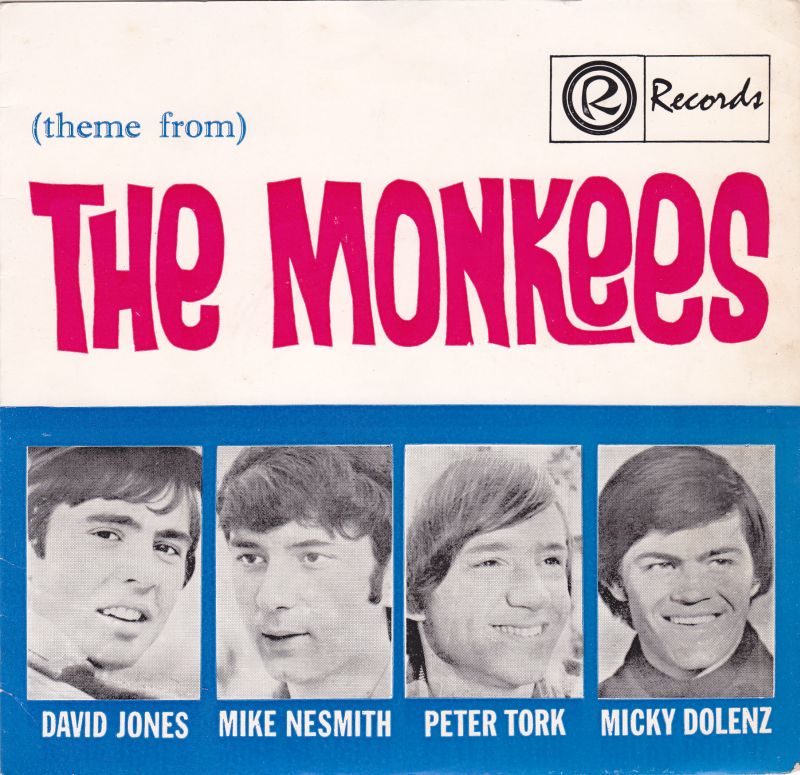
Hey Hey…Let’s all wake up to the Monkees on this quarantined morning. It’s hard to resist this song…it’s fun and reminds me of the intro to their television show…which is a good thing.
This was the first song written and recorded for The Monkees TV series, which ran on NBC 1966-1968. Written to introduce the Monkees and used as the theme song for the show.
It was written by the songwriter/producers Tommy Boyce and Bobby Hart, who were hired to write three songs for the show’s pilot, including the theme. When they wrote it, the cast had not been chosen and they had very little direction…the show was pitched as “An American version of The Beatles” and loosely based on the Beatles movie A Hard Day’s Night.
Peter Tork:“I always thought the song worked fine as the theme song for the TV show. But I never allowed us to sing it in public,” “The whole idea of standing up there and singing, ‘We’re wonderful/We’re the wonderful ones/And our names are The Wonderful Ones,’ was too self-congratulatory. What we do now is, the backing band plays [the music] and Micky and I come out onstage to it. I can’t ever see us singing ‘Hey, hey, we’re the Monkees!’ I couldn’t bear it.”
From Songfacts
The finger snaps and “here we come” line were influenced by the Dave Clark Five song “Catch Us If You Can,” where they sing, “Here we come again, catch us if you can.”
The Monkees didn’t play on their early albums, so very often the only band member to appear on a song would be its lead vocalist, which in this case was Micky Dolenz. This song was produced by the song’s writers, Tommy Boyce and Bobby Hart, who had members of their band, the Candy Store Prophets, play the instruments. The backing credits are as follows:
Micky Dolenz: vocal Tommy Boyce: backing vocals Wayne Erwin, Gerry Mcgee & Louie Shelton: guitar Larry Taylor: bass Billy Lewis: drums Gene Estes: percussion
Turns out this song works very well in a documentary about actual monkeys: It was used to open the 2015 Disney film Monkey Kingdom.
The Monkees Theme
Here we come Walkin’ down the street We get the funniest looks from Everyone we meet
Hey, hey, we’re the Monkees And people say we monkey around But we’re too busy singing To put anybody down
We go wherever we want to Do what we like to do We don’t have time to get restless There’s always something new
Hey, hey, we’re the Monkees And people say we monkey around But we’re too busy singing To put anybody down
We’re just tryin’ to be friendly Come and watch us sing and play We’re the young generation And we’ve got something to say, oh
Any time Or anywhere Just look over your shoulder Guess who’ll be standing there?
Hey, hey, we’re the Monkees And people say we monkey around But we’re too busy singing To put anybody down
Whaaa, one time!
Hey, hey, we’re the Monkees And people say we monkey around But we’re too busy singing To put anybody down
We’re just tryin’ to be friendly Come and watch us sing and play We’re the young generation And we’ve got something to say
Hey, hey, we’re the Monkees Hey, hey, we’re the Monkees
You go and see Pete Townshend to watch him windmill his guitar and jump about. Not on this song…you hear Pete happily playing on a banjo…and that is a great thing. He also slips in the accordion for good measure. This is not The Who’s best song but it’s happy and catchy. It’s also the first Who song I remember hearing without knowing much about them. My sister surprisingly had this single…a bright spot among the many bad ones she owned.
This song was on the album The Who By Numbers released in 1975 and peaked at #8. Squeeze Box made it to #16 in the Billboard 100 in 1976.
Townshend wrote all of the songs and they were deeply personal. He had just turned 30 and he was beginning to question his place in Rock and Roll. A question he would wrestle with a few more years.
Squeeze Box was originally intended for a Who television special planned in 1974. In the planned performance of the song, the members of the band were to be surrounded by 100 topless women playing accordions
Pete Townsend: “It’s not about a woman’s breasts, vaginal walls, or anything else of the ilk.”
Roger Daltrey:“What’s great about ‘Squeeze Box’ is that it’s so refreshingly simple, an incredible catchy song. A good jolly. I’ve never had a problem with that song because it doesn’t pretend to be anything other than what it is and I love it for that. Live audiences love it. Nothing wrong with a bit of ‘in-and-out’, mate!”
From Songfacts
“Squeeze Box” is a slang term for an accordion, but it is also slang for the vagina. The band just wanted to see if they could get away with singing about the joys of explicit sex.
In the liner notes to Pete Townshend’s compilation album Scoop, he wrote that he recorded the song for fun one day when he had bought himself an accordion. The accordion gave the song a polka-esque rhythm and the lyrics were “intended as a poorly aimed dirty joke.” Townshend had no thought of it ever becoming a hit.
The song is about an accordion (sort of), but there is hardly any of the instrument in the song. You can hear some in the section about 90 seconds in that goes, “squeeze me, come on and squeeze me,” but the subsequent instrumental section is mostly banjo. Pete Townshend played both instruments.
Squeeze Box
Mama’s got a squeeze box She wears on her chest And when daddy comes home He never gets no rest ‘Cause she’s playing all night And the music’s all right Mama’s got a squeeze box Daddy never sleeps at night
Well the kids don’t eat And the dog can’t sleep There’s no escape from the music In the whole damn street ‘Cause she’s playing all night And the music’s all right Mama’s got a squeeze box Daddy never sleeps at night
She goes in and out and in And out and in and out and in and out She’s playing all night And the music’s all right Mama’s got a squeeze box Daddy never sleeps at night
She goes, squeeze me, come on and squeeze me Come on and tease me like you do I’m so in love with you Mama’s got a squeeze box Daddy never sleeps at night
She goes in and out and in and out And in and out and in and out ‘Cause she’s playing all night And the music’s all right Mama’s got a squeeze box Daddy never sleeps at night
It’s easy to relate to this song… most have someone who they felt got away and you still think about them and wonder if they think about you.
It has a great hook and it gets you right away. The Moody Blues have been described as a progressive rock band but I have never thought of them that way. Maybe because I don’t particularly like progressive rock bands. I’ve always thought the Moodies were a great pop/rock band who plays for the song like Story In Your Eyes, Question, and others. This song is more of a pop song than some of their early ones but a catchy one.
It was written by Justin Hayward and peaked at #9 in the Billboard 100, #1 in the Adult Contemporary Charts, and #2 in the Mainstream Rock Charts in1986.
Justin Hayward: “I found with ‘Wildest Dreams’ that it was a common experience for a lot of people,” he said. “I thought I was writing a frivolous sort of song. I thought ‘Wildest Dreams’ would be a throwaway thing that people wouldn’t really take much notice of lyrically. But I found out that it was a common experience and desire by a lot of people. So that was very revealing.”
From Songfacts
The Moody Blues were one of the first bands to use a Mellotron, which was a keyboard instrument that played sounds by triggering tape loops. Mike Pinder, a founding member of the band, was their Mellotron virtuoso. After Pinder’s departure in 1979, Justin Hayward began experimenting with synthesizers and became particularly fond of the Yamaha DX7, which is apparent on this track.
Tony Visconti, famous for his work with David Bowie, produced The Other Side Of Life album and encouraged the band to use some unusual instruments. “Most of ‘Wildest Dreams’ – 90% of it – is Tony Visconti, my DX7, and a guitar synth,” Justin Hayward tells us. “The piece at the beginning that sounds like a sort of Theremin, a (humming) ‘oooo ooo,’ that’s a guitar synth. All of that is. So it was just another way of exploring musical avenues. Tony Visconti was very much into that and the first person who really turned the band on to programming in a serious way. And he was very, very good at it, so I enjoyed every moment of that.”
Justin Hayward wrote the song “I Know You’re Out There Somewhere,” which appeared on the next Moody Blues album, Sur la Mer, as a sequel to this song, with the singer longing to find the girl.
For “Somewhere,” he went back to his Yamaha DX7 synthesizer and used the same keyboard and bass sounds, keeping the same tempo. This gave the songs a similar musical feel to connect them musically, and then he wrote the lyrics to continue the story.
Your Wildest Dreams
Once upon a time Once when you were mine I remember skies Reflected in your eyes I wonder where you are I wonder if you think about me Once upon a time In your wildest dreams
Once the world was new Our bodies felt the morning dew That greets the brand new day We couldn’t tear ourselves away I wonder if you care I wonder if you still remember Once upon a time In your wildest dreams
And when the music plays And when the words are touched with sorrow When the music plays I hear the sound I had to follow Once upon a time
Once beneath the stars The universe was ours Love was all we knew And all I knew was you I wonder if you know I wonder if you think about it Once upon a time In your wildest dreams
And when the music plays And when the words are touched with sorrow When the music plays And when the music plays I hear the sound I had to follow Once upon a time
Once upon a time Once when you were mine I remember skies Mirrored in your eyes I wonder where you are I wonder if you think about me Once upon a time In your wildest dreams (ah, ah, ah, ah, ah, ah) In your wildest dreams (ah, ah, ah, ah, ah, ah) In your wildest dreams (ah, ah, ah, ah, ah, ah) In your wildest dreams (ah, ah, ah, ah, ah, ah)
As Van Morrison would say…Into The Mystic… this song off of Sgt Pepper was a George Harrison song…and he was the only Beatle on it… This is about as sixties as you can get with the sitar and philosophical lyrics.
This was a brilliant addition to Sgt Pepper to show yet another side to the Beatles.
It’s hard to overestimate how profound of an effect that the introduction to Eastern religion had on George Harrison. Under the name of Sam Wells, George, along with his wife Pattie, vacationed in Bombay, India for six weeks, beginning on September 20th, 1966. At the suggestion of Ravi Shankar, from whom he was going to take sitar lessons while there, he grew a mustache as a subtle disguise so as to ward off any Indian “Beatlemaniacs” that may have been around in the area.
The book Autobiography Of A Yogi really changed his life and mind. It influenced his writing of songs like Within You Without You’ and many others. George started to write this song on a pedal harmonium at friend Klaus Voormann’s home.
During the recording, George was there with Indian musicians and they had a carpet on the floor and there was incense burning.
At George Harrison’s request, they added a small bit of laughter at the end of the song as it faded out to lighten the mood a bit.
John Lennon: “I think that is one of George’s best songs, one of my favorites of his. I like the arrangement, the sound and the words. He is clear on that song. You can hear his mind is clear and his music is clear. It’s his innate talent that comes through on that song, that brought that song together. George is responsible for Indian music getting over here. That song is a good example.”
From Songfacts
Although this song is billed as being recorded by the Beatles, George Harrison was the only Beatle to play on the track. There is no guitar or bass, but there are some hand-drums.
Harrison spent weeks looking for musicians to play the Indian instruments used on this. It was especially difficult because Indian musicians could not read Western music.
This is based on a piece by Indian musician Ravi Shankar, who helped teach Harrison the sitar. Harrison wrote his own lyrics and shortened it considerably.
Harrison wrote this as a 30-minute piece. He trimmed it down into a mini-version for the album.
This was the only song Harrison wrote that made it onto the album. He also contributed “Only A Northern Song” (recorded in February of 1967 as verified by the Anthology 2 album), but it was left off the album at the last minute. It was initially intended to go on the first side of Sgt. Pepper between “She’s Leaving Home” and “Being for the Benefit of Mr. Kite.” >>
This was one of Harrison’s first songs to explore Eastern religion, which would become a lifelong quest. He believed in reincarnation, which helped him accept death in 2001, when he lost his life to cancer.
Oasis covered this for the BBC to celebrate the 40th anniversary of Sgt. Pepper’s Lonely Hearts Club Band.
This is the second Indian classical-influenced song that George Harrison wrote for the Beatles, the first being “Love You To.”
“Now “Within You/Without You” was not a commercial song by any means. But it was very interesting. [George Harrison] had a way of communicating music by the Indian system of kind of a separate language… the rhythms decided by the tabla player.” –Sir George Martin, from the documentary The Material World.
Within You Without You
We were talking About the space between us all And the people Who hide themselves behind a wall of illusion Never glimpse the truth Then it’s far too late when they pass away
We were talking About the love we all could share When we find it To try our best to hold it there, with our love, with our love We could save the world, if they only knew
Try to realize it’s all within yourself, no-one else can make you change And to see you’re really only very small And life flows on within you and without you
We were talking About the love that’s gone so cold And the people Who gain the world and lose their soul They don’t know, they can’t see Are you one of them?
When you’ve seen beyond yourself then you may find peace of mind is waiting there And the time will come when you see we’re all one And life flows on within you and without you
One quick story before the song. When I was 6 years old my dad, mom, sister. and I piled into the car and we all traveled to the carnival. I was so excited…too excited. I was in the backseat and stuck my head out the driver’s side window. My dad was not paying attention…can you see this coming? My dad started to roll the window up and could not understand why it was stuck. My neck was in it and Dad was trying to roll up harder. By this time I could not breathe, my face was turning red, and I was flopping around like a mouse in a trap…my mom yelled at my dad…MAX IS IN THE WINDOW… what? my dad asked…then my mom and sister screamed…MAX IS IN THE WINDOW…in unison no less. I can still hear him….Son…why the hell did you have your head handing out the window? Uh Dad…I wanted out to go to the carnival.
I loved carnivals growing up. At night they were magical with the lights, sounds, and smells.
This song was on The Band’s fourth studio album Cahoots. The song was written by Rick Danko, Levon Helm, and Robbie Robertson. The song peaked at #72 in the Billboard 100 in 1972. The album Cahoots peaked at #21 in the Billboard Album Charts in the same year.
The Band had a new studio in Bearsville NY to experiment in during the early ’70s. It was opened by their manager Albert Grossman but Robbie Robertson commented that it left them a bit cold. They are also going through drug problems with three members at the time of recording.
Rick Danko in 1993: “I think we shipped a million copies of that second album,” “And that changed a lot of people’s lives — in particular, the Band’s. After that, we were only getting together once a year, for a couple of months, to record. It was like we were too decadent to play.”
Life Is A Carnival
You can walk on the water Drown in the sand You can fly off a mountaintop If anybody can
Run away, run away (run away, run away) It’s the restless age Look away, look away (look away, look away) You can turn the page
Hey, buddy, would you like to buy a watch real cheap? Here on the street I got six on each arm And two more ’round my feet
Life is a carnival Believe it or not Life is a carnival Two bits a shot
Saw a man with a jinx In the third degree From trying to deal with people People, you can’t see
Take away, take away (take away, take away) This house of mirrors Give away, give away (give away, give away) All the souvenirs
We’re all in the same boat ready to float Off the edge of the world The flat old world The street is a sideshow From the peddler to the corner girl
Life is a carnival It’s in the book Life is a carnival Take another look
Hey, buddy, would you like to buy a watch real cheap? Here on the street I got six on each arm And two more ’round my feet
Life is a carnival Believe it or not Life is a carnival Two bits a shot









 PowerPop... An Eclectic Collection of Pop Culture