

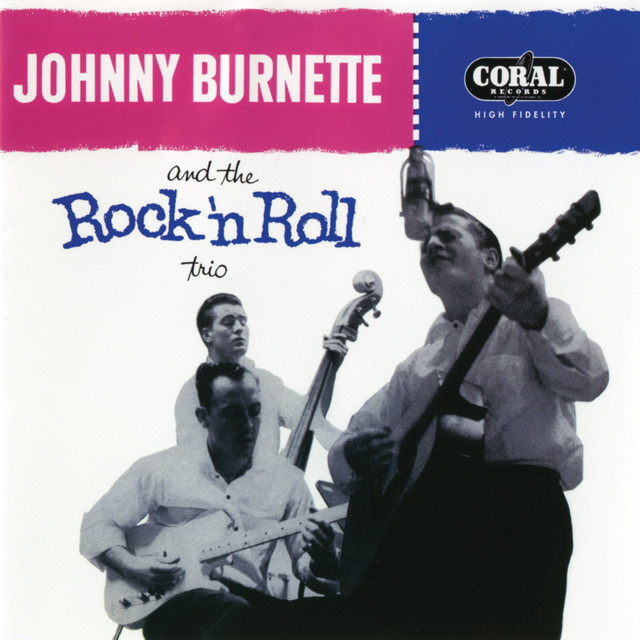
The first time I heard this song I was knocked out by that guitar sound. Not just the playing, but that incredible slapback echo that seems to jump right out of the speakers. You can buy countless pedals and plugins today that promise the same effect, but to my ears, nothing quite captures what they were doing in the 1950s. There is just something alive about it. I get all nerdy over this sound but I can’t help it.
The Johnny Burnette Trio was one of the wildest rockabilly bands of the era. They were formed by brothers Johnny and Dorsey Burnette, along with guitarist Paul Burlison; they blended country, rhythm and blues, and early rock into a raw sound. This song, recorded in 1956, became one of their signature recordings. It wasn’t a major hit at the time, but it became one of the defining records of rockabilly. Burlison’s guitar playing, along with Johnny Burnette’s vocal, gave the record an excitement that still comes across nearly seventy years later.
Paul Burlison always maintained that part of his distorted guitar sound happened because a tube in his amplifier had become loose during a rough drive to a studio. Rather than fixing it, he liked the gritty sound and kept playing. Whether every detail of that story is exactly as remembered has been debated over the years, but it’s one of rockabilly’s great legends. It helped point the way toward the distorted guitar sounds that became common in rock music years later.
I’m going to get a little technical on this subject…see nerdy again. One of the secrets behind that sound was the recording itself. In the 1950s, there were no digital effects and very few electronic echo units. Engineers often created an echo by using two tape machines. The signal was recorded on one machine and immediately played back on a second machine a fraction of a second later. By mixing the original signal with that of the delayed playback, they created the famous slapback echo that became a trademark of rockabilly. Studios also used echo chambers, actual rooms with a speaker at one end and a microphone at the other. The natural reflections inside the room produced reverb that sounded warm and real because it actually was. Every studio had its own sound, which is one reason records from that era have so much personality. You can tell if it’s a Stax or Motown by the sound in the sixties as well.
This song reminds me that sometimes limitations create the greatest music. The musicians couldn’t rely on technology to make a recording exciting. They had to play with energy, and the engineers had to invent ways to capture it. The result is a record that still sounds fresh today. If you want to hear rockabilly at its finest, with one of the greatest guitar sounds ever put on tape, this is a train well worth climbing aboard.
Below in the live cut, Johnny Black is on bass, filling in for Dorsey Burnette.
Lonesome Train
Lonesome train, on a lonesome track
I am goin’ away, ain’t comin’ back
I am goin’ somewhere far from my baby
On a lonesome train, on a lonesome track
A lonesome train, on a lonesome track
Got all my troubles in one big pack
My baby left me, so sad and lonely
On a lonesome train, on a lonesome track
Lonesome train, on a lonesome track
My girl don’t love me and that’s a fact
No use in livin’, no use in dyin’
On a lonesome train, on a lonesome track
On a lonesome train, on a lonesome track
I want my baby, I want her back
Don’t want to go on forever travelin’
On a lonesome train, on a lonesome track
Discover more from PowerPop... An Eclectic Collection of Pop Culture
Subscribe to get the latest posts sent to your email.


The original Stray Cats!
LikeLiked by 2 people
Very cool insight on the studio and recording. Especially the distortion guitar. A bit like the Rocket 88 fuzzy broken amp story.
LikeLiked by 1 person
I was hoping the distortion and reverb wasn’t a little over the top on the way I explained it.
LikeLiked by 2 people
Oh no I don’t think so, as you explained it was more happenstance than anything else. For me just a dimension of the song I was , let’s say – uniformed about.
LikeLiked by 2 people
I love the idea of having an echo room…when the Grateful Dead was playing at the Pyramids…they tried putting a mic inside one of the empty tombs as an echo box…so many ways of doing it without a box or an effect.
LikeLiked by 2 people
Lol that’s both creative and creepy!
LikeLiked by 2 people
LOL…yes it is!
LikeLiked by 2 people
(The Grateful Dead- Playing Live At The Pyramids???? That would make one hell of a live album!)
LikeLiked by 2 people
It might be one…but here is a clip
LikeLiked by 2 people
That clip kinda sums up the Grateful Dead. They start in the background, accompanying the Egyptian musicians. When “Fire on the Mountain” starts, it is driven by the bass. Garcia comes in playing through an envelope filter (the wah-wah sound). If you’re not paying attention, you might not notice that he stops playing and Weir takes over the lead line. After the first vocal interlude, it is pure ensemble playing – not just a band comping behind a lead guitar. And, at 16:30, the camera focuses briefly on Bill Walton (UCLA and, at the time of this recording, Portland Trail Blazers basketball player). By the way, Bill Kreutzmann is playing with a broken wrist and in a cast. If you watch the video, you never really see his left hand – it’s not doing much.
LikeLiked by 2 people
Oh yes! Thanks for reminding me about Bill…I remember reading about that. It happened right before they took off I believe. Bill Walton…thats right..he went up in a pyramid with them.
Now I’m going back and watching some longer cuts by them. Thanks as always.
LikeLike
I recall reading in a book by one of the Dead that Keith Godchaux insisted on bringing a Steinway concert grand (pretty much the only keyboard he was willing to play), but they couldn’t afford to bring their piano tuner (one would think he’d be one of the more important parts of the entourage) so it was always out of tune and most of their recordings were garbage. With the magic sound engineers can work nowadays some of it was resurrected and released as the album “Rocking the Cradle” 30 years later.
LikeLiked by 2 people
I agree that the sound can be approximated, but you can’t capture it exactly like the 50s. Classic stuff.
LikeLiked by 1 person
Thanks to Robert Gordon and Link wray I was introduced to this song. Great info Max and yes “it still sounds fresh today”
LikeLiked by 1 person
CB…it downright rocks. I love that slapback…I’ll have to check their versions out.
LikeLike
There’s a great live version of Robert and Spedding doing it. Doesnt have that crisp studio sound but it has everything else we love about this music.
LikeLiked by 1 person
I just caught a live cut by them in 1978…it does sound great…don’t know if that is the one you are talking about…but it doesn’t matter…it was on.
LikeLike
If it’s black and white that’s it. I caught them back then. Fantastic!
LikeLiked by 1 person
Thats it!
LikeLike
You know guys like Spedding, Beck were into these rockabily ax-men.
LikeLiked by 1 person
Yea…and I will be listening to it this week for sure. It’s simple…and that is not a put down…everything is clear…it doesn’t have 20 guitars coming in…something that can be replicated on the back porch.
LikeLike
Oh this is great! I’m not familiar with the Johnny Burnette trio. I should be and now I will be. Cool to see that live track with Alan Freed. They sounded great live. Minimalism at its best.
LikeLiked by 1 person
I feel in love with a trio format when I saw the play “Buddy” in Nashivlle in the 1990s. Those rockabilly trios are so powerful.
LikeLiked by 1 person
pretty good if standard-ish late-50s song. Those Burnettes sure did have a feel for rockabilly! Your explanation on the guitar sounds is cool, even if some of it goes above my head. But it reminded me a lot of photography. Now with a good edition of Photoshop or anything like that, anything is possible. But when I was growing up and getting into it, if you wanted to get something different you had to work with the real ‘instruments’… filters on cameras, dodging and burning in the darkroom to enhance specific parts of an image, cross-processing to get wild color effects, things like that. There’s something to be said for the ease of the process now but back then, it took real talent and special knowhow just like it did for musicians or producers to get different effects.
LikeLiked by 2 people
I think everyone….even in that field…should know how to do it both ways. As far as reverb…you could place a speaker and a mic in a bathroom and get that natural reverb…I’ve done it before. The distortion…those vaccum tubes…when they jar a loose or malfunction…you get interesting sounds
LikeLiked by 1 person
I remember reading JJ Burnel had a rip in one of his amp cones and he found to his surprise that it made his bass sound more menacing so he went with it. Happy little accident as bob Ross would have said
LikeLiked by 1 person
Yea…I knew guys that took a razor blade and cut their speaker cones…I just couldn’t do that…but I probably should have lol.
LikeLike
I 100% have to share your excitement about Johnny Burnette’s amazing sound. It’s impossible to listen to “Lonesome Train” without starting to groove along!
LikeLiked by 1 person
I know man…that slapback is just so cool…makes a voice sound huge
LikeLiked by 1 person
The need to improvise around the problem was the beginning of the George Martin/Phil ‘Loose Canon’ Spector master manipulation style of production I guess. The two stories I recall from way back was Dave Davies taking the cut-throat razor to his amp and the Honeycombs stomping their feet out on the stairs at Joe Meeks studio. Both stories I’m sure I heard back in the day by 60s/70s DJs.
LikeLiked by 1 person
They had to be inventive…and came up with this stuff that now they try to copy with plugins and boxes….
LikeLiked by 1 person
Give me the Dave style ob. He had the razor handy because Mick was going to kick the shit out of him. Pure in the moment by Dave.
LikeLiked by 2 people
I guess Dave wanted to have a slice of luck on his side CB?
LikeLiked by 1 person
He had to even the odds with Mick.
LikeLiked by 2 people
Mick shoulda helsdonto his hi-hat, and his drum stand…
LikeLiked by 2 people
Sorry CB, I didn’t proof read my reply about the hi-hat- as is all too obvious!
LikeLiked by 1 person
Great track, Max as I really enjoyed this. I was surprised that this song was recorded with only the lead guitar being electric, and I wonder how many songs were recorded that way years ago.
LikeLiked by 1 person
I like that…it gives it a different sound. Oh quite a bit because they only had 2 tracks to work with at this time.
LikeLiked by 1 person
In the 70s I knew a self-taught electrical engineer who designed and built an amplifier. He bought spring reverb units from an old guy who made them in a workshop in his garage in a small town near here. He designed circuits that he claimed he didn’t understand but gave him sounds he was looking for. He had one switch that he didn’t know how to label if he was going to try to manufacture and sell this amp – he had a switch position that gave him Carlos Santana’s tone and sustain, another that gave him Jerry Garcia’s tone. Alas, as a small start-up company, it didn’t last long.
LikeLiked by 1 person
If I had the money…I would go out and buy those old boxes like that you were talking about. So many companies came up with boxes and many didn’t last long. I have one box that is a no name distortion box…I looked it up and people are paying over 1000 dollars for which blows my mind. It’s an ugly box and pretty good size…but I wouldn’t take anything for it. It gives you the most raunchiest sound you could ever want. Not heavy metal but a dirty Keith Richards sound.
LikeLiked by 1 person
my dad loved this guy. Dad was into all of the old rockabilly, twangy country singers since that’s what was big in England when he was growing up in the late forties and early fifties
LikeLiked by 1 person
Oh yes…he had great taste! Yes my dad did as well…Little Richard was his guy…but I love this music….it’s simple structures but alive and harder to play than they sound.
LikeLiked by 1 person
my dad loved little richard. but, the one guy out of them all…bobby darin. there wasn’t a stage big enough to hold him
LikeLiked by 1 person
Never really heard of them, they remind me of Los Lobos. Based on that song, its weird they don’t have the canonisation/RRHOF treatment.
Another time, in the 1980s,1 Burlison was working with the Sun Rhythm Section at a show in Pennsylvania. Los Lobos was in town that night, and after Burlison came offstage the Los Angeles rockers were waiting for him in back. As Burlison recalls, Los Lobos’ Cesar Rosas thrust a guitar at him “and said, `Show me.’ I said, `What?’ He said, `How you did “Train Kept A Rollin’.”
LikeLiked by 1 person
That is a really cool story…thanks for that. I hadn’t heard of Burlison much before this I don’t think….but I love his sound and I get why Rosas ask that.
LikeLike