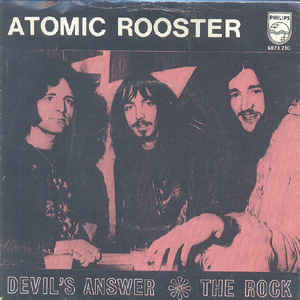
Atomic Rooster… Now that is a name. I’ve been in short term bands with different names such as… “The Flying Junebugs”, “The Cryin ‘Shame” and “Green Swingset” but Atomic Rooster is unique. Atomic Rooster was an English rock band, originally composed of former members of The Crazy World of Arthur Brown. Throughout their history keyboardist, Vincent Crane was the only constant member and wrote the majority of their material.
This is another song I noticed on the Life On Mars series in the mid-2000s.
Their history is defined by two periods: the early-mid-1970s and the early 1980s. Their genre in music is difficult to define since they went through radical changes in very short times during the life of the band. However, their best-known era represented a more hard rock/progressive rock sound, exemplified by their only hit singles, Tomorrow Night (UK No. 11) and The Devil’s Answer (UK No. 4), both in 1971.
The Devil’s Answer
People are looking but they don’t know what to do It’s the time of the season for the people like you Come back tomorrow, show the scars on your face It’s a clue to the answer we all chaseThree, five and seven lift the heaviest load reach the top of the heaven that’s fallen below Devil may care but you wish for the best can’t you see there’s an answer that lies there Come all you sinners and keep with the time can we see all the faces that have fallen behind Don’t make the reason it’s a secret for you
There’s a clue to the answer we all know There’s no clue to the answer we all know People are looking but they don’t know what to do It’s the time of the season for the people like you Come back tomorrow, show the scars on your faceIt’s a clue to the answer we all chase It’s a clue to the answer we all chase
This is a rocking song from 1971 made it to the top 10 at #10 in the Billboard 100, #5 in Canada, and #5 in the UK. This song got blacklisted and of course, gave it a boost. After singles such as “Mary Had A Little Lamb” this song gave Paul some “cool” teenager credibility about apparently getting high.
In an interview with the October 2010 edition of Mojo magazine, McCartney claimed to be surprised when the BBC blacklisted this song. Said the former Beatle: “Look at Bob Dylan, ‘everybody must get stoned.’ It was like, ‘Ooh, does he mean you get high? Or does he mean getting drunk? So there was that ambiguity and I assumed the same would apply to me.”
This song was banned by the BBC for what they described as “inappropriate sex and drugs references.” Fair enough – McCartney is singing about getting high, using his “sweet banana” and “doing it” to her!
McCartney talked about this song in a 2018 interview with GQ. “A lot of people were getting high, so to me it was just like a fantasy song, sort of saying, ‘Hey girl, come on let’s get high,'” he said. “It was just about the times. It’s very much a period piece, but it goes down well.”
McCartney dropped this from his setlists after 1976, but brought it back in 2013 and has played it recurrently ever since. As a grandfather, the song can be a bit embarrassing, so he tweaks it a bit, singing, “Let’s get hi… on life!”
Hi Hi Hi
Well, when I met you at the station You were standing with a bootleg in your hand. I took you back to my little place For a taste of a multicolored band. We’re gonna get hi hi hi, The night is young. She’ll be my funky little mama, Gonna rock it and we’ve only just begun.
We’re gonna get hi, hi, hi With the music on. Won’t say bye, bye, bye, bye, bye, bye, bye, bye Til the night is gone. I’m gonna do it to you, gonna do it, Sweet banana, you’ll never give up. We’re gettin’ hi, hi, hi, in the midday sun.
Well well, take off your face, Recover from the trip you’ve been on. I want to lie on the bed, Get you ready for my polygon. I’m gonna do it to you, gonna do it, Sweet banana, you’ve never been done. Yes, I go like a rabbit, gonna grab it, Gonna do it ’til the night is done.
We’re gonna get hi, hi, hi with the music on. Won’t say bye,bye, bye, bye, bye, bye, bye, bye Til the night is gone. I’m gonna do it to you, gonna do it, Sweet banana, you’ll never give up. We’re gonna get hi, hi, hi, we’re gonna get hi hi hi, We’re gonna get hi, hi, hi, in the midday sun.
Good riff and rock song by the Kinks. It starts off with a chord that is reminiscent of the “A Hard Days Night” intro. I was in high school when it was released and it was great to hear a guitar driven song.
Ray Davies wrote this about the stressful working schedules the Kinks were going through. The song peaked at #41 in the Billboard 100 in 1983.
Do It Again
Standing in the middle of nowhere Wondering how to begin Lost between tomorrow and yesterday Between now and then
And now we’re back where we started Here we go round again Day after day I get up and I say I better do it again
Where are all the people going Round and round till we reach the end One day leading to another Get up go out do it again
Then it’s back where you started Here we go round again Back where you started Come on do it again
And you think today is going to be better Change the world and do it again Give it all up and start all over You say you will but you don’t know when
Then it’s back where you started Here we go round again Day after day I get up and I say Come on better do it again
The days go by and you wish you were a different guy Different friends and a new set of clothes You make alterations and [a fact in you knows] A new house a new car a new job a new nose But it’s superficial and it’s only skin deep Cause the voices in your head keep shouting in your sleep Get back, get back
Back where you started, here we go round again Back where you started, come on do it again
Back where you started, here we go round again Day after day I get up and I say, do it agaiiinnn Do it again Day after day I get up and I say, do it again
The song started out as a mistake, but one that Charles Wright liked. The record company didn’t want him to record it. “No one wanted to record it. I had to sneak a bass player, drummer, and engineer into the studio one Sunday and cut it in secret,” Wright recalls. “The president of Warner Bros. told me I made a mistake. So did every DJ that I played it for. But I had a feeling that it was a hit.”
Charles was right…it peaked at #12 in the Billboard 100 in 1970. It has become one of the most licensed songs of the last 40 years.
Express Yourself
Express Yourself! Express Yourself!
You don’t ever need help from nobody else. All you got to do now:
Express Yourself!
What ever you do, do it good. What ever you do, do it good. All right…
It’s not what you look like, when you’re doin´ what you’re doin´. It’s what you’re doin´ when you’re doin´ what you look like you’re doin´!
Express Yourself! Express Yourself!
They’re doin´it on the moon, yeah… In the jungle too. Everybody on the floor, now. Jumpin´ like a kangaroo. So let the horns do the thing they do, yo…
Some people have everything, and other people don’t. But everything don’t mean a thing if it ain´t the thing you want.
Express Yourself! Express Yourself!
O, do it! O, do it. Do it to it. Go on and do it. Yo, do it. Give.
The first time I heard this song was the Dave Clark Five’s version. It was written by Motown president Berry Gordy Jr, who wrote it for The Temptations, but they failed to arrive for the recording session. At the same time but in a different Motown studio, The Contours arrived to record “It Must Be Love,” but Gordy had other ideas – he asked them to cut “Do You Love Me” instead. The song became one of Motown’s first hits.
The song peaked at #3 in the Billboard 100 in 1962. This would be The Contours last top 40 hits although they would place 8 songs in the top 100.
From Songfacts
Joe Billingslea of The Contours told Mojo magazine February 2009 the story of this song: “We had just left the record hop and we turned at the studio. The doors were always open in those days. Berry was down there at the piano and he said ‘I want you to try this song I’m writing.’ He told us how he wanted the backgrounds to go and we sang it. ‘Try it again, I didn’t quite like it,’ he said. After about the third time he said, ‘That’s not right. I think I’ll give it to The Temptations instead.’ I told him not to. We did it again and he said, ‘That’s exactly how I want it. Come in tomorrow morning, we’re going to record it.’ So we did.
I didn’t like the song. It reminded me of ‘Twist And Shout.’ I said: ‘This song ain’t gonna do nothin’, man.’ That same week it was released and the following week it made the charts. I turned around and said: I love that song! Did I change my opinion? Of course! We realized later that The Temptations could never have sung that song because it wasn’t suited to them but Berry had motivated us to sing it the way he wanted it.”
This song peaked in popularity just as Motown launched their first “Motortown Revue” tour to showcase their acts. The Countours were stars of the show, igniting crowds with “Do You Love Me.” Lower on the bill were some other Motown acts that had yet to hit, including Marvin Gaye, Little Stevie Wonder, and The Supremes.
After being featured in the 1988 movie Dirty Dancing, this was re-released 26 years after it was originally recorded. This time, it charted at #11. The song was a good fit for Dirty Dancing, which despite featuring some modern, original songs, was set in 1963. This was a great song of that era for a dance scene.
The Dave Clark Five recorded this in 1964 as the British Invasion was underway. Their rendition hit #11 in the US. On March 8, 1964, The DC5 played it on the first of their 12 appearances on The Ed Sullivan Show.
In his autobiography To Be Loved, recalls a confrontation with Motown’s primary bass player, James Jamerson, over this song. Jamerson, who is lauded as a creator of the Motown sound, was playing a jazz beat during the session despite Berry’s instructions. “You’ve got to stay on the f–kin’ downbeat,” Berry told him, hoping he wouldn’t have to kick his star bassist out of the session. When they rolled for the next take, Jamerson did as instructed, playing the Pop groove Gordy requested… until Berry took his eyes off him. “In that split second, Jamerson hit four or five Jazz upbeats in rapid succession,” Gordy recalled. “I turned to let him have it, but before I could say anything he had jumped back on the downbeat so brilliantly I could only smile.”
In 1963, London group Brian Poole And The Tremeloes recorded a version that topped the charts in 16 countries including the UK.
This song featured in a 2016 Pepsi commercial starring Janelle Monáe. In the spot, which debuted during the Super Bowl, Monáe dances to the song before entering another room where she goes through a time warp and joins in the celebration to Madonna’s “Express Yourself.”
Do You Love Me
You broke my heart ’cause I couldn’t dance, You didn’t even want me around And now I’m back to let you know I can really shake ’em down
Do you love me? (I can really move) Do you love me? (I’m in the groove) Now do you love me? (Do you love me now that I can dance?) Watch me, now (Work, work) ah, work it out baby (Work, work) well, I’m gonna drive you crazy (Work, work) ah, just a little bit of soul, now? (Work) Now I can mash potatoes (I can mash potatoes) I can do the twist (I can do the twist) Tell me, baby, do you like it like this? Tell me (tell me) tell me
Do you love me? Do you love me, baby? Now do you love me? (Do you love me now that I can dance?) Watch me, now (Work, work) ah, work it out baby (Work, work) well, I’m gonna drive you crazy (Work, work) you are getting kind of cold, now (Work) (Work, work) with just a little bit of soul, now ? (Work, work) come on, come on now (Work, work) I’m gonna drive you crazy (Work) I can mash potatoes I can do the twist Well now, tell me, baby, do you like it like this? Tell me (tell me) tell me
Do you love me? Do you love me, baby? Do you love me? Do you love me? Now that I can dance (Work, work) ah, work it out baby (Work, work) well, I’m gonna drive you crazy (Work, work) oh you are getting kind of cold, now (Work) (Work, work) with just a little bit of soul, now (Work, work) now don’t you get kinda bold, now? (Work, work) oh, work it out, baby
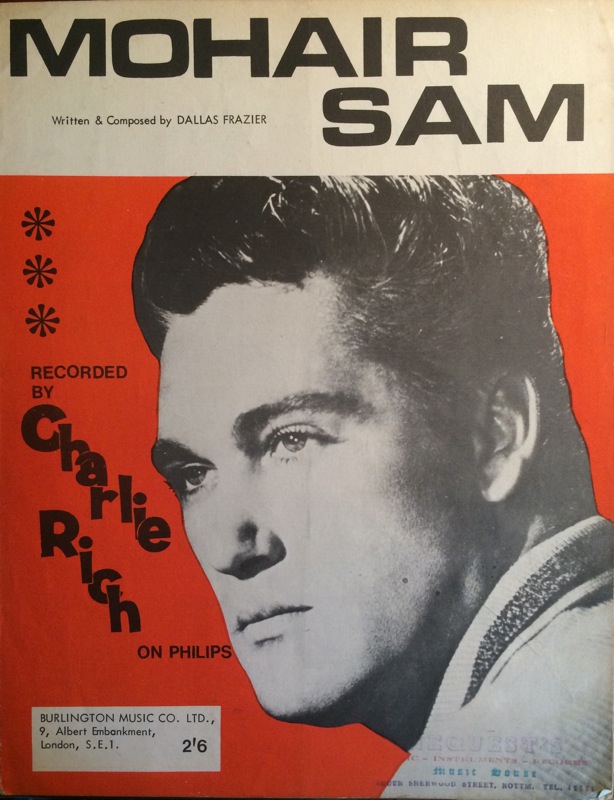
It’s a song by Charlie Rich who is more known as a country artist and his 1970s hits “Behind Closed Doors” and “The Most Beautiful Girl” off of his album Behind Closed Doors. This is not like Rich’s other hits but it’s a good song.
I first heard about this song when I read The Beatles were listening to this song when they met Elvis and Elvis had it on his jukebox when they all met. The song peaked at #21 in the Billboard 100 in 1966. The song became a hit, ending up in the top 30 on the pop charts.
Charlie played piano on Sun Records in the late 1950s and early 1960s, and then signed with Grove records…after that, he signed with Smash records and this was his first release on that label.
The song was written by Dallas Frazier who also wrote “Elvira”…the song that the Oak Ridge Boys made famous.
Mohair Sam
Well – who is the hippie that’s happenin’ all over our town? Tearin’ up chicks with the message that he lays down Who is the coolest guy, what is, what am? That’s fast-talkin’ – slow walkin’ – good-lookin’ Mohair Sam
Chicks are making reservations for his lovin’ so fine (so fine) Screamin’ and shoutin’ he’s got ’em all waitin’ in line Who is the coolest guy, what is, what am? That’s fast-talkin’ – slow walkin’ – good-lookin’ Mohair Sam
Who is the hippie that’s happenin’ all over our town? Tearin’ up chicks with the message that he lays down Who is the coolest guy, what is, what am? That’s fast-talkin’ – slow walkin’ – good-lookin’ Mohair Sam
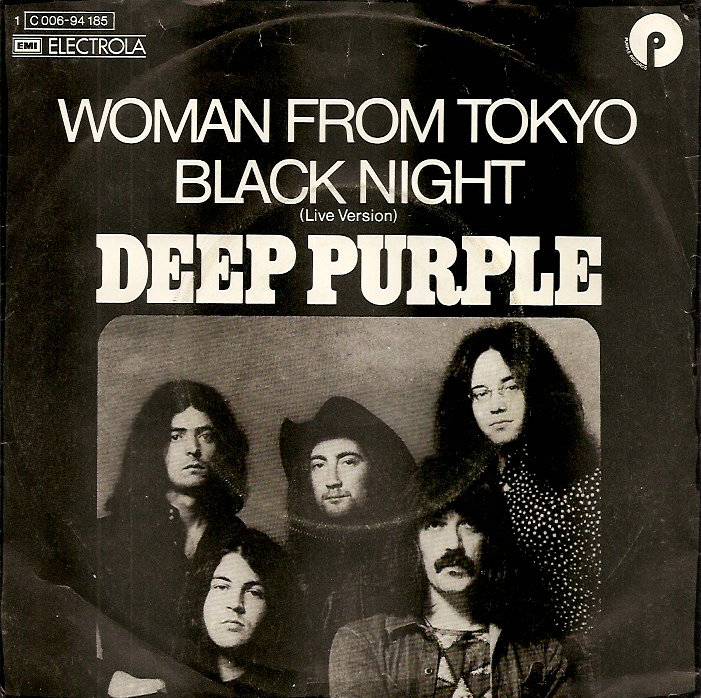
This song is all about the riff…it is a memorable riff… The song has drive and suspense. Woman from Tokyo peaked at #60 in 1973. This is one of the group’s most popular songs, but they never liked it very much. They didn’t start playing it live until they re-formed in 1984 after their 1976 split.
Because of endless touring and fatigue, Ian Gillan gave a six-month notice and stated that he was leaving the band after fulfilling all of his commitments in 1973. The album Who “Do We Think We Are” was released in January of 1973. The release generated the hit single “Woman from Tokyo.” “Smoke on the Water” was also busy that year becoming Deep Purple’s biggest hit of all-time.
After lead singer Ian Gillian left Deep Purple in 1973 they had two other lead singers before reforming in 1984…and they were David Coverdale and Joe Lynn Turner.
Deep Purple started recording their Who Do We Think We Are in Rome in July 1972. At this point, the band had yet to tour Japan, but they had three shows scheduled there for August: two in Osaka followed by one at the Budokan arena in Tokyo. Drawing on Japanese imagery (“the rising sun,” “an Eastern dream”), they concocted a story of a lovely lady from that country who drives them wild.
Rome was sunny and relaxing, so the band spent a lot of time in the swimming pool in lieu of working. There was also a sound problem in the studio, and the only track they got out of those sessions was “Woman From Tokyo.” The rest of the album was done in Germany.
In 1973, this was issued as a single, achieving a modest chart position of #60 in America. It aged well and got a lot of airplay on AOR and Classic Rock radio stations, keeping it alive. The stretched out “Toe-Key-Oh” became a bit of an earworm and helped embed the song into many an auditory cortex.
On some compilations from the ’70s, this song is listed as “live,” which Roger Glover insists is a lie, since they never did the song live in that decade.
Woman from Tokyo
Fly into the rising sun Faces, smiling everyone Yeah, she is a whole new tradition I feel it in my heart
My woman from Tokyo She makes me see My woman from Tokyo She’s so good to me
Talk about her like a Queen Dancing in a Eastern Dream Yeah, she makes me feel like a river That carries me away
My woman from Tokyo She makes me see My woman from Tokyo She’s so good to me
But I’m at home and I just don’t belong
So far away from the garden we love She is what moves in the soul of a dove Soon I shall see just how black was my night When we’re alone in Her City of light
Rising from the neon gloom Shining like a crazy moon Yeah, she turns me on like a fire I get high
My woman from Tokyo She makes me see My woman from Tokyo She’s so good to me
It took me a few listens to warm up to this song…after that, I’ve been hooked. Roger Daltrey on Happy Jack. “I remember when I first heard ‘Happy Jack’, I thought, ‘What the f–k do I do with this? It’s like a German oompah song!’ I had a picture in my head that this was the kind of song that Burl Ives would sing, so ‘Happy Jack’ was my imitation of Burl Ives!”
The song peaked at #24 in the Billboard 100 and #3 in the UK in 1967.
Pete Townshend based the “Happy Jack” character on the strange and not-too-intelligent guys who used to hang around English beaches and play with the kids. Townshend would play on the Isle Of Man beach as a kid.
This was featured on The Who’s second album, A Quick One. In the US, the album title was changed to “Happy Jack” due to record company fears that the original title was a reference to sex.
In 1966 The Who were slotted to film a television series in much the same vein as the Monkees series. For the pilot episode, the band filmed a clip to go along with this song. It featured the 4 of them as robbers attempting to rob a safe. They get distracted, however, by a cake sitting close by and wackiness ensues as The Who smear themselves from head to foot with frosting. Finally a cop busts in and foils their plan, chasing them out of the room. The show never aired, but the clip can now be found in the Kids Are Alright DVD. The clip is light years ahead of its time for what other bands of the ’60s were doing.
A live version can be found on the expanded Live at Leeds album.
At the tail end of the song, you can hear Townshend yelling the phrase “I saw yer!” to Who drummer Keith Moon. Apparently, Moon had been banished from the studio and was trying to sneak back in.
This song was used in an ad campaign for the Hummer H2 in 2004. The commercial featured a boy in a wooden car rolling straight down a hill to win a soap box derby instead of taking the winding road down like everyone else.
Happy Jack
Happy Jack wasn’t old, but he was a man He lived in the sand at the Isle of Man The kids would all sing, he would take the wrong key So they rode on his head on their furry donkey
The kids couldn’t hurt Jack They tried and tried and tried They dropped things on his back And lied and lied and lied and lied and lied
But they couldn’t stop Jack, or the waters lapping And they couldn’t prevent Jack from feeling happy
But they couldn’t stop Jack, or the waters lapping And they couldn’t prevent Jack from feeling happy
The kids couldn’t hurt Jack They tried and tried and tried They dropped things on his back And lied and lied and lied and lied and lied
But they couldn’t stop Jack, or the waters lapping And they couldn’t prevent Jack from feeling happy
I’ve always liked this song and Tanya’s voice. This song was first recorded by Alexander Harvey in 1972. Tracy Nelson (who sang backup on the original) and Bette Midler put the song in their live repertoire before it became a country hit for a 13-year-old Tanya.
The song peaked at #6 in the Country Charts, #3 in Canada and #72 in the Billboard 100 in 1972.
Helen Reddy would take the song to #1 in the Billboard 100 in 1973.
Barbra Streisand passed on the song after the backing track had been recorded by her producer without her prior knowledge.
Delta Dawn
Delta Dawn, what’s that flower you have on? Could it be a faded rose from days gone by? And did I hear you say he was a-meeting you here today To take you to his mansion in the sky?
She’s forty-one and her daddy still calls her “baby” All the folks around Brownsville say she’s crazy ‘Cause she walks dowtown with a suitcase in her hand Looking for a mysterious dark-haired man
In her younger days they called her Delta Dawn Prettiest woman you ever laid eyes on Then a man of low degree stood by her side And promised her he’d take her for his bride
Delta Dawn, what’s that flower you have on? Could it be a faded rose from days gone by? And did I hear you say he was a-meeting you here today To take you to his mansion in the sky?
Delta Dawn, what’s that flower you have on? Could it be a faded rose from days gone by? And did I hear you say he was a-meeting you here today To take you to his mansion in the sky?
Delta Dawn, what’s that flower you have on? Could it be a faded rose from days gone by? And did I hear you say he was a-meeting you here today To take you to his mansion in the sky?
Delta Dawn, what’s that flower you have on? Could it be a faded rose from days gone by? And did I hear you say he was a-meeting you here today To take you to his mansion in the sky?
A great bluesy song off of Pearl, Janis’s last album. The song peaked at #78 in the Billboard 100 in 1971. “Get It While You Can” was written by the songwriting team of Jerry Ragovoy and Mort Shuman, and originally recorded by the soul singer Howard Tate. The song was the title track to Tate’s debut album, which was produced by Ragovoy. His version made just #134 in the US, and Tate struggled in the business before giving up music in the mid-’70s.
Pearl was Janis’s most polished album. Janis died on October 4, 1970, and the album was released on January 11, 1971. The album would peak at #1.
John Lennon’s birthday was on October 9 and Janis recorded a birthday message for him while completing Pearl. She sang “Happy Trails”…but by the time John received the tape, Joplin had died.
In 2002, Tate once again teamed up with Ragovoy to record a new album called Rediscovered, on which they included a new version of this song. Speaking with Record Collector about the new version, Tate said, “The words mean much more to me now than they did back then, then they were just the words of a song someone had wrote for me. Now they have all the meaning in the world, I can relate to them. You have to Get It While You Can because you may not get it tomorrow, you may not get another chance.”
The most popular version of this song was recorded by Janis Joplin and the Full Tilt Boogie Band and included as the last track on her 1971 posthumous album Pearl. So if you listen to her primary studio albums in order of release, this is the last song you hear from her.
This song is about not passing up the opportunity for love and comfort, because life’s too mean and short. Isn’t that just about the cornerstone of Joplin’s philosophy? In the book Love, Janis by Janis’ sister Laura Joplin, Full Tilt Boogie Band guitarist John Till shares this moment of Janis’ free-wheeling spirit: “She’d come boogeying up to me and our faces would come right together like that, and then she’d give me a great big kiss. And I wouldn’t remember nothing except big asterisks and f***ing exclamation points over my head… It was an experience, taking a guitar solo in front of forty thousand people and getting this kiss from Janis.”
Also from Love, Janis, a glimpse into her application of the counter-culture philosophy right towards her last year: “In private, she was changing in small but important ways. When someone who latched onto her group was grumbling angrily about the ‘pigs’ abusing their power, Janis cut him short. ‘They’re cops, just people doing their job, honey. Don’t call them pigs, it just makes it worse.’ When she first started touring with Big Brother, if a waitress was rude to them because of their attire and style, they often left without tipping. On the Full Tilt tour, a rude waitress might be left a $100 bill, as a way to change her attitude about hippies.”
From the same book, a quote from Janis offering a take on her life’s work: “My whole purpose is to communicate. What I sing is my own reality. But just the fact that people come up to me and say, ‘Hey, that’s my reality too,’ proves to me that it’s not just mine.”
This song reached its peak position of #78 US in September 1971, nearly a year after Joplin died.
Get It While You Can
In this world, if you read the papers, darling You know everybody’s fighting ah with each other You got no one you can count on babe Not even your own brother So if someone comes along He gonna give you some love and affection
I’d say get it while you can, yeah Honey, get it while you can, yeah Hey hey, get it while you can Don’t you turn your back on love, no, no
Don’t you know when you’re loving anybody, baby You’re taking a gamble on a little sorrow But then who cares, baby ‘Cause we may not be here tomorrow, no
And if anybody should come along He gonna give you any love and affection I’d say get it while you can, yeah Hey, hey, get it while you can Hey, hey, get it while you can Don’t you turn your back on love No no no, no no no no no
Oh, get it while you can, yeh Honey get it when you’re gonna wanna need it dear, yeah yeah Hey hey, get it while you can Don’t you turn your back on love No no no, no no no no, get it while you can
I said hold on to somebody when you get a little lonely, dear Hey hey, hold on to that man’s heart Hey hey, get it, want it, hold it, need it Get it, want it, need it, hold it Get it while you can, yeah Honey get it while you can, baby, yeah Hey hey, get it while you can
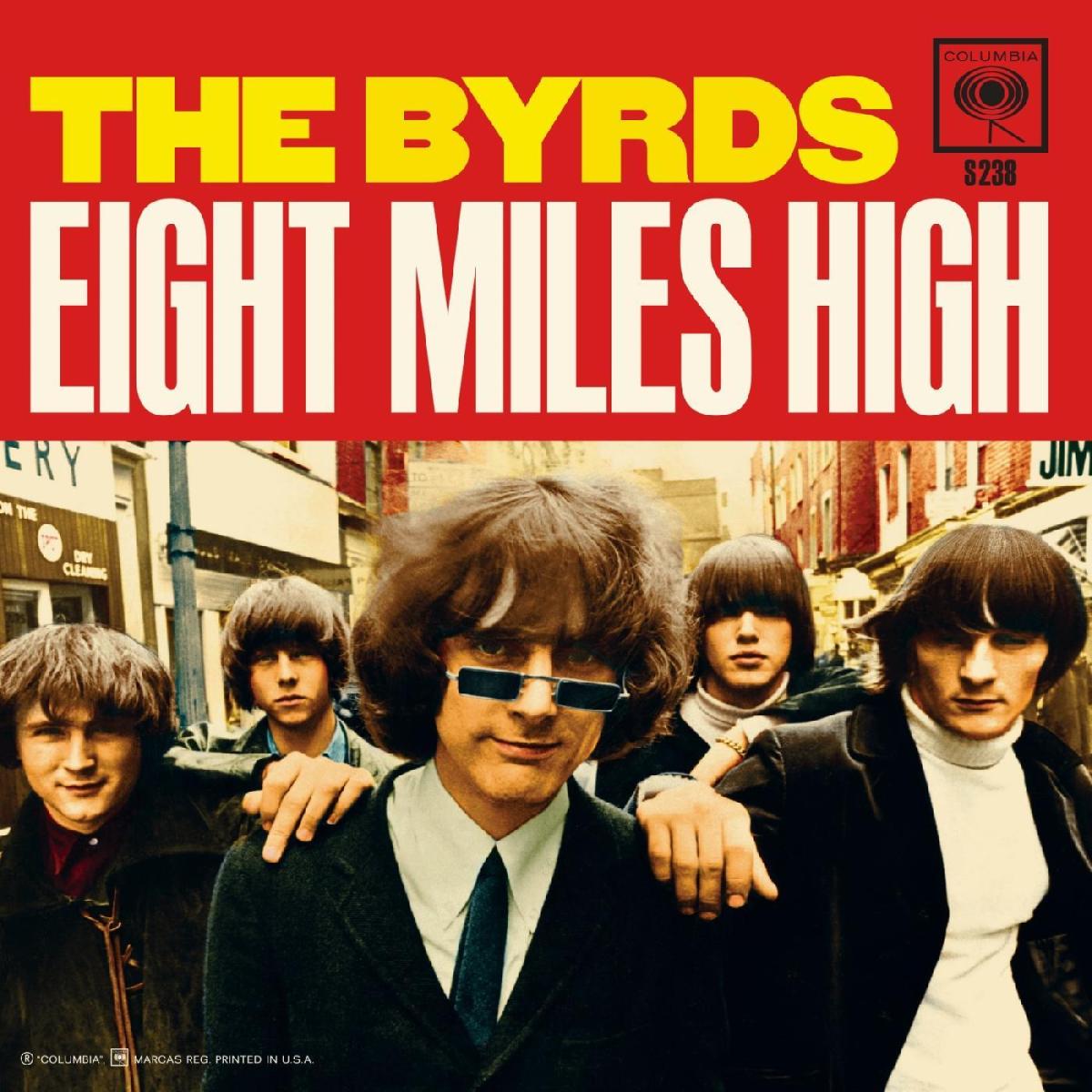
One of the reasons that Roger McGuinn is one of my favorite guitarists is because of this song. Roger has said he was influenced by John Coltrane when arranging the song.
The song peaked at #14 in the Billboard 100 and #24 in the UK in 1966
Many people…including me believe this song is about drugs, but the band claimed it was inspired by a flight where singer Gene Clark asked guitarist Roger McGuinn how high they were in the sky. McGuinn told him six miles, but for the song, they changed it to eight.
Roger McGuinn on Eight Miles High
Eight Miles High has been called the first psychedelic record. It’s true we’d been experimenting with LSD, and the title does contain the word “high”, so if people want to say that, that’s great. But Eight Miles High actually came about as a tribute to John Coltrane. It was our attempt to play jazz.
This story was likely a smokescreen to keep the song in the good graces of sensitive listeners. The band had been doing a lot of drugs at the time, including LSD, which is the likely inspiration. If the band owned up to the drug references, they knew it would get banned by some radio stations, and that’s exactly what happened when a radio industry publication reported that the song was about drugs and that stations should be careful about playing it. As soon as one station dropped it, others followed and it quickly sank off the charts.
When we asked McGuinn in 2016 if the song was really about drugs, he replied: “Well, it was done on an airplane ride to England and back. I’m not denying that the Byrds did drugs at that point – we smoked marijuana – but it wasn’t really about that.”
In his book Echoes, Gene Clark said that he wrote the song on his own with David Crosby coming up with one key line (“Rain gray town, known for its sound”), and Roger McGuinn arranging the song with help from Crosby.
In the Forgotten Hits newsletter, McGuinn replied: “Not true! The whole theme was my idea… Gene would never have written a song about flying. I came up with the line, ‘Six miles high and when you touch down.’ We later changed that to Eight because of the Beatles song ‘Eight Days a Week.’ I came up with several other lines as well. And what would the song be without the Rickenbacker 12-string breaks?”
This song is often cited in discussions of “Acid Rock,” a term that got bandied about in 1966 with the release of Bob Dylan’s Blonde on Blonde album. The genre covers a kind of psychedelic music that became popular at the time, and also the look and lifestyle that went with it. “Acid Rock” was hailed as a pathway to higher consciousness and derided as senseless drug music. At the end of the ’60s, the term petered out, as rock critics moved on to other topics for their think pieces.
The band recorded this on their own, but Columbia Records made them re-record it before they would put it on the album, partly because they had contracts with unions. The Byrds liked the first version better.
Don McLean referred to this in his song “American Pie,” which chronicles the change in musical style from the ’50s to the ’60s. The line is “Eight miles high and falling fast- landed foul out on the grass.” McLean could be sardonically implying that the song is about drugs, since “foul grass” was slang for marijuana.
Husker Du recorded a noise-pop version in 1985.
For decades, the story went that “Eight Miles High” was a commercial failure because it had been banned from radio due to its perceived pro-drug messages. Research presented by Mark Teehan on Popular Music Online challenges this theory. Teehan instead blames the song’s failure to chart on three factors:
First, its sound was too far ahead of its time, and radio stations didn’t know what to do with it.
Second, the departure of Gene Clark led to Columbia Records significantly shrinking the scope of the band’s advertising campaign.
Third, the success of Paul Revere and the Raiders’ “Kicks” further diminished Columbia’s support for the Byrds and “Eight Miles High.”
Eight Miles High
Eight miles high and when you touch down You’ll find that it’s stranger than known Signs in the street that say where you’re going Are somewhere just being their own
Nowhere is there warmth to be found Among those afraid of losing their ground Rain gray town known for its sound In places small faces unbound
Round the squares huddled in storms Some laughing some just shapeless forms Sidewalk scenes and black limousines Some living some standing alone
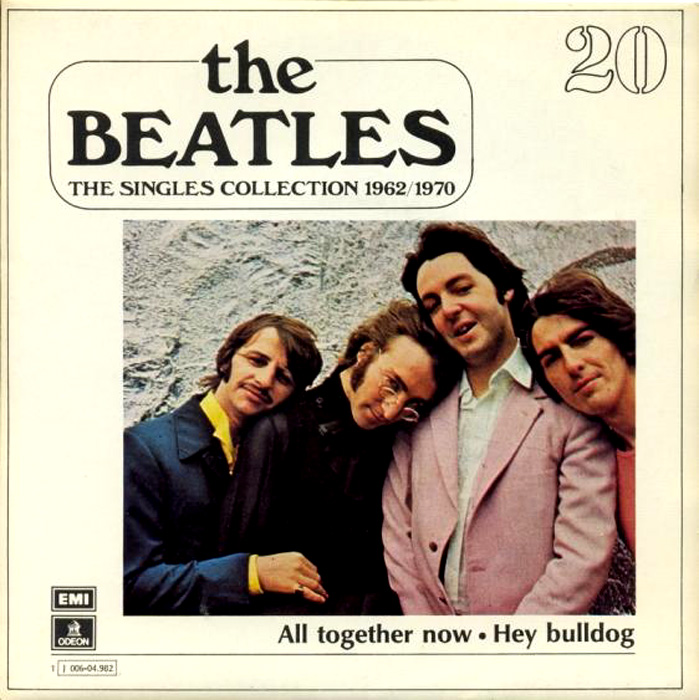
The Beatles recorded this while they were filming the promotional video for “Lady Madonna.” Since they had to be in a studio while filming, Paul McCartney thought they should record a song. This is a nice rocking song written by Lennon. The original name was “Hey Bullfrog” but Paul barked at the end and made John Lennon laugh. They kept in the barking and changed the title, even though there is no mention of a bulldog in the verses or chorus.
John said Hey Bulldog was “a good sounding record that means nothing.” This song would not be out of place today. It is one of the few Beatle songs that gets overlooked and underplayed.
Geoff Emerick, the engineer describes the events of this session. “Even though it was destined to be given to the ‘Yellow Submarine’ film, ‘Hey Bulldog’ was a really strong song. The vibe that day was great… all four Beatles were in an exceptionally good mood because they knew they would be heading to India in a matter of days. Despite the fact that there was a film crew underfoot, it was a Sunday session, so things were quite relaxed – the Abbey Road complex was largely deserted, and The Beatles could wander around the corridors if they wanted to.”
Dave Grohl played the song with Jeff Lynne in 2014 in a tribute to the Beatles after the Grammys.
This was the first recording session to which John Lennon brought Yoko.
This was the last song The Beatles recorded before leaving for a retreat in India to study meditation with the Maharishi.
John Lennon called this “a good sounding record that means nothing.” Musically, it has some interesting nuances. The middle part contains an interesting example of Lennon’s polyphonic technique: The piano in the background does not follow the singer. Near the end of the song, Lennon talks while accompanied by the music, which could be considered a forerunner to Rap. In the climax, Lennon starts shouting, and the others follow. They scream like mad while the guitar in the background plays the same notes again and again as if nothing has happened.
Hey Bulldog
Sheepdog, standing in the rain Bullfrog, doing it again Some kind of happiness is Measured out in miles What makes you think you’re Something special when you smile
Childlike no one understands Jackknife in your sweaty hands Some kind of innocence is Measured out in years You don’t know what it’s like To listen to your fears
You can talk to me You can talk to me You can talk to me If you’re lonely, you can talk to me
Big man (yeah) walking in the park Wigwam frightened of the dark Some kind of solitude is Measured out in you You think you know me, but you haven’t got a clue
You can talk to me You can talk to me You can talk to me If you’re lonely, you can talk to me
Hey hey
Roar
Hey, bulldog (hey bulldog)
Woof
Hey, bulldog Hey, bulldog Hey, bulldog
Hey man
Whats up brother?
Roof
What do ya say
I say, roof
You know any more?
Ah ah (you got it, that’s it, you had it) That’s it man, wo ho, that’s it, you got it
Woah
Look at me man, I only had ten children
Ah ah ah ah ah ah ha ha ha ha Quiet, quiet (ok) Quiet Hey, bulldog, hey bulldog
The first Band album I ever bought was The Best of The Band. When I heard “The Shape I’m In” I knew I was going to like them. I knew the hits of course but the songs I never heard of at that point were great. I then started to buy their albums and loving this band. The song was off on the album Stage Fright and was a B side to the song “Time To Kill.”
There is a great version on The Last Waltz which is below. Robbie wrote the song for Richard to sing and at that time Levon, Rick, and Richard were heavy into heroin and drinking. The song peaked at #64 in Canada.
Robbie Robertson talks some about writing this song
At one time, there was talk that if you wanted to play like the angels, you had to dance with the devil—that heroin was a gateway to music supremacy. That myth was yesterday, but the power of addiction was still in full force. It hit me hard that in a band like ours, if we weren’t operating on all cylinders, it threw the whole machine off course. This was the first time that writing songs was painful for me. In some cases I couldn’t help but reflect on what was happening behind the curtain. I wrote “The Shape I’m In” for Richard to sing, “Stage Fright” for Rick, and “The W. S. Walcott Medicine Show” for Levon—all with undertones of madness and self-destruction. While watching Richard pound out the rhythm on the clavichord, I couldn’t help but see the irony as he sang out, “Oh, you don’t know, the shape I’m in.”
The Shape I’m In
Go out yonder, peace in the valley Come downtown, have to rumble in the alley Oh, you don’t know the shape I’m in
Has anybody seen my lady This livin’ alone would drive me crazy Oh, you don’t know the shape I’m in
I’m gonna go down by the water But I ain’t gonna jump in, no, no I’ll just be lookin’ for my maker And I hear that that’s where she’s been?
Oh, out of nine lives, I spent seven Now, how in the world do you get to Heaven Oh, you don’t know the shape I’m in
I’ve just spent 60 days in the jail house For the crime of having no dough, no no Now here I am back out on the street For the crime of having nowhere to go
Save your neck or save your brother Looks like it’s one or the other Oh, you don’t know the shape I’m in
Now two young kids might start a ruckus You know they feel you’re tryin’ to shuck us Oh, you don’t know the shape I’m in
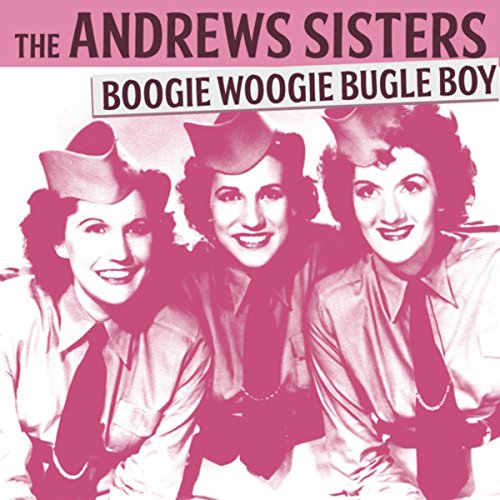
I can’t help but like this song. It’s super catchy and the vocals sound so good. My 18-year-old son of all people got me into listening to 40s music…Frank Sintra and big band and I heard this one on satellite radio and remembered hearing it when I was younger.
The Andrews Sisters made the song famous when they performed it in the 1940 Abbott and Costello movie Buck Privates. The song begins in the movie with a solo trumpeter opening Reveille jazz style before a piano enters with a boogie-woogie bass vamp. Dressed in military uniforms and sitting on barstools drinking malts, the sisters stand up and start singing their inimitable close harmonies (notes near enough to grab with one hand on a piano). At the Academy Awards the following spring, “Boogie Woogie Bugle Boy” won the Oscar for Best Song.
By the time they retired from singing professionally, the Andrews Sisters had become the most successful female vocal group in history to that point, recording some 600 tunes that sold 75 million to 100 million records. When the Vocal Group Hall of Fame opened in Sharon, Pennsylvania, in 1998, they were among the original inductees. “Boogie Woogie Bugle Boy” remains their signature song and was voted number 6 of 365 on the 2001 list Songs of the Century.
There is a 70s version with Bette Midler and a newer version with Katy Perry…I’ll stick with the Andrew Sisters.
Boogie Woogie Bugle Boy
He was a famous trumpet man from out Chicago way
He had a boogie style that no one else could play
He was the top man at his craft
But then his number came up and he was gone with the draft
He’s in the army now, a-blowin’ reveille
He’s the boogie woogie bugle boy of Company B
They made him blow a bugle for his Uncle Sam
It really brought him down because he couldn’t jam
The captain seemed to understand
Because the next day the cap’ went out and drafted a band
And now the company jumps when he plays reveille
He’s the boogie woogie bugle boy of Company B
A-toot, a-toot, a-toot-diddelyada-toot
He blows it eight-to-the-bar, in boogie rhythm
He can’t blow a note unless the bass and guitar is playin’ with ‘I’m
He makes the company jump when he plays reveille
He’s the boogie woogie bugle boy of Company B
He was some boogie woogie bugle boy of Company B
And when he plays the boogie woogie bugle he was busy as a “bzzz” bee
And when he plays he makes the company jump eight-to-the-bar
He’s the boogie woogie bugle boy of Company B
Toot toot toot-diddelyada, Toot-diddelyada, toot-toot
He blows it eight-to-the-bar
He can’t blow a note if the bass and guitar isn’t with ‘I’m
Ha-ha-hand the company jumps when he plays reveille
He’s the boogie woogie bugle boy of Company B
(Instrumental)
He puts the boys to sleep with boogie every night
And wakes ’em up the same way in the early bright
They clap their hands and stamp their feet
Because they know how he plays when someone gives him a beat
He really breaks it up when he plays reveille
He’s boogie woogie bugle boy of Company B
I first heard this song in the seventies and liked it. I ordered Three Dog Night’s Greatest hits off of television. They were very successful in the late sixties and seventies…songs like Joy To The World, Family of Man, Black and White, The Show Must Go On, etc… They racked up 11 top ten hits and 3 number 1’s… and 21 songs in the Billboard 100 altogether.
They were unusual because they had not one, not two…but three lead singers.
I always wondered what “Shambala” meant…now I know. The word ‘Shambala’ has a spiritual meaning in the Buddhist religion, and some Tibetan Buddhists believe that it is a mythical kingdom or a mystical land hidden somewhere in the Himalaya mountains…
The song’s writer, Daniel Moore, told this story. I remember getting excited about the sound of the word, ‘Shambala.’ Before I wrote the song, I called a friend, Eddie Zip, who I’d been working with and telling him, ‘That word Shambala has a magic sound to it, you ought to put together a band and call it Shambala, you couldn’t lose.’ We had just recorded one of his songs titled ‘Don’t Make God’s Children Cry.’ We were getting – ELEVATED!
I wrote the words and melody, a capella, driving on the Ventura Freeway in about 10 minutes. I got home, picked up my Martin guitar and had the music finished in 5 minutes; a pretty good 15 minutes.
The song peaked at #3 in the Billboard 100 and #4 in Canada in 1973.
This is the commercial I ordered it from back in 1970s.
This was written by the songwriter Daniel Moore, and first released by the Texas songwriter B.W. Stevenson. Moore told Songfacts: “Regarding the song, ‘Shambala,’ it was written entirely by myself, Daniel Moore, in the fall of 1972. It was recorded by Three Dog Night in December of 1972. It was recorded by B.W. Stevenson in Late February, 1973 and released two weeks before the Three Dog Night version was released. During those two weeks B.W.’s version sold 125,000 single 45s. Then Three Dog Night released their version and sold 1,250,000 single 45s.”
Later in 1973, with the Three Dog Night version of “Shambala” climbing the charts, Stevenson released a carbon copy single called “My Maria” (credited to Stevenson and Moore), which peaked at #9 US, two months after “Shambala” hit #3.
‘In 1972 my brother, Matthew, called me and informed me that he had received a letter from Dorothy Beg at Lake Pleasant, Massachusetts that told him where and who he had been in his past lives. He had sent a letter to her requesting this information. After recounting several past lives the letter ended with, ‘My messenger tells me to tell you, ‘Let your light shine in the halls of Shambala.” In the phone conversation at that point Matthew said, ‘Shambala, what the hell is that?’
So I did some research and found dozens of references to the word Shambala, the 5000-year-old word originating from Sanskrit. Some were weird, some were goofy but the one I liked was found in Alice Bailey’s Treatise On White Magic. It basically said that there was a gigantic cavern under the Gobi Desert that has a replica of every evolving human being. And when that replica begins to light up or glow (meaning you are cleaning up your act and becoming more spiritual minded or raising your consciousness to a higher level), there is point where your replica gets bright enough to warrant a spiritual teacher being sent to you.
The recording session of my demo in 1972 was with Dean Parks and Jim Varley. Dean (playing bass) was sitting with me (I was engineering, playing the acoustic guitar and singing live) in the control room. We were wearing earphones with the speakers turned off, and 50 feet away at the other end of the studio on the other side of the glass with earphones, was Jim Varley playing drums. Twenty-eight years later I had Greg Beck overdub an electric guitar and that is what you hear on this recording. That’s the only time Dean Parks and Greg Beck have played together, according to Greg.
Three Dog Night heard the song through a publisher, Lindy Blaskey, who was working at ABC Dunhill Publishing. He called me and was very excited because he had gotten such a positive reaction from Three Dog Night and their producer Richie Podler. Anyway, they cut it, it was their single and it was a hit. Bless all of their hearts.
Postscript: In the Guinness Book of World Records, under Prophecies, there is a reference to Shambala where it says, ‘Any one who furthers the name, ‘Shambala’ shall be rewarded 100 times.’ And so it is.”
This was used in a commercial television advertisement campaign for Citgo Petroleum.
Cory Wells, who along with Danny Hutton and Chuck Negron was one of three vocalists in the band, sang lead on this track. Wells died in 2015 at age 74.
Shambala
Wash away my troubles, wash away my pain With the rain in Shambala Wash away my sorrow, wash away my shame With the rain in Shambala
[Chorus] Ah, ooh, yeah, yeah, yeah, yeah, yeah
Everyone is helpful, everyone is kind On the road to Shambala Everyone is lucky, everyone is so kind On the road to Shambala
[Chorus]
How does your light shine, in the halls of Shambala
I can tell my sister by the flowers in her eyes On the road to Shambala I can tell my brother by the flowers in her eyes On the road to Shambala
[Chorus]
How does your light shine, in the halls of Shambala








 PowerPop... An Eclectic Collection of Pop Culture