This was a great cover by The Clash. It was on the London Calling album released in 1979. They started off as a punk band but The Clash, unlike some other Punk bands, could really play and sing well…, especially Mick Jones. He was probably the best pure musician in the band.
The song was originally by Vince Taylor and released in 1959. It was the B side to a song called Pledging My Love. Taylor wrote the song but Tony Sheridan is credited with the cool guitar riff running through the song. The song’s riff reminds me of the original Batman riff…or really the other way around.
The Clash’s version of the song is the best-known. They did it in one take. It was the B side to the single London Calling. The single peaked at #46 in the UK in 1988 re-release. It also peaked at #64 with another UK re-release in 1991.
Rolling Stone magazine named London Calling the best album of the ’80s. It should be noted that it was first released in the UK in December 1979. In the US, it was released two weeks into January 1980, meaning that from a US perspective, it’s a 1980s album.
I like Vince’s version just as well… a good rock song through and through.
Brand New Cadillac
Drive Drive
My baby drove up in a brand new Cadillac Yes, she did My baby drove up in a brand new Cadillac She said, “Hey, come here, daddy” I ain’t never comin’ back
Baby, baby, won’t you hear my plea? Yeah, come on, sugar, just come on back to me She said, “Balls to you, big daddy”
Baby, baby, won’t you hear my plea? Oh, oh, come on, just hear my plea She said, “Balls to you, daddy” She ain’t comin’ back to me
Oh God Baby, baby, drove up in a Cadillac I said, “Jesus Christ, where’d you get that Cadillac?” She said, “Balls to you, daddy” She ain’t never comin’ back She ain’t, she ain’t comin’ back She ain’t never comin’ back She ain’t never comin’ back She ain’t never comin’ back
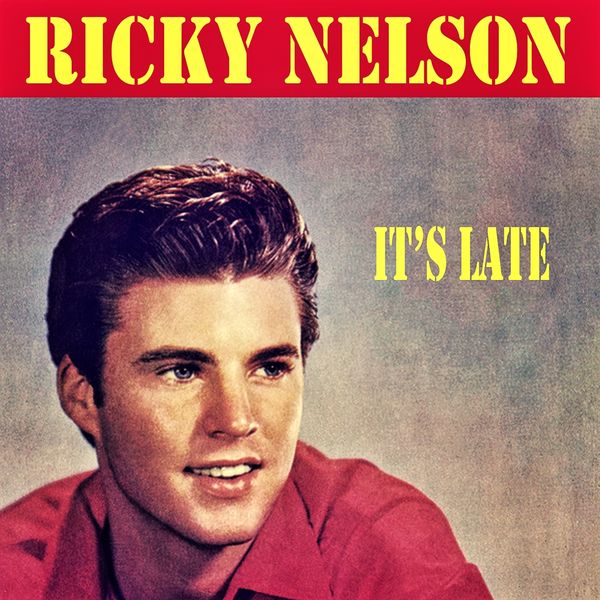
Ricky Nelson was a rockabilly guy and a very good one. He gets lost in the shuffle because he was a huge teenage actor at the time on his family’s show…The Adventures of Ozzie and Harriet. Actors that switch to music are sometimes looked over but Nelson was very successful. All in all, he released 94 singles and 24 studio albums in his career. When talking about the fifties though….Chuck Berry, Fats Domino, Jerry Lee Lewis, Buddy Holly, and Elvis get brought up a lot but Nelson not as much.
t’s Late was written by Dorsey Burnette and his cousin Johnny Burnette and Dorsey released it in 1958. The following year Nelson recorded and released the song. It peaked at #9 on the Billboard 100 and #3 in the UK in 1959.
I went through a Ricky Nelson phase when I graduated high school in 1985. I purchased a greatest hits package and was learning more songs from him. I wanted to go see him perform that year and I kept waiting for him to appear somewhere because I heard he was touring. This was before the internet and you had to look at the newspapers for any announcements and listen to the radio. Musicians would play at places and you would never know sometimes.
I never got a chance to see him because on December 31, 1985, his chartered jet crashed killing him and six other passengers.
I have to admit…I like the Dorsey Burnette version of this also.
It’s Late
It’s late, it’s late We gotta get on home It’s late, it’s late We’ve been gone too long
Too bad, too bad We shoulda checked our time Can’t phone, can’t phone We done spent every dime
It’s late, it’s late We’re ’bout to run outta gas It’s late, it’s late We gotta get home fast
Can’t speed, can’t speed We’re in a slow-down zone Baby, look at that clock Why can’t it be wrong
If we coulda left home at a quarter to nine Woulda had fun and plenty of time We got started just a little bit late Hope this won’t be our last date
Look up, look up Is that the moon we see? Can’t be, can’t be Looks like the sun to me
It’s late, it’s late I hate to face your dad Too bad, too bad I know he’s gonna be mad
It’s late, it’s late We gotta get on home It’s late, it’s late We’ve been gone too long
It’s late, it’s late We’re ’bout to run outta gas It’s late, it’s late We gotta get home fast
Can’t speed, can’t speed We’re in a slow-down zone Baby, look at that clock Why can’t it be wrong
If we coulda left home at a quarter to nine Woulda had fun and plenty of time We got started just a little bit late Hope this won’t be our last date
Look up, look up Is that the moon we see? Can’t be, can’t be Looks like the sun to me
It’s late, it’s late I hate to face your dad Too bad, too bad I know he’s gonna be mad
It’s late, it’s late We gotta get on home It’s late, it’s late We’ve been gone too long
After this song his career started a decline but you could not keep this man down. He would reemerge and have a country hit filled 60s and 70s. The song swings and jumps like Jerry Lee did.
This one was released in 1958 and it peaked at #7 on the Billboard 100, #4 on the Billboard Country Charts, #3 on the R&B Charts, and #8 in the UK. It was released shortly before High School Confidential. Elvis may have had a dangerous reputation but he wasn’t…Jerry Lee was the real deal. If there was ever a wildman of rock…this man would win first prize.
We know most of the stories but forget those. It’s the music that he is remembered for. He helped shape rock and roll and it is still felt to this day. His songs even feel dangerous…he had swing in his music that carried it. He kept the same in his country songs as well.
His piano playing was different than most. He kept a boogie pattern in everything he did. He was influenced by diverse artists such as Al Jolson, Jimmie Rodgers, Hank Williams, Pentecostal preachers, and rhythm and blues music. You combine all of that and you have Jerry Lee Lewis.
On a side note…if you want to hear one of the best live albums ever…give Jerry Lee Lewis, ‘Live at the Star Club, Hamburg’ (1964) a try. It’s the same club that The Beatles played a little earlier.
Jerry Lee Lewis: “I was reading a lot of magazines about Sam Phillips and Sun Records … so I told my dad, this is the man we need to go see. And we did. We drove down from Ferriday into Memphis and pulled up in front of Sun Records. I came in and auditioned for Jack Clement, who said I could never make it playing the piano. He said rock ’n’ roll was out, cause Elvis had it all tied up. He said I could forget that. Well, I said, ‘I don’t think so.’ I said, ‘I’m a hit.’ He said, ‘They all say that, son.’ I said, ‘I’m not all. I’m different.’”
Here is another version by X.
Breathless
Now, if you love me Let’s please don’t tease If I can hold you then Let me squeeze
My heart goes ’round and ’round My love comes a-tumblin’ down You leave me Ahhhhh, breathless-ah
Well, I shake all over and You know why I’m sure it’s love, honey That’s no lie ‘Cause when you call my name You know I burn like wood in flame You leave me Ahhhhh, breathless
Ooh, baby! Mm-mm, crazy! You’re much too much Honey, I can’t love you enough Now, it’s all right to hold me tight But when you love me Love me right
Oh, come on, baby Now, don’t be shy This love was meant for you and I Wind, rain, sleet or snow I’m gonna be wherever you go You have left me Ahhhh, breathless-ah
Oh, keep it goin’
Well, ooh, baby! Mmm-mmm, crazy! You’re much too much I can’t love you enough Well, it’s all right to hold me tight But when you love me Love me right
Well, come on, baby Now, don’t be shy Love was meant for you and I Wind, rain, sleet or snow I’m a goin’ to b-be wherever you go You leave me Ahhhh, breathless
We’re gonna tear down the mailbox, rip up the floor Smash out the windows and knock down the door
Bill Haley heard this song played on an R&B station and wanted to try it. It was different from the country he played. He started this off in a nightclub and people went crazy. He described it as “Cowboy Jive” and everyone rose to their feet…he knew he was on to something here. The song is credited to Doc Bagby, Don Keene, and Harry Crafton.
Bill had a radio show also during this point. The man that followed him on air was a disc jockey named Jim Reeves (not the singer Jim Reeves) and he played R&B. Haley had heard Jimmy Preston’s version of Rock This Joint on Reeves’s show. Haley had been wanting to incorporate countryfied rocking boogies in the repertoire of his band, The Saddlemen, this song seemed to him to be the perfect way to take that concept further.
The one thing I noticed about Haley’s version is guitar player Danny Cedrone’s solo… it was recycled for Rock Around The Clock…note for note. Later on…Bill Haley and his Comets would re-record this song as well.
It was released by Essex Records in 1952 but didn’t get into the national charts. Preston’s version was released in 1949 and is known as one of the first rock and roll records. In 1957 this version was rereleased in the UK and peaked at #20. That same year the Comets would rerecord it and release it but it didn’t chart.
It’s a cool early rock and roll song. There have been 16 different versions of it. Billy Swan and Reverend Horton Heat another to play it.
Rock This Joint
We’re gonna tear down the mailbox, rip up the floor
Smash out the windows and knock down the door
We’re gonna rock, rock this joint
We’re gonna rock, rock this joint
We’re gonna rock, rock this joint
We’re gonna rock this joint tonight
Well, six times six is thirty six
I ain’t gonna hit for six more licks
We’re gonna rock
Rock this joint
We’re gonna rock
Rock this joint
We’re gonna rock
Rock this joint
We’re gonna rock this joint tonight
Do the sugar foor rag, side by side
Flying low and flying wide
We’re gonna rock
Rock this joint
We’re gonna rock
Rock this joint
We’re gonna rock
Rock this joint
We’re gonna rock this joint tonight
Do an ol’ Paul Jones and a Virginia Reel
Just let your feet know how you feel
We’re gonna rock
Rock this joint
We’re gonna rock
Rock this joint
We’re gonna rock
Rock this joint
We’re gonna rock this joint tonight
Well six times six is thirty six
I ain’t gonna hit but six more licks
We’re gonna rock
Rock this joint
We’re gonna rock
Rock this joint
We’re gonna rock
Rock this joint
We’re gonna rock this joint tonight
Don’t be a square man… listen to Eddie Cochran and play backseat bingo. Well, I thought I would try some of the fifties phrases.
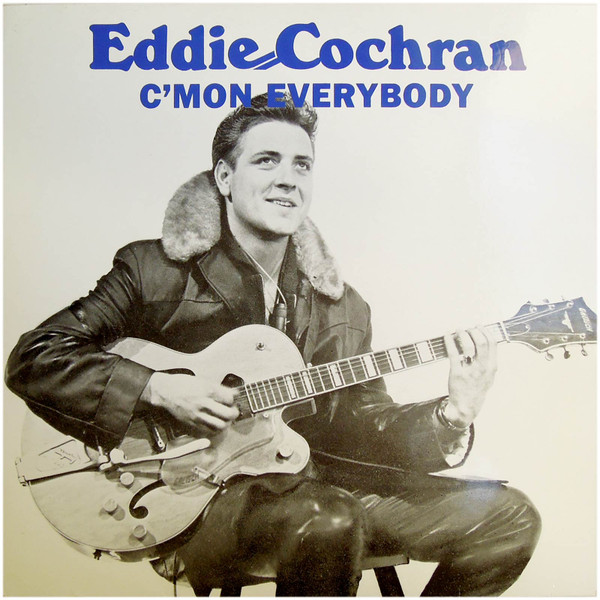
Eddie Cochran was one of the first rock star guitar players…he was ahead of his time. He didn’t use his guitar as a prop like some did (cough cough Elvis)…he played it and played it well. He also worked as a session musician. He helped bring rock guitar along in more ways than just his playing. He was one of the first to modify his pickups and he did away with the wound G string on the guitar. He replaced it with an unwound string which made it easier to bend. Many future musicians were paying attention, sitting on the front row of his British tour.
His influence can be heard throughout rock and roll…It was because Paul McCartney knew the chords and words to “Twenty Flight Rock” that impressed John Lennon enough to ask Paul to become a member of the Quarrymen.
Eddie was popular, especially in the UK where they never forgot the 50s stars that started it all. C’mon Everybody peaked at #6 in the UK and #35 on the Billboard 100 in 1958.
During a British tour in 1960, Eddie Cochran, Gene Vincent, Sharon Sheeley (Eddie’s fiancé), and tour manager Pat Thompkins were in a taxi. They were leaving a show in Bristol, England to go to the London Airport…the taxi hit a lamp post and Eddie was thrown from the car and suffered a head injury and died in a hospital. He was only 21 years old. Gene Vincent received injuries to his already bad leg and walked with a limp after the crash. Eddie was the only one to die.
Sharon Sheeley was a songwriter. She wrote Ricky Nelson’s first hit “Poor Little Fool” and a couple of songs (Love Again and Cherished Memories) for Cochran.
I love the set of this video!
C’mon Everybody
Oh, well, c’mon everybody and let’s get together tonight I got some money in my jeans, and I’m really gonna spend it right Well, I’ve been a doin’ my homework all the week long And now, the house is empty and the folks are gone Ooh, c’mon everybody
Oh well, my baby’s number one, but I’m gonna dance with three or four And then the house’ll be shakin’ from the bare feet a-slappin’ the floor Well, when you hear that music, you can’t sit still If your brother won’t rock, then your sister will Ooh, c’mon everybody
Oh well, we’ll really have a party, but we gotta put a guard outside If the folks come home, I’m afraid they’re gonna have my hide There’ll be no more movies for a week or two No more runnin’ ’round with the usual crew Who cares, c’mon everybody
I never knew that Buddy Holly covered this song…somehow I missed or forgot that he covered it.
This was recorded back in 1956 as one of his first recordings. It wasn’t released until 4 years after he died. The original version is just Buddy on guitar and vocals and Jerry Allison on drums. Producer Norman Petty then overdubbed the other instruments with help from a band called The Fireballs.
I consider him the beginning of power pop. His Fender playing a clean jangling melody. Songs like Maybe Baby, Peggy Sue, and Words of Love influenced future artists like The Beatles, Hollies, Bob Dylan, and the list is endless. He wrote his own songs and is still influencing artists today with a recording career that only lasted less than three years.
Buddy Holly’s music is still relevant almost sixty years after he passed away in 1959. He didn’t have a big voice like Elvis, Little Richard, or some of his peers but he wrote and crafted beautiful melodies for his voice to weave through.
This song peaked at #4 on the UK Charts and #116 on the Billboard 100 in 1963. The song was on an album called Reminiscing. The album peaked at #2 on the UK Album Charts and #40 on the Billboard Album Charts.
Not only was he a great songwriter but also a great producer and he would have only got better. Unlike many of his fifties counterparts, I believe that Buddy Holly would have fit in the music scene post-Beatles. I always thought his best songs were in front of him. Most of his music transcends the fifties and would have fit nicely in the sixties.
Here are two versions…the bottom WITH the overdubs and the other the original raw recording.
Bo Diddley
Bo Diddley buy baby a diamond ring If that diamond ring don’t shine He gonna take it to a private eye If that private eye can’t see
He better not take that ring from me Won’t you come to my house back at home Take a-my baby on away from home Love a-that photo, where ya been Up to your house and gone again Bo Diddley caught a fat cat
To make a-pretty baby a Sunday hat Bo Diddley caught him a nanny goat To make a pretty baby a Sunday coat Bo Diddley, Bo Diddley have you heard My pretty baby says she wants a bird
Do you want to see a club come alive? Start playing What I’d Say by Ray Charles. An absolutely fantastic song by the man. You can stretch this song out to 20 minutes and it doesn’t lose steam. From the opening riff, it never slows down.
It was written by Charles and the call-and-response style was inspired by church music Charles grew up with. When the preacher said something, the congregation shouted it back. “What’d I Say” stands as the epitome of call-and-response in music.
The intro will hook you right off the bat. The Beatles would cover this in Hamburg and The Cavern and make it last 15 or more minutes. Many artists covered this song. The song peaked at #6 on the Billboard 100 and #1 on the R&B Charts in 1959.
He played this song in a club in Brownsville, Pennsylvania in 1958. When he was finishing the song he realised he had 12 more minutes to fill in the set. He told him to follow him and they did. He later said: “I had sung everything I could think of. So I said to the guys, ‘Look, I’m going to start this thing off, I don’t know where I’m going, so y’all just follow me.’ And I said to the girls, ‘Whatever I say, just repeat after me.'” After that night he knew he had something great. He recorded it really fast and got it out.
He called Jerry Wexler at Atlantic Records about his hot new tune and on February 18, 1959, he cut “What’d I Say” in a handful of live takes. The engineer on this song was the great future producer Tom Dowd. The take was very long but Dowd edited down to six and a half minutes. This was his first top ten hit in the Billboard 100 although he had many R&B hits.
Ray Charles continued to include “What’d I Say” in his shows…usually as his encore. In 2002, the Library of Congress added the single to the U.S. National Recording Registry.
What I’d Say
Hey mama, don’t you treat me wrong
Come and love your daddy all night long
All right now, hey hey, all right
See the girl with the diamond ring
She knows how to shake that thing
All right now now now, hey hey, hey hey
Tell your mama, tell your pa
I’m gonna send you back to Arkansas
Oh yes, ma’m, you don’t do right, don’t do right
Aw, play it boy
When you see me in misery
Come on baby, see about me
Now yeah, all right, all right, aw play it, boy
When you see me in misery
Come on baby, see about me
Now yeah, hey hey, all right
See the girl with the red dress on
She can do the Birdland all night long
Yeah yeah, what’d I say, all right
Well, tell me what’d I say, yeah
Tell me what’d I say right now
Tell me what’d I say
Tell me what’d I say right now
Tell me what’d I say
Tell me what’d I say yeah
And I wanna know
Baby I wanna know right now
And-a I wanna know
And I wanna know right now yeah
And-a I wanna know
Said I wanna know yeah
Hey, don’t quit now! (c’mon honey)
Naw, I got, I uh-uh-uh, I’m changing (stop! stop! we’ll do it again)
Wait a minute, wait a minute, oh hold it! Hold it! Hold it!
Hey (hey) ho (ho) hey (hey) ho (ho) hey (hey) ho (ho) hey
Oh one more time (just one more time)
Say it one more time right now (just one more time)
Say it one more time now (just one more time)
Say it one more time yeah (just one more time)
Say it one more time (just one more time)
Say it one more time yeah (just one more time)
Hey (hey) ho (ho) hey (hey) ho (ho) hey (hey) ho (ho) hey
Ah! Make me feel so good (make me feel so good)
Make me feel so good now yeah (make me feel so good)
Whoa! Baby (make me feel so good)
Make me feel so good yeah (make me feel so good)
Make me feel so good (make me feel so good)
Make me feel so good yeah (make me feel so good)
Huh (huh) ho (ho) huh (huh) ho (ho) huh (huh) ho (ho) huh
Aw, it’s all right (baby it’s all right)
Said that it’s all right right now (baby it’s all right)
Said that it’s all right (baby it’s all right)
Said that it’s all right yeah (baby it’s all right)
Said that it’s all right (baby it’s all right)
Said that it’s all right (baby it’s all right)
Whoa! Shake that thing now (baby shake that thing)
Baby shake that thing now now (baby shake that thing)
Baby shake that thing (baby shake that thing)
Baby shake that thing right now (baby shake that thing)
Baby shake that thing (baby shake that thing)
Baby shake that thing (baby shake that thing)
Whoa! I feel all right now yeah (make me feel all right)
Said I feel all right now (make me feel all right)
Whoa! (make me feel all right)
Tell you I feel all right (make me feel all right)
Said I feel all right (make me feel all right)
Baby I feel all right (make me feel all right)
Put your glad rags on and join me, hon We’ll have some fun when the clock strikes one
Bill Haley looked more like your dad than a rock star but his music helped kick rock and roll off. His music was different than Elvis, Chuck, Jerry Lee, Fats, and Buddy Holly. It had a country western swing and jive to it that the others didn’t have. I wanted to cover Mr. Haley today since we had a song yesterday about him. Rock Around The Clock is another B side that was remembered more than the flip side.
Haley started out as a country and western swing singer. He played with a lot of artists such as Hank Williams. Listening to the older pre-rock recordings…he was quite good. He then ran across early versions of rock and roll and combined it with western swing and it worked. He also incorporated some jazz elements in his act.
He toured from the mid-40s to the early 50s playing clubs all over America. He eventually released a song he wrote called Crazy, Man Crazy and it peaked at #12 on the Billboard Hot 100 in 1953. He later switched to Decca and the producer wanted him to release a song called Thirteen Women. The song was about the atom bomb going off and he had 13 women around him. It was the B-Side that will be remembered. As usual…the producer didn’t see a hit on the B-Side…and that would be Rock Around The Clock. What helped the song was that it was included in the film The Blackboard Jungle. That also hurt Haley in the long run because it was connected to teenage delinquency.
The song was written by Max C. Freedman and James E. Myers. It peaked at #1 in the Billboard 100 and #1 in the UK in 1955-56. It recharted in Canada in 1966 and 1968 at #41 both years. It recharted again in 1974 and peaked at #39 on the Billboard 100, #26 in Canada, and #12 in the UK because of Happy Days.
Haley was blinded in his left eye as a child due to a failed operation. Haley later adopted his distinctive spit-curl hairstyle to distract attention from his blind eye. The hairstyle caught on as a 50s-style haircut. His popularity started to decline in America with the emergence of Elvis but he was huge in Europe when he toured there in 1957. They had many more top twenty hits in the UK than in America.
He enjoyed a career resurgence in the late 1960s with the rock and roll revival movement. “Rock Around the Clock” recharted again in 1974 at #34 on the Billboard 100 thanks to Happy Days. That is where I discovered the song and Haley.
He battled alcohol throughout the 60s and 70s. He passed away on February 9, 1981. Haley was posthumously inducted into the Rock and Roll Hall of Fame in 1987.
The A Side…13 Women
Rock Around The Clock
One, two, three o’clock, four o’clock, rock
Five, six, seven o’clock, eight o’clock, rock
Nine, ten, eleven o’clock, twelve o’clock, rock
We’re gonna rock around the clock tonight
Put your glad rags on and join me, hon
We’ll have some fun when the clock strikes one
We’re gonna rock around the clock tonight
We’re gonna rock, rock, rock, ’til broad daylight
We’re gonna rock, gonna rock, around the clock tonight
When the clock strikes two, three and four
If the band slows down we’ll yell for more
We’re gonna rock around the clock tonight
We’re gonna rock, rock, rock, ’til broad daylight
We’re gonna rock, gonna rock, around the clock tonight
When the chimes ring five, six and seven
We’ll be right in seventh heaven
We’re gonna rock around the clock tonight
We’re gonna rock, rock, rock, ’til broad daylight
We’re gonna rock, gonna rock, around the clock tonight
When it’s eight, nine, ten, eleven too
I’ll be goin’ strong and so will you
We’re gonna rock around the clock tonight
We’re gonna rock, rock, rock, ’til broad daylight
We’re gonna rock, gonna rock, around the clock tonight
When the clock strikes twelve, we’ll cool off then
Start a rockin’ round the clock again
We’re gonna rock around the clock tonight
We’re gonna rock, rock, rock, ’til broad daylight
We’re gonna rock, gonna rock, around the clock tonight
Ritchie Valens is known now because of the plane crash, the 1987 movie La Bamba, and the music he made. His rise was short and he was only 17 years old when he died. I remember the movie in the 80s, I went in not knowing much about him except the song La Bamba. I came out with a new appreciation for Ritchie Valens and he carries more influence than his small catalog. Now before you think that I took the movie as gospel…I didn’t but it did get him noticed.
Valens recorded more songs than I ever knew. He recorded 29 songs and he wrote 21 of them. Come On, Let’s Go still sounds fresh and the quality is great. The song peaked at #42 on the Billboard 100 in 1958. It has been covered by Tommy Steel which peaked at #10 in the UK in 1958, The McCoys #22 on the Billboard 100, and Los Lobos for 1987 the movie which peaked at #21 on the Billboard 100 in 1987. After he died, a live album was released as well.
Bob Keane produced most of Ritchie Valens’ recordings. In the summer of 1958, the two hit the road to promote the young new rock singer’s first release which was this song. While in the car, Valens played him another song that he would like to try that he didn’t write. It was a Mexican folk song that Keane didn’t think that audiences would like because of the Spanish lyrics. On top of that…Valens didn’t know much Spanish at all. But…that’s a song for another post.
Valen’s contributions are huge. He is considered a pioneer of Chicano and Latin rock, inspiring many musicians of Mexican heritage. Artists like Santana and Los Lobos are among the artists he influenced. Who knows how far Valens could have gone had the airplane crash hadn’t happened. Not only was he a great performer but he could write as well.
The B side…Framed
Come On, Let’s Go
Well, come on, let’s go, let’s go, little darlin’
Tell me that you’ll never leave me
Come on, come on, let’s go again
Go again and again
Well, now, swing me, swing me, swing me, little darlin’
Come on, let’s go, little darlin’
Let’s go, let’s go again once more
Well, I love you, babe
And I’ll never let you go
Come on, baby, so, oh, pretty baby, I love you so
Well, let’s go, let’s go, let’s go, little sweetheart
Forever we can always be together
Come on, come on, let’s go again
Oh, well, I love you, babe
And I’ll never let you go
Come on, baby, so, oh, pretty baby, I love you so
Well, come on, let’s go, let’s go, little darlin’
Tell me that you’ll never leave me
Come on, come on, let’s go again
Again, again, and again
Again, again, and again
Again, again, and again
I bought some records at a relative’s yard sale when I was really young. A Chuck Berry album, The Doors LA Woman album, and this single. So for a dollar, I took home a great deal. This one is an excellent song with a beat that won’t leave you.
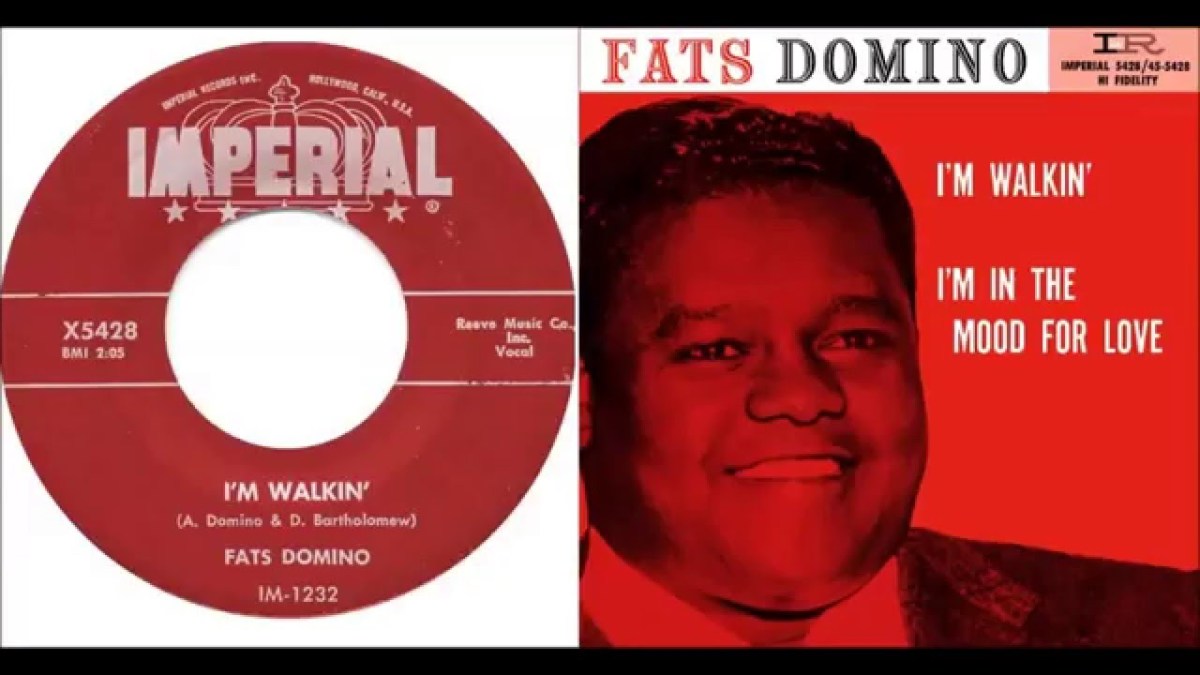
Antoine “Fats” Domino Jr. was not flashy and wild like some of his 1950s peers such as Elvis, Little Richard, and Jerry Lee Lewis. The first I heard of Fats Domino was on “Happy Days” and the song Blueberry Hill.
Domino was the youngest of eight children in a musical family, he spoke Creole French before learning English. At age 7 his brother-in-law taught him how to play the piano. By the time he was 10, he was already performing as a singer and pianist.
This song was inspired by a comment a fan made to Domino after Domino’s car broke down: “Hey, look at Fats Domino, he’s walking!” Domino then thought to himself, “Yeah, I’m walking,” and wrote the song as he walked.
Domino wrote this song with Dave Bartholomew, a fellow New Orleans musician who did a lot of work arranging and composing songs for him. One thing about the song that just jumps out is the sax solo by Herbert Hardesty. He also played on Ain’t That A Shame.
It peaked at #5 in the Billboard 100 and #19 in the UK in 1957.
Domino received The Lifetime Achievement Grammy, a National Medal of the Arts from President Bill Clinton, and induction into the Rock and Roll Hall of Fame. Fats semi-retired in the 80s and said he would not travel outside of New Orleans.
He lived in New Orleans During Hurricane Katrina, he lost most of his possessions and he and his family were rescued by the Coast Guard. He unselfishly made many personal appearances to raise money for the hurricane relief. His house was hit hard and he lost his National Medal and gold records but George Bush gave him another medal to replace the lost one and the RIAA gave him replacement gold records.
To raise money for repairs for his own home, friends and fellow musicians recorded a tribute album, Goin’ Home: A Tribute to Fats Domino, featuring the likes of Robert Plant, Elton John, and Sir Paul McCartney. He was living in New Orleans at the time of his death on October 24, 2017.
I’m Walkin’
I’m walkin’, yes indeed, and I’m talkin’ ’bout you and me
I’m hopin’ that you’ll come back to me (yes)
I’m lonely as I can be, I’m waitin’ for your company
I’m hopin’ that you’ll come back to me
What ‘ya gonna do when the well runs dry?
You’re gonna run away and hide
I’m gonna run right by your side, for you pretty baby I’ll even die
I’m walkin’, yes indeed, I’m talkin’ ’bout you and me
I’m hopin’ that you’ll come back to me
I’m walkin’, yes indeed, and I’m talkin’ ’bout you and me
I’m hopin’ that you’ll come back to me (yes)
I’m lonely as I can be, I’m waitin’ for your company
I’m hopin’ that you’ll come back to me
What ‘ya gonna do when the well runs dry?
You’re gonna sit right down and cry
What ‘ya gonna do when I say bye-bye?
All you’re gonna do is dry your eye
I’m walkin’, yes indeed, I’m talkin’ ’bout you and me
I’m hopin’ that you’ll come back to me
This will be the last Christmas post of 2023. I’m sure a lot of you are relieved!
This song is not only my favorite Christmas Carol… I think it’s up there with the best songs ever written. I hope everyone has a great Christmas/Holiday this year…not only that but have a Happy New Year in 2024.
There are over 26,000 different versions of “Silent Night” on Spotify, meaning you could listen to a different rendition of the carol every night for 72 years.
Halfway through December 1818, the church organ in St. Nicholas in Oberndorf, 11 miles north of Salzburg in what is now Austria, broke (a popular version of the story claims that mice had eaten out the bellows). The curate, 26-year-old Josef Mohr, realized it couldn’t be repaired in time to provide music on Christmas Eve. He told his troubles to his friend, a headmaster and amateur composer named Franz Gruber, while giving him as a present a poem he had written two years earlier. Gruber was so taken by the rhythm of the poem that he set it to music, and on Christmas Eve there was music after all. Mohr played his guitar while the pair sang the song. It was the first public performance of “Stille Nacht” or as we know it “Silent Night.”
It is believed that Silent Night has been translated into over 300 languages around the world, and it is one of the most popular carols of all time.
From Songfacts
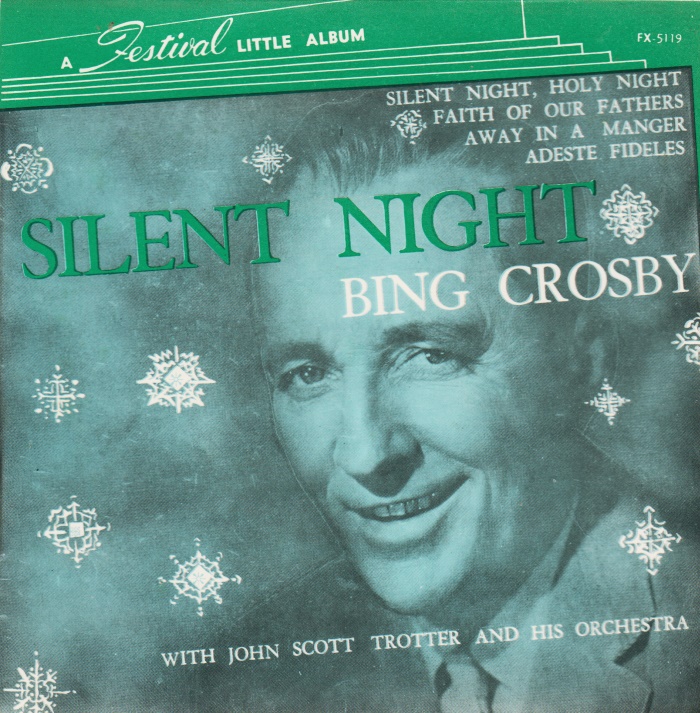
Bing Crosby’s version became his best-seller of the 1930s.
Music licensing company PPL announced in December 2010 that this carol tops the list of Britain’s “most recorded Christmas song of all time.” Said Mike Dalby, Lead Reporting Analyst at PPL: “Silent Night is a beautiful carol which encapsulates the feeling of Christmas entirely. Everyone from punk band The Dickies right through to Sinead O’Connor has recorded it, which exemplifies just how much it resonates with all different types of artists.”
According to PPL, Sinead O’Connor’s 1991 recording was the most popular version of the carol in Britain.
When the organ builder finally did show up to repair the St. Nicholas organ, he was given a copy of the “Silent Night” composition and brought it home. From there, traveling folk singers got a hold of it and began incorporating the carol into their repertoire. It didn’t make its way to America until 1839.
As the song gained traction throughout Europe, Franz Gruber composed several different orchestral arrangements. He donated all profits from the carol to local charities for children and the elderly, and eventually died penniless.
According to Steve Sullivan’s Encyclopedia of Great Popular Song Recordings, Crosby, a devout Catholic, refused to record the religious song, arguing it would be “like cashing in on the church or the Bible.” Crosby met with Father Richard Ranaghan, a priest trying to raise money for overseas missions, and decided to donate the royalties to the cause. But Ranaghan died in a car accident later that year, so the money went to several charities throughout the US and abroad.
This song lends itself to interpretation because the first four bars are all on the same chord. Jim Brickman explains: “There’s room to treat it dynamically in a different way: in the tempo, in the sounds and silences, in the time signature.”
Silent Night
Silent night, holy night.
All is calm, all is bright.
‘Round yon virgin mother and child.
Holy infant so tender and mild.
Sleep in heavenly peace,
Sleep in heavenly peace.
Silent night, holy night.
All is calm, all is bright.
‘Round yon virgin mother and child.
Holy infant so tender and mild.
Sleep in heavenly peace,
Sleep in heavenly peace.
There have been many versions of this great story. I would safely say this is the most popular Christmas story of them all. This is the version that I like the most. The great Alastair Sim plays Ebenezer Scrooge and he is the reason I like this so much. When I think of the Scrooge… I think of him. I like a lot of other renditions of this story but this one is my goto version.
The movie is in black and white which turns some people off but it makes it that much better to me. They do have a color version but trust me…watch the black and white version. It gives the movie a darker feeling.
The effects they use are obviously not CGI but they get the point across well and serve the story. I like the scene where the ghost of Jacob Marley is warning Ebenezer of being greedy…the two were not on the set at the same time…it looked really good for being 1951…or anytime for that matter.
So get some eggnog or hot butter rum and sit back and watch this great movie.
From IMDB…spoilers
Ebenezer Scrooge (Alastair Sim) is a greedy businessman who thinks only of making money. For him, Christmas is, in his own words, a humbug. It has been seven years since his friend and partner, Jacob Marley (Sir Michael Hordern), died and on Christmas Eve. Marley’s ghost tells him he is to be visited during the night by three spirits. The Ghost of Christmas Past (Michael Dolan) revisits some of the main events in Scrooge’s life to date, including his unhappy childhood, his happy apprenticeship to Mr. Fezziwig (Roddy Hughes), who cared for his employees, and the end of his engagement to a pretty young woman due to a growing love of money. The Ghost of Christmas Present (Francis De Wolff) shows him how joyously is nephew Fred (Brian Worth) and his clerk, Bob Cratchit (Mervyn Johns), celebrate Christmas with those they love. The Ghost of Christmas Yet to Come (Czeslaw Konarski) shows him what he will leave behind after he is gone. Scrooge awakens on Christmas morning, a new man intent on doing good and celebrating the season with all of those around him.
Dave has asked us…The magic that is Christmas is that you can invite any musician (or person from the music world) to be your guest. Even if they’ve passed away, they can be at your table for a meal and a few stories. So, who would you invite? And any little musical gift you hope they might possibly come with?
Well, I’m cheating a bit…my Christmas guest left the earth in 1964 and yes, he was a musician…just not a rock musician. He played the harp and played it quite well…his nickname even contained that name…Harpo Marx. But Max…why not a rock musician? If I had to pick a rock musician, it would be one of two people. John Lennon or Keith Moon. I would say Lennon would be my number one choice but I wanted to go a different route.
Why am I picking Harpo? He hung out with the top artists, writers, musicians, and athletes of his time. He was always at peace with himself. He has said he never had a bad night’s sleep. The guy was close to what you see on screen. He had so many stories about his life that just those would keep you entertained. There are more reasons…but here are some of the things he did.
The man was born in 1888 and grew up in New York. He didn’t graduate from high school…no, he jumped out the window of his second-grade classroom and never went back to his teacher Miss Flatto. Did the lack of education stop him in life? No, not at all as you will see.
In 1909 his mother Minnie roped him into appearing on stage with his brothers in a singing play. He was dressed in a duck suit and promptly peed in his pants. “Coney Island, New York. Made my debut at Henderson’s and peed in my pants. I felt shamed and disgraced, but Minnie wouldn’t let me quit the act on any such flimsy pretext. She hung my trousers out to dry in the sea breeze between shows. By the second show, I was much less scared, so enthusiastic in fact that everybody was afraid I might sing. But I didn’t. I just opened my mouth when Groucho did.”
The brothers hit the vaudeville circuit and any rock stars who say their beginning was rough…they don’t know what rough is. The Brothers would stay in boarding houses when possible but sometimes slept in the park. They ate food that was infested with bugs and people treated them terribly because show people were frowned upon at that time. They were in Vaudeville from 1909 to 1924. That was a lot of hard living and the brothers were in their mid-thirties before they hit Broadway.
The review that would change Harpo’s life came in 1924 in their first play (I’ll Say She Is) to make Broadway. The review was written by the author Alexander Woollcott. He wrote glowingly about all the brothers, but Harpo is the one he singled out. Woollcott met Harpo backstage and soon introduced Harpo to some of the most sophisticated writers and artists of that time. Harpo soon became a member of the Algonquin Round Table. That was where witty and cutting remarks flowed like water. Groucho said it was like falling in a den of lions. Some of the regulars were Dorothy Parker, Alexander Woollcott, Heywood Broun, Robert Benchley, Robert Sherwood, George S. Kaufman, Franklin P. Adams, Marc Connelly, Harold Ross, and Russell Crouse. Harpo has said that he was a professional listener. Despite only having a 2nd grade education he could hold his own and was a vivacious reader.
Kaufman would co-write 2 plays for the brothers, The Cocoanuts and Animal Crackers. They were Broadway smashes and soon the brothers would be making movie versions of both. In 1929 they made The Cocoanuts movie in New York while acting in Animal Crackers on Broadway. They would make Animal Crackers next and then move to Hollywood. Their film career lasted from 1929 to 1949 with a movie called Love Happy with Marilyn Monroe. They made 13 in all.
Harpo was a happy bachelor until he met Susan Fleming in 1932 and they were married in 1936. He was very much like his character on the screen except he talked of course. He hung out with royalty, artists, and even toured Russia in 1933 and carried secret papers taped to his leg out of the country for America. He never found out what he risked is life for though. Some FBI agents got the papers as soon as he got to New York.
Harpo and Susan wanted children, so they adopted. Harpo had said he wanted a child in every window when he went to work. So, they adopted 4 kids and from all accounts…was one of the best dads you could possibly get. If he came home late, he would sometimes wake one of his children just to play games with them. None of his kids ever wrote books on how bad he was or ever said anything bad publicly. He did have a set of rules that he went by and had them pinned up. This is them and I had the same rules on our refrigerator when Bailey was small, although a few were altered because we had no pool table or harp.
Life has been created for you to enjoy, but you won’t enjoy it unless you pay for it with some good, hard work. This is one price that will never be marked down.
You can work at whatever you want to as long as you do it as well as you can and clean up afterwards and you’re at the table at mealtime and in bed at bedtime.
Respect what the others do. Respect Dad’s harp, Mom’s paints, Billy’s piano, Alex’s set of tools, Jimmy’s designs, and Minnie’s menagerie.
If anything makes you sore, come out with it. Maybe the rest of us are itching for a fight, too.
If anything strikes you as funny, out with that, too. Let’s all the rest of us have a laugh.
If you have an impulse to do something that you’re not sure is right, go ahead and do it. Take a chance. Chances are, if you don’t you’ll regret it – unless you break the rules about mealtime and bedtime, in which case you’ll sure as hell regret it.
If it’s a question of whether to do what’s fun or what is supposed to be good for you, and nobody is hurt whichever you do, always do what’s fun.
If things get too much for you and you feel the whole world’s against you, go stand on your head. If you can think of anything crazier to do, do it.
Don’t worry about what other people think. The only person in the world important enough to conform to is yourself.
Anybody who mistreats a pet or breaks a pool cue is docked a months pay.
Harpo played in some of the seediest joints you could imagine and had to endure a lot of antisemitism, but he was loved by all around him including children and animals.
His son Bill, who is a talented musician, released a book a few years ago. He said in 1964 that Harpo loved The Beatles when they first arrived. Bill was a professional piano player and he didn’t think The Beatles would last. Harpo told him that he better get used to them because they would be remembered in history because they were starting something new. Bill said six years later he was playing a gig and many of his songs were Beatle songs. He thought… “Dad was right again” while playing Let It Be.
Here is an intro that Harpo wrote to Harpo Speaks…I thought you would enjoy this…he gives a brief story of him.
I’ve played piano in a whorehouse. I’ve smuggled secret papers out of Russia. I’ve spent an evening on the divan with Peggy Hopkins Joyce. I’ve taught a gangster mob how to play Pinchie Winchie. I’ve played croquet with Herbert Bayard Swope while he kept Governor Al Smith waiting on the phone. I’ve gambled with Nick the Greek, sat on the floor with Greta Carbo, sparred with Benny Leonard, horsed around with the Prince of Wales, played Ping-pong with George Gershwin. George Bernard Shaw has asked me for advice. Oscar Levant has played private concerts for me at a buck a throw. I have golfed with Ben Hogan and Sam Snead. I’ve basked on the Riviera with Somerset Maugham and Elsa Maxwell. I’ve been thrown out of the casino at Monte Carlo. Flush with triumph at the poker table, I’ve challenged Alexander Woollcott to anagrams and Alice Duer Miller to a spelling match. I’ve given lessons to some of the world’s greatest musicians. I’ve been a member of the two most famous Round Tables since the days of King Arthur—sitting with the finest creative minds of the 1920s at the Algonquin in New York, and with Hollywood’s sharpest professional wits at the Hillcrest. (Later in the book, some of these activities don’t seem quite so impressive when I tell the full story. Like what I was doing on the divan with Peggy Hopkins Joyce. I was reading the funnies to her.) The truth is, I had no business doing any of these things. I couldn’t read a note of music. I never finished the second grade. But I was having too much fun to recognize myself as an ignorant upstart. I can’t remember ever having a bad meal. I’ve eaten in William Randolph Hearst’s baronial dining room at San Simeon, at Voisin’s and the Colony, and the finest restaurants in Paris. But the eating place I remember best, out of the days when I was chronically half starved, is a joint that was called Max’s Busy Bee. At the Busy Bee, a salmon sandwich on rye cost three cents per square foot, and for four cents more you could buy a strawberry shortcake smothered with whipped cream and a glass of lemonade. But the absolutely most delicious food I ever ate was prepared by the most inspired chef I ever knew—my father. My father had to be inspired because he had so little to work with. I can’t remember ever having a poor night’s sleep. I’ve slept in villas at Cannes and Antibes, at Alexander Woollcott’s island hideaway in Vermont, at the mansions of the Vanderbilts and Otto H. Kahn and in the Gloversville, New York, jail. I’ve slept on pool tables, dressing-room tables, piano tops, bathhouse benches, in rag baskets and harp cases, and four abreast in upper berths. I have known the supreme luxury of snoozing in the July sun, on the lawn, while the string of a flying kite tickled the bottom of my feet.
I can’t remember ever seeing a bad show. I’ve seen everything from Coney Island vaudeville to the Art Theatre in Moscow. If I’m trapped in a theatre and a show starts disappointingly, I have a handy way to avoid watching it. I fall asleep. My only addictions—and I’ve outgrown them all—have been to pocket billiards, croquet, poker, bridge and black jelly beans. I haven’t smoked for twenty years.
The only woman I’ve ever been in love with is still married to me.
My only Alcohol Problem is that I don’t particularly care for the stuff.
Who wouldn’t want to talk to this man? Thank you…and as far as a musical gift… I would love to hear Harpo play either the Harp, or piano, or just tell me Vaudeville stories!
Nice little Christmas song by Chuck Berry… the father of Rock and Roll. The song has a “Carol” vibe to it and that is never a bad thing. It was one of the first rock and roll Christmas songs and it was released in 1958.
Berry based this song on “Rudolph The Red-Nosed Reindeer,” giving Rudolph a bit of an attitude as he delivers the toys. The song is credited to Johnny Marks and Marvin Brodie. Johnny Marks wrote Rudolph the Red Nose Reindeer. Chuck puts his stamp on this song.
The song is sometimes known as “Run Run Rudolph,” which is how it appears on some other covers. Other artists to record the song include Sheryl Crow, Bryan Adams, The Grateful Dead, Jimmy Buffett, Dwight Yoakam, Bon Jovi, and Keith Richards.
The song peaked at #69 in the Billboard 100 in 1958 and has re-charted many times through the years…it peaked at #36 in the Billboard 100 in January of 2020…and I’m sure it is charting now.
The song appeared in a lot of films including Home Alone, Diner, The Santa Clause 2, Cast Away, and Jingle All the Way.
Run Rudolph Run
Out of all the reindeers you know you’re the mastermind Run, run Rudolph, Randalph ain’t too far behind Run, run Rudolph, Santa’s got to make it to town Santa make him hurry, tell him he can take the freeway down Run, run Rudolph ’cause I’m reelin’ like a merry-go-round
Said Santa to a boy child what have you been longing for? All I want for Christmas is a rock and roll electric guitar And then away went Rudolph a whizzing like a shooting star Run, run Rudolph, Santa’s got to make it to town Santa make him hurry, tell him he can take the freeway down Run, run Rudolph, reeling like a merry-go-round
Run, run Rudolph, Santa’s got to make it to town Santa make him hurry, tell him he can take the freeway down Run, run Rudolph, reeling like a merry-go-round
Said Santa to a girl child what would please you most to get? A little baby doll that can cry, sleep, drink and wet And then away went Rudolph a whizzing like a Saber jet Run, run Rudolph, Santa’s got to make it to town Santa make him hurry, tell him he can take the freeway down Run, run Rudolph ’cause I’m reelin’ like a merry-go-round
One of the best riffs in blues or rock. It’s been recycled in so many songs but never loses its bite. This song was a reworking of the Bo Diddley song “I’m A Man.” Great song by the great Muddy Waters.
Muddy recorded several versions of this song through the years. He recorded the original at Chess Records in Chicago in 1955. One of the reasons I love this song so much is because the guitar line is easy to play but very memorable. Waters used the same basic riff on his song “Hoochie Coochie Man.” George Thorogood also used it for his song “Bad To The Bone.”
The song peaked at #51 in the UK in 1988 and #5 in the R&B Charts in 1955.
Muddy Waters originally recorded this in 1955, then re-recorded it in 1977 for his Hard Again album in a version produced by Johnny Winter. The song was written by Muddy Waters, Mel London, and Bo Diddley.
He was born McKinley Morganfield in Rolling Fork, Mississippi, around 1913. Nicknamed “Muddy” as a child, he worked on the huge Stovall cotton plantation before following the northward migration of African Americans to Chicago, where he drove a truck and signed to Chess Records, a tiny blues label run by two émigré Polish brothers, Leonard and Phil Chess. As Muddy Waters, he established himself as a pioneering electric blues musician in the early 1950s.
Mannish Boys
Oh, yeah
Oh, yeah
Everything gonna be alright this mornin’
Now, when I was a young boy
At the age of five
My mother said I was gonna be
The greatest man alive
But now I’m a man
I’m age twenty-one
I want you to believe me, honey
We having lots of fun
I’m a man (yeah)
I spell M
A, child
N
That represent man
No B
O, child
Y
That spell mannish boy
I’m a man
I’m a full-grown man
I’m a man
I’m a rollin’ stone
I’m a man
I’m a hoochie-coochie man
Sittin’ on the outside
Just me and my mate
I’m made to move
Come up two hours late
Wasn’t that a man?
I spell M
A, child
N
That represesnt man
No B
O, child
Y
That spell mannish boy
I’m a man
I’m a full-grown man
I’m a man
I’m a rolllin’ stone
I’m a man
Full-grown man
Oh, well
Oh, well









 PowerPop... An Eclectic Collection of Pop Culture