Kinks Weeks – Autumn Almanac … number1sblog.com

I’ve been visiting Stewart at Number1sblog for a few years. His blog never lets me down. Learning about #1 songs in the UK and how different the American charts can be from them. He is currently in the year 1998 but travel back to see the previous years also. He always gives you a quality take on every #1 song. 

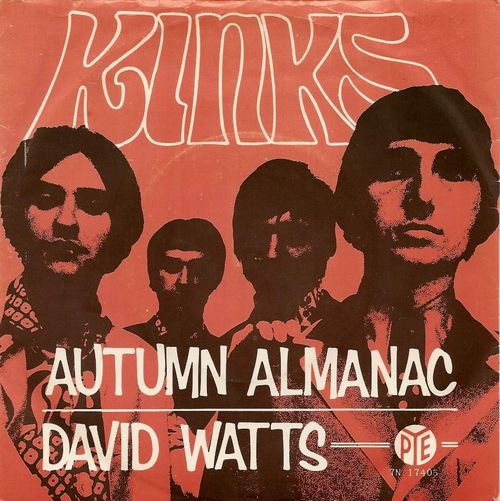
The Kinks, ‘Autumn Almanac’

Thanks, Max, for giving us the space to write about our favourite songs from Britain’s third-best band of the 1960s. And yes, the Kinks were the sixties ‘third’ British band. Forget the Who, or the Hollies. Don’t dare mention Manfred Mann or Herman’s Hermits! In bronze position, behind the Beatles and the Stones, stand Muswell Hill’s finest.

The Kinks scored twelve top ten hits, and three number ones, between 1964 and 1967, with their last big chart hit of the sixties being ‘Autumn Almanac’. And if you needed an example of why many non-Brits might not choose the Kinks as the ‘60s third-best band, then this is the perfect record.

Not many pop songs talk of sweeping leaves, of crawly caterpillars, buttered currant buns, or of rheumatic backs. Nothing very rock ‘n’ roll there. Nor is there in the middle-eight: I like my football on a Saturday, Roast beef on Sundays, All right… It’s quintessential Kinks: tongue-in-cheek vignettes of British life. Not as famous as Terry and Judy from ‘Waterloo Sunset’, the unnamed aristocrat in ‘Sunny Afternoon’, or the legendary ‘Lola’, but every bit as vital. No wonder Blur’s Damon Albarn named ‘Autumn Almanac’ as his favourite Kinks’ record, given that he spent much of the nineties trying to recreate it…

But before it all gets too cozy and twee, Ray Davies turns his attention to British ideas of respectability, and the class system. This is my street, And I’m never gonna leave it… If I live to be ninety-nine… The singer is trapped in his lower-middle class environment. Everyone he meets, seems to come from his street, and he can’t get away… No social climbing allowed.

For this to be the Kinks final Top 10 record of the decade is fitting. It’s the culmination of their move away from the garage rock of ‘You Really Got Me’, through to more traditional, folksy pop. ‘Autumn Almanac’ is at one moment crunchy guitars, the next a trombone-led, music hall singalong.

But while it’s easy to claim that the Kinks were too ‘British’ for American audiences, leading to less chart success as the sixties went on; that’s not quite the full picture. The fact that they had been banned from touring the States since 1965 thanks to their habit of attacking one another on stage was probably a much more pressing reason.

Still, maybe it was a blessing in disguise, for the touring ban coincided with a change in their sound. Their hard-rocking early hits are great, but for me the classic Kinks period starts with the hilariously catty ‘Dedicated Follower of Fashion’, through ‘Dead End Street’, and the timeless ‘Waterloo Sunset’, to this. My answer might change depending on which time of year it is, but ‘Autumn Almanac’ will always be close to the top of my ‘Best Kinks Songs’ list.

Beatles Week – Please Please Me @number1sblog.com

I’ve been visiting Stewart at Number1sblog for a few years. His blog never lets me down. Learning about #1 songs in the UK and how different the American charts can be from them. He is currently in the year 1989 but travel back to see the previous years also. He always gives you a quality take on every #1 song. 

Stewart writes about every UK number one single at number1sblog.com. He’s 630 singles in, give or take, and about to enter the 1990s…

When Max asked us to write a post on our favourite Beatles song, I instantly thought about choosing one of their seventeen UK number one singles. It would have been ‘on-brand’ for me, at least, at the number 1s blog. But I’ve been there and done those, so I decided to cast my eye one place further down the charts.

The Fab Four have two very famous #2 singles. One is the ‘Penny Lane’ / ‘Strawberry Fields Forever’ double-A that became their first single in four years not to make #1, in March 1967 (famously held off by none other than Engelbert Humperdinck). The other is the single that introduced them to the British public in January 1963: ‘Please Please Me’.

‘Love Me Do’ had been the Beatles’ first single to make the charts a few months before. It has huge significance, for obvious reasons, in the history of the band but I’ve never loved it. It’s slow, it’s a bit predictable. Not terrible, not at all, but I can’t imagine many who heard it on the wireless in October 1962 thinking that this new band were going to change the world. ‘Please Please Me’, however…

There are many moments in the Beatles’ discography in which they took a lightyear-sized step towards the future, and this was the first. The tempo has increased a hundred-fold from ‘Love Me Do’, everything – guitars, vocals, drums – is tight, the harmonies inspired by the Everly Brothers, the harmonica in the intro an alarm announcing them to the world. John Lennon was the main player here: he wrote it, and it’s his harmonica that gives the song its distinctive hook. It’s a simple song (a lot of the early, early Merseybeat hits were traditional pop arrangements modernised with guitars and drums) and originally a slow, bluesy number that George Martin thought was dreary. It’s him we have to thank for upping the tempo, and turning this into a rattling, breakneck pop hit, with that wonderful, swinging middle-eight.

The record was released during one of Britain’s worst-ever winters, and legend has it that the audience for their performance of the song on ‘Thank Your Lucky Stars’ on January 19th would have even larger than usual, with large swathes of the country snowbound. This was the first time most people had seen or heard The Beatles, with their long (by 1963 standards) hair and their natty suits. It created a buzz, and got them booked on tours supporting Tommy Roe, Helen Shapiro, and Roy Orbison. ‘Please Please Me’ began to shoot up the charts, and by the time those tours came around The Beatles had been bumped up the bill to headliners. Martin predicted that it would be the Beatles’ first number one hit, and he was correct.

Well, sort of… The singles charts of the 1950s and ’60s were a tad messy. There wasn’t just one of them, for a start. You had the ‘Melody Maker’ chart, the ‘NME’ chart, and the ‘Record Retailer’ chart. None of which offered a complete overview of a week’s sales – they all conducted ‘surveys’ of select record stores over the phone. ‘Please Please Me’ hit #1 in the NME chart (which had the largest circulation) and ‘Melody Maker’ chart, but it only reached #2 in ‘Record Retailer’, which was the one that the Official Singles Chart chose to follow. So, it may well have been the UK’s biggest selling single at some point; we’ll just never know for sure… The history books record it as having stalled behind Frank Ifield’s dull-as-dishwater country ballad ‘The Wayward Wind’ for two weeks.

It’s far from the only single to have suffered this unfortunate fate – it wasn’t until 1969 that the UK charts were unified into one – but it’s a landmark single from the biggest pop group in history, with one of the very best middle-eights. And it set the tone for the next two years, in which the Fab Four would release single after single of pop perfection. ‘From Me to You’, the record that officially gave them their first #1, was perhaps a step back towards ‘Love Me Do’. But then came ‘She Loves You’, and ‘I Want to Hold Your Hand’, and there was no looking back.

It’s interesting to note that an intervention from George Martin, and a particularly snowy winter, contributed to the official start of Beatlemania. Of course a band as good as the Beatles, with a songwriting partnership as prolific as Lennon-McCartney, would have made it eventually. It’s just fitting that ‘Please Please Me’, their first of many, many great songs, was the record that did it.