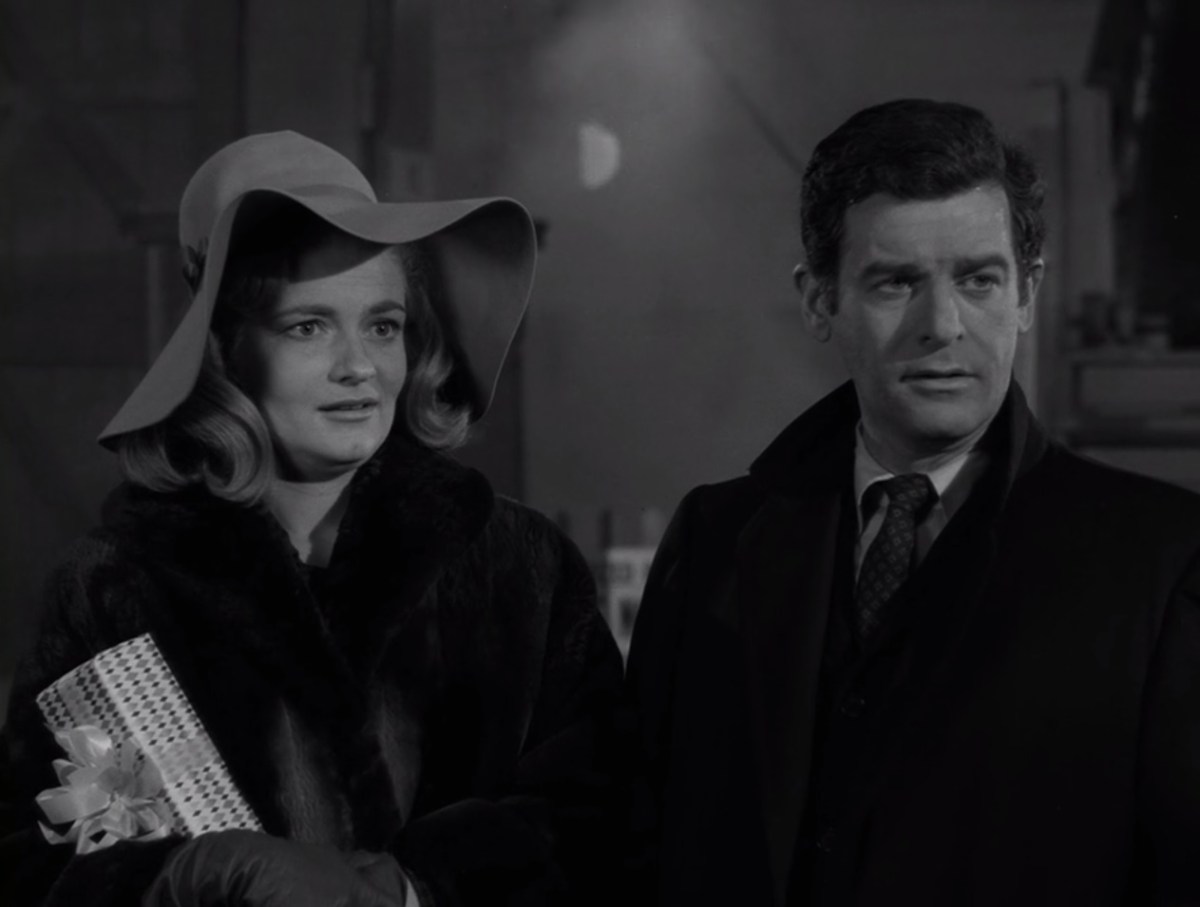
This one dishes out some Twilight Zone poetic justice to one of the characters. Patrick O’Neal plays Harmon Gordon who marries a much younger woman and then fails to keep up with her. He seeks an experimental serum from his brother Raymond that Raymond is heistant to give him. The serum is designed to make people younger but it has not been tested enough.
Ruta Lee plays Flora Gordon and it’s clear that why she married Harmon. Harmon acts blind to the way Flora treats him but Raymond sees through the situation. I don’t feel a lot of sympathy for Harmon because he had to know what he was geting himself into. The ending is a twist that I didn’t see coming the first time I watched it.
It’s not in the upper class of the Twilight Zone but not a bad one to watch.
From IMDB:
Until episodes became available on VHS and DVD, this was one of four “lost” episodes of The Twilight Zone (1959) that were not included with syndication packages during the 1960s through the 1980s. The other three were The Twilight Zone: Miniature (1963), The Twilight Zone: Sounds and Silences (1964), and The Twilight Zone: The Encounter (1964). This episode, “Miniature,” and “Sounds and Silences” were excluded from the package because of lawsuits that had been filed claiming those episodes were plagiarized. “The Encounter” had drawn complaints of anti-Japanese prejudice and epithets expressed by one of the characters. The episodes were finally re-released for broadcast television in a 1983 special hosted by Patrick O’Neal, the lead actor of “Fountain”.
This show was written by Rod Serling and Lou Holtz
Rod Serling’s Opening Narration:
Picture of an aging man who leads his life, as Thoreau said, ‘in quiet desperation.’ Because Harmon Gordon is enslaved by a love affair with a wife forty years his junior. Because of this, he runs when he should walk. He surrenders when simple pride dictates a stand. He pines away for the lost morning of his life when he should be enjoying the evening. In short, Mr. Harmon Gordon seeks a fountain of youth, and who’s to say he won’t find it? This happens to be the Twilight Zone.
Summary
Harmon Gordon is now quite elderly but is married to Flora, an attractive woman some 40 years younger than him. She’s something of a gold digger and is now quite bored with her marriage. Harmon turns to his younger brother Raymond, a medical doctor who has been experimenting with cellular regeneration. Raymond’s experiments to date have been on lab animals and he’s reluctant to help Harmon as he has no idea what effect his youth serum might have on him. In the end, he administers his serum and by the next day Harmon is a new man, so to speak.
It happens to be a fact: as one gets older, one does get wiser. If you don’t believe it, ask Flora. Ask her any day of the ensuing weeks of her life, as she takes notes during the coming years and realizes that the worm has turned: youth has taken over. It’s simply the way the calendar crumbles…in the Twilight Zone.
CAST
Rod Serling … Narrator / Self – Host (uncredited) Patrick O’Neal…Harmon Gordon Ruta Lee…Flora Gordon Walter Brooke … Dr. Raymond Gordon
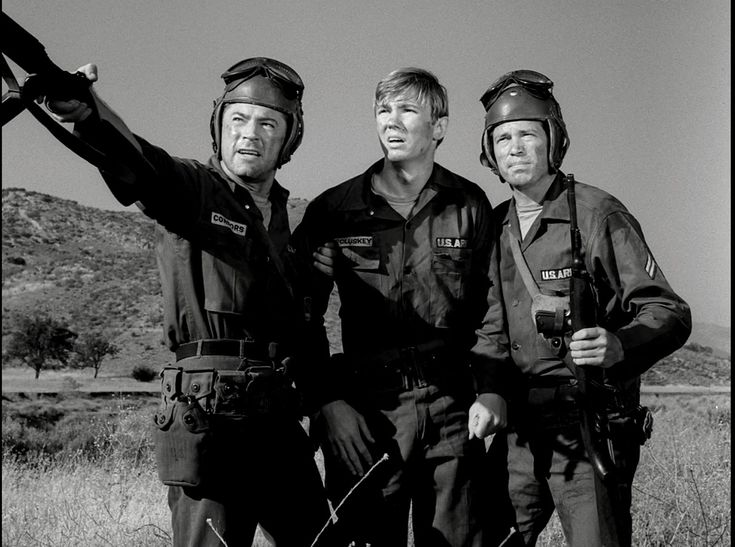
I like this one a lot. You learn some history and enjoy some Time Travel. Warren Oates, Randy Boone, and Ron Foster play three National Guardsmen on war game maneuvers on June 25th, 1964, near the Little Big Horn battlefield where, in 1876, General Custer held his famous last stand with the 7th cavalry against an army of Sioux, which led to their massacre. They find a canteen that appears brand new…but it was from 100 years ago.
As for the characters…There’s the true believer, the sergeant, who seems to have an unbelievably detailed knowledge of the historical event and the greenhorn kid. They all play their parts well. You will not see a lot of locations in this episode but you see the characters, even the skeptic, turn true into believers.
If I would have graded this on a personal scale…it would be a 5. I’m not sure it would be that for everyone. The funny thing is…the 5th season had some known classics and a few not graded so high. Two of those (near the ned) are two of my favorites but I try to grade this more on a masses scale when possible. The 5th season was a roller coaster.
From IMDB Trivia
The tank used is an M3A3 Stuart light tank.
Captain William Benteen, who is mentioned several times, previously served as the namesake of James Whitmore’s character in The Twilight Zone: On Thursday We Leave for Home (1963).
This episode takes place on June 25, 1876 and June 25, 1964.
The Battle of Little Bighorn occurred June 25-26, 1876 near Crow Agency, in Bighorn County, Montana. This is in the south central part of the state of Montana.
This show was written by Rod Serling
Rod Serling’s Opening Narration:
June twenty-fifth 1964—or, if you prefer, June twenty-fifth 1876. The cast of characters in order of their appearance: a patrol of General Custer’s cavalry and a patrol of National Guardsmen on a maneuver. Past and present are about to collide head-on, as they are wont to do in a very special bivouac area known as….the Twilight Zone.
Summary
A National Guard tank crew on war games suddenly find themselves back in time to June 25, 1876, the day General Custer fought and lost to the Sioux at the battle of the Little Big Horn. They report what they’ve seen and heard but the officer-in-charge is more than a little dubious about what they claim. They return to the area, and when the attack begins, they join the fight. When the commander goes to locate them, he finds something else entirely.
***Before you watch this…they had a bit of fun beeping words to make it sound bad. It is funny I will admit. This is the only one I could find that is not a drawn out review…like the one you are reading!***
Rod Serling’s Closing Narration:
Sergeant William Connors, Trooper Michael McCluskey, and Trooper Richard Langsford, who, on a hot afternoon in June, made a charge over a hill—and never returned. Look for this one under ‘P’ for phantom, in a historical ledger located in a reading room known as the Twilight Zone.
CAST
Rod Serling … Narrator / Self – Host (uncredited) Ron Foster…Sgt. William Connors Randy Boone…Pvt. Michael McCluskey Warren Oates…Cpl. Richard Langsford Greg Morris…Lieutenant Woodard Jeffrey Morris…Finnigan Wayne Mallory…Scout Robert Bray…Captain Dennet Lew Brown…Sergeant Jacques Shelton…Corporal
Probe 7, Over and Out sets up a situation filled with a number of dramatic possibilities. This is an episode that could have been an hour long to explore more avenues. It reminds me of the episode Two but goes a different route. The acting in this one is very good as always. Richard Basehart plays Colonel Adam Cook who just crash landed on a planet. His ship is beyond repair, and he doesn’t have hope his home planet will help him. He does have communication with his General back home but the General has bad news of a Nuclear war coming.
There will be no help for Colonel Adam, but he has a new world to explore. He meets up with Antoinette Bower who plays Norda. Norda is also stranded on this planet. There is a language and personality barrier that they will have to cross. It’s a good Twilight Zone that could have been better with a little more exploration.
From IMDB Trivia
Norda refers to the apples as “seppla,” which is an anagram of “apples.”
This was the first episode of the series to air since The Twilight Zone: Uncle Simon (1963) two weeks earlier. The Twilight Zone: Night Call (1964) was to have been shown on November 22, 1963, but the broadcast was canceled due to the assassination of US President John F. Kennedy in Dallas, Texas that day. It was eventually shown on February 7, 1964.
Much, if not all, of Norda’s language is simply backwards-English. For example, “em” for “me” and “ouy” for “you”
This show was written by Rod Serling
Rod Serling’s Opening Narration:
One Colonel Cook, a traveler in space. He’s landed on a remote planet several million miles from his point of departure. He can make an inventory of his plight by just one 360-degree movement of head and eyes. Colonel Cook has been set adrift in an ocean of space in a metal lifeboat that has been scorched and destroyed and will never fly again. He survived the crash but his ordeal is yet to begin. Now he must give battle to loneliness. Now Colonel Cook must meet the unknown. It’s a small planet set deep in space. But for Colonel Cook, it’s the Twilight Zone.
Summary
Astronaut Adam Cook crash lands on an Earth-like planet several light-years away. His ship is badly damaged and beyond repair. He manages to contact his home base but they have little encouragement for him. They don’t have a replacement spacecraft to rescue him and the security situation is such that they may soon be at war. Cook readies himself to make a home on his new world when he discovers another inhabitant, a human-like female from another world. As they learn to communicate, he learns her name is Eve Norda and together set off to begin a new life
***WARNING…VIDEO SPOILERS***
Rod Serling’s Closing Narration:
Do you know these people? Names familiar, are they? They lived a long time ago. Perhaps they’re part fable, perhaps they’re part fantasy. And perhaps the place they’re walking to now is not really called ‘Eden.’ We offer it only as a presumption. This has been the Twilight Zone.
CAST
Rod Serling … Narrator / Self – Host (uncredited) Richard Basehart…Colonel Adam Cook Antoinette Bower…Eve Norda Harold Gould: General Larrabee Barton Heyman: Lieutenant Blane
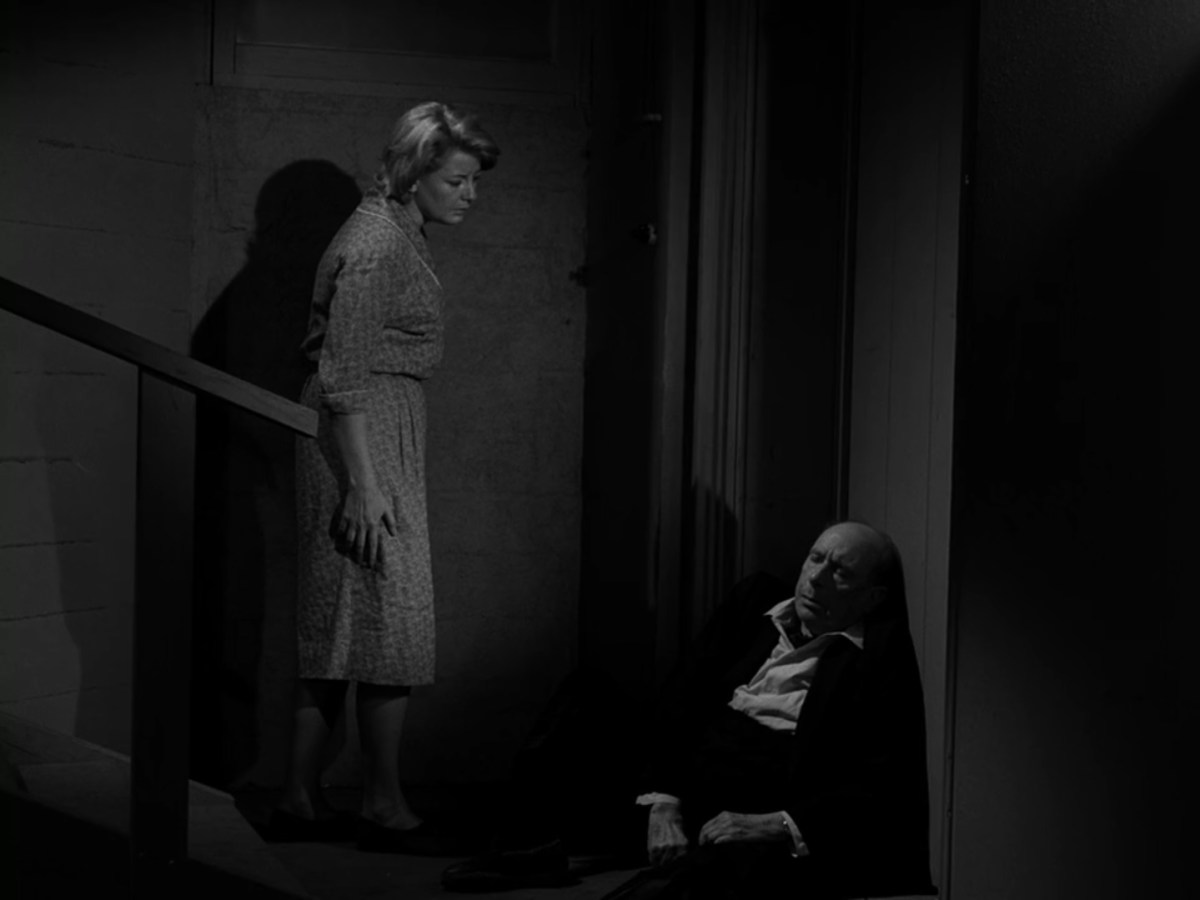
This is not a top drawer Twilight Zone episode. On the surface… the problem is no relatable character and absolutely no sympathy. Uncle Simon is a sick, mean, and vindictive old man. He was being cared for by Constance Ford who plays Barbara Polk. Uncle Simon is quite mean to Barbara but she stayed for 25 years putting up with it. You have to wonder why Barbara is still there taking his abuse for years. As you watch you start finding out why.
Its a sad story about two sad people, both of whom make it a point to say everything thats on their mind but by this point. Uncle Simon tells Barbara at one point “You are the only woman I know who looks as if, underneath her clothes, she wore clothes.” That perfectly described the bland Barbara. I wanted so much to feel pity for Barbara…and in some ways I do but her reasons for being there are to inherit the mansion and money. You just get the feeling she wasn’t there for the right reasons.
There is one bright spot. Robby the Robot makes an appearance in this one. Robby has 30 screen credits from 1956 Forbidden Planet to 2014’s The Big Bang Theory.
From IMDB:
The Twilight Zone: Probe 7, Over and Out (1963), the next episode of The Twilight Zone (1959), would not air for two weeks. The broadcast of the following week’s episode on November 22, 1963, which was to have been The Twilight Zone: Night Call (1964), was canceled due to the assassination of U.S. President John F. Kennedy in Dallas, Texas that day.
Robby the Robot from Forbidden Planet (1956) is used in this episode. However, the dome portion of his head has been altered. This is one of many instalments to use props from “Forbidden Planet”, since the series was frequently filmed at MGM, which kept the film props in use for many years.
This show was written by Rod Serling
Rod Serling’s Opening Narration:
Dramatis personae: Mr. Simon Polk, a gentleman who has lived out his life in a gleeful rage; and the young lady who’s just beat the hasty retreat is Mr. Polk’s niece, Barbara. She has lived her life as if during each ensuing hour she had a dentist appointment. There is yet a third member of the company soon to be seen. He now resides in the laboratory and he is the kind of character to be found only in the Twilight Zone.
Summary
Barbara Polk takes care of her elderly and mean-spirited uncle Simon. He is a scientist who spends much of his time in his basement laboratory but when he’s not there, he seems to take great pleasure in demeaning his niece. She can’t wait for him to die and doesn’t hesitate to tell him so. When he does die, things are… not quite what she expected.
Rod Serling’s Closing Narration:
Dramatis personae, a metal man who’ll go by the name of Simon, whose life as well as his body has been stamped out for him; and the woman who tends to him, the lady Barbara, who’s discovered belatedly that all bad things don’t come to an end, and that once a bed is made, it’s quite necessary that you sleep in it. Tonight’s uncomfortable little exercise in avarice and automatons, from the Twilight Zone.
CAST
Rod Serling … Narrator / Self – Host (uncredited) Cedric Hardwicke … Uncle Simon Constance Ford … Barbara Polk Ian Wolfe … Schwimmer Robby the Robot … Robotic Uncle Simon
As far as the rating on this one. I was in between 4.5 and 5…it could go either way. It is a great episode.
James Coburn (French) and John Anderson (Goldsmith) are terrific in this Twilight Zone episode. The Old Man in the Cave dwells on a small group of Atomic Holocaust survivors whose status quo is maintained by an unseen source that lives in a cave. Mr Goldsmith is the leader of this group and he is told what to do by this cave dweller.
Coburn’s character is the neighborhood bully with power. He swaggers in with his men and take over the group. He mock’s Mr. Goldsmith about the faith he has with the cave dweller’s instructions. Against Goldsmiths vehement objections, they distribute food and liquor branded contaminated by the Old Man in the cave. Resentful over their past restrictions, the townspeople force Goldsmith to open the cave. The “Old Man” is seen…but as what?
The ugly side of human beings is on full display in this episode. Humans without faith in something can be scared, frightened, and in turn… scary.
From IMDB: Based upon the short story “The Old Man” by Henry Slesar. Though it was copyrighted in 1962, the story went unpublished until 1980, when it appeared in the anthology Microcosmic Tales from Taplinger Pub. Co.
This show was written by Rod Serling and Henry Slesar
Rod Serling’s Opening Narration:
What you’re looking at is a legacy that man left to himself. A decade previous he pushed his buttons and a nightmarish moment later woke up to find that he had set the clock back a thousand years. His engines, his medicines, his science were buried in a mass tomb, covered over by the biggest gravedigger of them all—a bomb. And this is the earth 10 years later, a fragment of what was once a whole, a remnant of what was once a race. The year is 1974 and this is The Twilight Zone.
Summary
Ten years after an atomic apocalypse, a small group of survivors manage to eke out a very difficult existence. They’ve managed to survive in large part due to the advice they receive from an old man who lives in a cave outside of the town. Goldsmith acts as the intermediary and the old man’s advice on things like crops or the safety of a batch of old canned goods are usually correct. When four soldiers led by Major French arrive in the town, the social order is upended with the townsfolk attacking the old man’s cave but not really prepared for what they find inside
Rod Serling’s Closing Narration:
Mr. Goldsmith, survivor. An eyewitness to man’s imperfection. An observer of the very human trait of greed. And a chronicler of the last chapter—the one reading “suicide”. Not a prediction of what is to be, just a projection of what could be. This has been The Twilight Zone.
CAST
Rod Serling … Narrator / Self – Host (uncredited) James Coburn … French John Anderson … Goldsmith Josie Lloyd … Evie, townswoman who says, “We already took chances. The old man told us not to plant on the north acreage.” John Craven … townsman who asks, “Been to the cave, Jason?” John Marley … Jason Uncredited (in order of appearance): Natalie Masters … townswoman Don Wilbanks … Furman
This episode launched a lot of horror movies like Child’s Play. It did have a future star…the great Telly Savalas as a stepfather named Erich Streator. Mr. Streator is not a likable character but yet you may have a little pity for him as the show goes along. He shows glimpses of being a decent human being but fails miserably with his role as a stepfather. You do have to look deep to find sympathy.
He has a great wife (Mary La Roche) and a stepdaughter (Christie) who loves her new doll. The doll can talk and move… “My name is Talking Tina and I love you very much.”
You have so much sympathy for his wife Annabelle…even without the doll. Some people might say that the episode is predictable but remember…there weren’t many shows out about talking dolls at the time…maybe none. There is no comedy in this one like the Chucky movies that came decades later. The doll is working as Christie’s protector…at least you think so. Is it all in Erich Streator’s head?
From IMDB:
June Foray, the voice of the “Talky Tina” doll, was also the voice of Mattel’s “Chatty Cathy” doll, upon which the doll in this episode was based.
Tina and Christie are both nicknames for Christina. The doll and the child share a name, so among many other interpretations it could be argued that the doll is a proxy through which Christie expresses hostility toward her stepfather and protects her shy, frightened mother.
According to The Twilight Zone Companion, this episode was written in one day by Jerry Sohl, even though credit was given entirely to Charles Beaumont.
The child actress who portrays Christie is credited as being the voice of “Lucy Van Pelt” in the classic TV special, “A Charlie Brown Christmas”.
This show was written by Rod Serling, Charles Beaumont, and Jerry Sohl
Rod Serling’s Opening Narration:
Talky Tina, a doll that does everything, a lifelike creation of plastic and springs and painted smile. To Erich Streator, she is the most unwelcome addition to his household—but without her, he’d never enter the Twilight Zone.
Summary
Erich Streater is upset when his wife comes home with her daughter Christie having bought her yet another doll. Christie loves her new Talking Tina doll but her stepfather takes an immediate dislike to it. Anytime he is alone with the doll, it spouts abusive comments to the effect that it hates him and that it’s going to kill him. He’s convinced that his wife is behind it all, something she vehemently denies. He tries to get rid of the doll but it always seems to reappear – and also seems intent on following through with its threats.
***WARNING…VIDEO SPOILERS***
Rod Serling’s Closing Narration:
Of course, we all know dolls can’t really talk, and they certainly can’t commit murder. But to a child caught in the middle of turmoil and conflict, a doll can become many things: friend, defender, guardian. Especially a doll like Talky Tina, who did talk and did commit murder—in the misty region of the Twilight Zone.
CAST
Rod Serling … Narrator / Self – Host (uncredited) Telly Savalas … Erich Streator Mary La Roche … Annabelle Streator Tracy Stratford … Christie Streator June Foray … Talky Tina (voice) [uncredited]
Rod Serling was great at this kind of low-life character. They were not evil but just the bottom of society. Mickey Rooney plays Grady who was small in more ways than one. He was a jockey who was disqualified from racing and he blames everyone but the one responsible…himself. Mickey Rooney runs a gamut of emotions from rage to grief to terrible self-loathing and is credible throughout. He carries the show…although he must because he is the only actor in it. A bit of Twilight Zone justice is dished out at the end.
This is another character that you won’t have much sympathy with at all. It is an impressive one-man show. Agnes Moorehead did this in The Invaders and was incredible.
This one is by no means a bad episode. It’s just not a classic one. I think the basic story was done better in Nervous Man in a Four Dollar Room, another episode of a self-pitying loser being lectured by his alter ego.
From IMDB: With exactly one performer appearing–either in image or voice, not counting Rod Serling’s routine turn as host–this episode features the smallest cast of any in the series. Close runner-ups include The Twilight Zone: Where Is Everybody? (1959), The Twilight Zone: King Nine Will Not Return (1960), The Twilight Zone: Nervous Man in a Four Dollar Room (1960), The Twilight Zone: The Invaders (1961) and The Twilight Zone: Two (1961).
This show was written by Rod Serling
Rod Serling’s Opening Narration:
The name is Grady, five feet short in stockings and boots, a slightly distorted offshoot of a good breed of humans who race horses. He happens to be one of the rotten apples, bruised and yellowed by dealing in dirt, a short man with a short memory who’s forgotten that he’s worked for the sport of kings and helped turn it into a cesspool, used and misused by the two-legged animals who’ve hung around sporting events since the days of the Coliseum. So this is Grady, on his last night as a jockey. Behind him are Hialeah, Hollywood Park and Saratoga. Rounding the far turn and coming up fast on the rail—is the Twilight Zone.
Summary
Grady is a champion jockey who has recently been banned from the sport owing to his participation in race fixing and the drugging of horses. He claims he is innocent and currently has an appeal with the racing commission but his agent isn’t hopeful. Suddenly, Grady begins hearing a voice – his own as it turns out, speaking to him from his own mind. As Grady rages over the unfairness of it all, he is granted his one true wish.
***WARNING…VIDEO SPOILERS***
Rod Serling’s Closing Narration:
The name is Grady, ten feet tall, a slightly distorted offshoot of a good breed of humans who race horses. Unfortunately for Mr. Grady, he learned too late that you don’t measure size with a ruler, you don’t figure height with a yardstick, and you never judge a man by how tall he looks in a mirror. The giant is as he does. You can make a parimutuel bet on this, win, place, or show, in or out of the Twilight Zone.
Richard Erdman plays Patrick Thomas McNulty who is an insufferable know it all bore. He is a self-proclaimed idea man…but not a good one. He is given a gift…a very special gift that he wanted to exploit. Mr. McNulty was given a stopwatch that could control time. This story is made for the Twilight Zone but it helps when you have sympathy for the main character. You don’t in this one but yet it still works. It does have a good Twilight Zone ending.
It reminds me a little of Time Enough at Last but not as good. Erdman does a great job playing McNulty because he is a convincing pain. The inspiration for the episode came from a book written by John D. MacDonald published a year earlier called “The Girl, the Gold Watch, and Everything”. Much later the book was made into a movie called The Girl, the Gold Watch and Everything in 1980.
The biggest disappointment is Potts, he is the fellow that gave McNulty the stopwatch. The dialogue doesn’t give us many clues…its supposed to make Potts seem the kind of eccentric character who might give a total stranger a mysterious and magical device, but it plays very flat. Potts is no more than a plot device, the intention being to get the watch into McNulty’s hands as quickly as possible. It was a wasted opportunity in not exploring that charcacter.
The reason I bring it up is an early draft of the script featured an alternate closing shot: One of the “frozen” people, whom McNulty has just run past, turns to face the camera after McNulty vanishes around a corner. It’s Potts, who smiles and winks at us…indicating that, as with the watch he gave McNulty, there’s a lot more to him than meets the eye.
This show was written by Rod Serling and Michael D. Rosenthal
Rod Serling’s Opening Narration:
Submitted for your approval or at least your analysis: one Patrick Thomas McNulty, who, at age forty-one, is the biggest bore on Earth. He holds a ten-year record for the most meaningless words spewed out during a coffee break. And it’s very likely that, as of this moment, he would have gone through life in precisely this manner, a dull, argumentative bigmouth who sets back the art of conversation a thousand years. I say he very likely would have except for something that will soon happen to him, something that will considerably alter his existence—and ours. Now you think about that now, because this is The Twilight Zone.
Summary
After Patrick Thomas McNulty gets fired from his job, he goes to a neighborhood bar where his non-stop chatter drives all of the customers away. One of the last patrons in the bar has a gift for him: a stopwatch. It’s a strange gift and he has no idea what he might do with it. When he presses the button however everything around him stops. He returns to work the next day and tries to market it, but to no avail. He then returns to the bar and again drives everyone out the bar with his bombast.
Rod Serling’s Closing Narration:
Mr. Patrick Thomas McNulty, who had a gift of time. He used it and he misused it, and now he’s just been handed the bill. Tonight’s tale of motion and McNulty – in the Twilight Zone.
CAST
Rod Serling … Narrator / Self – Host (uncredited) Richard Erdman … Patrick Thomas McNulty Herbie Faye … Joe Palucci, the bartender Leon Belasco … Potts, the drunk who gives McNulty the stopwatch Doris Singleton … Secretary to McNulty’s boss Mr. Cooper Roy Roberts … Mr. Cooper, McNulty’s annoyed boss Richard Wessel … Charlie, drinker in Palucci’s bar Ray Kellog … Fred, who delivers coffee to McNulty’s office Ken Drake … Daniel, last patron in Palucci’s bar who tells McNulty, “Come on fella, we’re trying to watch.” Sam Balter: … sports announcer on TV in Polucci’s bar Al Silvani … one of the drinkers in Polucci’s bar
As far as classics go…you can’t get much more classic than this one. Nightmare at 20,000 Feet goes beyond the Twilight Zone into pop culture. It’s been parodied and remade, but this is the definitive version. The Twilight Zone the movie redid this one and they did a good job but it’s not as eerie as this one. The new Twilight Zone in 2019 also did a version.
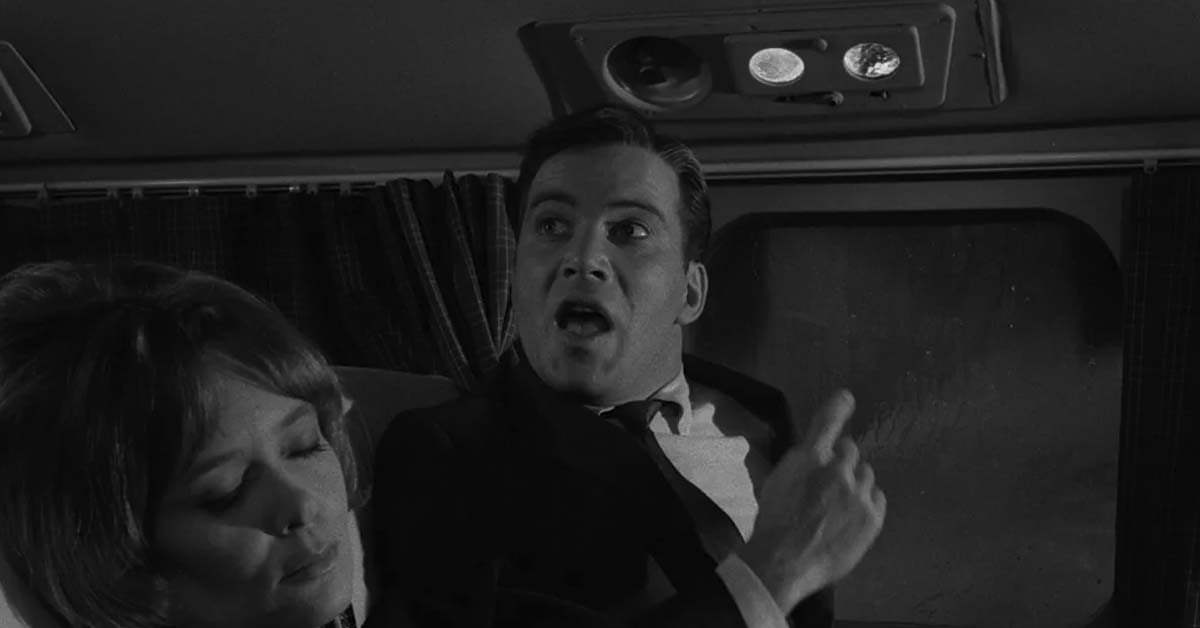
William Shatner does a great job in this episode as a man (Bob Wilson) who just recovered from a nervous breakdown. Wilson is complex, intelligent, and insecure. He is a man on the brink, trying desperately to hold on to his recently regained normalcy. Shatner’s over-the-top mannerisms work in this episode. The episode still works, partly because of the claustrophobic airplane setting with an added violent thunderstorm. I’ve heard criticism on the monster makeup but if I saw that thing on the wing of a plane I was on…I would freak out also.
Shatner’s character reminds me of The Boy Who Cried Wolf, but this time will he be vindicated?
Richard Donner (Superman and the Omen) directed this episode. The logistics involved in filming Nightmare at 20,000 Feet were enormous. The set consisted of the interior of an airline passenger cabin with the left airplane wing attached to the outside. This was all suspended over a huge water tank, in order to contain the water from the rain effect. Donner remembers the shooting as one big headache.
Richard Matheson’s scripts were so respected that they were filmed almost exactly as written. The only change was one of title, from Flight to The Last Flight.
To show what a great sense of humor Rod Serling had…read the last quote by him down below.
Richard Donner: Because you were suspended up, you had no stage floors. Every movement was a bitch. He lists the factors that had to be considered in virtually every shot. A man flying in on wires. Wind. Rain. Lightning. Smoke, to give the effect of clouds and travel and speed. Actors. You couldnt hear yourself think because of the noise of the machines outside. And fighting time, all the time. It was just unbearable. If any one of those things went wrong, it ruined the whole take. All of this consumed lots of time. We were supposed to take a fourth day in the tank set with the airplane
Then they found out that the studio had committed it to another company. We had to work all night to finish it up. We went overtime till early the next morning.
I love it, I do love it. Its just such an unusual thing for television, really, to see that much energy go into a little half-hour film. And the story was good, too.
From IMDB: William Shatner played an elaborate prank on set when he conspired with a friend who was visiting the filming, actor Edd Byrnes, to trick director Richard Donner into thinking Shatner died. Between takes, and when Donner was off set getting coffee, Shatner and Byrnes staged a fake fight on the set, which was suspended some 30 feet above a giant, empty tank. When Donner ran back in the studio to see what was happening the two men chased each other around the back of the airplane set and wound up atop the plane wing. Donner saw a body falling off the wing and Byrnes yelling in terror as it impacted the concrete floor. Donner said when he ran to the fallen, motionless figure, thinking it was a dead or grievously injured William Shatner, he was greeted with laughter the moment he realized it was just an articulated human dummy the two men had found in another part of the studio and threw off the wing. Donner later joked, “Honestly, my first reaction was, ‘Don’t tell me I have to shoot the whole show over again.'”
Rod Serling:The final story on Nightmare at 20,000 Feet occurred several months after the shooting. Matheson and I were going to fly to San Francisco. It was like three or four weeks after the show was on the air, and I had spent three weeks in constant daily communication with Western Airlines preparing a given seat for him, having the stewardess close the [curtains] when he sat down, and I was going to say, Dick, open it up. I had this huge, blownup poster stuck on the [outside of the window] so that when he opened it there would be this gremlin staring at him. So what happened was we get on the plane, there was the seat, he sits down, the curtains are closed, I lean over and I say, Dick at which point they start the engines and it blows the thing away. It was an old prop airplane. … He never saw it. And I had spent hours in the planning of it. I would lie in bed thinking how we could do this.
This show was written by Rod Serling and Richard Matheson
Rod Serling’s Opening Narration:
Portrait of a frightened man: Mr. Robert Wilson, thirty-seven, husband, father and salesman on sick leave. Mr. Wilson has just been discharged from a sanitarium where he spent the last six months recovering from a nervous breakdown, the onset of which took place on an evening not dissimilar to this one, on an airliner very much like the one in which Mr. Wilson is about to be flown home—the difference being that, on that evening half a year ago, Mr. Wilson’s flight was terminated by the onslaught of his mental breakdown. Tonight, he’s traveling all the way to his appointed destination, which, contrary to Mr. Wilson’s plan, happens to be in the darkest corner of the Twilight Zone.
Summary
Bob Wilson is on a flight when he sees a creature of some sort out on the wing of the aircraft. He’s only recently recovered from a nervous breakdown and isn’t sure that what he is seeing is real. Every time someone else looks out the window, the creature hides from view. When the creature begins to tamper with one of the engines he begs his wife to tell the pilots to keep an eye on the engines. If they see nothing, he agrees to commit himself to an asylum when they arrive at their destination. His paranoia drives him to a desperate act
***WARNING…VIDEO SPOILERS***
Rod Serling’s Closing Narration:
The flight of Mr. Robert Wilson has ended now, a flight not only from point A to point B, but also from the fear of recurring mental breakdown. Mr. Wilson has that fear no longer… though, for the moment, he is, as he has said, alone in this assurance. Happily, his conviction will not remain isolated too much longer, for happily, tangible manifestation is very often left as evidence of trespass, even from so intangible a quarter as the Twilight Zone.
CAST
Rod Serling … Narrator / Self – Host (uncredited) William Shatner…Bob Wilson Christine White…Julia Wilson Edward Kemmer…the flight engineer Asa Maynor…stewardess Betty Crosby Nick Cravat [uncredited]…the gremlin
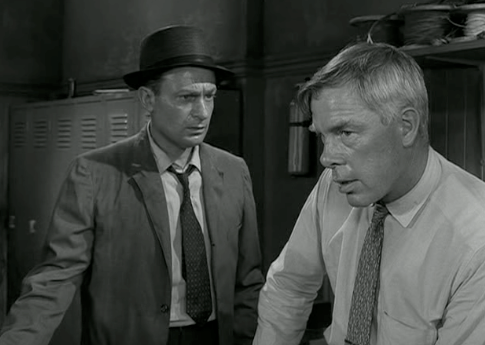
Steel is very good starring the movie star…Lee Marvin.
This episode has a parallel to the NFL in present day to me. With CTE (Chronic traumatic encephalopathy), football as I knew it is gone. In 20 years it probably won’t resemble the game now. Steel is set in 1974 and boxing between humans is illegal. It was deemed as too dangerous and now robots fight each other intead of humans.
Lee Marvin plays Steel Kelly who was a former boxer until the law was passed to ban human boxing. He now owns an older model robot (an old B2) named Battling Maxo. Marvin is a determined, sad, and desparate character. He believes in his outdated fighter and will do anything to keep the broken down Maxo going…including doing the unthinkable.
Marvin’s gritty performance brings this episode up above normal ones. Taking the place of the boxing trainer would be mechanic Pole…played by Joe Mantell. He keeps Maxo going but knows the robot is washed up and busted. He wants to scrap him but Steel won’t hear of it…they keep looking for parts that just aren’t made anymore.
The two robot faces were crafted by William Tuttle. Lifemasks were taken of the actors, atop which the robot faces were sculpted in clay. Foam rubber and latex copies were cast of these, which were then glued onto the actors faces. As for the inhuman, expressionless eyes, those were sections of ping-pong balls, painted black, with pinpoint eye holes through the center.
This show was written by Rod Serling and Richard Matheson
Rod Serling’s Opening Narration:
Sports item, circa 1974: Battling Maxo, B2, heavyweight, accompanied by his manager and handler, arrives in Maynard, Kansas, for a scheduled six-round bout. Battling Maxo is a robot, or, to be exact, an android, definition: ‘an automaton resembling a human being.’ Only these automatons have been permitted in the ring since prizefighting was legally abolished in 1968. This is the story of that scheduled six-round bout, more specifically the story of two men shortly to face that remorseless truth: that no law can be passed which will abolish cruelty or desperate need—nor, for that matter, blind animal courage. Location for the facing of said truth: a small, smoke-filled arena just this side of the Twilight Zone.
Summary
In the not too distant future, boxing has been banned and replaced by robot fighters in the ring. Sam “Steel” Kelly is a former boxer but now owns one of these pugilistic machines. Unfortunately his robot, which he’s named Battling Maxo, is getting old and many of its parts are no longer available. Kelly is broke and is doing everything he can to ensure Battling Maxo can enter the ring as the promoter has made it clear there’s no payment if there’s no bout. When Maxo breaks down however, Kelly decides to takes its place.
Rod Serling’s Closing Narration:
Portrait of a losing side, proof positive that you can’t outpunch machinery. Proof also of something else: that no matter what the future brings, man’s capacity to rise to the occasion will remain unaltered. His potential for tenacity and optimism continues, as always, to outfight, outpoint and outlive any and all changes made by his society, for which three cheers and a unanimous decision rendered from the Twilight Zone.
Sorry I could NOT find a video clip without a reviewer. He does give it away…just so you know.
CAST
Rod Serling…Narrator / Self – Host (uncredited) Lee Marvin…Steel Kelly Joe Mantell…Pole Chuck Hicks…Maynard Flash Merritt Bohn…Nolan Frank London…Maxwell Larry Barton…Boxing Match Spectator (voice) (uncredited) Slim Bergman…Boxing Match Spectator (uncredited) Louis Cavalier…Boxing Match Spectator (uncredited) Ken DuMain…Boxing Match Spectator (uncredited) Tipp McClure…Battling Maxo (uncredited) Edwin Rochelle…Boxing Match Spectator (uncredited)
This one is not known as a classic, but it should be. Jack Klugman plays a bookie with a drinking problem named Max Phillips. Klugman’s transformation will resonate with viewers. Max gets a telegram that his son is dying in Vietnam. He realizes he wasted a great deal of his life dreaming instead of doing and working instead of spending more time with his son. He makes a deal with God for one more hour with his son. Afterward, he makes one more deal.
Klugman’s performances in his last scenes were some of the best of the series. How much time do we spend doing other things (even work) other than to be with our love ones? In Praise of Pip is a thought-provoking and touching drama about a man’s love for his son and a reminder to pay attention to what is really important in life.
This is Anne Serling’s (Rod Serling’s daughter) favorite episode of the Twilight Zone. She noticed a lot of the dialog in this episode that happened between her and her father.
The script originally had Pip stationed in Laos, but the network had Rod Serling change it to Vietnam.
I was surprised about the early mention of Vietnam in this one. There were officially no combat or special forces in Laos. The implication that the U.S. had troops fighting in Laos (even in The Twilight Zone) could be an embarrassment and might cause repercussions. U.S. Special Forces were fighting (in an advisory capacity) in South Vietnam. Suggest South Vietnam. This episode was produced about two years before the massive intervention of American forces in South Vietnam.
From IMDB: Bill Mumy’s father rarely joined his son on sets, but joined him on this occasion because the two often visited the pier they filmed on. His father recalled being impressed with Jack Klugman who introduced himself to the family and explained that father and son would be extremely affectionate. Mumy joined his own son Seth Mumy on set of Dear God (1996) with Klugman 30 years later.
This show was written by Rod Serling
Rod Serling’s Opening Narration:
Submitted for your approval: one Max Phillips. A slightly-the-worse-for-wear maker of book, whose life has been as drab and undistinguished as a bundle of dirty clothes. And t fhough it’s very late in his day, he has an errant wish that the rest of his life might be sent out to a laundry, to come back shiny and clean. This to be a gift of love to a son named Pip. Mr. Max Phillips, homo sapiens, who is soon to discover that man is not as wise as he thinks. Said lesson to be learned in the Twilight Zone.
Summary
In the early 1960s, small-time bookie Max Phillips (Jack Klugman) hates his life. His only pride is his son, Pip, who is serving the U.S. Armed Forces in Vietnam. When a young man uses company funds to place a bet with Max, the man loses the wager. Max then returns his money, which angers Max’s bosses.
Rod Serling’s Closing Narration:
Very little comment here, save for this small aside: that the ties of flesh are deep and strong; that the capacity to love is a vital, rich, and all-consuming function of the human animal. And that you can find nobility and sacrifice and love wherever you may seek it out: down the block, in the heart or in the Twilight Zone.
CAST
Rod Serling…Narrator / Self – Host (uncredited) Jack Klugman…Max Phillips Connie Gilchrist…Mrs. Feeny Robert Diamond…Pvt. Pip Billy Mumy: Young Pip Ross Elliott: doctor in Vietnam Gerald Gordon: lieutenant in Vietnam Russell Horton: George Reynold S. John Launer: Mr. Moran Kreg Martin: Mr. Moran’s enforcer Stuart Nisbet…surgeon in Vietnam
Again I will say…I want to thank you all who have stuck with me through this long haul. We are now finished with the 4th season! The 5th and also last season lasts 36 episodes.
I do have one to add that was on The Westinghouse Desilu Playhouse that was a precurser to the Twilight Zone called The Time Element. It was a teleplay that premiered on November 24, 1958. It was Rod Serling’s first science fiction story.
After going through 4th season …it was better than I gave it credit for earlier. The hour long episodes changed the way I graded them because they were different than the 30 minute episode. Some did suffer from too much padding but some were able to tell a more complete story. You did have a few that didn’t click well at all.
If you want… please comment on what you think I got wrong, right, or just your favorite episodes.
In the spring of 1963, CBS renewed Twilight Zone for a fifth season, shortening it back to a half hour. The networks experiment had failed: Twilight Zone’s expanded size had not made for an expanded audience. The season contained 18 long episodes.
Rod Serling: Our shows this season were too padded. The bulk of our stories lacked the excitement and punch of the shorter dramas we intended when we started five years ago and kept to for a while. If you ask me, I think we had only one really effective show this season, On Thursday We Leave for Home. … Yes, I wrote it myself, but I overwrote it. I think the story was good despite what I did to it.
Looking back, Serling’s assessment was too hard. There had been a number of really good hour-long episodes, among them On Thursday We Leave for Home, Death Ship, In His Image, Valley Of The Shadows, Printer’s Devi and The New Exhibit. The Twilight Zone had not embarrased itself in this season.
The 5th season was not as consistent as the first 3 but it contains some of my favorite episodes.
This show closed out the 4th season and the one hour long experiment was over. The Bard is my least favorite episode of the entire series. I’ve seen some lists where it’s the bottom or near the bottom. On the other hand, I’ve seen some have it high. It’s a comedy episode that just doesn’t work. One thing that is interesting about this episode is the appearance of Burt Reynolds playing a Marlon Brando character. That added a star in my rating but even Burt couldn’t save this one.
Jack Weston plays Julius Moomer and the character is a no-talent writer who uses black magic to bring William Shakespeare back to write a television program. Even typing it sounds cringe-worthy. The plot had some good elements of a Twilight Zone but Weston’s character is just not likable. It might have worked in a shorter format with a different script.
Some may think this is a hilarious episode…I just never did.
From IMDB: William Shakespeare (John Williams) quotes lines from his plays nine times with a trumpet flourish sounding each time, and most of the time, him telling what play, act, and scene the quote came from. Three from ‘Romeo & Juliet,’ two from ‘Twelfth Night,’ and one each from ‘Troilus and Cressida,’ ‘As You Like It,’ and ‘A Mid-Summer’s Night Dream’, plus a partial one from ‘Hamlet’ (cut short when Shakespeare forgets the end of the “To be or not to be” line.
Cora (Judy Strangis) looks at the book , “Ye Book of Ye Black Art”, Julius (Jack Weston) is using to conjure black magic and refers to him as Faust. In a classic German legend based on Johann Georg Faust, he makes a pact with the devil, exchanging his soul for unlimited knowledge and worldly pleasures. The devil sends his representative, Mephistopheles. He makes a bargain with Faust: Mephistopheles will serve Faust with his magic powers for a set number of years, but at the end of the term, the Devil will claim Faust’s soul, and Faust will be eternally enslaved.
Burt Reynolds’s character is clearly an amalgam of Marlon Brando and Paul Newman.
Rod Serling’s Opening Narration:
You’ve just witnessed opportunity, if not knocking, at least scratching plaintively on a closed door. Mr. Julius Moomer, a would-be writer, who if talent came 25 cents a pound, would be worth less than car fare. But, in a moment, Mr. Moomer, through the offices of some black magic, is about to embark on a brand-new career. And although he may never get a writing credit on the Twilight Zone, he’s to become an integral character in it.
Julius Moomer, a talentless, but relentless, self-promoting hack who dreams of becoming a successful television writer, uses a book of magic to summon William Shakespeare to write dramatic teleplays that Moomer will pass off as his own. Shakespeare becomes irritated by Moomer’s lack of appreciation and is even more appalled when he discovers the changes wrought on his plays by cynical television executives.
Rod Serling’s Closing Narration:
Mr. Julius Moomer, a streetcar conductor with delusions of authorship, and if the tale just told seems a little tall, remember a thing called poetic license, and another thing called the Twilight Zone.
CAST
Rod Serling … Narrator / Self – Host (uncredited) Jack Weston … Julius Moomer John Williams … William Shakespeare Burt Reynolds … Rocky Rhodes Henry Lascoe … Gerald Hugo John McGiver … Mr. Shannon Howard McNear … Bramhoff Judy Strangis … Cora Marge Redmond … Secretary Doro Merande … Sadie William Lanteau … Dolan Clegg Hoyt … Bus driver John Newton … TV interviewer John Bose … Daniel Boone (uncredited) Rudy Bowman … Robert E. Lee (uncredited)
The story is not really scary but the setting will remind you of a horror movie. It takes place on a ship that is surrounded by fog. Mix that with black and white and the Wolfman film comes to mind. This is the first hour-long episode I watched many years ago. This episode benefits from the hour format. You see a couple who are teetering on breaking up decide on a cruise. Throughout the episode, you see the gradual healing and the companionship replacing turmoil. Their older fellow passengers help them both along the way. This story could not have been made as well in a half-hour-long format.
I would strongly recommend this and there is a twist but the twist is a little ambiguous. This is not an episode where a bad person gets cosmically punished for doing bad things. It does show real-life problems that you can relate to today. The cinematographer and set designers deserve praise in this episode.
From IMDB: Because of the large number of well-known actors in this episode, the closing theme featured a credit roll of cast names instead of the usual still frames. The remaining non-cast credits were then done with standard still frames. This was the only episode of the series to ever use a credit roll.
This was the last Charles Beaumont Twilight Zone screenplay to be actually fully written by Beaumont himself. Around the time this episode was made, Beaumont (then only 34) began suffering from the rapid onset of a degenerative neurological disorder (believed to be either Alzheimer’s and/or Pick’s Disease) which affected his speech, memory, and concentration, as well as causing him to physically age very rapidly. As the disease progressed, Beaumont was soon unable to meet his writing commitments. A number of his writer friends, including Jerry Sohl and William F. Nolan, supported Beaumont by ghostwriting stories with or for him and submitting them in his name, although Beaumont insisted on splitting the fees with his helpers. His last screen credit (also probably ghostwritten) was in 1965, by which time he was too ill to work at all, and he died on 21 February 1967, aged only 38, although his son later recounted that his father “looked ninety-five” at the time of his death.
This show was written by Rod Serling and Charles Beaumont
Rod Serling’s Opening Narration:
Portrait of a honeymoon couple getting ready for a journey – with a difference. These newlyweds have been married for six years, and they’re not taking this honeymoon to start their life but rather to save it, or so Eileen Ransome thinks. She doesn’t know why she insisted on a ship for this voyage, except that it would give them some time and she’d never been on one before – certainly never one like the Lady Anne. The tickets read ‘New York to Southampton,’ but this old liner is going somewhere else. Its destination – the Twilight Zone.
Summary
Eileen and Alan Ransome’s marriage is going through a bad patch and they decide to go on a holiday to London. Eileen insists on traveling by ship and they book passage on the Lady Anne, an old ship that is not recommended by the travel agent but is leaving quite soon. When they arrive at the port terminal another passenger, Mr. McKenzie, insists strenuously that the young couple has made a mistake and tries to discourage them from coming along on what is a “private cruise”. Mrs. McKenzie keeps her own counsel but clearly shares her husband’s sentiments. Another passenger, Burgess, tries to warn them off as well. He and McKenzie offer them money, eventually $10,000, to leave immediately. The Ransomes take umbrage and refuse. The couple finds that all of the other passengers are quite elderly but unsurprisingly have a good deal of wisdom to dispense to the young couple. Alan and Eileen are just beginning to really enjoy the trip when the captain suddenly puts them off the ship at gunpoint with provisions and a promise to notify the authorities of their location. They are rescued but as for the Lady Anne and her other passengers — well, there’s the rub
Rod Serling’s Closing Narration:
The Lady Anne never reached port. After they were picked up by a cutter a few hours later, as Captain Protheroe had promised, the Ransomes searched the newspapers for news – but there wasn’t any news. The Lady Anne with all her crew and all her passengers vanished without a trace. But the Ransomes knew what had happened, they knew that the ship had sailed off to a better port – a place called the Twilight Zone.
CAST
Rod Serling … Narrator / Self – Host (uncredited) Gladys Cooper … Millie McKenzie Wilfrid Hyde-White … Toby McKenzie Cecil Kellaway … Burgess Lee Philips … Alan Ransome Joyce Van Patten … Eileen Ransome Alan Napier … Capt. Protheroe Cyril Delevanti … Officer Jack Raine … Officer Colin Campbell … Addicott Don Keefer … Spierto Frank Baker … Otto Champion (uncredited) Sam Harris … Mersia Jones (uncredited) Freda Jones … Ship Passenger (uncredited) Colin Kenny … Ship Passenger (uncredited) Carl M. Leviness … Ship Passenger (uncredited) Scott Seaton … Ship Passenger (uncredited) Arthur Tovey … Ship’s Greeter (uncredited)
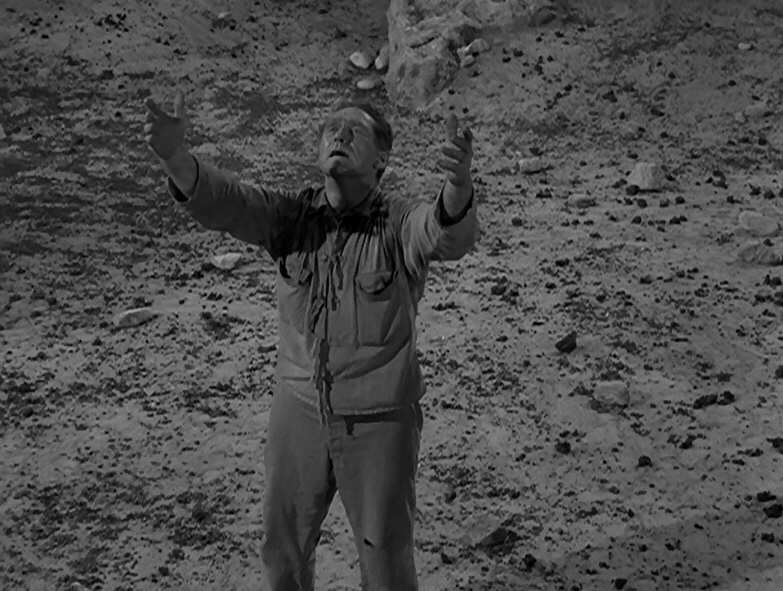
This is a not just a great episode…it’s a classic one. The episode takes place in 2021. James Whitmore plays Captain William Benteen and his acting in this is top notch. The writing also is one of Rod Serling’s best scripts. Captain Benteen reminded me of a cult leader…he doesn’t make the Jim Jones jump but he is similiar. Loving, caring, power hungry, narcissistic, and dictatorial. You see all phases and you also see regret but only when it’s too late.
The people in this episode are a remnant society who left the Earth looking for an Eden, a place without war, without jeopardy, without fear. What they found was quite different. They have been here 30 years. The planet is a nightmare place of two suns, unending day and terrible meteor storms. Despair prevails among the 187 survivors of the original colony and suicide is not uncommon. Their thirty-year survival is attributable to one source: the iron leadership of Benteen, their self-appointed Captain.
If you only watch one hour long episode of the Twilight Zone…make it this one. Human nature is on full display in this episode…both the best and the worse. This is a science-fictional examination of the positive and negative uses of power.
From IMDB: The cave that the colonists use as their meeting hall was originally the underground lair of the Morlocks in The Time Machine (1960).
When the rescue ship from Earth arrives, several colonists ask about various places on Earth during a meeting between the ship’s crew and the colonists. One of the questions is about the Finger Lake District of New York. This area had a special significance to script writer Rod Serling. It is located close to his home town of Binghamton, he and his family vacationed there frequently, and Serling named his company that produced “The Twilight Zone,” Cayuga Productions, after one of the lakes. He later taught at Ithaca College for the last five years before his death.
The striking diorama backgrounds of the planet, the model and the large-scale prop of the rescue ship sent to bring the colonists home, and the uniforms of the rescue crew were all originally created for Forbidden Planet (1956). This was a recurring feature on “The Twilight Zone” which was frequently filmed at MGM Studios, and often prominently featured recycled props and set pieces from “Forbidden Planet”. The previous episode, “The Incredible World of Horace Ford” featured copies of the original blueprints of designs for Robby the Robot, created by MGM production designer Robert Kinoshita.
This show was written by Rod Serling
Rod Serling’s Opening Narration:
This is William Benteen, who officiates on a disintegrating outpost in space. The people are a remnant society who left the Earth looking for a millennium, a place without war, without jeopardy, without fear, and what they found was a lonely, barren place whose only industry was survival. And this is what they’ve done for three decades: survive; until the memory of the Earth they came from has become an indistinct and shadowed recollection of another time and another place. One month ago a signal from Earth announced that a ship would be coming to pick them up and take them home. In just a moment we’ll hear more of that ship, more of that home, and what it takes out of mind and body to reach it. This is the Twilight Zone.
Summary
The colonists of Pilgrim I, Earth’s first space colony, have spent 30 years on their new home. It’s a lonely, barren place more akin to hell then Eden. Now, they’re awaiting the arrival of a ship to take them to Earth. Some colonists are at their wits’ end; another – the 9th in 6 months – commits suicide. Their leader, William Benteen, a tough drill sergeant-type, who they call Captain, does his best to keep them together. When the ship arrives, they’re given 3 days to prepare to leave. As the day of departure approaches, Benteen’s assumption that the community will stay together on Earth, is wrong; most will go their own way once on earth. Hearing this, Benteen decides they should stay. When the group decides otherwise, Benteen’s left with only one option.
Rod Serling’s Closing Narration:
William Benteen, who had prerogatives: he could lead, he could direct, dictate, judge, legislate. It became a habit, then a pattern and finally a necessity. William Benteen, once a god, now a population of one.
CAST
Rod Serling … Narrator / Self – Host (uncredited) James Whitmore … Captain William Benteen Tim O’Connor … Colonel Sloane James Broderick … Al Paul Langton … George Jo Helton … Julie Mercedes Shirley … Joan Russ Bender … Hank Danny Kulick … Jo-Jo (as Daniel Kulick) Madge Kennedy … Colonist John Ward … Colonist Shirley O’Hara … Colonist Tony Benson … Colonist (as Anthony Benson) Lew Gallo … Lt. Engle








 PowerPop... An Eclectic Collection of Pop Culture