
Max Picks …songs from 1994

1994

We are nearing the end of Max Picks…we still have one more year to go.

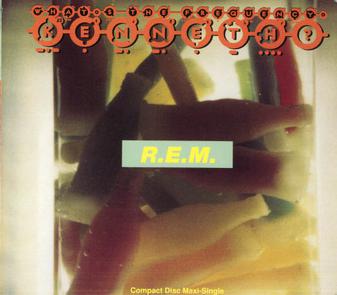
R.E.M. – What’s The Frequency Kenneth? 

This song along with Fall On Me is my favorite REM song.

REM really let loose on their album Monster. I love the tone on Peter Bucks’s guitar and the loud in-your-face production. Peter Buck played the late Kurt Cobain’s Fender Jag-Stang, which he plays upside-down because Cobain was left-handed. This to me…is very close to having a REM and Replacements song all in one.

This song is about an incident that took place on October 4, 1986, when the CBS news anchor Dan Rather was attacked on a New York City sidewalk by a crazed man yelling “Kenneth, what is the frequency.” The man turned out to be William Tager, who was caught after he killed a stagehand outside of the Today Show studios on August 31, 1994. Tager, who was sentenced to 25 years in prison, said he was convinced the media was beaming signals into his head, and he was on a mission to determine their frequencies.

Lead singer Michael Stipe says this is an attack on the media, who overanalyze things they don’t understand.

After this song I lost contact with REM’s music for a long time…the same with The Replacements. Those two bands represented the best of the 80s for me.

Weezer – Buddy Holly

This was released to radio on September 7, 1994, which would have been Buddy Holly’s 58th birthday.

The video for this song hooked me for not only the mention of Buddy Holly, Mary Tyler Moore but also the Happy Days set… Plus its a fun song.

Spike Jonze directed the video. Vintage Happy Days footage was intercut with shots of Weezer performing on the original Arnold’s Drive-In set. Al Molinaro, who played the diner’s owner on the series, made a cameo appearance in the video. One of the most popular clips of 1995, it scored four MTV Video Music Awards, including Breakthrough Video and Best Alternative Music Video, and two Billboard Music Video Awards, among them Alternative/Modern Rock Clip of the Year.

Pretenders – I’ll Stand By You

Chrissie Hynde wrote this with Tom Kelly and Billy Steinberg. “I’ll Stand by You” was released as the second single from the  1994 album Last of the Independents. It’s a beautiful song that has been covered a few times.

For Hynde, working with outside songwriters was different, as she was used to writing on her own. It ended up being a very positive experience that led to more collaborations.

Chrissie had said she was uncomfortable about having such a hit but felt better after Noel Gallagher said “he wished he’d written it.”

Chrissie Hynde: “When I did that song, I thought, Urgh this is s–t. But then I played it for a couple of girls who weren’t in the business and by the end of it they were both in tears. I said, OK, put it out.”

Green Day – When I Come Around

This was my first introduction to Green Day. The more albums they released the more I liked them. American Idiot is probably my favorite album but this song was a good introduction to the band for me.

Billie Joe Armstrong, Mike Dirnt, and Tré Cool are listed as writers of this song. It was not released as a single, which was a strategic move by Green Day’s label Reprise to up the sales of the album.

When performing this song at Woodstock ’94, a fan threw a clump of mud on stage and Billie Joe stuck it in his mouth. This caused the fans to keep throwing mud and started the infamous mud fight. Many fans look back at Woodstock ’94 fondly, calling it “Mudstock ’94” largely because of this incident.

Nirvana – The Man Who Sold the World

This version has a charm about it I like. Cobain did a great job on this.

David Bowie liked this cover saying, “I was simply blown away when I found that Kurt Cobain liked my work, and have always wanted to talk to him about his reasons for covering ‘The Man Who Sold the World’.”

What he didn’t like were the kids that came up after his show and said, ‘It’s cool you’re doing a Nirvana song.’ And I think, ‘F**k you, you little tosser!”

Nirvana performed it on the MTV Unplugged episode a few months before Cobain died…it was released on the MTV Unplugged album in November of 1994.

REM – What’s the Frequency Kenneth?

REM really let loose on their album Monster. I love the tone on Peter Bucks guitar and the loud in your face production. Peter Buck played the late Kurt Cobain’s Fender Jag-Stang, which he plays upside-down because Cobain was left-handed.

This song is about an incident that took place on October 4, 1986, when the CBS news anchor Dan Rather was attacked on a New York City sidewalk by a crazed man yelling “Kenneth, what is the frequency.” The man turned out to be William Tager, who was caught after he killed a stagehand outside of the Today show studios on August 31, 1994. Tager, who was sentenced to 25 years in prison, said he was convinced the media was beaming signals into his head, and he was on a mission to determine their frequencies.

Lead singer Michael Stipe says this is an attack on the media, who overanalyze things they don’t understand.

The song slows down at the end because of bassist Mike Mills. They noticed he was in pain, but everyone followed him and finished the track. After they were done, Mills was taken to the hospital and it was discovered he had appendicitis. They never got back to redo the song.

This song peaked at #21 in the Billboard 100 in 1994.


From Songfacts

When Michael Stipe wrote the lyrics, Tager had not yet been identified as Rather’s assailant. He wrote the song after becoming intrigued by the case and the media reaction to it, calling it “The premier unsolved American surrealist act of the 20th century.”

Tager got out of jail in 2010.

After this song came out, “What’s the frequency, Kenneth” became a catchphrase and was a running joke on The David Letterman Show (for a short time, “Kenneth” also became a term used for a clueless person). Rather had a good sense of humor about it and later appeared on the show, singing this with R.E.M. backing him.

Peter Buck remembered the experience in the liner notes for In Time: The Best of R.E.M. 1988–2003: “I like Dan Rather. He’s a fine newsman, an interesting person to talk to, and quite a bit nuttier than most of those media types (I consider that a good thing). That said, nothing in my rich and varied life prepared me for the experience of performing behind him as he ‘danced’ and ‘sang’ ‘What’s the Frequency, Kenneth?'”

There is a song by Game Theory on their 1987 album Lolita Nation called “Kenneth, What’s the Frequency?” It was produced by Mitch Easter, who was R.E.M.’s producer for Chronic TownMurmur, and Reckoning. Coincidence? 

Despite his painful ordeal, Mills notes this as “one of my favorite rockers in our canon, touching on pop culture and yet with balls” in Part Lies, Part Heart, Part Truth, Part Garbage 1982–2011.

The line, “Richard said, ‘Withdrawal in disgust is not the same as apathy,'” refers to Richard Linklater, director of Slacker (1991) and Dazed and Confused (1993). More recently, he directed Waking Life (2001) and the acclaimed “Before” trilogy: Before Sunrise (1995), Before Sunset (2004) and Before Midnight (2013).

In the liner notes for the compilation album Part Lies, Part Heart, Part Truth, Part Garbage 1982–2011, Stipe says he quoted the director “to aid in a fictional narrative that details a generational belly flop the size of Lake Michigan.”

This was the first single released from the album, which indicated the harder edge that R.E.M. took on Monster, their ninth album.

This single was the first piece of music to be released by R.E.M. that included a lyric sheet. The first R.E.M. album to include printed lyrics was Up, from 1999.

The music video, directed by Peter Care, shows the band performing this song under multicolored flashing lights and is notable for debuting new looks for Michael Stipe, who shaved his head, and Mike Mills, who grew out his hair and decked himself out in a rhinestone suit borrowed from Gram Parsons.

This was featured on Friends in the episode “The One with Two Parts: Part 2” and on Beavis and Butt-Head in “Wet Behind the Rears,” both in 1995. It was also used in the 1999 Martin Scorsese film Bringing Out the Dead, starring Nicolas Cage and Patricia Arquette.

What’s The Frequency Kenneth?

“What’s the frequency, Kenneth?” is your Benzedrine, uh-huh
I was brain-dead, locked out, numb, not up to speed
I thought I’d pegged you an idiot’s dream
Tunnel vision from the outsider’s screen

I never understood the frequency, uh-huh
You wore our expectations like an armored suit, uh-huh

I’d studied your cartoons, radio, music, TV, movies, magazines
Richard said, “Withdrawal in disgust is not the same as apathy”
A smile like the cartoon, tooth for a tooth
You said that irony was the shackles of youth

You wore a shirt of violent green, uh-huh
I never understood the frequency, uh-huh

“What’s the frequency, Kenneth?” is your Benzedrine, uh-huh
Butterfly decal, rearview mirror, dogging the scene
You smile like the cartoon, tooth for a tooth
You said that irony was the shackles of youth

You wore a shirt of violent green, uh-huh
I never understood the frequency, uh-huh
You wore our expectations like an armored suit, uh-huh
I couldn’t understand

You said that irony was the shackles of youth, uh-huh
I couldn’t understand
You wore a shirt of violent green, uh-huh
I couldn’t understand
I never understood, don’t fuck with me, uh-huh