

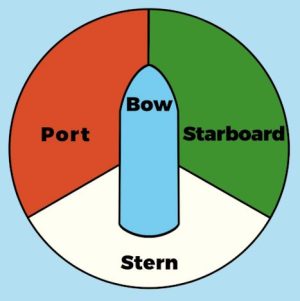
I can’t tell you how happy I was to get that reaction to the last Titanic post, and thank you all for reading. Thank you for indulging me. You all probably know these terms, but I didn’t, so if any of you were like me, this will help. The Bow is the front of the ship, and the Stern is the back end. The Port Side = left-hand side of a ship when you are on board and facing forward toward the bow. Starboard Side = right-hand side of a ship when you are on board and facing forward toward the bow. I’m going to tell you a not-so-well-known event about some fortunate luck the RMS Titanic had (yes, it could have been much worse), the lifeboat dilemma, and a couple of personal stories.
The coal fire. Before the iceberg ever struck RMS Titanic, a smoldering coal fire had been burning in one of the ship’s starboard coal bunkers, something not uncommon on steamships of the era (she had stops in Cherbourg, France, and Queenstown (now Cobh), Ireland before moving to the open Atlantic). To control it, stokers spent a couple of days shoveling an estimated 300 tons of coal from the starboard side over to the port side, a backbreaking task done in intense heat below deck. That weight shift reportedly gave the ship a slight port list (list = leaning) even before the voyage settled into the Atlantic. When the iceberg opened the starboard side to the sea, some historians believe that extra coal weight on the port side briefly helped counter the incoming flooding, slowing the list to starboard for a short time and giving the ship a little more balance during the early stages of the sinking. They did a computer simulation, and the computer said it should have sunk in 90 minutes. Then they entered the coal being moved, then the computer said it would take 3 hours, or 180 minutes. It really took 160 minutes, more on that with the next post.
When the call came for women and children first, there weren’t many wanting to do that. Lowering lifeboats was dangerous at that time, and many people have been killed doing that. You are 80 feet or so up in the air, being lowered into cold and darkness. It was incredibly dark on that moonless night. They had only the stars and the ship’s lights over the Atlantic.
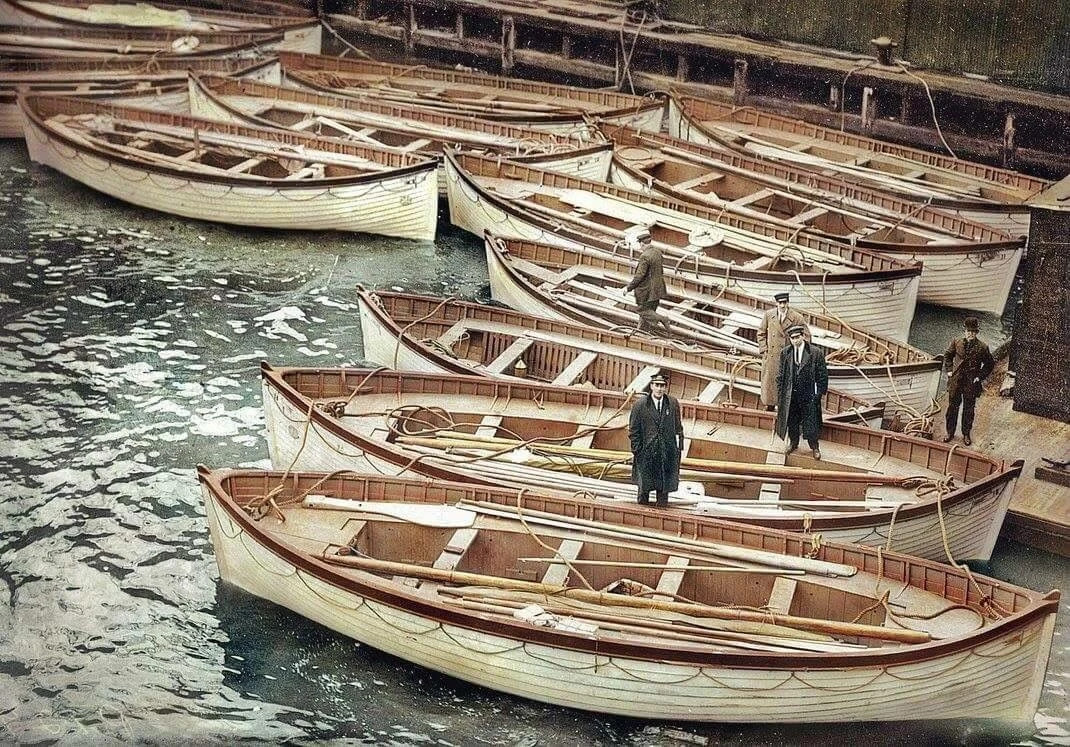
Life Boats. One thing that I didn’t understand was why the Titanic didn’t have enough lifeboats for the people she carried. The maritime law at the time was based on the ship’s tonnage. The Titanic had more lifeboats than she needed by law. Also, the Titanic was built so you could cut her into 3 sections and she would float (so she was a lifeboat as well), but that was without damaging 5-6 compartments. Back then, lifeboats were there to ferry people between the sinking ship and a rescue ship. They were not meant to be boats that people would stay on for hours or days in the Atlantic. They were also fortunate that the ocean was calm that night, not usual for the Atlantic. These were not light fiberglass boats; they were heavy wooden boats, weighing almost 6 tons with all of the equipment!
They had 20 lifeboats (The 20 boats consisted of 14 standard wooden boats, two emergency cutters, and four collapsible boats), and they didn’t even get all of those off properly. Remember, they were lowered by davits (crane-like devices used on ships to support, raise, and lower equipment such as boats, anchors, or dinghies). The Titanic gave them 160 minutes, which, compared to other shipwrecks, is quite a bit of time. What they needed more than anything was more time. I’m not saying that it would be a bad thing to have enough lifeboats. But when you think about it, launching those boats back then from so high up (around 80 feet) was not easy. Imagine being lowered into complete darkness up 80 feet. That is why passengers didn’t want to leave the warm ship to freeze in the Atlantic. They still thought the Titanic would not sink. It took so long that it drew people into a false sense of security. There were so many ships in the shipping lanes that they thought another ship would be close by and they would have enough time. That night, the Californian was 20 miles away at most (Titanic’s crew saw the ship and kept signaling), but their Marconi (radio operator) operator had gone to bed, and Titanic’s pleas were not heard by them. It was heard by the Carpathia (further away), which came to the Titanic’s rescue, but she didn’t get there until around 4am the next morning. They picked up the survivors, but that is it. The Titanic struck the iceberg at 11:40 pm on April 14, 1912, and sank at 2:20am on April 15, 1912.
So yes, I do believe more lifeboats would be a good idea, but more training and also passenger drills would have made a huge difference. You must remember, though, when a ship is listing to one side badly, you have to use the other side to lower boats, which wipes out half of your lifeboats on the up high side. Now they have made davits that will handle the listing, I’m happy to say.
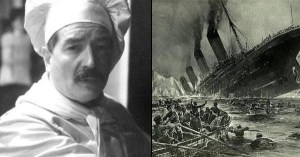
Personal Story: Charles Joughin (one of my favorites) was the chief baker aboard the Titanic, and his story became one of the most unusual survival accounts from the disaster. He knew he would not take a lifeboat seat, but he was going to help as many as possible and feel good at the same time. He didn’t give up, but knew what could happen. After the ship struck the iceberg, Joughin helped load women and children into lifeboats and threw deck chairs overboard so people in the freezing water might have something to cling to. Unlike many passengers who panicked, he stayed busy and calm as the ship’s final moments approached… Well, yes, he stayed calm and warm because, in between helping women and children, Mr Joughin would go to his cabin for shots of whiskey. When the final lifeboats departed, Joughin remained calm and rode the Titanic down like an elevator. Witnesses confirmed this. Luckily for him, there was no big suction from the stern going down. He was the last one to get off the stern as it plunged. He was picked up by a lifeboat and survived! He wasn’t falling down drunk, but he was highly buzzed, and he said he didn’t feel the 28-degree water and stayed in the water longer than most. Others say he was in the water longer than most that lived. He did a great job and saved a lot of lives.
Charles did everything he could, like sending bread to the lifeboats, helping to load people into them, throwing wooden chairs into the water for floatation devices, and still having time for a drink or two or three.
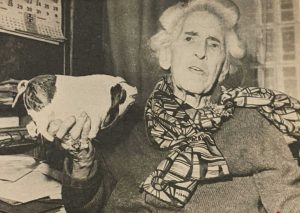
Personal Story: Fashion buyer and journalist Edith Rosenbaum (an older Edith in the 1970s above) boarded the RMS Titanic in first class after covering fashion collections in Europe, carrying with her a small toy pig music box given by her mother for good luck. When the ship struck the iceberg on April 14, 1912, Rosenbaum at first resisted leaving her cabin, worried about her belongings, but a crew member reportedly insisted she get into Lifeboat No. 11. She got the crew member to go get her toy pig. Finally, the crew member had to throw the pig into the boat just so that Edith would get in. The pig was a small mechanical music box that played the tune “La Maxixe.” During the long hours in the freezing Atlantic, she wound it up to calm frightened passengers and children in the lifeboat. Rosenbaum survived the disaster and later credited the pig with helping keep spirits up during the ordeal. The toy itself survived as well, becoming one of the more personal artifacts connected to the sinking of the Titanic.
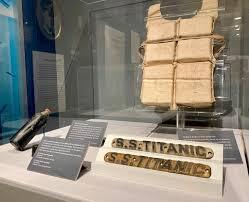
No authenticated, fully intact lifeboats from the Titanic are known to exist today. Of the 20 boats, 13 were brought to New York by the Carpathia, where they were stored briefly, stripped for souvenirs, and likely broken up, sold, or re-purposed for other White Star Line vessels by 1913. Some plaques that went on them still exist, as shown above.
If you get really interested in the Titanic, I recommend two YouTube channels. These young guys are historians and have a huge passion. You have Mike Brady from Oceanliner Designs and Sam Pence from Historic Travels. Mike is very professional and personable. Sam is very personable and professional. Both are ship fans, especially the old steamer liners. I get lost in their YouTube sites.
