
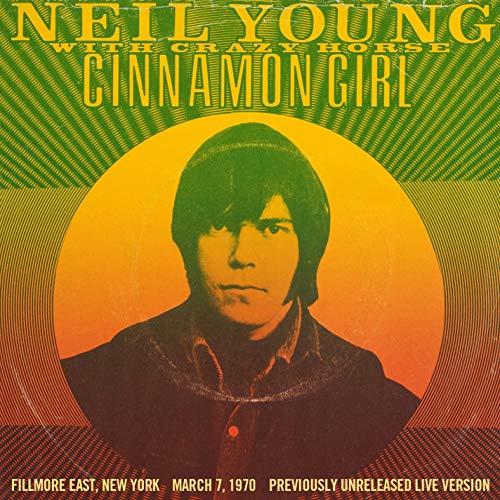
Neil Young – Cinnamon Girl

Love the nasty sound Neil has on his guitar. It’s a raw, fuzzed-out letter to the cosmos, sealed with a one-note guitar solo and dropped in the mailbox of your brain forever. It never leaves. This is a song I grew up on, but not this version. Somehow, I had The Gentrys version in my small record collection given to me by someone. It’s close, but no cigar. 

That riff, oh that riff. It’s a heavy, descending chunk of molten iron, equal parts garage and pre-grunge blueprint. It’s played in double drop D tuning, which is basically the rock ’n’ roll equivalent of letting the air out of your tires before racing. Everything sounds lower, meaner, sludgier. The minute it hits, it’s clear: Neil doesn’t want perfection. He wants feel. We played this song so many times that I know it by heart. 

Neil recruited guitarist Danny Whitten, bassist Billy Talbot, and drummer Ralph Molina from a local psychedelic group called The Rockets and renamed them Crazy Horse. The song was on the album Everybody Knows This Is Nowhere. The album peaked at #34 on the Billboard 200 album chart and #32 in Canada.

In the liner notes of his Decade compilation, Neil said, “Wrote this for a city girl on peeling pavement coming at me through Phil Ochs’ eyes playing finger cymbals. It was hard to explain to my wife.” Although Neil Young never said who it was about, the bit about finger cymbals could be a reference to ’60s folk singer Jean Ray, who performed with then-husband Jim Glover under the name Jim and Jean

Brian Ray, who is currently Paul McCartney’s guitarist and Jean’s younger brother, has said the song is indeed about his sister. Jean also said that she inspired another Neil Young track from Everybody Knows This Is Nowhere: Cowgirl in the Sand.

The song peaked at #55 in the Billboard 100 and #25 in Canada in 1970.

Cinnamon Girl

I want to live with a Cinnamon Girl
I could be happy the rest of my life 
with a Cinnamon Girl

A dreamer of pictures, I run in the night
you see us together chasin’ the moonlight
my Cinnamon Girl

Ten silver saxes, a bass with a bow
the drummer relaxes and waits between shows
for his Cinnamon Girl

A dreamer of pictures, I run in the night
you see us together chasin’ the moonlight
my Cinnamon Girl

Pa, send me money now
I’m gonna make it somehow
I need another chance
You see, your baby loves to dance
yeah, yeah, yeah

Neil Young – Down By The River

This song and Like a Hurricane are high on my list of Neil’s songs. I also like the live versions of this song, which can stretch into 15 minutes at times. He keeps it interesting. 

Young traded licks with Danny Whitten of Crazy Horse, Neil wrings every drop of feeling out of a few simple chords as he always does. He has always been one of the best at getting everything out of one simple note. That is why he is one of my favorite guitar players. He doesn’t do it with technical brilliance or flash, just total feel. He can sit on one note and make it scream. 

This song was on the 1969 Everybody Knows This Is Nowhere released in 1969. Crazy Horse was on the album also…Crazy Horse included Danny Whitten – guitar, Billy Talbot – Bass, and Ralph Molina on drums.  The album included Cinnamon Girl and Cowgirl in the Sand. This was the first album of many to feature Crazy Horse. 

Neil Young wrote Down by the River and Cinnamon Girl in 1968, reportedly during a bout of high fever and delirium while bedridden with the flu at a house in Topanga Canyon, California. That is a great day’s work, sick or not. Young used a Gibson Les Paul nicknamed “Old Black,” run through a small Fender amp cranked to overdrive for a natural distortion.

The album peaked at #32 in Canada and #34 on the Billboard Album Charts in 1970. Down by the River didn’t chart, but Cinnamon Girl did peak at #25 in Canada. With the chorus of “I shot my baby down by the river,” this song gets your attention. In a 1970 interview, Neil Young cleared it up: “There’s no real murder in it. It’s about blowing your thing with a chick. See, now in the beginning, it’s ‘I’ll be on your side, you be on mine’. It could be anything. Then the chick thing comes in. Then at the end it’s a whole other thing. It’s a plea… a desperation cry.” 

Neil Young: “I’d like to sing you a song about a guy who had a lot of trouble controlling himself, he let the dark side come thru a little too bright.” The explanation goes on the describe the murder, the killer’s arrest and, finally, the guilt he feels as he realized what he’s done.”

Neil Young: “I’m trying to make records of the quality of the records that were made in the late Fifties and the Sixties, like Everly Brothers records and Roy Orbison records and things like that. They were all done with a sort of quality to them. They were done at once. It’s just a quality about them, the singer is into the song and the musicians were playing with the singer and it was an entity, you know. It was something special that used to hit me all the time, that all these people were thinking the same thing, and they’re all playing at the same time. It happens on a few cuts, you can hear it. I think “Cinnamon Girl,” “Everybody Knows This Is Nowhere,” and “Round And Round” has that feeling of togetherness, although it was just Danny and me and Robin Lane.”

Down By The River

Be on my side I’ll be on your side, baby
There is no reason for you to hide,
This much madness is too much sorrow,
It’s impossible to make it today,
Hey, hey, ooh-ooh

She could drag me over the rainbow,
Send me away.

Down by the river
I shot my baby
Down by the river,
Dead, shot her dead.

You take my hand, I’ll take your hand,
Together we may get away.

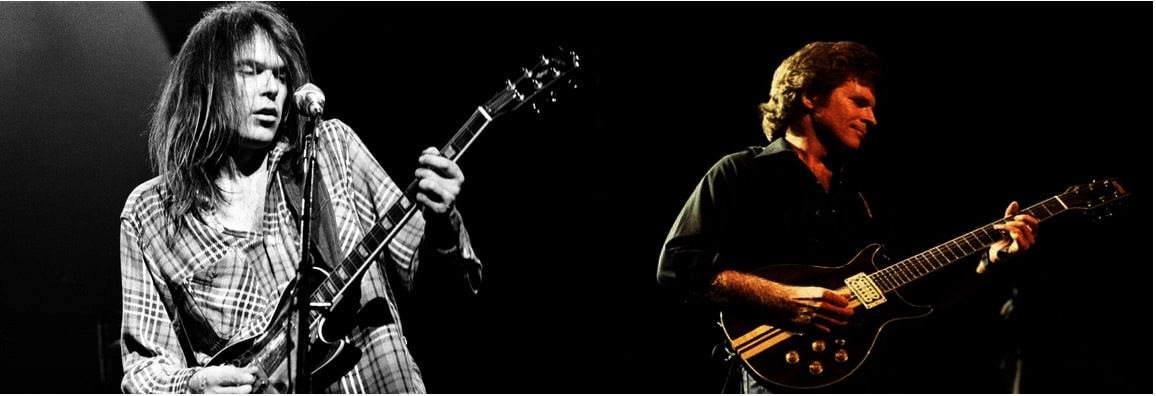
Neil Young and John Fogerty Lawsuits

In the eighties, two lawsuits popped up pertaining to these two artists.

Neil Young was basically sued for NOT sounding like himself by David Geffen and John Fogerty was sued for sounding too MUCH like himself by Saul Zaentz and Fantasy Records.

In the early eighties, David Geffen signed Neil Young to a huge contract to Geffen Records. Neil who will do his own thing no matter what or when…released an album called “Trans” his foray into electronic music. Geffen wanted another “Harvest” with another Heart of Gold or Old Man…instead he got “Computer Age” and “We R in Control” with Neil singing through a Vocoder. After that Neil was asked to do more rock and roll by a Geffen record company executive…the record company was thinking more of the lines of the harder rock Rust Never Sleeps…so Neil gave them rock and roll all right… “Everybody’s Rockin” an album full of early fifties Doo-wop and rockabilly sounding songs. The record company was not amused…he then released an album full of country music… In his contract, Neil had full artistic freedom.

Geffen had claimed the new albums were  “unrepresentative” of Neil’s music.

Geffen sued him for 3.3 million dollars but the case was settled and Geffen had to apologize to Neil.

In 1985 John Fogerty finally broke his silence with the album Centerfield. He had not released anything since 1975. He was involved with legal hassles and could not make music. Centerfield was a good album that signaled to the world John was back. He then was sued by Fantasy Records owner Saul Zaentz who signed the great Creedence Clearwater Revival to a terrible contract with Fantasy Records that kept John…the main songwriter and singer under contract forever. On top of that John gave up his copyrights to his CCR songs to Saul and Fantasy just to get out of that contract. The first single off of the Centerfield album “Old Man Down the Road” shot up the charts. Saul sued claiming it sounded too much like an old Creedence song that John wrote and sang called “Run Through the Jungle”. So he was being sued for plagiarizing himself. John would take his guitar to court to demonstrate how he wrote the two songs.

John won the case in 1988 and a lot of other musicians breathed a sigh of relief because other artists could have been sued for sounding like their younger selves if John would have lost. John countersued Fantasy Records for legal fees and it went to the Supreme Court in 1994…. they ruled in favor of Fogerty.