

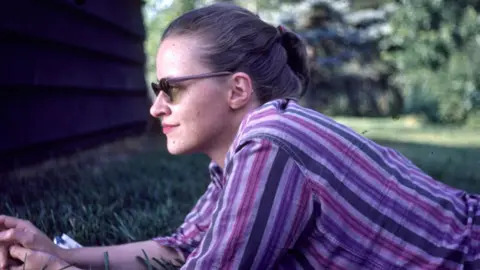
I wrote this for Lisa’s WMM (Women Music March) as I have proudly done for the past few years in March. Lisa was one of the first followers I had when starting out, and she is one of the readers who helped build my site in a lot of ways. Please go see the original post and visit her site. Thanks, Lisa!
It’s a shame she is more remembered for what may or may not have happened to her than for her music. She has been hailed for being ahead of her time, and she was. I plead with everyone reading this, please look her up and read some things about her. I have barely scratched the surface with this post.
Connie Converse is one of the most unusual stories in folk music or music in general. She wrote quiet, thoughtful songs in the early 1950s. That was years before the folk revival made that style popular. At the time, almost no one outside a small circle of friends heard her music. Decades later, people realized she had been doing something new long before it became fashionable.
She was born Elizabeth Eaton Converse in 1924 in New Hampshire. She grew up in a strict Baptist family and showed an early interest in writing and music. After leaving college, she moved to New York City in the late 1940s. She went there hoping to find a place in the arts. Instead of the louder folk style that would come later, Converse wrote reflective songs that sounded closer to personal thoughts or even letters.
During the early 1950s, she performed occasionally in New York apartments and small gatherings. Her friend Gene Deitch, who later worked in animation, recorded many of her songs at home on a tape machine. In 1954, she appeared on The Morning Show on CBS, singing several of her compositions. The appearance did not lead to a recording contract, and by the end of the decade, she stepped away from performing.
In the early 1960s, Converse moved to Michigan and worked in publishing and writing. Music slowly faded from her life, and she became a huge activist on racism. On August 10, 1974, she wrote letters to friends and family and packed her belongings into a Volkswagen Beetle and drove away from her Ann Arbor, Michigan home. She was never heard from again, and her disappearance remains unexplained. She left letters indicating a desire to start a new life and instructed friends/family not to look for her. No traces of her or her car were ever found. There have been theories about her. While she may have started a new life, the most widely discussed theories include suicide (possibly by driving into a body of water) or death by misadventure.
Several years after she left, someone told her brother Philip that they had seen a phone book listing for “Elizabeth Converse” in either Kansas or Oklahoma, but he never pursued the lead. About ten years after she disappeared, the family hired a private investigator in hopes of finding her. The investigator told the family, however, that even if he did find her, it was her right to disappear, and he could not simply bring her back. After that, her family respected her decision to leave and ceased looking for her.
Her music might have stayed unknown if Gene Deitch had not preserved those early tapes. In 2009, the label Squirrel Thing Recordings released a collection of her recordings. For the first time, people heard the songs she had written more than fifty years earlier. Listeners were struck by how modern they sounded, both in their lyrics and their quiet delivery.
Today, Connie Converse is often mentioned as a lost pioneer of singer-songwriter music. She worked alone with a guitar, writing direct songs about daily life, loneliness, and independence, years before artists in the 1960s folk revival made that approach common.
What makes Connie Converse interesting is timing. She was writing personal, singer-songwriter-style material in the early 1950s, almost a decade before that approach became common. If these songs had been recorded during the 1960s folk revival, her story might look very different.
Connie Converse: “Human society fascinates me and awes me and fills me with grief and joy; I just can’t find my place to plug into it”
“I believe all true art is, in this sense, impersonal:
its value does not depend on knowing or thinking anything
about its maker. Art is not an extension of the artist’s personality,
but has its own life”
“The problem, or at least a problem, I’ve been told —
is that I am not very concerned about being missed
upon any of my exits, not the ones that are voluntary
nor the ones that swoop down without warning
to cover me in a quilt of dark feathers”.
 PowerPop... An Eclectic Collection of Pop Culture