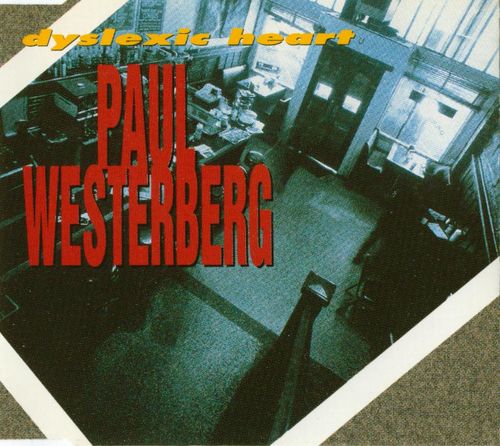
Paul Westerberg – Dyslexic Heart

I know much more about The Replacements than Paul’s solo career but I’ve been listening and I’ve liked what I’ve heard. This song has catchy guitar riffs running through it and is accessible. It’s a good one to introduce him solo on here. During the 1980s Westerberg’s songwriting was second to none. I’m finding a lot of his solo work the same.

This song was used in the 1992 movie Singles and appears on the soundtrack along with tracks by Jimi Hendrix, Pearl Jam, Alice in Chains, Chris Cornell, The Smashing Pumpkins, Soundgarden, and more. Another Westerberg song, Waiting For Somebody, is also on it. The album peaked at #6 on the Billboard Album Charts. Dyslexic Heart peaked at #4 on the Billboard Alternative Charts. The album helped open up grunge to the mainstream.

Cameron Crowe (a huge Replacements fan) had asked Westerberg to contribute a couple of songs to the soundtrack. He made this song right after the Replacements disbanded. The following year, he would release his first solo album called 14 Songs.

The Replacements started out as a punk band. They eventually switched over to a more rock approach with rock songs and ballads. Westerberg remained a true punk in spirit with his irrelevant attitude.

The Singles soundtrack played a key role in popularizing grunge, and some even referred to Paul Westerberg as the “Godfather of Grunge.” Westerberg responded to this label with humor and humility:

“I don’t know… I guess I wore a plaid shirt, and yes, I played real loud, but… what is grunge? I don’t know. I don’t hear a lot of melody in what they’re doing on the West Coast. Nirvana, I suppose, has some hooks, I can see that, but a lot of it sounds to me like Boston with a hair up its ass. The Ramones probably have more to do with it than we did. Play Ramones records on 16 and you’ve got grunge!”

That response is one of the reasons I’m such a fan of him.

Here is a fuzzy video of him live in 1993.

Dyslexic Heart

You shoot me glances and they’re so hard to read
I misconstrue what you mean
Slip me a napkin and now that’s a start
Is this your name or a doctor’s eye chart?

I try and comprehend you but I got a dyslexic heart
I ain’t dying to offend you, I got a dyslexic heart

Thanks for the book, now my table is ready
Is this a library or bar?
Between the covers I thought you were ready
A half-angel, half-tart

I try and comprehend you but I got a dyslexic heart
I ain’t dying to offend you, I got a dyslexic heart

Do I read you correctly, you need me directly
Help me with this part
Do I date you? Do I hate you?
Do I got a dyslexic heart?

You keep swayin’, what are you sayin’?
Thinking ’bout stayin’?
Or are you just playing, making passes?
Well, my heart could use some glasses

Are you stayin’?
What are you sayin’?
Well are you swayin’?
Are you just playing, making passes?
Well, my heart could use some glasses

I try and comprehend you, I got a dyslexic heart
Do I read you correctly, I need you directly
Help me with this part
Do I love you? Do I hate you?
I got a dyslexic heart?

Big Star – Life Is White

Love this driving song by Big Star. It was on Radio City, their second album. Some say it is a response to the Chris Bell song off the first album called My Life Is Right…or a message to his girlfriend Diane (Don’t like to see your face Don’t like to hear you talk at all) that he was splitting with at the time.

After the failure of their first album, singer/songwriter guitar player Chris Bell quit Big Star. Alex Chilton didn’t know if Big Star was going to make another album. He continued making demos because he could always do a solo album. The two other members, drummer Jody Stephens and bass player Andy Hummel wasn’t sure either what was going to happen. They had talked about ending the band.

Their record company Ardent was under the Stax umbrella. They sent out invitations to all of the major rock journalists of the day in 1973. They invited them to Memphis to see Ardent’s roster of bands but most of all Big Star. The rock writers loved Big Star. Many legendary writers were there including Lester Bangs.

Stax agreed to foot the bill, which amounted to $40,000 to fly in more than one hundred rock critics from across the U.S. and U.K., put them up at the Holiday Inn, wine and dine them, bus them to Memphis landmarks like Graceland, and, on the final night, knock them out with a showcase at Lafayette’s Music Room, featuring Skin Alley, Larry Raspberry and the High-Steppers, and Big Star.

As writers from California (Shaw, Gene Sculatti, and Cameron Crowe), the New York City area (Richard Meltzer, Andy Shernoff, Gary Kenton, Pete Tomlinson, Lenny Kaye, and Nick Tosches), upstate New York (Billy Altman), Austin (Chet Flippo), Detroit (most of Creem’s staff, including Lester Bangs and Jaan Uhelszki), and the U.K. (Simon Frith, Ben Edmonds, and Pete Frame) signed on, Big Star was persuaded to play the gig.

The writers sat through the other bands and by the time Big Star took the stage, around midnight, they were well lubricated. Big Star couldn’t have had a more receptive audience. Rock critics are not known to dance but they were all on the floor and some has since called the performance by Big Star magic. Some called it the greatest performance and sound they ever heard. That night is what convinced Big Star to stay together and finish their second album Radio City. They played most of the first album, some covers, and a few songs they had worked on including Life Is White.

What I question is…Stax would give money for things like this but could not distribute records?

Alex had the quote below while he was in Big Star. What he said foretold Big Star’s future. It would be years later before the album would sell anything and get noticed. They would make one more album…Big Star Third/Sister Lovers before ending it.

Alex Chilton: “The important thing is to make a good record,” “because if you make a good record, it doesn’t matter what happens. It’s going to sell from then on to some degree, even though it doesn’t sell anything when it comes out and is a big disappointment to everybody. If it’s really good, people are going to want it from then on, and that’s the important thing. It might take five or ten years for it to pay off—or it might take twenty years, and you might be dead when it pays off. If it’s good, it’s going to pay off for somebody, sometime.”

Life Is White

Don’t like to see your face
Don’t like to hear you talk at all
I could be with Ann
But I’d just get bored

Can’t even bring myself to call
And I don’t want to see you now
‘Cause I know what you lack
And I can’t go back to that

Whatever’s all the same
Now there’s nobody to know
And I can’t recall, recall your name
All I can say is so

And I don’t want to see you now
‘Cause I know what you lack
And I can’t go back to that

Your life is white
And I don’t think I like
You hanging around

Don’t like to see your face
Don’t like to hear you talk at all
I could be with Ann
But I’d just get bored

Can’t even bring myself to call
And I don’t want to see you now
‘Cause I know what you lack
And I can’t go back to that now