
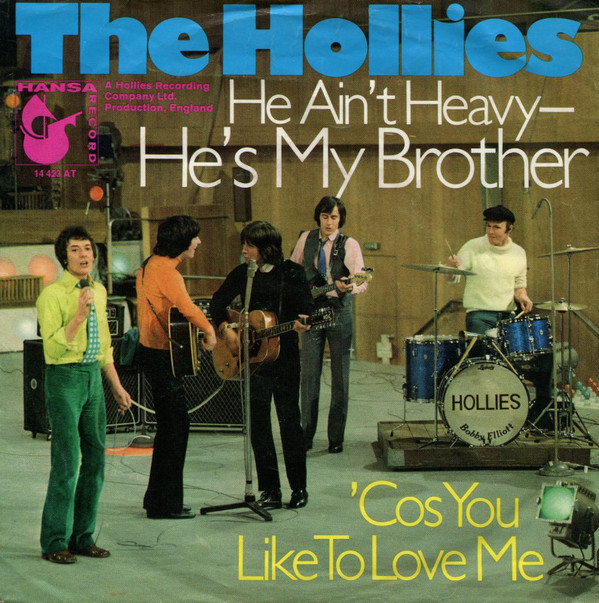
Hollies – He Ain’t Heavy (He’s My Brother)

What a soulful song this is coming out of the Hollies. After Graham Nash left the group, they started to change into more of a 70s rock band. 

The Hollies may be best known for their chiming guitars, close harmonies, and pop feel on songs like Bus Stop or Carrie Anne, but in 1969, they took a hard turn straight into emotional overdrive with this song. This wasn’t your typical British Invasion earworm. This was a slow-burning ballad with a title that sounded like scripture. The star of this song is Alan Clarke’s lead vocal. A gut-wrenching vocal that makes Clarke sound like he lived the song. 

It was released in 1969 and was written by Bobby Scott and Bob Russell. A young Elton John played piano on the song. It peaked at #7 on the Billboard 100, #11 in Canada, #3 in the UK, and #7 in New Zealand. It was used in a commercial in 1988 and in that year went to number 1 in the UK charts. I always thought the song had a spiritual sound to it.

Speaking of the songwriters, Bobby Scott was a jazz pianist, and Bob Russell was writing these lyrics while battling terminal cancer. The phrase “He ain’t heavy, he’s my brother” came from a story involving a Scottish orphanage and a child being carried on another’s back. Back in 1918, a boy named Howard Loomis was abandoned by his mother at Father Flanagan’s Home for Boys, which had opened just a year earlier. Howard had polio and wore heavy leg braces. Walking was difficult for him, especially when he had to go up or down steps. Soon, several of the Home’s older boys carried Howard up and down the stairs. One day, Father Flanagan asked Reuben Granger, one of those older boys, if carrying Howard was hard. Reuben replied, “He ain’t heavy, Father… he’s my brother.”

Tony Hicks: “In the 1960s when we were short of songs I used to root around publishers in Denmark Street. One afternoon, I’d been there ages and wanted to get going but this bloke said: ‘Well there’s one more song. It’s probably not for you.’ He played me the demo by the writers [Bobby Scott and Bob Russell]. It sounded like a 45rpm record played at 33rpm, the singer was slurring, like he was drunk. But it had something about it. There were frowns when I took it to the band but we speeded it up and added an orchestra. The only things left recognizable were the lyrics. There’d been this old film called Boys Town about a children’s home in America, and the statue outside showed a child being carried aloft and the motto He Ain’t Heavy, He’s My Brother. Bob Russell had been dying of cancer while writing. We never got, or asked for, royalties. Elton John – who was still called Reg – played piano on it and got paid 12 pounds. It was a worldwide hit twice.”

He Ain’t Heavy(He’s My Brother)

The road is long
With many a winding turn
That leads us to who knows where
Who knows where
But I’m strong
Strong enough to carry him
He ain’t heavy, he’s my brother

So on we go
His welfare is of my concern
No burden is he to bear
We’ll get there

For I know
He would not encumber me
He ain’t heavy, he’s my brother

If I’m laden at all
I’m laden with sadness
That everyone’s heart
Isn’t filled with the gladness
Of love for one another

It’s a long, long road
From which there is no return
While we’re on the way to there
Why not share

And the load
Doesn’t weigh me down at all
He ain’t heavy he’s my brother

He’s my brother
He ain’t heavy, he’s my brother, he ain’t heavy

Hollies – Carrie Anne

I have a soft spot for the Hollies. They started in the early sixties and continued through the seventies without Graham Nash who quit the Hollies for what he thought was a hipper band…Crosby, Stills, and Nash. Soon to include the elusive Neil Young.

Hollies members Allan Clarke, Tony Hicks, and Graham Nash wrote this song and shared the lead vocals, with each taking a verse (Clarke, then Hicks, then Nash). The Hollies had great harmonies and also a secret weapon in Tony Hicks as a guitar player. He was and still is outstanding but was never as known as his later neighbor George Harrison and his other peers.

Tony’s son Paul Hicks was in Dhani Harrison’s band and has worked with Giles Martin on Beatle remastering projects.

This song is about the British singer and actress Marianne Faithfull, who is well known for her relationship with Mick Jagger. She also had a brief fling with lead singer Alan Clarke. For a short time. “Marianne” was changed to “Carrie-Anne” so it wouldn’t be so obvious.

The song peaked at #9 in the Billboard 100, #9 in Canada, #3 in the UK, and #2 in New Zealand in 1967. This song was a straight-ahead pop hit, but changes were coming. Sgt Peppers was released so The Hollies, with the urging of Nash, tried going the more psychedelic route. The next single was King Midas In Reverse which only peaked at #18 in the UK and was considered a failure. Personally…it’s my favorite early Hollies song.

A side note…The Canadian actress Carrie-Anne Moss, best known for playing Trinity in The Matrix, was named after this Hollies hit. The song was on the charts at the time of her birth in August 1967.

From Songfacts

The group didn’t let on that the song was about Faithfull until 1995, when Graham Nash spilled the beans in a documentary.

In the song, the singer recalls the schoolyard days when he and Carrie Anne were friends, but she went for the older boys. Now their older and he tells her that although she’s lost her charm, he’s willing to “be her teacher” and take her on. By the end of the lesson, he’s sure she’ll be his girl.

According to the book Forty Years of Steel by Jeffrey Thomas, this song marks the first use of steel drums in a commercial pop record. Steel drums evoke an island vibe, but there’s nothing tropical about this song and none of The Hollies played the instrument (it’s not clear who played it on the record, but their producer, Ron Richards, apparently arranged it). Still, inserting a steel drum solo where a guitar solo would be certainly made the song stand out. Stephen Stills, Nash’s bandmate in Crosby, Stills & Nash, incorporated steel drums into his 1970 hit “Love The One You’re With.”

The Hollies had a very impressive run of hits starting in 1963, but Graham Nash wanted to put hit-making aside so they could create songs with more weight behind them. He ended up leaving the group in 1968 and forming Crosby, Stills & Nash. In an interview with Bruce Pollock, Nash said listeners “want to hear songs that mean more to them than ‘Hey Carrie Ann, what’s your game.'”

Carrie Anne

Hey, Carrie Anne
Hey, Carrie Anne
When we were at school, our games were simple
I played a janitor, you played a monitor
Then you played with older boys and prefects
What’s the attraction in what they’re doing

Hey, Carrie Anne, what’s your game now
Can anybody play
Hey, Carrie Anne, what’s your game now
Can anybody play

You were always something special to me
quite independent, never caring
You lost your charm as you were aging
Where is your magic disappearing

Hey, Carrie Anne, what’s your game now
Can anybody play
Hey, Carrie Anne, what’s your game now
Can anybody play

You’re so, so like a woman to me
(So like a woman to me)
So, so like a woman to me
(Like a woman to me)

Hey, Carrie Anne, what’s your game now
Can anybody play
Hey, Carrie Anne, what’s your game now
Can anybody play

People live and learn but you’re still learning
You use my mind and I’ll be your teacher
When the lesson’s over, you’ll be with me
Then I’ll hear the other people saying

Hey, Carrie Anne, what’s your game now
Can anybody play
Hey, Carrie Anne, what’s your game now
Can anybody play

Carrie Anne, Carrie Anne, Carrie Anne