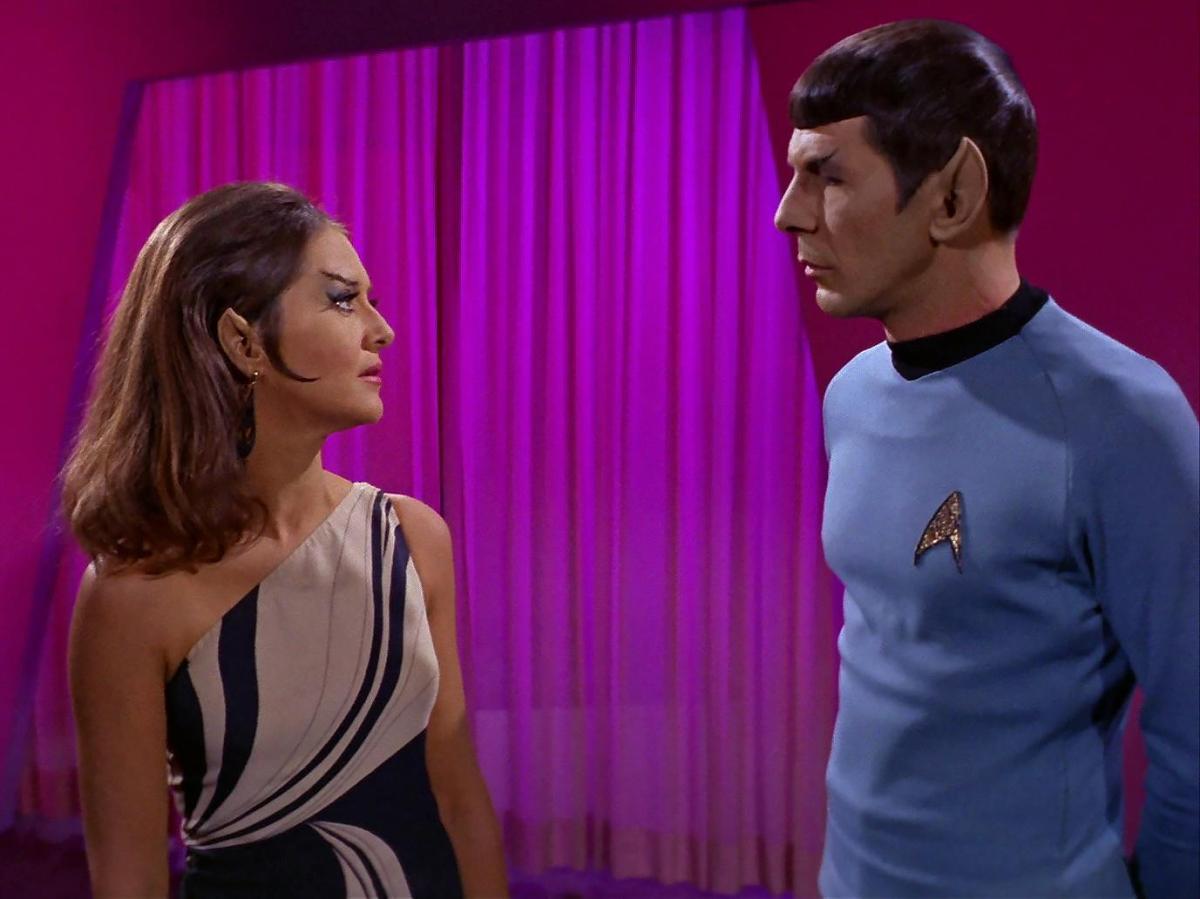
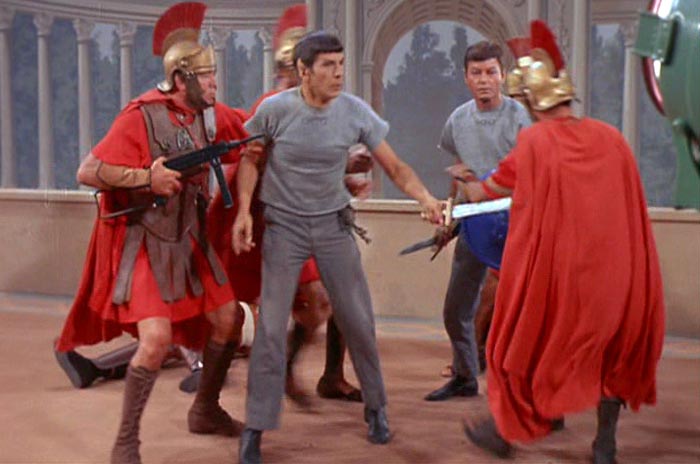
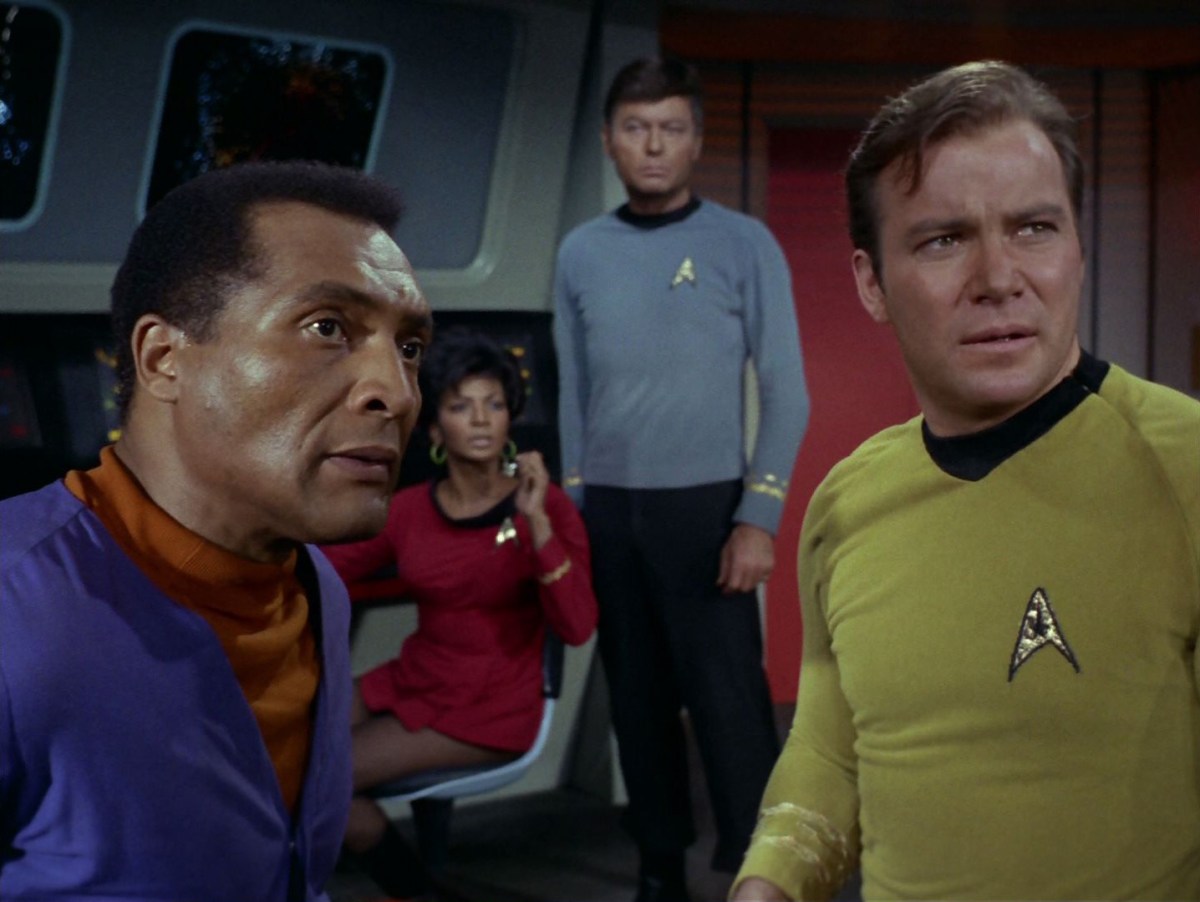
Star Trek – The Omega Glory

★★★1/2 March 1, 1968 Season 2 Episode 23

If you want to see where we are…and you missed a few…HERE is a list of the episodes in my index located at the top of my blog. 

This show was written by Gene Roddenberry

***I’ll be starting a new series called “Through The Years” starting after this post.***

This episode has been called really good and the worst of the series. I don’t think it’s the worse by any stretch of the imagination. For me it was a little convoluted but a good episode to watch. 

Gene Roddenberry originally wanted to produce this script early in the first season, along with Star Trek: Mudd’s Women, but NBC thought the script was weak and ordered the staff to ‘shelve’ it for an indefinite time to be possibly reworked and produced later on. Despite NBC still objecting against it, Roddenberry finally had his way to make “The Omega Glory” late in the second season.

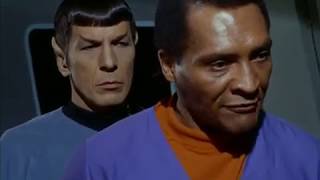
Star Trek - The Omega Glory B

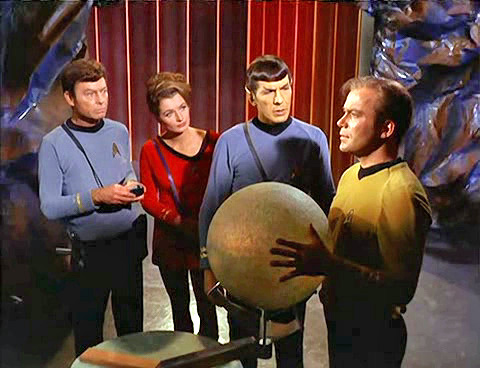
The Enterprise comes across the U.S.S. Exeter, and finds its entire crew dead — victims of absolute dehydration resulting from a plague contracted from the surface of the planet the Exeter was orbiting. Kirk, Spock, and McCoy beam down to the planet’s surface and learn that the inhabitants are immune and that the newest inhabitant is Ron Tracey, captain of the Exeter. Unfortunately, the inhabitants of the planet are divided into the urban-dwelling “Khoms” and the more rustic “Yangs,” each in deadly combat with the others.

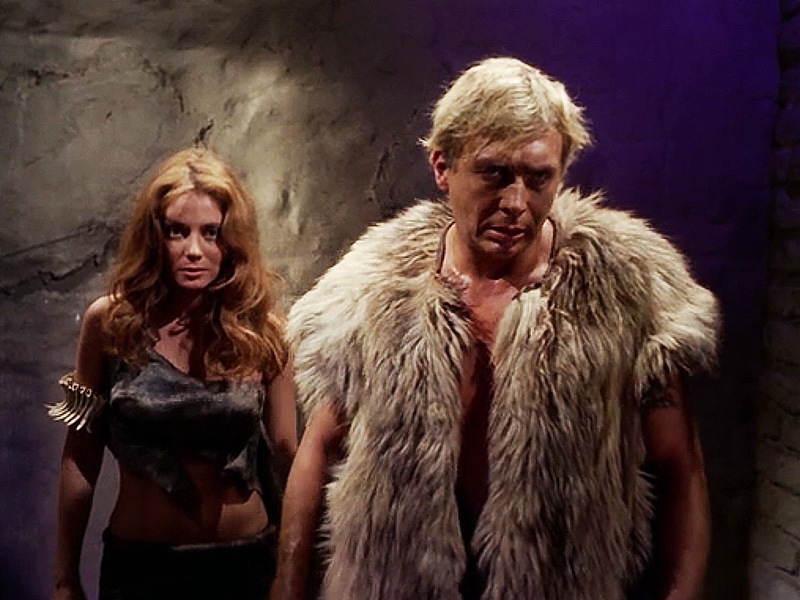
They find themselves in a town where relatively backward villagers are preparing to execute two captives who are apparently savages. The execution is stopped by the sole survivor of the Exeter, Capt. Ron Tracey. He explains that they are in a Kohm village and the savage Yangs are waging a war against them. It turns out Tracey has broken the prime directive by arming the Kohms because he has learned that not only are people living on the surface immune to the condition that killed his crew… they also live to a great age… he intends to find out how then make a fortune with the knowledge.

Tracey has Kirk, Spock and McCoy locked up, Galloway is dead by now, and while confined Kirk is put in a cell with a Yang. After a fight the Yang escapes and warns his people about a Kohm ambush. They are then victorious and take the village; it is then that Kirk learns that the Yangs have some shocking similarities with the United States… only this society lost a war and forget the meanings of its familiar ‘holy words’.

This episode is not a veiled observation on communism…it’s in the open completely. 

From IMDB:

This is the second of three times the Enterprise encounters another Constitution-class star ship with the entire crew dead. The other two were in Star Trek: The Doomsday Machine (1967) and Star Trek: The Tholian Web (1968).

NBC announced that Star Trek would be renewed for a third season during the closing credits of “The Omega Glory,” broadcast on 1 March 1968. In the announcement, they also wrote “Please do not send any more letters”, responding to the vast amount of mail received during the protests organized by Gene Roddenberry and Bjo Trimble.

This was one of three scripts submitted to NBC (along with Star Trek: Where No Man Has Gone Before (1966) and Star Trek: Mudd’s Women (1966)) when they were seeking to do a second pilot for the series. They ultimately chose to kickstart the series with “Where No Man Has Gone Before”.

Only episode where a victim of the Vulcan neck-pinch actually makes a sound at the time of the pinch. Normally, the neck-pinch incapacitates the victim before he/she can make a sound.

This episode marks the first and only time in the original series that a reference is made to phaser “power packs.”

The original 1965 script draft named the missing starship as the USS Argentina. The Enterprise landing party consisted of Kirk, Spock, a young navigator named Lieutenant Commander Piper, a helmsman called Lieutenant Phil Raintree, and the ship’s doctor named Milton Perry.

A letter reprinted in Inside Star Trek: The Real Story reveals that Gene Roddenberry personally submitted his teleplay for consideration for an Emmy Award.

Here the USS Enterprise visits another world possessing a parallel-Earth culture. Other such examples include Star Trek: Miri (1966) and Star Trek: Bread and Circuses (1968). There are also Earth cultures in Star Trek: A Piece of the Action (1968), Star Trek: Patterns of Force (1968), Star Trek: The Paradise Syndrome (1968), and Star Trek: Plato’s Stepchildren (1968), but they were introduced deliberately or accidentally by people from Earth and/or the Federation, and did not originate organically.

Scenes from The Omega Glory were featured in a set of View Master (3-D) slides. In this adaptation, the Yangs were renamed the Meraks.

Morgan Woodward (USS Exeter Captain Ronald Tracey) had previously played another wild-eyed madman, Simon Van Gelder in Star Trek: Dagger of the Mind (1966).

This is the first time the chief medical officer of another Federation star ship, Dr. Carter, is seen. Although he is sitting in the command chair on the bridge, it is unclear if he is in command of the Exeter or is merely recording his warning. Not until Star Trek: The Next Generation: Descent, Part II (1993) would a doctor clearly be in command of a star ship. (Star Trek: The Next Generation: Remember Me (1990) had teased viewers with the possibility.)

The Kohm guarding Dr. McCoy can be seen in green coveralls in Star Trek: The Man Trap (1966), both in the corridor and in the turbolift, and as one of the miners in Star Trek: The Devil in the Dark (1967). He can also be seen extensively as a background character in Kung Fu (1972) and Hawaii Five-O (1968).

Spock attempting to telepathically “suggest” Sirah to pick up the communicator was reminiscent of the early concepts that Spock has special powers over women.

The remastered version of “The Omega Glory” aired in many North American markets during the weekend of 30 June 2007. The episode included dramatic new effects shots of the Enterprise and the Exeter in orbit of a more Earth-like, computer-generated Omega IV. Among the fine details inserted into the show, a small glimpse of the Exeter appears on the Enterprise viewscreen as it approaches the planet at the start of the episode.

Roy Jenson’s voice was electronically altered. The preview trailer contains unaltered dialogue for Cloud William which doesn’t have the “slowed down” effect.

It is learned that the Exeter had a standard complement of four shuttlecraft. During the search for survivors, Galloway informed Kirk that “all four of the craft” were still on the hangar deck. Whether all Constitution-class vessels were equipped with that number of shuttles is not made clear.

The shot of Sulu manning the helm station with an empty captain’s chair in the background in mid-Act One is recycled from Star Trek: Arena (1967).

This takes place in 2268.

Empty phasers make a click noise just like an empty gun. (When Tracey tries to shoot Kirk a second time.)

When Sirah holds the communicator while hypnotized by Spock, the lid/antenna appears to open by itself, without being flipped open in any way. In actuality, Sirah is seen using her right index finger to pull the right top hinge; thereby opening the cover.

Wu was born in 1806.

Scotty and Chekov do not appear in this episode.

Wu’s father was born well before 1268.

A canned female scream is also heard in Star Trek: A Private Little War (1968) and Star Trek: The Gamesters of Triskelion (1968).

For the scenes involving the American flag Fred Steiner, the original “Perry Mason” theme composer, provided the only original music written for this show.

McCoy gives the prognosis that an Omega lV serum can’t prolong alien life. And that the Kohms’ & the Yangs’ vast prolonged lifespan is evolutionary. However, Spoke is a product of genetic engineering. So at least offspring might enjoy “immortality.” And with 23rd century science & medicine, “adulthood” gene splicing is feasible.

Roy Jenson (Cloud William) and Irene Kelly (Sirah) both appeared in different shows of “Mission: Impossible”, another initial Desilu production. Jenson appeared in the “The Killing” of season two, and Kelly in “The Elixir” of season three.

Summary

As the Enterprise approaches planet Omega IV, they find another starship, the U.S.S. Exeter, in orbit. Kirk, Spock, and McCoy beam aboard to find the ship abandoned but strewn with uniforms and crystals. The last log entry from the ship’s surgeon tells them they have been infected with a deadly virus brought aboard from a returning landing party. Kirk’s party beams down to the planet’s surface and finds there is one Exeter survivor: Captain Ron Tracey. He has apparently ignored the Prime Directive and has taken sides in a local dispute supporting the Kohms against their arch-rivals, the Yangs. As McCoy tries to find a cure for the virus, Spock and Kirk try to make sense of the situation. They eventually realize there is an odd parallel with Earth’s own history.

CAST

William Shatner … Captain James Tiberius ‘Jim’ Kirk
Leonard Nimoy … Mister Spock
DeForest Kelley … Dr. McCoy
Morgan Woodward … Captain Tracey
Roy Jenson … Cloud William
George Takei … Sulu
Nichelle Nichols … Uhura
Irene Kelly … Sirah
Morgan Farley … Yang Scholar
David L. Ross … Lt. Galloway
Lloyd Kino … Wu
Ed McCready … Dr. Carter
Frank Atienza … Kohn Villager
Bill Blackburn … Lieutenant Hadley (uncredited)
Frank da Vinci … Security Guard (uncredited)
Ed Fury Ed Fury … Guard (uncredited)
Eddie Paskey … Lieutenant Leslie (uncredited)
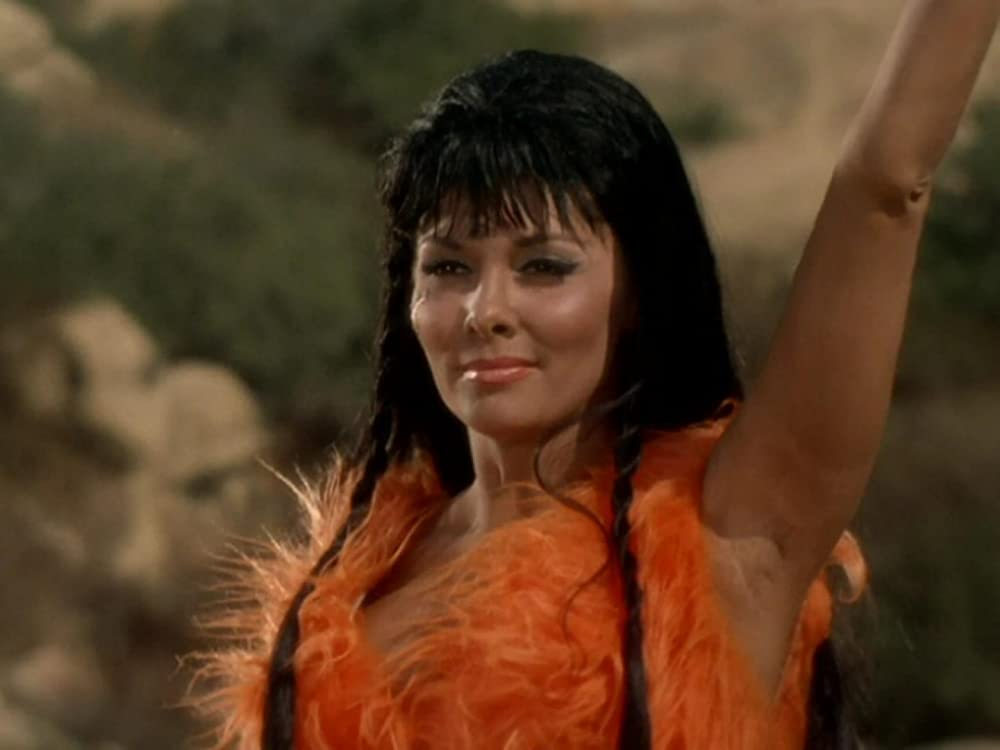
Adele Yoshioka … Kohm Servant (uncredited)

Star Trek – By Any Other Name

★★★★ February 23, 1968 Season 2 Episode 22

If you want to see where we are…and you missed a few…HERE is a list of the episodes in my index located at the top of my blog. 

This show was written by Gene Roddenberry, D.C. Fontana, and Jerome Bixby

The Enterprise Crew finds themselves being conquered by a superior alien race (Kelvans). A small group of superior alien beings takes the form of humans in order for them to hijack the Enterprise.

They need the ship so they can return to their old world which is beyond the Great Barrier. They turn almost the whole crew into these clay balls, except for Kirk, Spock, Scotty, and Bones, whom they need to help them run the ship. The only weakness the hijackers seem to have is that since they’re in human form for the time being, they’re vulnerable to human emotions.

Star Trek - By Any Other Name B

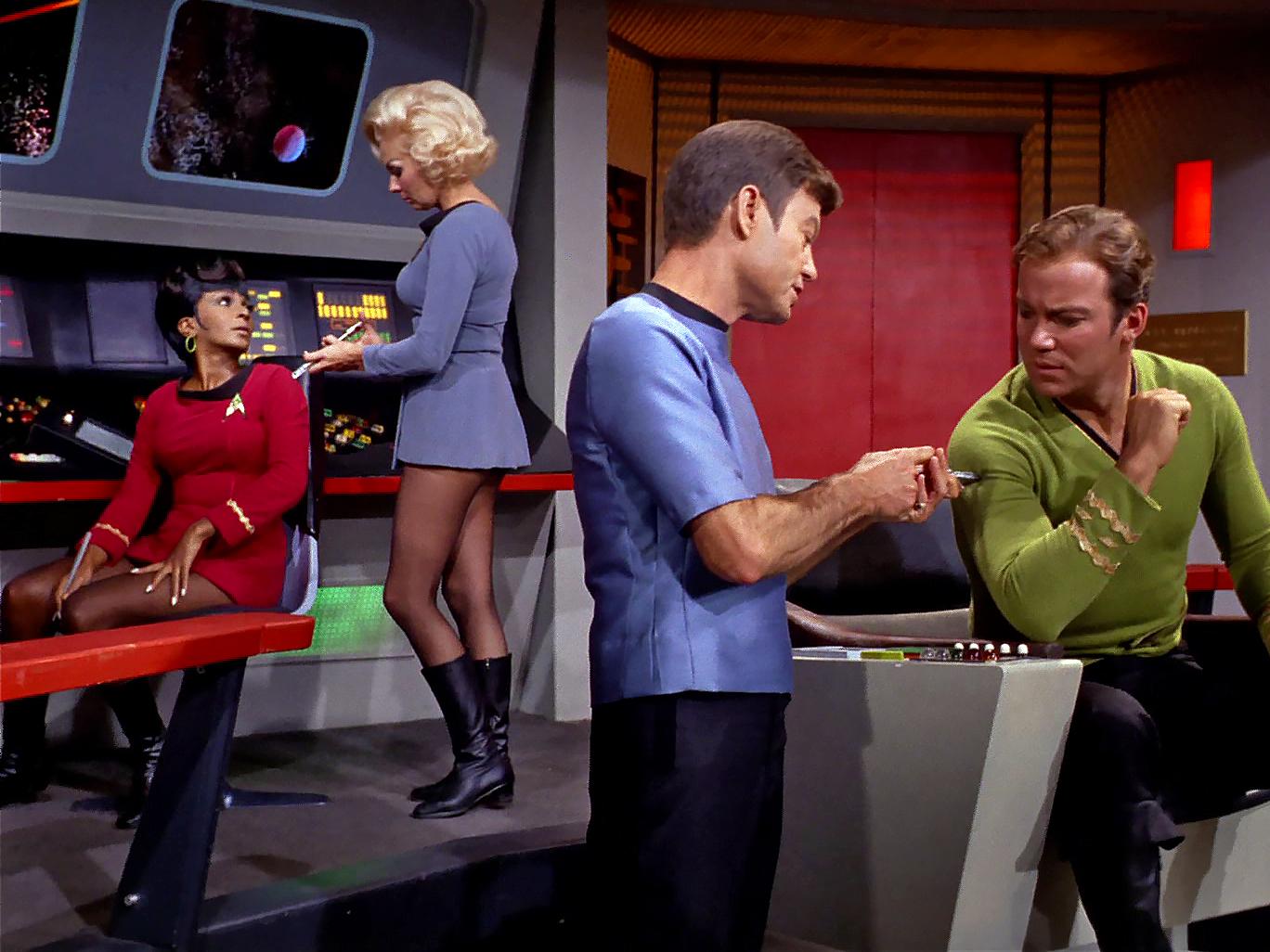
Once the senior crew realizes the Kelvans are susceptible to human weaknesses things get quite amusing as Scotty gets one of them drunk, McCoy gives injections saying they are vitamin supplements but actually, they just make him very irritable and, perhaps inevitably Kirk sets about seducing the beautiful Kelinda causing Rojan to get jealous.

In human form, they cannot resist the emotions that they are getting. Will it be the Achilles heel that Kirk has been looking for? This is a good solid episode…not a classic one but not all of them can be. 

***Spoiler***

The only thing I didn’t like about the episode is… there was no action or punishment for the death of  Yeoman Leslie Thompson.

From IMDB:

While drinking with Tomar, Scotty finds a bottle of unidentifiable alcohol, and when Tomar asks, “What is it?” Scotty hesitates for a moment and finally says “It’s green.” This has become an iconic Scotty moment, and is even spoofed in Star Trek: The Next Generation: Relics (1992).

Direct references to two previous episodes were made. After Rojan mentions the galactic barrier, Kirk says, “We’ve been there.” (Star Trek: Where No Man Has Gone Before (1966)); Even Spock repeats his analysis of the barrier word for word: “Density negative. Radiation negative. Energy negative.” When the landing party is detained in a cave, Kirk recalls their imprisonment on Eminiar VII and Spock’s use of a mind-meld to fool the guards. (Star Trek: A Taste of Armageddon (1967)).

Jerome Bixby’s original script was much darker than the filmed episode. The Kelvans (then called the Dvenyens) executed ten Enterprise crew members by opening the shuttle bay doors and letting them be blown out into space. (Technically, they would be blown out by escaping air. This could have been a goof because, even in the Orignal Series, the shuttle bay had force fields to prevent this happening, unless the Kelvans deliberately lowered them.) Kirk was put through “hellish torture”. Also, crew members were chosen to mate with each other (Kirk was paired with Yeoman Leslie Thompson) to breed slaves for the Kelvans. NBC objected to all these, which led producer Gene L. Coon to order a heavy rewrite. The production staff also deemed the mating aspect too similar to Star Trek: The Cage (1966).

Kirk mentions that an intergalactic voyage by a 23rd century starship would take “thousands of years” to reach the Andromeda Galaxy. For the Kelvans, intergalactic travel is a three-century journey. In the 24th century, as seen in Star Trek: The Next Generation: Where No One Has Gone Before (1987), Federation technology has apparently matched the Kelvans, perhaps due to this encounter, when it is discussed that a return trip to the Milky Way from the Triangulum Galaxy would take three hundred years at maximum warp.

A three-dimensional chess set is often seen in the series, but a three-dimensional checkers set can be seen in the rec room in this episode. It is later destroyed in a fight.

The Kelvan word for flower is “sasheer.” Actress Sasheer Zamata of Saturday Night Live (1975) fame was named after it by her Trek-loving parents.

Scotty’s quarters are only seen in this episode. Decorations include a tartan kilt, a sporran, bagpipes, a Scottish targe (shield), medieval armor, and a wall plaque. Although the plaque apparently depicts stylized drafting tools, they also resemble part of a three-dimensional chess set and the primary hull of a Klingon battle cruiser.

A shot in the end credits is an outtake from Star Trek: Return to Tomorrow (1968), which was produced one week earlier and aired two weeks later. It shows actor Bill Blackburn removing his latex make-up as one of Sargon’s androids. It was from a clip later used in the second season blooper reels: Blackburn gratefully peeled off the makeup as assistant director Tiger Shapiro said, “Well, son, you wanted show business. Goddammit, you got it!”

The basis of this episode can be found in Gene Roddenberry’s first ever produced science fiction script, Chevron Hall of Stars: The Secret Weapon of 117 (1956). The episode featured a pair of aliens (the male played by Ricardo Montalban, Star Trek’s “Khan”) who disguise themselves as humans to study Earth people, get overwhelmed by the sensations and experiences of their new host bodies, and decide to remain human.

When Mr. Scott offers to fill the glass of the Kelvan Tomar from his bottle of prized Scotch whisky, on pause you can clearly see that the middle finger on his right hand, which he always tries so hard to cover up, is missing. Doohan lost the finger in battle on D-Day.

Second appearance of the Galactic Barrier at the edge of the galaxy. The first was Star Trek: Where No Man Has Gone Before (1966).

The title is from William Shakespeare’s Romeo and Juliet: “What’s in a name? That which we call a rose, by any other name would smell as sweet.”

Stewart Moss (Hanar) played Joe Tormolean in Star Trek: The Naked Time (1966).

Robert Fortier (Tomar, one of the Kelvans) had played a small role in the earlier William Shatner vehicle Incubus (1966), a novelty horror film famous for being “the Esperanto movie.”

The remastered version of this episode premiered in syndication on the weekend of 8 March 2008. It featured new effects shots of the Kelvan outpost from space, an expanded matte painting of the planet’s terrain as the landing party beams down, a swirling Andromeda Galaxy, and the galactic barrier’s new look.

Julie Cobb (Yeoman Leslie Thompson) was married from 1986 until 2006 to James Cromwell (Zefram Cochrane in Star Trek: First Contact (1996), and numerous other Trek roles).

This was the only episode lensed by cinematographer Keith C. Smith, replacing Gerald Perry Finnerman, who was apparently unavailable for an unknown reason. Smith was the director of photography on Mission: Impossible (1966), filmed next door to Star Trek at Desilu Studios at the time.

The Saurian Brandy container makes an appearance in this episode. The distinctive-shape bottle was actually a modified George Dickel 1964 commemorative edition “powder horn” whisky bottle.

Jerome Bixby based his teleplay for “By Any Other Name” on a short story he wrote and published in 1950, “Cargo to Callisto.” In the story, four Martian criminals, with the ability to take over human beings and assume their shape and mannerisms, use that ability to escape from a Martian prison and flee the planet. The story’s protagonist realizes that his wife and two friends have been taken over, finds the Martians’ bodies, kills them and thus restores to normal the humans that they’d taken. Before Bixby wrote this story, the idea of a hostile alien being able to shape-shift into any human form was used by John W. Campbell Jr. in his novella “Who Goes There?”, the basis of The Thing from Another World (1951), The Thing (1982), and The Thing (2011), although the 1951 version left out the shape shifting element.

As Scotty, Spock, and Kirk left engineering to head to the bridge in the turbolift, it is seen going sideways prior to going upwards to the bridge.

A similar, if not identical, green drink to the one shared between Scotty and Tomar was also seen in Star Trek: Enterprise: In a Mirror, Darkly, Part II (2005), aboard the Defiant.

The swiveling biobed normally situated in sickbay was removed to allow McCoy and Tomar to roll the gurney carrying Spock to the biofunction monitor.

Tomar’s name is the Spanish word for ‘to drink’.

This is the tenth consecutive episode from which Sulu is absent, but he returns to the series in the next episode to be produced, Star Trek: Return to Tomorrow (1968).

According to guest star Stewart Moss after filming was complete, he asked fellow guest star Barbara Bouchet out for a date. She replied, “But for what purpose? You’re an attractive man, but what can you do for me? Six months later Moss married actress Marianne McAndrew, and Bouchet eventually married Italian film producer Luigi Borghese.

This takes place in 2268.

Michael Jan Friedman’s novel ‘The Valiant: The Untold Story of Picard’s First Command’ (2000) is a sequel to both Star Trek: Where No Man Has Gone Before (1966) and ‘By Any Other Name’. After a prologue set in 2069, the main story takes place in the 24th century, in the decades leading up to the start of Star Trek: The Next Generation (1987).

Warren Stevens (Rojan) played Dr. Oslow in Forbidden Planet (1956), one of Gene Roddenberry’s stated inspirations for Star Trek.

Summary

The Enterprise is taken over by Kelvans, an advanced race from the Andromeda galaxy that is intent on making the 300-year journey home. Their leader, Rojan, immobilizes all of the crew but for Kirk, Spock, McCoy, and Scott. As the trip progresses, however, Spock realizes that having taken human form, the Kelvans are now developing emotions. Kirk introduces romance into the equation by purposely wooing Kelinda thereby rendering Rojan insanely jealous.

CAST

William Shatner … Captain James Tiberius ‘Jim’ Kirk
Leonard Nimoy … Mister Spock
DeForest Kelley … Dr. McCoy
Warren Stevens … Rojan
Barbara Bouchet … Kelinda
James Doohan … Scott
Nichelle Nichols … Uhura
Majel Barrett … Christine
Stewart Moss … Hanar
Walter Koenig … Chekov
Robert Fortier … Tomar
Lezlie Dalton … Drea
Carl Byrd … Lt. Shea
Julie Cobb … Yeoman Thompson
Bill Blackburn … Lieutenant Hadley (uncredited)
Frank da Vinci … Lt. Brent (uncredited)
Roger Holloway … Lt. Lemli (uncredited)
Eddie Paskey … Lieutenant Leslie (uncredited)

Star Trek – Patterns Of Force

★★★★★ February 16, 1968 Season 2 Episode 21

If you want to see where we are…and you missed a few…HERE is a list of the episodes in my index located at the top of my blog. 

This show was written by Gene Roddenberry and John Meredyth Lucas

This is a very interesting episode. Kirk and crew take on another planet’s Nazis.  A plague of thought/speech spread on a planet called Ekos. The Ekosians, a warlike primitive people, are subverted to channel their aggression against their peaceful neighboring planet, Zeon. The Zeons were more advanced up until a few years ago; but now, Ekos have the same technology, and plans are made to exterminate the Zeons. It all started innocently enough. It’s a bit strange.

The Federation has had this non-interference directive, the Prime Directive, in place for at least a century or more. I understand a sometimes aggressive hotshot like Kirk rationalizing around this directive at times of intense situational imperative, but now an elderly Federation historian, a supposed expert on what tampering with history means, decides to re-arrange a culture’s status quo on what appears to be a whim…a chance to play God, as McCoy puts it.

Star Trek - Patterns Of Force B

The Ekosians are the Nazis here, whereas the Zeons are stand-ins for the persecuted Jews. The episode does succeed in capturing some of that brutality associated with the Nazi regime and there’s plenty of suspense as Kirk & Spock attempt to infiltrate the Nazi HQ to see their Federation rep, now Fuhrer.

If anything, this is the serious version of “A Piece of the Action” – the scary contemplation of how an entire society can be deluded into following a certain doctrine.  The most intriguing aspect is Melakon, the deputy Fuhrer who is, in fact, the actual incarnation of Hitler or Himmler…take your pick.

From IMDB:

Due to the post-war German ban on Nazi-related imagery and paraphernalia, this was the only Star Trek episode that was not shown on German TV until mid-1990s, when these restrictions were gradually relaxed to allow for artistic expression.

All the Nazi uniforms used in this episode are taken from Paramount’s costume storage, and were previously featured in many of the studio’s World War II-era films. Many of them featured mismatched epaulets, collar tabs, and other rank-identifying insignia. However, McCoy’s collar tabs, bearing a single silver oak leaf, correctly identify him as a colonel, as Kirk had ordered.

Leonard Nimoy refused to have any publicity pictures taken of him in Nazi uniform. He was due to attend Hanukkah services later that month (filming took place in December), and did not want any controversies to arise.

This episode with its Nazi storyline proved rather difficult to make for a lot of the cast and crew who were Jewish. This included William Shatner and Leonard Nimoy.

The name of the planet Zeon is a variation of the word “Zion”, a Hebrew term, as in Mount Zion, near the city of Jerusalem. The names of the Zeons: Isak, Davod and Abrom are obvious references to Isaac, David and Abraham, traditional Hebrew biblical names.

According to Valora Noland (Daras), her costume originally did not have a swastika on it and it was added right before filming. Noland, whose parents fled Nazi Germany, was offended by this and stated that she would not have taken the role if she knew she would be wearing a swastika. Noland quit acting entirely after this episode.

This is the second mention of Nazi Germany in Star Trek, the first being in Star Trek: The City on the Edge of Forever (1967). However, in Star Trek: Mirror, Mirror (1967), Scotty did compare Evil Sulu’s security system to “the ancient Gestapo”.

In one of the sequences of news footage, all of which consisted of stock shots and stock footage, a car with Adolf Hitler accompanied by soldiers is used to represent John Gill as the Führer on the planet Ekos. The sequence is a use of stock footage from The Triumph of the Will (1935), the infamous Nazi propaganda film for whose production Leni Riefenstahl was responsible.

The “leader principle” Kirk mentions at the end of the episode was a foundation of the leadership in Nazi Germany. Known in German as “Führerprinzip”, it essentially can be described as a state of law in which there are no laws above those of the Führer, and that the government must obey and enforce such laws.

The character Eneg (Patrick Horgan) is Gene Roddenberry’s first name, spelled backwards.

Skip Homeier, who plays Melakon, would later play the insane demagogue Dr. Sevrin in Star Trek: The Way to Eden (1969).

The front of the Ekosian Chancellery has all of its windows and shutters closed, for the real world reason that the actual building was an active office of Paramount Pictures with daily business going on inside while the film crew and actors were shooting the exterior. Even so, two individuals who appear to be curious Paramount Pictures employees can be seen looking down on the courtyard from an upper window.

This is the only episode of Star Trek besides Star Trek: The City on the Edge of Forever (1967) in which Leonard Nimoy is seen without a shirt.

The underground area is the same set as was used for Star Trek: The Devil in the Dark (1967).

The remastered version of “Patterns of Force” aired in many North American markets during the weekend of 19 May 2007. While the episode required very few new effects, an entirely new shot of the Enterprise phasering the Ekosian warhead was substituted. In addition, Ekos was given a CGI-makeover as a more Earth-like planet, with new orbital shots of the Enterprise, and the rubindium crystal beam was refined.

The Schulberg Building (formerly, the Directors Building) and the Lubitsch Building (formerly, the Producers Building), both located on the Paramount Studios lot, were used for the exterior shots of the Ekosian Nazi headquarters complex.

The attacking V-2 rocket on the viewscreen of Enterprise was reused footage of the Orion scout ship from Star Trek: Journey to Babel (1967) earlier in the season.

This episode was finally shown on German pay TV in 1996 and included on all DVD/Blu-ray season sets. This episode was also finally shown on the public network channel ZDFneo on November 4, 2011.

The missile fired at the Enterprise was shown to be a V2. In 1942, one of these ethanol/liquid oxygen-fueled rockets reached an altitude of 118 miles, making it the first man-made object in space.

Skip Homeier, who plays Melakon, had his feature film debut playing a Nazi youth in Tomorrow, the World! (1944).

Several uniforms, such as Kirk and McCoy’s, show cuffbands reading “Adolf Hitler”. They represent members of the Leibstandarte Adolf Hitler, special bodyguards of the Führer.

V-2 rocket footage from World War II Germany is used in the newscast showing Ekosian missiles.

Due to a re-rating in late 2016, this episode is now suitable for ages 12 and up in Germany.

An early draft had the source of cultural contamination arriving aboard a small Ambassador-class vessel called the Magellan. The name was later applied in Star Trek: The Next Generation (1987) to the Ambassador-class of ships in the mid-24th century.

Gilbert Green, who played the S.S. Major, also played Nazi General Hans Stofle in Hogan’s Heroes: Hello, Zolle (1966).

The second occasion, after Star Trek: The City on the Edge of Forever (1967), where Vulcans are shown to have body hair, with Spock fully removing his shirt to show a full front torso covered in hair.

This takes place in 2268.

Two of the main guest stars, Richard Evans (Isak) and Patrick Horgan (Eneg), died four days apart on October 2 and 6, 2021, respectively. Eddie Paskey (as a Nazi storm trooper rather than his regular role of Lt. Leslie) had died a few weeks earlier on August 17, 2021. Two other iconic Trek guest stars would die just a matter of days after Evans and Horgan. They were Jan Shutan (Lt. Mira Romaine in Star Trek: The Lights of Zetar (1969)) just a day after Horgan on October 7, 2021, and then, three days later, the repeat Trek actor and stunt performer Bob Herron (Jeffrey Hunter’s stunt double in the pilot Star Trek: The Cage (1966)), Kirk’s gym buddy Sam in Star Trek: Charlie X (1966) and the recreation of the villainous Klingon warrior Kahless the Unforgettable in Star Trek: The Savage Curtain (1969)). Evans’s passing had not been widely known until a time after the later death of Horgan was reported. Learning afterward that Evans had died first lent an oddly spiritual twist to his most famous line, referring to their respective characters, when Isak says “Eneg is one of us.”

Summary

The Enterprise travels to the planet Ekos to search for the missing Federation cultural observer Professor John Gill. When they arrive, they find that Ekosian society has been completely patterned after Nazi Germany – down to its uniforms and the hatred of everyone from their neighboring planet Zeon – and the Fuhrer of this neo-Nazi regime is John Gill! Kirk and Spock are soon taken prisoner, but they also learn that there is an underground movement that opposes the totalitarian and vicious regime. As they realize that Gill has been incapacitated, they focus their efforts on dethroning the real power – Melakon, the Deputy Fuhrer.

HERE IS THE PREVIEW…I TRIED 5 DIFFERENT VIDEOS AND ALL CAME UP AS “AGE RESTRICTED” AND WOULD NOT LET YOU GET TO THE VIDEO…SO CLICK ON THE LINK. 

CAST

William Shatner … Captain James Tiberius ‘Jim’ Kirk
Leonard Nimoy … Mister Spock
DeForest Kelley … Dr. McCoy
Richard Evans … Isak
Valora Noland … Daras
Skip Homeier … Melakon
David Brian … John Gill
James Doohan … Scott
Nichelle Nichols … Uhura
Patrick Horgan … Eneg
William Wintersole … Abrom
Gilbert Green … S.S. Major
Walter Koenig … Chekov
Lev Mailer … S.S. Lieutenant (as Ralph Maurer)
Ed McCready … S.S. Trooper
Peter Canon … Gestapo Lieutenant
Paul Baxley … First Trooper
Chuck Courtney … Davod
Bart La Rue … Newscaster
Benjie Bancroft … Soldier at Party (uncredited)
Bill Blackburn … Lieutenant Hadley / S.S. Trooper (uncredited)
John Blower … Ekosian Gestapo Lt. Col. (uncredited)
Frank da Vinci … Soldier at Party (uncredited)
Len Felber … Soldier at Party (uncredited)
Adolf Hitler … Self (archive footage) (uncredited)
Roger Holloway … Soldier at Party (uncredited)
Jeannie Malone … Blonde in Audience (uncredited)
Sean Morgan … Second Trooper (uncredited)
Basil Poledouris … Trooper (uncredited)
Robert Strong Robert Strong … Soldier at Party (uncredited)
Bob Whitney … Soldier at Party (uncredited)

Star Trek – Return To Tomorrow

★★★★1/2 February 9, 1968 Season 2 Episode 20

If you want to see where we are…and you missed a few…HERE is a list of the episodes in my index located at the top of my blog. 

This show was written by Gene Roddenberry and John T. Dugan

A very good episode of three survivors of a race that were killed millions of years ago. They are just energy without form. The crew has to transport under 112.37 miles of rock. As Spock would say…the episode is fascinating. 

In a region of space where no other Federation sip has yet been, the Enterprise comes across a planet with three impressive survivors. All that remains of these beings is pure energy, their bodies lost in some cataclysmic war fought 500,000 years ago.

Star Trek - Return To Tomorrow B

Their minds are capable of feats that 23rd-century humanity can scarcely dream of. So they’ve been waiting around in these containment globules for half a million years, waiting for their probable descendants to start exploring space. The reason the survivors contacted the Enterprise was to borrow three humanoid bodies (Kirk, Spock, and Ann Mulhall) in order to construct android shells for themselves. They borrow Kirk’s (now call him Sargon), Spock’s (now Henoch, from the ‘other’ side), and Dr. Mulhall’s (now Thalassa). It was just to be temporary. The longer they stay in the body the more the body deteriorates. 

There’s a kink in the plans though. Apparently, Henoch hasn’t spent the past half million years contemplating peaceful pursuits… we learn this in short order when Spock’s face assumes an uncharacteristically evil grin as Henoch confidently makes plans to remove Sargon from the equation and take over everything. He plans to be free and live as a human. Will Spock, Kirk, and Doctor Mulhall’s bodies and souls die? 

We get to see Spock act out as a sadistic villain…there’s a creepy chilling tone to some of this as Thalassa starts turning bad also. Majel Barrett as Christine Chapel does a great job in this episode as well. She gets to share something that she has always wanted. 

From IMDB:

As a lieutenant commander, Ann Mulhall has the distinction of being the highest-ranking female Starfleet character shown in The Original Series.

The voice of Sargon was played by James Doohan. Sargon of Akkad was a Mesopotamian king, who by most accounts, began ruling around 2269 B.C. In the show the year is around 2268 A.D.

First Star Trek appearance of Diana Muldaur. She would also appear as Miranda Jones in the episode Star Trek: Is There in Truth No Beauty? (1968), and as Dr. Kathryn Pulaski in 20 episodes of Star Trek: The Next Generation (1987).

This episode marks George Takei’s return to the series after an absence of some months while filming The Green Berets (1968). His last appearance was Star Trek: I, Mudd (1967), which was ten episodes earlier in production order.

One of the fiberglass globes was re-used later as part of the Romulan cloaking device in Star Trek: The Enterprise Incident (1968), and for M-4 in Star Trek: Requiem for Methuselah (1969).

Thalassa is a Greek name for the sea. Henoch is a variation of the Hebrew name Enoch, who in the Book of Genesis was a man taken bodily to Heaven without dying.

Writer John T. Dugan wrote the original script of this episode after he had read an article about highly sophisticated robots. In his original draft, Sargon and Thalassa continue their existence as spirits without bodies, floating around the universe. However, Gene Roddenberry, who did an uncredited re-write on the script, changed the ending to the aliens fading out into oblivion. This led to Dugan using his pen-name John Kingsbridge in the episode’s credits.

Joseph Pevney was originally slated to direct this episode; however, he quit the series after Star Trek: The Immunity Syndrome (1968), citing the lack of discipline from the actors after producer Gene L. Coon left the show.

A still image taken from blooper reel of Bill Blackburn (Hadley/Android) removing the latex android make-up from his head appears in the end credits of Star Trek: By Any Other Name (1968). That episode was produced the week before this one and aired two weeks later, on 23 February 1968.

The stand for one of the globes was later turned upside-down and used as a piece of technology on Atoz’s desk in Star Trek: All Our Yesterdays (1969).

This episode features colorful back lights on the Enterprise sets, mostly green and purple, which were not used since the early episodes of the first season.

The name of the planet itself, Arret, is never mentioned onscreen. Arrete means “stop” in French, from which the English word “arrest” is derived.

The remastered version of this episode aired in many North American markets during the weekend of 7 July 2007. It featured new effects shots of the Enterprise and a new, more realistic version of planet Arret. It also included shots of the planet matted into interior viewscreen shots.

Still photos of a smiling Spock leaning against a doorway and a non-canonical image of Bill Blackburn, dressed as the android, were used in the end credits of Star Trek: The Immunity Syndrome (1968). That episode was produced before this one, but did not go to air until 19 January 1968.

This episode and its writer, John T. Dugan, earned a Writers Guild of America Award nomination in the category Best Written Dramatic Episode in 1968.

This is the second time a reference is made in Star Trek about the Apollo moon program, after Star Trek: Tomorrow Is Yesterday (1967). Filmed more than a year-and-a-half before the first lunar landing, Kirk rhetorically asks McCoy in this episode, “Do you wish that the first Apollo mission hadn’t reached the Moon?” The first manned Apollo mission, Apollo 1 (intended to be a test-flight of the Command and Service Module in Earth orbit only), never flew, since a tragic fire claimed the lives of three astronauts. This happened on 27 January 1967, months before the script was submitted to the production team and a full year before this episode aired. The first Apollo mission in which astronauts orbited, and technically “reached”, the moon was Apollo 8 in December 1968, ten months after this episode aired. However, the Apollo 11 astronauts were the first to “reach” the moon by landing on it in 20 July 1969, after Star Trek was canceled. Kirk’s next comments about going “on to Mars and then to the nearest star” seem to suggest that he is referring to the Apollo 11 lunar mission.

This takes place in 2268.

This episode is the latest in any season to feature a new score, albeit a partial one, by George Duning. Parts of the new score would be heard for the rest of the season, including the menacing Henoch cues in Star Trek: Patterns of Force (1968) and Star Trek: The Omega Glory (1968). However, most of this score, notably the love themes, would never be reused in another episode. This sets it apart from other scores, such as those from Star Trek: Who Mourns for Adonais? (1967) and Star Trek: Elaan of Troyius (1968), whose themes would be reused extensively.

Summary

Brought deep into an uncharted part of the galaxy, the Enterprise comes across three disembodied beings, their essence each contained in a globe-like receptacle. Their leader, Sargon, asks only one thing of Kirk and his crew – lend them the bodies of Kirk, Spock and crew member Ann Mulhall long enough for them to build robot bodies to inhabit for perpetuity. The beings have been without physical form since their civilization was destroyed over 500,000 years ago but have powers far greater than ordinary humans. Kirk and the rest agree to the exchange, but the alien occupying Spock’s body, Henoch, clearly has designs on keeping the body he has just obtained. When he manages to convince Thalassa to do the same, Sargon – and the body of Capt. Kirk – is in trouble.

CAST

William Shatner … Captain James Tiberius ‘Jim’ Kirk / Sargon
Leonard Nimoy … Mister Spock / Henoch
DeForest Kelley … Dr. McCoy
Diana Muldaur … Ann Mulhall / Thalassa
James Doohan … Scott / Voice of Sargon
Nichelle Nichols … Uhura
George Takei … Sulu
Cindy Lou … Nurse
Majel Barrett … Christine Chapel
Bill Blackburn … Lieutenant Hadley / Android (uncredited)
Frank da Vinci … Lt. Brent (uncredited)
Roger Holloway … Lt. Lemli (uncredited)
Jeannie Malone … Nurse (uncredited)
John Hugh McKnight … Command Lieutenant (uncredited)
Eddie Paskey … Guard (uncredited)

Star Trek – A Private Little War

★★★1/2 February 2, 1968 Season 2 Episode 19

If you want to see where we are…and you missed a few…HERE is a list of the episodes in my index located at the top of my blog. 

This show was written by Gene Roddenberry and Don Ingalls

This episode gets philosophical at the end and will make you think. 

While conducting a survey on a planet Captain Kirk visited several years earlier he is surprised to discover the primitive yet peaceful people he once knew are now armed with flintlock firearms. Not enough time progressed for them to be that far ahead. 

As the team prepares to leave Spock is shot and seriously injured. While he is being treated a Klingon ship is sighted and Kirk is convinced that they are responsible for arming the people on the planet. Leaving Spock in the capable hands of Dr M’Benga, Kirk and McCoy return to the planet to investigate further.

Star Trek - A Private Little War B

Soon after landing Kirk is attacked by a creature with a poisonous venom; unable to return to the ship McCoy takes him to the village of his old friend Tyree where he is cured by Tyree’s wife. We learn that there are two main tribes; the peaceful Hill People and the Villagers who are using weapons against them. Tyree’s wife wants him to press Kirk to supply even better weapons and she with the help of a few select plants, can be very persuasive. When it is confirmed that the Klingons have helped the Villagers Kirk has a difficult decision… does he stay uninvolved or does he arm the Hill People to create a balance of power?

This isn’t a classic episode but it is entertaining. Thanks to Spock’s injury we learn more about the Vulcans… in particular how they consciously fight to heal themselves. The story on the planet was interesting too; clearly a metaphor for the various proxy wars of the cold war era where the East and West would arm allies in third-world countries rather than getting involved in direct conflict.

From IMDB:

The Mugato was called The Gumato in the original script. But DeForest Kelley kept mispronouncing it so it was changed. The closing credits still name the creature as The Gumato.

(At around 17 mins) Is the first clear close-up ever of the Sick Bay panel. The vertical scales are, from left to right: Temperature – left scale in °F and right in °C -, Brain – K3 (unknown unit)-, Lungs – no units, but it seems to measure FRC (Functional Residual Capacity) in liters, Cell Rate – no units -, Blood – Q5 (or possibly Qs; perhaps pressure; corrected to %O2 in some mock-ups/merchandise) – and Blood – T2 × 10 (Blood transverse relaxation time – ms ×10). Center symbols: Top Circle “Respiration”, second Circle “Pulse” then two legends: Adjust for Normal, Recorder. The inclusion of both Fahrenheit and Centigrade is odd.

This episode features the last production credit for showrunner Gene L. Coon who resigned halfway through Season 2. His replacement John Meredyth Lucas struggled to come to terms with the show’s unrelenting schedules and the budget cuts that Paramount was insisting on. NBC were also unhappy about the show’s implications about sex, threatening the airing of a show that was already on the borderline of cancellation.

Nancy Kovack’s character (Nona) displays her navel, despite the folklore that broadcast standards censors prohibited showing that part on a woman.

First of two appearances of Booker Bradshaw as Dr. M’Benga, the expert in Vulcan physiology. Second appearance in Star Trek: That Which Survives (1969).

The mugato was designed by Janos Prohaska, who had also created the Horta for Star Trek: The Devil in the Dark (1967).

The Star Trek Universe has been known to tackle societal, political, environmental, and other types of issues throughout the history of the franchise. This one tackled the Vietnam War head-on, not only specifically pointing out the “20th-Century brush wars on the Asian continent”, but also as portraying the Federation and the Klingon Empire as superpowers using an otherwise peaceful world as pawns in their struggle for power (a direct allegory of the Cold War at that time, between NATO and the Red Bloc).

The original writer, Don Ingalls, put the pseudonym Jud Crucis on it after Gene Roddenberry rewrote it. Ingalls’ original contained many more overt Vietnam analogies than what finally appeared. According to Allan Asherman’s ‘The Star Trek Compendium’, this script referred to Apella as a “Ho Chí Minh-type” and the tribesmen as wearing Mongolian clothes. Though friends with Roddenberry since their days as LAPD officers, Ingalls did not like the changes, and the pseudonym was his wordplay on “Jesus Crucified”.

The planet they’re on is named Neural in the script, but this name is never heard in the show itself.

This is the only episode in Season 2 to not have a happy ending music.

Janos Prohaska owned the ape suit, having acquired it from a previous film project.

An obvious reference to the western classic cliché of white and black hats (white hat = good guy, black hat = bad guy), the use of blond hair for the ‘good guys’ and black hair for the ‘bad guys’.

This episode is preceded, both in production and airing order, by Star Trek: Journey to Babel (1967). Given McCoy’s reluctance in that episode to operate on a Vulcan due to his unfamiliarity with Vulcan physiology, it is probable that, between that episode and this, he recruits M’Benga to serve on the Enterprise as a safeguard should anything happen to Spock.

It is stated a flintlock would be the first firearm developed. In fact, it was the match lock then the wheel lock, then the flint lock.

In Don Ingalls’ original story outline, the Klingon antagonist was Kor from Star Trek: Errand of Mercy (1967).

The Mugato is the same suit used as a white gorilla in Voyage to the Bottom of the Sea: Fatal Cargo (1967) and as a Garboona – a cross between a gorilla and a baboon – in Here’s Lucy: Lucy’s Safari (1969). However, it did not have the spikes on its head and back in either of those appearances. All three creatures were played by Janos Prohaska.

This is the only episode in which Spock and Kirk are both incapacitated in two separate incidents, with different causes, for an overlapping time period.

Nona uses the same dagger as seen in Star Trek: Wolf in the Fold (1967).

Krell’s name is never mentioned but is shown in the script.

They shot a scene of Nancy Kovack showering semi-nude (shot from the back) and put it in the final cut presented to NBC. This aim to have Standards and Practices (the NBC censors) lock onto that scene and demand it be removed. This was to distract them from the other more sensual elements of the rest of the story that they might have taken issue with. The showering scene is shown on the blooper reels which can be tracked down on Youtube.

This takes place in 2268.

Ned Romero (Krell) also appeared in Star Trek: The Next Generation: Journey’s End (1994) as Anthwara, and Star Trek: Voyager: The Fight (1999) as Chakotay’s great-grandfather.

Sulu does not appear in this episode.

When McCoy is heating the rocks with pulses from his phaser, a close up shots shows his finger is not even pushing the button on his phaser.

Summary

Kirk gets to return to the planet where, 13 years earlier as a young lieutenant, he conducted his first planetary survey. The natives live a simple Eden-like existence with little or no technology to speak of. Bows and arrows are their main weaponry. When Kirk, Spock and McCoy beam down, they find a rival tribe now has flintlock rifles, centuries ahead of normal development. With Spock almost mortally wounded and taken back to the Enterprise, Kirk and McCoy see if Klingons have been upsetting the planet’s natural development, but Kirk’s soon waylaid by a mugatu (a wild, poisonous primate), and it’s up to the wife (a healer of sorts) of his old friend Tyree to save him. She’s an ambitious, opportunistic “witch” woman who heals Kirk while also ensnaring his soul. Her price: nothing less than Kirk’s violation of the Prime Directive.

Another Age Restricted video

CAST

William Shatner … Captain James Tiberius ‘Jim’ Kirk
Leonard Nimoy … Mister Spock
DeForest Kelley … Dr. McCoy
Nancy Kovack … Nona
Michael Witney … Tyree
James Doohan … Scott
Nichelle Nichols … Uhura
Ned Romero … Krell
Majel Barrett … Nurse Chapel
Walter Koenig … Chekov
Booker Bradshaw … Dr. M’Benga
Arthur Bernard … Apella
Janos Prohaska … The Gumato
Paul Baxley … Patrol Leader
Bill Blackburn … Lieutenant Hadley (uncredited)
Roger Holloway … Lt. Lemli (uncredited)
Jeannie Malone … Native Woman (uncredited)
Eddie Paskey … Lieutenant Leslie (uncredited)
Roy N. Sickner … Villager (uncredited)

Star Trek – The Immunity Syndrome

★★★★★ January 19, 1968 Season 2 Episode 18

If you want to see where we are…and you missed a few…HERE is a list of the episodes in my index located at the top of my blog. 

This show was written by Gene Roddenberry and Robert Sabaroff

This episode has flown under the radar of some fans. I rate it very highly and it’s one of my favorites of the 2nd season. 

The Enterprise is on its way for a well-deserved rest on some planet but then they find a disruption in the Gamma VII-A solar system. The U.S.S. Intrepid, manned by Vulcans, is in the area and all on board died. Mr. Spock sensed the 400 deaths, being a Vulcan himself.

Star Trek - The immunity syndrome

The Enterprise continues its investigation when they see a dark hole on the screen it’s not a black hole, it’s not a cloud but what is it? They are being sucked into the hole, the ship’s energy is being drained and the members of the Enterprise are being drained of their lives. it is a living organism much like a cell that is 11,000 miles wide.

Bones volunteers to go out in a shuttlecraft to inspect it closer to send back the information to the ship. Spock steps up and insists that he is the person for the job. Kirk insists that it is his decision. What is this Amoeba-like creature? Who will Kirk send out on the suicide mission?

Again I can’t say much else or I would give it away. Personally, I really like this episode.

From IMDB:

This is the last time the interior of a shuttlecraft is shown in the series.

The space amoeba optical effects were created by Frank Van der Veer of Van der Veer Photo Effects. The amoeba itself was a mixture of liquids pressed between two thin sheets of glass. As the sheets were moved, the liquid would flow, as if the amoeba were pulsating.

This is the last episode directed by Joseph Pevney who, along with Marc Daniels, holds the record for directing the most number of episodes for the series (14).

This was the last time in which Kirk’s green wrap-around tunic was used. The last time viewers would see the shirt would be in Star Trek: Bread and Circuses (1968), which had been filmed earlier but not aired for almost a year.

This is the first episode ending with a “Paramount Television” logo instead of the “Desilu” logo, after Desilu was sold to Paramount Pictures.

The end credits include a make-up test shot of Bill Blackburn (who normally played Hadley) as the android from Star Trek: Return to Tomorrow (1968) wearing a brown velour zippered top.

Although the name was cut from the final draft, the captain of the USS Intrepid was named Satak.

John Winston (Kyle) wears a gold uniform for the only time in the series. This was done so that he would match the stock footage from the captain’s chair viewpoint, showing Chekov and Hadley’s right shoulder. This was apparently arranged partway through filming, because, in the teaser, Kyle can briefly be seen at the helm wearing his typical red uniform.

The equipment inside the shuttlecraft included computer banks that were previously seen in the Starbase operations room in Star Trek: The Menagerie: Part I (1966) and the Eminian war room in Star Trek: A Taste of Armageddon (1967).

The remastered version of this episode features never-before-seen effects shots of the Enterprise in total darkness illuminated only by its windows and running lights.

This was what is known as a “bottle” episode, which is often done to save money. Star Trek was often at odds over its budget and often exceeded it due to special effects and set constructions. The network insisted they produce a “cheap” episode to save money. This one had no expensive guest stars (which saves a lot of money), no outdoor location filming, and no new set construction, and therefore came significantly under budget.

The young crew woman whom Kirk admires, as he records his log at the end of this show, appears to be the same extra who portrayed the second female Klingon in Star Trek: Day of the Dove (1968).

Kirk’s deep compassion for his crew is shown somewhat more prominently than usual at around 10:10. Due to exhaustion, Lt. Uhura is sitting with her head leaning on her hand in an uncharacteristically distracted manner. As Kirk approaches her to give her instructions to send a signal to Star Fleet, he squeezes her shoulders and pats the right one affectionately.

In the remastered version of Star Trek: The Doomsday Machine (1967), two shuttle craft are seen in Enterprise’s hangar. In this one, the “Galileo” is the only one seen. This is because Commodore Matthew Decker used the “Columbus” in a suicidal attempt to destroy the planet killer. The Enterprise had not put in for re-supply since that incident, so the “Columbus” had not yet been replaced.

The scene where Spock telepathically feels the loss of the Intrepid’s crew is famously mirrored in the original “Star Wars.” As Obi-Wan Kenobi, he suffers much the same reaction when a planet is destroyed by imperial forces.

Only episode of the series that doesn’t have a guest cast, other than semi regulars John Winston and Eddie Paskey.

The usual banter between Spock and McCoy takes on an uncharacteristically dark tone as Spock is preparing to board the shuttlecraft. His exhausted condition obviously affects his behavior, McCoy accuses Spock of ambition and spite. “You’re determined not to let me share in this, aren’t you?” Had he been thinking more clearly, he would have realized Vulcans do not act on ambition or spite. (More accurately, they *profess* not to do so.)

The CGI shots in the remastered version appear in 16:9 (widescreen), instead of the standard 4:3 (fullscreen) aspect ratio.

47 reference: Spock states that the shuttle’s shields will last only 47 minutes.

Spock explains that Vulcan was never conquered, and that Vulcan collective consciousness cannot conceive of the feeling of being conquered. However, in Star Trek: The Conscience of the King (1966) McCoy says “Now I know why they were conquered” in response to Spock’s refusal to drink alcohol. This might be explained by Vulcan never having been conquered, but one or more of their colonies having been annexed by another power at some point. Or, more likely, that McCoy just doesn’t know Vulcan history very well.

This takes place in 2268.

As Enterprise applies thrust in an attempt to break free, McCoy grabs Chapel to keep her from hitting the wall. One (possibly intentionally) botched take of this, with McCoy holding her by her breasts, can be seen in the famous blooper reels.

Summary

The Enterprise is sent to investigate the disruption of the Gamma VII-A solar system and the destruction of the U.S.S. Intrepid, staffed solely by Vulcans. When they arrive they find a large dark mass floating in space that is draining energy from everything around it, including the Enterprise. Drawn into the mass, they find a huge amoeba-like creature and Kirk must decide which of his two friends, McCoy or Spock, to send into it aboard a shuttle craft on a mission of no return.

CAST

William Shatner … Captain James Tiberius ‘Jim’ Kirk
Leonard Nimoy … Mister Spock
DeForest Kelley … Dr. McCoy
James Doohan … Scott
Nichelle Nichols … Uhura
Walter Koenig … Chekov
John Winston … Lt. Kyle
Majel Barrett … Christine Chapel
Bill Blackburn … Lieutenant Hadley (uncredited)
John Blower … USS Enterprise Lt. Cmdr. (uncredited)
Frank da Vinci … Lt. Brent (uncredited)
Bob Johnson … Starbase 6 Commander (voice) (uncredited)
Jeannie Malone … Yeoman (uncredited)
Eddie Paskey … Lieutenant Leslie (uncredited)


Star Trek – A Piece Of The Action

★★★★ January 12, 1968 Season 2 Episode 17

If you want to see where we are…and you missed a few…HERE is a list of the episodes in my index located at the top of my blog. 

This show was written by Gene Roddenberry, David P. Harmon, and Gene L. Coon

This is more of a comedy episode but I love the plot. It’s almost as if they made a parody of Star Trek…but it works and works well. I’ve given it 4 stars…not because of the sci-fi plot…but because it’s very entertaining. You just have to watch it with that in mind. 

A society of people who imitate whatever they are exposed to. Someone on a ship 100 years before left a book about Chicago mobsters of the 1920s. When the Enterprise arrived.. that is what they found. A society of mobsters and submachine guns of the twenties and thirties. 

This is one of those episodes which could quite easily have turned out to be an embarrassing disaster but instead, it is an amusing triumph. Seeing Kirk talking like a cliché gangster was priceless as was the reaction of a rather confused Scotty as he tried to understand him.

Star Trek - A piece of the action b

William Shatner was clearly enjoying himself in these scenes. Guest stars Anthony Caruso and Vic Tayback do fine jobs as the rival bosses, the delightfully named Bela Oxmyx and Jojo Krako, taking the roles just seriously enough to make this episode as good as it is. There are plenty of hilarious moments such as Kirk inventing the convoluted card game ‘fizzbin’ and later demonstrating that the ability to captain a starship doesn’t qualify him to drive a car. Overall this is a great comedy episode…definitely a lot of fun to watch.

It’s also funny watching Spock try to act/talk like the mobsters. Scotty pretty much didn’t try. My favorite scene is when, like I mentioned before, Kirk is driving a car with Spock as an unwilling passenger. They jerk, stop, and weave down the road. This conversation starts the second time Kirk asks Spock to ride with him. 

Spock: [balking at the prospect of another ride in a car with Kirk at the wheel] Captain, must we?

Kirk: It’s faster than walking.

Spock: But not as safe.

Kirk: Are you afraid of cars?

Spock: Not at all, Captain. It’s your DRIVING that alarms me.

And

Spock: Captain… you are an excellent starship commander. But as a taxi driver, you leave much to be desired.

Kirk: It was that bad?

From IMDB:

This is the only time in TOS in which the Enterprise’s phasers are used to stun, and not to kill, destroy or damage. It is also the only time the Enterprise’s phasers are used for a wide proximity shot, as in this case when they are set to blanket a one city block area around a central point in order to stun a dispersed group of people.

After filming wrapped, the studio received a letter from Anthony Caruso, who played Bela Oxmyx. It was a letter from “Oxmyx” thanking the crew of the Enterprise for creating the “syndicate” and things were proceeding nicely on Sigma Iotia II. As he goes on in the letter, it is now the 1950s and he is sporting a crew-cut. He also mentioned wanting to visit Las Vegas, remarking “It seems like my kind of town”.

James Doohan provided the voice of the radio announcer.

Marvel Comics published a sequel story to this as part of their ‘Star Trek: Unlimited series’. The story, “A Piece of the Reaction”, featured the crew of the U.S.S. Enterprise-E (from Star Trek: First Contact (1996)) returning to the planet to discover that its society had gone on to model itself after 23rd Century Starfleet, thanks to the communicator that McCoy left behind. The planet is now led by the tough kid Kirk and Spock met in the street, who wishes to hijack the Enterprise-E and finally gain command of a starship, just like his idol, James T. Kirk.

The car that Kirk drove to “put the bag on Krako” had a V-12 engine, as a V-12 emblem is seen on the radiator. It was a Cadillac, probably a 1931 model. Note the winged radiator cap, which Cadillacs of that vintage had. It is a nod to Chicago crime boss, Al Capone, who had a 1928 V-12 Cadillac. It also represents the only time that a member of the Enterprise crew is seen operating any kind of land vehicle within the original series.

Kirk makes up the rules of the card game “fizz bin” as he goes along. William Shatner ad-libbed the rules, so his pauses to think and the other actors’ confusion are all genuine. In Diane Duane’s novel “The Empty Chair”, McCoy invents a new version, Tournament Fizzbin, with the help of Kirk, Sulu, Scotty, and a great deal of Romulan ale.

In Star Trek: Enterprise: Horizon (2003), a hard-bound copy of a book beginning with the title ‘Chicago Gangs’ can be briefly glimpsed on a bookshelf in Travis Mayweather’s quarters on board the ECS Horizon, suggesting that Mayweather had some connection to the group which contaminated Iotian culture.

Gene Roddenberry, in his original 1964 Star Trek pitch, included a one-sentence idea for an episode titled “President Capone,” in which the Enterprise crew land on a planet which is a parallel version of 1920s Chicago where Al Capone is president. George Clayton Johnson later developed the idea into an outline titled “The Syndicate” which later became a treatment titled “Chicago II”. The concept was abandoned until producer Gene L. Coon found the treatment and worked on a script with David P. Harmon titled “Mission Into Chaos”.

This is the only episode of TOS that ends with a freeze-frame.

One of several “parallel Earth” plots in the series, contrived in part to save money, by avoiding the necessity for “alien” sets, costumes, and makeup.

The last script is credited to series writer-producer Gene L. Coon. He would, however, contribute two more scripts to the third season, but these were under the pseudonym of Lee Cronin.

John Harmon (Tepo, one of the lesser bosses) previously appeared in Star Trek: The City on the Edge of Forever (1967) as the bum Rodent. He had also appeared 20 years earlier in Fear in the Night (1946), which starred DeForest Kelley.

Ronald D. Moore wanted Deep Space 9’s tribute episode to involve returning to Iotia to see that the planet was now imitating the 23rd-century era Federation as a form of commentary on how the show became a global phenomenon in the intervening decades. Instead, the tribute episode was produced as Star Trek: Deep Space Nine: Trials and Tribble-ations (1996), sequel to Star Trek: The Trouble with Tribbles (1967).

This is the only episode in which Kirk calls McCoy “Sawbones” instead of “Bones”.

The script originally featured Romulans with whom Kirk has to compete in making a deal with the Iotians.

The street set is on the Paramount lot and can be seen in many television series. The steps leading up to Oxmyx’ headquarters were used in Dear John (1988).

This episode contains Chekov’s smallest speaking part in TOS, with only one line of dialogue, “Approaching Sigma Iotia II, Captain.”

The exterior street set used for Krako’s office is the same exterior of the Washington Square portion of the Paramount backlot used for Laverne & Shirley (1976) (1976). The Pizza Bowl exterior can also be seen as the Billiard Hall outside Oxmyx’ window. These exteriors were destroyed or severely damaged during the 1983 backlot fire.

Bill Blackburn’s character, Hadley, is given his name in this episode. It is also the only episode in which Hadley is referred to by name.

In the remastered version, the planet Sigma Iotia II was given a CGI-makeover, now a more Earth-like planet. Aside from orbital establishing shots, new phaser effects were created’ depicting the block-wide stun implemented from the Enterprise, replacing the more cartoonish aspects of the original.

The scene when Kirk puts his feet up on Krako’s table and declares that now the Federation is “taking over the whole ball of wax” is reminiscent of a similar scene in the classic gangster film Little Caesar (1931).

This is listed as one of the “Ten Essential Episodes” of TOS in the 2008 reference book “Star Trek 101” by Paula M. Block and Terry J. Erdmann.

In the 1990s, British science fiction authors Eugene Byrne and Kim Newman wrote a series of stories entitled “Back in the USSA,” imagining a world where Al Capone became the US President, as in Gene Roddenberry’s original TV proposal. The stories are jammed full of TV and film spoofs, including a humorous Russian soldier who closely resembles Pavel Chekov.

The ‘Star Trek Encyclopedia’ confirms that the Horizon was a Daedalus-class ship. It is later seen as a model on Star Trek: Deep Space Nine (1993) in Sisko’s office.

“Chicago Mobs of the Twenties” was published in 1992.

This is the first episode in which a site-to-site transport is performed – although due to the events of Star Trek IV: The Voyage Home (1986), it is not the first time from a historical perspective.

This was one of a few times in TOS where any character is depicted using ground transportation. Another was in Star Trek: Assignment: Earth (1968), when Gary Seven hitched a ride in the trunk of a 1966 Dodge Coronet.

That big gun all the men carried was the Thompson Submachine Gun invented in 1918. It became a favorite of both gangsters and Feds during Prohibition. The big metal cans under the barrels are magazines holding 100 rounds of .45 ACP ammo, enough firepower to cut a Cadillac in half.

No stardate is logged in the episode. Stardate 4598.0 appeared in Bjo Trimble’s ‘Star Trek Concordance’, apparently using an earlier script version, and the fotonovel provides a closing stardate 4598.7.

Summary

The Enterprise visits the planet Sigma Iotia II, the first time in 100 years a Federation ship has called there. The U.S.S. Horizon was the first to visit but was soon thereafter destroyed. Their message, sent by regular radio, was only recently received. Little is known about the Iotians other than they are fast learners and very imitative. The Horizon’s visit also predated the Prime Directive, so it’s wondered to what extent cultural contamination has taken place. What they find on arrival is that the entire planet has patterned itself along the lines of violent Chicago mobs of the 1920’s, with two bosses in particular, Bela Oxmyx and Jojo Krako, both out to take control.

CAST

William Shatner as Capt. Kirk
Leonard Nimoy as Mr. Spock
DeForest Kelley as Dr. McCoy
Anthony Caruso as Bela
Vic Tayback as Krako
Lee Delano as Kalo
James Doohan as Scott
Nichelle Nichols as Uhura
Walter Koenig as Chekov
John Harmon as Tepo
Sheldon Collins as Tough Kid
Dyanne Thorne as First Girl
Sharyn Hillyer as Second Girl
Buddy Garion as Hood
Steven Marlo as Zabo

Star Trek – The Gamesters Of Triskelion

★★★ January 5, 1968 Season 2 Episode 16

If you want to see where we are…and you missed a few…HERE is a list of the episodes in my index located at the top of my blog. 

This show was written by Gene Roddenberry and Margaret Armen

My favorite line out of this one? You’re Out of your Vulcan Mind, Spock! It was said by McCoy and you could imagine “Vulcan” was in place of something they could not say.

Star Trek - The Gamesters of Triskelion

Angelique Pettyjohn played Shahna in this episode. Pettyjohn later became an adult film actress which is rare for that time because not many made the jump from movies/tv shows to adult films. Is it just me or does she favor Lady GaGa?

This episode was not one of the great ones, to say the least. It’s not a terrible episode though…because it is fun. When the episode begins, Kirk, Uhura, and Chekov are being beamed by the Enterprise’s transporter.

However, instead of “sparkling” from the transporter, they disappear and are transported by a fantastic force well across the galaxy. The Enterprise looks for them but doesn’t realize that the seemingly impossible has occurred and only later does Spock play a hunch and begin searching well beyond the transporter’s range…to other star systems.

They have no idea where they are but the planet’s three suns mean they are many light years from where they intended to be. They soon learn that they are to be trained as Thralls on the planet Triskelion. Thralls are gladiators trained to fight for whichever of the unseen Providers buys them.

In this episode, we see Kirk again being a Cassanova and trying to win their freedom. 

From IMDB:

The look of the character Galt was modeled after Ming the Merciless, the archenemy from the Flash Gordon comic strip.

During an interview, Angelique Pettyjohn said that when she first auditioned for the role of Shahna, she admitted to the producers that she didn’t think she fit the character. When they asked why, she said the script describes her as an Amazon, but at 5’6″, Pettyjohn said she’s hardly an Amazon. The producers all laughed and said “Look, honey, next to Shatner, you’ll look like an Amazon.”

A triskelion is an ancient symbol used in Greek, Roman and Celtic cultures. It was originally three spiral but evolved into three legs, as seen in the flag of the Isle of Man. The symbol shown on the planet is a geometric version of this design.

When Joseph Ruskin saw that his costume consisted of a long black floor-length robe, he came up with the idea of walking in an extremely fluid way (known as “glide stepping” by marching bands). He thought that combined with the robe, it might make the viewer wonder if he was even a biped humanoid, or perhaps had some other means of movement.

In the remastered version, one piece of new footage was added to this episode. The establishing shot of the planet Triskelion, shown during the opening credits, now included the system’s trinary suns.

The producers interrupted filming of this episode to tell the cast and crew that the show had been cancelled. Everyone was depressed throughout the rest of production. But then fans started protesting and writing letters until NBC decided to keep it on for another season.

Joseph Ruskin (Galt) also played Tumek in Star Trek: Deep Space Nine: The House of Quark (1994) & Star Trek: Deep Space Nine: Looking for Par’Mach in All the Wrong Places (1996), Cardassian Informant in Star Trek: Deep Space Nine: Improbable Cause (1995), a Son’a officer in Star Trek: Insurrection (1998), a Vulcan master in Star Trek: Voyager: Gravity (1999) and a Suliban doctor in Star Trek: Enterprise: Broken Bow, Part 1 (2001). He has thus appeared in every Star Trek television series except Star Trek: The Next Generation (1987), although Insurrection features the TNG crew. With the exception of Majel Barrett, who has appeared in every Star Trek series, he was the only actor to appear in all four of the series in question. Furthermore, given that Barrett only provided the computer voice in Voyager and Enterprise, Ruskin was the only actor to appear on screen in all four series mentioned above. Along with Barrett, Clint Howard, Jack Donner, and Vince Deadrick, Ruskin was one of only five actors to appear in both Star Trek: The Original Series and Star Trek: Enterprise. He, Barrett and Howard also appeared in Deep Space Nine. Ruskin also worked on two Star Trek video games, lending his voice to Master Si’tann in Star Trek: Hidden Evil (1999) and to Admiral Nolotai and Vulcan Master N’Kal in Star Trek: Away Team (2001).

Angelique Pettyjohn (Shahna), real name Dorothy Lee Perrins, found that her movie career never really took off. By the early 1980s, she had developed a substance abuse and alcohol addiction. These resulted in her descent into softcore, then hard core pornographic films and striptease. Fortunately she was able to clean herself up to a degree and distance herself from porn thanks to the growing Star Trek and Sci Fi convention industry. She realized that she could make a living appearing at sci-fi conventions after the popularity of the Star Trek franchise grew, due to the release of the films. As part of her appearances, she posed for and sold two versions of a poster as her Shahna character (one in her silver costume and one where she was totally nude) as well as signing autographs and photos. However, the years of alcoholism and drug addiction finally caught up with her and probably contributed to her early death at the age of 48 (from cancer) in 1992.

The top of Lazarus’ ship from Star Trek: The Alternative Factor (1967) was recycled as the glass bubble that encases the Providers.

The original script featured Sulu. However, George Takei was unavailable due to his commitment to the movie The Green Berets (1968). The script was rewritten with Chekov taking the place of Sulu.

The original version of the script featured Kirk, Sulu, and Uhura being taken captive while traveling in a shuttlecraft. However, the production staff thought it was too similar to the Teaser of Star Trek: Metamorphosis (1967), and changed it to feature them being detained while transporting down instead.

The story of “The Gamesters of Triskelion”, relates to the Roman Empire. In ancient Rome, slaves and other captive were trained as gladiators (strictly, meaning sword-fighters but the word is used for all fighters in the arenas). They fought each other to the death in spectacles of violence and death, for the amusement and entertainment of the Roman citizens. In this episode, Kirk, Uhura, Chekov, and other alien lifeforms from across the galaxy, have been abducted and brought to Triskelion, are enslaved and trained as gladiators, and were forced to fight each other for the amusement of the Providers.

The ruins that Kirk and Shahna encounter while jogging were recycled from the planet surface in Star Trek: The Man Trap (1966).

The red stand-up collar of Galt’s costume appears to be constructed from a popular 1960s table placemat, made of tiny plastic discs embedded in a plastic sheet.

Although the unaired first pilot had shown Number One at the helm, Ensign Haines is the first woman seen at that position during Kirk’s command.

The backdrop for the Gamesters’ underground lair is a reused matte painting previously appearing in Star Trek: The Devil in the Dark (1967).

The knives are reused from Star Trek: Mirror, Mirror (1967).

The original title of this episode was “The Gamesters of Pentathalon”.

Parodied in The Simpsons: Deep Space Homer (1994).

A rare television appearance for Angelique Pettyjohn, a burlesque and hardcore adult film performer.

The “collars of obedience” are very similar to the control device placed around Dr. Zachary Smith’s neck in Lost in Space: Invaders from the Fifth Dimension (1965), aired 3 November 1965.

Scriptwriter Margaret Amen came up with the idea after having seen a re-release of Spartacus (1960) a few weeks before and used the gladiator training school scenes as inspiration.

Aside from the standard CGI replacement footage of the Enterprise, the remastered version most notably featured new effects shots of the planets Gamma II and Triskelion.

A persistent rumor is that Bea Arthur guest-starred here, using the name Jane Ross, but Arthur tried to end the confusion in 2001 when she told Television Academy Interviews that she has never guest-starred on “Star Trek” or used the name Jane Ross. But the rumor still persists, because of the physical similarities between Arthur and Ross.

This takes place in 2268.

Kirk’s conversation with Shahna is parodied in South Park: Hooked on Monkey Fonics (1999) when Kyle explains love to Rebecca in her father’s garden.

The thrall with blue makeup is identical to one of the prisoners in the season #3, “Whom Gods Destroy”.

Cameo
Bob Johnson: Johnson, voice of one of the Providers, was one of America’s most famous voices for a few years: he was the tape recorded voice that gave the Impossible Missions Force its assignments at the beginning of most episodes of Mission: Impossible (1966). Mission was filmed next door to the Star Trek set, and actors from the series would often wander over to see what was happening on the Enterprise. Johnson previously did voice work on the first Star Trek pilot, Star Trek: The Cage (1966).

Dick Crockett: stunt coordinator appears as the Andorian thrall.

Summary

Kirk, Uhura and Chekov find themselves suddenly transported light years across the galaxy to the planet Triskelion. There, they are trained as thralls, slaves who engage in gladiatorial combat for the pleasure of the Providers, three faceless beings who amuse themselves by wagering on the outcomes. Outfitted with collars that inflict pain for disobedience, the thralls are submissive and pliant. Kirk eventually challenges the Providers to a wager that will either result in freedom for all or a lifetime of slavery.

CAST

William Shatner…James T. Kirk
Leonard Nimoy…Mr. Spock
DeForest Kelley…Dr. McCoy
Joseph Ruskin…Galt
Angelique Pettyjohn…Shahna
Nichelle Nichols…Uhura
James Doohan…Scott
Steve Sandor…Lars
Walter Koenig…Chekov
Jane Ross…Tamoon
Victoria George…Ensign Jana Haines
Dick Crockett…Andorian thrall
Mickey Morton…Kloog

Star Trek – The Trouble With Tribbles

★★★★★ December 29, 1967 Season 2 Episode 15

If you want to see where we are…and you missed a few…HERE is a list of the episodes in my index located at the top of my blog. 

This show was written by Gene Roddenberry and David Gerrold

This could be the most famous episode of Star Trek…the one most known. A well-earned 5 Star episode for this one. They did something that the Twilight Zone never managed to do…to make a classic episode funny…and this one is. 

The Enterprise responds to a priority one distress call on a space station but Kirk is far from impressed when he learns that the call was signaled by The Under Secretary for Agriculture Baris to guard some storage compartments of a new wheat hybrid. Reluctantly, Kirk agrees but only assigns two guards, giving his other available staff shore leave on the station.

The importance of the grain is brought home to him though when Starfleet commands him into action and the Klingons turn up on the station for “shore leave”. With all these pressures on him, peddler Cyrano Jones selling a strangely enchanting creature called a Tribble doesn’t even show up on his radar. Stanley Adams does a great job playing Cyrano Jones.

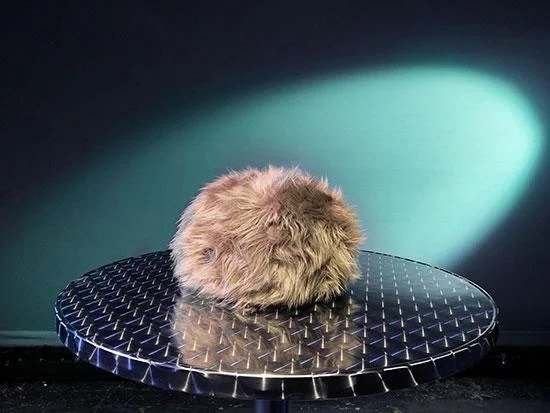
Tribble


These Tribbles are adorable. There is only one problem with these furry creatures. They are born pregnant so you will never have just one. They soon fill the space station and soon The Enterprise. Everyone who sees them likes them…except for one race…and that would be The Klingons. 

I have one request…WATCH the episode. I don’t want to write anymore and give anything else away. Some Star Trek fans say the episode is too lightweight…I disagree…it’s very entertaining and it’s nothing wrong with having an entertaining light episode. If I had to rank episodes…I would rank this 2nd behind The City On The Edge Of Tomorrow. 

Deep Space 9 did an episode built around this episode. They go back in time and see Kirk, Spock, and the rest of the Enterprise when this happens. Check that one out…the effects are great…they put this crew with the Enterprise crew and it looks great. 

From IMDB:

The scene in which Kirk is buried in an avalanche of tribbles took eight takes to get right. The tribbles were thrown into the hatch by members of the production crew. The crew members were not sure when to stop because they were unable to see the scene. This is why additional tribbles keep falling on Kirk one by one. William Shatner can be seen looking perplexed as to why more tribbles keep falling on him.

To create the one tribble moving on its own, the prop supervisor bought a battery powered toy dog and stripped it down to the mechanical works. Once recovered with fur including the toy legs, the prop moved on camera along the railing on the Enterprise bridge without wires or external assistance. The toy was so noisy all the dialogue in the scene had to be looped with ADR (re-recorded after shooting).

Tribbles have made subsequent appearances in numerous different versions of Star Trek, including important plot focuses in Star Trek: The Animated Series: More Tribbles, More Troubles (1973) and Star Trek: Deep Space Nine: Trials and Tribble-ations (1996), and cameo appearances in Star Trek III: The Search for Spock (1984), Star Trek Into Darkness (2013) and even Star Trek: Enterprise (2001) and Star Trek: Discovery (2017).

The noises that the tribbles make were a combination of dove coos, screech owl cries and air escaping from balloons.

During the famous “bar fight”, careful observers will note that while tables are broken, all the chairs remain intact. The tables were studio property: the chairs were rented, and if damaged would have to be paid for.

William Shatner recalled the great enjoyment all the cast had filming this episode. He noted, “The trouble we had with ‘Tribbles’ was [to] keep your straight face. It was just a lot of fun.”

Writer David Gerrold tried to pitch a sequel to this episode during the third season. But producer Fred Freiberger rejected it because he did not like the comedic tone of this episode. Gerrold’s idea eventually became an animated spin-off, Star Trek: The Animated Series: More Tribbles, More Troubles (1973).

When Dr. McCoy figures out that the Tribbles are in a perpetual state of being pregnant, this marks one of the very first instances on American TV of the use of that word. Just 15 years earlier, Desilu Productions, the original company behind “Star Trek”, was forbidden from using that word during I Love Lucy: Lucy Is Enceinte (1952), so the word “expecting” was used instead.

The pile of Tribbles near the end was actually created by gluing Tribble props around a large wire frame which William Shatner then stood in the middle of to give the illusion of mass numbers. In reality, there were only five hundred Tribbles made. This is obvious when you look at how the Tribbles are piled up, and none have landed on the floor at Spock’s feet.

James Doohan insisted on doing his own stunts in the barroom brawl.

In some scenes (and if you watch in high definition), a coffee stain is clearly visible on Spock’s velour shirt. Leonard Nimoy spilled his cup of coffee during lunch and there were no other costumes available for him.

William Campbell (Koloth) recalled that, after this episode was aired, his neighbour’s son consequently addressed his wife as “Mrs. Klingon”.

George Takei does not appear in this episode. For much of the second season, he was filming The Green Berets (1968). Many scenes written for Sulu were switched over to Chekov.

According to David Gerrold’s ‘The World of Star Trek’, Tribbles would be around the set for some time afterward, allowing for occurrences such as what was mentioned earlier or popping up in various other places as well for some months after the production of the episode.

This episode was nominated for a Hugo Award for Best Dramatic Presentation at the 1968 Science Fiction Convention.

According to Michael Okuda and Denise Okuda’s text commentary on this episode for the second season DVD set, the last fresh footage of the Enterprise was done for this episode. In every episode to follow, the shots of the ship were all stock footage.

The inspiration for the design of the tribbles came from a fluffy keyring.

At 37:10, you can get a rare glimpse of James Doohan’s missing finger as Scotty brings in an armful of Tribbies. Doohan lost it when he was wounded fighting with the Canadian forces on D-Day June 6, 1944.

The line in which Spock says that Kirk heard what Baris said, but could not believe his ears, was lifted directly from a Mad Magazine spoof of Star Trek (titled Star Blecch) that had just been published.

Captain Koloth pronounces his race, “Clingans”. As in Wilbur Clingan, Gene Roddenberry’s inspiration for the Klingons.

William Schallert appeared at one of the earliest Star Trek conventions, finding it rewarding and also confusing. Schallert recalled encountering many fans in person, who would react by calling and addressing him as Nilz Barris, and at the time he had completely forgotten the name of the character he played.

This is the first time in the series the Klingon language is mentioned. It is called “Klingonese” in the script and the DVD-subtitles. However, because actor Michael Pataki began to laugh at the end of the word, and cut himself off before finishing his consonants, the word is heard as “Klingonee”. It is spelled “Klingoni” in the Netflix subtitles.

In his first meeting with the Klingon commander, Koloth cites authority to shore leave rights as authorized by the Organian Treaty. This occurred in Star Trek: Errand of Mercy (1967) when the Organians prevented a war between the Federation and the Klingon Empire. The Treaty of Organia dictates interactions between the two sides to prevent another chance of war.

The bar set, including the bartender’s costume, is recycled from Star Trek: Court Martial (1967), with slight modifications, mostly in decoration.

Writer David Gerrold intended to play the crewman who is with Scott and Chekov when the barroom brawl breaks out, but the role went to stuntman Paul Baxley instead.

Despite this episode’s popularity, producer Robert H. Justman wrote in his book “Inside Star Trek: The Real Story” that he never liked this episode. Justman felt that the humor was too over-the-top and the show became a parody of itself.

Initially Leonard Nimoy was not a fan of the episode as he felt it to be frivolous. Its deepening reputation as one of the classics of The Original Series as the years went on helped him change his mind.

In David Gerrold’s book “The Trouble with Tribbles”, he quoted a memo he wrote when the show was being prepared suggesting that the character of Cyrano Jones be changed from an unscrupulous trader to an old man who was too befuddled to realize what he was doing by importing Tribbles into a space station and on a star ship. “What a role for Boris Karloff,” Gerrold wrote in his memo. In the book, Gerrold expressed regret he didn’t pursue this idea further because it would have gotten the legendary Karloff onto Star Trek.

William Campbell makes his second appearance as an alien. His first was as Trelane in “The Squire of Gothos”, and this role as the Klingon Captain Koloth. The role of Koloth was intended as a recurring character, but the next time a Klingon was needed, Campbell was unavailable and a different character and actor was cast.

The storyline greatly resembles one subplot in ‘The Rolling Stones’, a 1952 novel by Robert A. Heinlein. Gene Roddenberry and Heinlein made an undisclosed copyright agreement before The Trouble With Tribbles aired. Heinlein conceded to David Gerrold that both he and Gerrold possibly “owed something to Ellis Parker Butler”, author of the short story ‘Pigs is Pigs’ (According to Bjo Trimble, this episode is based upon said short story, ‘Pigs Is Pigs’, although Gerrold’s first-hand account only acknowledges the similarities but does not specifically cite the short story as “the basis” for this episode, and, as the author, he should know). See also Star Trek: Charlie X (1966) and Star Trek: Operation — Annihilate! (1967), which have strong Heinlein similarities.

This is listed as one of the “Ten Essential Episodes” of TOS in the 2008 reference book “Star Trek 101” by Paula M. Block and Terry J. Erdmann.

The producers of the Remastered Edition insist to everyone that all shots of the station and ships are brand-new and not reused from Star Trek: Deep Space Nine: Trials and Tribble-ations (1996) as had been rumored. Comparisons reveal that no space shots were reused.

William Campbell returned to the role of Koloth 27 years later in Star Trek: Deep Space Nine: Blood Oath (1994).

Spock’s estimate of the tribble population (1,771,561) is mathematically accurate, given the explanation: “That’s assuming one tribble, multiplying with an average litter of 10, producing a new generation every 12 hours over a period of three days.” The population growth, counting by 12-hour intervals, would go from 1 tribble to 11; 121; 1,331; 14,641; 161,051; 1,771,561. It also assumes that tribbles have a life expectancy of at least 3 days, which is possible but not certain; a relatively short life expectancy would tally with their high metabolism, growth rate, and “multiplicative proclivities.”

On the DVD commentary for Star Trek: The Animated Series: More Tribbles, More Troubles (1973), David Gerrold, shares a story of meeting a fan visiting the Filmation Associates facility who strongly urged him to write a sequel to the original Trouble with Tribbles. He said despite telling the fan three times he had already done so and it “was in production,” the fan continued to pitch his ideas for the sequel. After the animated sequel aired, he got a letter forwarded by NBC, from that same fan, saying he wasn’t asking for money only “asking for some of the credit.” Gerrold wrote back to him, telling him “asking for half the credit is asking for half the money,” and telling the fan that he didn’t hear him say he had already written it. He explained further to the fan that this is the reason why people in the industry, especially writers, try to avoid talking to fans and amateurs because if anything even just similar is later produced, it would be deemed as “stolen.”

In the bar set, recycled from Star Trek: Court Martial (1967), many tribbles were made out of carpet as background. Most visible versions were made from off-cuts from fur garments, as revealed in the book to accompany episode. The tribbles that move had mechanical toys placed inside them.

When Kirk remarks to both Uhura and Chekov that they didn’t waste any time taking shore leave, Uhura replies, “And how often do I take shore leave?” Star Trek: Shore Leave (1966), another episode with a comedic tone, premiered exactly one year earlier. Although Uhura was in that episode, she spent it, at least onscreen, aboard the Enterprise instead of the amusement planet where some of the other crewmembers were taking shore leave.

Summary

Having received a Priority One distress call from an outlying space station, the Enterprise arrives to find they have been summoned there by a Federation commissioner merely to protect a shipment of seeds meant to sow wheat on Sherman’s planet. The planet is also coveted by the Klingons, who are taking shore leave at the station. The trouble arises with tribbles – small furry creatures that seem to multiply without end. However, their fortuitous presence reveals both a problem with the wheat and a traitor on the space station.

CAST

William Shatner…James T. Kirk
Leonard Nimoy…Mr. Spock
DeForest Kelley…Dr. McCoy
William Schallert…Nilz Baris
William Campbell…Koloth
Stanley Adams…Cyrano Jones
Whit Bissell…Lurry
James Doohan…Scott
Nichelle Nichols…Uhura
Michael Pataki…Korax
Ed Reimers…Admiral Fitzpatrick
Walter Koenig…Chekov
Charlie Brill…Arne Darvin
Paul Baxley…Freeman
David L. Ross…Guard
Guy Raymond…K-7 Bartender

Star Trek – Wolf In The Fold

★★★★ December 22, 1967 Season 2 Episode 14

If you want to see where we are…and you missed a few…HERE is a list of the episodes in my index located at the top of my blog. 

This show was written by Gene Roddenberry and Robert Bloch

This episode put some of the spotlight on Scotty. Scotty was key to the Enterprise’s survival. Kirk knew just how much he could push the limits of the Enterprise with Scotty at his disposal. You could say in many ways he was just as important as Spock, Kirk, or Bones with his jobs. Without Scotty performing miracles on the engines…they could not travel. 

Star Trek - Wolf in the Fold b

In this episode, Scotty’s integrity is put on the line. He takes a walk with a space belly dancer and suddenly finds himself over her dead body with a knife. Is Scotty the culprit? Is Scotty in fact the criminal which the Argelians seek? And then when trying to track his last 24 hours…a crew member running tests on Scotty is found…you guessed it…dead with Scotty right beside her again.

We then have a trial that uncovers an entity that has been masquerading as Hengist feeding on fear. I have to wonder if Stephen King was influenced by this episode somewhere. The novel IT has a monster (Pennywise) that feeds on fear…with many similarities with this episode. 

A good mystery episode with Jack The Ripper being brought up. When the first woman was killed you saw a lot of fog like in London in the Ripper’s time. Jack The Ripper had been dead for hundreds of years…it couldn’t be him right?

From IMDB:

For most of Star Trek, James Doohan (“Scotty”) hides his right hand, which was missing the middle finger due to a WWII D-Day injury. While being questioned with his hand resting on the lie detector scanner, his fingers are hidden by being curled around the edge of the plate. During a close-up shot of the machine reacting to an intentional lie being told, a five-digit hand spread across the plate is seen – that of a stunt double. Doohan later wrote about it in his autobiography and said this was one of his favorite episodes.

This episode was made around the time that Leonard Nimoy earned an Emmy nomination for his portrayal of Mr Spock. William Shatner has admitted that this put his nose out of joint considerably, leading to tensions between the two actors, so this episode was a conscious effort on the part of the writers to sideline Nimoy and give Shatner center stage. (After the series finished, these animosities were put aside and the two remained lifelong friends up until a few years before Nimoy died in 2015.)

Robert Bloch originally wrote that Kirk, Scotty, and Bones having drinks which had colored layers. Their moods would change as they drank each layer. This idea was dropped as being too complicated of a special effect. Network censors were concerned that it would appear that they were using drugs. The producers argued against this but were unable to use the drinks anyway.

This is one of the very few episodes of the second season to feature music composed by Alexander Courage (mainly because of the feud between Courage and Gene Roddenberry, and his resulting withdrawal from the series).

A large number of costumes in the Argelius bar scene are reused from previous episodes. Some of the extras in the bar are wearing turtleneck uniforms from Star Trek: The Cage (1966) and Star Trek: Where No Man Has Gone Before (1966). Two extras in the bar (one of them later seen on the foggy street) are wearing the silver cadet uniforms made for the Finnegan character from Star Trek: Shore Leave (1966). Also, one bar patron (played by regular background performer Joseph Paz) is wearing Commissioner Ferris’ costume from Star Trek: The Galileo Seven (1967), and another is wearing a colonist jumpsuit recycled from Star Trek: The Devil in the Dark (1967).

According to Tanya Lemani, the makeup for Kara was initially much more elaborate. Lemani recalled, “They sent me to the makeup department because they wanted to do something extravagant with my look. The first day, they put feathers of different colours all over my face – on my eyelashes, my eyelids, my nose. Then they took me to the director, Joe Pevney, and he said, ‘No. No. Less!’ The makeup people kept trying to match his vision for four days, with less and less feathers and fewer colours each time, but Joe kept saying, ‘No.’ Finally, on the fifth day, I came in with no makeup and he said, ‘That’s it. That’s what I want to see – her face.” Lemani did her own belly dance choreography for the scene, but due to censorship concerns, had to cover her navel with a jewelled flower.

In Star Trek: The Next Generation: Relics (1992), an older Scotty remembers the events of “Wolf in the Fold” as “a wee bit of trouble.”

Clocking in at approximately 15 minutes and 30 seconds, the courtroom hearing that constitutes virtually the third act of the episode appears to be the longest uninterrupted scene, confined to a single setting, in the original series.

This is the first episode of the second season to completely utilize stock music, largely from Gerald Fried’s scores for Star Trek: Catspaw (1967) and Star Trek: Friday’s Child (1967). Fried’s Finnegan jig from Star Trek: Shore Leave (1966) can also be heard.

This is the first time where Scott’s first name is given as Montgomery. It is next spoken in Star Trek: Is There in Truth No Beauty? (1968) where he introduces himself to Marvick.

In the late 1980s, the pop band Information Society sampled Scotty’s line, “Let’s go see”, in their song “Walking Away”.

A few months after Wolf in the Fold was broadcast, guest star John Fiedler took on the voice of Piglet in Winnie the Pooh and the Blustery Day (1968). He was to reprise the role on several occasions, making it one of his most enduring roles.

This is one of two TOS episodes that prominently feature Scott. The other episode is Star Trek: The Lights of Zetar (1969).

Uhura and Chekov do not appear in this episode.

Robert Bloch’s third and final contribution to the series.

This takes place in 2267.

On the 1993 album “Zoo Rave, Vol 2”, the house/techno/rave artist John Greczula (aka Texas Audio) sampled Kirk’s lines, “You were a musician at the cafe. You played for the murdered girl”, and Tark’s responses, “Since she was a little girl she danced for me” and “The man who did it must be found”, in his rave song, “Mystery Cafe.”

William Shatner and Joseph Bernard previously appeared together in Judgment at Nuremberg (1961).

Kara’s dance music was from the pilot show “The Cage”, when Vina is dancing as an Orion slave girl in the cabaret scene.

James Doohan, who was single at the time, stated in his autobiography that he dated Tanya Lemani (Kara) a few times after filming for this episode wrapped.

Summary

While on shore leave on the planet Argelius II with Dr. McCoy and Captain Kirk, Chief Engineer Scott finds himself accused of murdering an exotic dancer he met in a nightclub. He has no recollection of the incident but is found standing over the girl with a bloody knife in his hand. For Mr. Hengist, the chief administrator, the case is cut and dried, but Jaris, the planet’s leader, suggests that his wife chair a séance to identify the killer. Tragedy strikes again, still pointing to Mr. Scott as the culprit. Kirk suggests they retire to the Enterprise where they can use its computers to determine if Scott is lying and who the real culprit may be.

CAST

William Shatner…Capt. Kirk
Leonard Nimoy…Mr. Spock
DeForest Kelley…Dr. McCoy
John Fiedler…Hengist
Charles Macauley…Jaris
Pilar Seurat…Sybo
James Doohan…Scott
George Takei…Sulu
Charles Dierkop…Morla
Joseph Bernard…Tark
Tania Lemani…Kara
John Winston…Transporter Chief
Virginia Aldridge…Karen Tracy
Judy McConnell…Yeoman Tankris
Judi Sherven…Nurse
Majel Barrett…Computer Voice
William Blackburn…Hadley
Marlys Burdette…Serving Girl #1
John Fiedler…Redjac (voice)
Steve Hershon…operations officer
Suzanne Lodge…Serving Girl #3
Eddie Paskey…Leslie
Gary Wright…Starfleet cadet

Star Trek – Obsession

★★★★ December 15, 1967 Season 2 Episode 13

If you want to see where we are…and you missed a few…HERE is a list of the episodes in my index located at the top of my blog. 

This show was written by Gene Roddenberry and Art Wallace

As a young officer on the USS Farragut James T. Kirk encountered a strange creature and was lucky to live to tell the tale. Reminding him of that fact is a new crew member assigned to the Enterprise, the son of the late commander of the Farragut played by Stephen Brooks. It’s with some mixed emotions that William Shatner deals with Brooks.

The monster is an intelligent gas, made of an element that’s not supposed to exist naturally, and that’s able to transform itself as a means of camouflage.

Star Trek – Obsession (Review) | the m0vie blog

Complicating things is the fact that the Enterprise is on a critical rescue mission already when Shatner commits his vessel to fight the creature. Something that for once Leonard Nimoy and DeForest Kelley are in agreement on (they agree he shouldn’t fight it) and question Shatner’s judgment. As the title suggests…he is obsessing over this creature instead of the critical mission the Enterprise is on. 

This is a good episode although there was no prior hint that Kirk was the sort of man who would be recklessly obsessive yet here we are expected to believe that he would abandon an urgent mission without even contacting Star Fleet about the entity. All in all we learn more of Kirk’s character in this one. 

Ralph Senensky’s direction keeps this classic Shatner episode tight, exciting, and well-shot. 

From IMDB:

The ship which Kirk served on for his first deep space mission is disclosed to be the USS Farragut, and was named after David Glasgow Farragut, a flag officer of the United States Navy during the American Civil War. He was the first rear admiral, vice-admiral, and admiral in the United States Navy and is credited for uttering the phrase, “Damn the torpedoes, full speed ahead!”*, disregarding all danger while charging into enemy waters off the Alabama Coast. -This is an abridged version. He said “Damn the torpedoes. Four bells, Captain Drayton, go ahead. Jouett, full speed.”*

Second episode in a row in which Captain Kirk’s capacity of command is questioned.

This episode establishes the fact that Vulcan blood is copper-based, unlike human blood which is iron-based.

Only time in the series where phasers are said to have a disruptor setting.

“Obsession” is a “startrekified” version of Herman Melville’s Moby Dick, a seminal American novel first published in 1851. Captain Kirk of the Enterprise is Captain Ahab of the Pequod and the Gaseous Creature is the White Whale.

The only episode to have a security guard as the central story.

The unseen ship, the USS Yorktown, recalls the name of the ship in Gene Roddenberry’s original story concept he pitched to the networks in 1964, the SS Yorktown commanded by Robert April. The concept evolved to the USS Enterprise commanded by Christopher Pike in Star Trek: The Cage (1966), then James T. Kirk.

Filming took place during the Jewish holiday of Yom Kippur. Director Ralph Senensky was an observant Jew and left the set at sundown. Producer John Meredyth Lucas took his place. Lucas went on to officially direct three episodes of this series.

In an effect unique in the series, the phaser beam that Garrovick fires at the creature is outlined with a dark border.

Dikironium, of which the cloud creature is made, is an element with symbol Dk, has an atomic number of 112, and an atomic weight of 300. It was first discovered on the planet Vulcan. Element 112 was not discovered/produce until 1996 and was named Copernicium. Its atomic weight (technically, atomic mass) is 285.

This takes place in 2268.

In the medical records library between Spock and McCoy, there is a large object which looks like a vertical DVD rack. The same large object was in Harry Mudd’s laboratory in Star Trek: I, Mudd (1967).

Vocalization in the opening theme song is less prominent behind the instrumental than previously since vocalization began in Season 2.

Hikaru Sulu does not appear in this episode.

Director Ralph Senensky has said, having worked with actor Stephen Brooks on many previous occasions and liked him, that he specifically asked for Stephen Brooks for this show.

Summary

Captain Kirk is haunted by a creature from his past when conducting a mining survey on a planet. He first encountered it as a lieutenant aboard the U.S.S. Farragut and blames himself for freezing in a moment of crisis, causing the death of many crewmen. The creature is a cloud-like, gaseous being that lives on the red blood cells found in humans. Obsessed by his desire for revenge and to erase the memory of 11 years ago, he pursues the creature relentlessly, putting in jeopardy an assignment to collect essential medical supplies.

CAST

William Shatner…Capt. Kirk
Leonard Nimoy…Mr. Spock
DeForest Kelley…Dr. McCoy
Stephen Brooks…Ensign Garrovick
James Doohan…Scott
Nichelle Nichols…Uhura
Jerry Ayres…Rizzo
Majel Barrett…Nurse Chapel
Walter Koenig…Chekov
William Blackburn…Hadley
John Blower…Swenson
Frank da Vinci…Vinci
Steve Hershon…operations officer
Jeannie Malone…Yeoman
Eddie Paskey…Leslie
Basil Poledouris…Bardoli

Star Trek – The Deadly Years

★★★★1/2 December 8, 1967 Season 2 Episode 12

If you want to see where we are…and you missed a few…HERE is a list of the episodes in my index located at the top of my blog. 

This show was written by Gene Roddenberry and David P. Harmon

Another favorite of mine in the 2nd season. Some of the crew starts growing old…really quick. 

When an away team goes for a routine visit to a scientific outpost they are shocked to discover the personnel are dead or dying, apparently of old age, despite none of them being old.

Star Trek – The Deadly Years B

Back on the Enterprise, it isn’t long before members of the away team, with the exception of Chekov, start aging. At first, the signs are subtle; Kirk gives the same order twice and instructs Uhura to contact Star Fleet using a code that has already been cracked by the Romulans. It isn’t long before more obvious signs of aging show and if they don’t discover the cause and a remedy quickly most of the senior staff will be dead within days.

As time progresses Kirk’s ability to command comes into question and Commodore Stocker, who was being transported to a nearby star base, assumes command despite never serving on a starship before. This almost leads to disaster when he orders the Enterprise to head directly to the star base even though that course takes them through the Romulan neutral zone.

After that, the Romulans of course are after The Enterprise. With Kirk and Spock old…it doesn’t look like they will get out of this trouble with the Romulans. 

Here is a comparison of William Shatner…a Hollywood 80-year-old or so…and the real Shatner around 80-85 years old at the time of the picture. 

William Shatner old and old

From IMDB:

The cast wore oversized versions of their costumes as their characters aged in order to give the impression that they were shrinking.

William Shatner resisted looking too old as Captain Kirk aged. This is why at first the aging Kirk’s hairline is receding but later his hair is more full.

Having been born on July 16, 1882, Felix Locher (Robert Johnson) is the earliest born actor to appear in any “Star Trek” episode or film, at 85 years of age.

Kirk’s age (34) is established in this episode. William Shatner was 36.

Around this mid-season shoot, rumors started to circulate that Star Trek was going to be canceled. One of the show’s most ardent fans, Bjo Trimble, created a mailing list, urging everyone on it to write to the network pleading for the show’s survival. The ploy worked.

In “The World of Star Trek”, William Shatner relates that he endured an excruciating make-up session for this episode – all for nothing, because the shooting day was just about to end. The producers caught his exasperation in an infamous blooper, wherein he declares, “Robert H. Justman, I’m going home now, after spending three hours putting this [expletive deleted] make-up back on – and it’s your fault!”

Kirk reuses the scam involving the “corbomite” device, which he first described in Star Trek: The Corbomite Maneuver (1966). Although Chekov was not on the bridge on that occasion, he obviously heard the story from someone, as he and Sulu exchange knowing looks when Kirk mentions the word.

According to Walter Koenig, a close-up shot of his eyes was filmed as Chekov sees the dead body. Unfortunately, Koenig kept blinking during the shot and it took fifteen takes to get it right. However, the shot was deleted from the episode.

Lieutenant Uhura was originally supposed to be one of the landing party that starts to age but Gene Roddenberry refused to allow this on the grounds that it would make her unattractive. In Star Trek: And the Children Shall Lead (1968), Uhura had a rapid-aging scene.

This is the first time McCoy is aged using makeup in order to look much older than he is. The second time is in Star Trek: The Next Generation: Encounter at Farpoint (1987). Both versions look very similar.

Each crew member displays different symptoms of aging: Captain Kirk suffers from short-term memory loss and arthritis, Spock becomes hypersensitive to temperature changes, McCoy becomes more moody and irritable, Galway suffers from hearing loss, and Scotty finds that he is always tired.

Normally, make-up artist Fred B. Phillips would have been given a month to come up with the latex prosthetics to age his cast. Instead, he was given 10 days. Philips was able to get round the problem by drafting a whole troupe of make-up artists to assist him.

William Shatner reportedly threatened producer Robert H. Justman with bodily harm after enduring the three hour old-age makeup process for no reason. “Who’s afraid of such a wrinkled, feeble old coot!” scoffed Justman. Nevertheless, Justman kept his office door locked until shooting was finished.

When Spock questions Uhura during the competency hearing, he twice clearly refers to Uhura’s having signed her initials (note the plural) on a document. Lt. Uhura was never given a first name during the entire run of the series, which at the time lead some to believe she may have only had the single name “Uhura”. However, this episode established that, due to having more than one initial, she must also have had a name other than “Uhura”.

Dr. Wallace’s costume was made from drapes.

In the first scene, the landing party beams down to the planet surface in front of two buildings. The first one has a curved exterior with alternating raised light blue panels and sunken white panels with no “ribs”, but the second one has a similar curved exterior with “ribs” clearly protruding from the roof. This second building is a repurposing of the structure used as the home for Zefram Cochran in Star Trek: Metamorphosis (1967).

McCoy’s Southern dialect grows noticeably thicker as he ages.

The last shot of the episode is reused from Star Trek: Amok Time (1967). Note the wig there on Chekov, which he didn’t have on for the entire episode.

The proximity of the Gamma Hydra sector to the Romulan Neutral Zone is repeated in the opening scene of Star Trek II: The Wrath of Khan (1982), when the Enterprise supposedly violates the zone while patrolling near the sector. However, in the movie it’s the Klingons who attack.

If one goes by production order, this is the first episode in which Vulcans are mentioned to have a longer lifespan than humans. If one goes by airdate order, that title goes to Star Trek: Journey to Babel (1967).

The end credits include a make-up test shot of Bill Blackburn as a Tellarite.

Except for Checkov, the pronounced aging effects of each of the landing party are as follows: McCoy – Crankiness, somewhat difficulty enunciating words. Kirk – Memory loss, arthritis, stiffness. Scotty – Fatigue. (Duaring the competency hearing he just sits quietly and withdrawn.) Galway – Hearing loss, fast metabolism caused rapid aging and death. Spock – Sensitivity to cold, easily fatigued, failing eyesight, difficulty concentrating.

Areel Shaw’s line from Star Trek: Court Martial (1967) about how long it has been since she’s seen Kirk is recycled by Janet Wallace in this segment.

Kirk’s return to normal age was filmed differently from the version seen in the aired show. It was originally planned to have him take the antidote and, accompanied by a still-aged Spock, return to normal slowly on his way to the bridge. For unknown reasons, this scene was eliminated and just his lower body was filmed showing him writhing after the antidote was administered.

Summary

Rapid aging afflicts all six colonists on Gamma Hydra IV and five members of Kirk’s six-man landing party – all but Chekov. With the Neutral Zone so close, suspicion falls on the Romulans testing a new weapon, but is it? With time running out, answers are elusive. As Kirk’s memory progressively deteriorates, regulations necessitate a competency hearing no one wants – the outcome of which may eventually lead the Enterprise to its destruction with all aboard.

CAST

William Shatner … Captain James Tiberius ‘Jim’ Kirk
Leonard Nimoy … Mister Spock
DeForest Kelley … Doctor Leonard ‘Bones’ McCoy
James Doohan … Lieutenant Commander Montgomery ‘Scotty’ Scott
Nichelle Nichols … Lieutenant Nyota Uhura
George Takei … Lieutenant Hikaru Sulu
Majel Barrett … Nurse Christine Chapel
Charles Drake – Commodore Stocker
Carolyn Nelson – Yeoman Atkins
Sarah Marshall – Dr. Janet Wallace
Laura Wood – Elaine Johnson
Felix Maurice Locher – Robert Johnson
Beverly Washburn – Lt. Arlene Galway
Roger Holloway – Lt. Lemli
Eddie Paskey – Lt. Leslie
Frank Da Vinci – Lt. Brent

Star Trek – Friday’s Child

★★★ December 1, 1967 Season 2 Episode 11

If you want to see where we are…and you missed a few…HERE is a list of the episodes in my index located at the top of my blog. 

This show was written by Gene Roddenberry and D.C. Fontana

The main thing I noticed when I watched this episode is Julie Newmar as Eleen. I never missed her on Batman. 

Julie Newmar

Once again the crew of the Enterprise are in negotiations for an alien planet’s mineral rights… McCoy has been there before and cautions the captain about the importance of not breaching local etiquette; infringements can mean death. These aliens, the Capellans are intelligent but not advanced; fighting with swords and throwing weapons. The landing party, consisting of Kirk, Spock, McCoy and security are shocked to discover a Klingon is already there; leading to the red-shirt drawing his weapon and being killed.

The leader of the Capellans is keen to negotiate but his underling thinks they should deal with the Klingons as they offer military items and fights for the leadership. With the old leader dead his pregnant wife is expected to die but McCoy attempts to save her and the away team flees to the hills with her. Here Kirk and Spock must prepare to fight without use of their phasers while McCoy helps deliver the baby. Meanwhile, the Enterprise, commanded by Scotty, has been called away by a distress call, apparently from a freighter under attack from Klingons.

It was a strong episode for Scotty.  Faced with the decision to rescue the crew that was on the planet from Capella or answer a distress call from an unarmed freighter, Scotty stays consistent with Federation duty and leaves orbit to help the ship under attack. Turns out it was a Klingon ruse, but no harm was done. Doctor McCoy also has some good scenes with Eleen and her new born baby. 

Not one of my favorites but a decent episode. 

From IMDB:

This is the only episode in which Uhura and Sulu call Scotty by his nickname. Otherwise, they call him “Mr. Scott”.

For his first four appearances in the series, including this episode, Walter Koenig wore a The Monkees (1965)-style wig, which he absolutely detested. In one interview, he made joking and uncomplimentary references to that wig.

The actors playing Capellan warriors were given elevated shoes to make them appear like giants. Maab’s high headgear served the same purpose.

Third time Bones uses the saying “I’m a doctor, not a …” (In this case, escalator)

Lots of dialogue looping was used in this episode because of the outdoor setting. Some of the dubbing was crammed together, nearly on top of other lines.

When Chekhov is scanning the Klingons, he uses the term vessel as opposed to his normal “wessel.”

Temperatures reached 110 degrees in the Vazquez Rocks filming location, making it quite uncomfortable for the actors in the Capellan costumes. This location was also a setting for Star Trek: Arena (1967), Star Trek: Shore Leave (1966) and Star Trek: The Alternative Factor (1967).

This is the first episode where all seven “classic” crew members (Kirk, Spock, McCoy, Scotty, Uhura, Sulu, and Chekov) appear in the same scene, in the teaser, discussing the background for the Capellans, although Sulu is seen only on a view screen reporting from the bridge. The other six are all in the same briefing room together. The six also appear in the same scene together at the very end on the bridge, and Sulu is still absent, although the right arm of a helmsman that should be him is seen at the right edge of the screen.

In D.C. Fontana’s original script, Eleen sacrificed her child for her own life. But Gene Roddenberry objected to this and changed the ending. Eleen was originally written to be a stronger character who rebels against the male-dominated Capellan society but this was also changed.

In the footage seen in the briefing room of Dr. McCoy’s previous visit to Capella IV, he is seen wearing his present day Enterprise tunic, rather than a Star Trek: Where No Man Has Gone Before (1966) era tunic, which would have been appropriate for that time period. However, it can also be seen that the tunic’s sleeves show a lieutenant’s stripes, whereas McCoy’s present rank is lieutenant commander, as often indicated by his sleeves. This is consistent with his visit to Capella having taken place in a previous time period.

Eleen’s baby, Leonard James Akaar, would make numerous appearances decades later as a high-ranking Starfleet officer in many Star Trek novels from the Original Series, Star Trek: Deep Space Nine (1993) relaunch novels, and the Star Trek Titan series. In the latter, he holds the rank of Admiral.

The remastered version of this episode included new shots of the Enterprise herself. Several new, more realistic views of Capella IV from space were inserted into the episode. Other changes include cleaned-up mattes of the viewscreen during the briefing room scene, a more realistic sensor readout on the bridge, a corrected insert shot while Chekov is working the controls at the science station, updated phaser effects, and the establishment of the Klingon ship on screen as a D7-class.

Contained in Dr. McCoy’s emergency medical field kit, Magnesite-nitron tablets when crushed provide emergency illumination and heat through a bright flame. The tablets also could be used for ignition of a larger fire, heating of food, or sterilization of water.

The name of Tige Andrews’s character Kras is never spoken. He is only called “Klingon”.

This is the first episode that inn which makes the dubious claim of something being invented in Russia. In this case, he claims that the old Earth saying, “Fool me once, shame on you. Fool me twice, shame on me”, was invented in Russia. In fact, the earliest occurrence of the phrase, as listed in the OED, dates back over 300 years and comes from Italy.

When Scotty is in command of the ship, they receive a distress call from a Federation freighter, the S.S. Deirdre. Deirdre is the name of James Doohan’s second daughter.

A sequence in the blooper reel shows William Shatner entering the tent too quickly when Tige Andrews is looking for his weapon and exclaiming, “Oh, shit!”

Phaser One almost has enough power to explode rocks, as seen when the Klingon hits the one Spock is sheltered behind.

(at around 40 mins) This episode marks the first time Sulu’s attack scanner is shown deploying from underneath the helm console when Scotty orders “Battle Stations”.

In production order, this is only the second episode to feature Klingons; interestingly, the Klingon make-up design is different from their first appearance in “Errand of Mercy”; in the latter, their complexions were dark and swarthy, with stereotypical “Asian” facial hair. Kras, the Klingon in this episode, is bearded, but without the dark makeup and “Ming the Merciless” facial hair.

Capella, the planet where the action occurs, has the same name after a form of singing. Upon receiving the script, associate and supervising producer Robert H. Justman shouted, “Ah Capella!” (as in ‘acapella’) and burst into song, to much laughter. Although the pun story is probably true, it is more likely that the planet, Capella IV, is the fourth planet of one of the four stars in the Capella system. In reality, Capella is the name given to the brightest star in the constellation Auriga, and is also known as Alpha Aurigae. Its name is the diminutive of the Latin noun “capra” (“she-goat” or “nanny-goat”), hence “little she-goat”. The system’s four stars are in two binary pairs, and none of them have shown any evidence of containing exoplanets.

This is the second and final episode where Spock is knocked out in a fight (the first being Star Trek: Mirror, Mirror (1967), though in that case it was the mirror Spock who was incapacitated). In this one, a Capellan hits him with a sword while he and Kirk protect Eleen.

Summary

The Federation is in competition with the Klingons for an alliance with the inhabitants of Capella IV. The Capellans are a warrior tribe and there is dissension among them as to who to sign the mining rights treaty with. McCoy is familiar with their customs having once spent several months there. When a Capellan, who clearly favors the Klingons, stages a coup, Kirk, Spock and McCoy flee with the now dead leader’s wife, who is about to give birth. Meanwhile, the Enterprise receives a distress call from a Federation vessel under attack and, with Scotty in command, leaves orbit.

CAST

William Shatner … Captain James Tiberius ‘Jim’ Kirk
Leonard Nimoy … Mister Spock
DeForest Kelley … Dr. McCoy
Julie Newmar … Eleen
Tige Andrews … Kras
Michael Dante … Maab
James Doohan … Scott
George Takei … Sulu
Nichelle Nichols … Uhura
Cal Bolder … Keel
Ben Gage … Akaar
Walter Koenig … Chekov
Kirk Raymond … Duur (as Kirk Raymone)
Bob Bralver … Grant (as Robert Bralver)
Bill Blackburn … Lieutenant Hadley (uncredited)
Vic Christy … Capellan (uncredited)
Frank da Vinci … Capellan Warrior (uncredited)
Walker Edmiston … SS Dierdre (voice) (uncredited)
Eddie Paskey … Lieutenant Leslie (uncredited)

Star Trek –  Journey To Babel

★★★★ 1/2  November 17, 1967 Season 2 Episode 10

If you want to see where we are…and you missed a few…HERE is a list of the episodes in my index located at the top of my blog. 

This show was written by Gene Roddenberry and D.C. Fontana

An episode I’ve always liked a lot. We meet Spock’s parents in this one. The actress that played his mom was Jayne Wyatt. To show you how bizarre this show was in the 1960s…Wyatt never watched the show before and after she read the script…she thought it was a comedy. That is until she got on set and saw how everyone took the show so seriously. 

I think it’s this episode, more than any other, in which Spock’s lonely place in the Trek universe is spelled out. We, as the audience, had already gathered as much during the past forty or so episodes, but here, Spock’s mother, the ideal choice to voice such concerns out loud, makes apparent the pain Spock has endured during his life – in terms we had only guessed at earlier.

Star Trek -  Journey To Babel

She had known since he was a little boy that he belongs in neither the human nor the Vulcan worlds and, as a mother, she had no choice but to feel his pain, that ultimate form of alienation – but, as a human, her feelings are much more obvious to us. Nimoy gives another subtly excellent performance; his demeanor is slightly different when speaking with his mother about ‘the situation’ between himself and his father. Despite the Vulcan reserve, you sense his discomfort and sadness.

The personal story is played out as part of a larger plot element involving diplomatic negotiations among ambassadors on board the Enterprise headed toward the planetoid Babel. Competing interests among the representatives threaten (and eventually lead to) hostilities, as the impending conference will decide whether planets of the Coridan System will become part of the Federation. If that wasn’t enough going on, a third party is presented as a foil in order to profit from the dissension…but the story centers around the Vulcans and their relationship. 

While describing this episode I realized what a deep episode this is. There’s a lot of plot to it and a lot of new alien species and characters. The introduction of Spock’s parents was interesting and I really enjoy the dynamic that Spock has with his mother especially. While the politics of the Federation is the focal point of this episode, it really focuses more on Spock’s relationship with his parents.

From IMDB:

For two weeks after the airing of this episode, Mark Lenard received more fan mail than Leonard Nimoy.

In the first episode to feature Spock’s parents, actors Mark Lenard and Jane Wyatt asked Leonard Nimoy for advice on how the two of them could display their affection for one another in a subtle way since the Vulcans supress their emotion. Since it was Nimoy who had devised the Vulcan neck pinch and the Vulcan salute, Nimoy suggested they touch and stroke each others hand by the index and middle finger.

Gene Roddenberry wrote the scene in which Amanda tells Kirk of the rift between Spock and Sarek. Writer D.C. Fontana felt that it would be inappropriate for her to discuss this with someone she had just met. But Roddenberry wanted Kirk to be more involved with the story.

This episode introduces the Andorians and the Tellarites. Later episodes established that, along with Humans and Vulcans, they are two of the four founding members of the United Federation of Planets.

Actor John Wheeler, in character as Gav, had so much trouble seeing through the prosthetics over his eyes that he was forced to raise his head to see his castmates. This added to the early mythos that all Tellarites were arrogant as well as belligerent and aggressive.

Jane Wyatt would only play Spock’s mother one more time, in the film Star Trek IV: The Voyage Home (1986). In Star Trek: The Animated Series: Yesteryear (1973), to save costs, Majel Barrett voiced the role. Mark Lenard, however, reprised his role of Sarek in the animated series and again in the films Star Trek III: The Search for Spock (1984), Star Trek IV: The Voyage Home and Star Trek VI: The Undiscovered Country (1991), as well as the Star Trek: The Next Generation episodes Star Trek: The Next Generation: Sarek (1990) and Star Trek: The Next Generation: Unification I (1991).

Writer D.C. Fontana chose the name “Amanda” for Spock’s mother because it means “worthy of love” in Latin.

Mark Lenard had also been a potential candidate for the recasting of Spock if Leonard Nimoy were to quit the series.

Though they play father and son, Mark Lenard was 42 years old at the time and Leonard Nimoy was 36.

Jane Wyatt has said that some years after “Journey to Babel” first aired, while waiting in an airport she heard someone cry out the name Amanda. Wyatt said that at first she had no idea it was a fan trying to get her attention, as she had completely forgotten the name of the character she had played.

The original script called for an establishment shot of the city Sarek and his party travelled from. However, painting a matte to depict the city became budget prohibitive. Likewise, Sarek was initially to be beamed aboard the Enterprise, but use of existing shuttle craft stock footage was cheaper than employing Transporter effects.

Amanda’s description of Spock being bullied by other children for his human heritage was later shown in animated form in Star Trek: The Animated Series: Yesteryear (1973), and in live action form in the movie Star Trek (2009).

In the original draft script, there was a banquet scene featuring the three main diplomats: Sarek (the Vulcan), Shras (the Andorian), and Gav (the old Tellarite). When this scene was scrapped, the dialog was inserted into the final version of the buffet scene. Other dialog was scrapped that would have indicated that Sarek was an engineer before he became a diplomat, and that he was the son of the famous Vulcan diplomat Shaleris.

As a tribute to her long and distinguished career, Jane Wyatt is called “Miss Jane Wyatt” in the closing credits.

In the remastered version, the Enterprise shuttlebay and landing sequence was completely redone digitally, featuring a number of background actors visible within the viewing galleries. Also revamped were shots of Vulcan (now more closely resembling its appearance in Star Trek: Enterprise) and the battle between the Enterprise and the Orion ship, now featuring a more identifiable design.

The Andorians cock their heads for better visual acuity. According to Star Trek lore, the Andorian antennae are sensitive light beyond the normal human spectrum. Thus, Andorian vision is literally quadroscopic.

Before he was cast as Sarek, Mark Lenard played the first major Romulan character seen on Star Trek, the Romulan Commander in Star Trek: Balance of Terror (1966).

Scotty does not appear in this episode. Other characters refer to him as being nearby, but he never has to appear on-camera.

D.C. Fontana had become curious about past references to Spock’s background, and was inspired to more fully flesh them out. In particular, Fontana was inspired by information Spock had revealed about his parents in Star Trek: This Side of Paradise (1967). Fontana also felt such an episode would be an interesting way to reflect issues relating to the Generation Gap.

Many of the costumes worn by extras in the hallway and reception room scenes were recycled from several first season episodes, including the outfits worn by Galactic High Commissioner Ferris in Star Trek: The Galileo Seven (1967) and by Lazarus in Star Trek: The Alternative Factor (1967).

This is listed as one of the “Ten Essential Episodes” of TOS in the 2008 reference book “Star Trek 101” by Paula M. Block and Terry J. Erdmann.

Russ Peek, who plays one of Sarek’s aides, also appeared as mirror Spock’s Vulcan bodyguard in Star Trek: Mirror, Mirror (1967).

The Orion ship was recycled as the missile in Star Trek: Patterns of Force (1968), although this has been changed in the remastered version of the latter.

If one goes by airing order, this is the first episode in which Vulcans are mentioned to have a longer lifespan than humans. If one goes by production order, that title goes to Star Trek: The Deadly Years (1967).

The matte shot of Uhura appearing on the screen in engineering is one of the smallest mattes ever used in the series, until the view discs in Star Trek: All Our Yesterdays (1969).

Star Trek: Metamorphosis (1967) starring Elinor Donahue and Journey to Babel starring Jane Wyatt aired back-to-back. Both actresses had been regular cast members on Father Knows Best (1954), where Donahue played Wyatt’s daughter.

The Tantalus field controls used in Star Trek: Mirror, Mirror (1967) can be seen behind McCoy while Amanda is inquiring about Sarek’s condition.

The noise of the coded message sent by Thelev is also used in Star Trek: Miri (1966).

Bill Blackburn, in an unused make-up scheme for the Tellarites from a make-up test, can be seen in the end credits of Star Trek: The Deadly Years (1967) and Star Trek: A Private Little War (1968).

Mark Lenard, who played the 102-year-old Sarek, was 42 at the time of filming.

Summary

The Enterprise is transporting several diplomatic delegations to a conference on Babel regarding the future of the mineral-rich planet Coridan. Among the passengers are Spock’s parents, Ambassador Sarek and Amanda. There is obviously a chill between father and son owing to Spock’s choice of pursuing a career in Starfleet. Unknown to Spock or his mother is the fact that Sarek is seriously ill. There is also much tension among the delegations and a spy on board is transmitting coded messages to a ship that attacks the Enterprise. With Captain Kirk wounded in an earlier knife attack, Spock is in temporary command just as his father needs a transfusion that only he can provide.


CAST

William Shatner … Captain James Tiberius ‘Jim’ Kirk
Leonard Nimoy … Mister Spock
DeForest Kelley … Dr. McCoy
Jane Wyatt … Amanda (as Miss Jane Wyatt)
Mark Lenard … Sarek
Nichelle Nichols … Uhura
William O’Connell … Thelev
Majel Barrett … Nurse Chapel
Walter Koenig … Chekov
John Wheeler … Gav
James X. Mitchell … Josephs
Reggie Nalder … Shras
Bill Blackburn … Lieutenant Hadley (uncredited)
John Blower … Babel Conference Attendee (uncredited)
Jerry Catron … Montgomery (uncredited)
Billy Curtis … Small Copper-Skinned Ambassador (uncredited)
Frank da Vinci … Vulcan Aide (uncredited)
Jeannie Malone … Purple-Skinned Delegate (uncredited)
Jerry Maren … Small Copper-Skinned Ambassador (uncredited)
Eddie Paskey … Lieutenant Leslie (uncredited)
Russ Peek … Sarek’s 2nd Vulcan Aide (uncredited)
Kai J. Wong … Doctor (uncredited)

Star Trek – Metamorphosis

★★★★★ November 10, 1967 Season 2 Episode 9

If you want to see where we are…and you missed a few…HERE is a list of the episodes in my index located at the top of my blog. 

This show was written by Gene Roddenberry and Gene L. Coon

One of my top episodes of Star Trek. This one was directed by Ralph Senensky. I’ve mentioned Ralph before… he will be 100 years old on May 1st of this year. He has a website and still posts about his adventures in directing many episodes of Star Trek and so many other shows including The Twilight Zone, The Waltons, Mission Impossible, and too many to mention. Please visit his site…he has a lot of fun stories about each episode he directed. 

This one has everything you could want from a Star Trek episode. Great acting, writing, and even romance. 

Kirk, Spock, and Dr. McCoy are traveling with Commissioner Hedford, trying to get her back to the Enterprise so that they can hopefully cure her of a rare and deadly disease that she has. They are pulled down to a planet. They meet Zefram Cochrane, who supposedly died 150 years ago.

Star Trek - Metamorphosis B

He tells them that he had been out in space because he had gotten old and his wish was to die in space. However, he and his ship had been brought down to the planet just as they were. An alien entity he calls the companion was responsible for this as well as for rejuvenating him and making him back to around the age of 35. This companion has been able to keep him healthy, well, and at the same age for all these years.

They find a way to have a direct conversation with the companion. Spock is wanting to spend time asking the companion questions so that they can learn more about it. It is a very different species and part of their mission is to find new species and learn about them. I concur with Spock on this. Of course, because they made an error when writing this and made it so that the companion cannot heal the commissioner, Kirk stops Spock from asking the questions, pointing out that they need to hurry and try to get the companion to let them go so that they can get to the Enterprise, hopefully in time, to heal the commissioner.

Strong performances from Glenn Corbett and Elinor Donahue help raise this episode to classic status. A touching love story between a man isolated on a planet by himself, and a caring, alien life form he refers to as ” the Companion” is a thoughtful and moving story.

From IMDB:

A few scenes featuring Elinor Donahue had to be re-shot, because the original film negatives were damaged and couldn’t be used. Portions of the planet set had to be rebuilt, since other episodes were shot there by that time, using different sets. Meanwhile, Donahue got pneumonia and lost ten pounds. To hide this, they put Hedford’s scarf around her neck and upper body. However, her weight loss is still visible on her face. The re-shots were not directed by Ralph Senensky.

This is the first story to feature Zefram Cochrane, inventor of warp drive technology and an important figure in Federation history. He would later re-appear in Star Trek: First Contact (1996) and Star Trek: Enterprise: Broken Bow, Part 1 (2001), played by James Cromwell.

A view of the starship from dead center in front of the saucer section is used only in this episode.

This is the only episode in the first two seasons in which Captain Kirk is not on the Enterprise at any time during the plot. Likewise, the Enterprise does not appear until twenty-seven minutes into the episode. In four third season shows, Kirk also spends the entire episode off-ship: Star Trek: The Paradise Syndrome (1968), Star Trek: Plato’s Stepchildren (1968), Star Trek: Whom Gods Destroy (1969), and Star Trek: All Our Yesterdays (1969).

The scenes of Cochrane communicating with the Companion were all shot at one time. The set was then completely redone with his house added for all of the sequences with Kirk and company. The inconsistencies between the two versions of the same set can be seen in alien trees that are near Cochrane in one view and absent in the next.

To give an illusion of open space to a confined stage set, wide angle lenses were used. Although Glenn Corbett appears to be hundreds of yards away when he first runs toward the shuttle, he is much closer. Strategically placed rocks also allowed the camera to be very far away without seeing the edges of the set.

In the first draft, the Enterprise is temporarily commanded by Sulu, and the helmsman is an officer with an African background, named Lieutenant Ackrumba. The character later appeared in the novel “Mission to Horatius” by Mack Reynolds.

In the first draft script, Scotty is also on board the shuttlecraft (here called the Edison) with Kirk, Spock, McCoy, and Hedford. It was originally he who was to encounter the Companion while attempting to repair the shuttlecraft.

In a rare effect, slowly moving “clouds” were blown in from hidden vents, adding a touch of reality to the usually static planet set. This was also used in Star Trek: Obsession (1967).

George Takei disappears from the cast for the next 9 episodes after this one as he was off filming The Green Berets (1968) at the time.

Elinor Donahue recalled about this episode, “I remember watching it at home. And I am quite often nervous about watching something I’m in because there is nothing you can do about it once it’s out there. But I was very pleased with it; very happy.”

This was George Duning’s first Star Trek score, the strength of which got him rehired for many more assignments, including Star Trek: Patterns of Force (1968), Star Trek: Return to Tomorrow (1968), Star Trek: And the Children Shall Lead (1968), Star Trek: Is There in Truth No Beauty? (1968), and Star Trek: The Empath (1968). Portions of the score were reheard throughout the season, but the love themes were reused only once more, in Star Trek: The Gamesters of Triskelion (1968).

Ralph Senensky named this episode as his favorite among those he directed. Senensky recalled, praising the work of Gene L. Coon, “I just thought the script was absolutely wonderful. As I remember Gene, he was the least author-y type of person. He just didn’t seem like an author. He didn’t present that kind of sensitivity that his writing had expressed. It was just a deep, deep script and scene after scene had so many angles to come at it from. It was a complex script.”

The sparkling effects of the Companion would be reused in Star Trek: The Apple (1967) when the Enterprise fires phasers at Vaal, and again in Star Trek: Obsession (1967) inside of the deadly vampire cloud.

All the footage of the shuttlecraft in outer space was reused from Star Trek: The Galileo Seven (1967), some with the Companion animation added in post-production.

Technically, Zefram Cochran is 237 years old (87 plus the 150 years the Companion kept him young.)

When Kirk asks Cochrane for his first name, he replies, “Zefram”. Kirk then asks him if he is from Alpha Centauri and the inventor of the “space warp”. Cochrane then confirms he is. Yet in the movie Star Trek: First Contact (1996), Zefram Cochrane is from Earth. However, having invented the warp drive, it is conceivable that he went there and took up residence. It is possible he left to “die in space” from there. Therefore, he could be described as “from Alpha Centauri.”

A Gold Key Comics comic book was released as a sequel to this episode, #49: “A Warp in Space”.

The original voice of the Companion was too emotionless and robotic, and all of her dialog had to be re-recorded by another actress (apparently Elizabeth Rogers).

The Companion was designed by Richard Edlund at Westheimer photographic effects company.

Summary

While transporting ailing Assistant Federation Commissioner Nancy Hedford to the Enterprise aboard a shuttlecraft, Captain Kirk, Spock and Dr. McCoy encounter a gaseous creature that forcibly takes them to a planet with only one human inhabitant. The man turns out to be Zephram Cochrane, the inventor of the warp drive who supposedly died 150 years ago at the ripe old age of 87. The creature, whom he calls the Companion, found and brought him to the planet where it rejuvenated him and kept him alive. They can communicate but only on a non-verbal, empathic level, (which unintentionally lead to the shuttlecraft’s abduction when the man conveyed to it his loneliness). As Commissioner Hedford’s condition rapidly deteriorates, they need to free themselves to get her back to the Enterprise before it’s too late.

CAST

William Shatner … Captain James Tiberius ‘Jim’ Kirk
Leonard Nimoy … Mister Spock
DeForest Kelley … Dr. McCoy
Glenn Corbett … Zefram Cochrane
Elinor Donahue … Nancy Hedford
James Doohan … Scott
George Takei … Sulu
Nichelle Nichols … Uhura
Bill Blackburn … Lieutenant Hadley (uncredited)
Lisabeth Hush … The Companion (voice) (uncredited)
Eddie Paskey … Lieutenant Leslie (uncredited)