

February 1, 1968 Season 1 Episode 17
If you want to see where we are…HERE is a list of the episodes.
I wanted to say this before I start. These last episodes aren’t difficult to write about because they’re poorly made. They’re difficult because they’re symbolic rather than literal. They’re asking philosophical questions instead of telling a straightforward story. I like to be challenged as a viewer, and good and bad, this series does it. The proof is that we are still talking about it on a blog in 2026. Saying that, it took me weeks to write this.
Well, we are at the conclusion of this great series. There is something I would like to touch on first before we get into the episode. I would recommend not reading this if you want to see this episode, but look at and listen to the intro again that we have been seeing and hearing since day one. I personally think the show has been telling you something since the first episode.
Number Six: Where am I?
Number Two: In the village.
Number Six: What do you want?
Number Two: Information.
Number Six: Whose side are you on?
Number Two: That would be telling. We want information…information… information!!!
Number Six: You won’t get it!
Number Two: By hook or by crook, we will.
Number Six: Who are you?
Number Two: The new Number Two.
Number Six: Who is Number One?
Number Two: You are Number Six.
Number Six (running on the Village’s beach): I am not a number; I am a free man!!!
Number Two: [Laughter]
Now, let’s place a comma in part of this dialogue that we have heard since the beginning, and we have this:
Number Six: Who is Number One?
Number Two: You are, Number Six.
What power a comma has!
Now, whether you believe this or not is up to you, but in this episode, it basically plays it out. I’ve always thought (and thought WAY too much!) the Village works on several levels. On the surface, it is a prison. Underneath that, it is society. Underneath that, it is the complex human mind. Number Six spends the entire series fighting conformity, group thought, and control. But in the end, he may also be fighting parts of himself. So is Number 6 his own jailer? You are your own ruler. You are the person ultimately responsible for your choices.
Ok, let’s get to this episode and, IF I can put it in words. One word clears it up quite well, though… symbolism, because this episode is full of it.
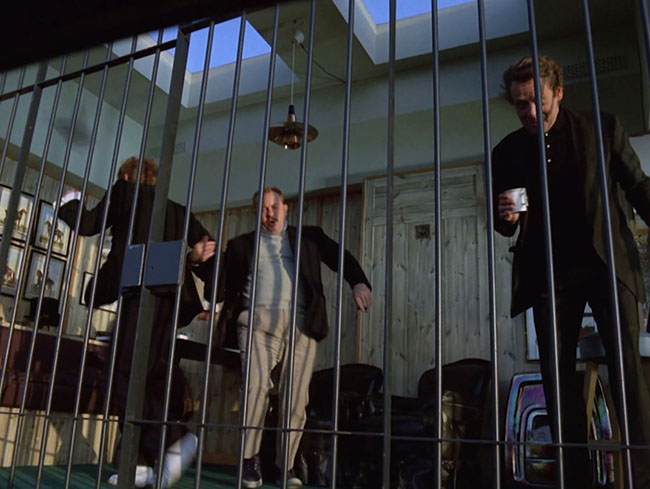
After surviving the ordeal of the last episode, Once Upon a Time, Number Six is brought before the rulers of the Village. To his surprise, after a while, he is treated as a hero rather than a prisoner. A strange assembly gathers to celebrate his victory. Number Six is questioned, praised, and finally given the chance to help decide the fate of the Village itself. The proceedings feel partly like a courtroom fever dream.
As the ceremony continues, Number Six encounters several familiar faces from his time in the Village. He also comes face to face with the mystery that has haunted him since the beginning of the series: the identity of Number One. The answers he receives are anything but straightforward. The episode becomes increasingly surreal. Masks appear. Roles change. Gunfire, and all hell breaks loose. The line between reality and symbolism begins to disappear. What seems important one moment is swept aside the next.
In the final act, Number Six and his allies fight their way out of the Village and escape to London. Yet even after reaching home, there is a feeling that the struggle is not really over. The final scenes suggest that the forces represented by the Village exist beyond any single location.
Like much of The Prisoner, this episode leaves many questions unanswered. I’ve read and talked to fans about it. Some viewers see it as a story about freedom. Others see it as a warning about power and the prisons we create for ourselves. Whatever the interpretation, it remains one of the most talked-about endings in television history.
One side note: the Beatles allowed Patrick McGoohan to use the song All You Need Is Love in this one. It was something they didn’t normally do. They were such huge fans that they gladly gave McGoohan permission. Funny, the most violent scene in the series was going on with All You Need Is Love blissfully playing in the background.
One thing I love about Fall Out is that McGoohan seems less interested in answering “Who is Number One?” than he is in asking, “Now what will you do?” That’s why people are still debating it nearly sixty years later, including you and me today. This is the last episode, so thank you for reading. Remember, the Village will always be somewhere near you now and in 10 years. My closing remark on the series would be this. Patrick McGoohan wasn’t really giving us an answer. I think he was giving us a mirror. Be Seeing You!
Discover more from PowerPop... An Eclectic Collection of Pop Culture
Subscribe to get the latest posts sent to your email.


The words “poorly written” jumped off the page at me. But I calmed down after I read more closely! Interesting Beatles connection as their song made a great foil for the scene. All these episodes make you think and now your getting all philosophical on us! Looking forward to getting caught up on this series.
LikeLiked by 1 person
I have spent way too much time thinking about this series…I really have. But that is the cool part…it makes you think and it’s not just Three’s Company…nothing wrong with that…but heck…we are still talking about it now.
LikeLiked by 1 person
Max, I am still congratulating you. You have done an excellent job at making a thick, demanding show all the more entertaining while telling us that it is thick and demanding. I couldn’t have done it.
Your introductory paragraph says it all, and you have applied it to every episode. ” They’re difficult because they’re symbolic rather than literal. They’re asking philosophical questions instead of telling a straightforward story. I like to be challenged as a viewer, and good and bad, this series does it. ”
Excellent.
I thank you.
LikeLiked by 1 person
Thank you Arthur for reading…I really appreciate it. Did you ever notice the Who is Number 1 bit? I may have read something into it but after seeing the last episode it does make sense…well to me anyway and with this show it’s easy to over think.
LikeLike
The idea that Number 1 is yourself and these are all issues the individual can deal with is very much a part of the show, even if it is given little breath. The idea that you are in control and put yourself in your own prison is powerful stuff for a once a week drama starring a spy. The idea that you build a community, or village, from the wounds and scars of your psyche and you rail against it is even more powerful. The fact that they had to play down this because tv is still a world of Dr. Phil talkshows is very much a fact that we deal with.
Yup, the show was WAY ahead of its time.
Lisa asked about Number 6’s sanity. Notice how the show steps around that question, the concept of sanity, altogether. The sanity of the individual or the sanity of the village? Is there a sanity of the village, of the group? And, whoo boy, now we are in very dangerous territory.
Great show. Makes you think. And thinking is dangerous.
LikeLiked by 1 person
Yea thinking is very dangerious…I laughed when I first saw you write that…but then it wasn’t as funny anymore because you are right. It’s hard not to over or under analyze this show.
LikeLiked by 1 person
from the email I sent you a couple of nights ago:
“Just finished watching season finale if the prisoner. Another mindbender that kept me on the edge of my seat. Am I right in thinking #1 was an ET? Those robes looked like kkk robes! The masks were creepy. The whole thing was mesmerizing.
An alternate theory is he went insane and regained his sanity? Was it all a dream? ”
I love the twist of the comma. It throws it into perspective, and brings the past of the show to the present. We are prisoners more than ever of information. And yes, we are always being watched, listened to, manipulated, etc.
I appreciate you taking the time you did to cover The Prisoner series. I’m positive I wouldn’t have watched to the end if you hadn’t. Still have some earlier episodes to watch from when I was on break.
LikeLiked by 1 person
I’m sorry Lisa! It’s been a long week…I completely missed the email.
That comma does a lot doesn’t it? Since day one we have been hearing that and it hit me…wait…Who is Number 1…You Are Number 6…they disguised it so well in the way he said it.
It was the most difficult writing I’ve ever done…how would anyone put this episode into words? You have to watch it.
I would like to think it was a dream…but I dont’ think so…you notice how his front door automatically opened? And of course the “1” …I guess love or hate the show…it makes you think.
LikeLiked by 1 person
No worries, Max, I am in the same boat with emails and all the rest. You gave a lot of your time to sharing this series and helping us understand what was going on.
The comma does it all. I enjoyed the various cast members through the season. The woman who was trying so hard to kill him and the guy representing “youth” were the most compelling characters to me.
I didn’t love the show, nor hate it, but I do acknowledge that it is an important show.
Told my younger son I finished the series. He said a lot of people were angry with how it ended, as it was ambiguous. Like in real life, few beginnings or endings are clear cut.
LikeLiked by 1 person
Mix the magic word puppies into my world…oh geez Lisa this is a lot of work!
Yea that comma unlocked the show. To think they have been saying it all along but your mind would not go there.
It’s an interesting show…not one you could binge forever but once in a while it’s rather fun to go to the village.
LikeLiked by 1 person
I didn’t remember that the village is in Scotland?
How old are the wee beasties now? Will you please either post or email current pics of them? How many left to be homed? How many girls and boys?
LikeLiked by 1 person
Yes I will email… they will be 8 weeks old next weekend…our independence day lol…they are eating dry dog food and doing great. That is when we plan to start letting them go. I will miss them alot…but not at 3am. 5 boys and 3 girls…
LikeLiked by 1 person
OK cool. I can’t imagine that many cute balls of fur toddling around. I’m imagining you laying on your back on the floor and getting swarmed by them. Not at 3am though! Ugh!
LikeLiked by 1 person
Yes…thats what happens…just lay round and they all come running/walking/hopping/triping at you. No…at 3am…it loses it’s feeling somehow.
LikeLiked by 1 person
🙂
LikeLiked by 1 person
Wow, I will have to watch this again with your thoughts in mind! Thanks, Max, for making this show more interesting and relevant than I had initially thought. 🤯 I know it was hard work and you did an excellent job!
LikeLiked by 1 person
Thank you Dana! I really appreciate it. No more TV shows for a while!!! lol…On Fridays I’m only going to post 1 post…and that is the ship/stories post. They take more research to write to say the least.
LikeLiked by 1 person
I so enjoy the ship stories and pictures. You are doing great on those, too!
LikeLiked by 1 person
Thanks Dana! I love doing something different and that helps keep me excited about posting as well. I love music don’t get me wrong…but it’s nice to have a challenge.
LikeLiked by 1 person
well you did a great job detailing and trying to make sense of the series and probably garnered it quite a few new fans! Well done! Just seemed a bit too weird or ‘out there’ for me after 2 episodes but maybe someday I’ll go back and if so, for sure will look up these posts again.
LikeLiked by 1 person
Thanks Dave…yea the series keeps you on your toes…and the last episode is out there but it does explain a lot. The prison is the prison we make for ourselves…is one way of looking at it….but that is just me.
LikeLiked by 1 person
I like your observation about the power of a possible comma in there. I agree, the show does make one think about things like how free we really are, as you point out ‘Three’s Company’ didn’t excell at that…
LikeLiked by 1 person
I thiiiiink I fall into the ‘mind is its own prison.’ As I said earlier, I saw it when I was too young to understand it, now I don’t think I’m old enough to understand it.
I feel you’re right about the comma too. If so, you’re told the answer, you just don’t hear it as such.
LikeLiked by 2 people
I could be off…but why word it that way? They had to do it just right for you not to notice. And…in the episode when he unmasks the hood and then the ape mask…there he is as Number 1…for a brief moment but it’s there.
I love your answer about being too young and not old enough now lol.
LikeLiked by 1 person
Oh and Thanks for following this obbverse. No more television shows for a while. On Fridays I will only post on the ships blog for a while. They take a lot longer to research.
LikeLiked by 1 person
A pleasure Max. I understand about the time research takes, in the few I’ve done, ie the Carol Wayne one, the research and double checking took way longer than I expected.
LikeLiked by 1 person
Yea…writing about the Beatles is second nature to me since I am such a Beatles and music nerd…but in this new endeavor… I have to recheck everything I do twice. In my Lusitania post in drafts…it has 30 revisions lol. I’m reading a book so I go back and add things.
LikeLiked by 1 person