

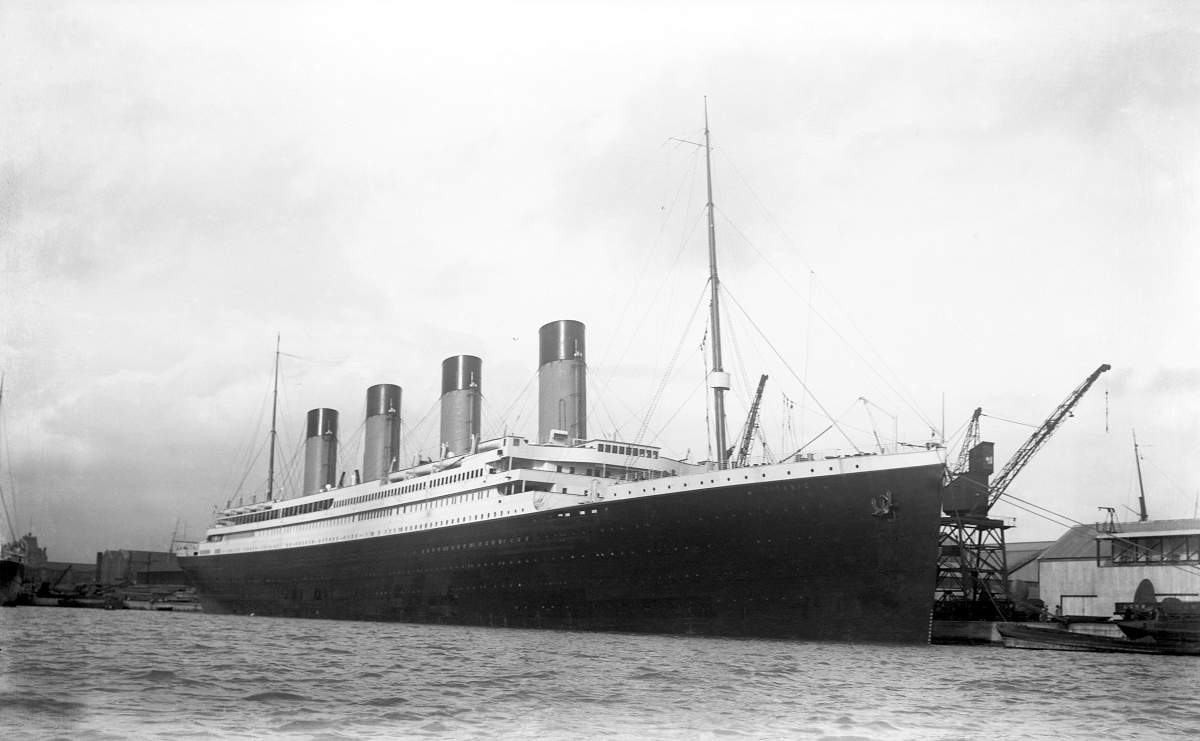
When I was a kid, I dreamed of finding and raising the Titanic. I could picture what it would look like and then take her to New York. Back then, many people thought she went down in one piece. Then, in 1980, they made a movie called To Raise The Titanic. Although it wasn’t a good movie, it was fun seeing their version of the raised ship. It actually matched my naive vision. I wanted so badly to walk on its deck. I’m keeping this post a little lighter at first anyway. Along with Walter Lord’s book, I remember hearing about crazy plans to raise her. Then, we will get into something more serious.
Before it was finally found in 1985, there were many ideas about how to raise her, many of them based on guesses about where the ship was and what condition it might be in. Since nobody had seen the wreck, engineers and dreamers came up with plans that ranged from serious engineering proposals to ideas that sounded like science fiction. Because again, most people thought the ship was in one piece.
One early idea was to attach giant electromagnets to the hull and lift the ship with cables from salvage ships above. Another proposal involved filling the Titanic with ping-pong balls or petroleum jelly to create buoyancy. In the 1960s and 1970s, some suggested pumping liquid nitrogen (it would take only 500,000 tons) into the wreck to freeze the water inside and out and make the ship buoyant enough to rise. Ironically, encasing it in an iceberg! You can’t make this stuff up. Others thought about attaching enormous flotation tanks or inflatable balloons to the hull. There was also an idea to use millions of hollow glass spheres that would sink down and displace water around the ship, helping lift it from the bottom. But you had to find it first!
Even back right after she sank, there were plans to get the family’s possessions off the ship. Little did they know where it was, and nothing at that time could have got even near it. The maximum they could dive in 1912 would have been 90 to 100 meters (300–330 feet). Much shorter than the 3,800 meters (12,500 feet) it would take.
Personal Stories
Most of the male passengers who survived the Titanic had to live with the stigma of surviving the wreck. That was because people automatically thought they took a child’s or a woman’s place. The truth is, there weren’t many at all like that. People did not want to get into a lifeboat at all at first. They wanted the warmth and the lit Titanic. They were sending out boats that were not completely full. They soon let some male crew members row, and if there were no women or children around, they would let a man get in. Boys over 13 years old were considered men. The crew was not immune to this stigma either. Although no one would want to put inexperienced men, women, and children in a lifeboat in the Atlantic without an experienced hand.
Some of the crew were ridiculed by passengers when they woke them up and tried to get them on a lifeboat. The ship was never advertised as “unsinkable,” but many of the passengers believed that. The press used phrases like “practically unsinkable“. The company stated that the ships were “designed to be unsinkable as far as it is possible to do so,” and many did think it was unsinkable.

Frederick Fleet was one of the lookouts aboard the RMS Titanic and is remembered as the crewman who first spotted the iceberg that led to the sinking. Stationed in the crow’s nest with fellow lookout Reginald Lee, Fleet saw the dark shape directly ahead and rang the warning bell three times before telephoning the bridge with the famous message, “Iceberg, right ahead!” Although the officers reacted quickly by attempting to turn the ship, there was not enough time to avoid impact. Fleet survived the sinking by escaping in Lifeboat 6, but he later testified during official inquiries about the events of that night, including the absence of binoculars in the crow’s nest. Fleet struggled financially and emotionally and died by suicide in 1965 after his wife died, and he was evicted from his home at age 77 by his wife’s brother. He carried the weight of that night for decades.

Bruce Ismay was painted as the villain at the time, but not as much now. Ismay survived, and that was not what people wanted to hear. He was the chairman of the White Star Line and traveled aboard during its maiden voyage. As one of the most senior company officials connected to the ship, Ismay became controversial after surviving the sinking while many passengers and crew died. During the evacuation, he helped load lifeboats and eventually entered a collapsible boat shortly before the ship made its final plunge. After being rescued by the RMS Carpathia, Ismay faced harsh criticism in newspapers and public opinion, with many accusing him of saving himself while others stayed behind. Official inquiries found no evidence that he had disguised himself or taken a place from a woman or child, but his reputation never fully recovered. He resigned as chairman of the White Star Line and president of the International Mercantile Marine (IMM) in 1913. He lived the rest of his life close to his family, staying out of the public light as much as possible. His wife forbade anybody from bringing up the Titanic tragedy around him.

 PowerPop... An Eclectic Collection of Pop Culture
Everyone wants to point fingers about the sinking of the Titanic, but it was a combination of events that cascaded out of control. This is a classic example of a “perfect storm” in maritime history, where a series of compounding technical, human, and environmental factors cascaded into a disaster.
LikeLiked by 3 people
Yea all that could go wrong…did. A cold mirage, No moon that night, and a ship 10-20 miles away that went to bed during the sinking and didn’t hear the distress signals.
LikeLiked by 2 people
If only they’d filled the hull with ping pong balls to begin with….
LikeLiked by 2 people
Yea…bad idea at that depth! They would instantly implode…but they have used ping pong balls to raise small ships in shallow water…so believe it or not…it works on smaller ships…it’s the nitrogen part that gets me. What they were told is you would need a factory built close by to manufacture enough nitrogen lol.
LikeLiked by 3 people
wow, that’s amazing. It never really occurred to me that it would be such a problem, but I never stopped and considered it I guess. I would’ve guessed they’d just throw a bunch of chains around it and hoist it up with a powerful crane but I guess there’s no way with a ship of that incredible size
LikeLiked by 1 person
2.5 miles down…pulling up a ship that is almost 3 football fields long. To get the stuff off the bottom they have to send a robot down with electrical arms.
I went to a Titanic museum before…that stuff they brought up is amazing! They only bring up stuff in the debris field…not in the ship.
LikeLiked by 3 people
So let it and it’s final inhabitants rest in peace is the moral I guess. And take expensive tourist voyeurs, err ‘voyages’ down there in a tin can to see it at your own risk!
LikeLiked by 2 people
Yea…I would LOVE to see it Dave. IF it was the navy offering to take me? I’d go….
LikeLiked by 1 person
not me man! I mean, sure , interesting but I beleive my basic knowledge of science says you can’t take a metal container about 30 000 feet down and have 30 000 feet of water pressing on it and not have it implode like a gorilla stomping on a Red bull can.
LikeLiked by 2 people
LOL… I would have never stepped foot in that dudes submersive…EVER. I already read enough about him…he used carbon fiber and everyone told him….no no no…it works for airplanes because the pressure is oposite than underwater…he was told it would implode…but that didn’t stop him.
The submersive that Robert Ballard used…in 1985 was built in 1964. I saw an interview with a sub guy….and he said that you should never worry about imploding…that should never happen…he said what you worry about is getting tangled in something….that is when it gets bad and no other sub to get you.
LikeLiked by 1 person
I remember my dad had a Clive Cussler “Raise The Titanic” book dated 1976. He was fascinated by the whole thing. I was 10 & really knew nothing of it. Later…conspiracies showed up.
LikeLiked by 2 people
I might have to look that book up. This is a subject that laid dormant in me for years…I think I saw a film clip of To Raise The Titanic and it rekindled it all again. I have spent hours watching the underwater discovery.
LikeLiked by 2 people
It was a “what-if” kind of thing. Other writers are Steve Hall & Bruce Beveridge, Fereidun Shokatfard & Don Lynch.
LikeLiked by 2 people
I like those kind of books…I’ve read “what if” the Beatles would have stayed together and other things…
LikeLiked by 3 people
I have my own fascination with the Edmund Fitzgerald
LikeLiked by 1 person
I just watched a documentary on that one recently. Some are horrifying. Look up the SS Eastland…that was crazy. Sinking at the dock but still killing a lot of people when she capsized.
LikeLiked by 1 person
Thanks for the data.
LikeLiked by 1 person
I was nine when it went down.
LikeLiked by 1 person
I don’t remember it…but of course I found out through the song.
LikeLike
No bodies recovered…
LikeLiked by 1 person
When they went down to look at it…they did find one or more…still preserved pretty much.
LikeLiked by 2 people
Did not know that…
LikeLiked by 1 person
There are some good documentaries on the Edmonds Fitzgerald on YouTube
LikeLiked by 1 person
Thanks!
LikeLiked by 1 person
more interesting information, thanks, Max!
LikeLiked by 1 person
Thanks for reading Dana…I appreciate it.
LikeLiked by 1 person
The idea of raising it was hamstrung early on by the lag in technology. By now, as the guy says in the lower vid, with every passing year it all gets more and more fragile and raising it is impossible to… fathom. (sorry Max🙄.) So it just ain’t gonna realistically or technically happen. Ah well, it’s all… water over the bridge now. (Sorry sorry sorry again Max.😬😬.)
LikeLiked by 2 people
Oh yes…when they found her in 85…all of those dreams vanished…also…this is a gravesite…it’s easy to lose focus with that. On the other hand it’s also an archaeological site… so they only take from the debris field not the ship.
You are breaking my heart! I did get to see a huge piece of the hull at a museum which was really cool. She would probably fall apart now…IF you get her off the bottom. The stern is pulvarized because of the sinking…the bow…is still in decent shape… her sister ship Brittanic…it almost fully intact…looks great.
LikeLiked by 3 people
***oh…Bruce’s grand uncle???? I guess that is what he was called…was Charles Lightoller…one of the main principles of the story…Bruce never fails to surprise me.
LikeLiked by 2 people
That’s the joy of WordPress, you never know who knows what.
LikeLiked by 3 people
I remember the 1976 book ‘Raise the Titanic’ by Clive Cussler and the subsequent (terrible) 1980 film.
Lew Grade, the impresario behind the movie said ‘It would’ve been cheaper to lower the Atlantic!’ 😂😂
LikeLiked by 2 people
I’m going to have to read that book. Yea that film was really bad…at the time though I was 13 and it was cool seeing that ship rise out of the water. The sad part is…they had Ken Marschall working for them on that movie, he is a Titanic historian and painter… and many times they refused to listen to him and finally didn’t ask him back after they changed directors.
Oh that is a GREAT quote Mark…thanks!
LikeLiked by 1 person