

★★★★ January 10, 1969 Season 3 Episode 15
If you want to see where we are…and you missed a few…HERE is a list of the episodes in my index located at the top of my blog.
This show was written by Gene Roddenberry, Oliver Crawford, and Gene L. Coon
This is a good episode and it does have a message that is as subtle as a sledgehammer…I’m interested to see your point of view in the comments. In some ways the story is subtle. It’s not about who was right or who was wrong…it’s the hate between them that is the enemy. The hatred between the two races will only lead to destruction.
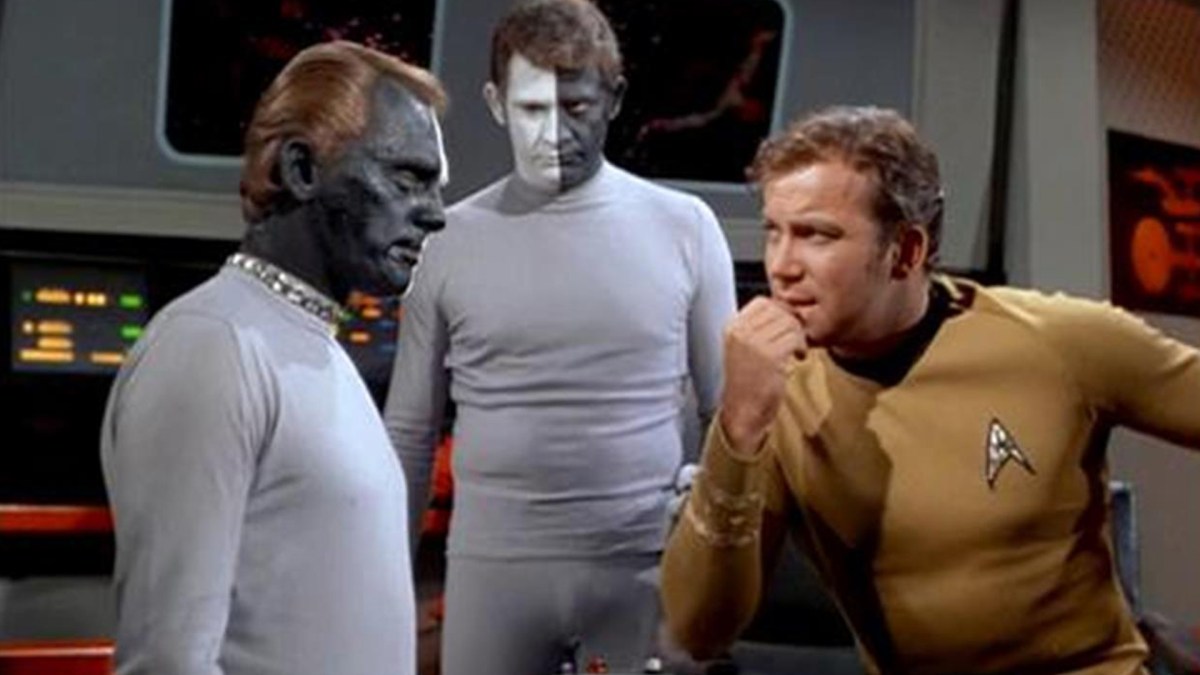
The Starship Enterprise has inadvertently crossed paths with two alien beings who have been at odds for 50,000 years, Lokai and Bele. A shuttlecraft was stolen from a Starbase 4 and the Enterprise is in pursuit. They use a tractor beam to “rescue” the shuttlecraft and a strange humanoid who is black on one side and white on the other.
His name is Lokai and he said he “borrowed” the shuttlecraft to escape a commissioner from the planet Cheron who has been pursuing him. When McCoy examines him, he determines that Lokai would be regarded as a superhuman when compared to average humans from Earth.

Shortly thereafter another humanoid obviously from the same planet appears on the Enterprise, Bele. He says the Enterprise holds “precious cargo”: Lokai. Bele also has the same trait of having a black side and a white side.
We learn that Bele regards Lokai as an inferior race and that Lokai’s “people” were destroying their civilization. By contrast, Lokai contends that Bele’s people enslaved his people. Bele also demonstrates abilities far above those of Earth humans. When the difference between the two is finely revealed, Kirk and Spock are somewhat flabbergasted as to the characteristic which distinguishes the individuals. Lokai’s race is black on the right side and white on the other. Bele is white on the right side and black on the left.
While this story device of humanoids with a black side and a white side may appear to be an obvious commentary on contemporary racial relations, the story does well to keep from portraying one side as being “right” and the other “wrong.” Lokai’s claims his people were oppressed by the people represented by Bele may at first seem like the obvious choice for our sympathies. But then we learn that Lokai’s people engaged in destruction on a mass scale. He also continually admonishes the crew for not carrying out justice because they are not willing to kill Bele. Simultaneously Bele believes he is pursuing not only Lokai but justice and that his apprehension of Lokai represents the greater symbolic rightness of “justice.”
SPOILERS:
This episode does have the marvelous self-destruct sequence initiated by Kirk, in which Spock & Scotty join in to voice the self-destruct codes. This sequence manages to squeeze out every bit of suspense possible for such a televised few minutes and foreshadows the now-famous sequence later duplicated in the 3rd Trek film, “The Search For Spock.” Knowing what we do now about that movie, the countdown to doom in this episode is all the more chilling. The ending is bleak but it backs up the point of the episode. This time Kirk’s speech didn’t work and nothing will work until they die.
Spock: To expect sense from two mentalities of such extreme viewpoints is not logical.
From IMDB:
The original story concept did not depict the aliens with bi-colored skin. One was a devil with a tail and the other was an angel. Episode director Jud Taylor came up with the idea of bi-colored skin shortly before the episode began filming. His original suggestion was that they be half-black/half-white, one color from the waist up and the other from the waist down, but each wearing reversed color schemes. The central idea stuck but the colors were finally separated along the vertical axis rather than along the horizontal.
Bele’s totally “invisible” ship perhaps is the most noticeable effect of the biggest budget cut in the original series.
During the filming of Frank Gorshin and Lou Antonio’s run sequences, Gorshin and Antonio collided with one another when neither actor knew the other was striding down opposite ends of the corridor. The camera crew hadn’t warned them that their scenes were being shot simultaneously.
The characters of Bele and Lokai are depicted as wearing gloves all the time. This was not because it was a requirement of the script or character descriptions, but because the black and white makeup would have smudged and rubbed off every time their hands touched anything or any other character.
This was the last episode Robert H. Justman worked on as co-producer. He left the show because of its declining quality and NBC’s harsh treatment of it.
This episode represents the last on-screen appearance of the hangar deck in the original series. The shuttlecraft makes one last appearance on the planet set of The Way to Eden (1969).
The screenplay was based on a story by Lee Cronin, the pseudonym of Gene L. Coon. He used a pseudonym because he had left Paramount and was under contract with Universal, so he was not supposed to be working for Paramount as well.
The characters of Bele and Lokai both wear shirts which are not pullovers but instead zip up the back. This was because makeup application with the shirts on would have soiled the shirts, and pulling shirts over their heads after the makeup was applied would have disturbed the makeup. Therefore makeup had to be applied first, including below the neckline of the mock turtlenecks they will be wearing. Then the shirts could be put on gently and laid over the made-up neck, and then zipped snugly up the back.
Frank Gorshin had trouble finding a way to interpret his character of Bele when he first received the script. He found the answer one evening, when he was watching a Kirk Douglas film on television with his wife. He realized that Douglas had portrayed the same kind of seething, angry, and stubborn character that he was looking for. Thus Gorshin used Kirk Douglas as a model for the role of Bele.
Gene L. Coon’s association with the series ended with the production of this episode. As with all of his contributions to the third season, the story was credited to one of his pen-names, Lee Cronin.
Every time there is a “red alert”, the camera quickly and repeatedly zooms in and out of a shot of one of the many flashing, red warning lights which indicate the red alert. This camera effect, no doubt an homage to Frank Gorshin’s role as The Riddler in “Batman” (1966-68), was only used in this episode.
The episode’s plot was a clear indictment of the discrimination and prejudice which was still rampant in the late 1960s by showcasing its complete absurdity, especially in light of the assassination of Martin Luther King less than a year prior, and just a few years after the Watts Riots and the events later depicted in the films Ghosts of Mississippi (1996), Malcolm X (1992) and Mississippi Burning (1988). The white/black and black/white makeup was also a rather obvious allegory to the tension that existed between many whites and blacks, especially in the Southern United States. However, many critics charged that this underlying message was considered much too obvious and heavy-handed, overshadowing what was otherwise excellent acting by Frank Gorshin and the series regulars.
This episode features a close-up of the Enterprise model. Zoom shots from below and above the saucer section are used, representing some of the rare ‘beauty shots’ of the ship filmed during the series. (Episodes Operation — Annihilate! (1967) and Metamorphosis (1967) have unique shots of the Enterprise as well.) During the opening credits in the first scene, for example, the camera glides underneath the saucer to an extreme close-up of the saucer’s phaser section and lights. That Which Survives (1969) uses the same shot briefly when the Enterprise is shaking at warp.
Leonard Nimoy (Spock) later directed Lou Antonio (Lokai) in Death on a Barge (1973).
The Saurian Brandy bottle makes an appearance in this episode (on a cabinet behind Spock in the scene where Bele is drinking with Kirk and Spock). The distinctive-shape container was actually a modified George Dickel 1964 commemorative edition “powder horn” whisky bottle.
The SciFi Channel, the DVD, and the remastered version added some new scenes that were not in the original broadcast or VHS versions. After Kirk makes his first log entry at the beginning of this episode, he asks Chekov about estimated time to Ariannus, tells Uhura to contact them to tell them that decontamination is to begin upon arrival, and asks Scotty if it will present any danger. Then, after the shuttle is bought to the hangar deck, there is a shot of the shuttlecraft docking with the Enterprise. Sulu then calls Kirk in the turbolift to inform him that hangar doors are closed. Finally, there is a shot of Kirk and Spock in the hallway, before they meet with the guards.
The costume Frank Gorshin wears is very similar in components to the costume he wore as The Riddler on Batman (1966).
Bele and Lokai have brown hair on their head, but their eyebrows are black and white to match their faces.
Summary
While on a mission of mercy, the Enterprise comes across a shuttlecraft stolen from Starbase 4. Its occupant is Lokai, a humanoid who is exactly half black and half white. Soon his pursuer, Commissioner Bele, arrives on board demanding that Lokai be turned over to him for transport to their home planet where Lokai has been convicted as a terrorist. Both men have extraordinary powers and it turns out that the pursuit has lasted 50,000 years. Their hatred of one another is racially based and, despite attempts by Kirk and others, they are not prepared to reconcile. The pursuit ends on their home planet where they learn the fate of their races.
CAST
William Shatner … Captain James Tiberius ‘Jim’ Kirk
Leonard Nimoy … Mister Spock
DeForest Kelley … Dr. McCoy
Frank Gorshin … Bele
Lou Antonio … Lokai
James Doohan … Scott
Walter Koenig … Chekov
Nichelle Nichols … Uhura
George Takei … Sulu
Majel Barrett … Nurse Chapel
Bill Blackburn … Lieutenant Hadley (uncredited)
Frank da Vinci … Lt. Brent (uncredited)
Roger Holloway … Lt. Lemli (uncredited)
Jeannie Malone … Yeoman (uncredited)

 PowerPop... An Eclectic Collection of Pop Culture
Great review Max. As Spock says it’s illogical. Unfortunately so many parallels in society back then and still today. I thought this was one of the most profound messages of the original series. The ending was a foreshadowing of the realities of prejudice and hate we still battle with today.
LikeLiked by 1 person
Thank you Randy. Yes I agree…and the ending was devastating…but unfortunately you knew it was coming…
LikeLiked by 1 person
Not subtle & sounds even-handed. From your descriptions the whole series seemed over the top (I’ve seen too few to really know) but sometimes you can’t be too subtle when trying to make a point or too few will understand.
LikeLiked by 1 person
Yes and they did balance this one out pretty well. I also think of The Zax from Dr Seuss…stubborn and unwilling to change.
LikeLiked by 1 person
So, I just can’t get past how tight that grey jersey looks on that guy in the featured photo. Kinda snug! Oof 😉
LikeLiked by 1 person
Lol… yea I see what you mean!
LikeLiked by 1 person
And still Bill Shatner insists that Star Trek wasn’t political.
LikeLike
Yea….that wasn’t true…just like the TZ
LikeLike
What a mess I had today. My computer crashed in a power failure this morning and it would not restart and my only option was to download Windows from the cloud. It is working again but all the settings that I normally use were set to defaults and it is frustrating getting around now.
LikeLiked by 1 person
Did you have your stuff saved in the cloud? I save mine on OneDrive. It does keep them when you say so though…yea I do that to my computer once a year from scratch…I install a lot of crap through a year…
LikeLiked by 1 person
I didn’t lose any data, it was just a problem getting all of my settings back to the way they were and that download and setup took forever.
LikeLiked by 1 person
Ok that is good about the data
LikeLiked by 1 person
No room for hidden messages in this episode, the message is literally in your face. The conclusion was inevitable, and yet Bele and Lokai go home and perpetuate the hate, to the bitter end. No room for grey areas between the two at all, ever. That is a a sad end to supposedly superior beings.
LikeLiked by 1 person
Yes it is…no doubt about this one. It was much better than I remembered it but it’s been a long time.
LikeLiked by 1 person
I like the two guest actors and both of them are familiar from other shows. I also like the concept of them being exactly the same except for the color reversal. How much more clear can it be that people are people and saying some are better or worse than others is a social construct.
LikeLiked by 1 person
Yes I totally agree…it’s a clear message and a correct one.
LikeLiked by 1 person
So… watching Frank Gorshin do Kirk Douglas on Star Trek is wonderful. That’s all, TWS.
LikeLiked by 1 person