

Welcome to the Hanspostcard TV Draft. I hope you will enjoy it! Today’s post was written by Liam at https://othemts.wordpress.com/
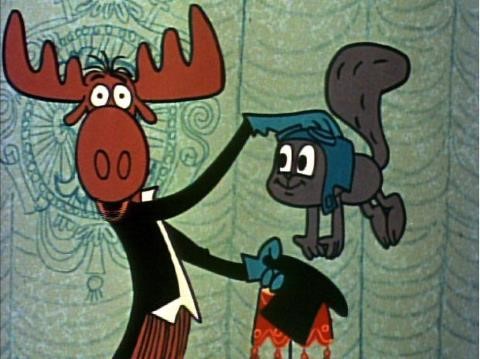
The Rocky and Bullwinkle Show
(1959 – 1964)
When you have an animated series featuring talking animals, the natural inclination is to file it under “Children’s Entertainment.” And yet The Rocky and Bullwinkle Show featured witty wordplay, spoofs of popular culture, self-referential humor, and political satire (particularly regarding the Cold War). You can tell that network execs were confused by the fact that they sometimes aired the show in prime time and sometimes on Saturday morning. During the show’s five season run from 1959 to 1964 it also switched networks. For the first two seasons it was on ABC and called Rocky and His Friends. Then it moved to NBC and became The Bullwinkle Show. CBS never gave it a shot but the show lived on in syndication under the names The Rocky Show, The Rocky and Bullwinkle Show, The Adventures of Rocky and Bullwinkle, and The Adventures of Bullwinkle and Rocky. Whew!
Ok, but beyond this rocky (pun intended) broadcast history, what was the show about? Jay Ward created the show to be an ongoing adventure serial about a moose and a squirrel. Animator Alex Anderson created many of the characters but declined to work on the show itself. Ward hired Bill Scott as head writer and co-producer of the show, as well as writers Chris Hayward and Allan Burns. General Mills came on board as the show’s main sponsor. The ongoing serial featured four main characters, two heroes and two villains:
- Rocket J. Squirrel (a.k.a. Rocky the Flying Squirrel), voiced by June Foray, is a noble all-American kid in squirrel form who serves as the straight man to his partner Bullwinkle’s antics. His catchphrase is “Hokey smokes!”
- Bullwinkle J. Moose, voiced by Bill Scott, is a good-hearted and optimistic, but very dimwitted moose. He and Rocky are roommates in the fictional town of Frostbite Falls, Minnesota. He attended Wossamotta U. on a football scholarship.
- Boris Badenov, voiced by Paul Frees, is a spy from the fictional nation of Pottsylvania (a thinly disguised amalgamation of countries behind the Iron Curtain.). He is constantly up to no good and scheming on a plan given to him by his Fearless Leader or concocting his own criminal conspiracy. He proudly introduces himself as the “world’s greatest no-goodnik.”
- Natasha Fatale, voiced by June Foray, is another Pottsylvania spy and Boris’ partner in crime. The design of Boris and Natasha are inspired by Charles Addams’ characters Gomez and Morticia Addams.
Over five seasons and 163 episodes, Rocky & Bullwinkle and Boris & Natasha appeared in 28 different serialized story arcs. The shortest serial had only 4 chapters while the longest had 40! And this was in the days before DVD box sets and streaming video made binge watching possible, so the creators of the show put a lot of faith in the audience remembering what happened earlier in the story.
A typical 23-minute episode would have two segments of a Rocky & Bullwinkle serial, each ending on a cliffhanger (and a bad pun). Additionally, the show would have a couple of supporting features drawn from the following:
- Dudley Do-Right of the Mounties – In a parody of silent film melodramas, the brave but dumber-than-Bullwinkle mounted policeman Dudley Do-Right (Bill Scott) attempts to foil the plots of the villainous Snidley Whiplash (Hans Conried). This usually requires rescuing Nell Fenwick (June Foray), whom Dudley loves, but she in return is only fond of his horse.
- Aesop and Son – Old fables are retold in a comical way by Aesop (Charles Ruggles) and his son, Junior (Daws Butler).
- Fractured Fairy Tales – Edward Everett Horton narrates fairy tales updated with modern themes and a lot of puns.
- Peabody’s Improbable History – Mister Peabody (Bill Scott), a genius talking dog, adopts a boy named Sherman (Walter Tetley). Since the boy needs exercise, Peabody invents a time machine called the WABAC. They travel to various historical events to see what “really” happened.
- Bullwinkle’s Corner – Bullwinkle attempts to be cultured by reading poetry with comical results.
- Know-it All – Bullwinkle, who we have already noted is quite dim, attempts to be the authority of various topics while Boris Badenov undermines his efforts.
The one great flaw of The Rocky and Bullwinkle Show is its animation style. Television animation of the 50s and 60s relied on the practices of limited animation such as reusing simple backgrounds and the stilted motions of the characters to save money. But even by the standards of limited animation, The Rocky and Bulwinkle Show’s animation was choppy and full of visible flaws. General Mills insisted on outsourcing the animation to the Mexican studio Gamma Productions S.A. de C.V, and Ward was never happy with the quality. But ultimately, the witty scripts and terrific voice acting made the poor quality animation irrelevant to the show becoming a classic.
The Rocky and Bullwinkle Show legacy lives on in syndicated reruns. Despite never being a morning person, I went through a phase as a teenager in the late 1980s where I would get up to watch it at 6am before school! The show has also been released in various home media formats. Attempts to revive the show in the 1970s and 80s failed but it eventually found its way to the big screen. Boris and Natasha: The Movie (1992) and Dudley Do-Right (1999) were live-action adaptations that both bombed. A live-action/animated hybrid movie The Adventures of Rocky and Bullwinkle (2000) was also poorly received. Mr. Peabody & Sherman (2014) from DreamWorks Animation got much better reviews and spun off a Netflix series (2015-2017). DreamWorks Animation Television followed up with a reboot series of The Adventures of Rocky and Bullwinkle (2018-2019) on Amazon Prime Video. I have not watched any of these having remained loyal to the original work of Jay Ward and company.
 PowerPop... An Eclectic Collection of Pop Culture