In Turntable Talk Dave said: This time around, we’re going Sans Sophomore Slump. We all remember the triumphant debuts to the scene by The Knack, Meat Loaf, the Ramones…but how many recall, let alone listen to ‘But the Little Girls Understand’, ‘Dead Ringer’s or ‘Leave Home’… the follow-ups for them? In other words a great 2nd album by any artist. Many times, that 2nd album is rushed, or the artist used all of their songs for the first album. The example I use is The Knack. It was a great fun first album and a bad second.
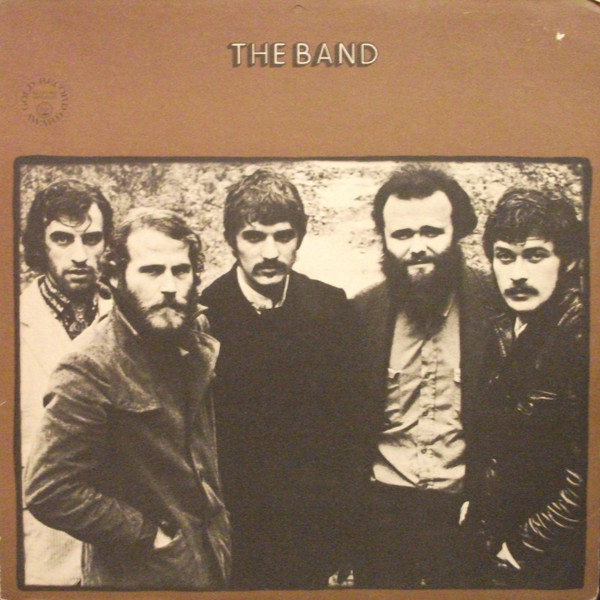
Thank you, Dave, for including me in this so I can talk about this great album. There were a few that came to mind while doing this. The Who’s A Quick One, Van Morrison’s Astral Weeks, Carole King Tapestry, and many more but I decided on this great Americana band that was actually most Canadian. The album is called The Band, and its nickname is The Brown Album. Their first album was Music From Big Pin,k and it was released in 1968. This album was released in 1969.
They recorded this album not in a recording studio but at Sammy Davis’s house in California. They remodeled the adjacent pool house into a recording studio. The Band fashioned a makeshift workshop environment similar to the one at their former home, Big Pink. The album peaked at #2 in Canada, #9 on the Billboard 100, and #25 in the UK.
The album is said to be a concept album about a past America. It’s an album that every rock fan should own. While even novice fans of the group likely know classics like “The Night They Drove Old Dixie Down” and “Up on Cripple Creak,” the record is an amazing listening experience from beginning to end. Robbie Robertson’s lyrics weave fluidly from one song to the next, while the musical accompaniment never disappoints.
Robertson wasn’t just a songwriter. He was more of a director and screenwriter, tailoring roles that played to the strengths of his three leading men. He did have 3 lead singers to work with who could have fronted 3 other bands. They knew each other so well that he could pick who sang what and when. His songwriting process had more in common with films than rock songs. Robertson would go to flea markets and antique stores to purchase screenplays. That’s how he wrote songs…like it was a screenplay.
The man not only was a great storyteller, but many of his songs were mini-movies you could visualize. Who couldn’t imagine the drunkard and his sweetheart defender Bessie betting on horses up on Cripple Creek? Those are not just songs; they are visual pictures sent through music that only Robertson could write. We continue to benefit from his hard work and gift…and always will.
Manuel was the most versatile singer in the Band. He was called the lead singer if someone asked. Manuel took the lead vocals on Across The Great Divide, Rockin’ Chair, and Jawbone, and shared it in King Harvest. Of all the singers, Manuel is overlooked more than the other two. It’s probably because he wasn’t singing lead on the huge “hits” such as The Weight, Up On Cripple Creek, and The Night They Drove Old Dixie Down. He does sing on one of my favorite Band songs ever…King Harvest (Has Surely Come). I didn’t realize how great a voice he had until I heard him sing Georgia On My Mind.
Levon had that great southern voice that was earthy and soulful. Robertson knew just when to use Levon, and he did strengthen Robertson’s songs. Rick Danko had the most vulnerable voice of all three. I never quite heard a voice like his before or since. The amount of talent they had was staggering. I’m talking about voices here, but I haven’t even mentioned the musical skills of these guys. Garth Hudson, who recently passed, played keyboards like NO other. I mean no other. He made a massive wall of sound in the background that identified them from other bands. His approach to his sound was so unique that it’s not copied much because it has to be in the right musical surroundings. Robertson has said that there was no one like him period.
This album contains some of their best-known and best tracks. Let’s look at some of the tracks. Now, is this as good as Music from Big Pink? I think so and in some ways, I like it more. I think it was their best album when all is said and done. I could yack and yack more…but just listen to the album!
Across The Great Divide, Rag Mama Rag, The Night They Drove Old Dixie Down, Up On Cripple Creek, Whispering Pines, King Harvest (Has Surely Come), When You Are Awake, Jemima Surrender, Rockin’ Chair, Look Out Cleveland, Jawbone, and The Unfaithful Servant.
This song was a B side to Cripple Creek. This was on the Band’s self-titled second album The Band with peaked at #9 in 1970 in the Billboard Album Charts. The song was written by Robbie Robertson:
’ I told Levon I wanted to write lyrics about the Civil War from a southern family’s point of view. ‘Don’t mention Abraham Lincoln in the lyrics’ was his only advice, ‘That won’t go down too well.’ I asked him to drive me to the Woodstock library so I could do a little research on the Confederacy. They didn’t teach that stuff in Canadian Schools. When I conjured up the story about Virgil Caine and his kin against this historical backdrop, the song came to life for me. Though I did stop and wonder, can I get away with this? You call this rock ‘n’ roll? Maybe!
Joan Baez covered this song and it peaked at #3 in the Billboard 100 in 1971…while the Bands version didn’t chart…Life isn’t fair at times. Asked about the Baez version of this song, Robbie Robertson said it was “a little happy-go-lucky for me,” but he was thankful that it introduced many listeners to The Band.
The song appeared at number 245 on Rolling Stone magazine’s list of the 500 greatest songs of all time.
From Songfacts
Robbie Robertson wrote this song, which is set during the American Civil War – “Dixie” is a term indicating the old American South, which was defeated by the Union army. The song is not related to his heritage, as Robertson is half-Mohawk Indian, half-Jewish Canadian.
Robertson came up with the music for this song, and then got the idea for the lyrics when he thought about the saying “The South will rise again,” which he heard the first time he visited the American South. This led him to research the Civil War.
The main character in the song, Virgil Caine, is fictional, but there really was a “Danville train” and “Stoneman’s cavalry.”
The train would have been part of the Richmond and Danville Railroad, a vital conduit for the Confederate Army. George Stoneman was a Union cavalry officer who led raids on the railroad.
The vocals featured the 3-part harmonies of Levon Helm, Richard Manuel, and Rick Danko on the choruses, and Helm sang the verses. He was the only band member who was from the South (Arkansas), so it was fitting that he played the role of Virgil Caine, a Virginia train worker, in this song.
This was recorded in Sammy Davis Jr.’s house in Los Angeles. The Band rented it and converted a poolhouse into a studio to record their second album.
Joan Baez covered this in 1971. It was her biggest hit, reaching US #3 and UK #6.
Her version was recorded at Quad Studios in Nashville with producer Norman Putnam, who gathered about 20 people from around the studio to sing on the chorus. One of those voices belongs to Jimmy Buffett, who Putnam would later work with on his album Changes in Latitudes, Changes in Attitudes.
Baez changed some of the lyrics on her version. For example, she sings, “Virgil Cain is my name and I drove on the Danville train. ‘Til so much cavalry came and tore up the tracks again.” The original lyrics are, “Virgil Cain is THE name and I SERVED on the Danville train. ‘Til STONEMAN’S cavalry came and tore up the tracks again” referring to George Stoneman, who was a general in the Union army).
This was used as the B-side to “Up On Cripple Creek.”
The Night They Drove Old Dixie Down
Virgil Caine is the name, and I served on the Danville train ‘Til Stoneman’s cavalry came and tore up the tracks again In the winter of ’65, we were hungry, just barely alive By May the tenth, Richmond had fell, it’s a time I remember, oh so well
The night they drove old Dixie down, and the bells were ringing The night they drove old Dixie down, and the people were singin’ they went La, la, la, la, la, la, la, la, la, la, la, la, la, la
Back with my wife in Tennessee, when one day she called to me “Virgil, quick, come see, there goes Robert E Lee” Now I don’t mind choppin’ wood, and I don’t care if the money’s no good Ya take what ya need and ya leave the rest But they should never have taken the very best
The night they drove old Dixie down, and the bells were ringing The night they drove old Dixie down, and the people were singin’ they went La, la, la, la, la, la, la, la, la, la, la, la, la, la
Like my father before me, I will work the land Like my brother above me, who took a rebel stand He was just eighteen, proud and brave, but a Yankee laid him in his grave I swear by the mud below my feet You can’t raise a Caine back up when he’s in defeat
The night they drove old Dixie down, and the bells were ringing The night they drove old Dixie down, and all the people were singin’, they went Na, la, na, la, na, na, na, na, na, na, na, na, na, na
The night they drove old Dixie down, and all the bells were ringing The night they drove old Dixie down, and the people were singin’, they went Na, la, na, la, na, na, na, na, na, na, na, na, na, na



 PowerPop... An Eclectic Collection of Pop Culture