

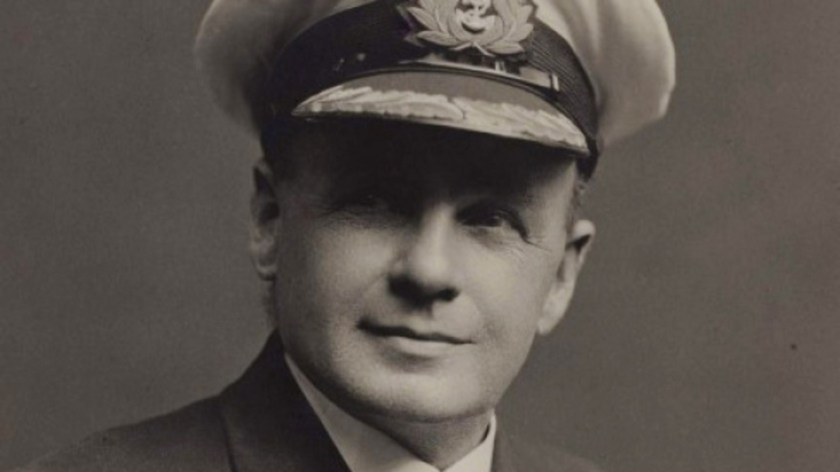
Charles Hebert Lightoller: Mr. Lightoller was born on March 30, 1874, in Chorley, Lancashire. This man lived a full life. He was stranded on a deserted island for 80 days, survived the sinking of the Titanic (while saving many lives), sunk a German U-boat in WW1, and did something at 66 years old that topped everything else. When I first read about Lightoller, I didn’t know what to think of him; he was strict on the women and children first policy. He interpreted it as women and children only on the Titanic. But in that situation, I can see why. This was standard practice at the time. Lifeboats were not seen as a way to save everyone. But as a way to ferry people from one ship to another. I would suggest watching a documentary or reading a book about this man.
He lived a life that almost reads like fiction. Before the RMS Titanic disaster ever happened, he had already been through shipwrecks and survival situations that would have broken most people. As a young sailor in the 1880s, he was aboard the ship Holt Hill when it caught fire in the Indian Ocean. Lightoller and others escaped in small boats and were stranded on a deserted island for 80 days, with little food or water, before being rescued. Years later, he joined the White Star Line and became Second Officer on the Titanic. On the night of April 14, 1912, he worked steadily as the ship sank, loading women and children into lifeboats and refusing to panic even as the decks tilted into the freezing Atlantic. When the water finally swept over the bridge, Lightoller was pulled under against a ventilator grate before a blast of air forced him back to the surface. He survived by climbing onto an overturned collapsible lifeboat with other men and was the highest-ranking officer to survive the sinking.
During World War I, he served in the Royal Navy and commanded torpedo boats and destroyers in dangerous waters. He fought at the Battle of Jutland in 1916 aboard HMS Garry, where his ship rammed and sank a German U-boat, an action that earned him recognition for bravery. Lightoller also took part in Atlantic convoy duty and anti-submarine patrols during the war.
Most people would have spent the rest of their lives talking about surviving the Titanic, fighting in WW1, and being shipwrecked, but Lightoller still had another chapter ahead of him. During World War II in 1940, when British troops were trapped on the beaches of Dunkirk, the British government called for civilian boats to help with the evacuation. Lightoller was 66 years old by then, old enough to stay safely at home, but instead he took his small motor yacht, the Sundowner, across the English Channel himself with his son and a young Sea Scout. German aircraft were attacking the beaches and the Channel was filled with burning ships and wreckage, but Lightoller pushed on anyway. The Sundowner was built to carry around 20 people comfortably, yet Lightoller brought back more than 120 exhausted British soldiers packed onto the little boat. He could easily have been killed during the crossing, but the same calmness he showed on Titanic appeared again at Dunkirk. He was shot at and bombed by German airplanes. It turned Charles Lightoller into one of the few men connected to two of the most famous sea stories of the 20th century.
He married in 1903 to Iowa Sylvania Zillah Hawley-Wilson, whom he was married to until he died in 1952. They had 5 children: Frederick Roger, Herbert Brian, Richard Trevor, Sylvia Mavis, and Claire Doreen. Roger was killed on March 9, 1945, near the end of the war; Herbert Brian was killed on September 4, 1939, near the start of the war.
His famous boat, the Sundowner, is being refurbished and saved. I want to thank Bruce Goodman for helping me with research about Charles Lightoller.
A Bad Omen
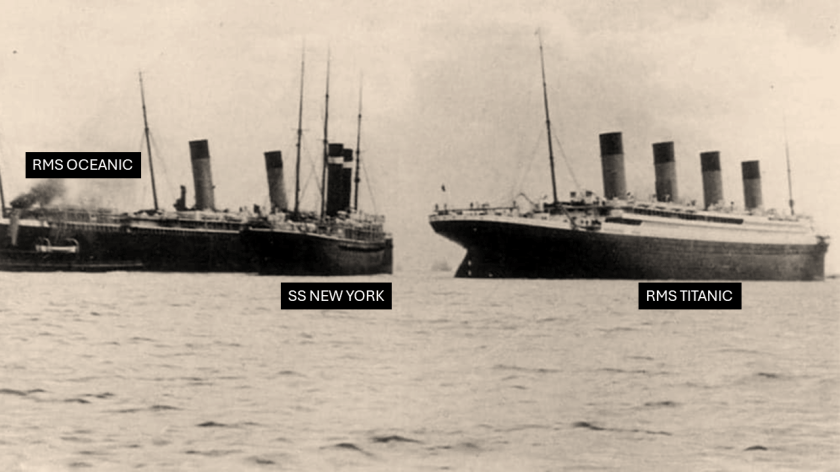
When RMS Titanic first pulled away from Southampton on April 10, 1912, thousands of people lined the docks to watch the biggest ship in the world begin her maiden voyage. As her massive propellers started turning, they created a strong suction in the harbor. Nearby was the smaller liner SS New York, tied up alongside the dock. The force from Titanic’s spinning propellers snapped New York’s mooring ropes and pulled the ship toward Titanic’s stern. For a few tense minutes, it looked like the two ships might collide before tugboats rushed in to push New York away. Titanic missed her by only a few feet. Many passengers and dock workers were shaken by what they had just seen.
Below is a picture taken on the Titanic which shows just how close the SS New York was to her.
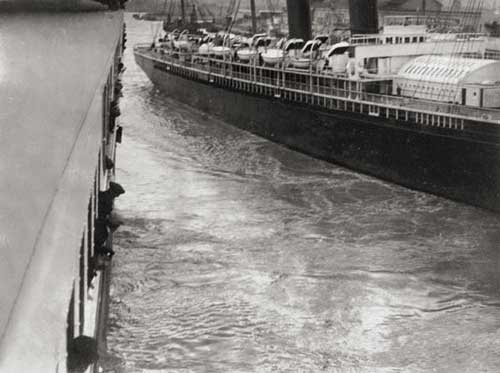
Afterward, some people quietly called it a bad omen. In the early 1900s, sailors and passengers often believed strange accidents before a voyage meant trouble ahead. At the time, most people brushed it off as just the danger of handling a ship so large in a crowded harbor. But after the disaster, survivors and historians looked back on the near collision with SS New York as one of the eerie moments connected to Titanic’s short life. It is possible that even a moderate collision on April 10, 1912, could have changed history.
If you are wondering what the RMS stood for, it stands for Royal Mail Ship (or Royal Mail Steamer). It was a prestigious designation indicating that the vessel was contracted by the British government to transport mail for the Royal Mail Service
Below is an excellent video, but long on Charles Lightoller’s heroism at Dunkirk.
