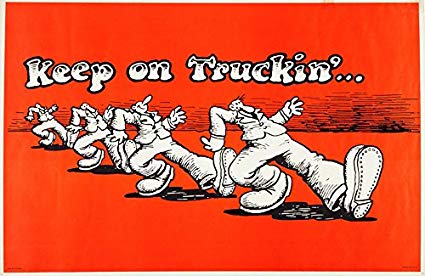
Keep On Truckin’ Poster

I have this hanging in my music room. I saw it on shirts, bumper stickers, and walls everywhere once upon a time. This phrase was used in a song from the 1930s called “Truckin’ My Blues Away” by Blind Boy Fuller and is the origin of this image.

In the seventies as a kid…I remember this phrase and picture everywhere. I saw bumper stickers, pics in magazines, and on patches for pants. In one local restaurant I went to as a kid they had this poster in the dining room. Fast forward to the 90s and the picture was still there. The place was sold in the 2000s and I tried to get the poster but they threw it away…arghhhh. It would have been cool to have that original one. 

Besides the smiley face…it’s one of the most iconic graphics of the 1970s. It was created by Robert Crumb for Zap Comics in 1968. The image was used many times without his permission for years. It was claimed that the Trademark symbol ™ was not on the original drawing.

Crumb went to court and the court ruled it Public Domain. The decision was later reversed in 1977. He sued many for using it including Amazon 2005. Crumb also came up with Fritz the Cat…

Quotes from Robert Crumb on the drawing.

For a while I was most well known for that [the Janis Joplin album cover, and for “Keep on Truckin’.” That was a drawing that came out of LSD trips, and the words came from a Blind Boy Fuller song from 1935. I drew it in my sketchbook and then for Zap. It sort of caught the popular imagination. It became a horrible popular thing.

Take Keep On Truckin’… for example. Keep on Truckin’… is the curse of my life. This stupid little cartoon caught on hugely. … I didn’t want to turn into a greeting card artist for the counter-culture! I didn’t want to do ‘shtick’—the thing Lenny Bruce warned against. That’s when I started to let out all my perverse sex fantasies. It was the only way out of being “America’s Best Loved Hippie Cartoonist.”
keep.jpg

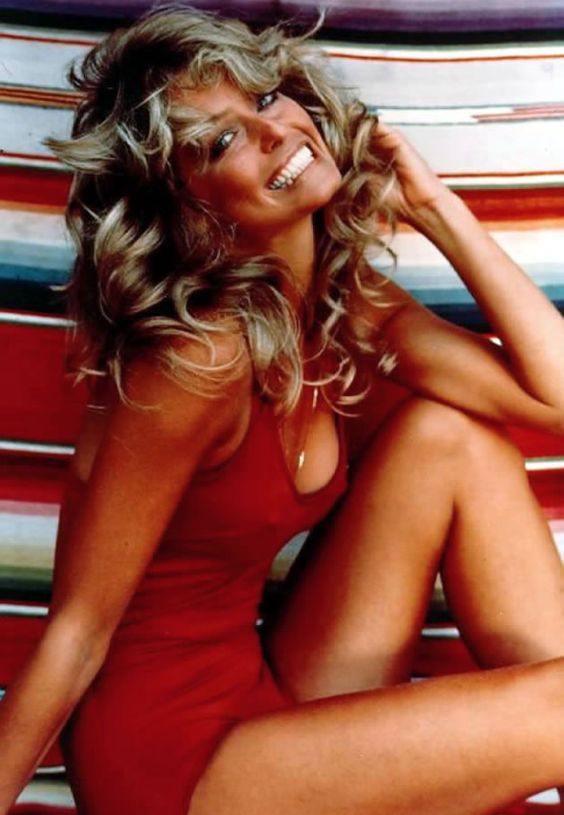
Farrah Fawcett Poster

If you were a male teenager in the 1970s… odds are you owned or wanted to own this poster. Over 12 million of these were sold and I remember seeing them everywhere. On friends bedroom walls, doors, closets, ceilings, and lockers.

She wasn’t even my favorite Angel…but still.

Other posters were popular during the 1970’s like Cheryl Tiegs, Olivia Newton-John, Loni Anderson but nothing came close to the numbers generated by Farrah’s poster at 3 dollars a pop.

The poster that came out in 1976 is so iconic that when you look at it you think “1970s”…

This is Bruce McBroom the photographer in Time Magazine.

 I shot rolls of film, and it just wasn’t happening. She’s a beautiful woman, but there wasn’t anything that I would put on a poster. I just didn’t feel it. By now we’re running out of backgrounds — we used the swimming pool, etc. I said, “Farrah, are you sure you don’t have a bikini? Something different?”

She went in to look around and came out of the back door and stood in the doorway in this red suit, and she said in her Southern accent, “Well, is this anything?” And I literally said to myself, “Oh my God.” I knew that was it. I had an Indian blanket from Mexico that served as the seat cover for my beat-up 1937 Chevy pickup with colors that, it just popped into my head, would match the suit. I’d like to make it sound like it was all planned. But it was a spontaneous, happy intersection of coincidence. I didn’t do anything. I just put her in a spot and asked her to turn it on. When I saw the film processed, I knew we’d gotten it — somewhere in these 36 frames, there’s a poster. I went back over to her house, and I showed her all the pictures. She told me later that she had picked out her top two favorites and marked them on the slides. I’ve since heard that when the guy in Cleveland got the pictures, he went, “First of all, where’s the bikini?” He told me he wasn’t ever gonna pay me because he hated the pictures. But I guess he showed them around to people in his business and they changed his mind. It was Farrah’s pose, Farrah’s suit, Farrah’s idea. She picked that shot. She made a lot of money for him and for herself and made me semi-famous.

Why it was so iconic I don’t know. If you think back, no one knew who Farrah Fawcett was. Charlie’s Angels didn’t come out until six months later. But this poster came out and sold millions of copies at, I think, $3 a pop. I think the reason it was such a success is that Farrah had such a fresh face. She was the girl next door. So if you were a teenager, you could bring this in the house and put it up in your room — as long as Mom didn’t look too closely. Once her poster became such an overnight success, the other actresses from Charlie’s Angels contacted the guy and wanted to do posters too. There were many that followed. And none of them came close.