

★★★★ March 15, 1968 Season 2 Episode 25
If you want to see where we are…and you missed a few…HERE is a list of the episodes in my index located at the top of my blog.
This show was written by Gene Roddenberry, Gene L. Coon, and John Kneubuhl
This is one that I like more than some Star Trek fans.
The Enterprise is on its routine patrol when it runs across some wreckage of the SS Beagle. The Beagle has been lost for 6 years and its captain was R. M. Merik, a man Kirk once knew. They find no signs of humans so they guessed that the crew was able to leave the ship before it was destroyed. They follow the debris trail to an unknown planet – never charted before. They discover the planet is very much like planet Earth and even pick up radio and video signals from it.
The ship’s computer picks up survivors from the Beagle on the planet. Kirk, Spock & McCoy beam down to the planet’s surface and are soon met with a group of men with shotguns – they are runaway slaves. Kirk, Spock, and McCoy befriend the runaway slaves. It is revealed that their slavery is over a belief or dispute of gods: sun god vs other gods. Kirk is looking for Captain Merik the slaves have mentioned a man named Merikus – is it one in the same man?
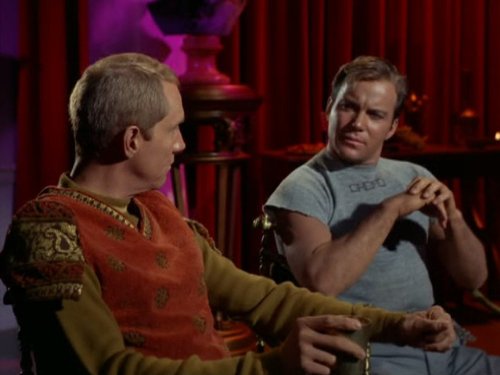
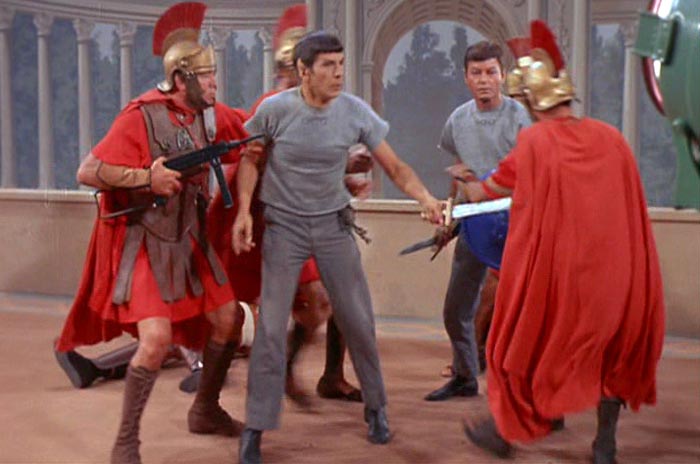
The planet is similar to Earth’s ancient Rome but mixed with 20th-century Earth and soon they find themselves in a 20th-century jail cell while searching for Merik… they soon find Merik. Merik takes them to the pro-council where Merik explains what happened to him, his crew, and the Beagle. Later Kirk is made to order some of his crew members down to fight in the old Roman-style arena. The mix of old Rome with the 20th Century with the gladiators and TV cameras takes a minute to get used to.
He tells Mr. Scott code green, all is well. Scotty knows that means trouble, don’t interfere but stand by. Kirk refused to bring down his men so Kirk, Spock, and McCoy are taken to the arena in a real fight to the death which is broadcasted on television. The Enterprise can pick up television signals but must stand by under the captain’s orders…Scotty cannot send down a landing party but he can do other things from the ship.
It’s a very interesting episode and one that I appreciate much more now that I have rewatched.
From IMDB:
The caves where the Children of the Sun hide out are one of the most-used locations in television and movies. In addition to being the entrance to Batman (1966)’s Batcave, they are also seen in Invasion of the Body Snatchers, Kung Fu (1972) and various police and western shows. They are located right below the famous Hollywood sign.
One of several “parallel Earth” plots in the series, contrived to save money by avoiding the necessity for “alien” sets, costumes, and makeup.
The coat of arms on the clothes of the Proconsul Claudius Marcus is William Shakespeare’s.
The title “Bread and circuses” is a translation of “Panem et circenses”, an ancient Roman metaphor for people choosing food and fun over freedom. It first appears around AD 100 in the Satires of Juvenal, which also provided the title of another Star Trek production about 20 years later: Star Trek: The Next Generation: Who Watches The Watchers (1989).
The episode parodies the television industry in several ways. Fake applause and catcalls are used to simulate a studio audience, and the race for high television ratings is lampooned several times. The TV station manager threatens the now-pacifist runaway slave that he had better fight convincingly: “You bring this network’s ratings down, Flavius, and we’ll do a special on you!” Later, the Proconsul sneers at Kirk about the captain’s impending death, to be televised from the arena, by telling Kirk that “You’re centuries beyond anything as crude as, television.” Kirk replies, “I’ve heard it was… similar,” an oblique reference to the series’ own ratings difficulties. Comic relief is in the scene where McCoy and Spock heckle each other on the TV Stage during the gladiatorial duels.
When Kirk and Spock are breaking out of their cell, two phalanxes of about 5 machine-gun-armed guards each run to block off each end of the corridor which would lead the flag officers to freedom. In the blooper reel, the lead guard of the group closest to the camera reaches his ‘mark’, but is unable to stop; his feet slide out from under him and he falls and goes sliding toward screen-right, after which everyone breaks out in laughter. When you watch the aired version of the scene closely, it has been edited in such a way that you never see that Roman trooper come to a complete stop. It seems they USED the ‘take’ and cut the embarrassing part (for the extra) out.
During the location shooting for this episode, the new producer John Meredyth Lucas visited the set, accompanied by Gene Roddenberry. Lucas was struck by the tension and bad atmosphere among the cast. “Shatner came around the corner, and when he saw Gene, he turned around and went the other way. And the cast was fighting too. All the actors complained to me about all the other actors.”
The Jupiter 8 car was actually the Reactor, a custom aluminum show car designed by Gene Winfield and completed in 1965. The Reactor was based on a 1956 Citroën DS chassis and powered by a Chevrolet Corvair engine. It also made appearances in Mission: Impossible (1966) and Bewitched (1964).
Claudius Marcus recommends the sparrow broiled in garum. Garum was a sauce made by salting the intestines of fish and collecting the fermented juices that dripped out. It was very popular in classical Greek and Roman cuisine.
The DVD and earlier VHS editions of this episode contain what is probably the best McCoy/Spock dialogue of the series, which was always edited out in syndication.
This episode marks the final appearance of Kirk’s second season green wrap-around tunic. Beginning in Star Trek: The Original Series: Assignment: Earth (1968), which followed, and when the series returned for its third and final season Kirk goes back to wearing his standard gold and black v-neck shirt full-time.
One of the shots of the planetary capital (in the opening of Act II) is of the Great Dome at the Massachusetts Institute of Technology, whose words can be read (somewhat) above the pillars. The next shot shows the Legion of Honor on the Left Bank in Paris. Its motto ‘Honneur et Patrie’ is not Latin but French.
This was one of the first second-season episodes filmed, but the penultimate one aired.
This is one of only two TOS episodes featuring dialog between the credits and the episode title card. The other episode is Star Trek: The Original Series: A Private Little War (1968).
Gene Roddenberry and Gene L. Coon wrote this episode’s teleplay from a story by playwright and television writer John Kneubuhl. However, Roddenberry and Coon received sole writing credit for the episode.
Gene Roddenberry revised the shooting script as the episode was being filmed. Director Ralph Senensky remembers picking up the day’s script pages when arriving to the set in the morning.
Ian Wolfe later made a second Star Trek appearance in Star Trek: The Original Series: All Our Yesterdays (1969), as Mr. Atoz.
The name of Merrick’s merchant vessel, the S.S. Beagle, is a reference to the vessel famous for carrying Charles Darwin on the mission to chart South America, the H.M.S. Beagle, which would, coincidentally, turn into a five year mission, and the early basis for Darwin’s “On the Origin of Species.”
The automatic weapons that the Roman guards wield are Danish Madsen M-50 sub-machine guns.
George Takei does not appear in this episode. He was shooting The Green Berets (1968) at the time.
Consistent with the Roman themes throughout this episode, the escaped slaves which Kirk, Spock, and McCoy first encounter are references to and representative of the Spartacus group of gladiators and slaves in rebellion against ancient Rome.
47-reference: The S.S. Beagle had a crew complement of 47.
This takes place in 2268.
Much like the “red shirt syndrome” in normal episodes, each Roman who dies seems to be wearing a red cape or cloak.
Ian Wolfe (Septimus) also starred in THX 1138 (1971) which indirectly connects him to the Star Wars & Star Trek franchises. Since THX-1138 is not an actual part of the STAR WARS franchise, this is not exactly true.
An outtake from a deleted scene is in the famous blooper reels: Spock and McCoy are reluctant to come out to fight in the games and the Game Master shouts, “If they refuse to move out on cue, skewer them!” Instead, he shouts, “If they refuse to move out on cue, screw them!” At that point, the onlooking cast bursts out laughing.
William Smithers (Merik) and Logan Ramsey (Claudius Marcus) both appeared in two different shows of the original “Mission: Impossible”, another Desilu production.
During the arena combat scene of Spock and McCoy, Merik mentions that a star ship is a very special vessel and crew, and that he tried for such a command. During the opening scene upon learning that Merik captained the SS Beagle, Kirk states that Merik was dismissed from the academy and went into the merchant service. When prodded by Spock in the cave of the Son Worshippers, he revealed that Merik failed the psycho-simulator test because of a split-second of indecision.
Summary
While searching for the crew of a destroyed spaceship, the Enterprise discovers a planet whose oppressive government is a 20th-century version of Earth’s Roman Empire. Kirk, Spock and McCoy meet the rebels, seemingly sun worshipers, but are soon thereafter apprehended by the regime. The missing Captain Merik is revealed as the “First Citizen” and a pawn of the regime, but he and the rebels ultimately help Kirk and company to escape. Back on the Enterprise, Uhura observes that the crew’s understanding of the rebels as sun worshipers was not completely accurate.
CAST
William Shatner … Captain James Tiberius ‘Jim’ Kirk
Leonard Nimoy … Mister Spock
DeForest Kelley … Dr. McCoy
William Smithers … Merik
Logan Ramsey … Claudius
Ian Wolfe … Septimus
William Bramley … Policeman
Rhodes Reason … Flavius
James Doohan … Scott
Nichelle Nichols … Uhura
Walter Koenig … Chekov
Bart La Rue … Announcer (as Bart Larue)
Jack Perkins … Master of Games
Max Kleven … Maximus
Lois Jewell … Drusilla
Paul Baxley … Policeman #1 (uncredited)
Bill Blackburn … Lieutenant Hadley (uncredited)
Frank da Vinci … Lt. Brent (uncredited)
Tony Dante … Legionnaire (uncredited)
Chester Hayes … Sound Effects Man (uncredited)
Roger Holloway … Lt. Lemli (uncredited)
Shep Houghton … Cameraman (uncredited)
Jeannie Malone … Yeoman / Slave Girl (uncredited)
Bob Orrison … Policeman #2 (uncredited)
Eddie Paskey … Lieutenant Leslie (uncredited)
Gil Perkins … Slave #3 (uncredited)
Paul Stader … Slave #1 (uncredited)
Tom Steele … Slave #2 (uncredited)
Joe Walls … Slave (uncredited)
 PowerPop... An Eclectic Collection of Pop Culture