

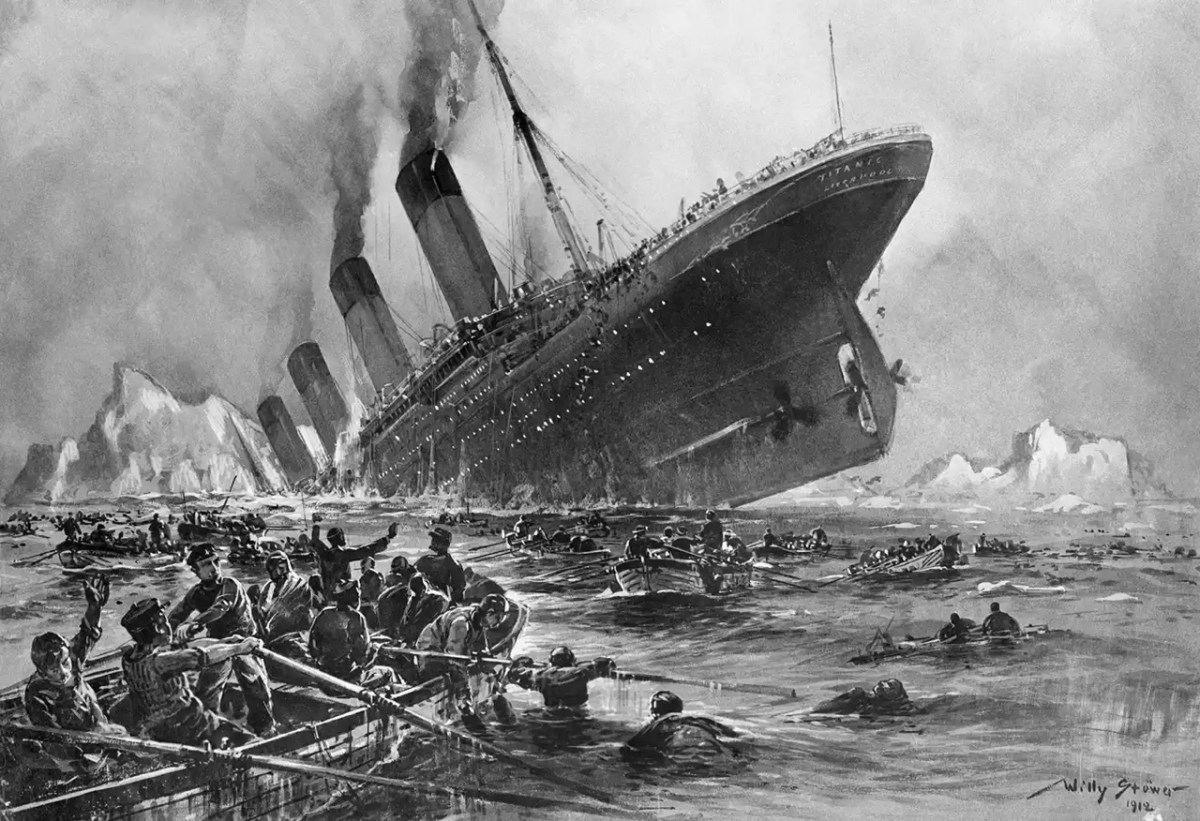
Someone asked me the other day if the RMS Titanic was rebuilt using the same blueprints today, would you sail on her? I said yes, I would. Titanic’s damage was catastrophic and a fluke. It wasn’t poor design that caused her to sink; it was the fact that she was dealt a long, glancing blow that pierced multiple compartments. An astronomically small percentage eventuality that no engineer would plan for. She was designed with a double bottom and watertight compartments for safety. She was also a huge ship. The biggest man-made movable object at that time in the world. To put the Titanic’s size in context, she comes up to almost 3 American Football fields put together. It was 269.1 meters long.
Many engineers say she would have survived if she had hit the iceberg head-on. That ship was built for that to happen, so it’s probably true. But if you were driving down the road at night and suddenly saw an object in the middle of the road, like a deer or cow, your first instinct would not be to hit it head-on. You would try to steer around it. If they had spotted it a minute earlier, they probably would have missed it. Here are some personal stories and a little-known accident that could have caused the ship to sink faster.
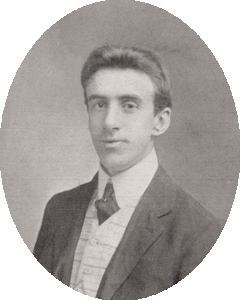
Since this is a music blog mostly, I had to talk about Wallace Hartley. He was the bandleader aboard the ship and became one of the most remembered figures from the sinking because he and his fellow musicians continued playing as the ship sank. He had worked on several passenger liners before joining Titanic’s maiden voyage. As panic spread and lifeboats were lowered, Hartley led the ship’s band in playing music to calm passengers and maintain order during the final hours. Survivors later recalled hearing hymns and popular tunes drifting across the deck as the bow slipped beneath the water, with many believing the final piece played was “Nearer, My God, to Thee.” Hartley’s body was recovered weeks later, still wearing his band uniform, and he was buried in England, where thousands attended his funeral in recognition of his courage and composure. His violin was also found floating in the case, and now it is in a museum.
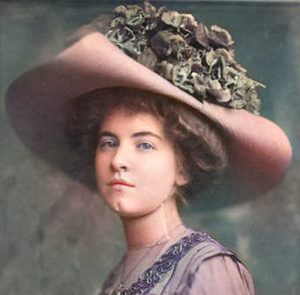
Margaret Brown (The Unsinkable Molly Brown) was an American socialite and philanthropist who became famous after surviving the sinking. Brown and her husband found wealth through mining investments. On the Titanic, she boarded Lifeboat No. 6 after the collision, where she reportedly urged the crew to row back to search for survivors. After being rescued by the RMS Carpathia, she organized aid for poorer passengers, raising money and helping create survivor lists. Her outspoken personality and determination earned her the nickname “The Unsinkable Molly Brown,” though she was never actually called that during her lifetime. I love this woman; she threatened to throw the officer overboard on the lifeboat if he didn’t go back and get survivors. To be fair, he was afraid of the lifeboat getting swamped and capsizing with people.
While she was a hero, the “Molly” nickname is a posthumous invention that transformed her into a colorful, legendary character. There is more information at Molly Brown House Museum.
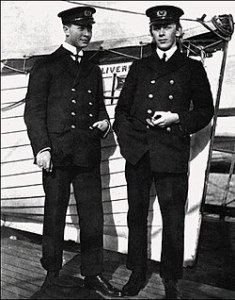
On the night of April 14–15, 1912, Jack Phillips and Harold Bride were already busy clearing a backlog of passenger messages when their Marconi wireless system had earlier broken down, forcing them to spend hours repairing the set so it could get back on the air, work that paid off when it came time to send distress calls after the collision. Phillips stayed at the key almost continuously, tapping out CQD and the newer SOS signals while Bride assisted. They relayed information and helped keep the failing equipment running as power weakened. Even as water crept closer and the strain on the system grew, they continued transmitting ship positions and pleas for help, giving nearby vessels a chance to respond. Bride was eventually washed off the deck and survived, while Phillips remained at his post until the end and died, an example of two operators who kept the line open as long as there was any current left to carry their signal. It paid off as well; the next morning, the survivors were picked up. They would not have survived on those lifeboats long on the Atlantic.
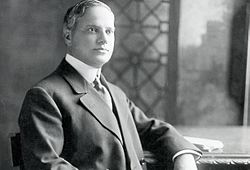
Benjamin Guggenheim was a wealthy American businessman and heir to the Guggenheim mining fortune who traveled aboard as a first-class passenger. When the ship struck an iceberg, Guggenheim initially slept through the impact but soon understood the seriousness of the situation. He and his valet helped with the deck evacuation. He famously said to some of the survivors: I am willing to remain and play the man’s game if there are not enough boats for more than the women and children. Tell my wife I played the game straight out and to the end. No woman shall be left aboard this ship because Ben Guggenheim is a coward. Near the end, he said this about him and his valet dressed in their best clothes: We dressed in our best and are prepared to go down like gentlemen, but we would like a brandy. Witnesses last saw Guggenheim and Victor Giglio (his valet) seated in deck chairs near the Grand Staircase as the ship’s final moments approached. His body was never recovered, but his acceptance of fate became one of the enduring stories of that night. I really like this guy! Guggenheim’s business morphed into the current company that owns the Los Angeles Dodgers.
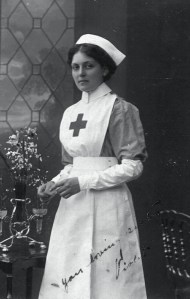
Violet Jessop was either really lucky or unlucky. Violet was an ocean liner stewardess who became known as “Miss Unsinkable” after surviving not only the Sinking of the RMS Titanic in 1912, but also two other major maritime disasters. Jessop worked for the White Star Line and served aboard the ship as a stewardess. After the collision with the iceberg, she helped passengers reach lifeboats and was eventually ordered into Lifeboat 16, where an officer handed her a baby to care for during the evacuation. She was rescued by the RMS Carpathia and later continued working at sea, surviving the collision of the RMS Olympic with another ship (the Olympic was repaired and good) in 1911 and the sinking of the hospital ship HMHS Britannic (Titanic’s young sister, it was sunk by a German mine and it was a hospital ship at that time) during World War I. Her remarkable survival story made her one of the most unusual figures connected to the Titanic. Here is a companion page with more information on Violet.
The Gangway Door theory.
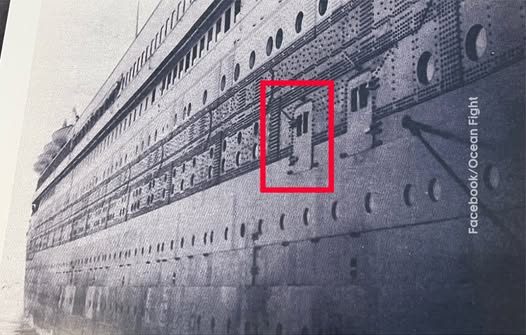
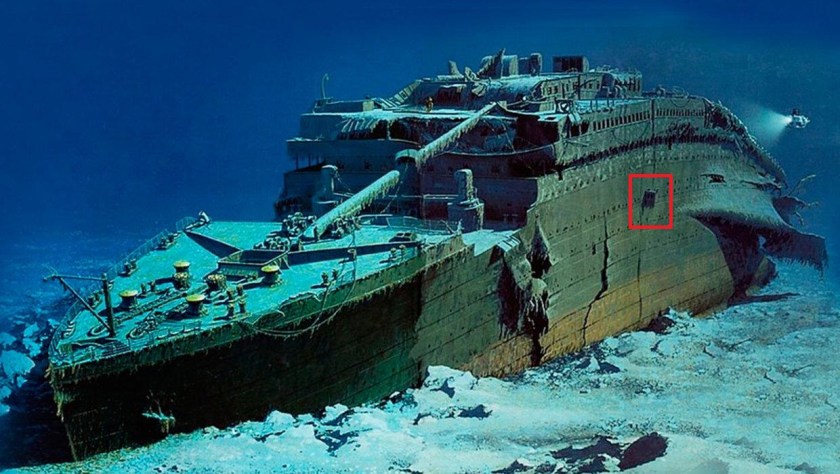
The Gangway door was opened and never closed. One of the lesser-known details of the sinking involves the port-side gangway door on D Deck, a large shell door typically used to board passengers and cargo while in port. During the evacuation, Second Officer Charles Lightoller ordered crewmen to open it so lifeboats could come alongside and take on passengers closer to the rising waterline, rather than forcing everyone to climb down from the Boat Deck. The idea made sense because many lifeboats were leaving partially filled. Evidence suggests the door was successfully opened, as it was later found open on the wreck. Some Titanic researchers believe that once the bow sank lower, seawater pouring through that opening may have accelerated flooding on the port side and shaved minutes off the ship’s remaining time afloat, though the exact effect is still debated. I DON’T fault the crew for this, with what was going on, who can blame them? BTW…this door was 3 x 6 feet, and that was maybe bigger than the smaller leaks that the iceberg brought. To be clear, the ship was sinking by that point anyway, but this very well could have sped it up.
Now, could it have blown open when the ship hit the bottom? Yes, but officers said at the inquiry that they did, in fact, load some lifeboats from there. So they did say it was open, and either they were in a hurry and didn’t close it all the way, they forgot to close it, or it was blown open at the sinking. Although there is a door right beside it that didn’t open. That would, though, explain the 20-minute difference in the computer simulations. Not that I entirely trust computer simulations, but it does make sense.
To put it into context. After using sonar (the damaged side is buried in the mud) to assess the damage caused by the iceberg on the wreck, the total was 12 square feet. The gangway door measures 18 square feet. Also, the damage wasn’t a huge gash. It was mostly a dented hull, with the rivets giving out. Just cuts, not a huge gash. Its length is what sank the ship. Five watertight compartments were breached. If there is one thing that could have made her stronger, it would be welding instead of rivets, but that wouldn’t come until The SS Fullagar was the first welded ship in 1920.
