

December 15, 1967 Season 1 Episode 12
If you want to see where we are…HERE is a list of the episodes.
Last week I said that this episode starts going into more different territory, but after rewatching it, it doesn’t go too far at all. Overall, it does stay rooted more in what we have been seeing…but don’t worry, a change is coming.
Number Six becomes the target of a campaign against people labeled “unmutual.” In the Village, that word is used for anyone who refuses to fit in. Citizens are expected to smile, cooperate, and agree with the system. Number Six does none of that. Soon, people begin turning against him in public meetings. They accuse him of being selfish and dangerous. The Village leadership pushes the idea that independent thinking is a disease that needs to be cured.
The episode plays heavily on public pressure and mob behavior. Number Six is brought before committees where crowds openly criticize him. Number 2, played by John Sharp, oversees the process and talks about “Instant Social Conversion” (a euphemism for a lobotomy). The treatment is supposed to remove aggression and rebellious behavior. The procedure was just a psychological trick, though. They did not use the lasers or anything to do a lobotomy. They just gave him drugs to alter his personality. The reason for not really doing it is that it would destroy his brain and he would be useless to them. After he woke up from being knocked out on the table, Number Six wakes up smiling. He is not sure at first what was going on.
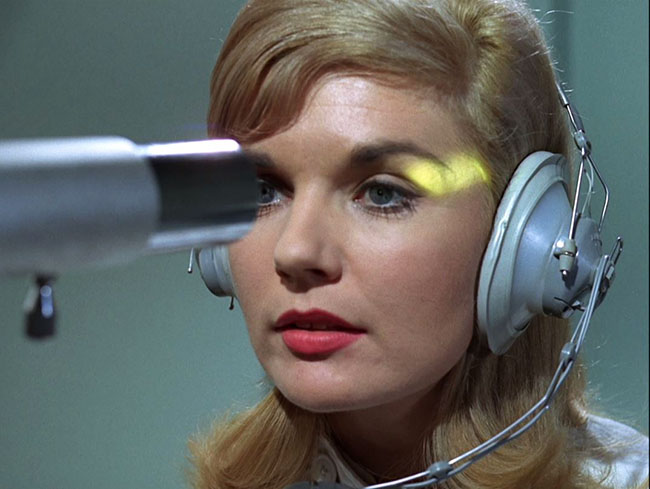
He is back at his home, and the doctor (Number 86) is slipping a drug in his tea. He sees this and avoids taking it. She does it again later, and Number 6 switches the tea, and she drinks it. Now she is drugged, and he gets the truth out of her and hypnotizes her into telling Number 2 that the Instant Social Conversion worked on him. Before she does, Number 6 pays a visit to Number 2 and reinforces that the drugs are working. Number 6 is allowed to talk to the village and get other people with secrets to tell them. In other words, Number 6 sets up Number 2 like a bowling pin and, with the help of the drugged Number 86, turns the village against Number 2. It’s a wonderful thing to see! You know, after re-reading what I wrote, half the battle in describing this show is the lack of proper names. It gets confusing following Numbers.
Behind the scenes, McGoohan and the staff were exhausted. McGoohan drove everyone, including himself, to the brink. It started to show in the scripts and the different directions it would take. I’m sure I will repeat this in the future, but while some say the show got too bizarre, we are still talking about it almost 60 years later…all for a 17-episode spy drama in the late 1960s. So that is a success to me. Be Seeing You!
Discover more from PowerPop... An Eclectic Collection of Pop Culture
Subscribe to get the latest posts sent to your email.


I think you hit upon something there- the numbers make the descriptions a bit more confusing to follow!
LikeLiked by 1 person
It does…you need a score card at times. But it’s all you can do really. That is why I called her “lady” or doctor instead of Number 86 at times..
LikeLiked by 1 person
Your description is, of course, dead on. I particularly like what you said in describing the Village, as it applies to the entire show. “The Village leadership pushes the idea that independent thinking is a disease that needs to be cured.”
I have noted that twice the show has named characters. One was last week, I think, the woman is briefly called by her name a couple of times. And there is a character from the episode where they dupe him into thinking he is back in London, I don’t remember his name but it is used repeatedly.
LikeLiked by 1 person
Yes you are right…in the first episode as well…his friend is called a name as well. Yes there are a few more.
LikeLike
Thinking about it, I notice a desire to put some importance in the numbering of the characters. The show does very little with this. There is Number 2, and the Number 1 that is the overall boss. But other than that, the numbers seem meaningless.
LikeLiked by 1 person
Yes….they are just placeholders for a person or a cog in the machine…
LikeLike
The characters reactions and the set dressing is all done in a flamboyantly theatrical way. Things like the spinning umbrellas all add to the surrealness of it all. All very unsettling.
LikeLiked by 2 people
Yes it is… they really turned on him but I love how he turned the tables.
and the reason I got this mixed up with the next one…you will see. “Change of Mind” ….I was thinking of the next one…that is where it starts to get out there.
LikeLiked by 1 person