

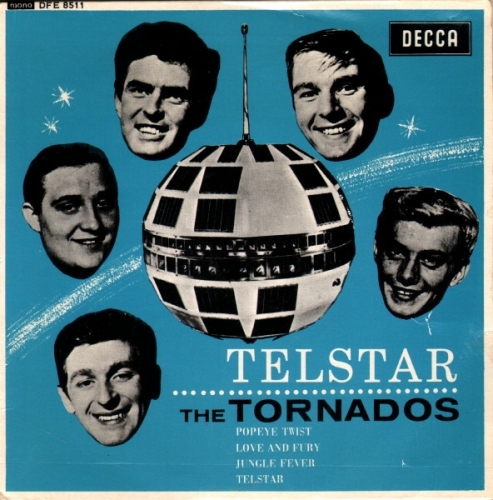
Dave posted this on January 16th on his Turntable Talk series. The theme was instrumentals. The problem wasn’t finding one…it was choosing one between all of the instrumentals out there.
I can’t really say how this song makes me feel. It still sounds futuristic, but I also feel nostalgic about an era before my time. It sounds both uplifting and melancholy at the same time.
This was the best-selling British single of 1962. It was also the first song by a British group to hit #1 in the US. This did not happen again until The Beatles’ “I Want To Hold Your Hand” in 1964.
The legendary Joe Meek wrote and produced this song. This was an adventurous instrumental record for the time and ahead of its time. The song took off and peaked at #1 on the Billboard 100, in Canada, New Zealand, and the UK in 1962.
Meek was ahead of his time. He was doing things in a studio that the Beatles found years later like playing things backwards and getting different effects in 1962. Meek was a genius at recording. Some say he was a mad genius because some say he had mental illnesses and a narcissistic personality disorder. There is a movie I would recommend watching… Telstar: The Joe Meek Story.
An instrumental with space sound effects, this was inspired by the Telstar communications satellite, which was launched shortly before this song was written. Telstar had been launched for 5 weeks when this song came out. Telstar no longer functions but still orbits the earth to this day.
The Tornados were a club band that disliked the song, but Meek added his effects at his home studio above a leather shop in northern London. An overdubbed Clavioline keyboard provoked spooked space effects, while a backward tape of a flushing toilet evoked all the majesty of a space-bound rocket. The Clavioline was an early electronic keyboard that could create a range of otherworldly sounds, to play the main melody of the song, which he then layered with other instruments and sound effects to create an orchestral and ethereal sound that evokes the vastness and wonder of space.
The Tornados received little money from the song. Meek had leased the record to Decca Records and having negotiated a 5% royalty of the record sales he received 29,000 pounds, very little of which was passed on to The Tornados.
I’ve listened to the first demo of it and it’s not like anything the finished product sounded like.
A little more on Meek…that’s who developed this song. George Martin had just left EMI in 1965 and the head of EMI was Sir Joesph Lockwood. Lockwood thought of Joe Meek as a suitable replacement for Martin. Martin still produced the Beatles as a contractor, but Meek could fill in his other EMI duties. Meek was told about the job offer but he didn’t want to give up his independence, but it was tempting. Meek was unable to decide. On January 17, 1967, Sir Joseph finally called him to press for a decision. Meek joined the meeting accompanied by his lawyer. It’s not known how the meeting went, only the result is known: Joe Meek said no. Meek would be dead of a murder (his landlady) suicide the next month.
 PowerPop... An Eclectic Collection of Pop Culture